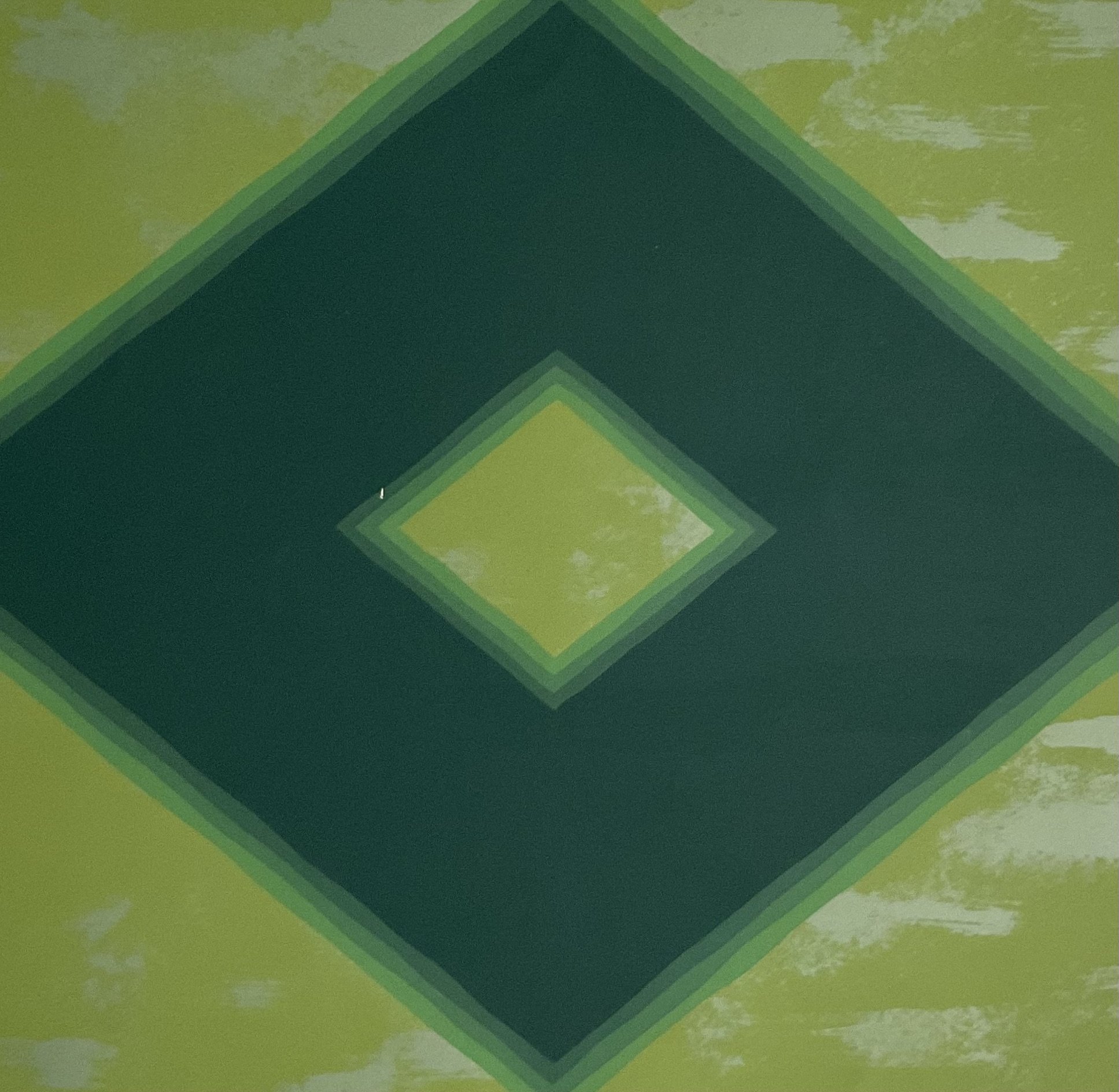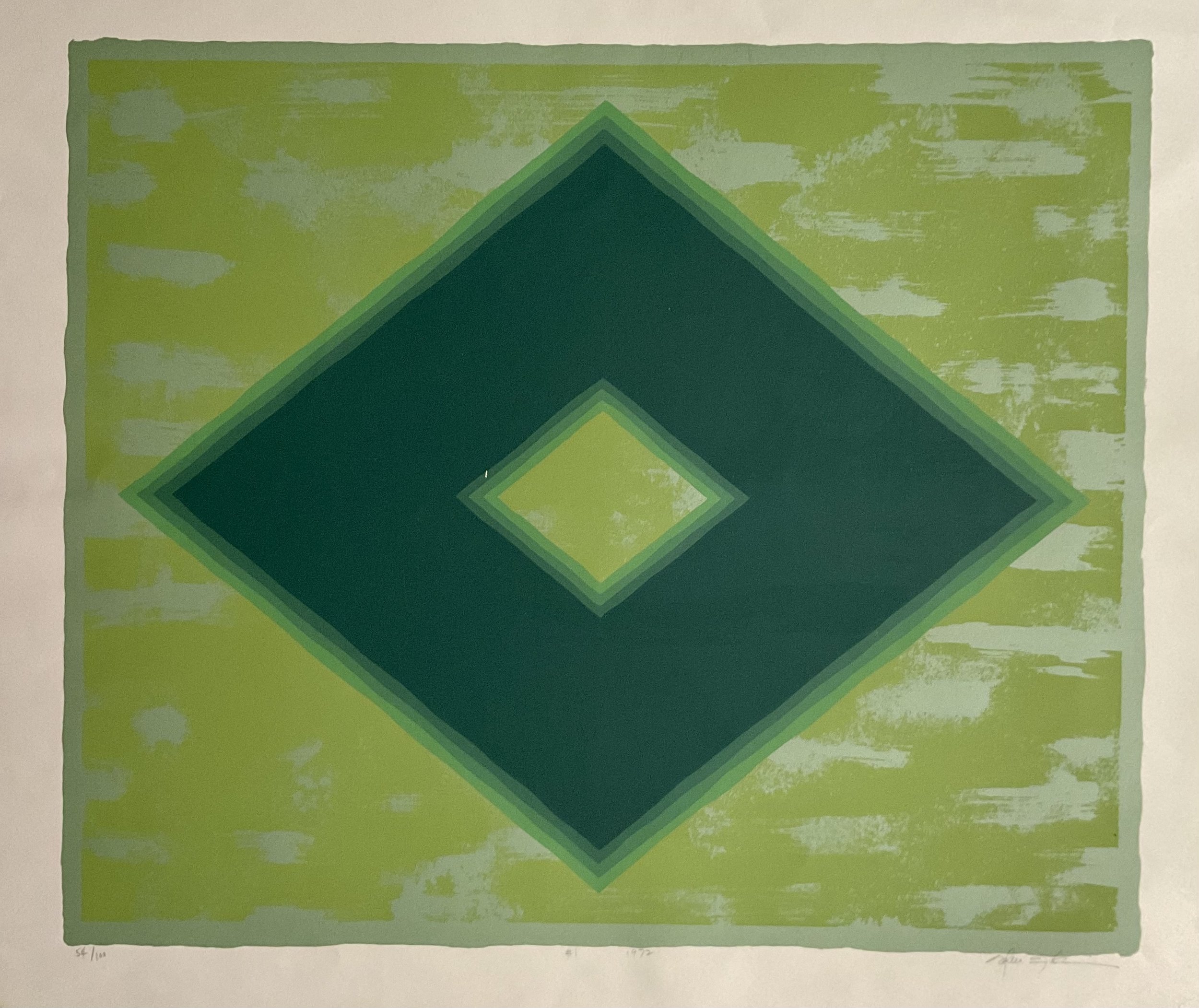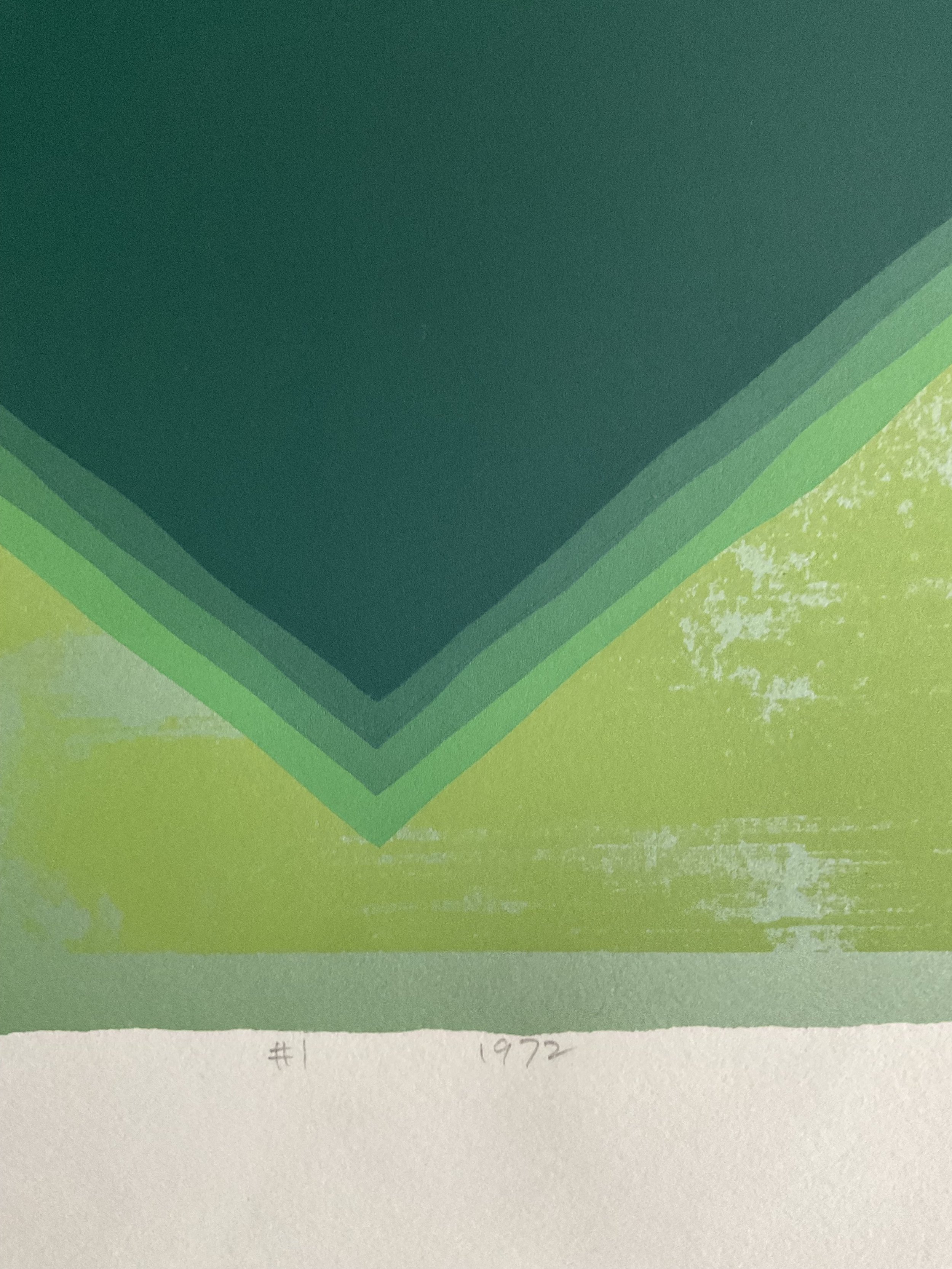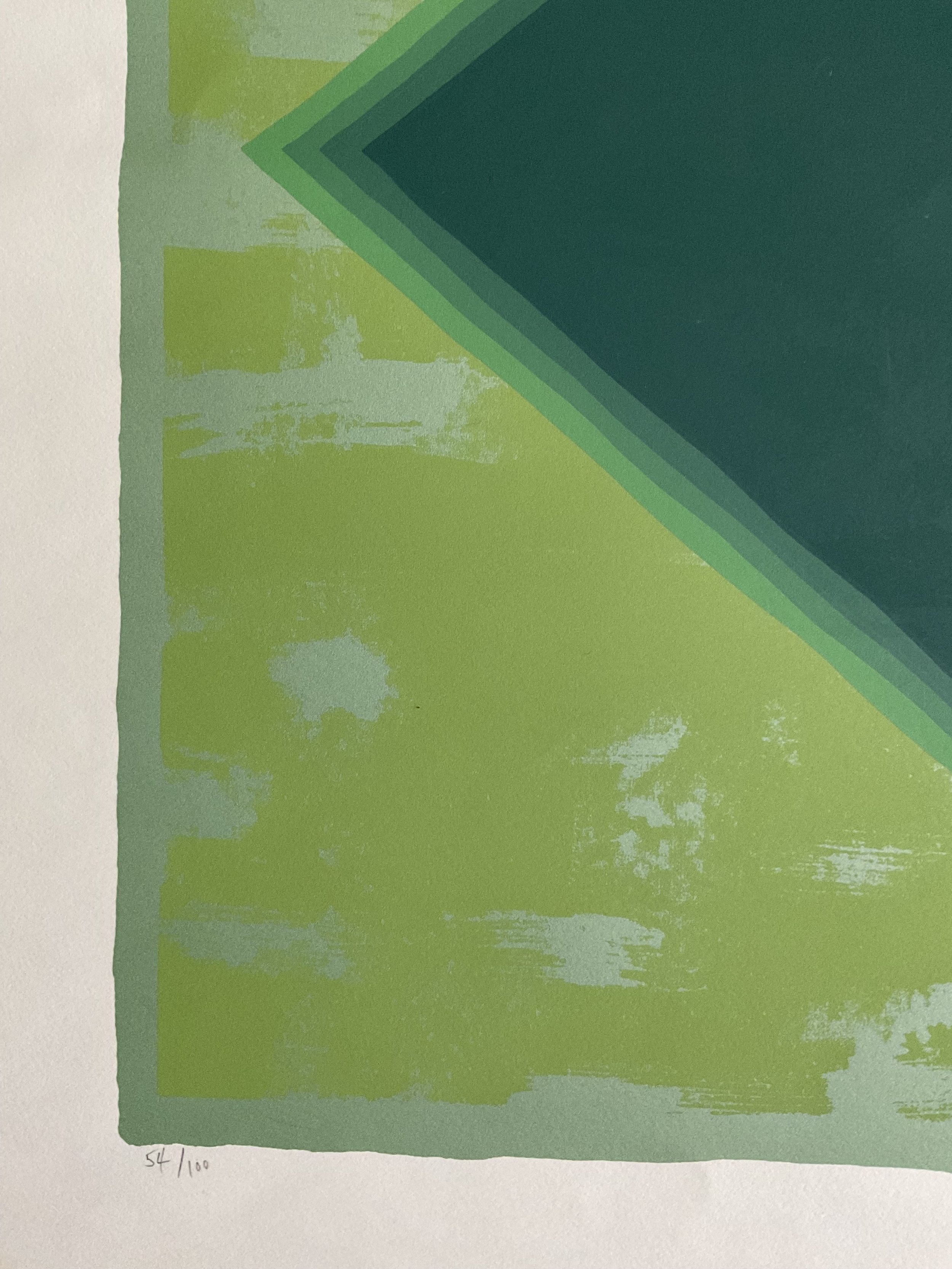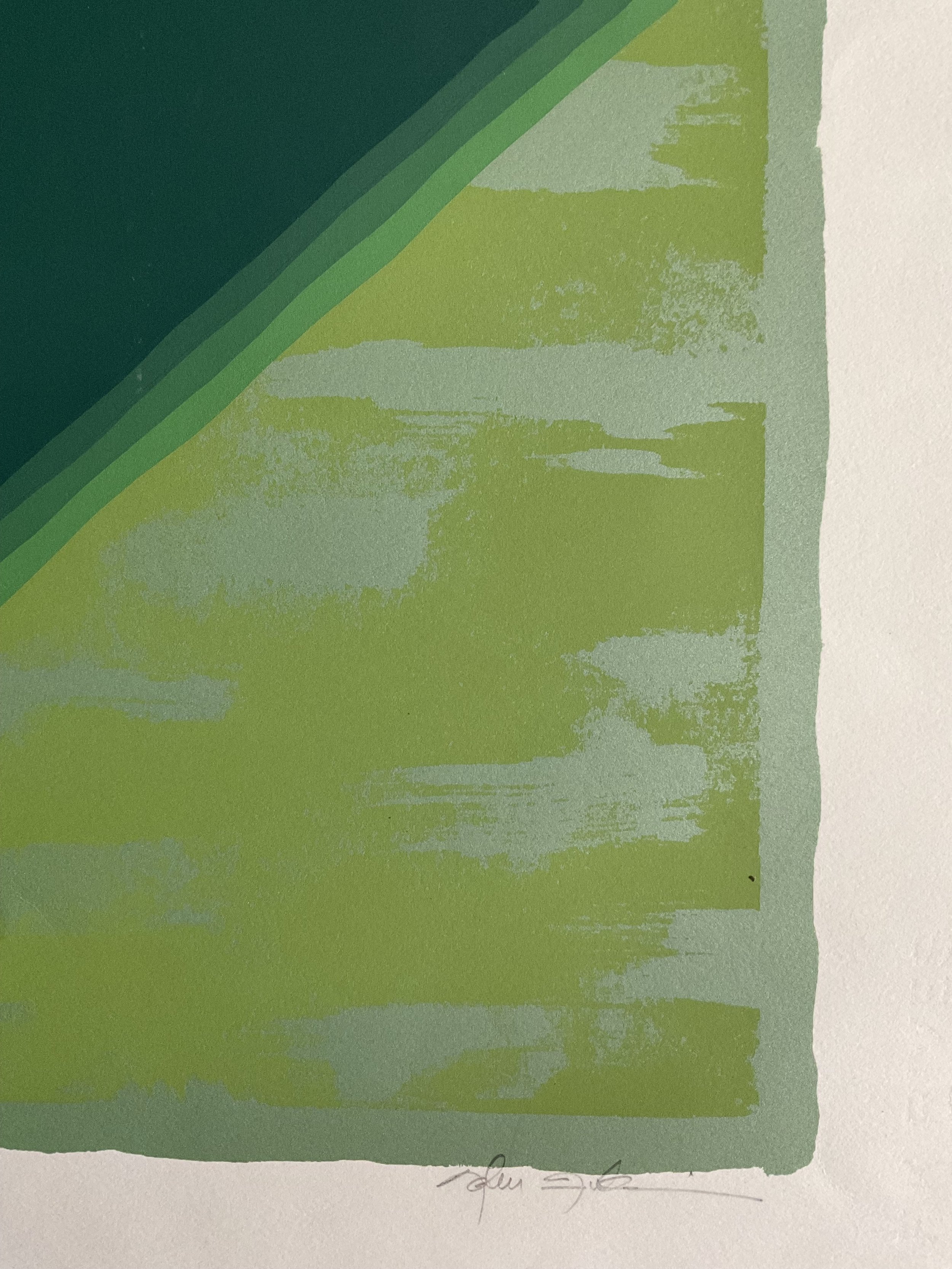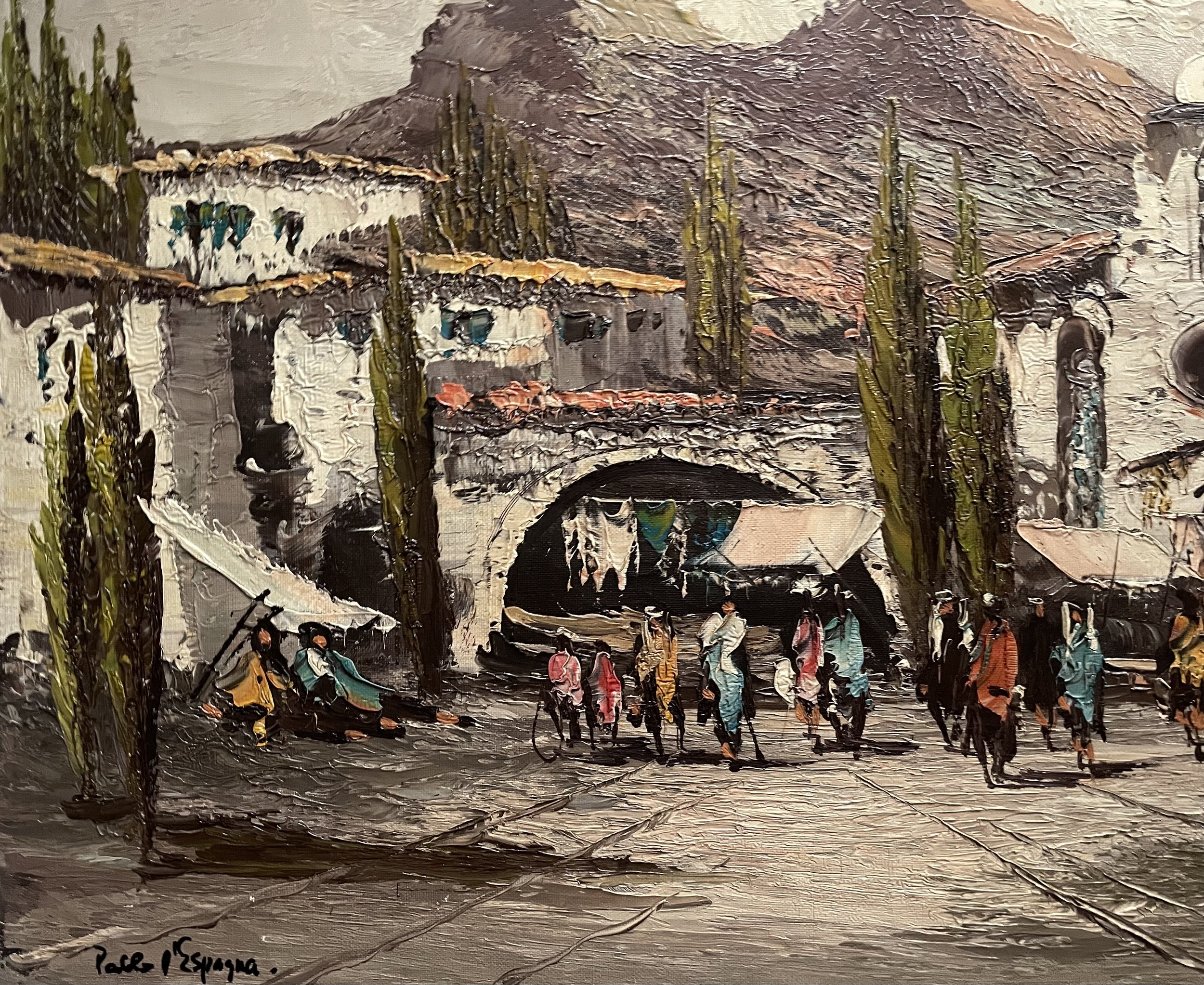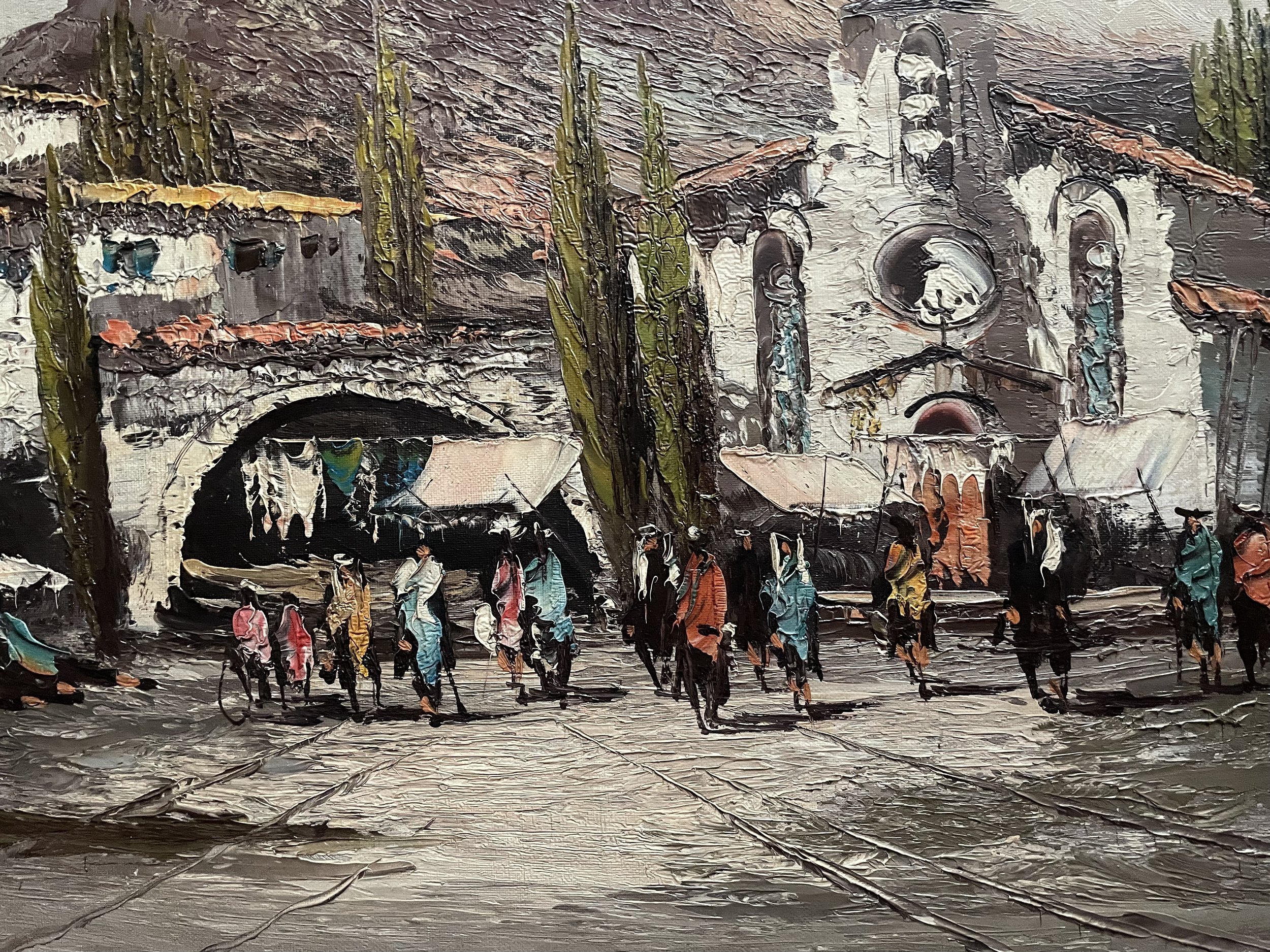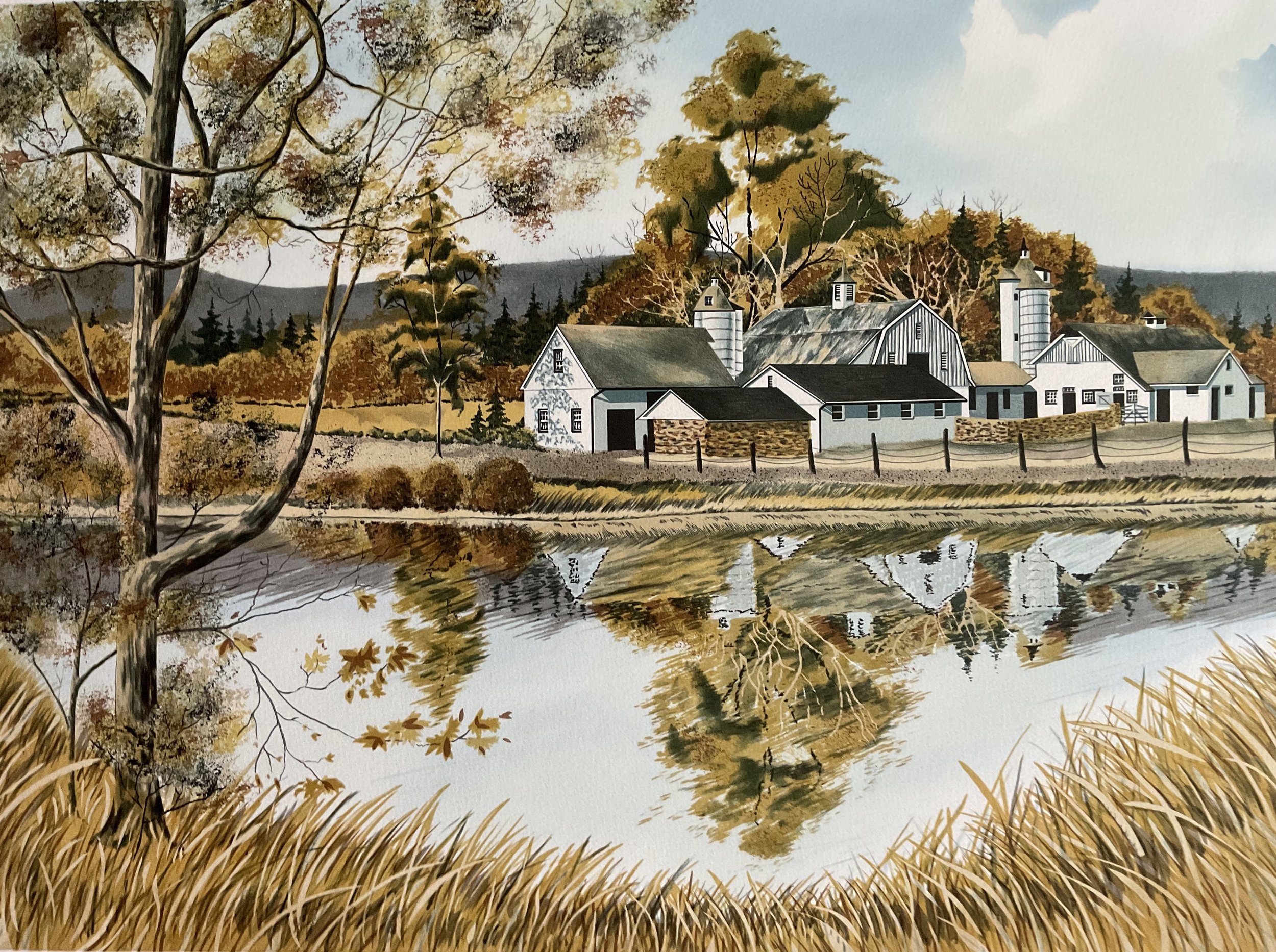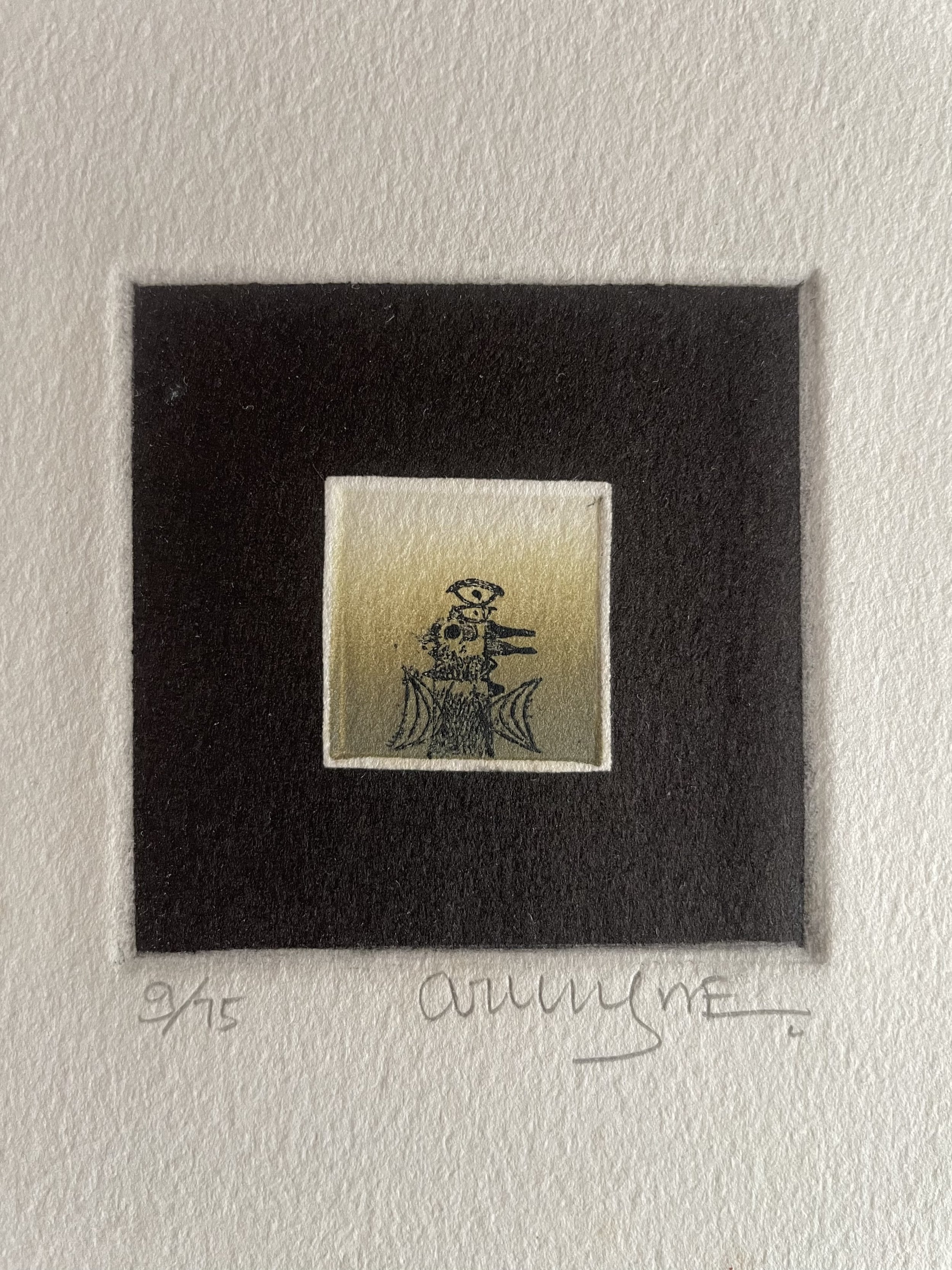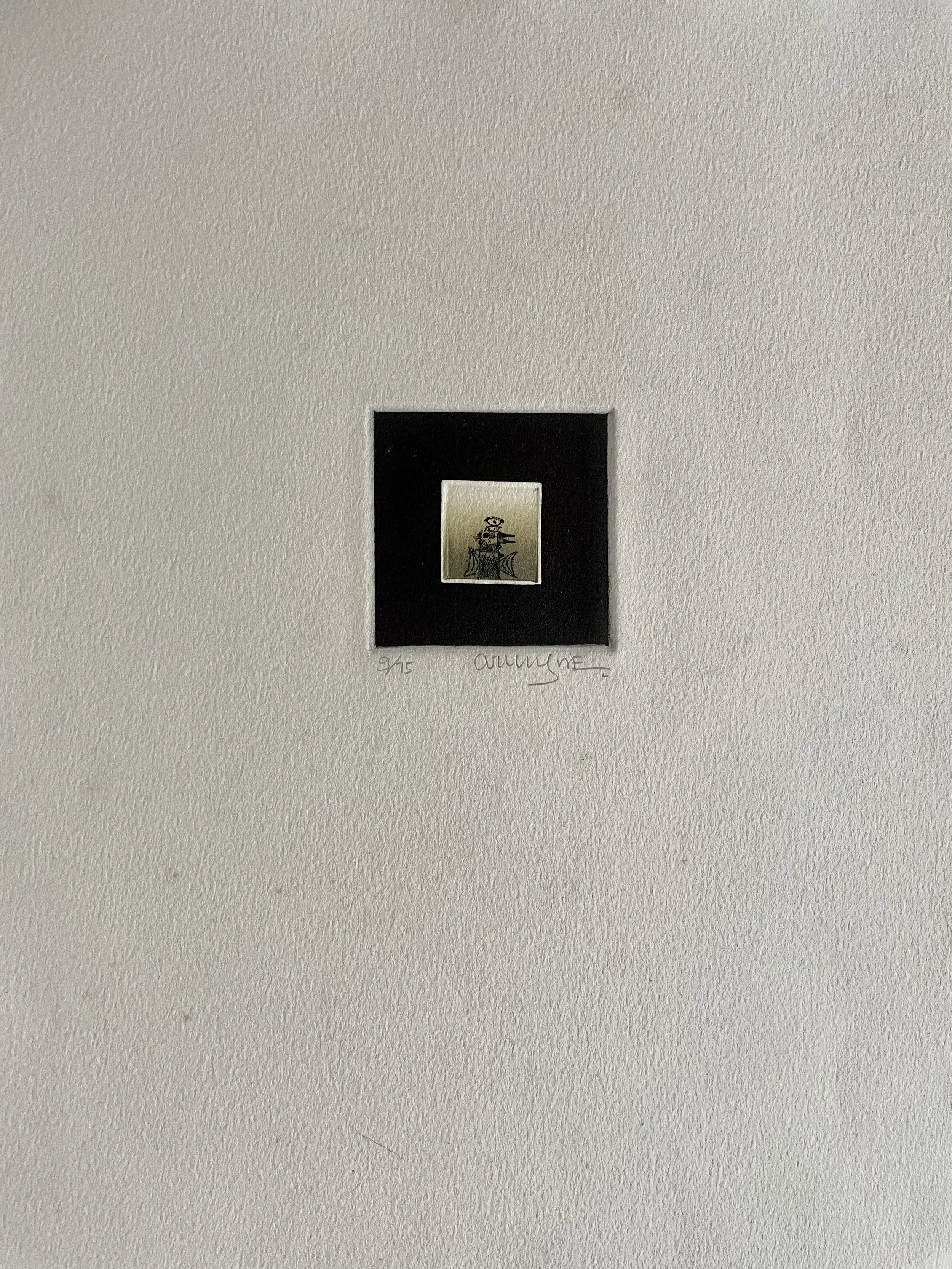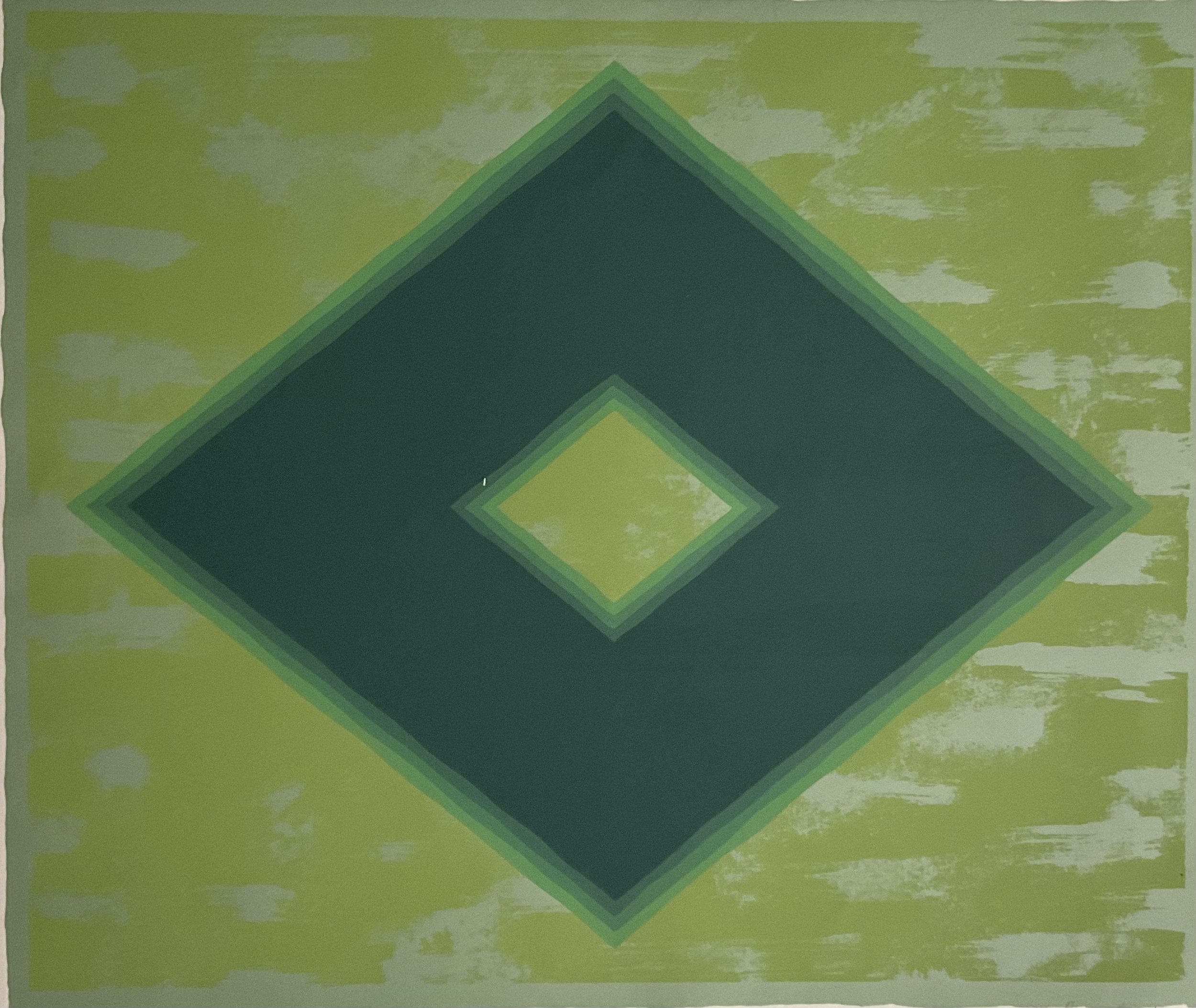
#1, 1972, Nobu Fukui (Japanese/American, b. 1942), 1972, serigraph on paper, 27 × 22 in., titled "#1" and dated "1972" lower center, numbered 54/100, pencil-signed lower right.

$1,200.00
Sold Out

#1, 1972, Nobu Fukui (Japanese/American, b. 1942), 1972, serigraph on paper, 27 × 22 in., titled "#1" and dated "1972" lower center, numbered 54/100, pencil-signed lower right.

Artwork Description

A luminous and meditative geometric serigraph from Fukui's celebrated early 1970s series of numbered abstract prints — works that established him as one of the most significant Japanese-American artists working in New York's Op Art and geometric abstraction milieu. The composition is built on one of the most fundamental and powerful geometric relationships in visual art: the square rotated 45 degrees to become a diamond, set within a larger square field.At the center of the composition a small yellow-green square — vivid, luminous, almost glowing — sits at the heart of a large deep teal diamond. Between the central square and the diamond's edge a series of concentric tonal rings graduate from yellow-green through increasingly deep greens toward the dense dark teal of the outer diamond — a device that simultaneously creates spatial depth, optical vibration, and a sense of slow, meditative pulsation. The diamond itself is set against a chartreuse yellow-green field whose surface is not flat but texturally varied — horizontal brush-stroke-like passages of a slightly lighter mint green animate the background with a quality that suggests water, light through leaves, or the memory of landscape reduced to pure color sensation.The outer border of the image is defined by a narrow band of deeper sage green, containing the composition and giving it a quiet architectural authority. The entire palette — deep teal, medium teal, vivid yellow-green, chartreuse, mint — operates within a tightly controlled green family, with no chromatic departure. This monochromatic discipline is what gives the work its meditative quality. Without the stimulation of contrasting hues, the eye is drawn inward — toward the small glowing center, through the concentric rings of tonal depth, into the stillness at the heart of the diamond.The effect is simultaneously optical and contemplative — qualities that distinguish Fukui's geometric work from the more aggressive Op Art of his contemporaries. Where Vasarely and Riley assault the eye, Fukui's geometry invites it inward.The serigraphic technique here is notably different from Spalatin's razor-edged precision. The background field carries visible painterly texture — the horizontal stroke-marks suggest a hand-applied ground rather than a purely mechanical screen — lending the work a quality of intimate materiality within its geometric rigor. This tension between the precise geometry of the central diamond and the painterly freedom of the background field is the work's most sophisticated quality.

Artist Biography

Nobu Fukui was born in Tokyo, Japan and came to the United States in 1962. He has been living and working in New York since 1963. Artsy He studied at the Art Students League in New York City from 1964 to 1965. InvaluableFukui came of age artistically in New York during one of its most fertile periods — the mid-1960s, when Abstract Expressionism was giving way to Minimalism, Op Art, and geometric abstraction, and the city was the undisputed center of the international art world. His numbered serigraph series of the late 1960s and early 1970s — of which this 1972 print is a prime example — placed him in direct dialogue with contemporaries including Spalatin, Josef Albers, and the broader international Op Art movement, while maintaining a distinctly meditative quality rooted in his Japanese visual sensibility.His work has been widely exhibited in New York and California. Invaluable His exhibition history includes solo exhibitions at Stephen Haller Gallery New York, Marisa Del Re Gallery New York, Jan Baum Gallery Los Angeles, Hokin Gallery Palm Beach, and Margaret Thatcher Projects New York. Artnet Fukui has been featured in articles for ArtDaily, The Wall Street Journal, and The New York Times. MutualArtFukui's work is held in several public collections including the New Britain Museum of American Art and the Indianapolis Museum of Art. Artsy His later career moved from geometric abstraction into vivid mixed-media collage paintings — incorporating cut imagery from comics, magazines, and newspapers — but the numbered serigraph series of the early 1970s remains among his most sought-after and historically significant work.The "#1, 1972" serigraph was published as part of a documented series of numbered abstract prints produced by Fukui during this period, consistent with the numbered series format — #1, #2, #3, #4, etc. — that appears across multiple dated editions from 1969 through 1972 in auction records. The edition of 100 and the Collector's Guild publishing model are consistent with the distribution network — including galleries and dealers like Mitch Morse — through which these works reached American collectors.

Dive into the pulsating world of Nobu Fukui's serigraph, "#1 1972," an electrifying piece that introduces geometric vibrating squares bathed in captivating shades of green. This signed and numbered work, part of a limited run of 100, is a remarkable gem unearthed from the dust of a retired NYC Manhattan gallery, where it patiently awaited discovery for over 50 years. Fukui, an artist whose roots entwine with the revolutionary spirit of the Gutai Art Association, infuses every inch of his grid-like compositions with an “energetic,” “animated,” and “intense” essence that critics have long celebrated. The New York Times has heralded him as a painter of impressive drive, and from the mingling of his background in Japan to the avant-garde atmosphere of 1960s New York—where he intersected with luminaries like John Cage and Robert Rauschenberg—it's clear that each stroke reflects a vibrant dialogue with the art world of his time. Now, this 27x22" serigraph awaits a home, ready to vibrate life into your space with its rhythm and depth.

#1, 1972, Nobu Fukui (Japanese/American, b. 1942), 1972, serigraph on paper, 27 × 22 in., titled "#1" and dated "1972" lower center, numbered 54/100, pencil-signed lower right.

Artwork Description

A luminous and meditative geometric serigraph from Fukui's celebrated early 1970s series of numbered abstract prints — works that established him as one of the most significant Japanese-American artists working in New York's Op Art and geometric abstraction milieu. The composition is built on one of the most fundamental and powerful geometric relationships in visual art: the square rotated 45 degrees to become a diamond, set within a larger square field.At the center of the composition a small yellow-green square — vivid, luminous, almost glowing — sits at the heart of a large deep teal diamond. Between the central square and the diamond's edge a series of concentric tonal rings graduate from yellow-green through increasingly deep greens toward the dense dark teal of the outer diamond — a device that simultaneously creates spatial depth, optical vibration, and a sense of slow, meditative pulsation. The diamond itself is set against a chartreuse yellow-green field whose surface is not flat but texturally varied — horizontal brush-stroke-like passages of a slightly lighter mint green animate the background with a quality that suggests water, light through leaves, or the memory of landscape reduced to pure color sensation.The outer border of the image is defined by a narrow band of deeper sage green, containing the composition and giving it a quiet architectural authority. The entire palette — deep teal, medium teal, vivid yellow-green, chartreuse, mint — operates within a tightly controlled green family, with no chromatic departure. This monochromatic discipline is what gives the work its meditative quality. Without the stimulation of contrasting hues, the eye is drawn inward — toward the small glowing center, through the concentric rings of tonal depth, into the stillness at the heart of the diamond.The effect is simultaneously optical and contemplative — qualities that distinguish Fukui's geometric work from the more aggressive Op Art of his contemporaries. Where Vasarely and Riley assault the eye, Fukui's geometry invites it inward.The serigraphic technique here is notably different from Spalatin's razor-edged precision. The background field carries visible painterly texture — the horizontal stroke-marks suggest a hand-applied ground rather than a purely mechanical screen — lending the work a quality of intimate materiality within its geometric rigor. This tension between the precise geometry of the central diamond and the painterly freedom of the background field is the work's most sophisticated quality.

Artist Biography

Nobu Fukui was born in Tokyo, Japan and came to the United States in 1962. He has been living and working in New York since 1963. Artsy He studied at the Art Students League in New York City from 1964 to 1965. InvaluableFukui came of age artistically in New York during one of its most fertile periods — the mid-1960s, when Abstract Expressionism was giving way to Minimalism, Op Art, and geometric abstraction, and the city was the undisputed center of the international art world. His numbered serigraph series of the late 1960s and early 1970s — of which this 1972 print is a prime example — placed him in direct dialogue with contemporaries including Spalatin, Josef Albers, and the broader international Op Art movement, while maintaining a distinctly meditative quality rooted in his Japanese visual sensibility.His work has been widely exhibited in New York and California. Invaluable His exhibition history includes solo exhibitions at Stephen Haller Gallery New York, Marisa Del Re Gallery New York, Jan Baum Gallery Los Angeles, Hokin Gallery Palm Beach, and Margaret Thatcher Projects New York. Artnet Fukui has been featured in articles for ArtDaily, The Wall Street Journal, and The New York Times. MutualArtFukui's work is held in several public collections including the New Britain Museum of American Art and the Indianapolis Museum of Art. Artsy His later career moved from geometric abstraction into vivid mixed-media collage paintings — incorporating cut imagery from comics, magazines, and newspapers — but the numbered serigraph series of the early 1970s remains among his most sought-after and historically significant work.The "#1, 1972" serigraph was published as part of a documented series of numbered abstract prints produced by Fukui during this period, consistent with the numbered series format — #1, #2, #3, #4, etc. — that appears across multiple dated editions from 1969 through 1972 in auction records. The edition of 100 and the Collector's Guild publishing model are consistent with the distribution network — including galleries and dealers like Mitch Morse — through which these works reached American collectors.

Dive into the pulsating world of Nobu Fukui's serigraph, "#1 1972," an electrifying piece that introduces geometric vibrating squares bathed in captivating shades of green. This signed and numbered work, part of a limited run of 100, is a remarkable gem unearthed from the dust of a retired NYC Manhattan gallery, where it patiently awaited discovery for over 50 years. Fukui, an artist whose roots entwine with the revolutionary spirit of the Gutai Art Association, infuses every inch of his grid-like compositions with an “energetic,” “animated,” and “intense” essence that critics have long celebrated. The New York Times has heralded him as a painter of impressive drive, and from the mingling of his background in Japan to the avant-garde atmosphere of 1960s New York—where he intersected with luminaries like John Cage and Robert Rauschenberg—it's clear that each stroke reflects a vibrant dialogue with the art world of his time. Now, this 27x22" serigraph awaits a home, ready to vibrate life into your space with its rhythm and depth.

Nobu Fukui

(American/Japanese, born 1942, TOKYO)

Timeline

1964–1965

ART STUDENTS LEAGUE, New York, NY

Exhibitions

2009

CONTINUUM, Stephen Haller Gallery, New York

2008

CONFLUENCE Stephen Haller Gallery, New York, NY

2008

Words Become Pictures (catalogue) Molloy College Art Gallery, Rockville Centre, NY

2008

Constant Aesthetic 2008 Stephen Haller Gallery, New York, NY

2007

ART20 2007 The Park Avenue Armory, New York, NY

2007

Color! Stephen Haller Gallery, New York, NY

2007

Stephen Haller Gallery, New York, NY (solo)

2006

Stephen Haller Gallery, New York, NY (solo)

2006

ART20 2006 The Park Avenue Armory, New York, NY

2006

Solstice Stephen Haller Gallery, New York, NY

2005

Focal Point Stephen Haller Gallery, New York, NY

2005

Asian Fusion Stephen Haller Gallery, New York, NY

2004

Resounding Spirit – Japanese Contemporary Art of the 1960s, Gibson Gallery, Postdam, NY

2004

Stephen Haller Gallery, New York, NY (solo)

2004

Gallery Camino Real, Boca Raton, FL (solo)

1999

Central Fine Arts, Inc. New York, NY (solo)

1995

Barbara Scott Gallery, Bay Harbor Island, FL (solo)

1993

Marisa Del Re Gallery, New York, NY (solo)

1993

Jan Baum Gallery, Los Angeles, CA (solo)

1993

Hokin Gallery, Palm Beach, FL (solo)

1993

David Klein Gallery, Birmingham, MI (solo)

Literature

2008

Catching the Imagination in Language and Imagery, B. Genocchio, New York Times, February 24, 2008

2008

The Eye Can Be Drawn..., Ariella Budick, NEWSDAY, March 14, 2008

2007

Dizzy Superheros, Michael Tyson Murphy, VILLAGE VOICE, June 21, 2007

2007

Nobu Fukui - Looking Forward - at Stephen Haller Gallery, ART KNOWLEDGE NEWS, June 12, 2007

2005

States of Stability, Carter Ratcliff, ART IN AMERICA. May 2005

2004

Nobu Fukui, Grace Glueck, THE NEW YORK TIMES, May 14, 2004

2004

A Man of Spirited Exploration, Priya Malhotra, ASIAN ART NEWS, November/December, 2004

2004

Gallery Going – Nobu Fuki, David Cohen, THE NEW YORK SUN, April 22, 2004

2000

Nobu Fukui at Central Fine Arts, Eleanor Heartney, ART IN AMERICA, February 2000

1993

Nobu Fukui, Henry Geldzahler, Marisa Del Re Gallery exhibition catalog, 1993

Selected Solo Exhibitions

2020

2018

2015
2014

2013

2008

Selected Group Exhibitions

2024

2023

2021

2019

2017

2016

2015