 Image 1 of 5
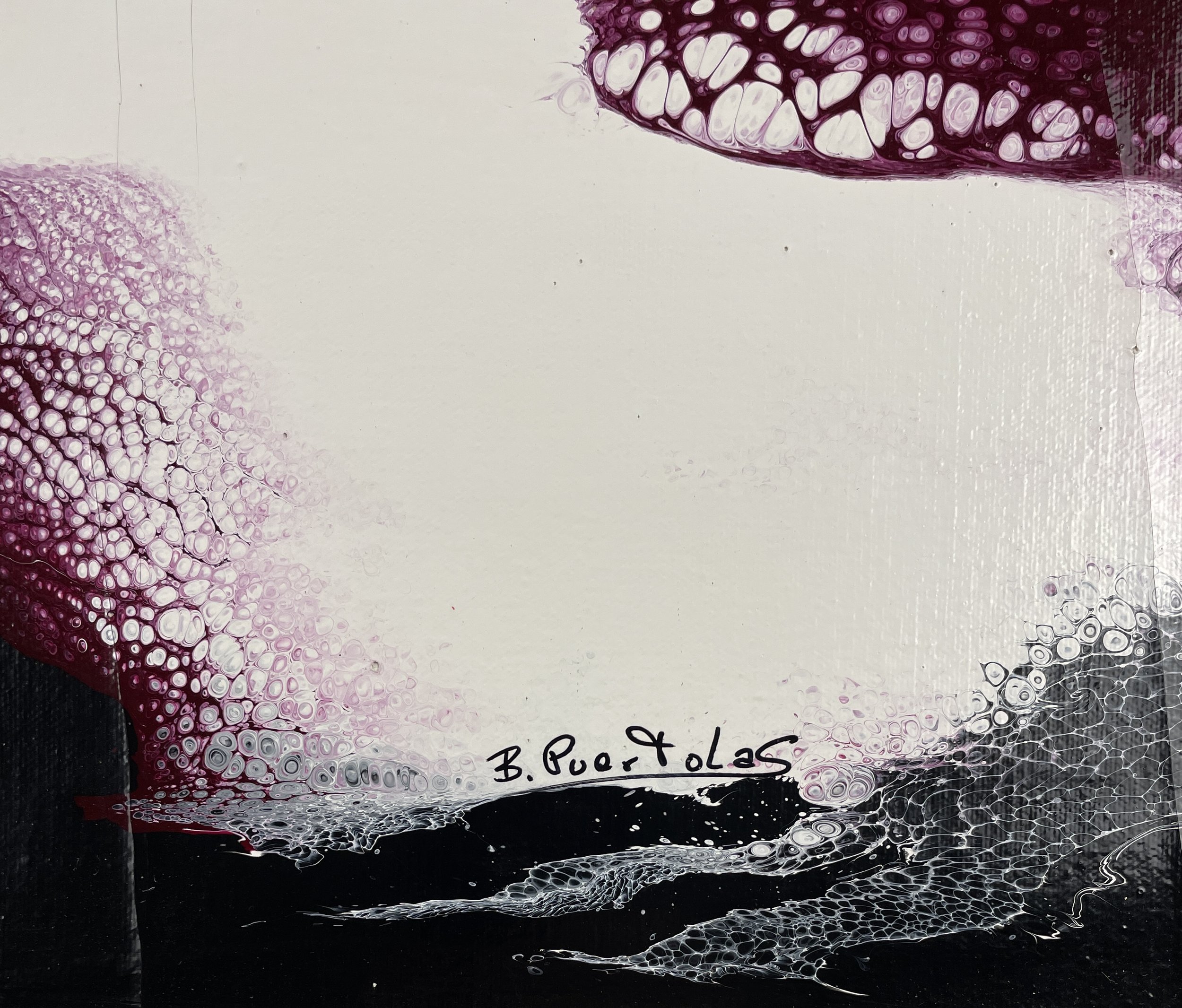 Image 2 of 5
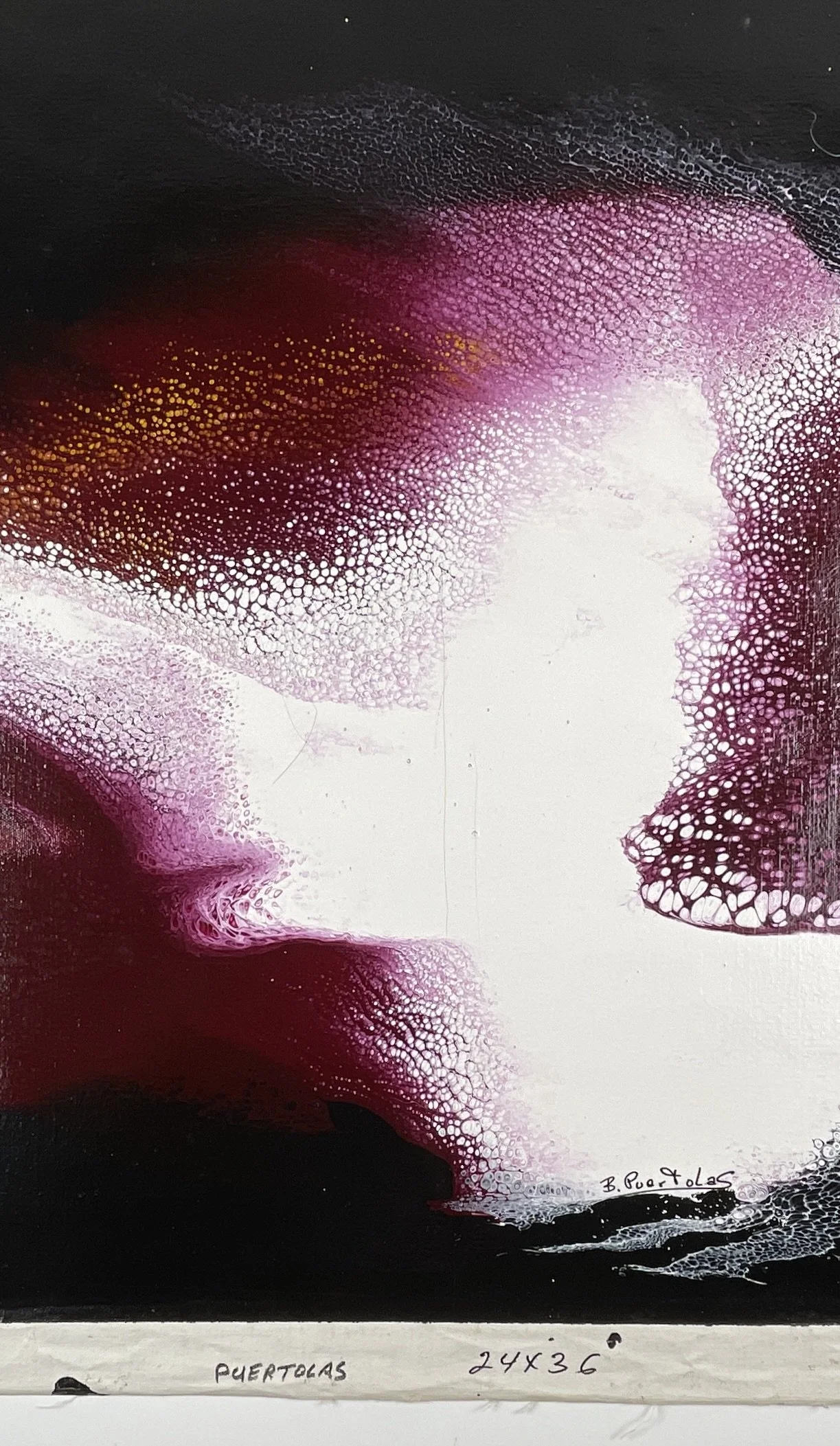 Image 3 of 5
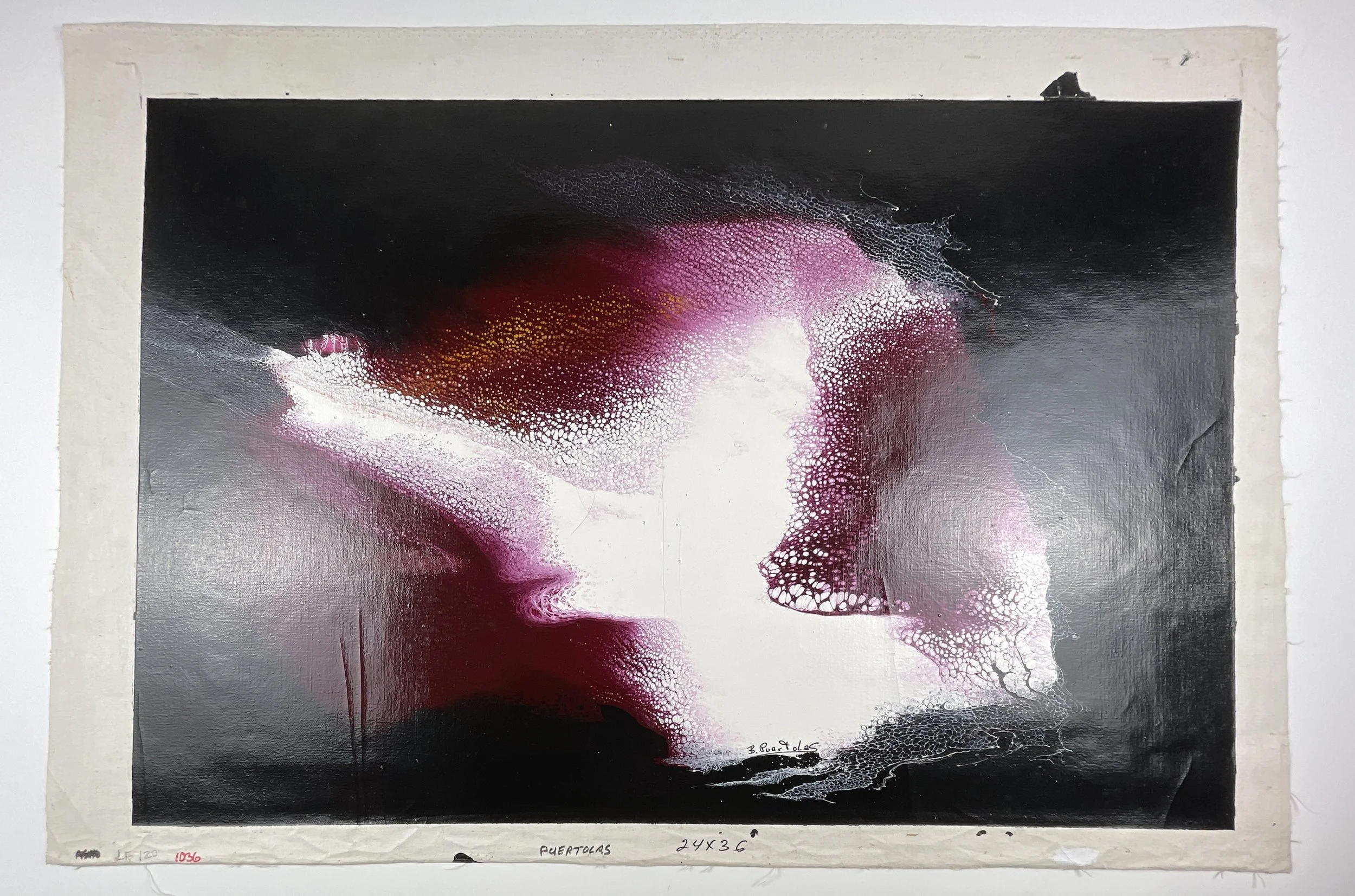 Image 4 of 5
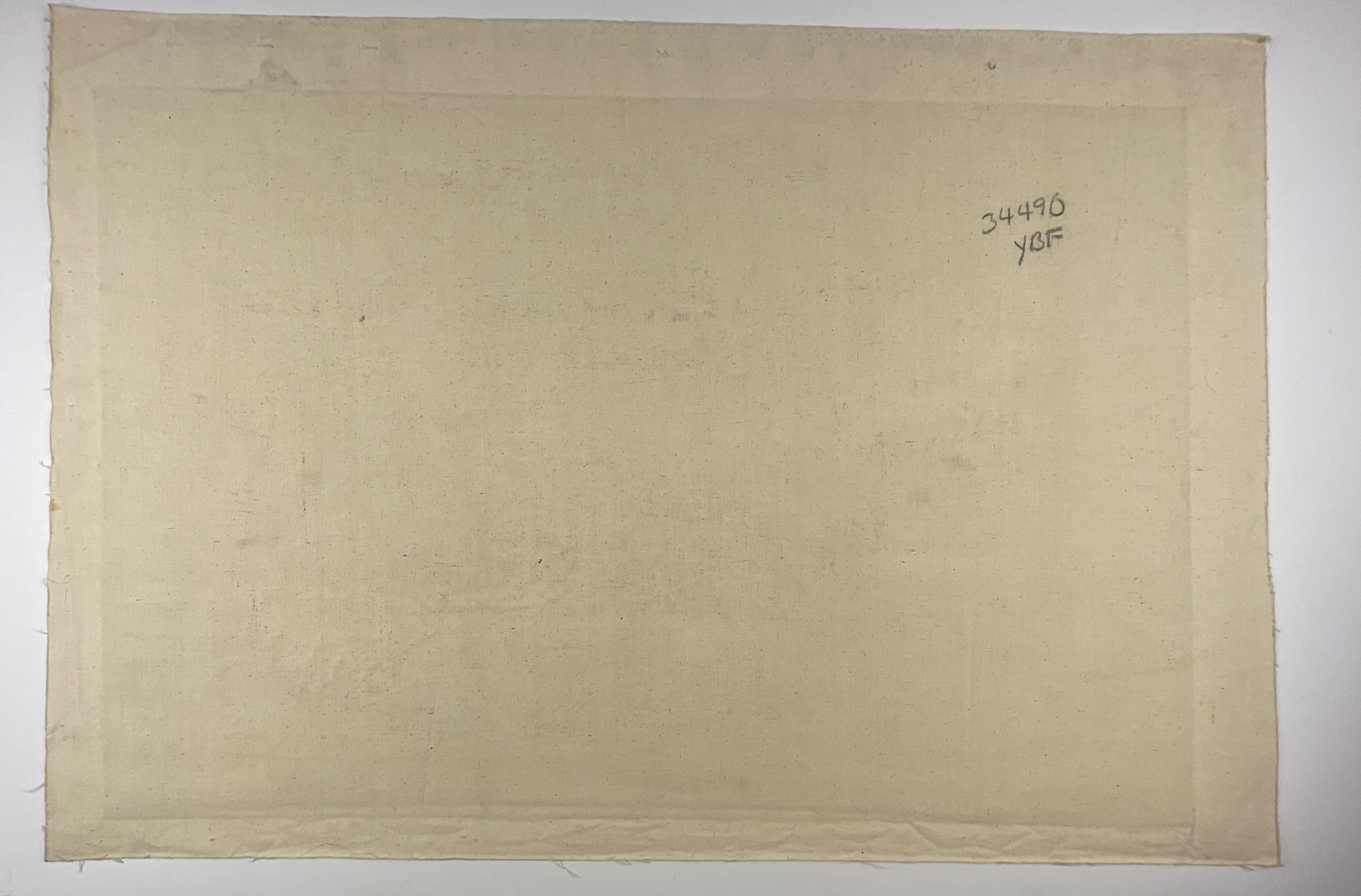 Image 5 of 5
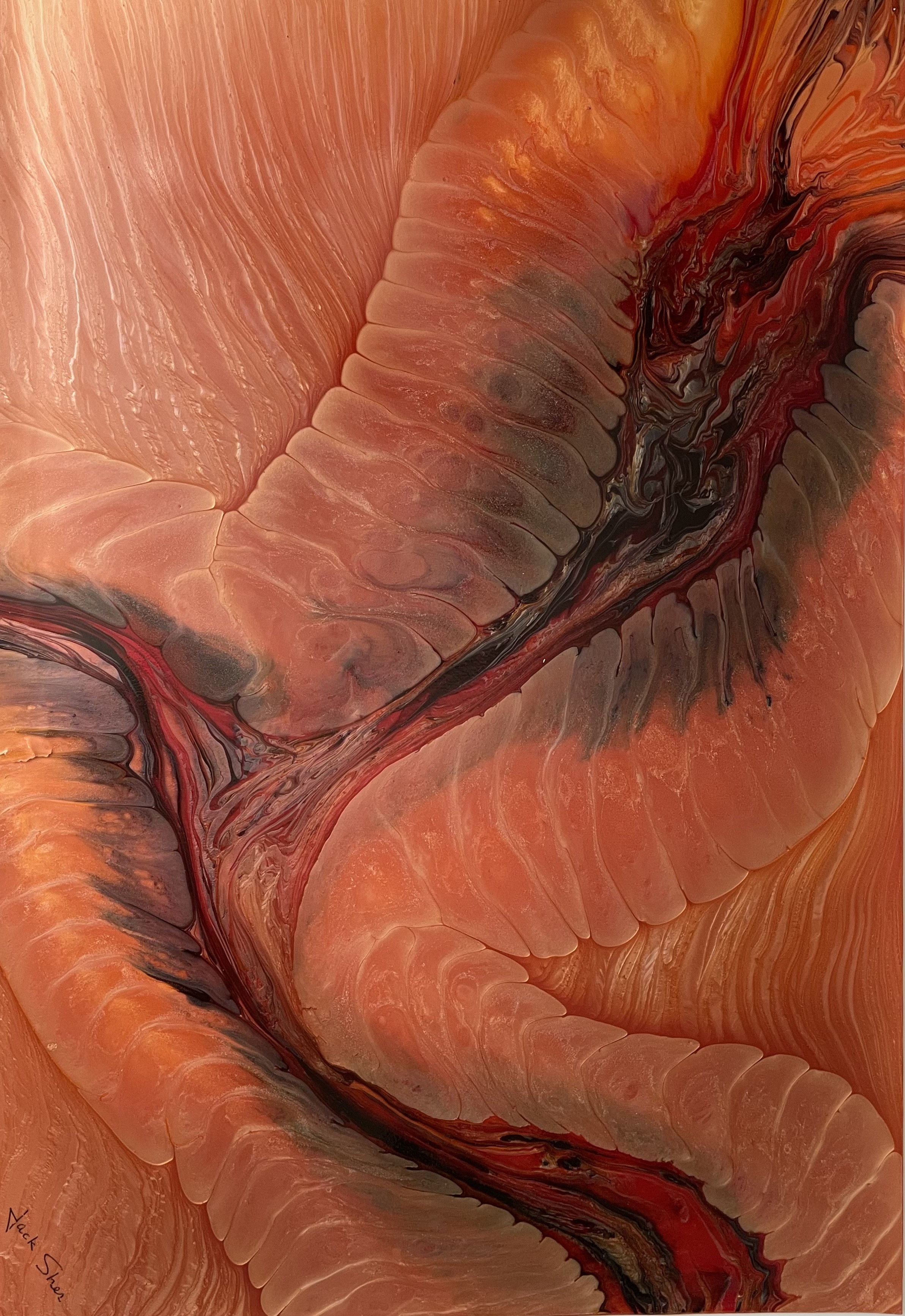
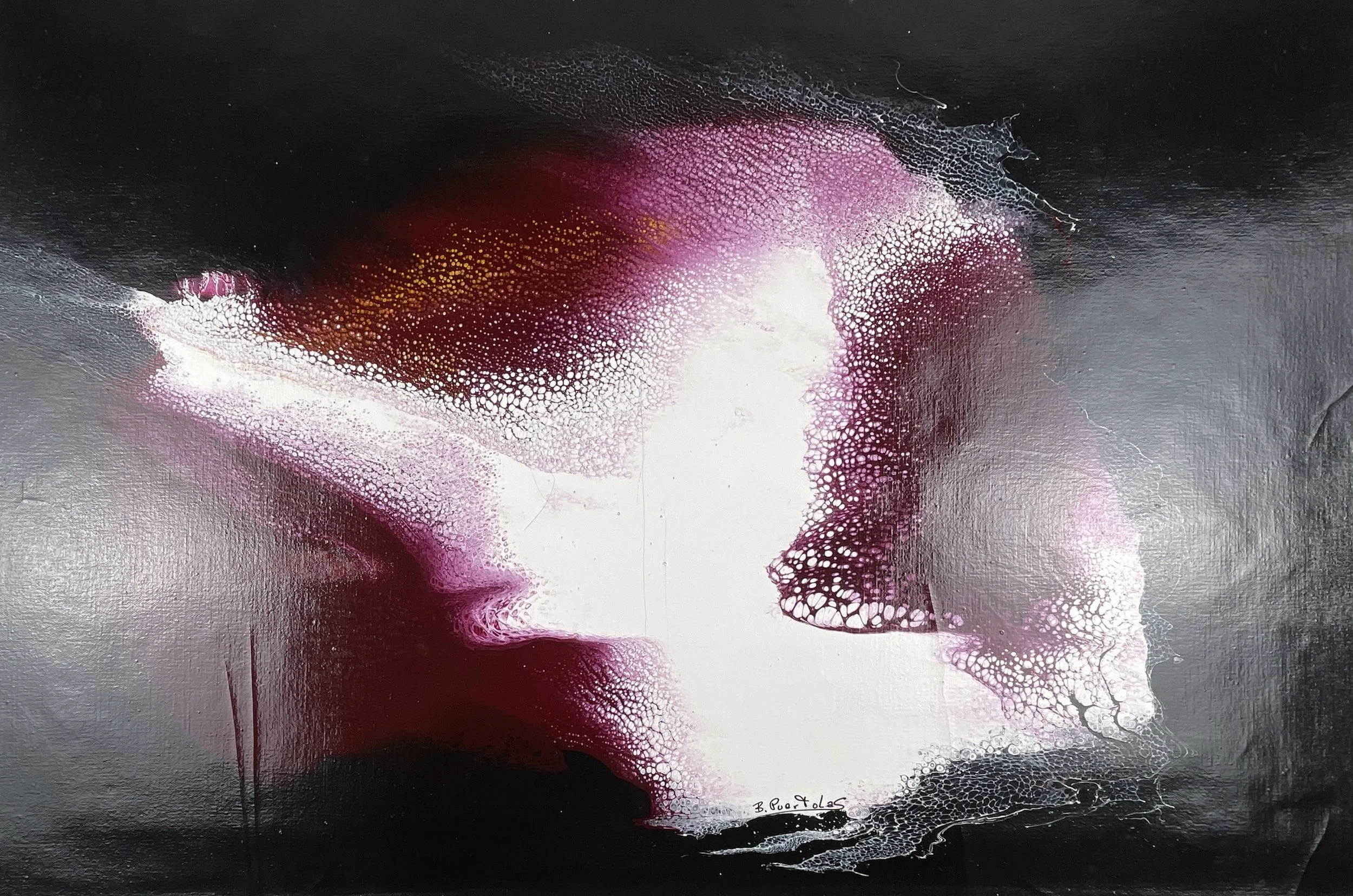
Cosmic Cellular Field (attributed), Bernard Puertolas (b. Spain, c.1920s), c.1962–1968, high-gloss acrylic polymer abstraction on canvas, 36 × 24 in., signed B. Puertolas.
Cosmic Cellular Field (attributed), Bernard Puertolas (b. Spain, c.1920s), c.1962–1968, high-gloss acrylic polymer abstraction on canvas, 36 × 24 in., signed B. Puertolas.
Dramatic mid-century abstract painting by Spanish-born artist Bernard Puertolas featuring luminous crimson and white cellular forms suspended in a deep black high-gloss field. Created during the artist’s experimental period in the United States, the work demonstrates early acrylic polymer techniques producing organic lace-like textures and glowing color fields. A striking example of post-war European abstraction intersecting with industrial material experimentation.
Artwork Description
This visually powerful abstract composition by Bernard Puertolas belongs to the experimental generation of post-war abstraction that merged traditional painting with emerging industrial materials. The composition presents a luminous central field of white expanding outward into crimson and burgundy tones, surrounded by a deep black ground that creates dramatic spatial contrast.
The painting’s structure appears almost biological or cosmic. A radiant white core pushes into surrounding red fields that dissolve into delicate cellular networks. These lace-like membranes form along the boundaries where pigments interact, creating thousands of microscopic bubble-like structures that appear suspended within the paint layer.
These distinctive cellular textures are produced through a chemical interaction between pigments and acrylic polymer mediums. Rather than conventional brushwork, the surface reveals fluid processes where pigments separate and reorganize during drying. The resulting pattern resembles mineral crystallization, microscopic tissue structures, or cosmic nebulae.
The crimson field contains subtle concentrations of golden pigment particles that shimmer against the darker ground. These minute points of light add depth and visual complexity, drawing the viewer deeper into the composition while reinforcing the illusion of luminous energy radiating from the central mass.
The painting’s glossy surface is another defining characteristic. Unlike traditional oil paintings that rely on varnish for sheen, this work incorporates the gloss directly into the paint structure through polymer mediums. The reflective surface creates a lacquer-like finish that amplifies the depth of the darker tones and intensifies the glowing white and red forms.
The dramatic red-black-white palette was widely explored by artists working in the early 1960s who were inspired by emerging scientific imagery, atomic age aesthetics, and cosmic exploration. Puertolas’s work reflects this cultural context, suggesting explosive energy, cellular growth, or astronomical phenomena.
The composition is signed “B. Puertolas” along the lower edge. The canvas margins also contain studio notations including the artist’s name, dimensions “24 × 36,” and internal reference numbers. These markings suggest the painting was cataloged or prepared within a studio or publishing environment rather than fully trimmed for exhibition presentation.
The untrimmed canvas edges and working notations indicate that the painting likely originated as a studio work or experimental piece. Such works were often retained for study, reproduction, or distribution through gallery systems.
Measuring approximately 36 × 24 inches, the painting represents a compelling example of mid-century experimental abstraction. It bridges the worlds of fine art, industrial chemistry, and design innovation—an intersection that defined many avant-garde practices during the post-war period.
Artist Biography
Bernard Puertolas was born in Madrid, Spain, into a family connected to the textile industry. His father operated a manufacturing facility where tapestries were produced, and this environment exposed the young artist to color design, pattern structure, and decorative arts at an early age. The influence of textile design would remain an important component of his artistic development.
Puertolas demonstrated exceptional drawing ability from a young age. By the age of fourteen, sketches he produced were already being adapted into tapestry designs created within his father’s workshop. This early integration of drawing with applied design helped cultivate a sensitivity to surface, structure, and pattern that would later emerge in his abstract work.
He later studied at the Escuela de Bellas Artes in Madrid, graduating with high honors. Recognizing his talent, he continued his studies at a private art school in Brussels where he initially focused on design. However, his growing interest in painting led him to relocate to France in order to pursue fine art more seriously.
At just eighteen years old, Puertolas held his first exhibition, which proved remarkably successful. Within two days he sold twenty-two paintings depicting bullfighting scenes, a subject that was among his earliest artistic interests.
The outbreak of the Spanish Civil War profoundly affected his life and career. Puertolas returned to Spain and became involved with the Republican side, painting murals and propaganda posters related to the war effort. When the war ended, many individuals associated with the Republican cause faced economic hardship and social repression. Puertolas’s father’s looms were destroyed, leaving the family’s textile business in ruins and severely limiting the artist’s opportunities.
Despite these difficulties, Puertolas continued painting and increasingly turned toward abstraction. In 1942 he attempted to leave Spain but was unable to obtain a visa. Determined to escape the political situation, he crossed into France by swimming across the border, during which he was wounded in the leg by gunfire. Because he had entered illegally, he faced additional obstacles and was unable to work freely.
Eventually he arranged passage to Mexico, where many Spanish exiles had relocated, including former Spanish president Juan Negrín. In Mexico Puertolas resumed his artistic career, exhibiting his paintings widely and illustrating for various magazines.
Years later he relocated from Mexico to the United States under contract with a textile printing company. In this position he developed innovative finishes and printing techniques for fabrics, expanding his expertise in surface chemistry and pigment behavior. His experimentation with industrial coatings and decorative materials influenced his approach to painting.
Working independently, he developed new concepts for wall coverings and decorative surfaces and eventually founded his own company. Throughout this period he continued to paint, increasingly focusing on abstraction and material experimentation.
Puertolas’s paintings were distributed through Nils Anderson Studios and later through exclusive representation by Mitch Morse Gallery in New York. These galleries introduced his work to American collectors interested in modern abstract painting.
His abstract works often combine luminous color contrasts with experimental surface reactions. Cellular textures, glowing gradients, and fluid pigment interactions became hallmarks of his mature style. These techniques reflect the intersection of artistic intuition with the chemical knowledge he gained through his work in textile and industrial design.
Puertolas’s career embodies the story of a twentieth-century artist shaped by political upheaval, migration, and innovation. His work connects European modernism with the experimental spirit of American post-war abstraction.
As of 2026, paintings by Bernard Puertolas remain of interest to collectors exploring the intersection of mid-century abstraction, design experimentation, and the history of artists displaced by the Spanish Civil War. His work represents a unique fusion of artistic resilience, material innovation, and international artistic exchange.
Bernard Puertolas mid-century abstract painting, high-gloss crimson and white cellular abstraction on black ground, experimental polymer technique, signed, 36 × 24 in.
Certificate of Authentication
Artist: Bernard Puertolas
Title: Cosmic Cellular Field (attributed)
Medium: Acrylic polymer and pigment on canvas (high-gloss)
Dimensions: 36 × 24 inches
Signature: Signed B. Puertolas
Date: circa 1962–1968
This artwork is an original abstract painting attributed to Bernard Puertolas based on the visible signature, documented biography, and stylistic characteristics consistent with the artist’s work.
Condition
Very good vintage condition. Surface retains strong integrated high-gloss finish. Minor edge wear and handling marks consistent with studio storage and age. Paint layer stable with no visible restoration.
Provenance
Artist studio or early distribution
Nils Anderson Studios
Mitch Morse Gallery, New York — exclusive representation and distribution
Private collection acquired through Mitch Morse Gallery
Artfind Gallery, Washington DC (current owner)
All works were acquired from Mitch Morse Gallery, which sourced artwork in New York, the United States, and Europe.
Provenance Note: Mitch Morse Gallery Collection
This artwork originates from the inventory of Mitch Morse Gallery, a respected New York–based gallery and publisher active during the mid-to-late 20th century. Mitch Morse was an established figure in the American art market, serving as an artist’s agent, publisher of original graphics, art dealer, distributor, and fine art restorer. He was also a Design Affiliate of A.S.I.D., listed in Who’s Who in the East, and a guest lecturer in graphics at New York University, with appearances on radio and television discussing art and design.
Through his gallery and associated publishing operations, Morse acquired paintings, prints, and original works from artists and studios across New York, Europe, and international art markets, assembling a broad inventory representing a wide range of artistic traditions and mediums. Works from this collection circulated through galleries and collectors throughout the United States.
The present painting was acquired through this network and is now held in the collection of Artfind Gallery, Washington DC, continuing the documented chain of gallery provenance from Mitch Morse’s original acquisitions.
Meta Business Suite Listing
Striking mid-century abstract painting by Bernard Puertolas featuring luminous crimson cellular forms emerging from a deep black high-gloss field. Experimental polymer abstraction from the artist’s American period.
#artfindgallery #bernardpuertolas #abstractpainting #midcenturymodernart #spanishmodernism #abstractexpressionism #modernistart #fineartcollector
SEO Title
Bernard Puertolas Mid Century Abstract Acrylic Painting Red Black 36x24
SEO Description
Original mid-century abstract painting by Spanish-born artist Bernard Puertolas featuring luminous crimson and white cellular forms on a deep black high-gloss field. Experimental acrylic polymer abstraction measuring 36 × 24 inches.
Price Recommendation (Three-Tier)
Floor: $900
Online Target: $1,950
Gallery Retail: $3,200
Sources
Artist biography document supplied with the artwork
Historical records of Spanish Civil War exile artists and post-war abstraction
Gallery distribution history associated with Nils Anderson Studios and Mitch Morse Gallery
Mid-century acrylic polymer experimentation in abstract painting
Abstract Energy Field (attributed), Bernard Puertolas (b. 1920s), c.1965–1975, high-gloss acrylic / resin abstract painting on canvas, 36 × 24 in., signed lower center.
Website Description
Striking high-gloss abstract painting by Spanish-born artist Bernard Puertolas featuring dramatic crimson, white, and black forms suspended in a deep reflective field. The composition combines fluid cellular textures with luminous gradients, creating an energetic modernist abstraction characteristic of mid-century experimental painting influenced by European abstraction and emerging American abstract movements.
Artwork Description
This powerful abstract composition by Bernard Puertolas presents an energetic field of luminous color suspended within a dark, reflective space. The painting is structured around a glowing central mass of white that radiates outward into crimson, magenta, and deep burgundy tones, set against a stark black ground. The dramatic tonal contrast creates the sensation of light emerging from within the surface of the painting itself.
The central form appears almost organic in structure. Edges dissolve into cellular patterns that resemble microscopic structures, mineral formations, or biological membranes. These delicate bubble-like textures occur where pigments meet and react, creating intricate lace-like boundaries between colors. The effect suggests movement, growth, and transformation.
Puertolas uses a highly polished surface technique that produces a reflective, high-gloss finish. Light glides across the surface of the work, enhancing the illusion that the color is suspended beneath a glass-like layer. This glossy finish intensifies the depth of the darker background while allowing the white and crimson tones to glow with remarkable luminosity.
The palette is intentionally restrained. The dominant tones—deep black, luminous white, and saturated red—create a dramatic emotional tension. A band of warm golden dots appears within the crimson field, adding subtle complexity and drawing the viewer deeper into the composition.
The visual language of the painting belongs firmly within the experimental abstraction of the mid-twentieth century. During this period many artists explored chemical reactions, fluid interactions, and unconventional surface treatments to produce unpredictable textures and organic patterns. Puertolas appears to embrace these processes, allowing the medium itself to generate delicate structures along the edges of color fields.
Although the work is fully abstract, its imagery evokes natural phenomena—cosmic explosions, molten minerals, biological cells, or shifting atmospheric forms. This ambiguity allows the viewer to interpret the composition through both scientific and emotional lenses.
The painting measures approximately 36 × 24 inches and is signed by the artist near the lower edge of the composition. Its glossy surface and experimental technique demonstrate Puertolas’s interest in combining painting with design innovation and material experimentation.
The result is a visually striking modern abstraction that merges the intensity of European abstract traditions with the bold experimentation that characterized American art in the decades following the Second World War.
Artist Biography
Bernard Puertolas was born in Madrid, Spain, into a family connected with textile production. His father operated a manufacturing facility where tapestries were produced, and this environment proved influential for the young artist. Exposure to patterns, weaving, and color combinations in textile design helped nurture his early interest in visual composition.
Puertolas demonstrated artistic ability at an early age. By the age of fourteen, sketches he produced were already being incorporated into tapestry designs created in his father’s workshop. This early experience linking drawing with decorative arts helped form the foundation for his later interest in design and abstract form.
He later enrolled at the Escuela de Bellas Artes in Madrid, where he graduated with high honors. Recognizing his talent, he was sent to Brussels to continue his studies at a private art school specializing in design. Although he initially studied design, his ambitions gradually shifted toward painting.
After one year in Brussels he relocated to France in order to pursue painting more seriously. At the age of eighteen he mounted his first exhibition, which proved remarkably successful. Within two days he reportedly sold twenty-two paintings, many depicting bullfighting scenes that were among his preferred early subjects.
The outbreak of the Spanish Civil War dramatically altered the course of his life. Puertolas returned to Spain where he lived with his family during the conflict. During this period he worked painting murals and propaganda posters for the Republican forces. When the war ended, many individuals associated with the Republican cause faced persecution and economic hardship. Puertolas’s family business suffered as his father’s looms were destroyed, leaving the artist with limited opportunities to work professionally.
Despite these difficulties, he continued painting and increasingly turned toward abstraction. In 1942 he attempted to leave Spain but was unable to obtain a visa. Determined to escape the political situation, he swam across the border into France, where he was wounded in the leg by gunfire. Because he had entered the country illegally, he faced further complications and was unable to work freely.
Eventually he arranged to travel to Mexico, where many Spanish exiles had settled, including former Spanish president Juan Negrín. In Mexico Puertolas was able to resume his artistic career and sold works to private collectors. His paintings were exhibited widely, and he also produced illustrations for various magazines.
Years later he moved to the United States from Mexico under contract with a textile printing company. In this role he developed innovative finishes and printing techniques for fabrics. His experimentation with color, surface, and material in textile design would later influence his painting methods.
Working independently as a designer, he developed new concepts in wall coverings and interior decorative surfaces and eventually formed his own company. Throughout this period he continued painting, gradually moving further into abstract art.
Puertolas’s paintings began to attract collectors and were sold through Nils Anderson Studios before he entered into exclusive representation with Mitch Morse Gallery in New York. This relationship introduced his work to American collectors interested in modern abstract painting.
His abstract works often combine dramatic color contrasts with experimental surface effects. Many of his compositions evoke cosmic or organic imagery created through fluid interactions between pigments, producing cellular textures and glowing fields of color.
Puertolas’s career bridges several creative disciplines: fine art, textile design, and industrial surface innovation. His paintings reflect the influence of European modernism while embracing the material experimentation that characterized post-war American abstraction.
As of 2026, works by Bernard Puertolas remain of interest to collectors exploring the intersection of European abstraction and mid-century experimental painting techniques. His work represents a fascinating blend of artistic resilience, design innovation, and the global migration of artists shaped by the political upheavals of twentieth-century Europe.
Concise Auction Listing
Bernard Puertolas abstract high-gloss painting, crimson and white cellular abstraction on black field, modernist mid-century composition, signed, 36 × 24 in.
Certificate of Authentication
Artist: Bernard Puertolas
Title: Abstract Energy Field (attributed)
Medium: High-gloss acrylic / resin on canvas
Dimensions: 36 × 24 inches
Signature: Signed B. Puertolas
Date: circa 1965–1975
This artwork is an original abstract painting by Bernard Puertolas based on the visible signature and documentation associated with the artist.
Condition
Very good vintage condition. Surface retains strong high-gloss finish with minor edge handling wear consistent with age and gallery storage. Paint layer stable.
Average Price Range of Recent Sales
Comparable abstract paintings by Bernard Puertolas generally sell within the range of:
$900 – $2,800 depending on size, technique, and condition.
Provenance
Artist studio / early gallery distribution
Nils Anderson Studios
Mitch Morse Gallery, New York — exclusive representation and distribution
Private collection acquired through Mitch Morse Gallery
Artfind Gallery, Washington DC (current owner)
All works have been acquired from Mitch Morse Gallery, which sourced artwork in New York, the United States, and Europe.
Cosmic Cellular Field (attributed), Bernard Puertolas (b. Spain, c.1920s), c.1962–1968, high-gloss acrylic polymer abstraction on canvas, 36 × 24 in., signed B. Puertolas.
Dramatic mid-century abstract painting by Spanish-born artist Bernard Puertolas featuring luminous crimson and white cellular forms suspended in a deep black high-gloss field. Created during the artist’s experimental period in the United States, the work demonstrates early acrylic polymer techniques producing organic lace-like textures and glowing color fields. A striking example of post-war European abstraction intersecting with industrial material experimentation.
Artwork Description
This visually powerful abstract composition by Bernard Puertolas belongs to the experimental generation of post-war abstraction that merged traditional painting with emerging industrial materials. The composition presents a luminous central field of white expanding outward into crimson and burgundy tones, surrounded by a deep black ground that creates dramatic spatial contrast.
The painting’s structure appears almost biological or cosmic. A radiant white core pushes into surrounding red fields that dissolve into delicate cellular networks. These lace-like membranes form along the boundaries where pigments interact, creating thousands of microscopic bubble-like structures that appear suspended within the paint layer.
These distinctive cellular textures are produced through a chemical interaction between pigments and acrylic polymer mediums. Rather than conventional brushwork, the surface reveals fluid processes where pigments separate and reorganize during drying. The resulting pattern resembles mineral crystallization, microscopic tissue structures, or cosmic nebulae.
The crimson field contains subtle concentrations of golden pigment particles that shimmer against the darker ground. These minute points of light add depth and visual complexity, drawing the viewer deeper into the composition while reinforcing the illusion of luminous energy radiating from the central mass.
The painting’s glossy surface is another defining characteristic. Unlike traditional oil paintings that rely on varnish for sheen, this work incorporates the gloss directly into the paint structure through polymer mediums. The reflective surface creates a lacquer-like finish that amplifies the depth of the darker tones and intensifies the glowing white and red forms.
The dramatic red-black-white palette was widely explored by artists working in the early 1960s who were inspired by emerging scientific imagery, atomic age aesthetics, and cosmic exploration. Puertolas’s work reflects this cultural context, suggesting explosive energy, cellular growth, or astronomical phenomena.
The composition is signed “B. Puertolas” along the lower edge. The canvas margins also contain studio notations including the artist’s name, dimensions “24 × 36,” and internal reference numbers. These markings suggest the painting was cataloged or prepared within a studio or publishing environment rather than fully trimmed for exhibition presentation.
The untrimmed canvas edges and working notations indicate that the painting likely originated as a studio work or experimental piece. Such works were often retained for study, reproduction, or distribution through gallery systems.
Measuring approximately 36 × 24 inches, the painting represents a compelling example of mid-century experimental abstraction. It bridges the worlds of fine art, industrial chemistry, and design innovation—an intersection that defined many avant-garde practices during the post-war period.
Artist Biography
Bernard Puertolas was born in Madrid, Spain, into a family connected to the textile industry. His father operated a manufacturing facility where tapestries were produced, and this environment exposed the young artist to color design, pattern structure, and decorative arts at an early age. The influence of textile design would remain an important component of his artistic development.
Puertolas demonstrated exceptional drawing ability from a young age. By the age of fourteen, sketches he produced were already being adapted into tapestry designs created within his father’s workshop. This early integration of drawing with applied design helped cultivate a sensitivity to surface, structure, and pattern that would later emerge in his abstract work.
He later studied at the Escuela de Bellas Artes in Madrid, graduating with high honors. Recognizing his talent, he continued his studies at a private art school in Brussels where he initially focused on design. However, his growing interest in painting led him to relocate to France in order to pursue fine art more seriously.
At just eighteen years old, Puertolas held his first exhibition, which proved remarkably successful. Within two days he sold twenty-two paintings depicting bullfighting scenes, a subject that was among his earliest artistic interests.
The outbreak of the Spanish Civil War profoundly affected his life and career. Puertolas returned to Spain and became involved with the Republican side, painting murals and propaganda posters related to the war effort. When the war ended, many individuals associated with the Republican cause faced economic hardship and social repression. Puertolas’s father’s looms were destroyed, leaving the family’s textile business in ruins and severely limiting the artist’s opportunities.
Despite these difficulties, Puertolas continued painting and increasingly turned toward abstraction. In 1942 he attempted to leave Spain but was unable to obtain a visa. Determined to escape the political situation, he crossed into France by swimming across the border, during which he was wounded in the leg by gunfire. Because he had entered illegally, he faced additional obstacles and was unable to work freely.
Eventually he arranged passage to Mexico, where many Spanish exiles had relocated, including former Spanish president Juan Negrín. In Mexico Puertolas resumed his artistic career, exhibiting his paintings widely and illustrating for various magazines.
Years later he relocated from Mexico to the United States under contract with a textile printing company. In this position he developed innovative finishes and printing techniques for fabrics, expanding his expertise in surface chemistry and pigment behavior. His experimentation with industrial coatings and decorative materials influenced his approach to painting.
Working independently, he developed new concepts for wall coverings and decorative surfaces and eventually founded his own company. Throughout this period he continued to paint, increasingly focusing on abstraction and material experimentation.
Puertolas’s paintings were distributed through Nils Anderson Studios and later through exclusive representation by Mitch Morse Gallery in New York. These galleries introduced his work to American collectors interested in modern abstract painting.
His abstract works often combine luminous color contrasts with experimental surface reactions. Cellular textures, glowing gradients, and fluid pigment interactions became hallmarks of his mature style. These techniques reflect the intersection of artistic intuition with the chemical knowledge he gained through his work in textile and industrial design.
Puertolas’s career embodies the story of a twentieth-century artist shaped by political upheaval, migration, and innovation. His work connects European modernism with the experimental spirit of American post-war abstraction.
As of 2026, paintings by Bernard Puertolas remain of interest to collectors exploring the intersection of mid-century abstraction, design experimentation, and the history of artists displaced by the Spanish Civil War. His work represents a unique fusion of artistic resilience, material innovation, and international artistic exchange.
Bernard Puertolas mid-century abstract painting, high-gloss crimson and white cellular abstraction on black ground, experimental polymer technique, signed, 36 × 24 in.
Certificate of Authentication
Artist: Bernard Puertolas
Title: Cosmic Cellular Field (attributed)
Medium: Acrylic polymer and pigment on canvas (high-gloss)
Dimensions: 36 × 24 inches
Signature: Signed B. Puertolas
Date: circa 1962–1968
This artwork is an original abstract painting attributed to Bernard Puertolas based on the visible signature, documented biography, and stylistic characteristics consistent with the artist’s work.
Condition
Very good vintage condition. Surface retains strong integrated high-gloss finish. Minor edge wear and handling marks consistent with studio storage and age. Paint layer stable with no visible restoration.
Provenance
Artist studio or early distribution
Nils Anderson Studios
Mitch Morse Gallery, New York — exclusive representation and distribution
Private collection acquired through Mitch Morse Gallery
Artfind Gallery, Washington DC (current owner)
All works were acquired from Mitch Morse Gallery, which sourced artwork in New York, the United States, and Europe.
Provenance Note: Mitch Morse Gallery Collection
This artwork originates from the inventory of Mitch Morse Gallery, a respected New York–based gallery and publisher active during the mid-to-late 20th century. Mitch Morse was an established figure in the American art market, serving as an artist’s agent, publisher of original graphics, art dealer, distributor, and fine art restorer. He was also a Design Affiliate of A.S.I.D., listed in Who’s Who in the East, and a guest lecturer in graphics at New York University, with appearances on radio and television discussing art and design.
Through his gallery and associated publishing operations, Morse acquired paintings, prints, and original works from artists and studios across New York, Europe, and international art markets, assembling a broad inventory representing a wide range of artistic traditions and mediums. Works from this collection circulated through galleries and collectors throughout the United States.
The present painting was acquired through this network and is now held in the collection of Artfind Gallery, Washington DC, continuing the documented chain of gallery provenance from Mitch Morse’s original acquisitions.
Meta Business Suite Listing
Striking mid-century abstract painting by Bernard Puertolas featuring luminous crimson cellular forms emerging from a deep black high-gloss field. Experimental polymer abstraction from the artist’s American period.
#artfindgallery #bernardpuertolas #abstractpainting #midcenturymodernart #spanishmodernism #abstractexpressionism #modernistart #fineartcollector
SEO Title
Bernard Puertolas Mid Century Abstract Acrylic Painting Red Black 36x24
SEO Description
Original mid-century abstract painting by Spanish-born artist Bernard Puertolas featuring luminous crimson and white cellular forms on a deep black high-gloss field. Experimental acrylic polymer abstraction measuring 36 × 24 inches.
Price Recommendation (Three-Tier)
Floor: $900
Online Target: $1,950
Gallery Retail: $3,200
Sources
Artist biography document supplied with the artwork
Historical records of Spanish Civil War exile artists and post-war abstraction
Gallery distribution history associated with Nils Anderson Studios and Mitch Morse Gallery
Mid-century acrylic polymer experimentation in abstract painting
Abstract Energy Field (attributed), Bernard Puertolas (b. 1920s), c.1965–1975, high-gloss acrylic / resin abstract painting on canvas, 36 × 24 in., signed lower center.
Website Description
Striking high-gloss abstract painting by Spanish-born artist Bernard Puertolas featuring dramatic crimson, white, and black forms suspended in a deep reflective field. The composition combines fluid cellular textures with luminous gradients, creating an energetic modernist abstraction characteristic of mid-century experimental painting influenced by European abstraction and emerging American abstract movements.
Artwork Description
This powerful abstract composition by Bernard Puertolas presents an energetic field of luminous color suspended within a dark, reflective space. The painting is structured around a glowing central mass of white that radiates outward into crimson, magenta, and deep burgundy tones, set against a stark black ground. The dramatic tonal contrast creates the sensation of light emerging from within the surface of the painting itself.
The central form appears almost organic in structure. Edges dissolve into cellular patterns that resemble microscopic structures, mineral formations, or biological membranes. These delicate bubble-like textures occur where pigments meet and react, creating intricate lace-like boundaries between colors. The effect suggests movement, growth, and transformation.
Puertolas uses a highly polished surface technique that produces a reflective, high-gloss finish. Light glides across the surface of the work, enhancing the illusion that the color is suspended beneath a glass-like layer. This glossy finish intensifies the depth of the darker background while allowing the white and crimson tones to glow with remarkable luminosity.
The palette is intentionally restrained. The dominant tones—deep black, luminous white, and saturated red—create a dramatic emotional tension. A band of warm golden dots appears within the crimson field, adding subtle complexity and drawing the viewer deeper into the composition.
The visual language of the painting belongs firmly within the experimental abstraction of the mid-twentieth century. During this period many artists explored chemical reactions, fluid interactions, and unconventional surface treatments to produce unpredictable textures and organic patterns. Puertolas appears to embrace these processes, allowing the medium itself to generate delicate structures along the edges of color fields.
Although the work is fully abstract, its imagery evokes natural phenomena—cosmic explosions, molten minerals, biological cells, or shifting atmospheric forms. This ambiguity allows the viewer to interpret the composition through both scientific and emotional lenses.
The painting measures approximately 36 × 24 inches and is signed by the artist near the lower edge of the composition. Its glossy surface and experimental technique demonstrate Puertolas’s interest in combining painting with design innovation and material experimentation.
The result is a visually striking modern abstraction that merges the intensity of European abstract traditions with the bold experimentation that characterized American art in the decades following the Second World War.
Artist Biography
Bernard Puertolas was born in Madrid, Spain, into a family connected with textile production. His father operated a manufacturing facility where tapestries were produced, and this environment proved influential for the young artist. Exposure to patterns, weaving, and color combinations in textile design helped nurture his early interest in visual composition.
Puertolas demonstrated artistic ability at an early age. By the age of fourteen, sketches he produced were already being incorporated into tapestry designs created in his father’s workshop. This early experience linking drawing with decorative arts helped form the foundation for his later interest in design and abstract form.
He later enrolled at the Escuela de Bellas Artes in Madrid, where he graduated with high honors. Recognizing his talent, he was sent to Brussels to continue his studies at a private art school specializing in design. Although he initially studied design, his ambitions gradually shifted toward painting.
After one year in Brussels he relocated to France in order to pursue painting more seriously. At the age of eighteen he mounted his first exhibition, which proved remarkably successful. Within two days he reportedly sold twenty-two paintings, many depicting bullfighting scenes that were among his preferred early subjects.
The outbreak of the Spanish Civil War dramatically altered the course of his life. Puertolas returned to Spain where he lived with his family during the conflict. During this period he worked painting murals and propaganda posters for the Republican forces. When the war ended, many individuals associated with the Republican cause faced persecution and economic hardship. Puertolas’s family business suffered as his father’s looms were destroyed, leaving the artist with limited opportunities to work professionally.
Despite these difficulties, he continued painting and increasingly turned toward abstraction. In 1942 he attempted to leave Spain but was unable to obtain a visa. Determined to escape the political situation, he swam across the border into France, where he was wounded in the leg by gunfire. Because he had entered the country illegally, he faced further complications and was unable to work freely.
Eventually he arranged to travel to Mexico, where many Spanish exiles had settled, including former Spanish president Juan Negrín. In Mexico Puertolas was able to resume his artistic career and sold works to private collectors. His paintings were exhibited widely, and he also produced illustrations for various magazines.
Years later he moved to the United States from Mexico under contract with a textile printing company. In this role he developed innovative finishes and printing techniques for fabrics. His experimentation with color, surface, and material in textile design would later influence his painting methods.
Working independently as a designer, he developed new concepts in wall coverings and interior decorative surfaces and eventually formed his own company. Throughout this period he continued painting, gradually moving further into abstract art.
Puertolas’s paintings began to attract collectors and were sold through Nils Anderson Studios before he entered into exclusive representation with Mitch Morse Gallery in New York. This relationship introduced his work to American collectors interested in modern abstract painting.
His abstract works often combine dramatic color contrasts with experimental surface effects. Many of his compositions evoke cosmic or organic imagery created through fluid interactions between pigments, producing cellular textures and glowing fields of color.
Puertolas’s career bridges several creative disciplines: fine art, textile design, and industrial surface innovation. His paintings reflect the influence of European modernism while embracing the material experimentation that characterized post-war American abstraction.
As of 2026, works by Bernard Puertolas remain of interest to collectors exploring the intersection of European abstraction and mid-century experimental painting techniques. His work represents a fascinating blend of artistic resilience, design innovation, and the global migration of artists shaped by the political upheavals of twentieth-century Europe.
Concise Auction Listing
Bernard Puertolas abstract high-gloss painting, crimson and white cellular abstraction on black field, modernist mid-century composition, signed, 36 × 24 in.
Certificate of Authentication
Artist: Bernard Puertolas
Title: Abstract Energy Field (attributed)
Medium: High-gloss acrylic / resin on canvas
Dimensions: 36 × 24 inches
Signature: Signed B. Puertolas
Date: circa 1965–1975
This artwork is an original abstract painting by Bernard Puertolas based on the visible signature and documentation associated with the artist.
Condition
Very good vintage condition. Surface retains strong high-gloss finish with minor edge handling wear consistent with age and gallery storage. Paint layer stable.
Average Price Range of Recent Sales
Comparable abstract paintings by Bernard Puertolas generally sell within the range of:
$900 – $2,800 depending on size, technique, and condition.
Provenance
Artist studio / early gallery distribution
Nils Anderson Studios
Mitch Morse Gallery, New York — exclusive representation and distribution
Private collection acquired through Mitch Morse Gallery
Artfind Gallery, Washington DC (current owner)
All works have been acquired from Mitch Morse Gallery, which sourced artwork in New York, the United States, and Europe.