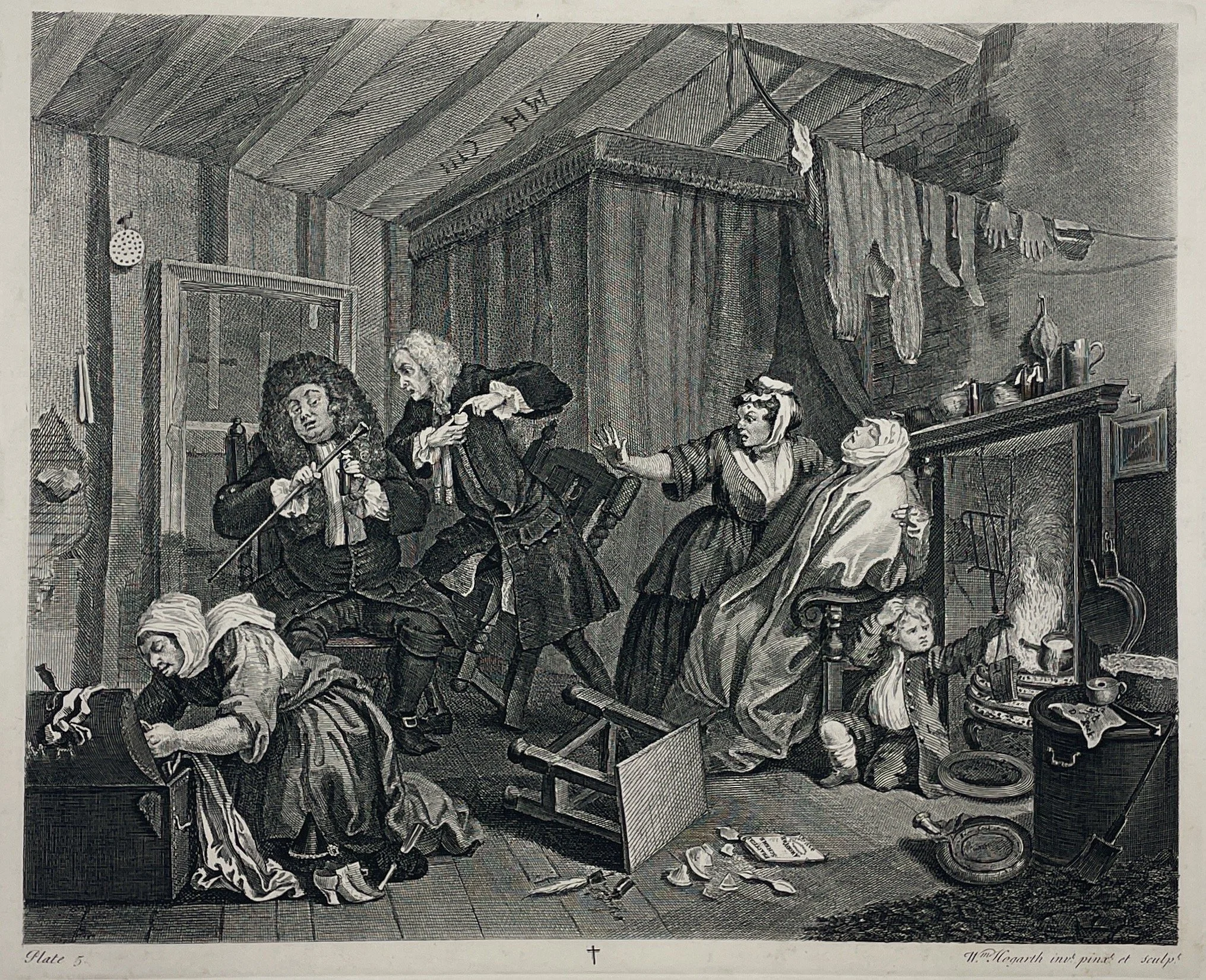
“Harlot’s Progress – Plate 5,” William Hogarth, 1732 satirical etching & engraving; Moll dying in her garret while physicians quarrel; plate-signed by Hogarth.

$2,000.00

“Harlot’s Progress – Plate 5,” William Hogarth, 1732 satirical etching & engraving; Moll dying in her garret while physicians quarrel; plate-signed by Hogarth.

William Hogarth’s A Harlot’s Progress – Plate 5 is one of the most dramatic images in the artist’s seminal 1732 moral series. Here Moll Hackabout lies dying of venereal disease in a cramped London attic while rival quack doctors violently dispute their methods. Surrounding her, thieves, servants, and opportunists plunder her belongings, marking the complete collapse of her life. This fine vintage impression, struck from Hogarth’s own copperplate and bearing his original inscription, offers collectors an evocative and sharply detailed example of Georgian satire, social commentary, and early narrative printmaking.

Artwork Description

Plate 5 presents one of the most somber and psychologically charged scenes in A Harlot’s Progress: Moll Hackabout dying of syphilis in a cramped garret, surrounded not by compassion but by chaos, exploitation, and quackery. Hogarth draws out the full tragedy of her final days with unflinching moral clarity and theatrical detail.

At the center, Moll sits slumped in a chair, frail and ghostly. Her unraveling form is emphasized by the way her clothes seem to reach toward her like spectral hands, subtly rendered to appear as though they are pulling her toward the afterlife. Hogarth’s mastery of expressive drapery heightens the sense of impending death.

To the left, the black-haired Dr. Richard Rock prepares to bleed her, brandishing a lancet as he argues heatedly with his rival, the white-haired Dr. Jean Misaubin, who thrusts forward with cupping glasses—their competing “cures” equally ineffective. Hogarth satirizes the medical profession by depicting both men as more concerned with quarreling than treating their patient.

A woman—likely Moll’s bawd or the landlady—rummages through a trunk beside her, stealing Moll’s possessions before she is even dead. Her posture and intent signal the complete abandonment of decency at Moll’s most vulnerable moment.
Beside the dying Moll, her maid attempts to intervene, raising her hands to halt the fighting and looting, yet her efforts fall entirely on deaf ears.

On the floor by the hearth sits Moll’s young son, scratching his head for lice or fleas. His presence is heartbreaking: he is innocent yet likely afflicted, possibly with the same congenital syphilis that is killing his mother. His vulnerability mirrors the generational entrapment and societal neglect that Hogarth condemns.

The garret is littered with discarded opiates (“anodynes”), empty vials, and dubious “cures,” signaling the pervasive medical fraud of the era. Broken crockery, scattered belongings, and upturned furniture add to the claustrophobia of the scene.

One of the most striking symbolic details is the Passover cake used as a flytrap on the mantle—a biting visual metaphor. It hints that Moll’s former Jewish keeper is still paying for her lodging, yet the religious reference underscores that Moll will not be “passed over” by death, unlike the Israelites of the Exodus story. Hogarth’s wit is razor-sharp even in the bleakest moments.

This deeply layered composition—alive with moral critique, theatrical chaos, and human tragedy—shows Hogarth at the height of his satirical power. Plate 5 stands as one of the most emotionally resonant and socially incisive images of the entire series.

Scene Overview

Plate 5 presents a claustrophobic, chaotic garret interior conveying Moll’s final days:

  • Moll Hackabout, wrapped in bed linens, sits slumped in a chair as she succumbs to syphilis, the era’s most devastating sexually transmitted disease.

  • To her left, Dr. Richard Rock (black wig) aggressively prepares to bleed her, brandishing his lancet.

  • To her right, Dr. Jean Misaubin (white wig) thrusts forward with cupping glasses, advocating his own dubious cure. The two were real-life medical rivals, well known in London.

  • A woman rummages through Moll’s trunk, stealing her last possessions.

  • Moll’s maid gestures desperately, trying to prevent the fighting and looting.

  • Moll’s child sits by the fire, scratching lice from his scalp—implying inherited disease, poverty, and hopelessness.

  • Opiates, elixirs, and cures litter the floor, signaling medical failure.

  • A Passover cake used as a flytrap suggests that Moll’s former Jewish patron has abandoned her—or that no “passing over” of death will take place.

  • Household chaos—broken dishes, overturned chairs, drying laundry—mirrors Moll’s spiritual and physical collapse.

Technique

  • Deeply worked engraving lines, cross-hatching, and tonal gradations exemplify Hogarth’s skill as both draughtsman and engraver.

  • Hogarth’s characteristic inscription appears sharply: “Wm. Hogarth invt. pinxt. et sculpt.”

  • The texture of fabrics, wig curls, and architectural space demonstrates his mastery of narrative detail.

Condition

  • Image: Crisp, clean, richly toned

  • Plate mark strong, lines detailed and intact

  • Sheet: expected light age toning consistent with high-quality 19th-century impressions

  • Never framed; excellent for conservation framing and display

Biography of William Hogarth (1697–1764)

William Hogarth pioneered the use of sequential narrative in fine art and revolutionized British satire through his engravings and moral allegories. Born in London in 1697, he trained as an ornamental and heraldic engraver before studying drawing at the St. Martin’s Lane Academy. His early exposure to London’s streets, taverns, and social hierarchies shaped his incisive depiction of everyday life.

With A Harlot’s Progress (1732), Hogarth became the first artist to create a serialized visual narrative intended for wide public distribution. Its runaway success established him as England’s foremost commentator on vice, hypocrisy, crime, and urban decay. Subsequent cycles—including A Rake’s Progress and Marriage A-la-Mode—cemented his influence on Western art history.

Hogarth defended artists’ rights through the Engravers’ Copyright Act of 1735, the first copyright protection for images, and his prints profoundly shaped later caricaturists such as Gillray and Rowlandson.

William Hogarth, “A Harlot’s Progress – Plate 5,” 1732 (later authorized restrike). Etching & engraving, 25×19 in. sheet, plate-signed. Dramatic garret scene of Moll’s final days. Strong impression from the original copperplate. Provenance: Mitch Morse Gallery, NYC.

Certificate of Authentication & Appraisal
Artwork: A Harlot’s Progress – Plate 5
Artist: William Hogarth (1697–1764)
Medium: Etching & engraving pulled from Hogarth’s original copperplate
Date: 1732 design; later authorized impression (Boydell/Bohn era)
Inscription: “Plate 5 / Wm. Hogarth invt. pinxt. et sculpt.”
Condition: Very good vintage condition, strong lines, clean image
Provenance: Mitch Morse Gallery, New York City
Certified for: Artfind Gallery, Washington, DC

Provenance Chain

  • William Hogarth, London (engraved 1732)

  • Jane Hogarth → John Boydell (1789)

  • Boydell → Baldwin, Cradock & Joy (1818)

  • BC&J → Henry Bohn (1835)

  • Subsequent circulation via British print dealers

  • Mitch Morse Gallery, Inc., NYC

  • Artfind Gallery, Washington, DC (current owner)

“A HARLOT’S PROGRESS – PLATE 5”

WILLIAM HOGARTH (1697–1764)
Satirical Etching & Engraving
1732 Design — Later Authorized Restrike from Original Plate

Sheet: 25 1/8 x 19 1/24 in.
Plate Image: 15 3/8 x 12 9/16 in.
Inscription:“Plate 5 / Wm. Hogarth invt. pinxt. et sculpt.”

From the retired Mitch Morse Gallery, Inc., NYC. Unframed, unmatted, and stored flat with the print face protected. Image area remains clean, well-preserved, and fully frameable.

KEY FACTS & VERIFIED HISTORY

Narrative Position

Plate 5 is the penultimate scene in Hogarth’s groundbreaking six-part morality tale A Harlot’s Progress. By this point, Moll Hackabout—once an innocent country girl seduced and brought to London—has spiraled through the city’s underworld and now lies dying of venereal disease.

Printing History

  • Originally engraved by Hogarth in 1732, based on now-lost paintings (destroyed in the 1755 Fonthill fire).

  • Surviving copperplates passed through:

    • Jane Hogarth → John Boydell (1789)

    • Boydell → Baldwin, Cradock & Joy (1818)

    • BC&J → Henry Bohn (1835)

  • Later authorized restrikes from these plates remain the only existing impressions after Hogarth’s lifetime.

Your sheet’s size, margins, paper tone, and plate characteristics are consistent with 19th-century Bohn-era impressions, the most collectible period post-Hogarth.

“Harlot’s Progress – Plate 5,” William Hogarth, 1732 satirical etching & engraving; Moll dying in her garret while physicians quarrel; plate-signed by Hogarth.

William Hogarth’s A Harlot’s Progress – Plate 5 is one of the most dramatic images in the artist’s seminal 1732 moral series. Here Moll Hackabout lies dying of venereal disease in a cramped London attic while rival quack doctors violently dispute their methods. Surrounding her, thieves, servants, and opportunists plunder her belongings, marking the complete collapse of her life. This fine vintage impression, struck from Hogarth’s own copperplate and bearing his original inscription, offers collectors an evocative and sharply detailed example of Georgian satire, social commentary, and early narrative printmaking.

Artwork Description

Plate 5 presents one of the most somber and psychologically charged scenes in A Harlot’s Progress: Moll Hackabout dying of syphilis in a cramped garret, surrounded not by compassion but by chaos, exploitation, and quackery. Hogarth draws out the full tragedy of her final days with unflinching moral clarity and theatrical detail.

At the center, Moll sits slumped in a chair, frail and ghostly. Her unraveling form is emphasized by the way her clothes seem to reach toward her like spectral hands, subtly rendered to appear as though they are pulling her toward the afterlife. Hogarth’s mastery of expressive drapery heightens the sense of impending death.

To the left, the black-haired Dr. Richard Rock prepares to bleed her, brandishing a lancet as he argues heatedly with his rival, the white-haired Dr. Jean Misaubin, who thrusts forward with cupping glasses—their competing “cures” equally ineffective. Hogarth satirizes the medical profession by depicting both men as more concerned with quarreling than treating their patient.

A woman—likely Moll’s bawd or the landlady—rummages through a trunk beside her, stealing Moll’s possessions before she is even dead. Her posture and intent signal the complete abandonment of decency at Moll’s most vulnerable moment.

Beside the dying Moll, her maid attempts to intervene, raising her hands to halt the fighting and looting, yet her efforts fall entirely on deaf ears.

On the floor by the hearth sits Moll’s young son, scratching his head for lice or fleas. His presence is heartbreaking: he is innocent yet likely afflicted, possibly with the same congenital syphilis that is killing his mother. His vulnerability mirrors the generational entrapment and societal neglect that Hogarth condemns.

The garret is littered with discarded opiates (“anodynes”), empty vials, and dubious “cures,” signaling the pervasive medical fraud of the era. Broken crockery, scattered belongings, and upturned furniture add to the claustrophobia of the scene.

One of the most striking symbolic details is the Passover cake used as a flytrap on the mantle—a biting visual metaphor. It hints that Moll’s former Jewish keeper is still paying for her lodging, yet the religious reference underscores that Moll will not be “passed over” by death, unlike the Israelites of the Exodus story. Hogarth’s wit is razor-sharp even in the bleakest moments.

This deeply layered composition—alive with moral critique, theatrical chaos, and human tragedy—shows Hogarth at the height of his satirical power. Plate 5 stands as one of the most emotionally resonant and socially incisive images of the entire series.

Scene Overview

Plate 5 presents a claustrophobic, chaotic garret interior conveying Moll’s final days:

  • Moll Hackabout, wrapped in bed linens, sits slumped in a chair as she succumbs to syphilis, the era’s most devastating sexually transmitted disease.

  • To her left, Dr. Richard Rock (black wig) aggressively prepares to bleed her, brandishing his lancet.

  • To her right, Dr. Jean Misaubin (white wig) thrusts forward with cupping glasses, advocating his own dubious cure. The two were real-life medical rivals, well known in London.

  • A woman rummages through Moll’s trunk, stealing her last possessions.

  • Moll’s maid gestures desperately, trying to prevent the fighting and looting.

  • Moll’s child sits by the fire, scratching lice from his scalp—implying inherited disease, poverty, and hopelessness.

  • Opiates, elixirs, and cures litter the floor, signaling medical failure.

  • A Passover cake used as a flytrap suggests that Moll’s former Jewish patron has abandoned her—or that no “passing over” of death will take place.

  • Household chaos—broken dishes, overturned chairs, drying laundry—mirrors Moll’s spiritual and physical collapse.

Technique

  • Deeply worked engraving lines, cross-hatching, and tonal gradations exemplify Hogarth’s skill as both draughtsman and engraver.

  • Hogarth’s characteristic inscription appears sharply: “Wm. Hogarth invt. pinxt. et sculpt.”

  • The texture of fabrics, wig curls, and architectural space demonstrates his mastery of narrative detail.

Condition

  • Image: Crisp, clean, richly toned

  • Plate mark strong, lines detailed and intact

  • Sheet: expected light age toning consistent with high-quality 19th-century impressions

  • Never framed; excellent for conservation framing and display

Biography of William Hogarth (1697–1764)

William Hogarth pioneered the use of sequential narrative in fine art and revolutionized British satire through his engravings and moral allegories. Born in London in 1697, he trained as an ornamental and heraldic engraver before studying drawing at the St. Martin’s Lane Academy. His early exposure to London’s streets, taverns, and social hierarchies shaped his incisive depiction of everyday life.

With A Harlot’s Progress (1732), Hogarth became the first artist to create a serialized visual narrative intended for wide public distribution. Its runaway success established him as England’s foremost commentator on vice, hypocrisy, crime, and urban decay. Subsequent cycles—including A Rake’s Progress and Marriage A-la-Mode—cemented his influence on Western art history.

Hogarth defended artists’ rights through the Engravers’ Copyright Act of 1735, the first copyright protection for images, and his prints profoundly shaped later caricaturists such as Gillray and Rowlandson.

William Hogarth, “A Harlot’s Progress – Plate 5,” 1732 (later authorized restrike). Etching & engraving, 25×19 in. sheet, plate-signed. Dramatic garret scene of Moll’s final days. Strong impression from the original copperplate. Provenance: Mitch Morse Gallery, NYC.

Certificate of Authentication & Appraisal
Artwork: A Harlot’s Progress – Plate 5
Artist: William Hogarth (1697–1764)
Medium: Etching & engraving pulled from Hogarth’s original copperplate
Date: 1732 design; later authorized impression (Boydell/Bohn era)
Inscription: “Plate 5 / Wm. Hogarth invt. pinxt. et sculpt.”
Condition: Very good vintage condition, strong lines, clean image
Provenance: Mitch Morse Gallery, New York City
Certified for: Artfind Gallery, Washington, DC

Provenance Chain

  • William Hogarth, London (engraved 1732)

  • Jane Hogarth → John Boydell (1789)

  • Boydell → Baldwin, Cradock & Joy (1818)

  • BC&J → Henry Bohn (1835)

  • Subsequent circulation via British print dealers

  • Mitch Morse Gallery, Inc., NYC

  • Artfind Gallery, Washington, DC (current owner)

“A HARLOT’S PROGRESS – PLATE 5”

WILLIAM HOGARTH (1697–1764)
Satirical Etching & Engraving
1732 Design — Later Authorized Restrike from Original Plate

Sheet: 25 1/8 x 19 1/24 in.
Plate Image: 15 3/8 x 12 9/16 in.
Inscription:“Plate 5 / Wm. Hogarth invt. pinxt. et sculpt.”

From the retired Mitch Morse Gallery, Inc., NYC. Unframed, unmatted, and stored flat with the print face protected. Image area remains clean, well-preserved, and fully frameable.

KEY FACTS & VERIFIED HISTORY

Narrative Position

Plate 5 is the penultimate scene in Hogarth’s groundbreaking six-part morality tale A Harlot’s Progress. By this point, Moll Hackabout—once an innocent country girl seduced and brought to London—has spiraled through the city’s underworld and now lies dying of venereal disease.

Printing History

  • Originally engraved by Hogarth in 1732, based on now-lost paintings (destroyed in the 1755 Fonthill fire).

  • Surviving copperplates passed through:

    • Jane Hogarth → John Boydell (1789)

    • Boydell → Baldwin, Cradock & Joy (1818)

    • BC&J → Henry Bohn (1835)

  • Later authorized restrikes from these plates remain the only existing impressions after Hogarth’s lifetime.

Your sheet’s size, margins, paper tone, and plate characteristics are consistent with 19th-century Bohn-era impressions, the most collectible period post-Hogarth.

“A HARLOT’S PROGRESS - PLATE 5” -

WILLIAM HOGARTH - Satirical Etching Engraving

25 1/8 x 19 1/24  inches.     Plate image: 15 3/8 x 12 9/16 inches. Inscription content: Lettered below image, "Plate 5./Wm. Hogarth invt. pinxt. et sculpt.”

From the retired Mitch Moore Gallery Inc, NYC. Unmatted, never framed or displayed. Image area is in very good frameable vintage condition. 

Description Plate 5

A squalid room where Moll Hackabout, wrapped in a sheet, is dying while two doctors (Richard Rock and Jean Misaubin) argue over their remedies; her serving-woman calls for attention for the invalid, another woman rifles through a trunk, and a small boy turns a joint of meat roasting in front of the fire. 1732

Etching and engraving

  • About the artist: WILLIAM HOGARTH

A celebrated painter of satirical commentaries on contemporary English life, Hogarth was primarily known in the eighteenth century through the publication and subscription sale of prints her personally engraved after his own painted compositions. Hogarth often designed his "Modern Moral Subjects" in narrative series in which he lampooned the foibles of his fellow Englishmen and women throughout society.

Hogarth achieved his first great success with A Harlot's Progress, a narrative cycle of six scenes depicting the moral dissolution of a once-innocent country girl through the life of a prostitution in London.

Painter, draughstman and engraver; b. London 1697; d. there 1764; son in law of Thornhill; trained as ornamental engraver; studied drawing at Vanderbank's Academy; active as a painter from 1728/9, specializing in portraits and genre to mid 1730s; engraved series of moral subjects 1732 'The Harlot's Progress'

The plates[edit]

Plate 1

Moll Hackabout arrives in London at the Bell Inn, Cheapside

The protagonist, Moll Hackabout, has arrived in London's Cheapside. Moll carries scissors and a pincushion hanging on her arm, suggesting that she sought employment as a seamstress. Instead, she is being inspected by the pox-ridden Elizabeth Needham, a notorious procuress and brothel-keeper, who wants to secure Moll for prostitution. The notorious rake Colonel Francis Charteris and his pimp, John Gourlay, look on, also interested in Moll. The two stand in front of a decaying building, symbolic of their moral bankruptcy. Charteris fondles himself in expectation.

Londoners ignore the scene, and even a mounted clergyman ignores her predicament, just as he ignores the fact of his horse knocking over a pile of pans.

Moll appears to have been deceived by the possibility of legitimate employment. A goose in Moll's luggage is addressed to "My lofing cosen in Tems Stret in London": suggesting that she has been misled; this "cousin" might have been a recruiter or a paid-off dupe of the bawdy keepers. Moll is dressed in white, in contrast to those around her, illustrating her innocence and naiveté. The dead goose in or near Moll's luggage, similarly white, foreshadows Moll's death as a result of her gullibility.

The inn sign, with a picture of a bell, may refer to the belle (French for beautiful woman) who has newly arrived from the country. The teetering pile of pans alludes to Moll's imminent "fall". The goose and the teetering pans also mimic the inevitable impotence that ensues from syphilis, foreshadowing Moll's specific fate.

The composition resembles that of a Visitation, i.e. the visit of Mary with Elizabeth as recorded in the Gospel of Luke 1:39–56.

Plate 2

Moll is now a kept woman, the mistress of a wealthy merchant

Moll is now the mistress of a wealthy Jewish merchant, as is confirmed by the Old Testament paintings in the background which have been considered to be prophetic of how the merchant will treat Moll in between this plate and the third plate. She has numerous affectations of dress and accompaniment, as she keeps a West Indian serving boy and a monkey. The boy and the young female servant, as well as the monkey, may be provided by the businessman. The presence of the servant, the monkey and the mahogany table of tea things all suggest the merchant's wealth has been made in the colonies.[10] She has jars of cosmetics, a mask from masquerades, and her apartment is decorated with paintings illustrating her sexually promiscuous and morally precarious state. She pushes over a table to distract the merchant's attention as a second lover tiptoes out.

Plate 3

Moll has gone from kept woman to common prostitute

Moll has gone from kept woman to common prostitute. Her maid is now old and syphilitic, and Henry Fielding, in Tom Jones (2:3), would say that the maid looks like his character of Mrs. Partridge. Her bed is her only major piece of furniture, and the cat poses to suggest Moll's new posture. The witch hat and birch rods on the wall suggest either black magic, or more importantly that prostitution is the devil's work. Her heroes are on the wall: Macheath from The Beggar's Opera and Henry Sacheverell, and two cures for syphilis are above them.

The wig box of highwayman James Dalton (hanged on 11 May 1730) is stored over her bed, suggesting a romantic dalliance. The magistrate, Sir John Gonson, with three armed bailiffs, is coming through the door on the right side of the frame to arrest Moll for her activities. Moll is showing off a new watch (perhaps a present from Dalton, perhaps stolen from another lover) and exposing her left breast. Gonson, however, is fixed upon the witch's hat and 'broom' or the periwig hanging from the wall above Moll's bed.

The composition satirically resembles that of an Annunciation, i.e. the announcement by the angel Gabriel to the Virgin Mary that she would conceive and become the mother of Jesus, the Son of God, as recorded in the Gospel of Luke 1:26–39.

Plate 4

Moll beats hemp in Bridewell Prison

Moll is in Bridewell Prison. She beats hemp for hangman's nooses, while the jailer threatens her and points to the task. Fielding would write that Thwackum, one of Tom Jones's sadistic tutors, looked precisely like the jailer (Tom Jones 3:6). The jailer's wife steals clothes from Moll, winking at theft. The prisoners go from left to right in order of decreasing wealth.

Moll is standing next to a gentleman, a card-sharp whose extra playing card has fallen out, and who has brought his dog with him. The inmates are in no way being reformed, despite the ironic engraving on the left above the occupied stocks, reading "Better to Work/ than Stand thus." The person suffering in the stocks apparently refused to work.

Next is a woman, a child who may have Down syndrome (belonging to the sharper, probably), and finally a pregnant African woman who presumably "pleaded her belly" when brought to trial, as pregnant women could not be executed or transported. A prison graffito shows John Gonson hanging from the gallows. Moll's servant smiles as Moll's clothes are stolen, and the servant appears to be wearing Moll's shoes.

Plate 5

Moll dying of syphilis

Moll is now dying of syphilis. Dr. Richard Rock on the left (black hair) and Dr. Jean Misaubin on the right (white hair) argue over their medical methods, which appear to be a choice of bleeding (Rock) and cupping (Misaubin). A woman, possibly Moll's bawd and possibly the landlady, rifles Moll's possessions for what she wishes to take away.

Meanwhile, Moll's maid tries to stop the looting and arguing. Moll's son sits by the fire, possibly sick with syphilis as well. He is picking lice or fleas out of his hair. The only hint as to the apartment's owner is a Passover cake used as a fly-trap, implying that her former keeper is paying for her in her last days and ironically indicating that Moll will, unlike the Israelites, not be spared. Several opiates ("anodynes") and "cures" litter the floor. Moll's clothes seem to reach down for her as if they were ghosts drawing her to the afterlife.

Plate 6

Moll's wake

In the final plate, Moll is dead, and all of the scavengers are present at her wake. A note on the coffin lid shows that she died aged 23 on 2 September 1731. The parson spills his brandy as he has his hand up the skirt of the girl next to him, and she appears pleased. A woman who has placed drinks on Moll's coffin looks on in disapproval. Moll's son plays ignorantly. Moll's son is innocent, but he sits playing with his top underneath his mother's body, unable to understand (and figuratively fated to death himself).

Moll's madam drunkenly mourns on the right with a ghastly grinning jug of "Nants" (brandy). She is the only one who is upset at the treatment of the dead girl, whose coffin is being used as a tavern bar. A "mourning" girl (another prostitute) steals the undertaker's handkerchief.

Another prostitute shows her injured finger to her fellow whore, while a woman adjusts her appearance in a mirror in the background, even though she shows a syphilitic sore on her forehead. The house holding the coffin has an ironic coat of arms on the wall displaying a chevron with three spigots, reminiscent of the "spill" of the parson, the flowing alcohol, and the expiration of Moll. The white hat hanging on the wall by the coat of arms is the one Moll wore in the first plate, referring back to the beginning of her end.