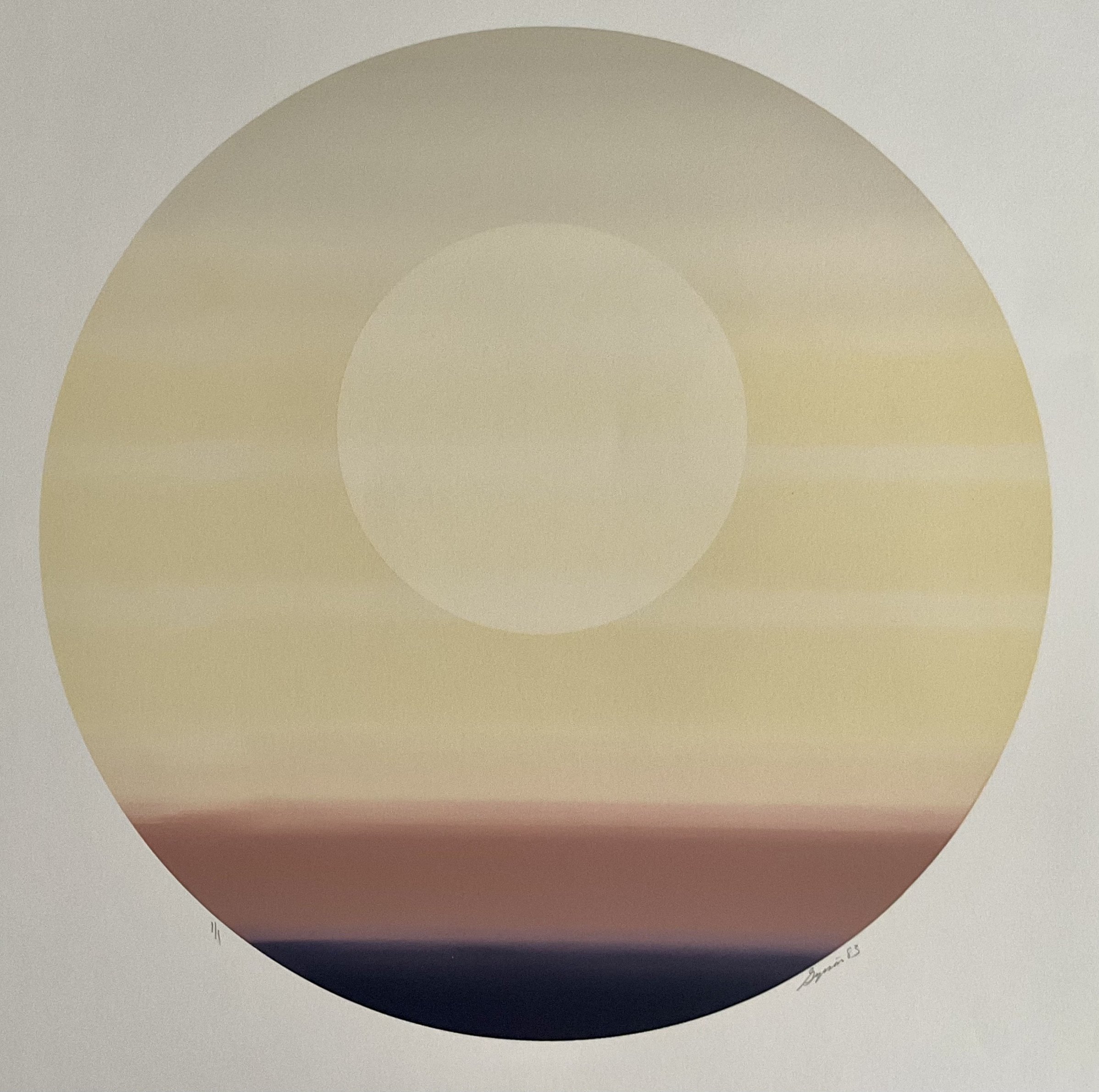
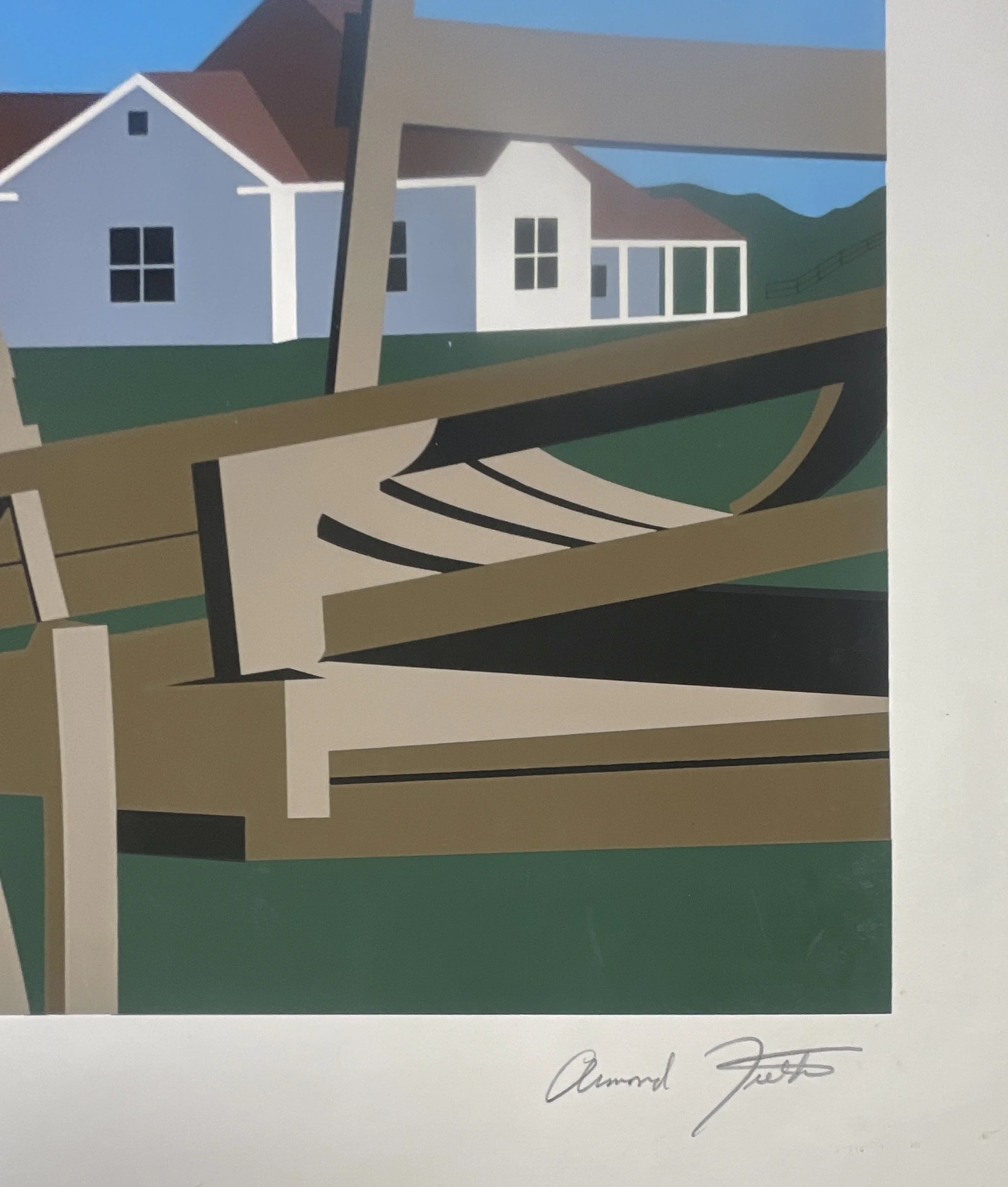
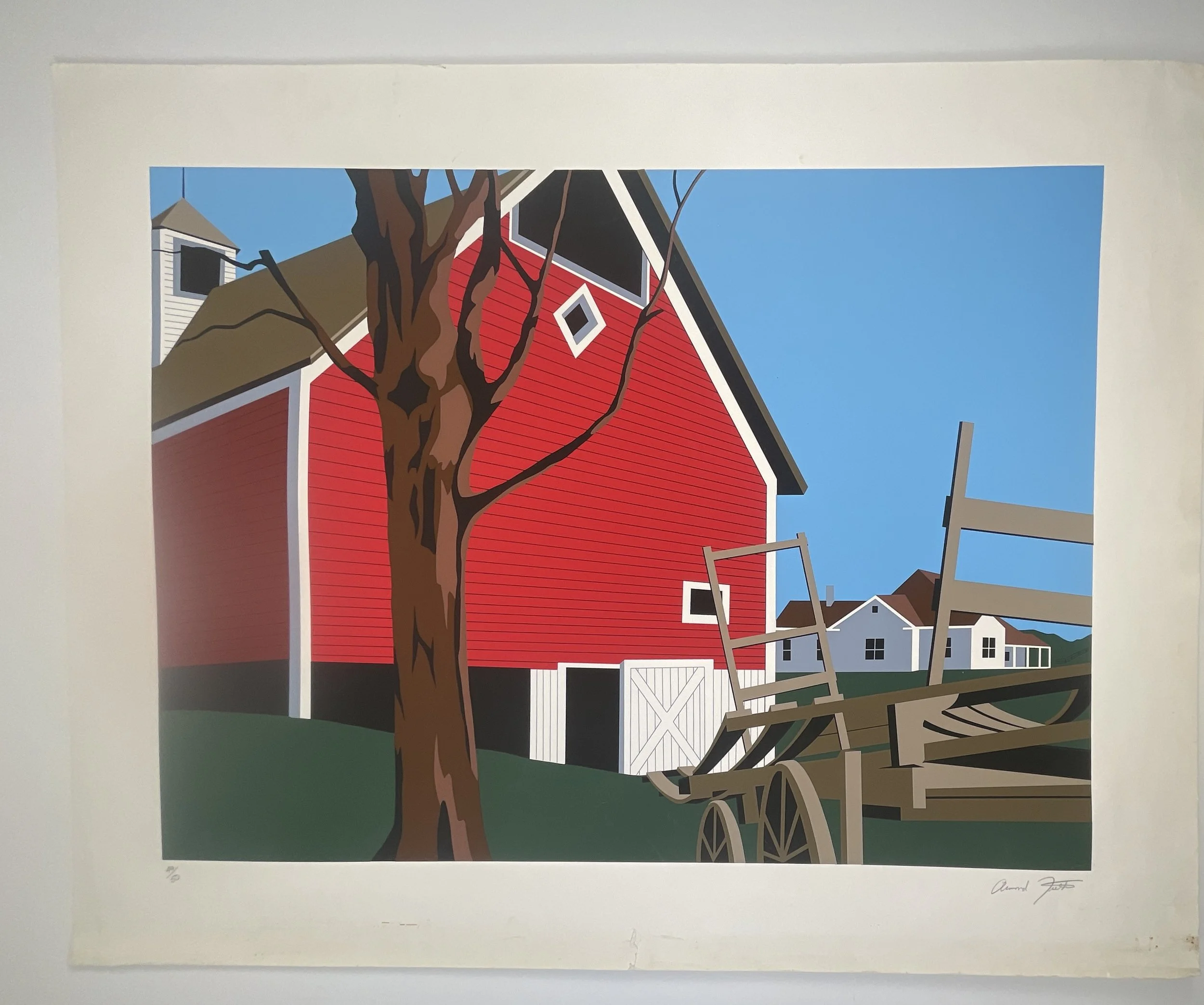
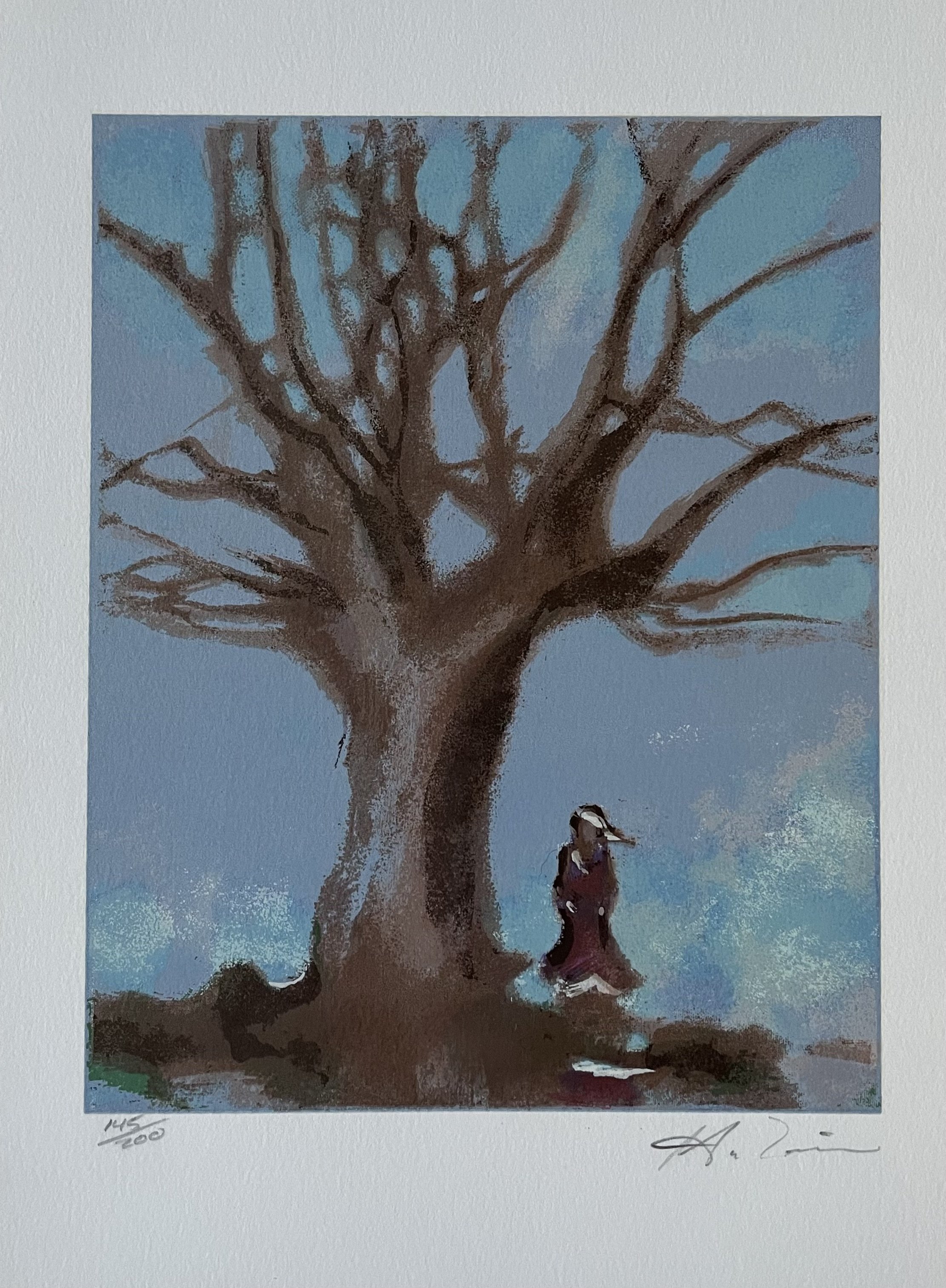
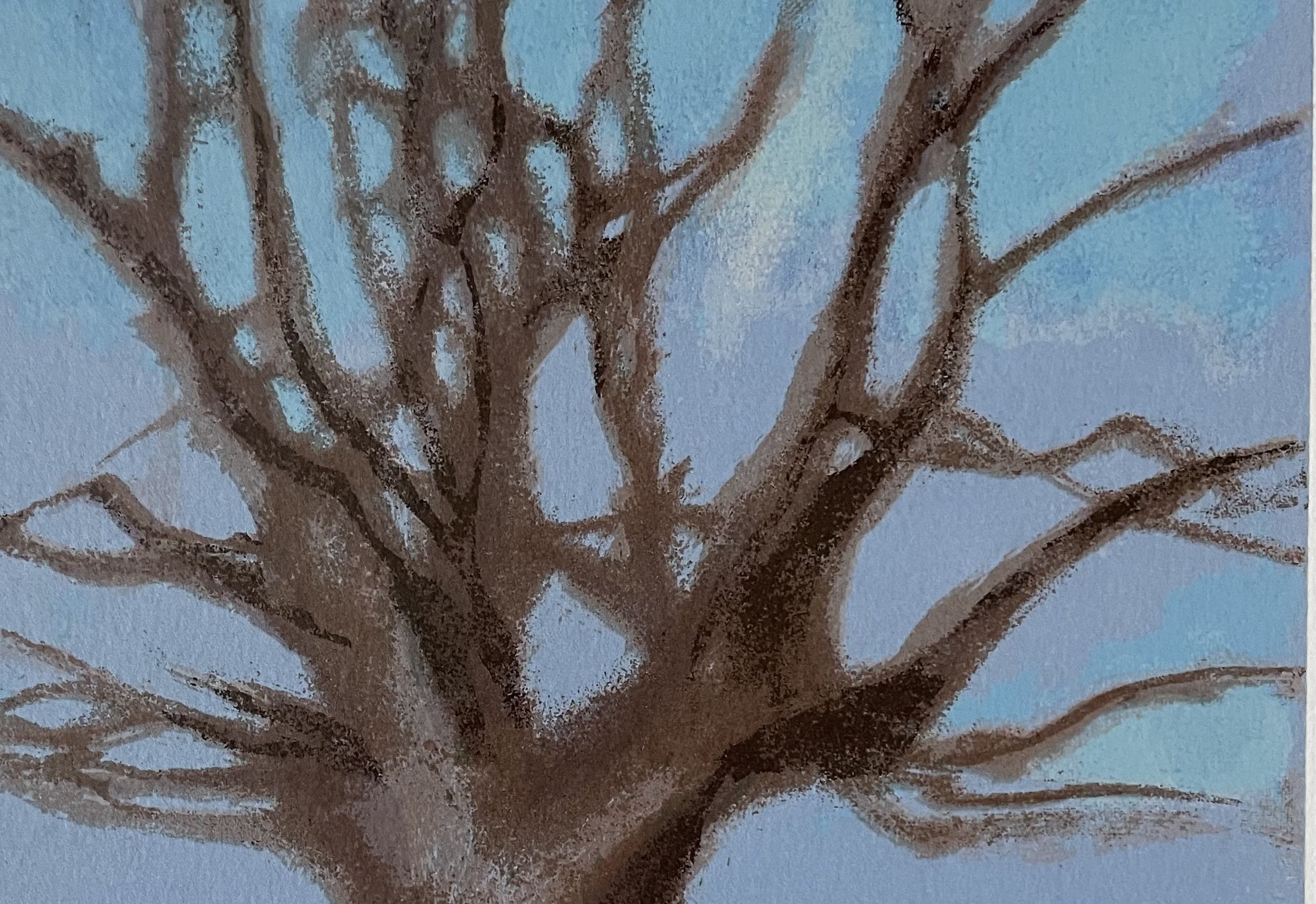
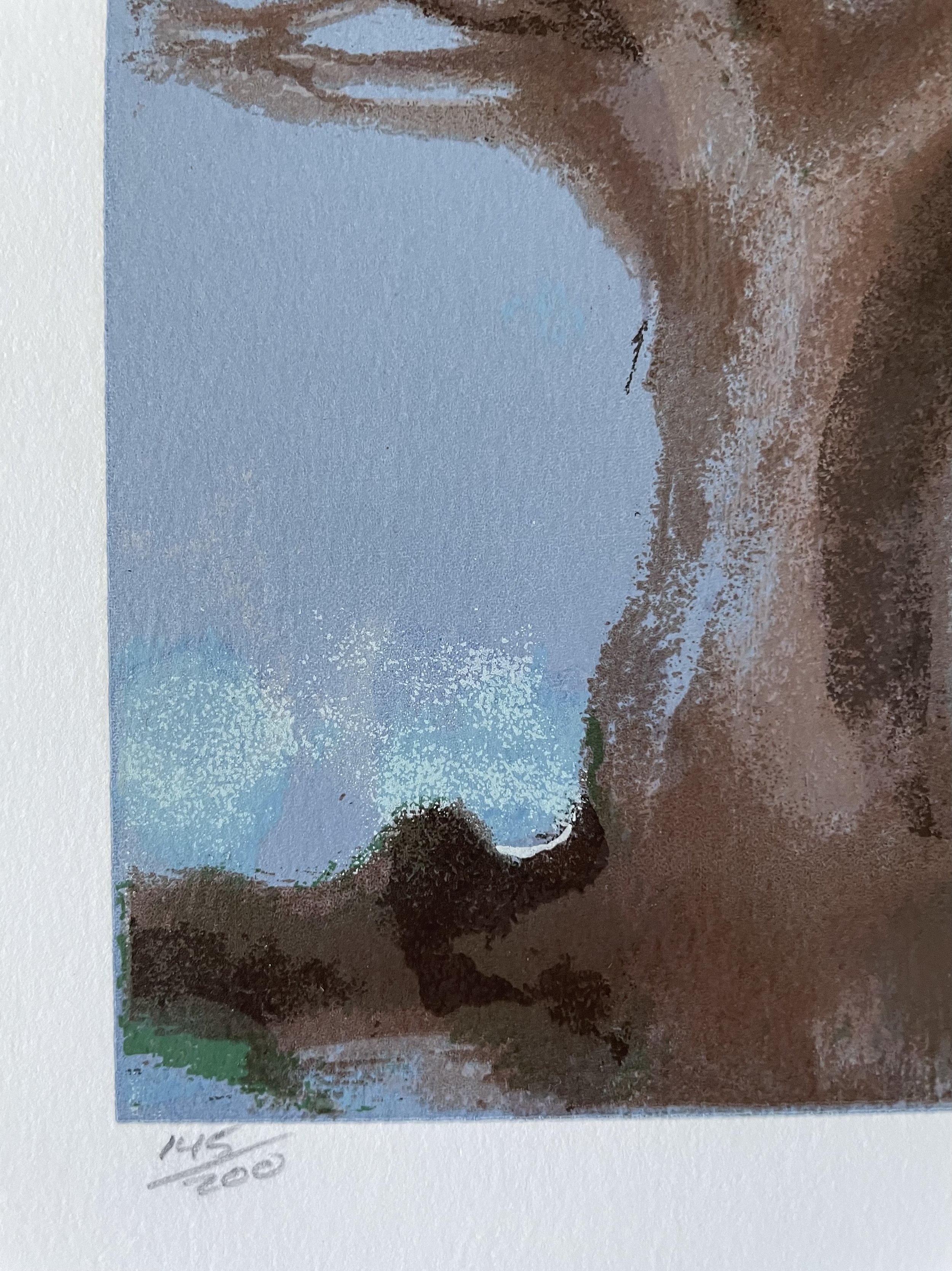
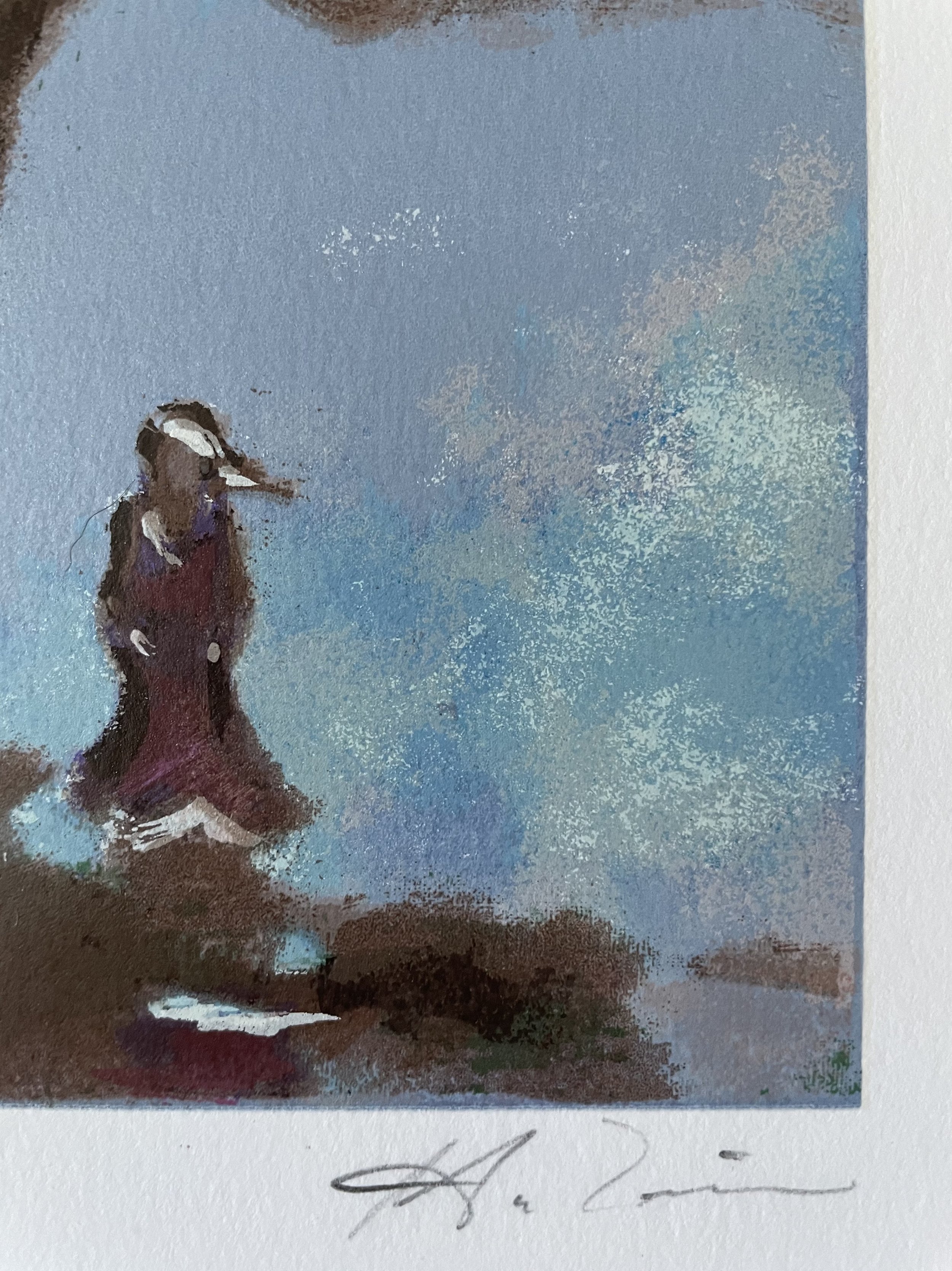
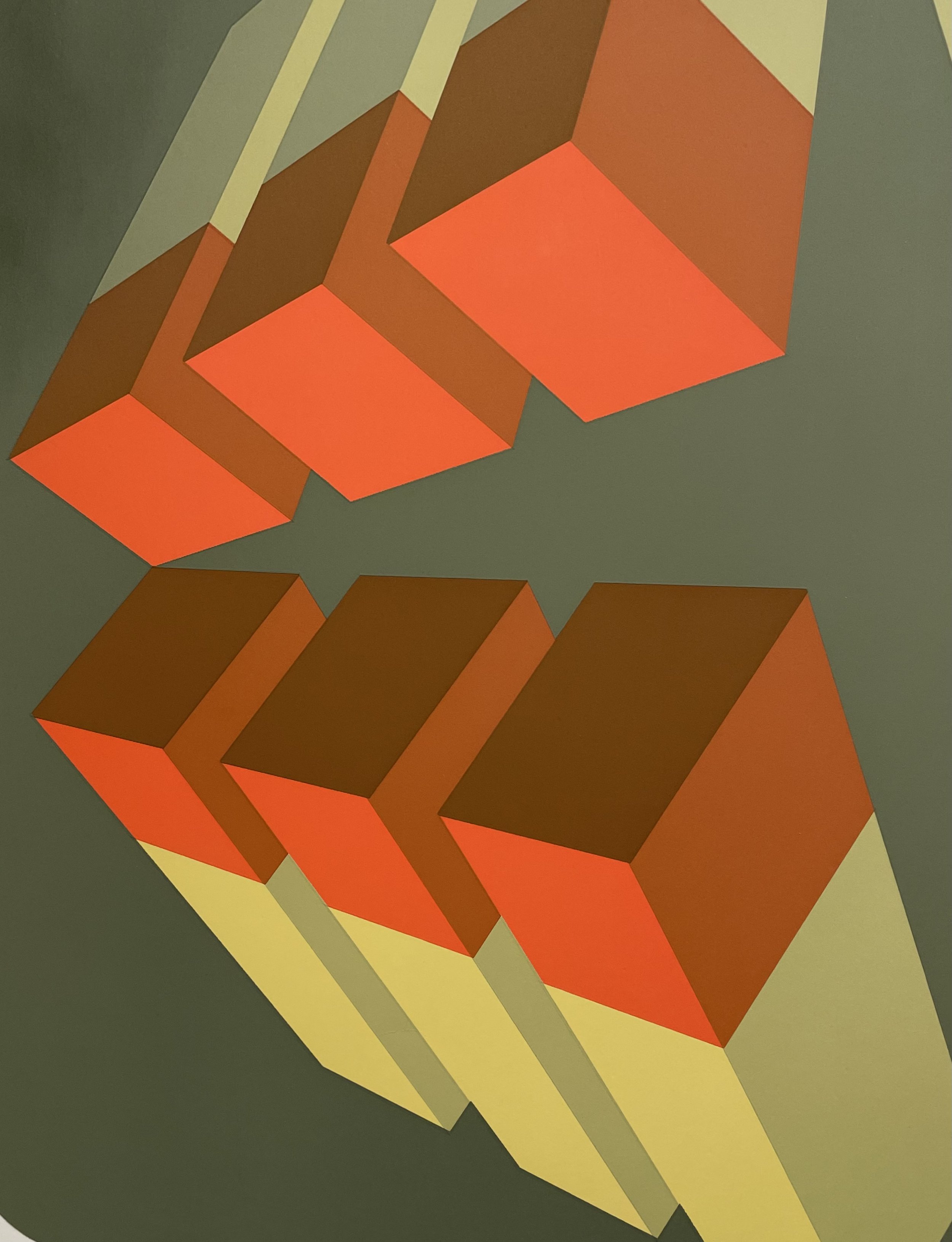
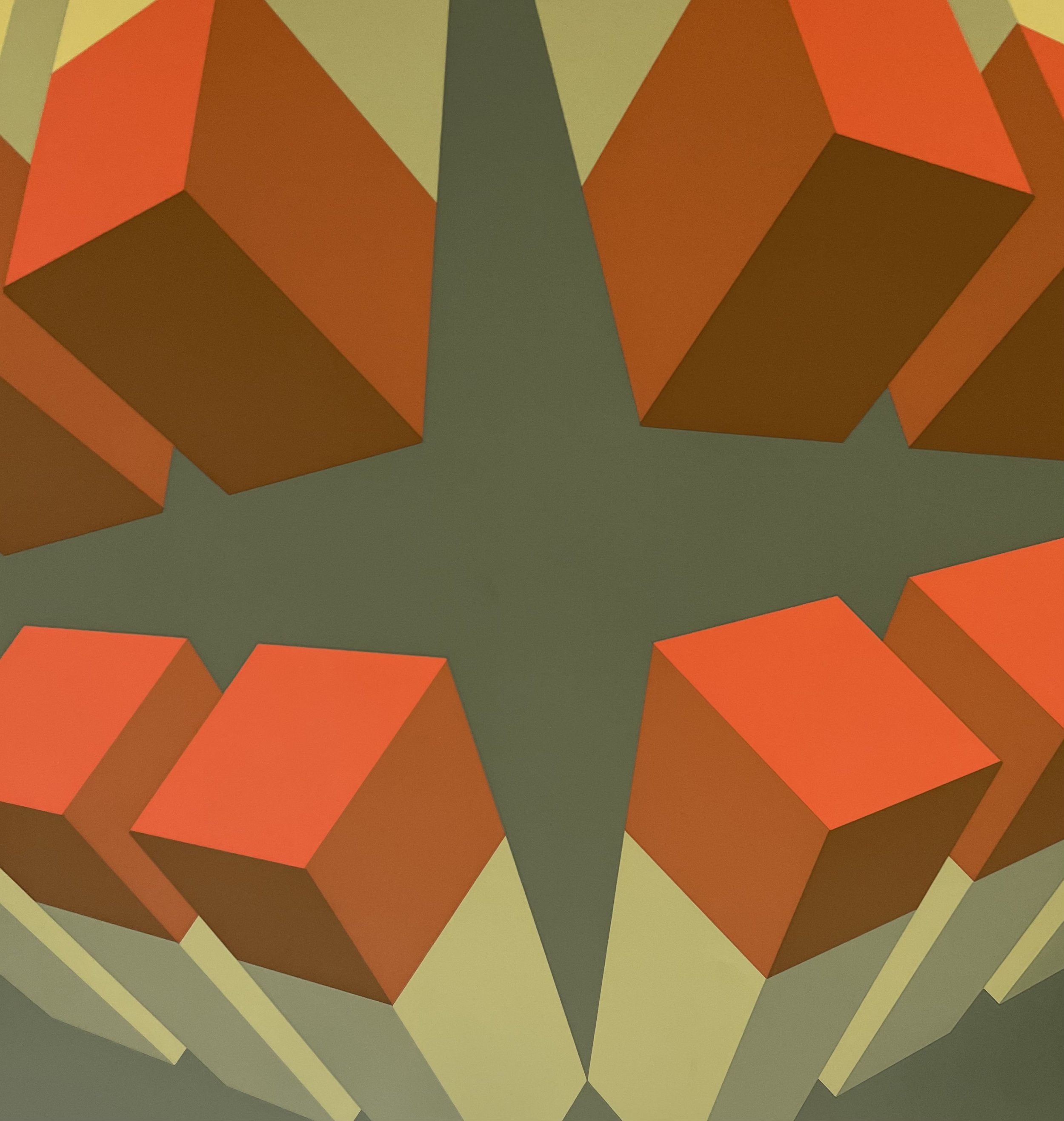
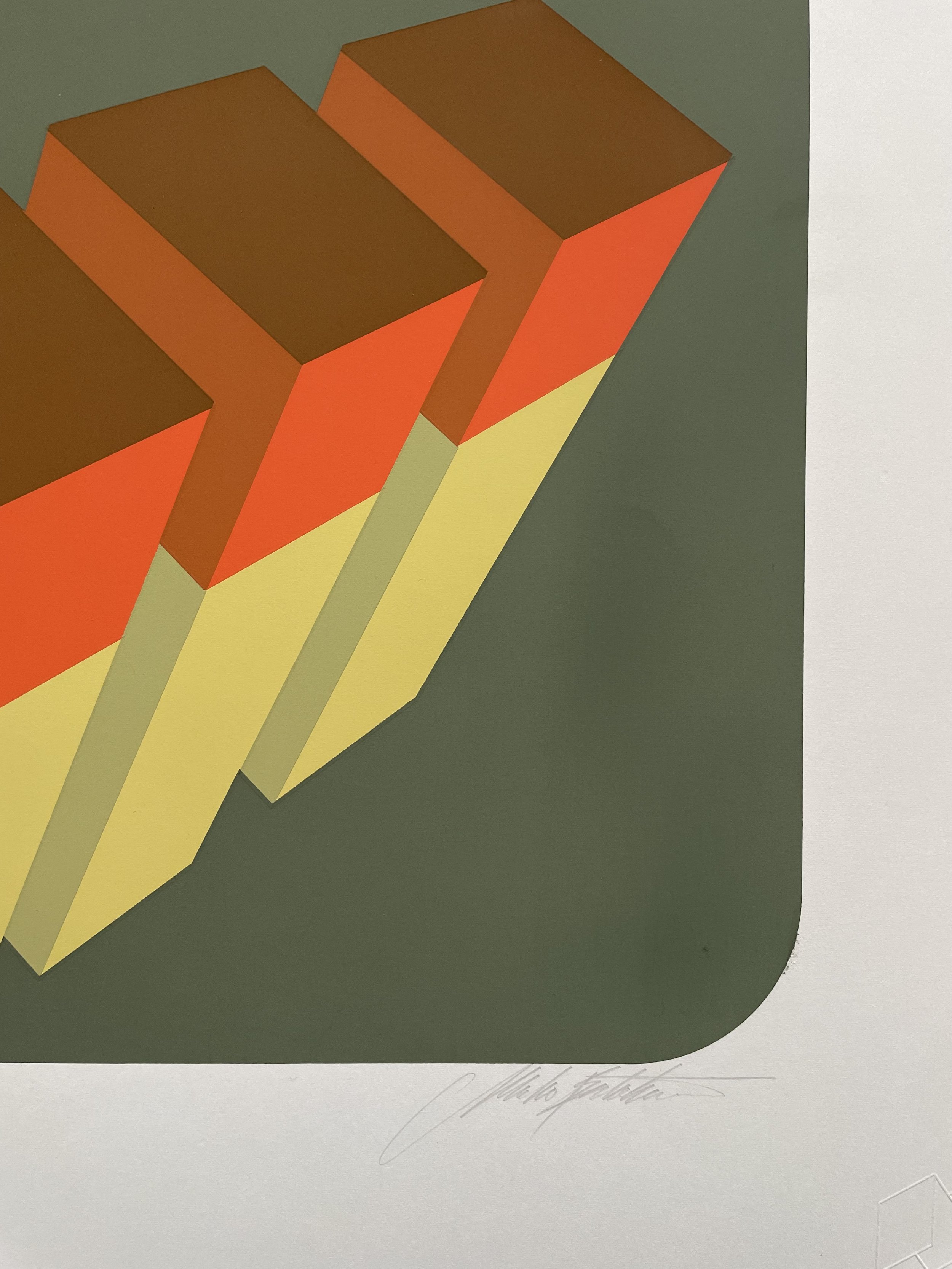
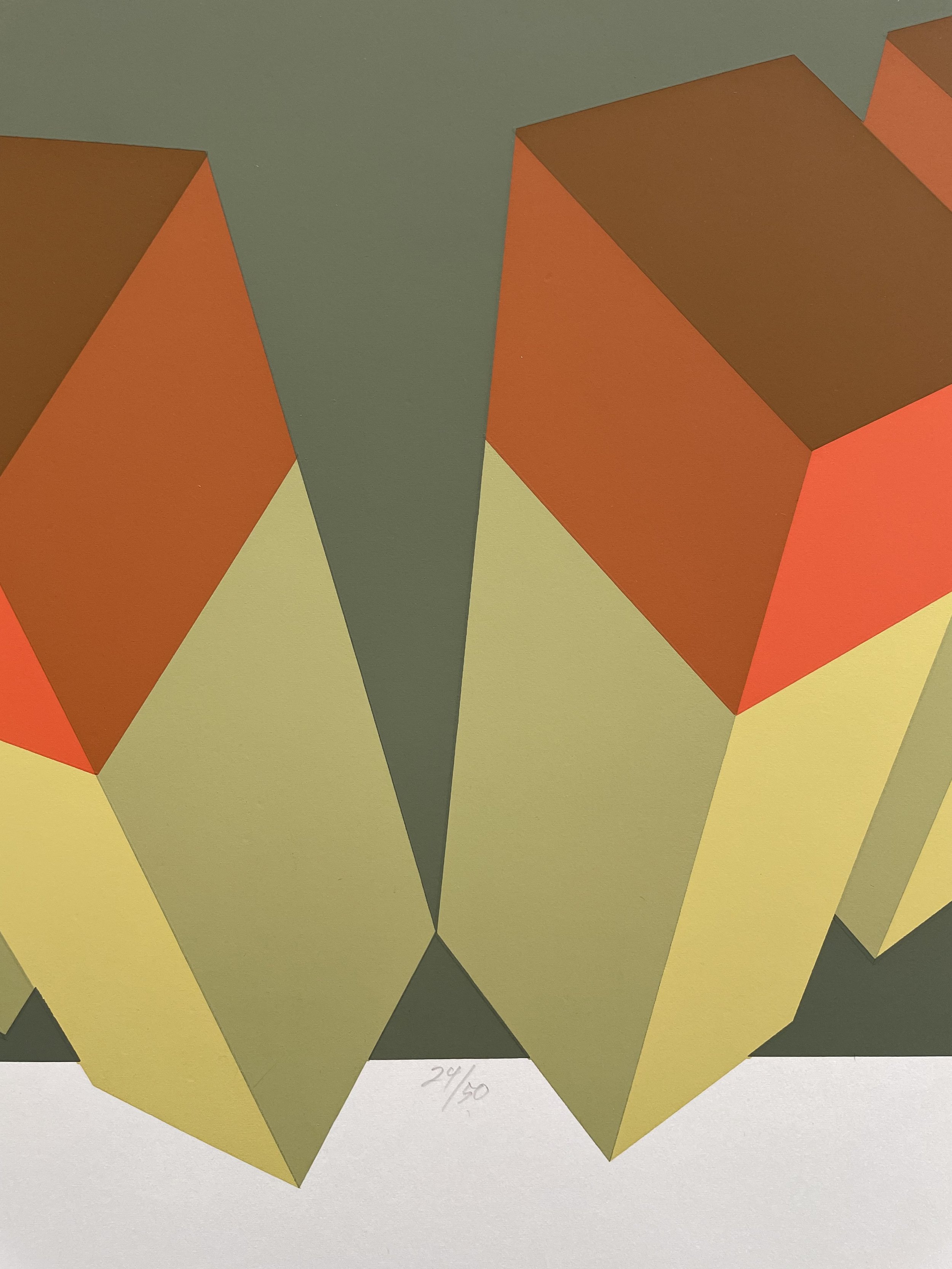
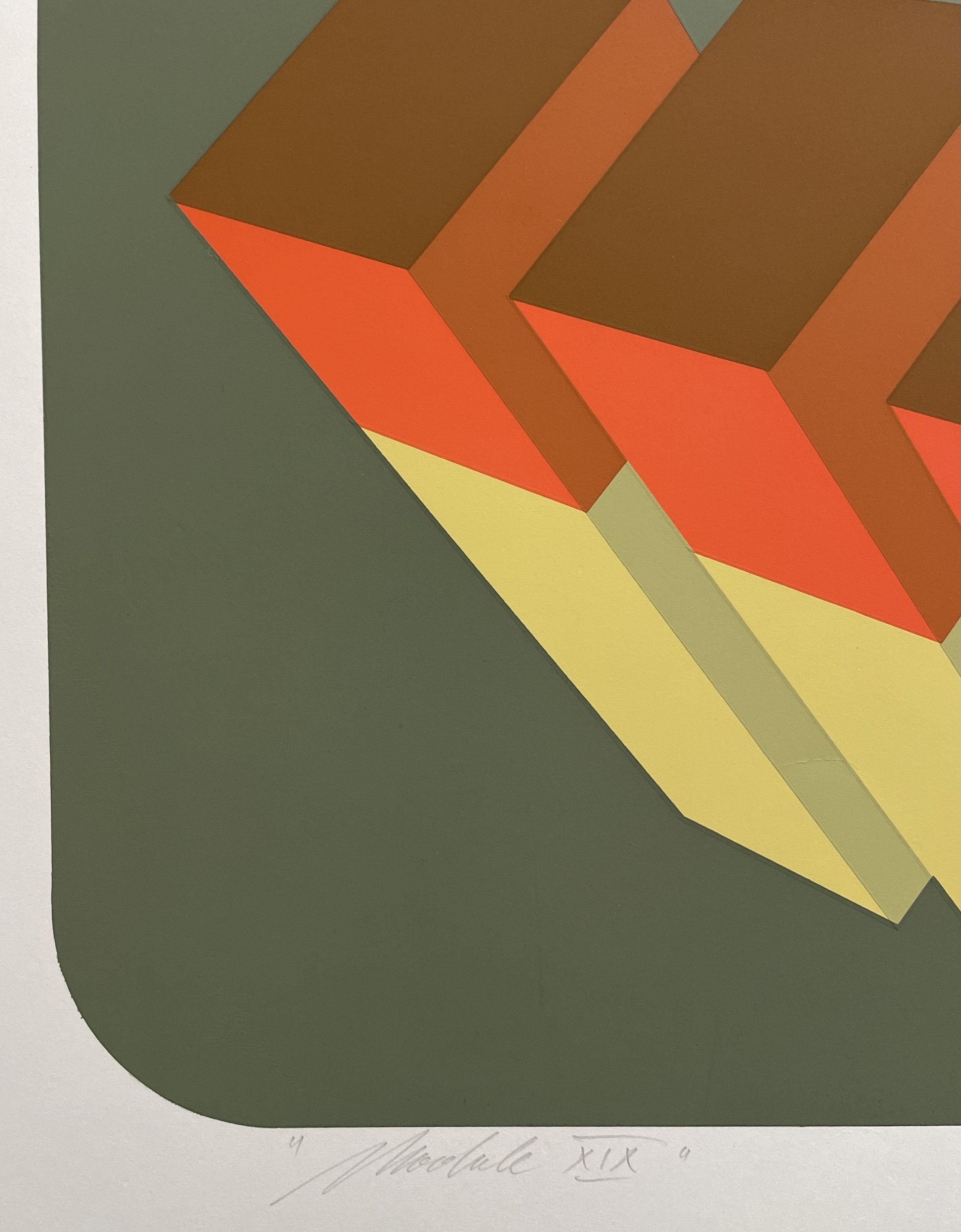
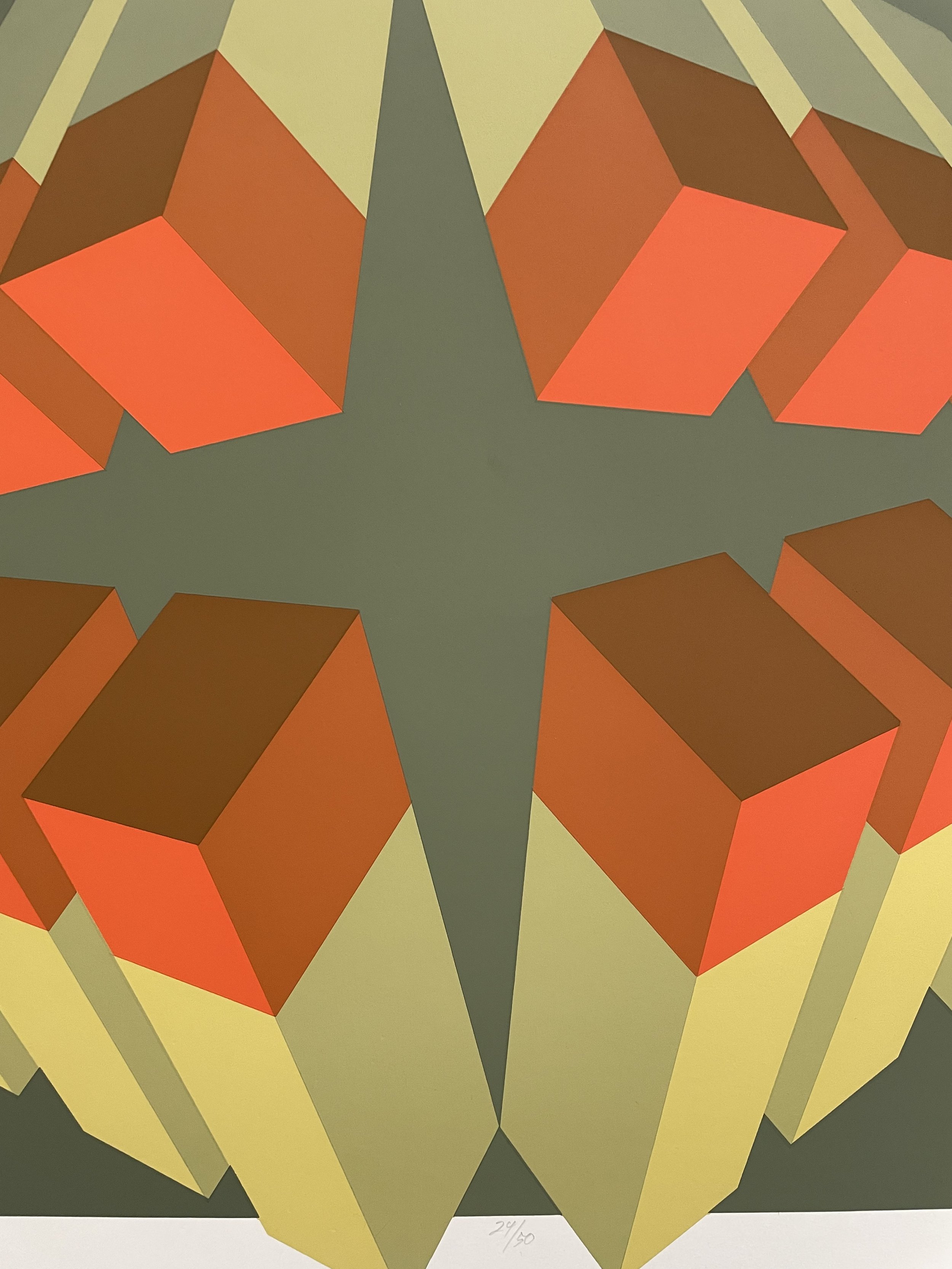
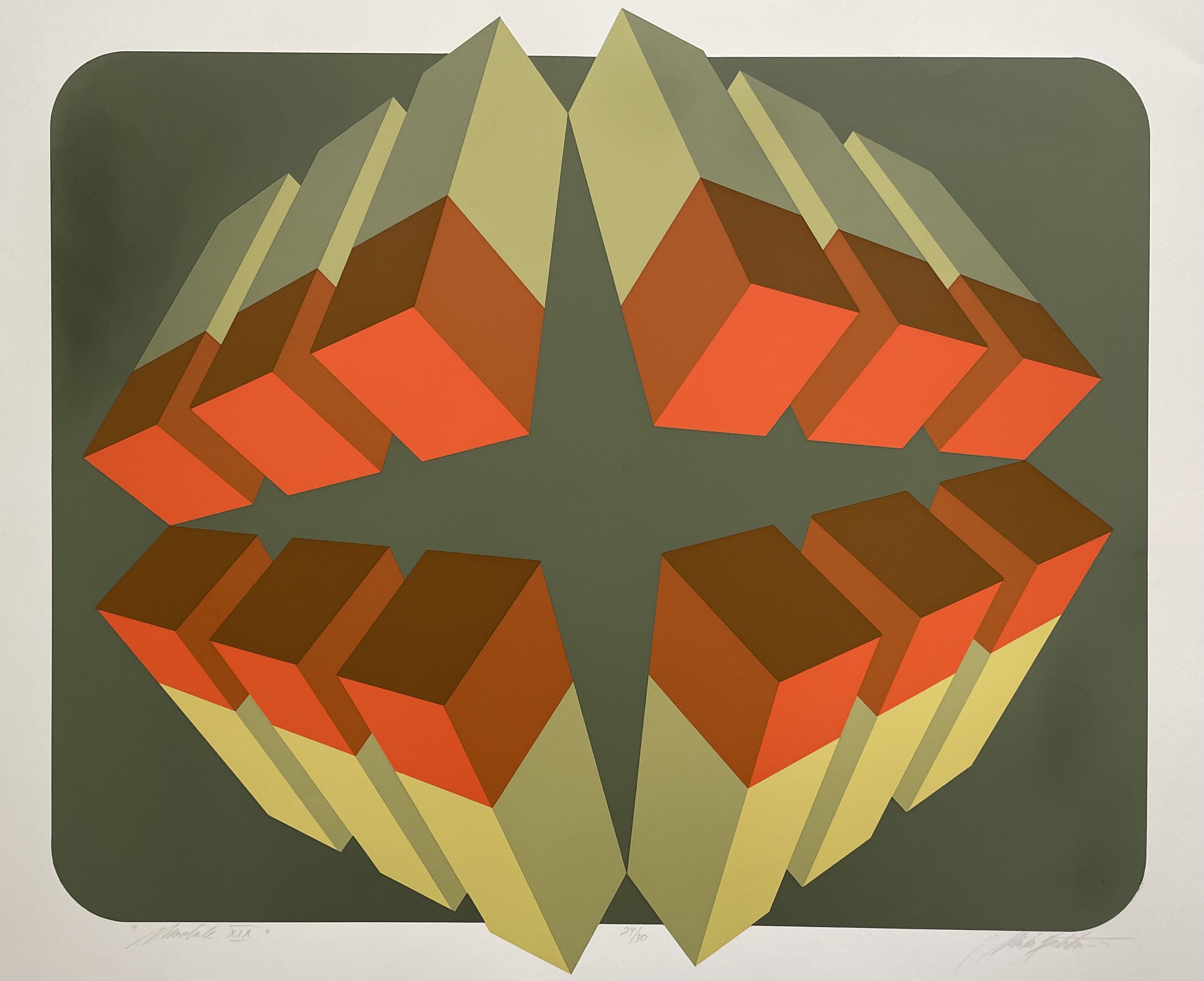
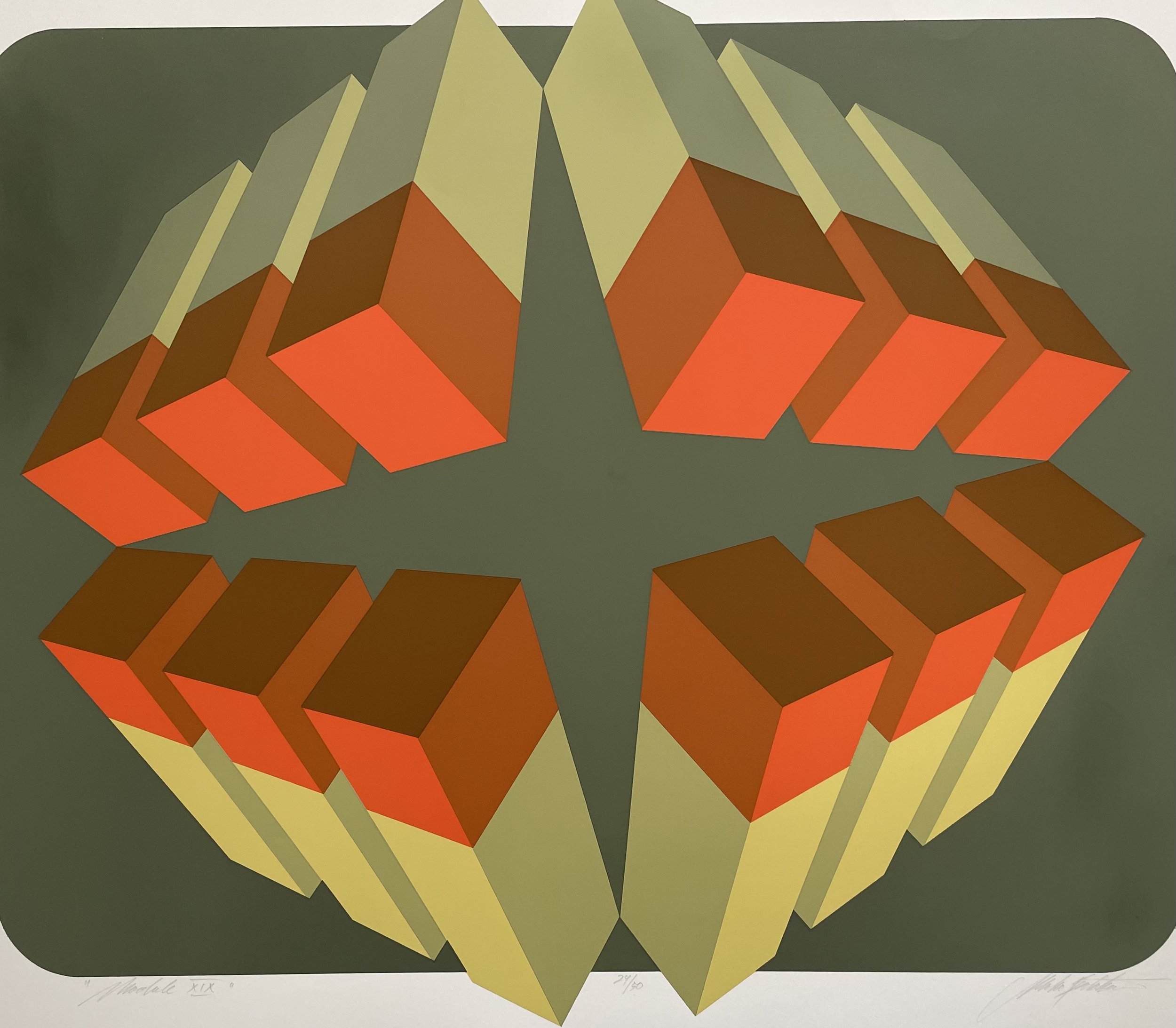
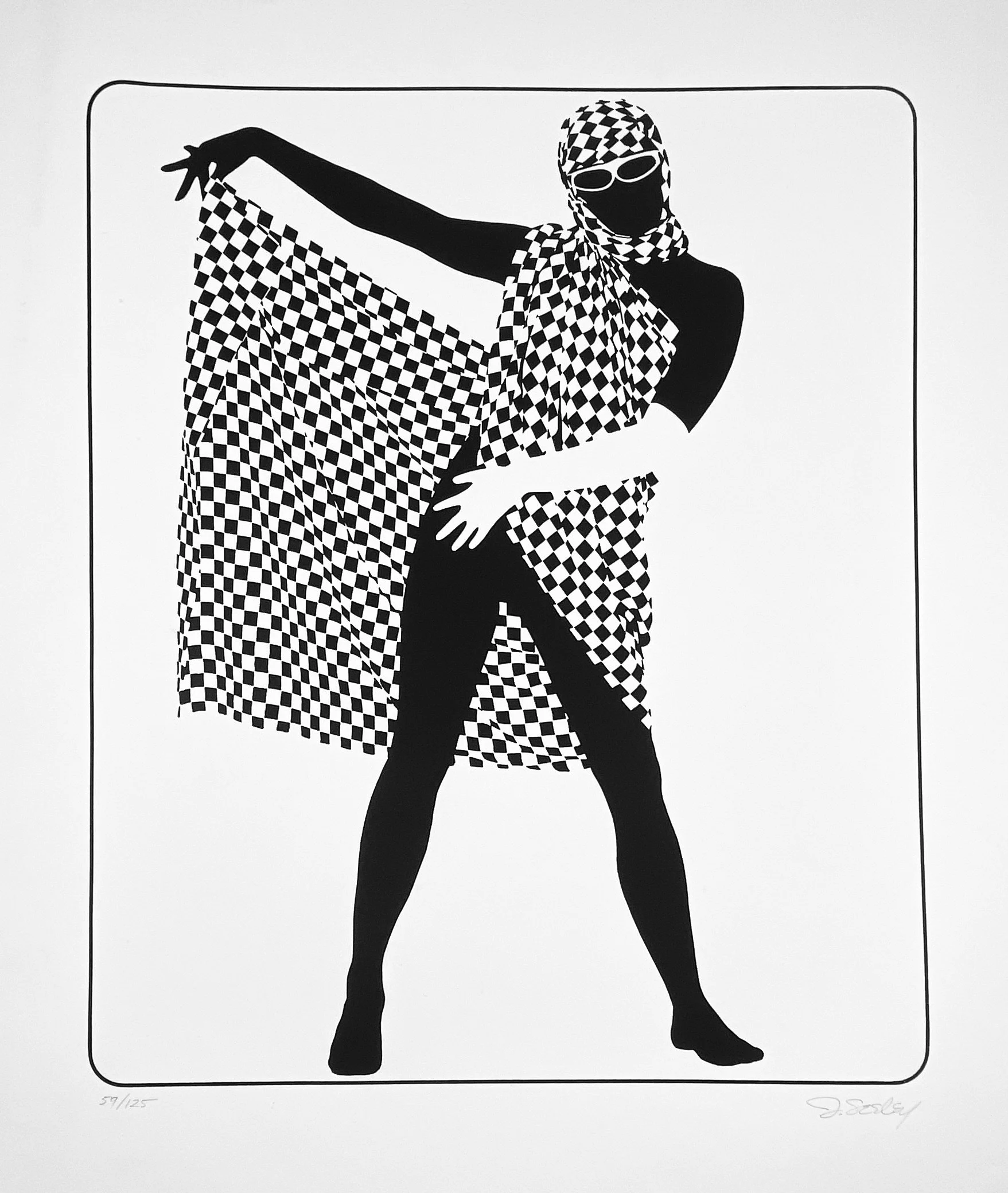
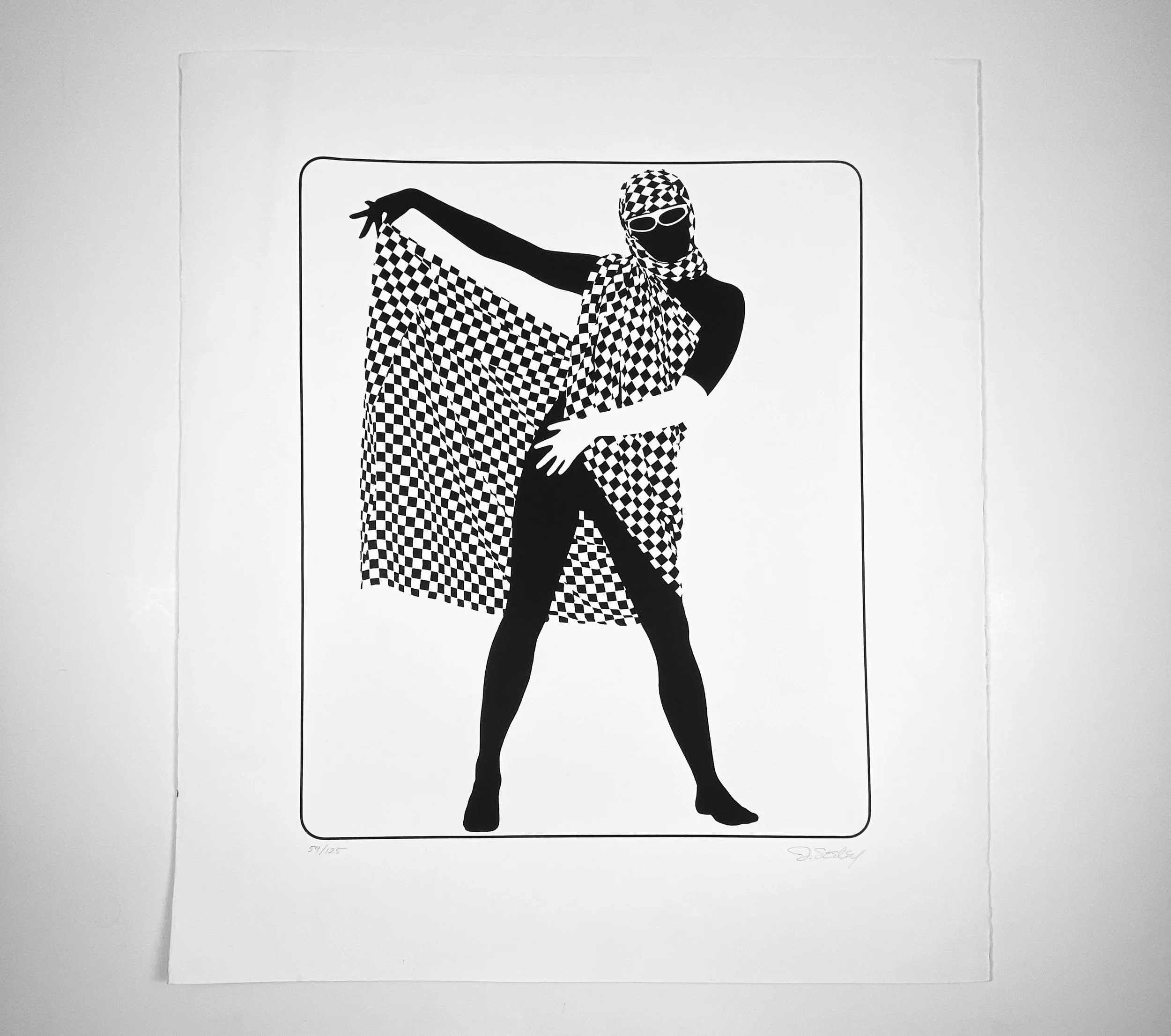
Untitled (Geometric Star), Mimo (active 1970s), c.1970s, silkscreen serigraph on prismatic vinyl, 24×24 in., signed “Mimo,” Artist’s Proof (A.P.).
Striking 1970s geometric serigraph by Mimo printed on prismatic vinyl, featuring layered star and square forms with op-art depth, signed artist’s proof from the Mitch Morse collection.
Artwork Description
This untitled geometric composition exemplifies the refined precision and visual vibrancy characteristic of Mimo’s work from the 1970s. Executed as a silkscreen serigraph on textured prismatic vinyl, the artwork employs a symmetrical star-like structure anchored by a central square, surrounded by layered angular and curvilinear forms.
The color palette—green, yellow, black, and white—interacts dynamically with the prismatic vinyl surface, which refracts light and creates a subtle optical shimmer. This material choice was central to Mimo’s practice, aligning the work with Op Art and Hard-Edge abstraction while pushing into a distinctly decorative-architectural realm favored by interior designers of the era.
The clean registration of colors, crisp edges, and deliberate spacing demonstrate a disciplined silkscreen process, while the prismatic substrate introduces a kinetic quality that shifts with ambient light and viewer movement. The work is signed “Mimo” in pencil and marked A.P., confirming it as an artist’s proof rather than a standard numbered edition.
Artist Biography — Mimo
Mimo is an enigmatic mid- to late-20th-century abstract artist active primarily during the 1970s, best known for bold geometric serigraphs printed on unconventional materials such as prismatic vinyl. Though biographical documentation is scarce—a not uncommon situation for artists working within commercial-gallery and design-forward contexts—Mimo’s work reflects a sophisticated engagement with international modernist movements.
Stylistically, Mimo’s compositions align with Op Art, Hard-Edge abstraction, and post-Bauhaus geometric modernism, drawing visual parallels to artists such as Victor Vasarely, Josef Albers, and Richard Anuszkiewicz. The emphasis on symmetry, optical vibration, and color interaction suggests familiarity with European abstraction as well as the American West Coast and New York design scenes of the late 1960s and 1970s.
Mimo’s repeated use of prismatic vinyl places the artist squarely within a short but significant period when artists experimented with industrial and synthetic substrates, blurring the boundaries between fine art, architecture, and interior design. These works were particularly favored by architects, corporate collectors, and modernist interiors, where reflective surfaces amplified spatial light and form.
The artist’s works were distributed through established American galleries, including Mitch Morse Gallery, which was known for championing innovative printmakers and material experimentation. Mimo’s prints were often issued in limited editions, with artist’s proofs reserved for galleries or close collaborators, underscoring their desirability.
Despite the limited public record, Mimo’s consistent visual language—precise geometry, luminous color, and experimental surfaces—establishes a clear artistic identity and positions the work firmly within the collectible canon of 1970s American geometric abstraction.
Mimo (active 1970s), Untitled (Geometric Star), silkscreen serigraph on prismatic vinyl, artist’s proof, signed, 24 × 24 inches. From the Mitch Morse Gallery collection.
Certificate of Value & Authentication
This artwork is an original silkscreen serigraph on prismatic vinyl by Mimo, created circa the 1970s. It is hand-signed by the artist and designated Artist’s Proof (A.P.), confirming its authenticity and status outside the numbered edition. Based on medium, period, condition, and market comparisons, this work is certified as an authentic example of 1970s geometric abstraction.
Provenance
Mimo
→ Mitch Morse Gallery, New York, USA
→ Acquired through Mitch Morse Gallery (NYC / Europe)
→ Artfind Gallery, Washington, DC (current owner)
Untitled (Geometric Star), Mimo (active 1970s), c.1970s, silkscreen serigraph on prismatic vinyl, 24×24 in., signed “Mimo,” Artist’s Proof (A.P.).
Striking 1970s geometric serigraph by Mimo printed on prismatic vinyl, featuring layered star and square forms with op-art depth, signed artist’s proof from the Mitch Morse collection.
Artwork Description
This untitled geometric composition exemplifies the refined precision and visual vibrancy characteristic of Mimo’s work from the 1970s. Executed as a silkscreen serigraph on textured prismatic vinyl, the artwork employs a symmetrical star-like structure anchored by a central square, surrounded by layered angular and curvilinear forms.
The color palette—green, yellow, black, and white—interacts dynamically with the prismatic vinyl surface, which refracts light and creates a subtle optical shimmer. This material choice was central to Mimo’s practice, aligning the work with Op Art and Hard-Edge abstraction while pushing into a distinctly decorative-architectural realm favored by interior designers of the era.
The clean registration of colors, crisp edges, and deliberate spacing demonstrate a disciplined silkscreen process, while the prismatic substrate introduces a kinetic quality that shifts with ambient light and viewer movement. The work is signed “Mimo” in pencil and marked A.P., confirming it as an artist’s proof rather than a standard numbered edition.
Artist Biography — Mimo
Mimo is an enigmatic mid- to late-20th-century abstract artist active primarily during the 1970s, best known for bold geometric serigraphs printed on unconventional materials such as prismatic vinyl. Though biographical documentation is scarce—a not uncommon situation for artists working within commercial-gallery and design-forward contexts—Mimo’s work reflects a sophisticated engagement with international modernist movements.
Stylistically, Mimo’s compositions align with Op Art, Hard-Edge abstraction, and post-Bauhaus geometric modernism, drawing visual parallels to artists such as Victor Vasarely, Josef Albers, and Richard Anuszkiewicz. The emphasis on symmetry, optical vibration, and color interaction suggests familiarity with European abstraction as well as the American West Coast and New York design scenes of the late 1960s and 1970s.
Mimo’s repeated use of prismatic vinyl places the artist squarely within a short but significant period when artists experimented with industrial and synthetic substrates, blurring the boundaries between fine art, architecture, and interior design. These works were particularly favored by architects, corporate collectors, and modernist interiors, where reflective surfaces amplified spatial light and form.
The artist’s works were distributed through established American galleries, including Mitch Morse Gallery, which was known for championing innovative printmakers and material experimentation. Mimo’s prints were often issued in limited editions, with artist’s proofs reserved for galleries or close collaborators, underscoring their desirability.
Despite the limited public record, Mimo’s consistent visual language—precise geometry, luminous color, and experimental surfaces—establishes a clear artistic identity and positions the work firmly within the collectible canon of 1970s American geometric abstraction.
Mimo (active 1970s), Untitled (Geometric Star), silkscreen serigraph on prismatic vinyl, artist’s proof, signed, 24 × 24 inches. From the Mitch Morse Gallery collection.
Certificate of Value & Authentication
This artwork is an original silkscreen serigraph on prismatic vinyl by Mimo, created circa the 1970s. It is hand-signed by the artist and designated Artist’s Proof (A.P.), confirming its authenticity and status outside the numbered edition. Based on medium, period, condition, and market comparisons, this work is certified as an authentic example of 1970s geometric abstraction.
Provenance
Mimo
→ Mitch Morse Gallery, New York, USA
→ Acquired through Mitch Morse Gallery (NYC / Europe)
→ Artfind Gallery, Washington, DC (current owner)
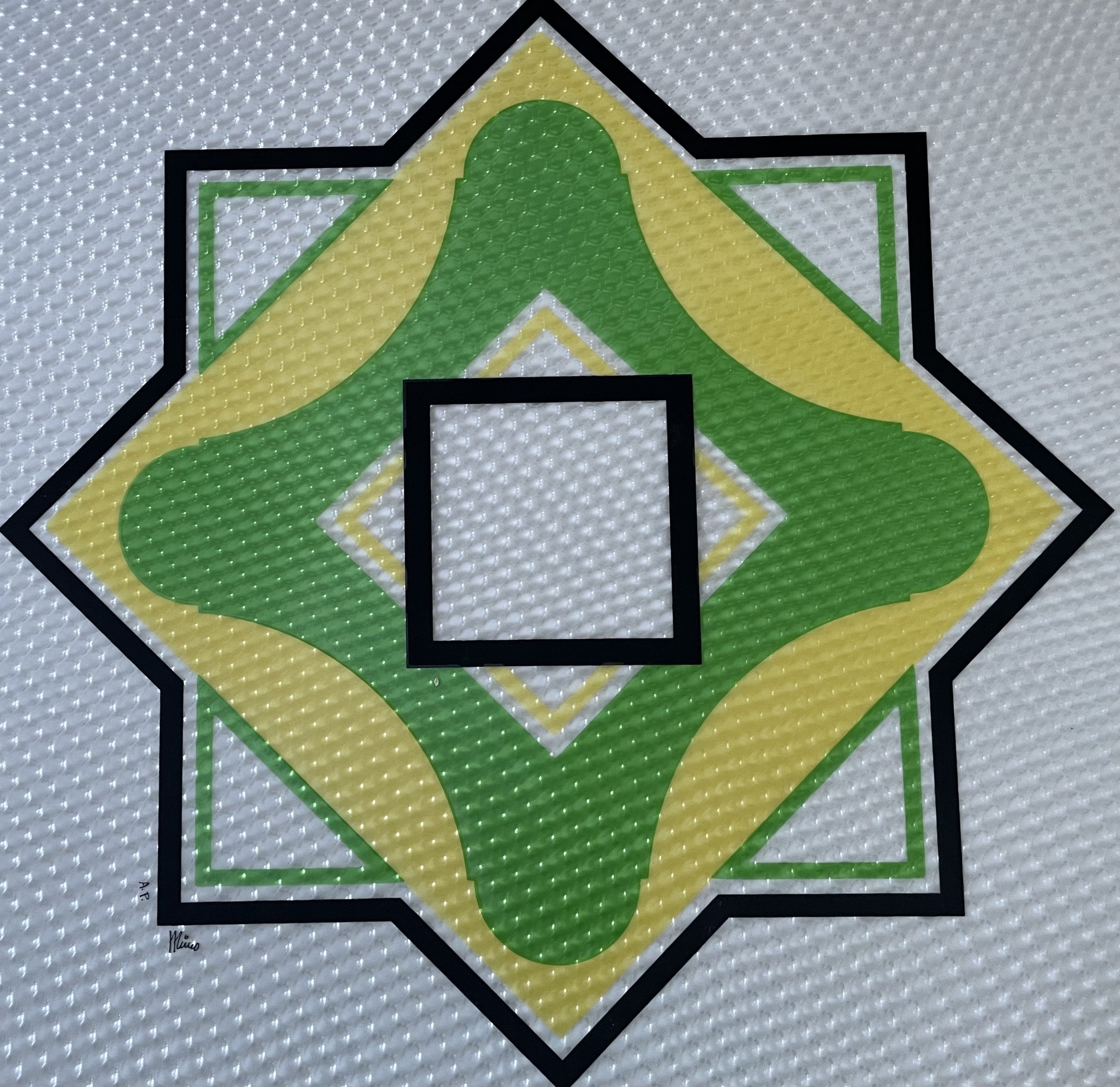 Image 1 of 7
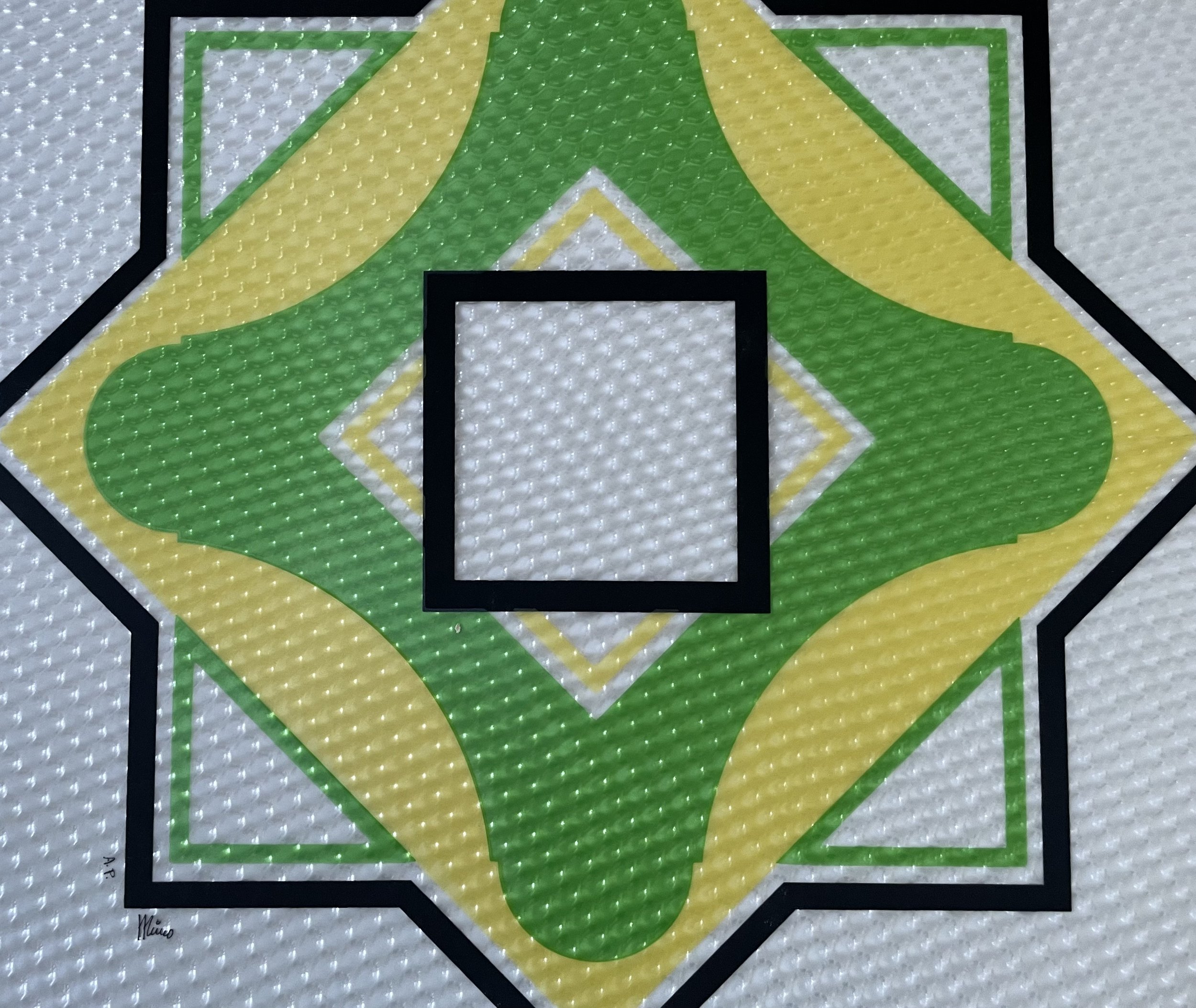 Image 2 of 7
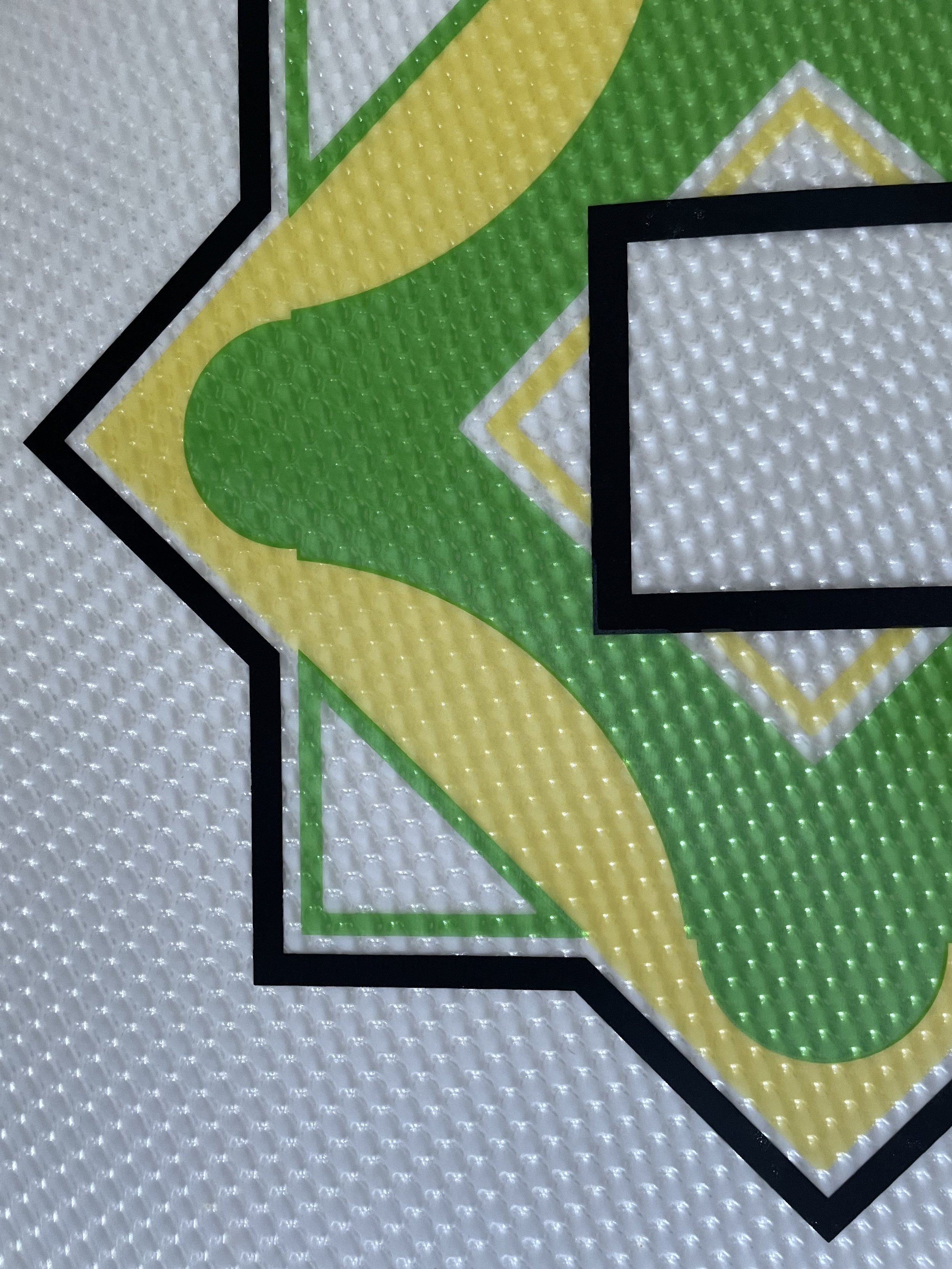 Image 3 of 7
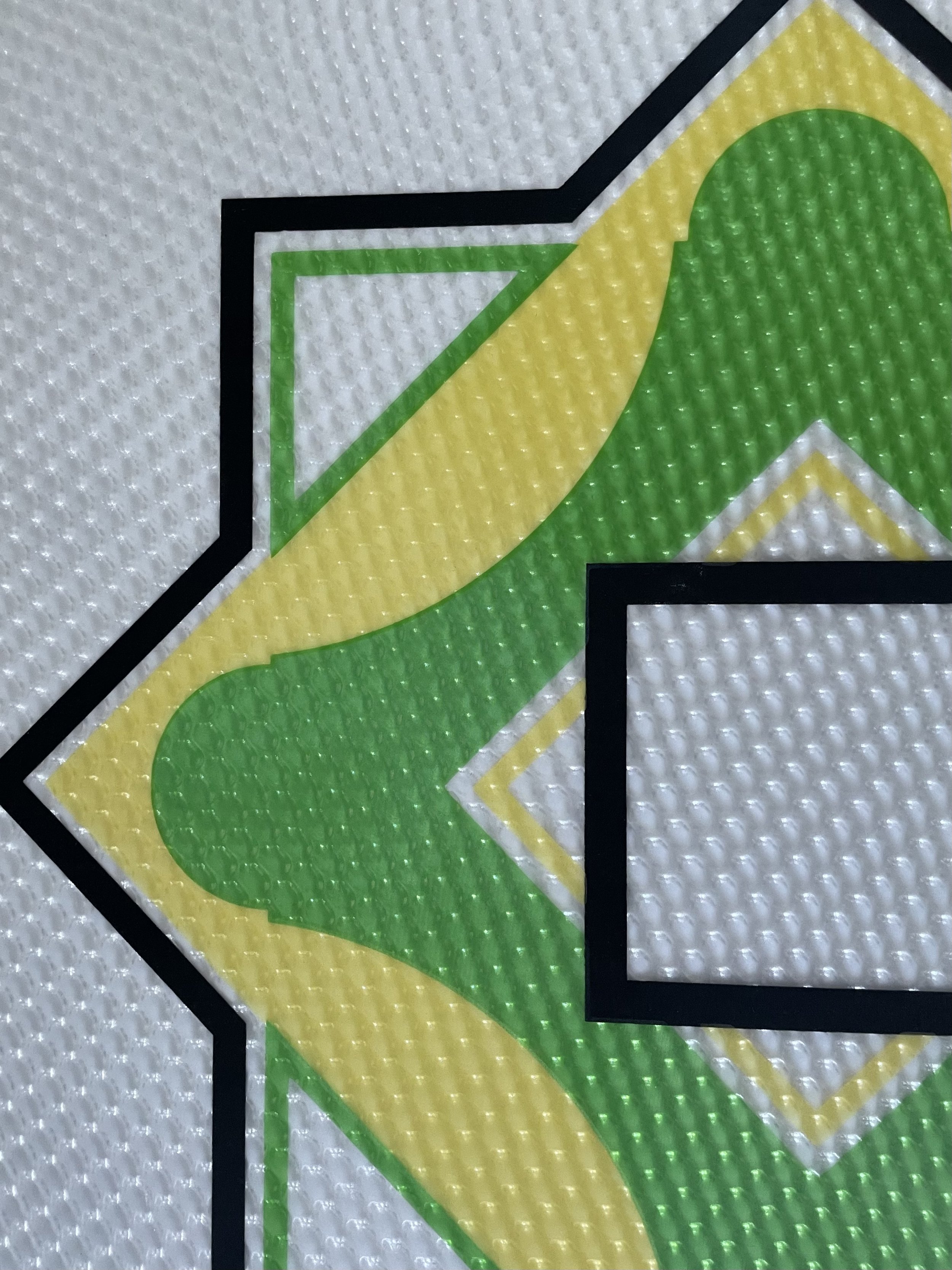 Image 4 of 7
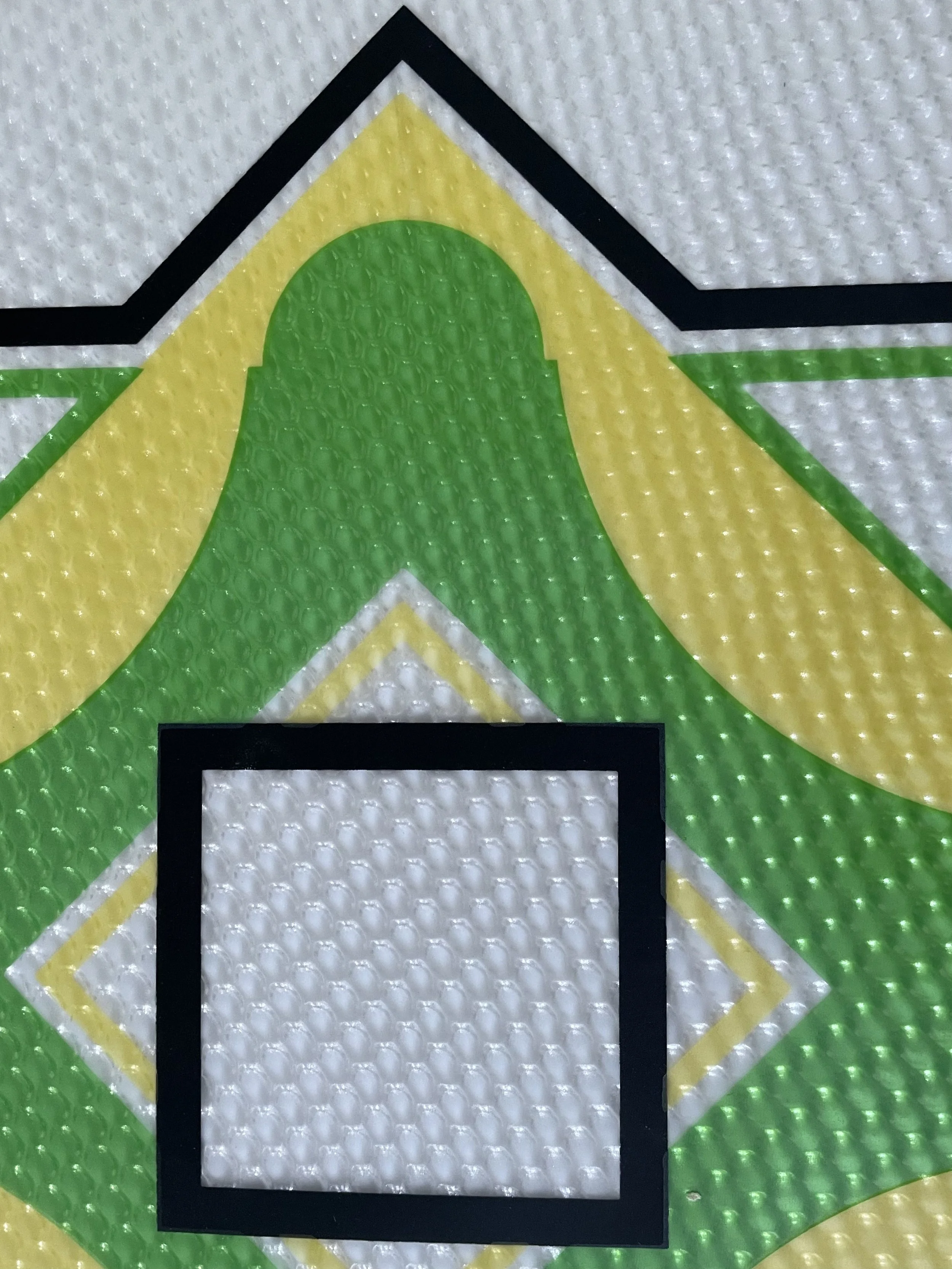 Image 5 of 7
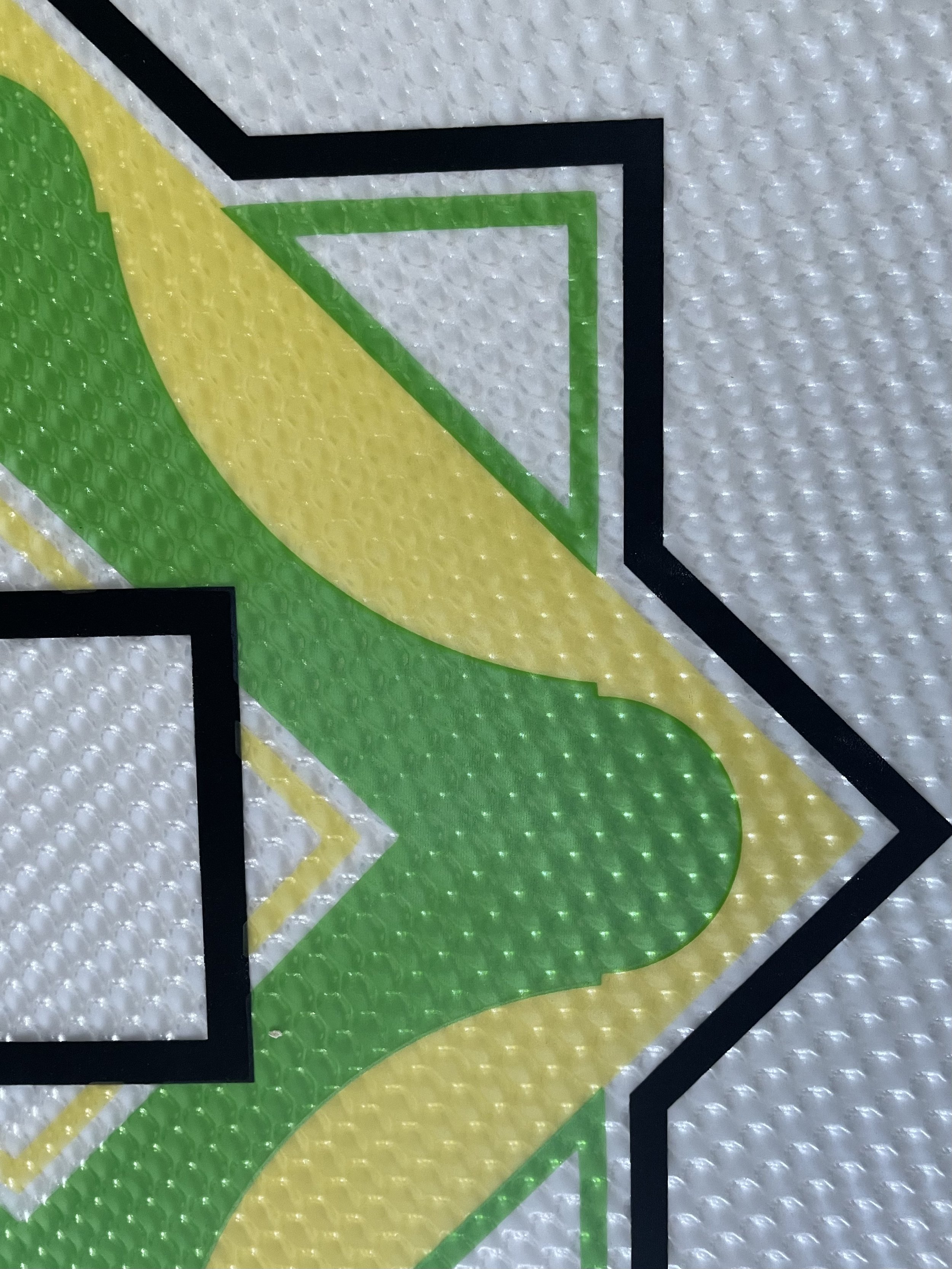 Image 6 of 7
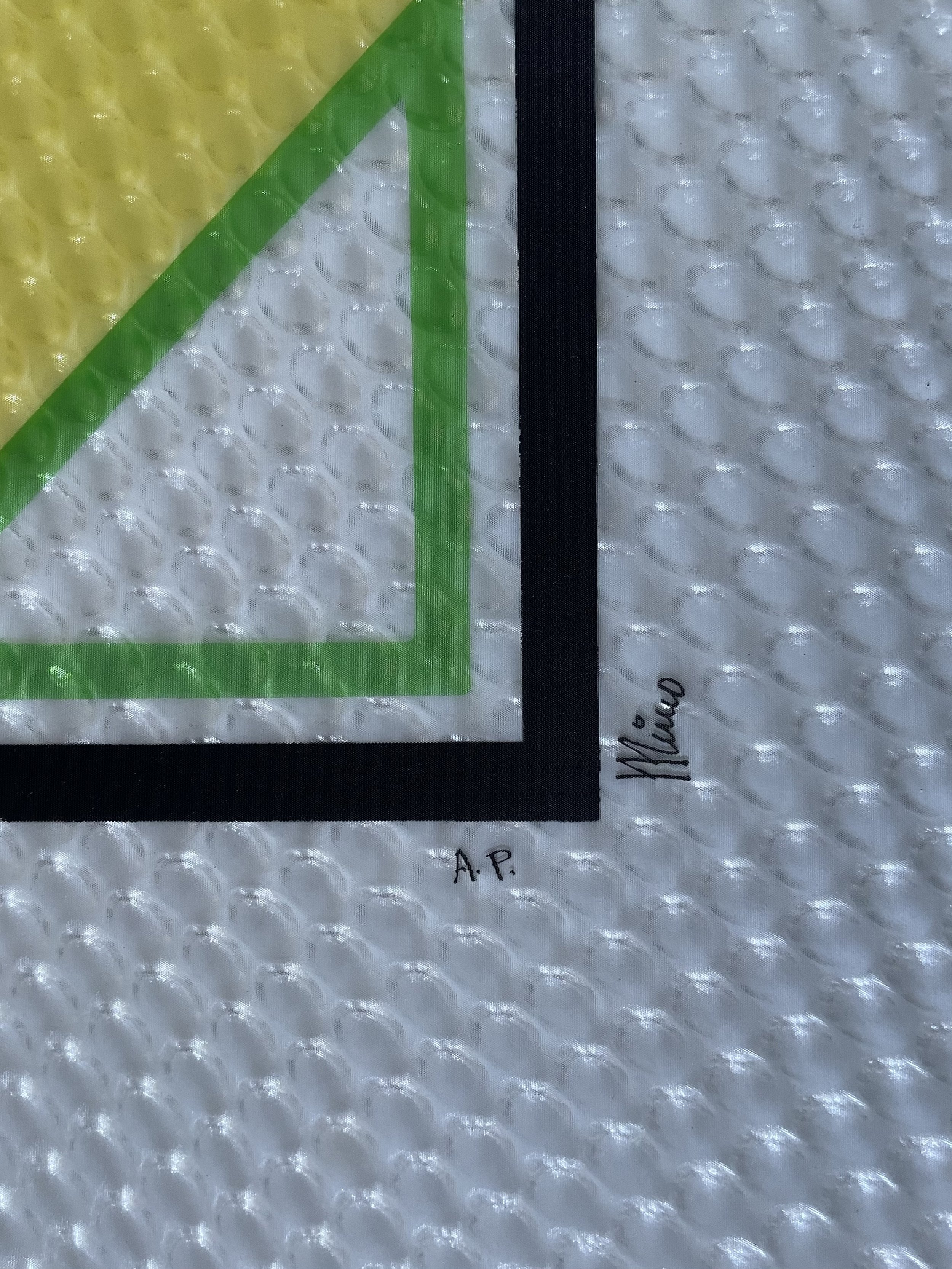 Image 7 of 7