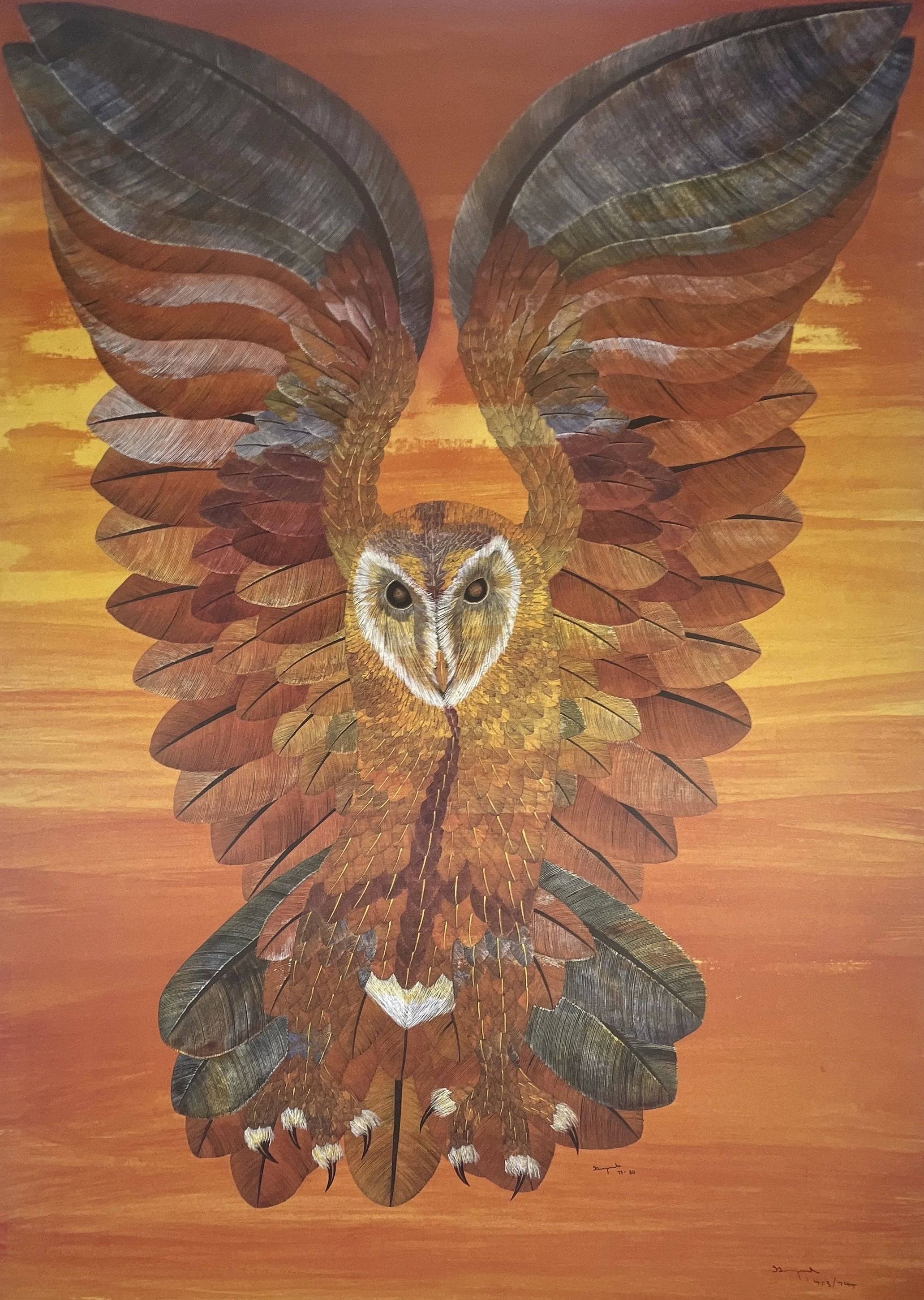
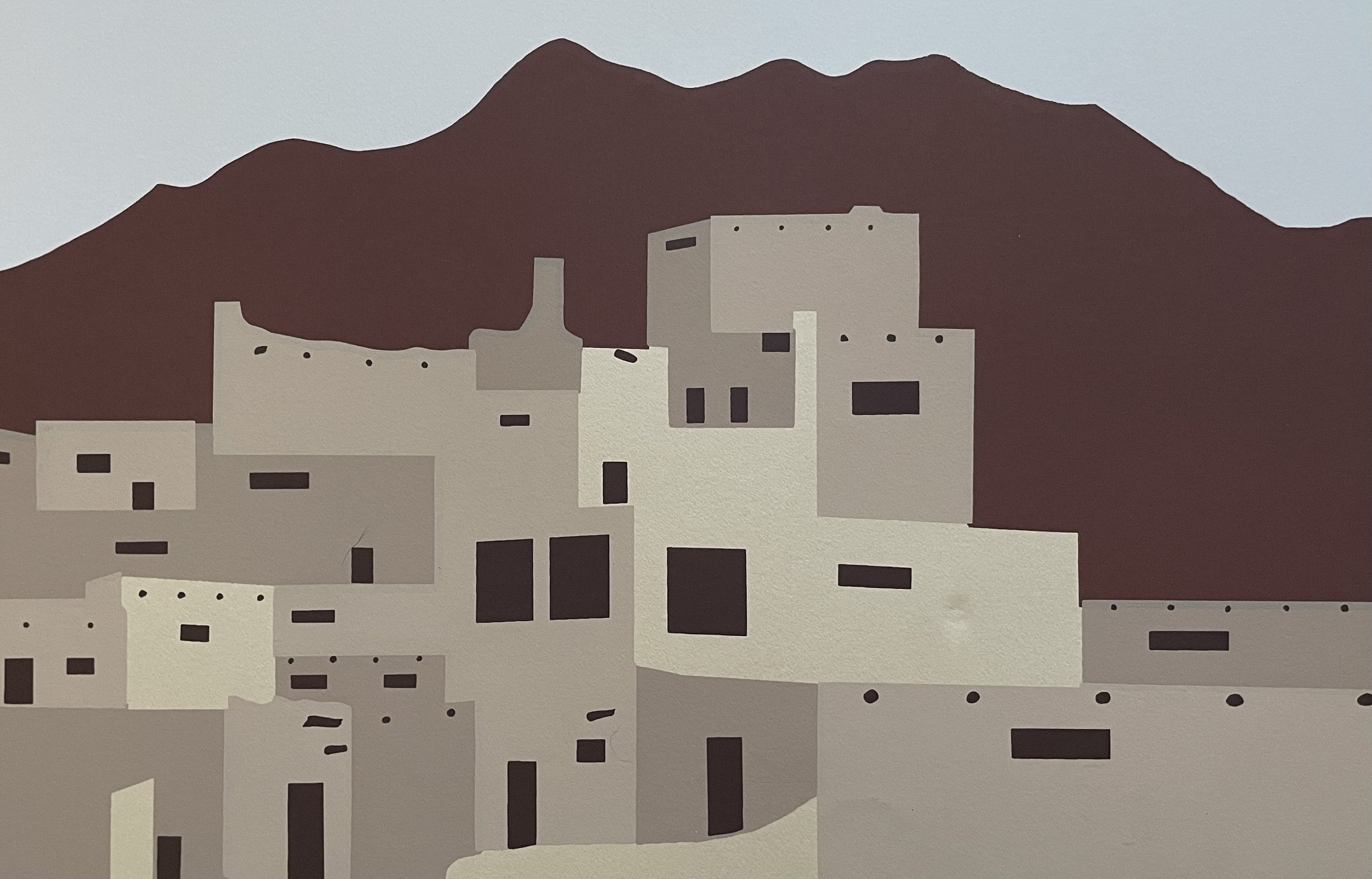
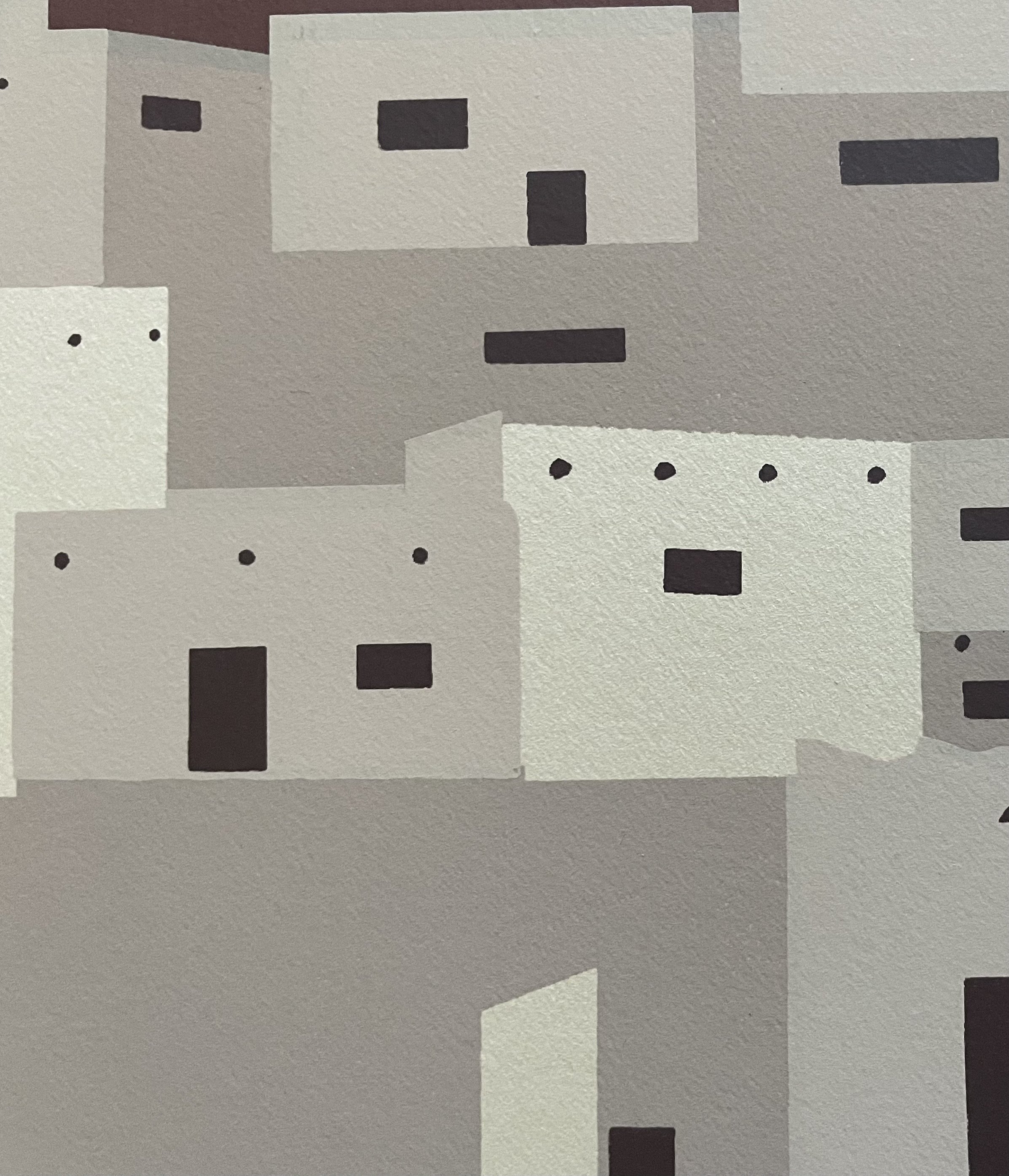
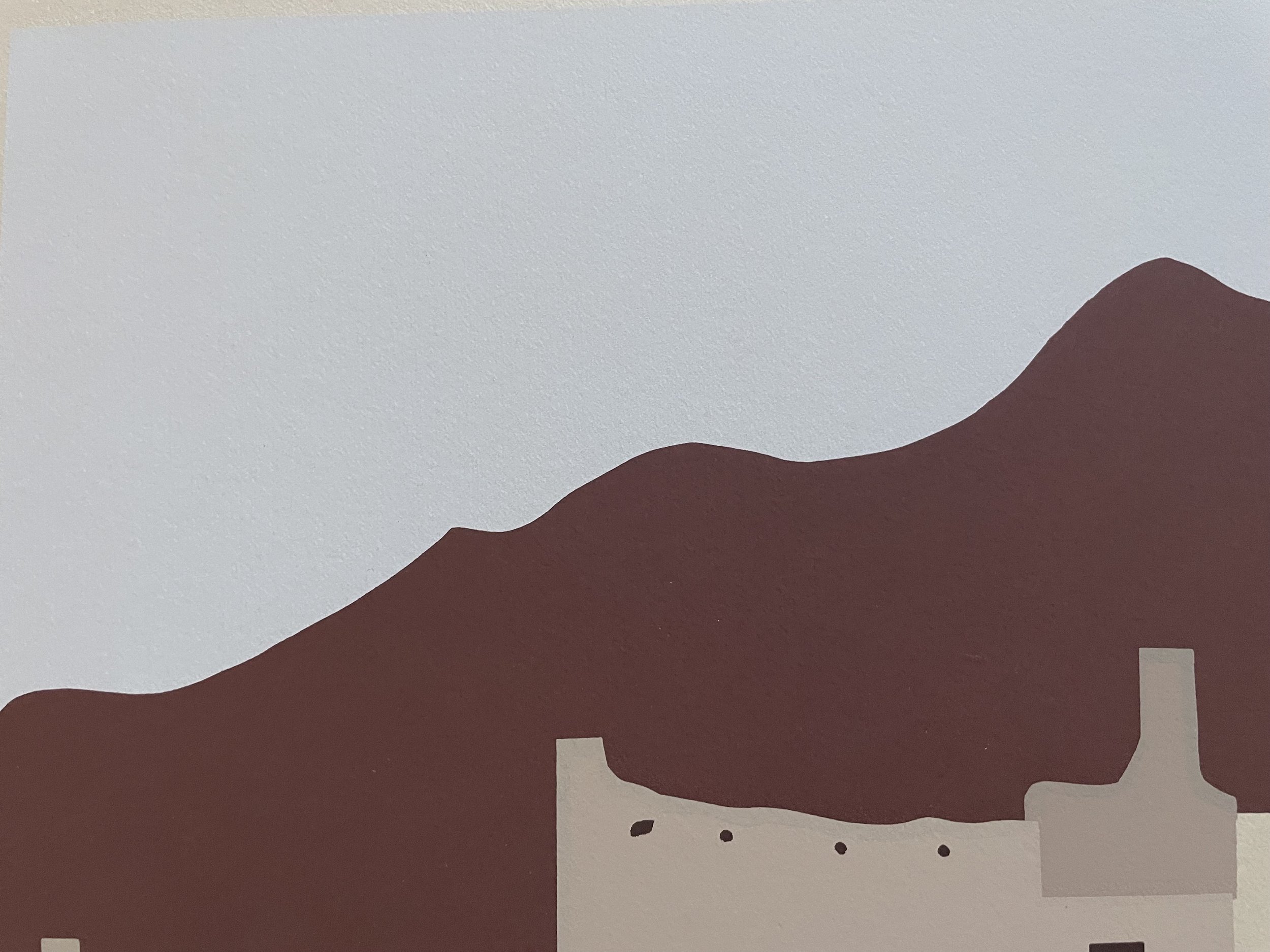
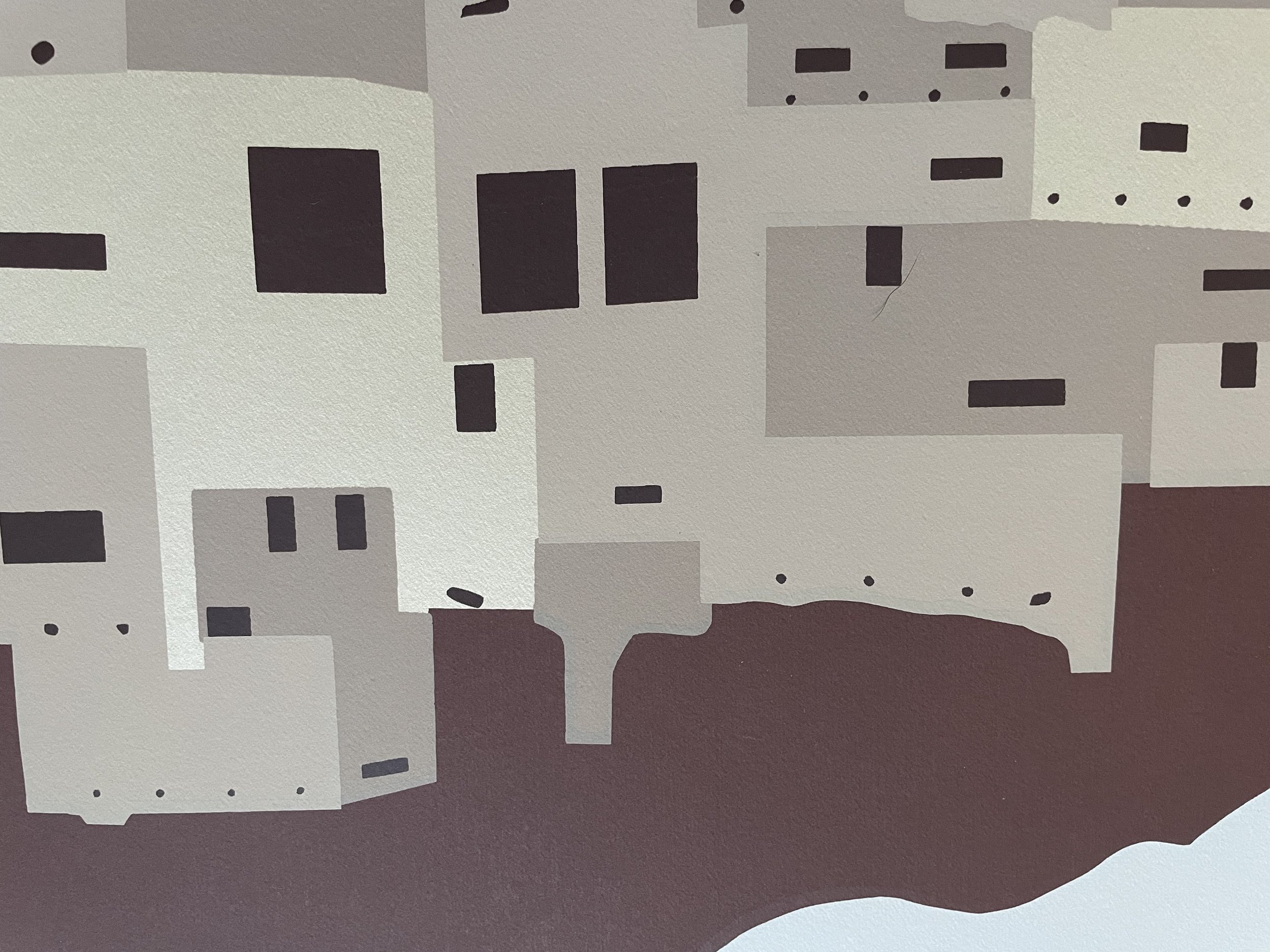
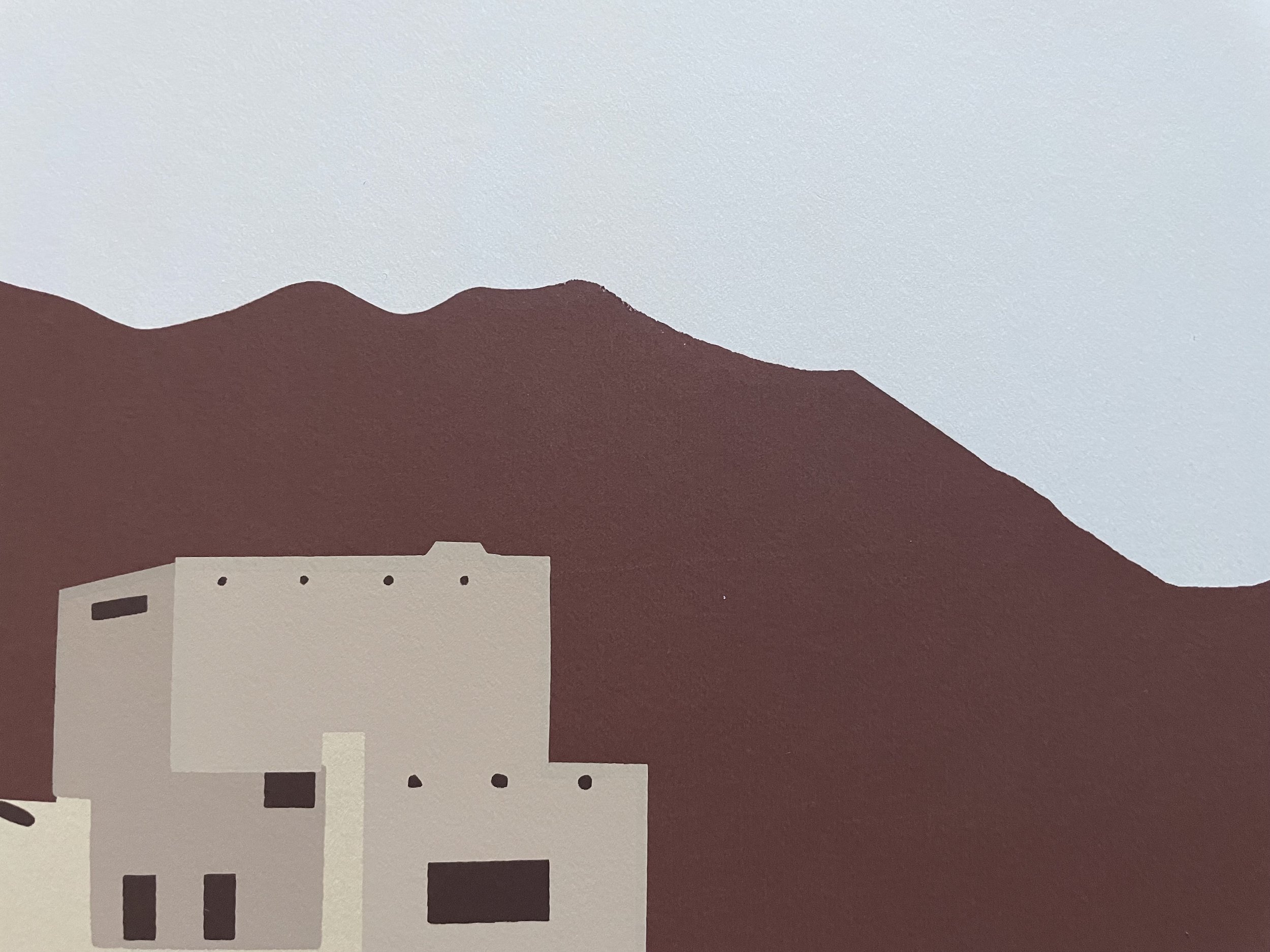
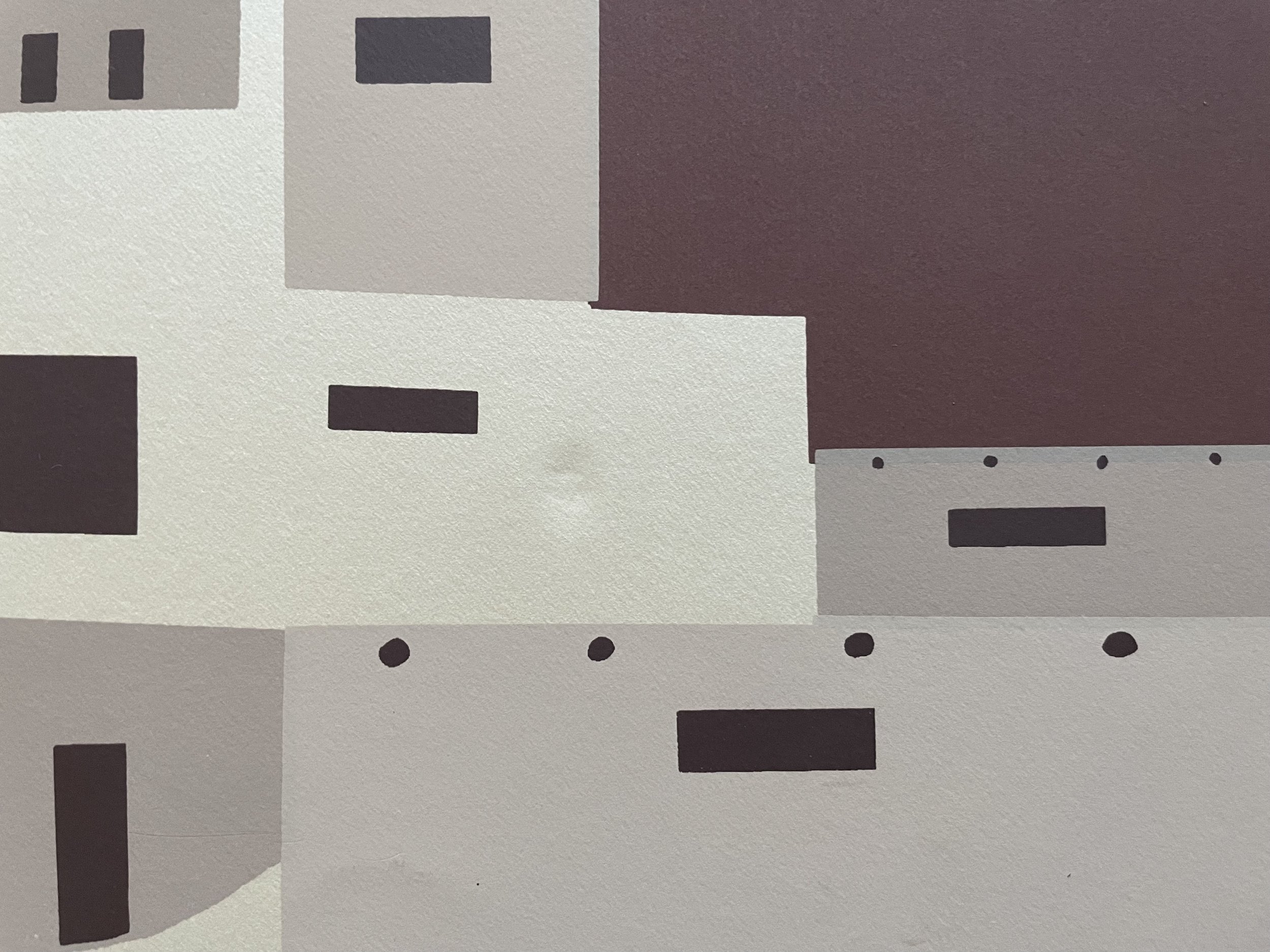
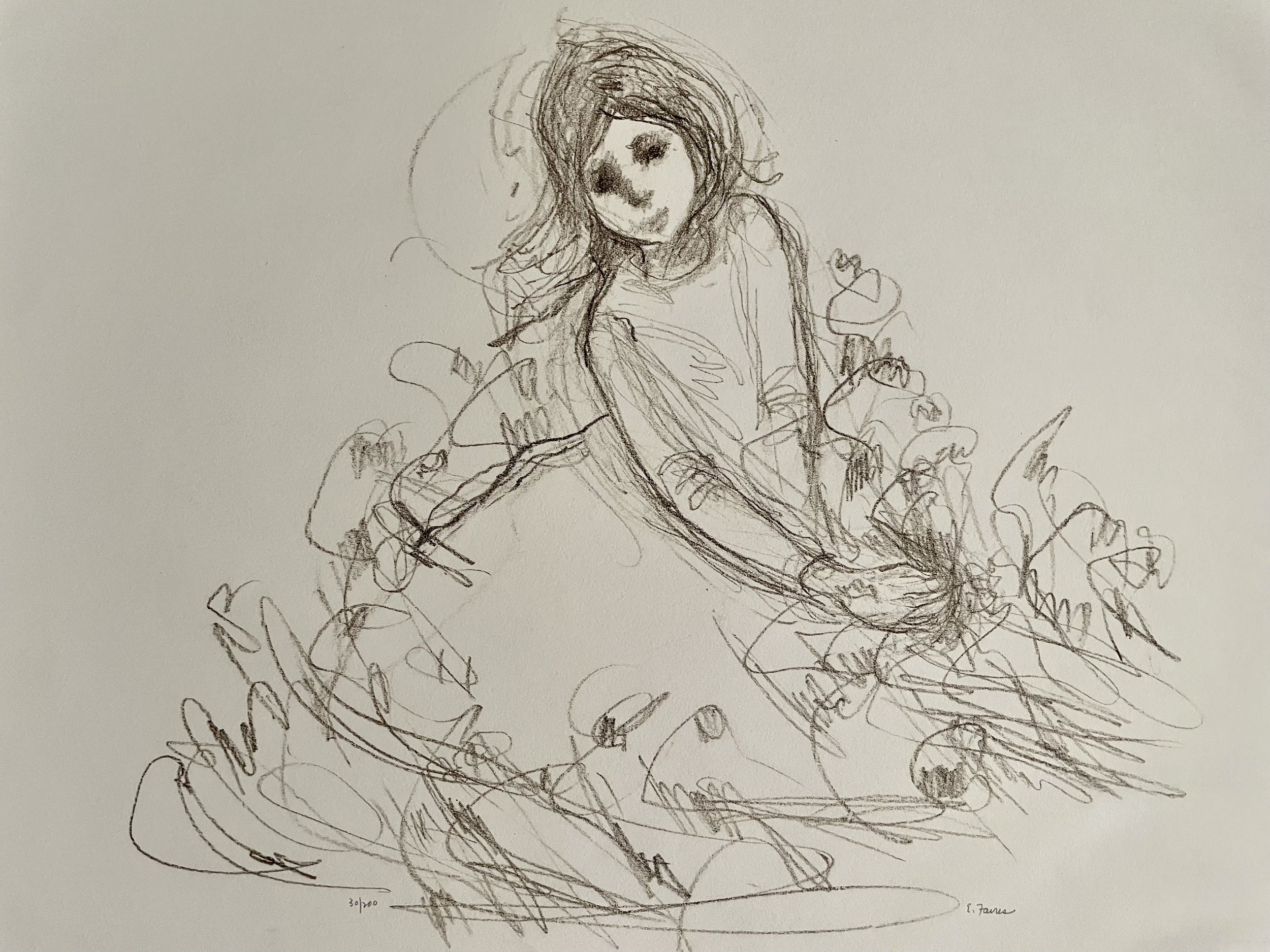
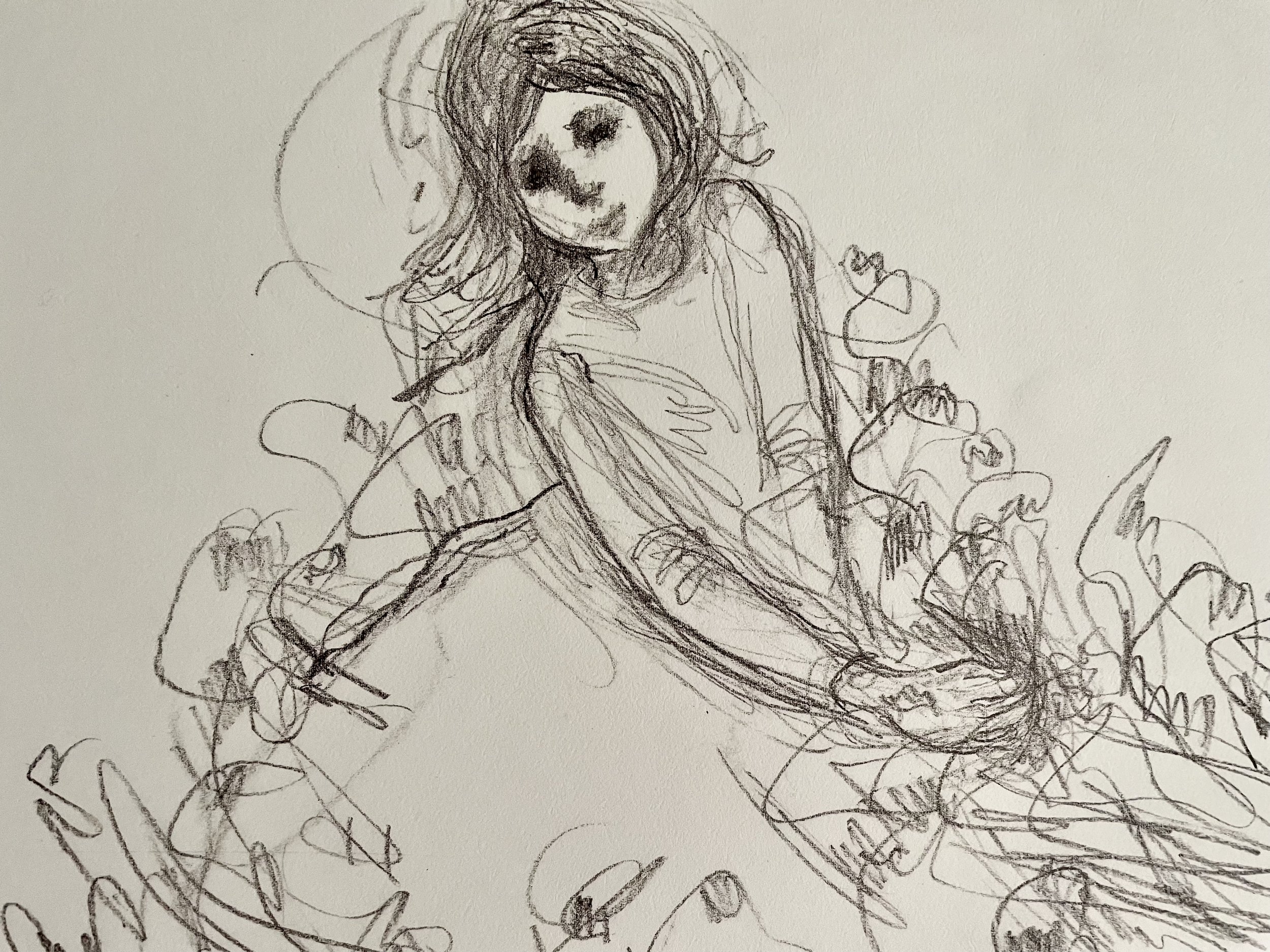
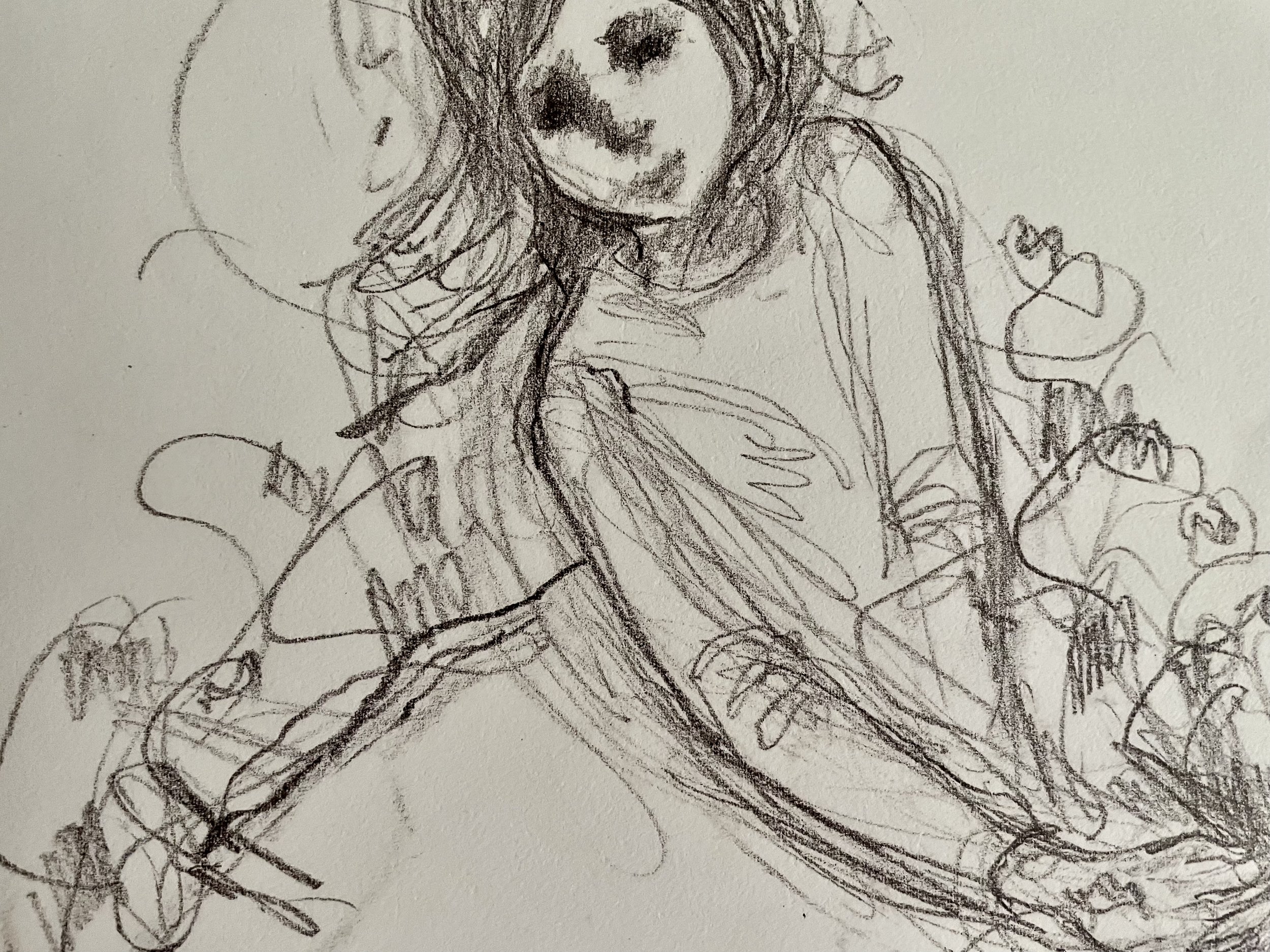
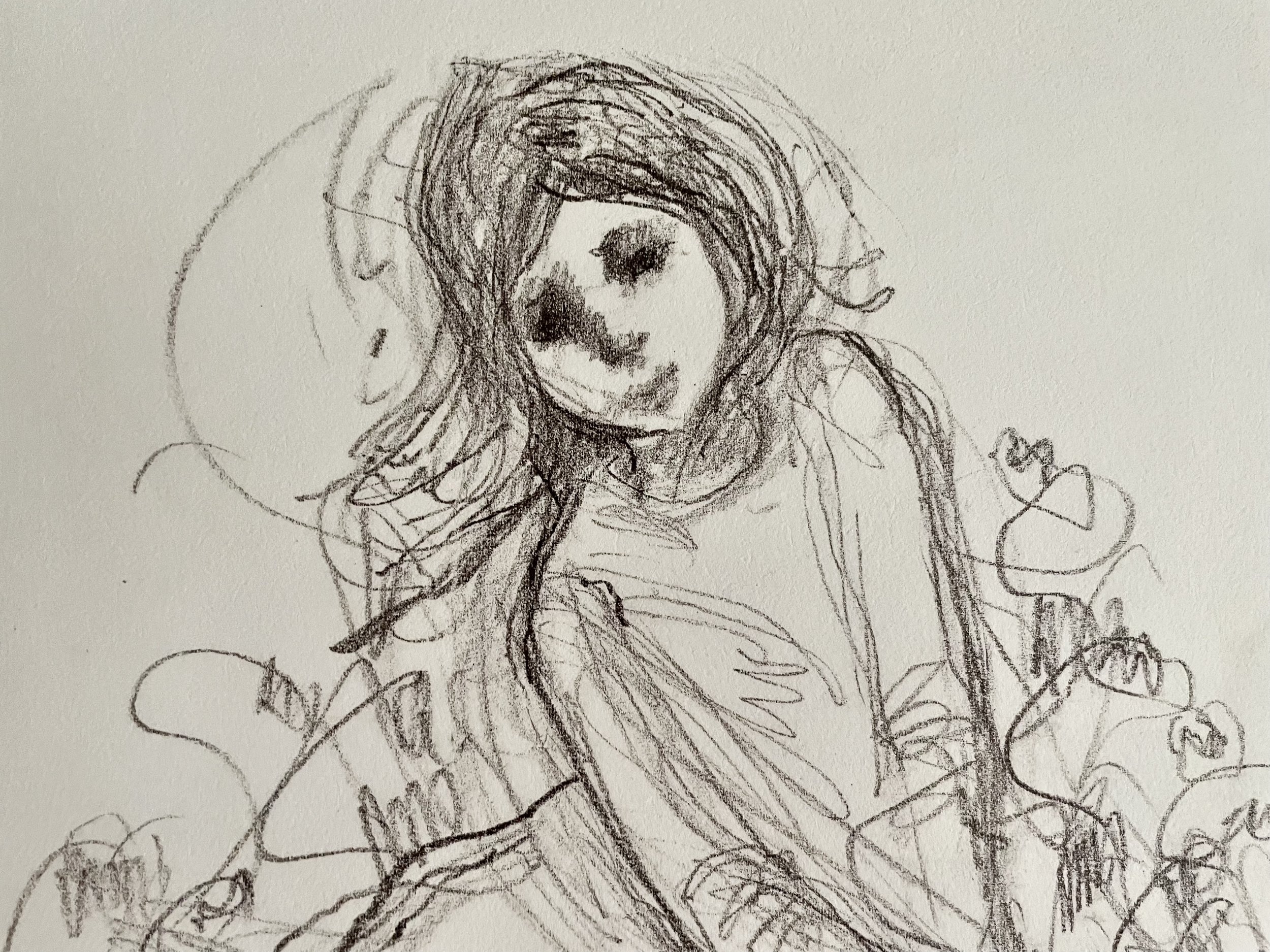
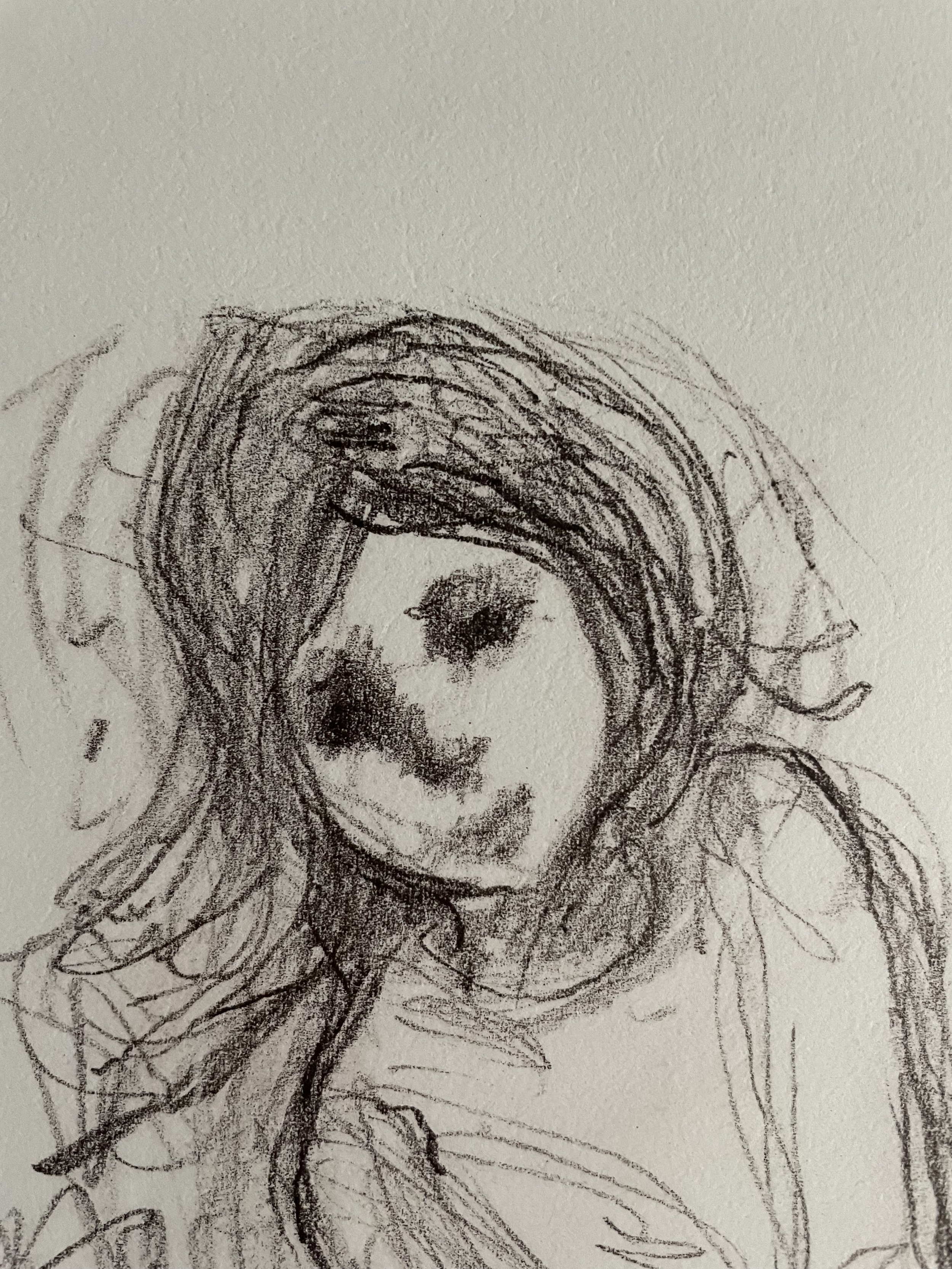
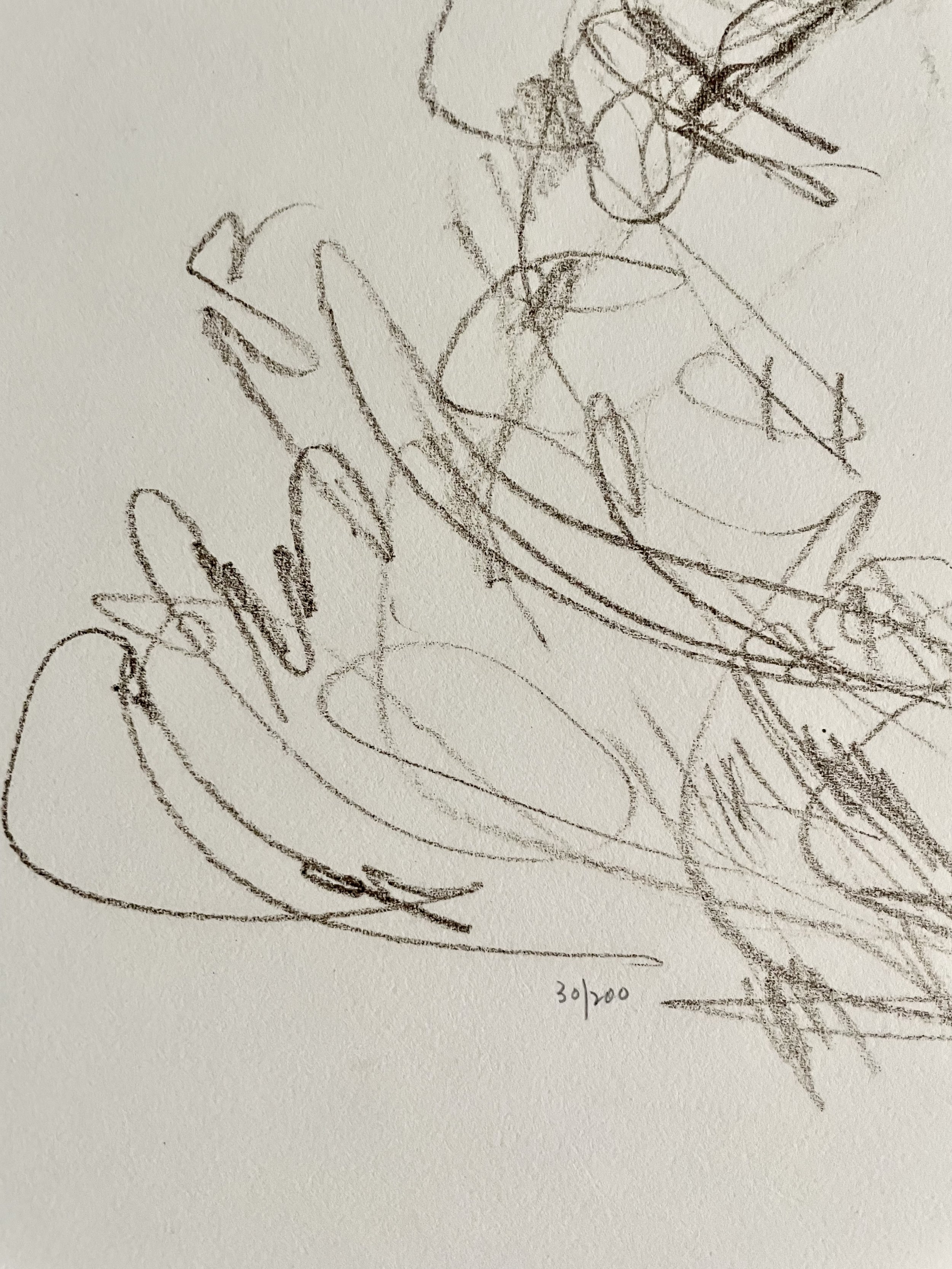
“French Countryside Landscape,” Jean-Pierre Tertre (French, b.1927), 1970s color lithograph, 20×26 in, pencil-signed, edition 139/275.
“French Countryside Landscape” by French printmaker Jean-Pierre Tertre is a 1970s signed, limited-edition color lithograph (139/275, 20×26 in) depicting a tranquil rural village framed by a dramatic leafless tree. Tertre’s refined linework, earthy greens and ochres, and elegant mid-century design sensibility make this an ideal piece for collectors of French landscape art, modern lithography, and vintage European prints with strong provenance from a retired Manhattan gallery via Mitch Morse Gallery to Artfind Gallery.
Artwork Description
This composition centers on a towering, bare-branched tree that rises almost to the top of the sheet, its fine network of lines silhouetted against a soft, grey-beige sky. Below, the land opens into a patchwork of fields rendered in warm ochre, muted green, and teal blue. A meandering path leads the eye toward a stone farmhouse and clustered outbuildings, their tiled roofs and walls echoing the earthy tones of the landscape.
The print is a color lithograph typical of the 1960s–70s Collector’s Guild era: flat but carefully registered color planes layered beneath crisp linear drawing. Tertre’s handling of the tree is especially striking—its trunk and branches are drawn with a calligraphic assurance that contrasts with the simplified geometric masses of the buildings and fields. The result is a delicate balance between graphic stylization and natural observation, a hallmark of mid-century European print design.
Color is used to create mood rather than literal description. The cool teal pool at the tree’s base and the turquoise stone wall in the foreground suggest lingering water or shadow, while the warm ochres and olives in the fields evoke late autumn or early spring. The distant band of trees and hills gives a sense of depth and situates the scene firmly in the French countryside.
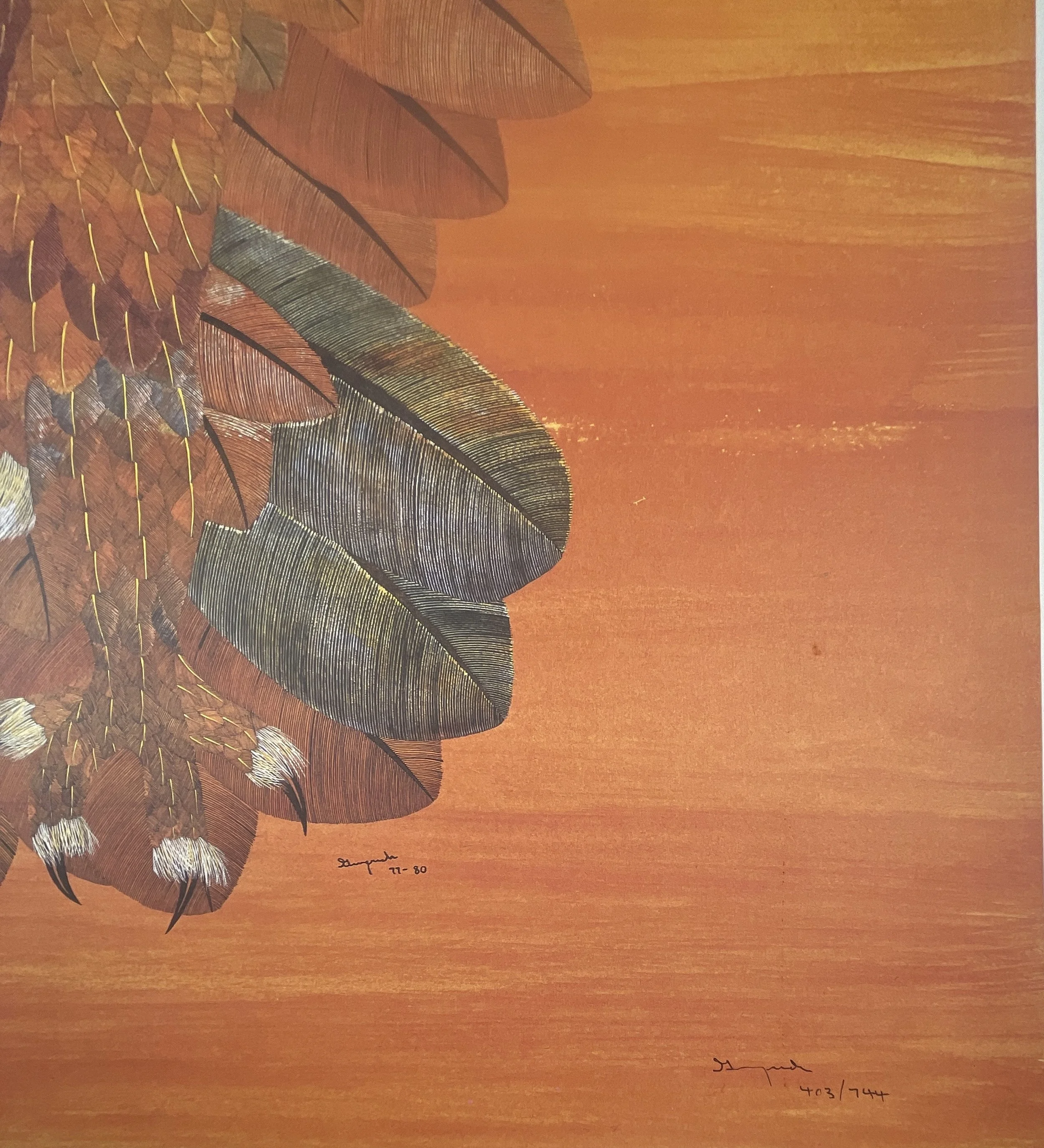
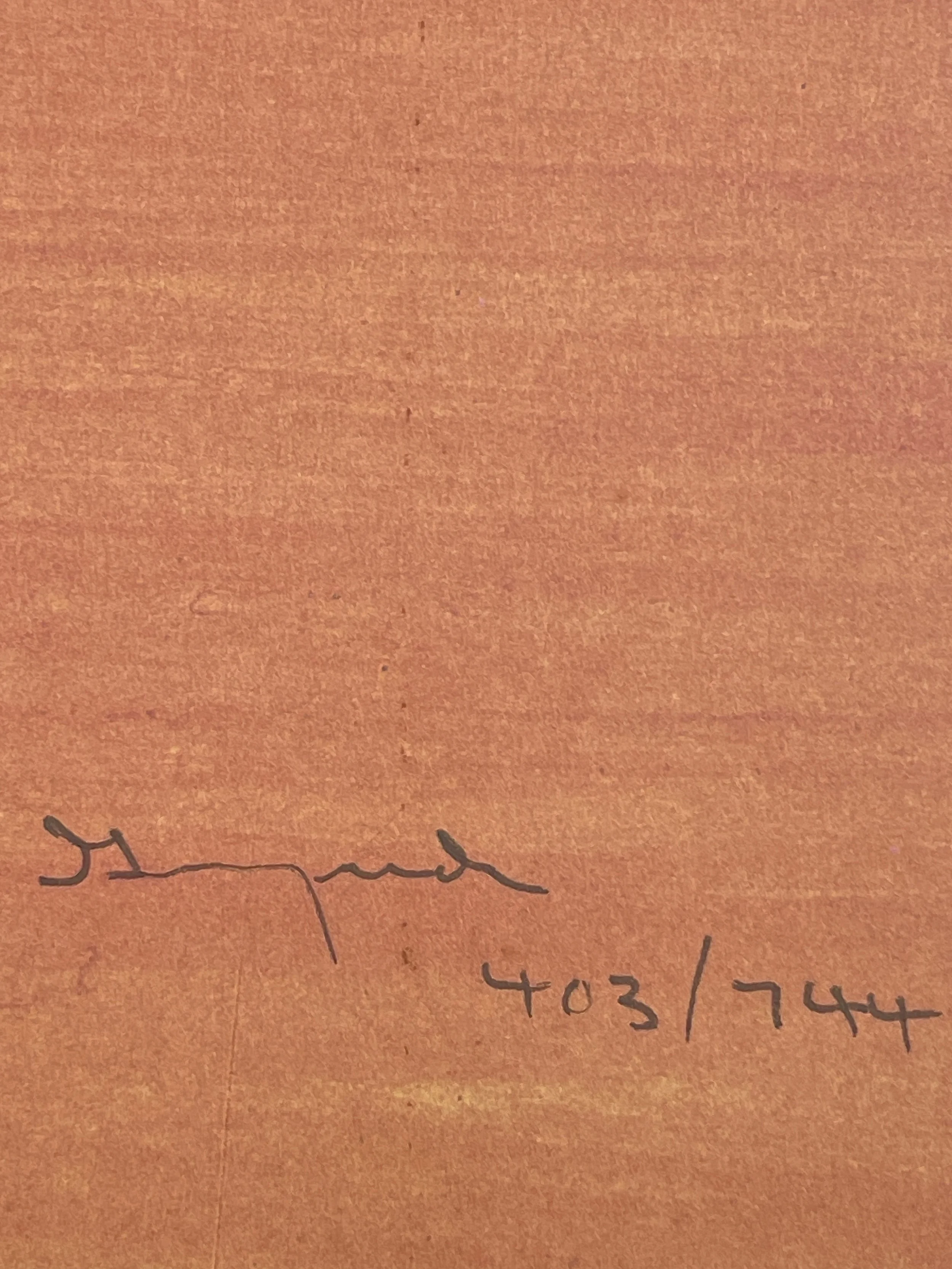
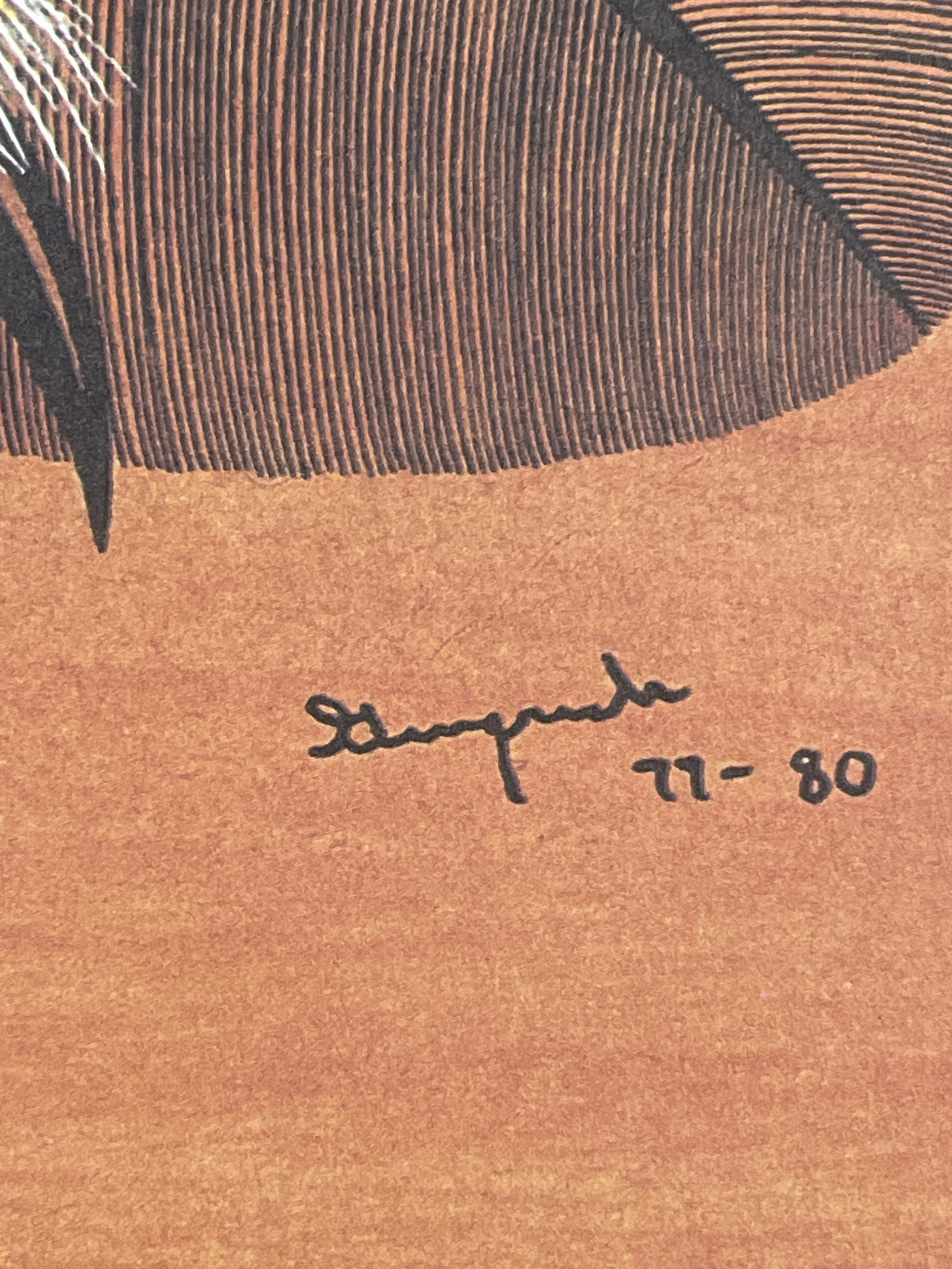
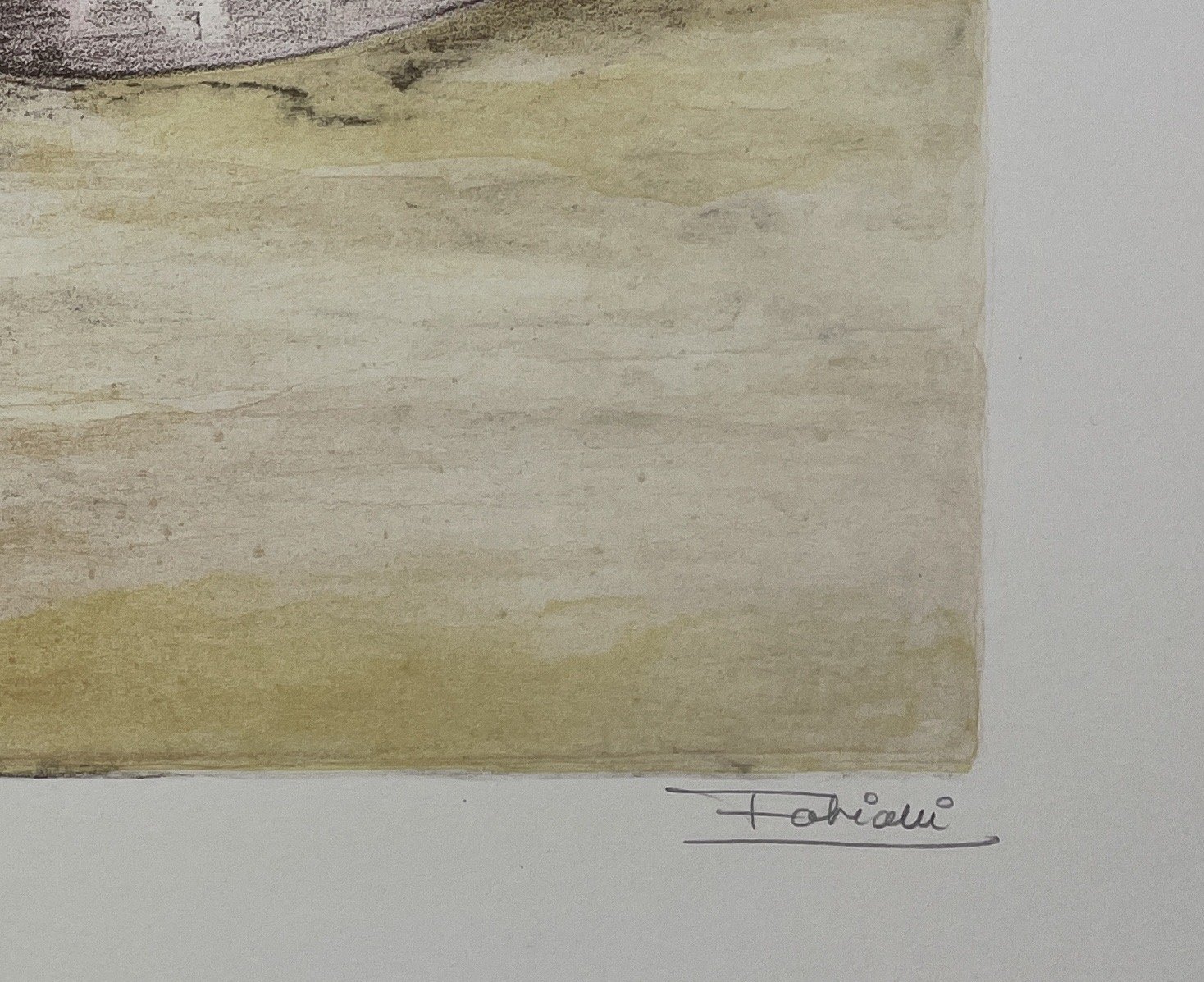
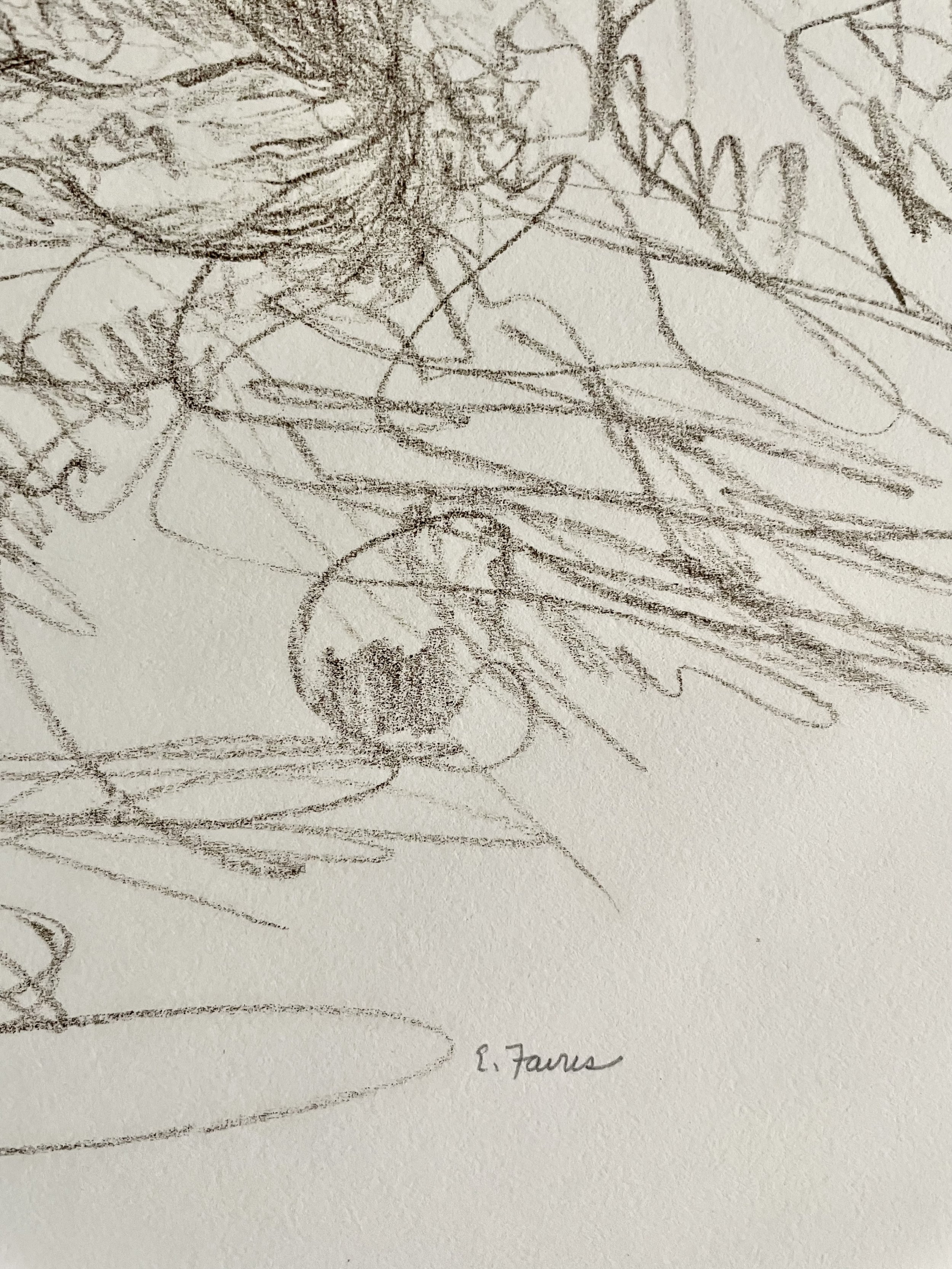
The sheet is pencil-numbered 139/275 at the lower left margin and pencil-signed “J. P. Tertre” at the lower right. Measuring approximately 20 × 26 inches, this work fits comfortably within Tertre’s body of landscapes that present quiet, contemplative views of rural France, emphasizing rhythm, pattern, and a gentle, reflective atmosphere.
Biography of Jean-Pierre Tertre (b.1927)
Jean-Pierre Tertre is a mid-20th-century French artist and printmaker, born in France in 1927 and generally described in art-market literature as a French, 20th-century artist specializing in prints and multiples.
Early in his career Tertre studied in Paris, where he is said to have attended the Collège des Arts Appliqués (School of Applied Arts for the City of Paris), grounding himself in design, drawing, and decorative arts. Building on this training, he developed a multi-disciplinary practice encompassing watercolor, mosaic, ceramic work, tapestry design, wood engraving, and lithography, though it is his original lithographs that have enjoyed the greatest visibility on the international print market.
Tertre has expressed a particular respect for original etching and lithography, describing these media as technically unforgiving and therefore honest: the plate or stone records every decision, without the possibility of correction through overpainting. That insistence on clarity and discipline is evident in his work, where elegant line and carefully controlled color dominate.
His imagery frequently focuses on rural and seaside landscapes—villages, harbors, beaches, and rolling farmlands—filtered through a modern, decorative sensibility. Simplified shapes, flattened spatial cues, and a controlled, often autumnal palette create a mood of quiet contemplation. Dealers and gallery notes often single out his use of greens, browns, and burnt orange to convey a subdued, meditative atmosphere, as seen in French Countryside Landscape.
Tertre’s lithographs were widely distributed in the mid-century period, particularly through publishers and galleries in Paris and Provence, and by organizations such as Collector’s Guild Ltd. in the United States. Auction records document his work appearing under the listing “Jean-Pierre Tertre (French, born 1927)” at sales in the U.S. and Europe, generally as limited-edition color lithographs of landscapes or harbor scenes.
In addition to stand-alone prints, Tertre has produced engraved and lithographic portfolios to accompany literary works, including illustrations for Flaubert’s La Légende de Saint Julien l’Hospitalier and the symbolist text Les Chants de Maldoror, showing his connection to the long French tradition of artist’s books.
While not as widely documented as some of his contemporaries, Tertre’s work remains appreciated among collectors of mid-century French prints for its combination of decorative clarity, warmth, and affectionate observation of the French landscape, qualities fully present in the lithograph at hand.
Jean-Pierre Tertre (French, b.1927), “French Countryside Landscape”, 1970s, color lithograph on paper, 20×26 in, pencil-signed lower right, numbered 139/275. Tranquil rural French landscape with dominant leafless tree and village beyond; classic mid-century Tertre lithograph with strong provenance via Mitch Morse Gallery.
Certificate of Value & Authentication
Artist: Jean-Pierre Tertre (French, b.1927)
Title: French Countryside Landscape
Date: c.1970s
Medium: Color lithograph on paper
Dimensions: 20 × 26 inches (sheet, approx.)
Edition: 139/275
Signature: Hand-signed “J. P. Tertre” in pencil at lower right; numbered 139/275 at lower left
Technique: Multi-color lithography with drawn line and flat, layered color planes typical of mid-century French printmaking.
Condition: Very good vintage condition with minor age-related handling typical for mid-20th-century prints (formal conservation report recommended for sale at higher tiers).
Authenticity:
– Signature and numbering consistent with known Tertre editions.
– Image, edition size, and dimensions match documented listings for “French Countryside Landscape,” 139/275.
– Provenance: originally held in a retired Manhattan gallery, then acquired by Mitch Morse Gallery (New York) and subsequently by Artfind Gallery, Washington, DC.
This certificate affirms that French Countryside Landscape is an authentic original lithograph by Jean-Pierre Tertre.
Provenance Chain (Collector-Formatted)
• Jean-Pierre Tertre (b.1927) – artist
• Mitch Morse Gallery, New York, NY – acquired from retired gallery, distributed through its network in NYC, the U.S., and Europe
• Artfind Gallery, Washington, DC – current owner
Artist Note: Paris-born Jean-Pierre Tertre is known for his refined lithographs, mosaics, and tapestries. His original prints are included in permanent collections in Paris and Provence, celebrated for their meditative compositions and understated palette.
The original lithographs created by Tertre are on permanent exhibition at Galleria in Paris and Provence. He has done numerous portfolios of multiple original to illustrate the works of famous writers., i.e. 13 original wood engravings for the Legend de Saint Julien by Gustav Flaubert.
“French Countryside Landscape,” Jean-Pierre Tertre (French, b.1927), 1970s color lithograph, 20×26 in, pencil-signed, edition 139/275.
“French Countryside Landscape” by French printmaker Jean-Pierre Tertre is a 1970s signed, limited-edition color lithograph (139/275, 20×26 in) depicting a tranquil rural village framed by a dramatic leafless tree. Tertre’s refined linework, earthy greens and ochres, and elegant mid-century design sensibility make this an ideal piece for collectors of French landscape art, modern lithography, and vintage European prints with strong provenance from a retired Manhattan gallery via Mitch Morse Gallery to Artfind Gallery.
Artwork Description
This composition centers on a towering, bare-branched tree that rises almost to the top of the sheet, its fine network of lines silhouetted against a soft, grey-beige sky. Below, the land opens into a patchwork of fields rendered in warm ochre, muted green, and teal blue. A meandering path leads the eye toward a stone farmhouse and clustered outbuildings, their tiled roofs and walls echoing the earthy tones of the landscape.
The print is a color lithograph typical of the 1960s–70s Collector’s Guild era: flat but carefully registered color planes layered beneath crisp linear drawing. Tertre’s handling of the tree is especially striking—its trunk and branches are drawn with a calligraphic assurance that contrasts with the simplified geometric masses of the buildings and fields. The result is a delicate balance between graphic stylization and natural observation, a hallmark of mid-century European print design.
Color is used to create mood rather than literal description. The cool teal pool at the tree’s base and the turquoise stone wall in the foreground suggest lingering water or shadow, while the warm ochres and olives in the fields evoke late autumn or early spring. The distant band of trees and hills gives a sense of depth and situates the scene firmly in the French countryside.
The sheet is pencil-numbered 139/275 at the lower left margin and pencil-signed “J. P. Tertre” at the lower right. Measuring approximately 20 × 26 inches, this work fits comfortably within Tertre’s body of landscapes that present quiet, contemplative views of rural France, emphasizing rhythm, pattern, and a gentle, reflective atmosphere.
Biography of Jean-Pierre Tertre (b.1927)
Jean-Pierre Tertre is a mid-20th-century French artist and printmaker, born in France in 1927 and generally described in art-market literature as a French, 20th-century artist specializing in prints and multiples.
Early in his career Tertre studied in Paris, where he is said to have attended the Collège des Arts Appliqués (School of Applied Arts for the City of Paris), grounding himself in design, drawing, and decorative arts. Building on this training, he developed a multi-disciplinary practice encompassing watercolor, mosaic, ceramic work, tapestry design, wood engraving, and lithography, though it is his original lithographs that have enjoyed the greatest visibility on the international print market.
Tertre has expressed a particular respect for original etching and lithography, describing these media as technically unforgiving and therefore honest: the plate or stone records every decision, without the possibility of correction through overpainting. That insistence on clarity and discipline is evident in his work, where elegant line and carefully controlled color dominate.
His imagery frequently focuses on rural and seaside landscapes—villages, harbors, beaches, and rolling farmlands—filtered through a modern, decorative sensibility. Simplified shapes, flattened spatial cues, and a controlled, often autumnal palette create a mood of quiet contemplation. Dealers and gallery notes often single out his use of greens, browns, and burnt orange to convey a subdued, meditative atmosphere, as seen in French Countryside Landscape.
Tertre’s lithographs were widely distributed in the mid-century period, particularly through publishers and galleries in Paris and Provence, and by organizations such as Collector’s Guild Ltd. in the United States. Auction records document his work appearing under the listing “Jean-Pierre Tertre (French, born 1927)” at sales in the U.S. and Europe, generally as limited-edition color lithographs of landscapes or harbor scenes.
In addition to stand-alone prints, Tertre has produced engraved and lithographic portfolios to accompany literary works, including illustrations for Flaubert’s La Légende de Saint Julien l’Hospitalier and the symbolist text Les Chants de Maldoror, showing his connection to the long French tradition of artist’s books.
While not as widely documented as some of his contemporaries, Tertre’s work remains appreciated among collectors of mid-century French prints for its combination of decorative clarity, warmth, and affectionate observation of the French landscape, qualities fully present in the lithograph at hand.
Jean-Pierre Tertre (French, b.1927), “French Countryside Landscape”, 1970s, color lithograph on paper, 20×26 in, pencil-signed lower right, numbered 139/275. Tranquil rural French landscape with dominant leafless tree and village beyond; classic mid-century Tertre lithograph with strong provenance via Mitch Morse Gallery.
Certificate of Value & Authentication
Artist: Jean-Pierre Tertre (French, b.1927)
Title: French Countryside Landscape
Date: c.1970s
Medium: Color lithograph on paper
Dimensions: 20 × 26 inches (sheet, approx.)
Edition: 139/275
Signature: Hand-signed “J. P. Tertre” in pencil at lower right; numbered 139/275 at lower left
Technique: Multi-color lithography with drawn line and flat, layered color planes typical of mid-century French printmaking.
Condition: Very good vintage condition with minor age-related handling typical for mid-20th-century prints (formal conservation report recommended for sale at higher tiers).
Authenticity:
– Signature and numbering consistent with known Tertre editions.
– Image, edition size, and dimensions match documented listings for “French Countryside Landscape,” 139/275.
– Provenance: originally held in a retired Manhattan gallery, then acquired by Mitch Morse Gallery (New York) and subsequently by Artfind Gallery, Washington, DC.
This certificate affirms that French Countryside Landscape is an authentic original lithograph by Jean-Pierre Tertre.
Provenance Chain (Collector-Formatted)
• Jean-Pierre Tertre (b.1927) – artist
• Mitch Morse Gallery, New York, NY – acquired from retired gallery, distributed through its network in NYC, the U.S., and Europe
• Artfind Gallery, Washington, DC – current owner
Artist Note: Paris-born Jean-Pierre Tertre is known for his refined lithographs, mosaics, and tapestries. His original prints are included in permanent collections in Paris and Provence, celebrated for their meditative compositions and understated palette.
The original lithographs created by Tertre are on permanent exhibition at Galleria in Paris and Provence. He has done numerous portfolios of multiple original to illustrate the works of famous writers., i.e. 13 original wood engravings for the Legend de Saint Julien by Gustav Flaubert.
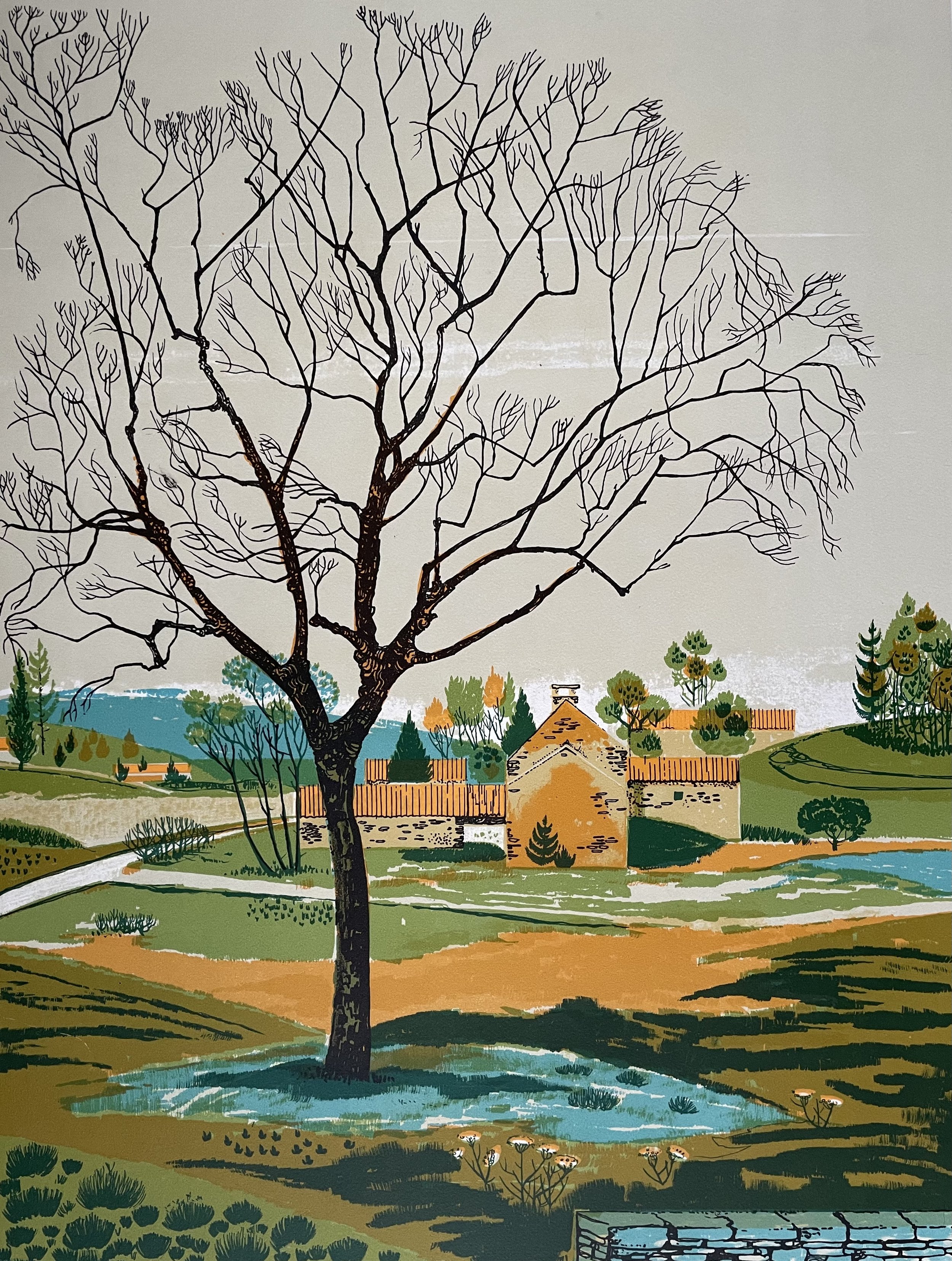 Image 1 of 9
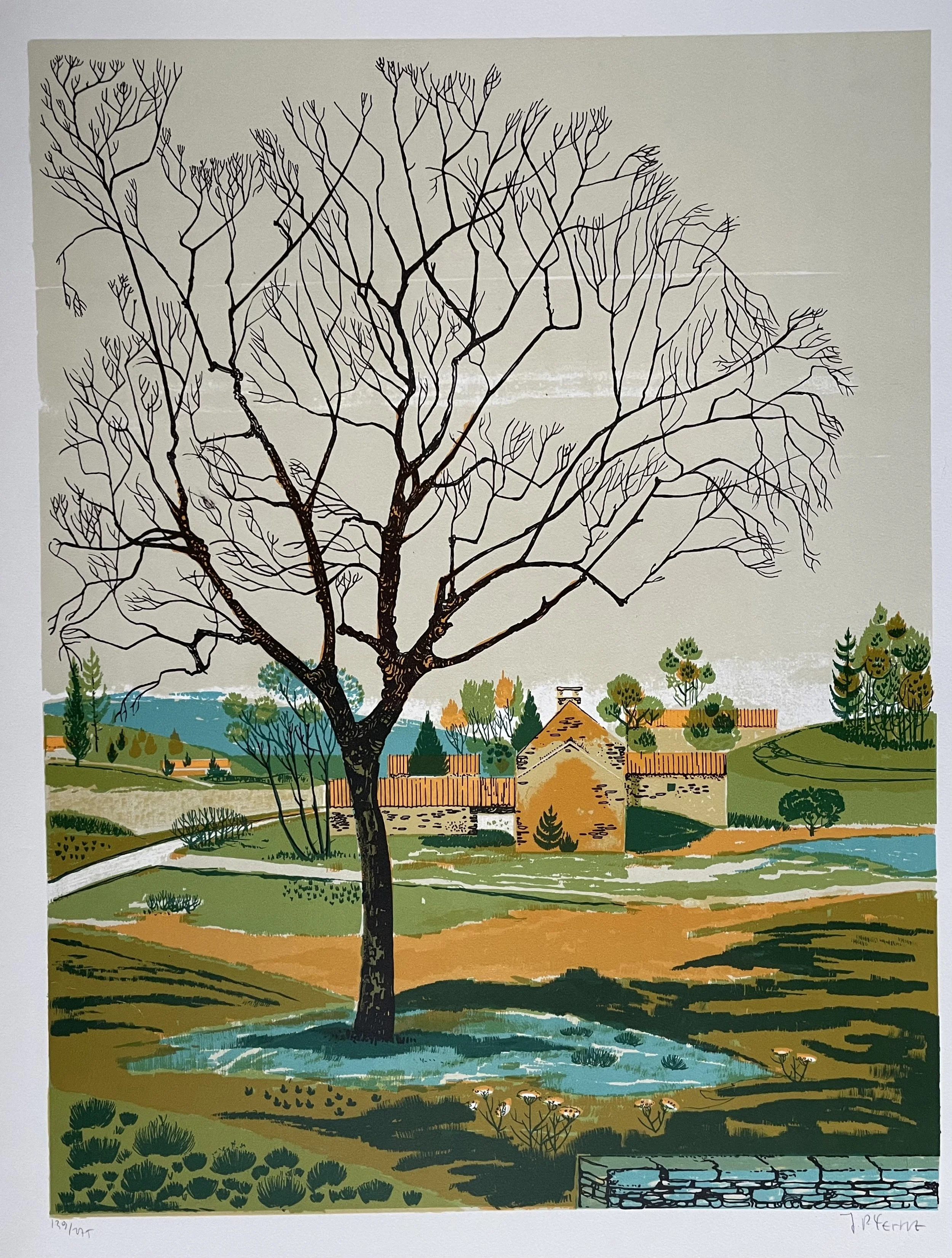 Image 2 of 9
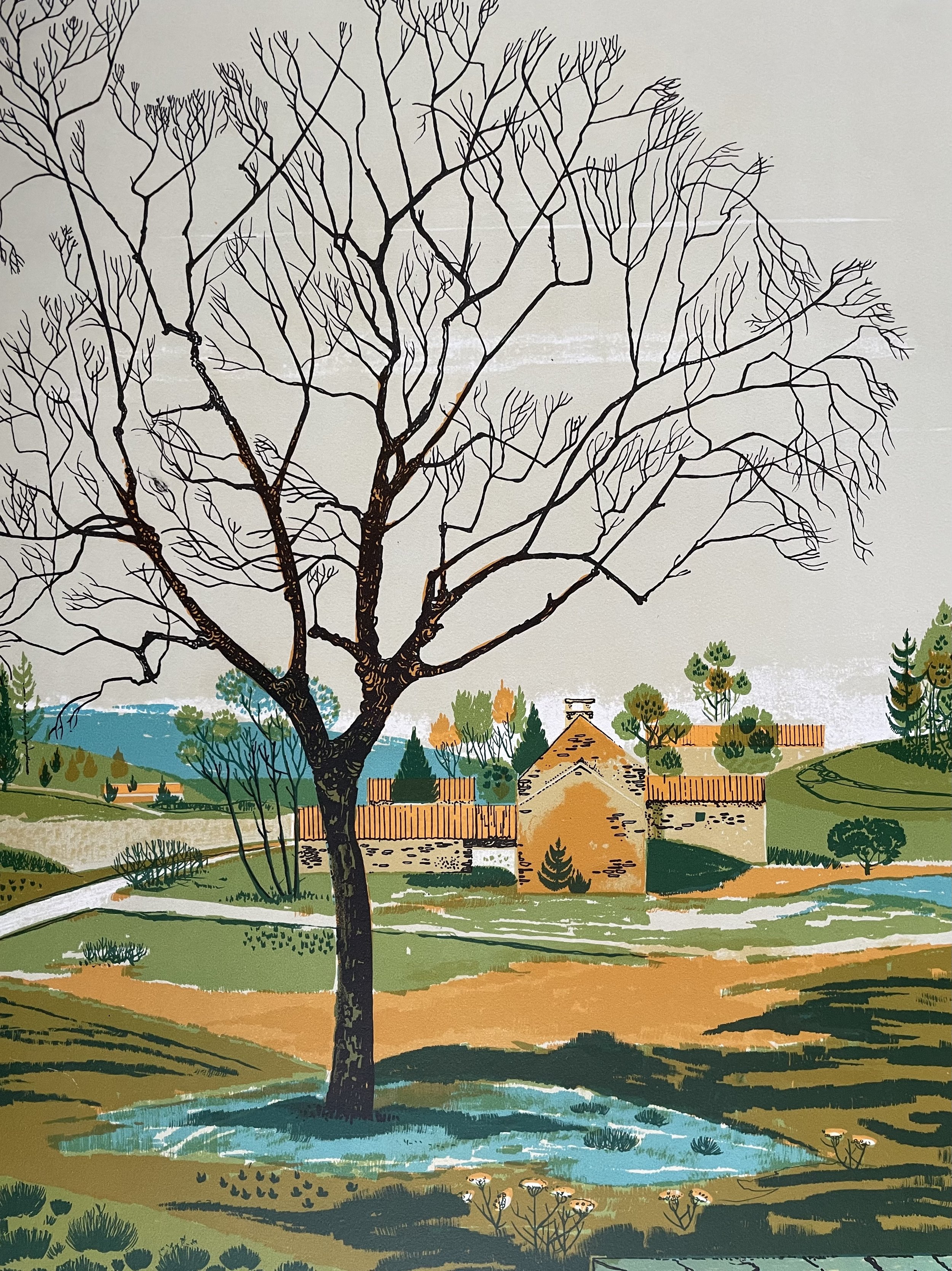 Image 3 of 9
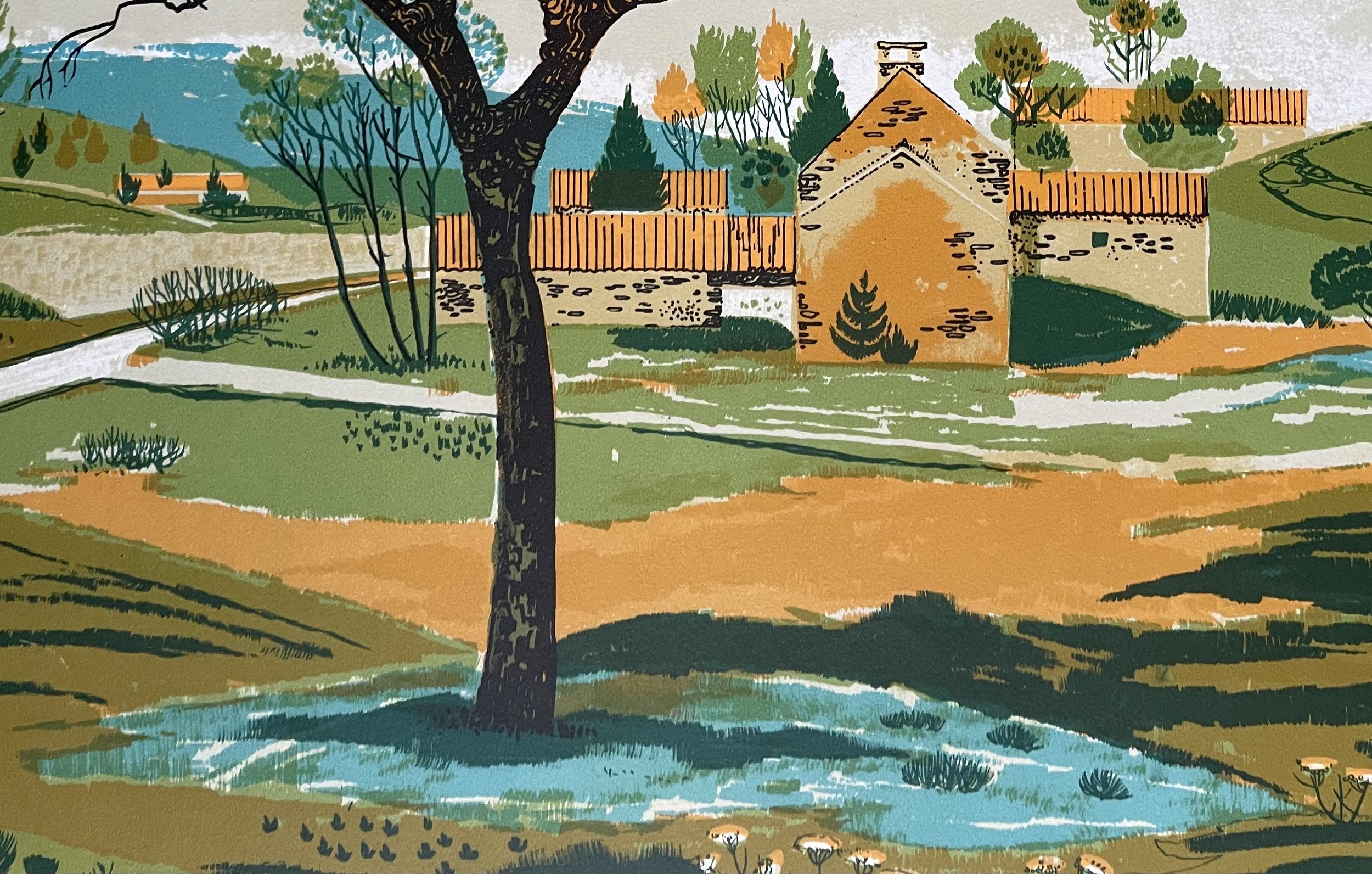 Image 4 of 9
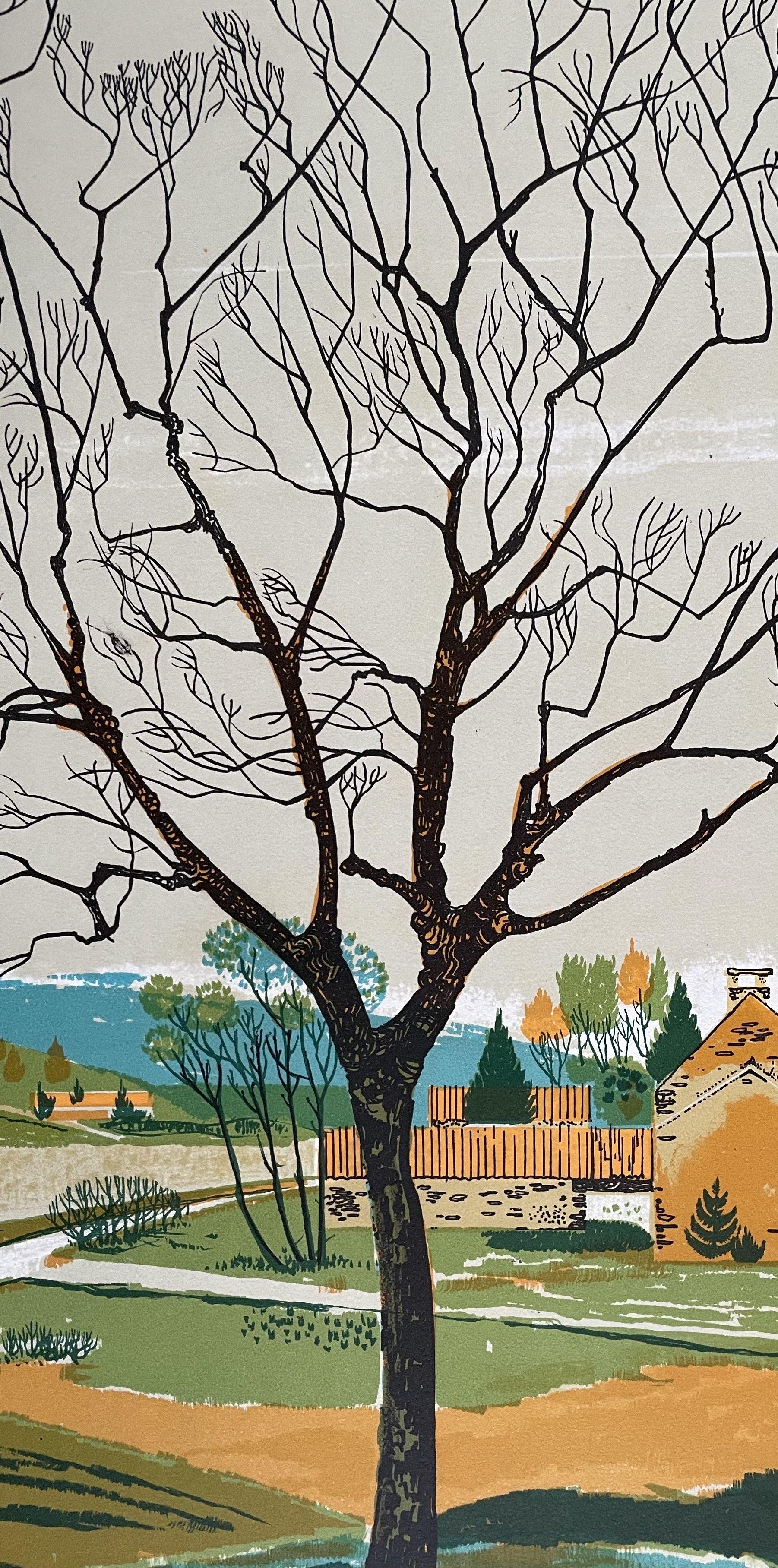 Image 5 of 9
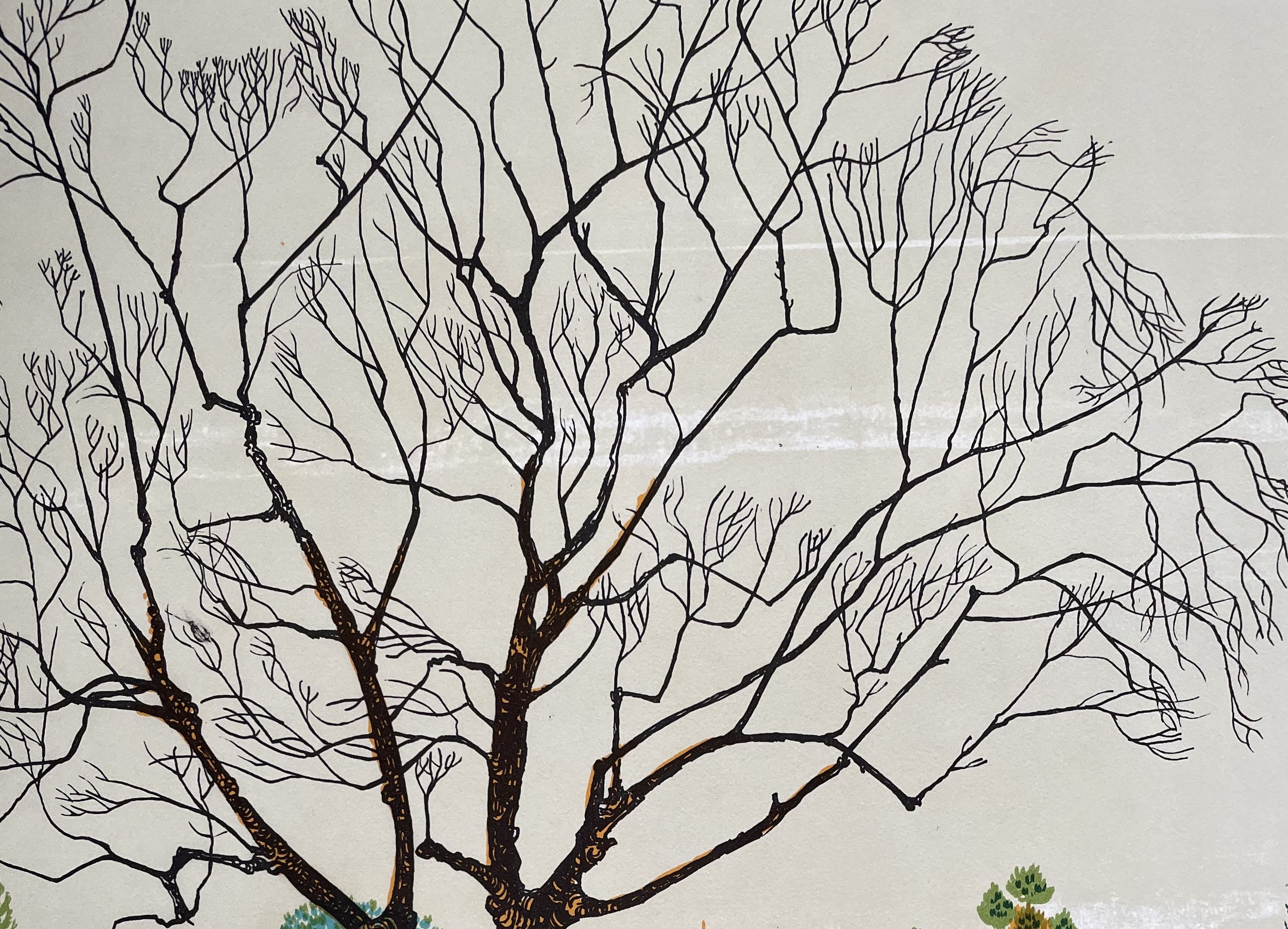 Image 6 of 9
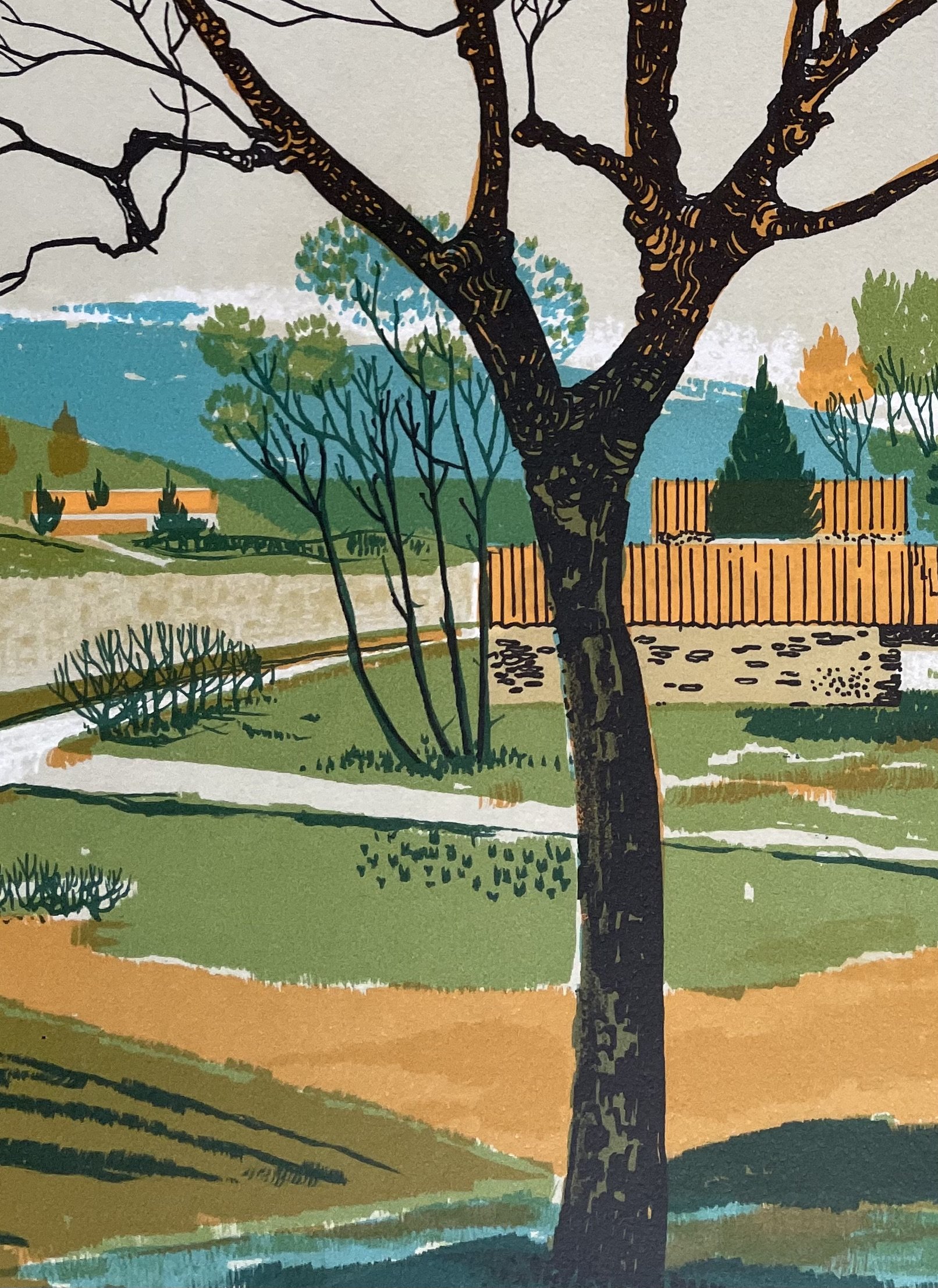 Image 7 of 9
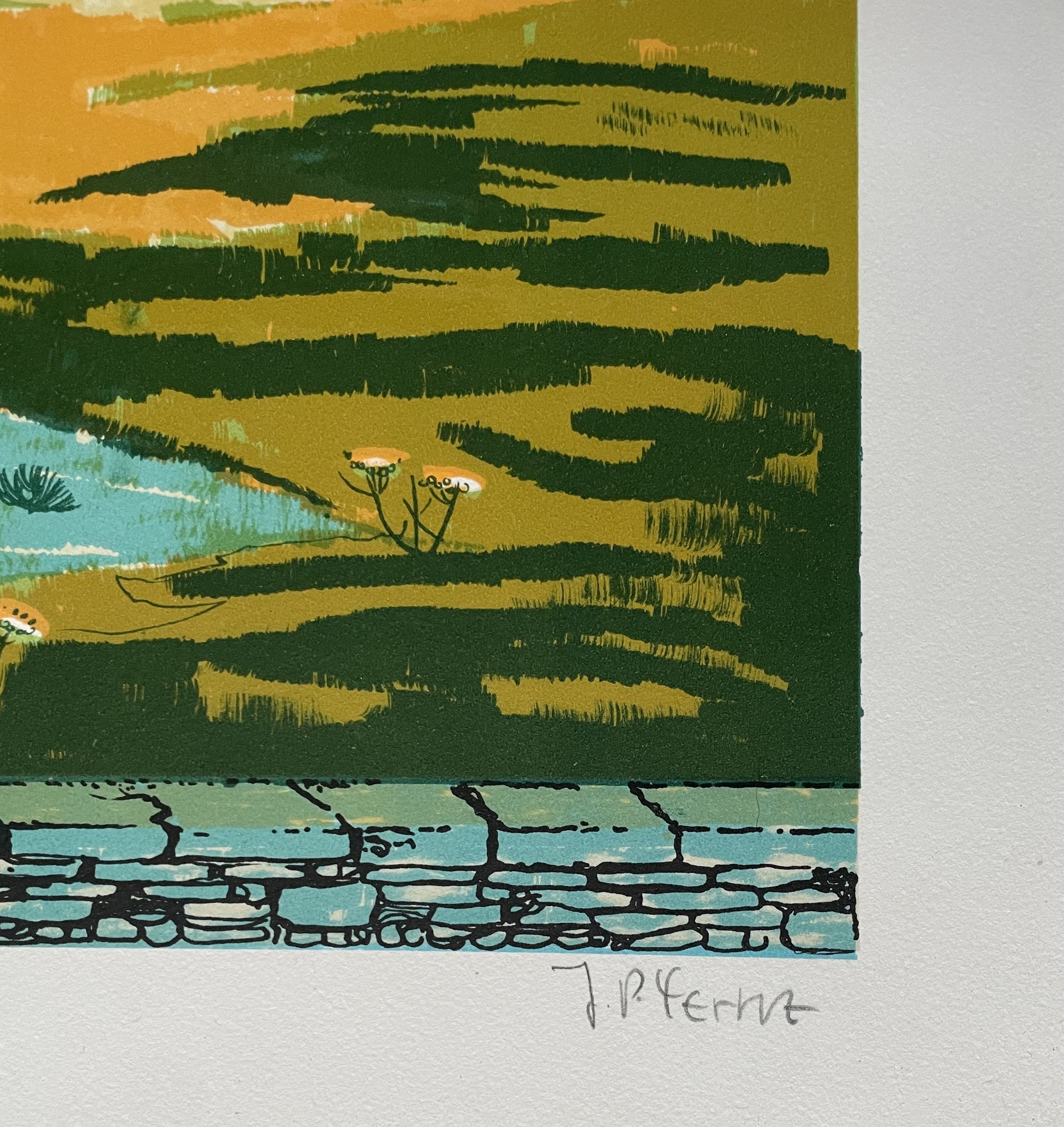 Image 8 of 9
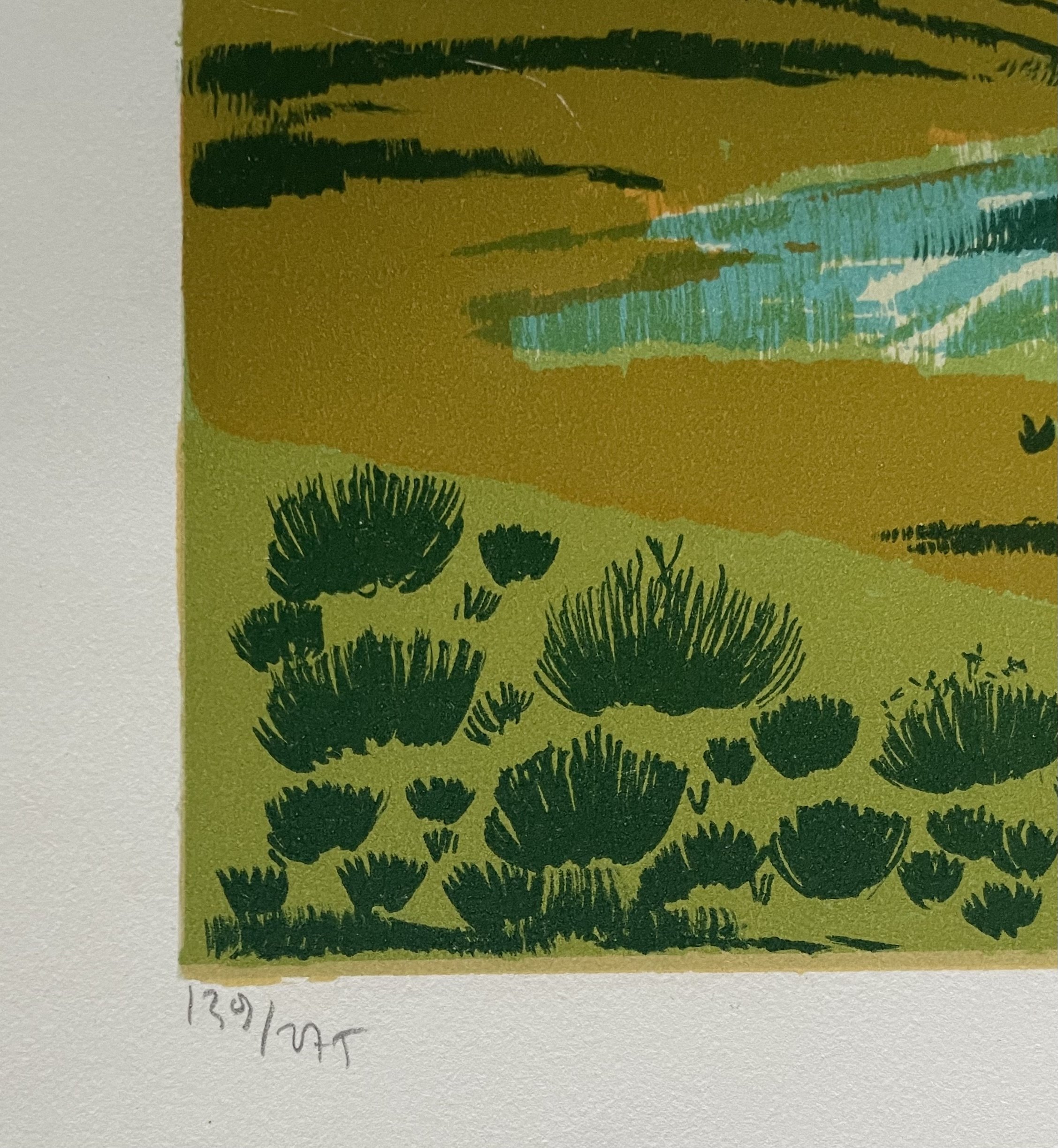 Image 9 of 9