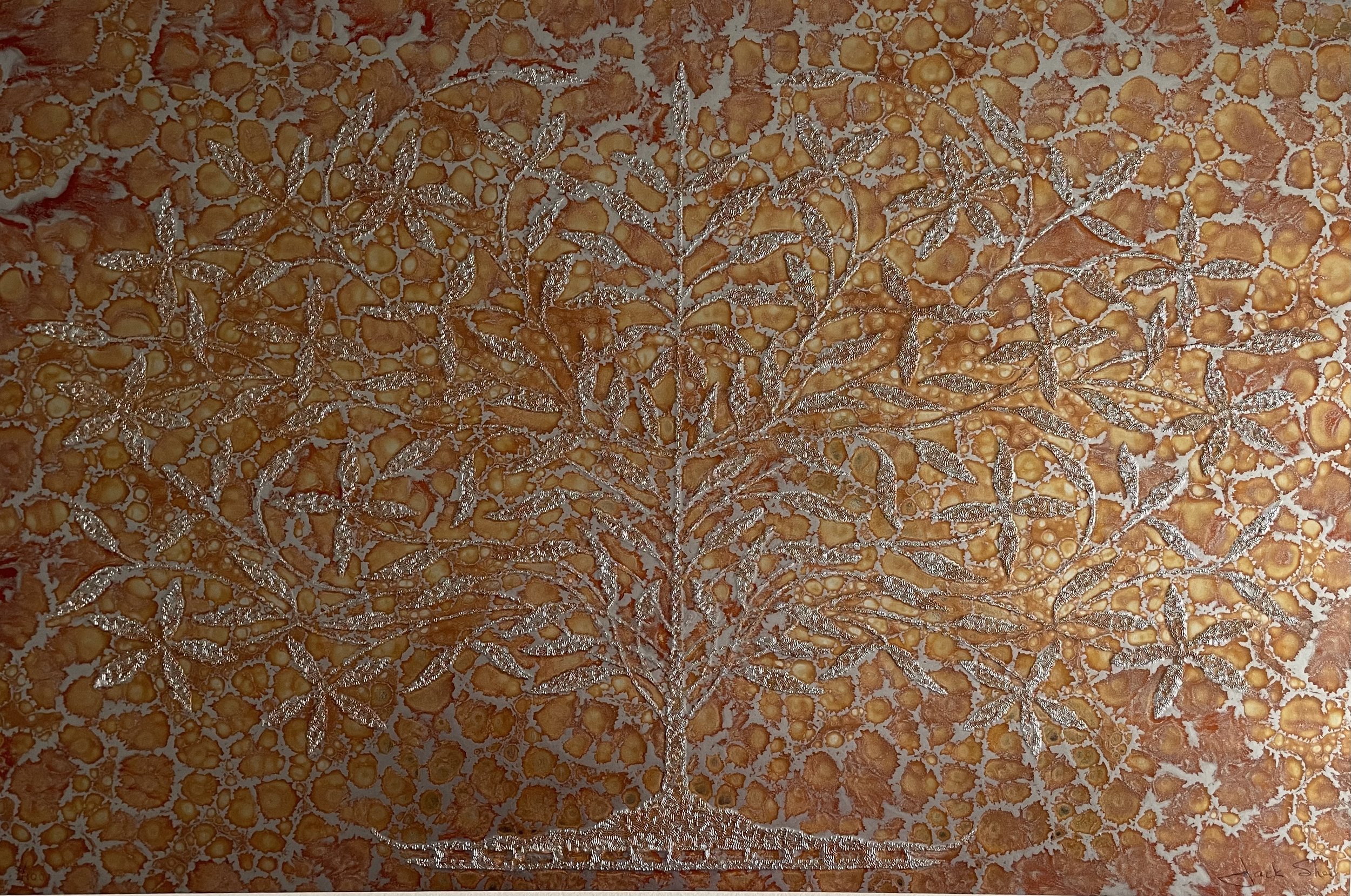
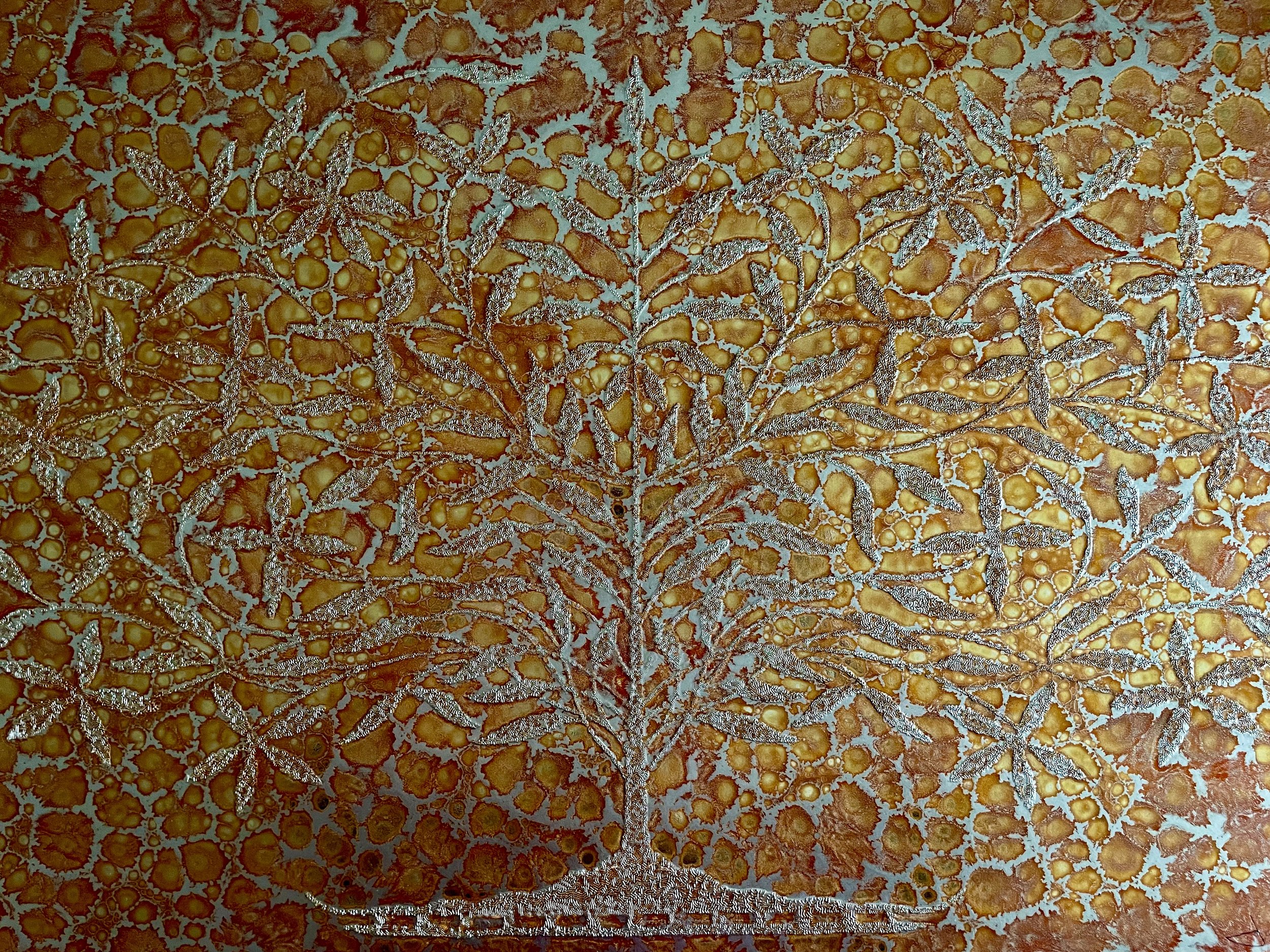
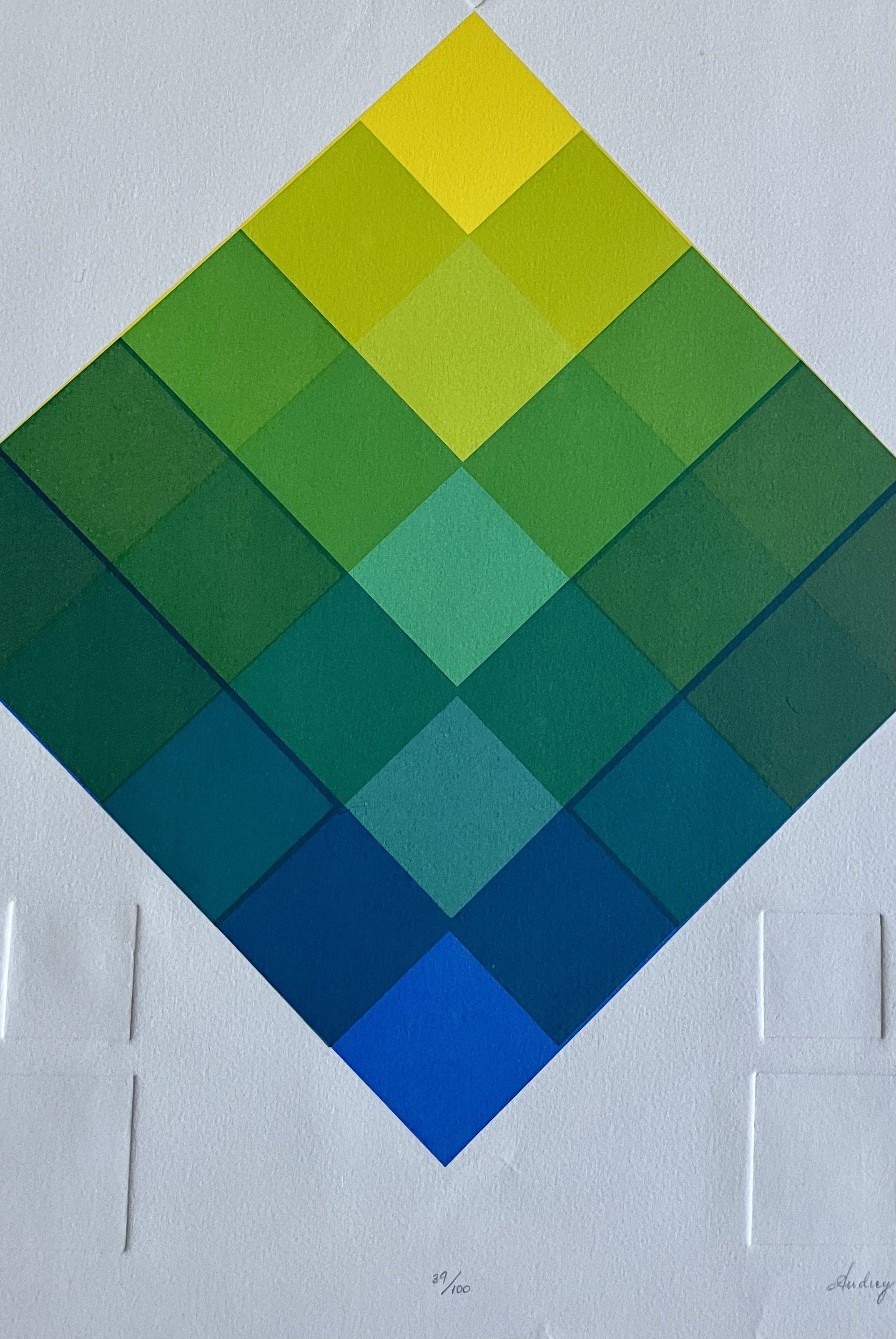
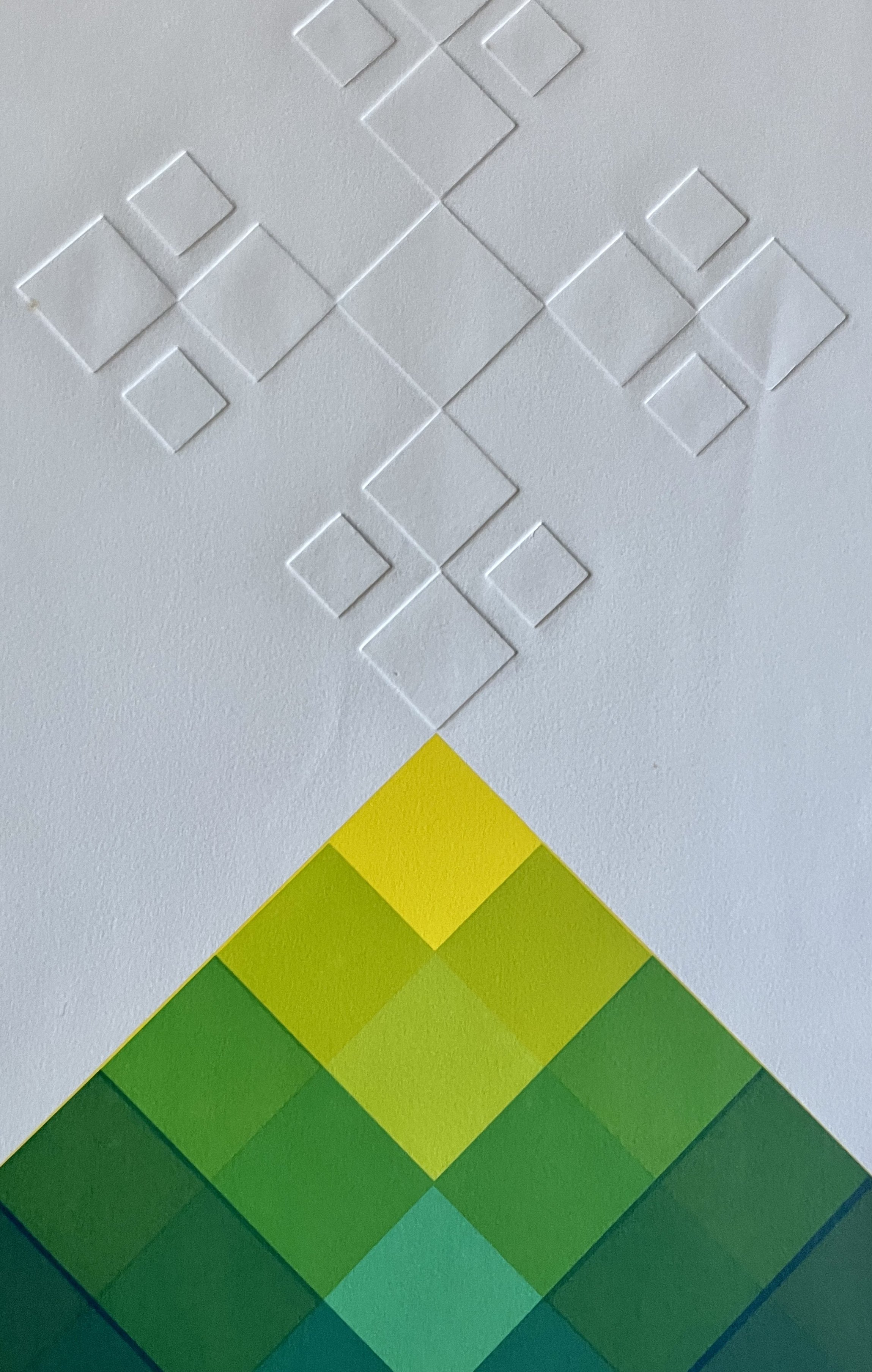
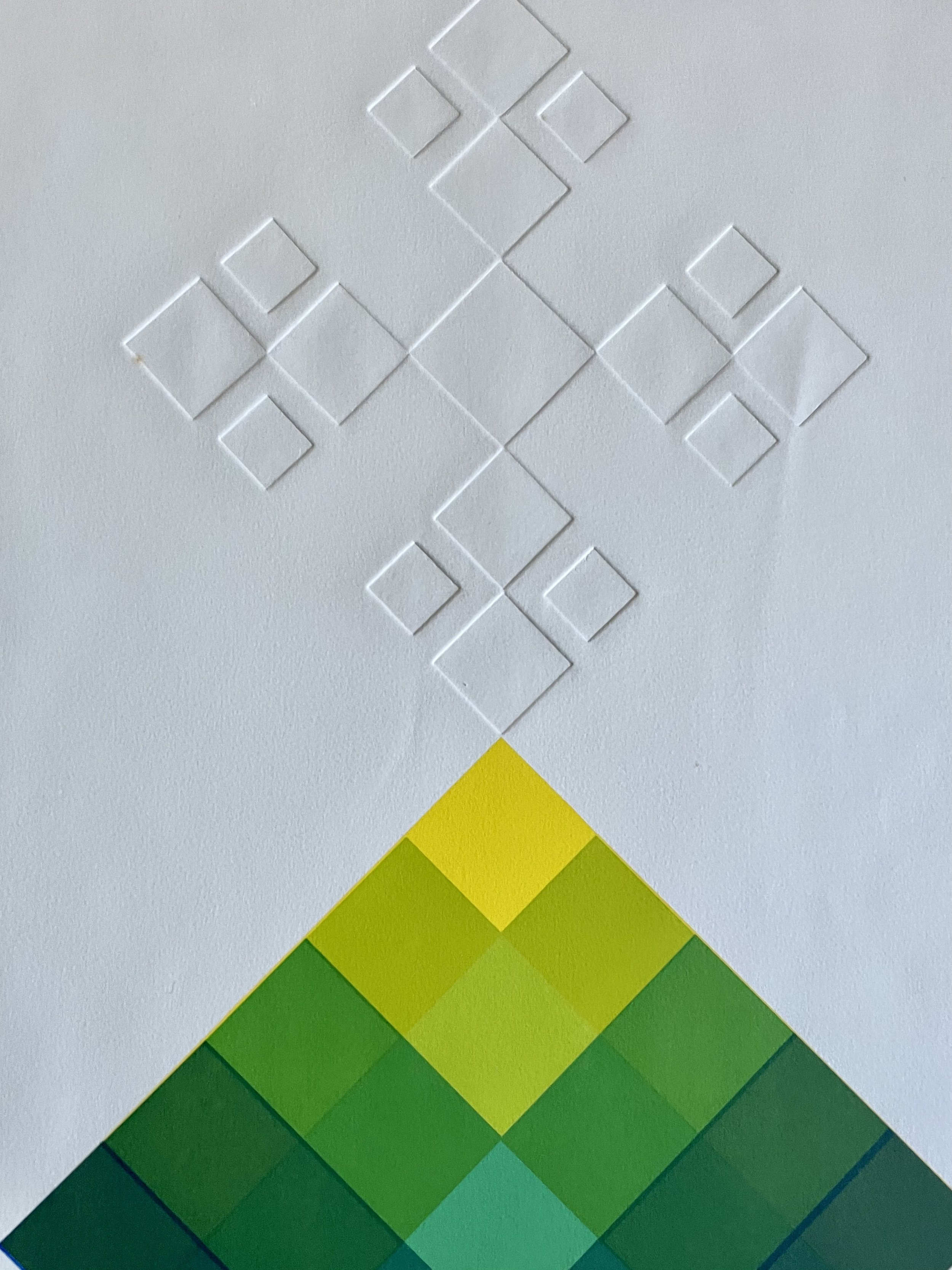
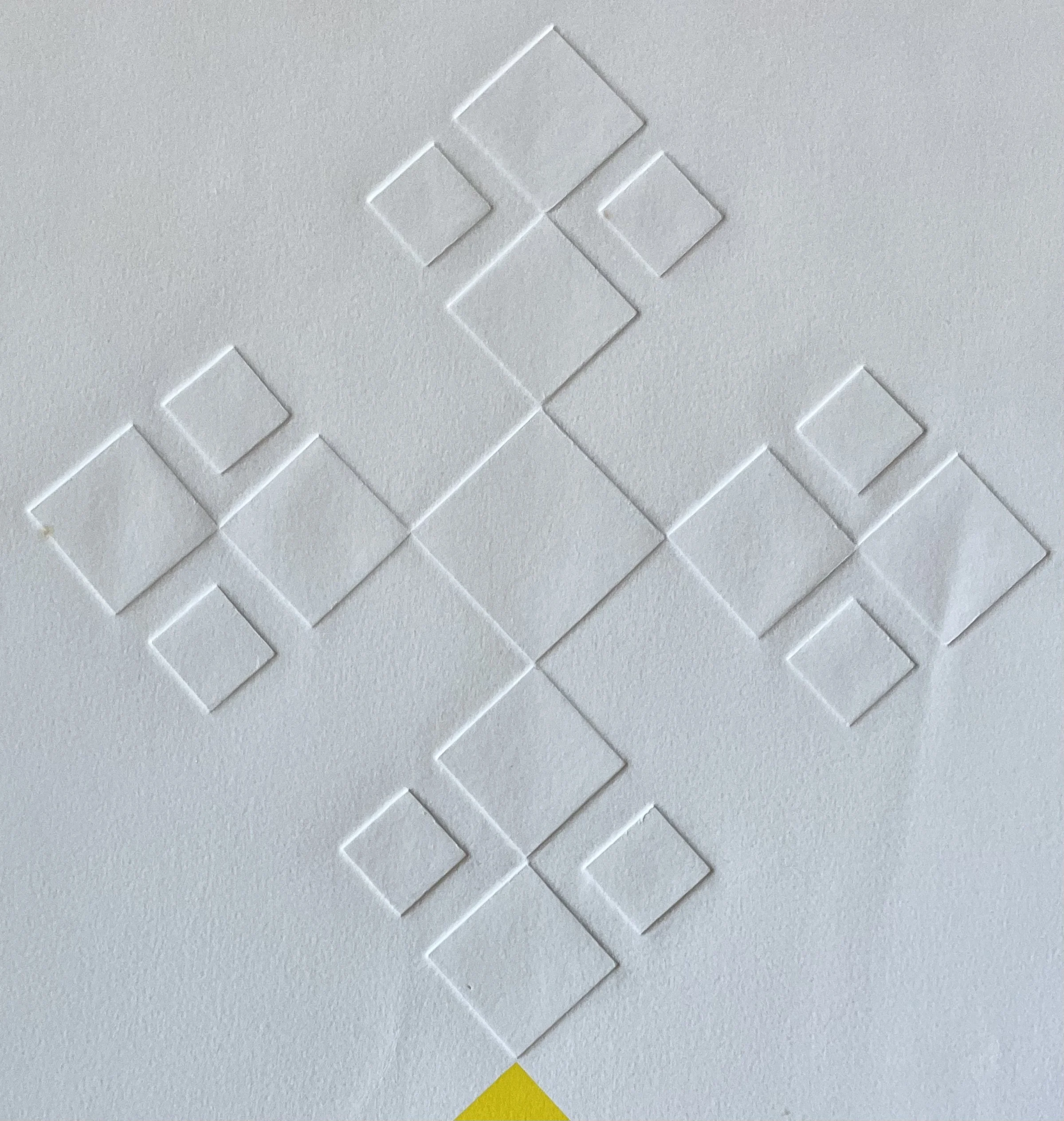
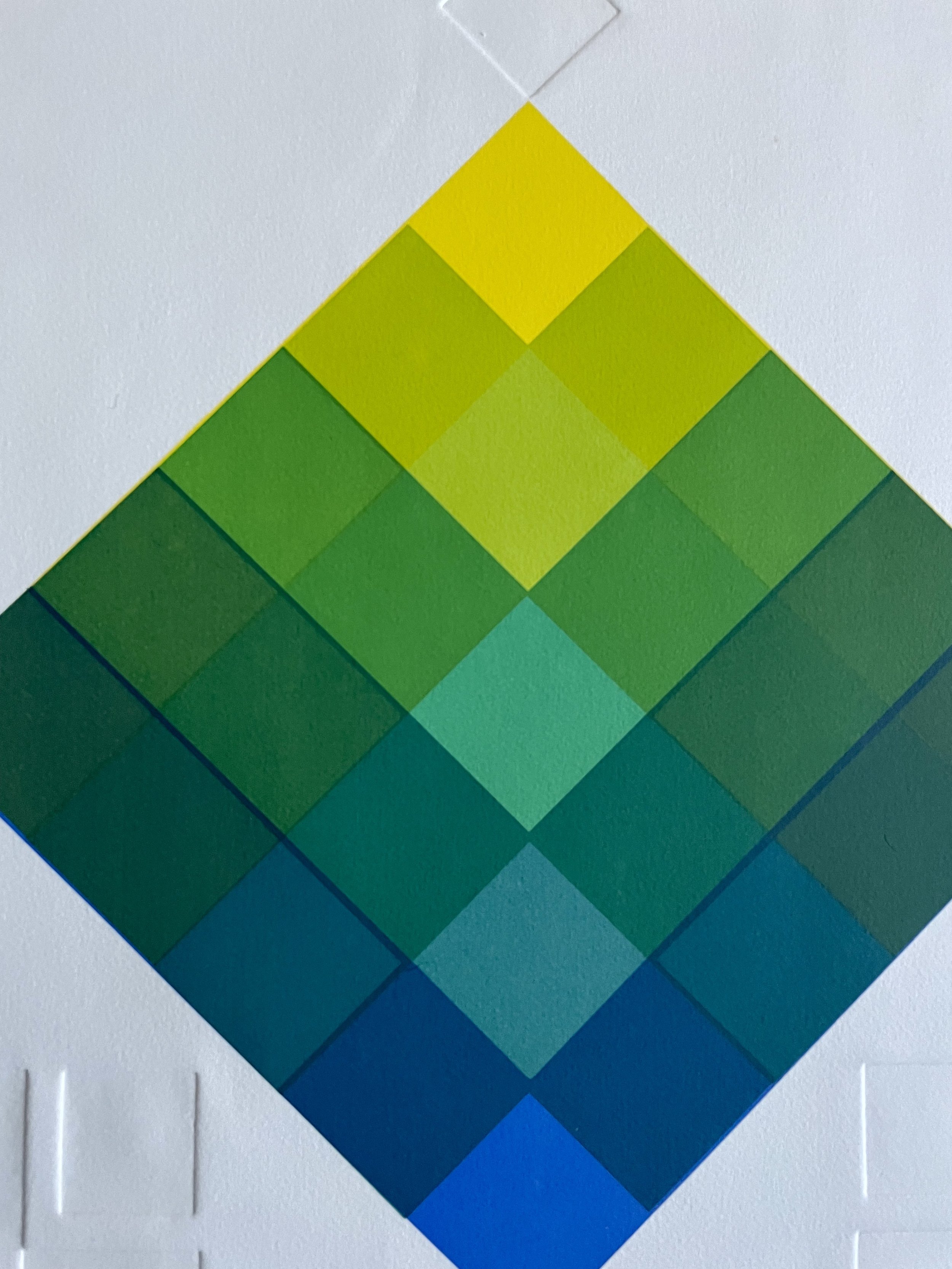
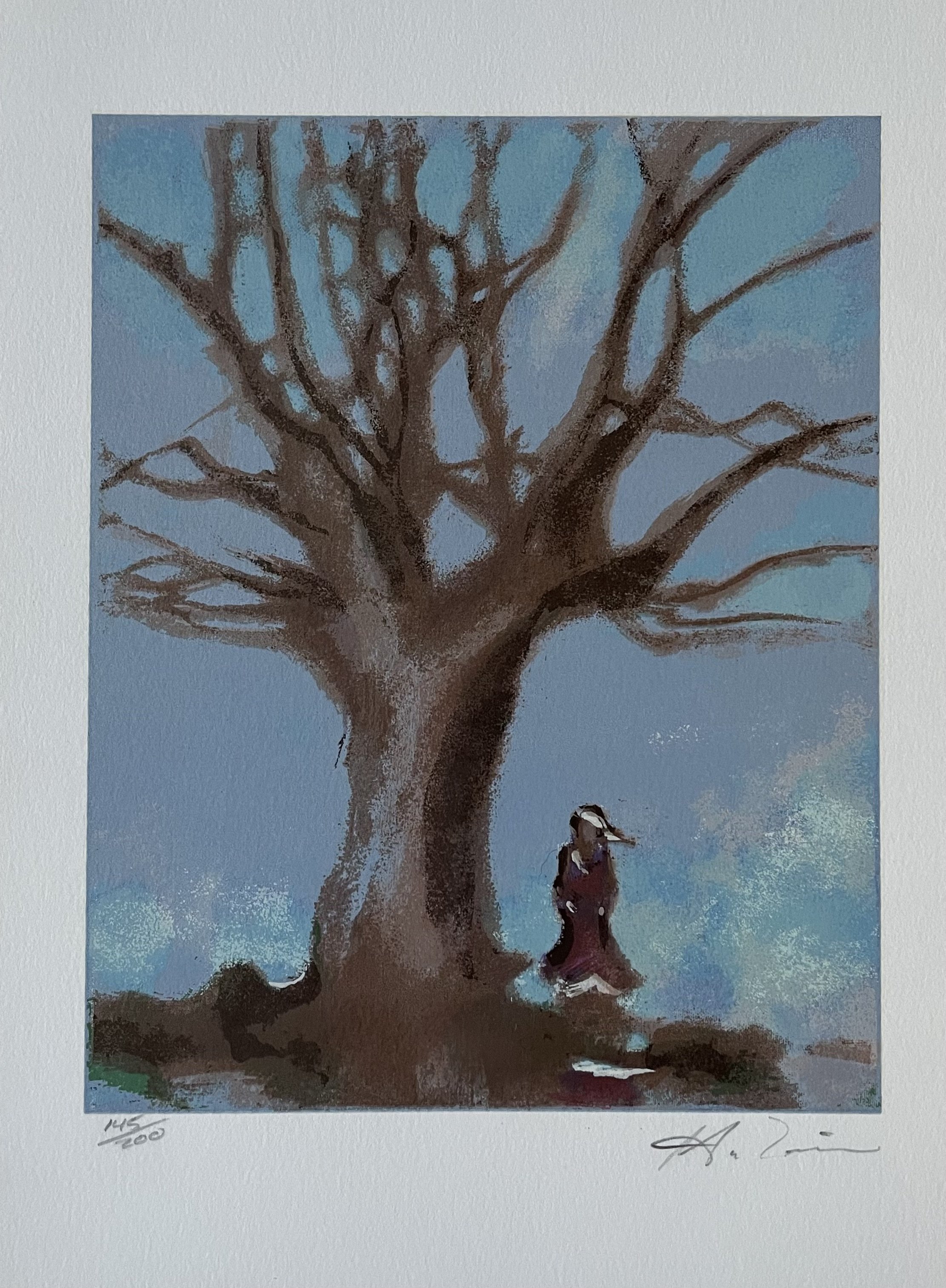
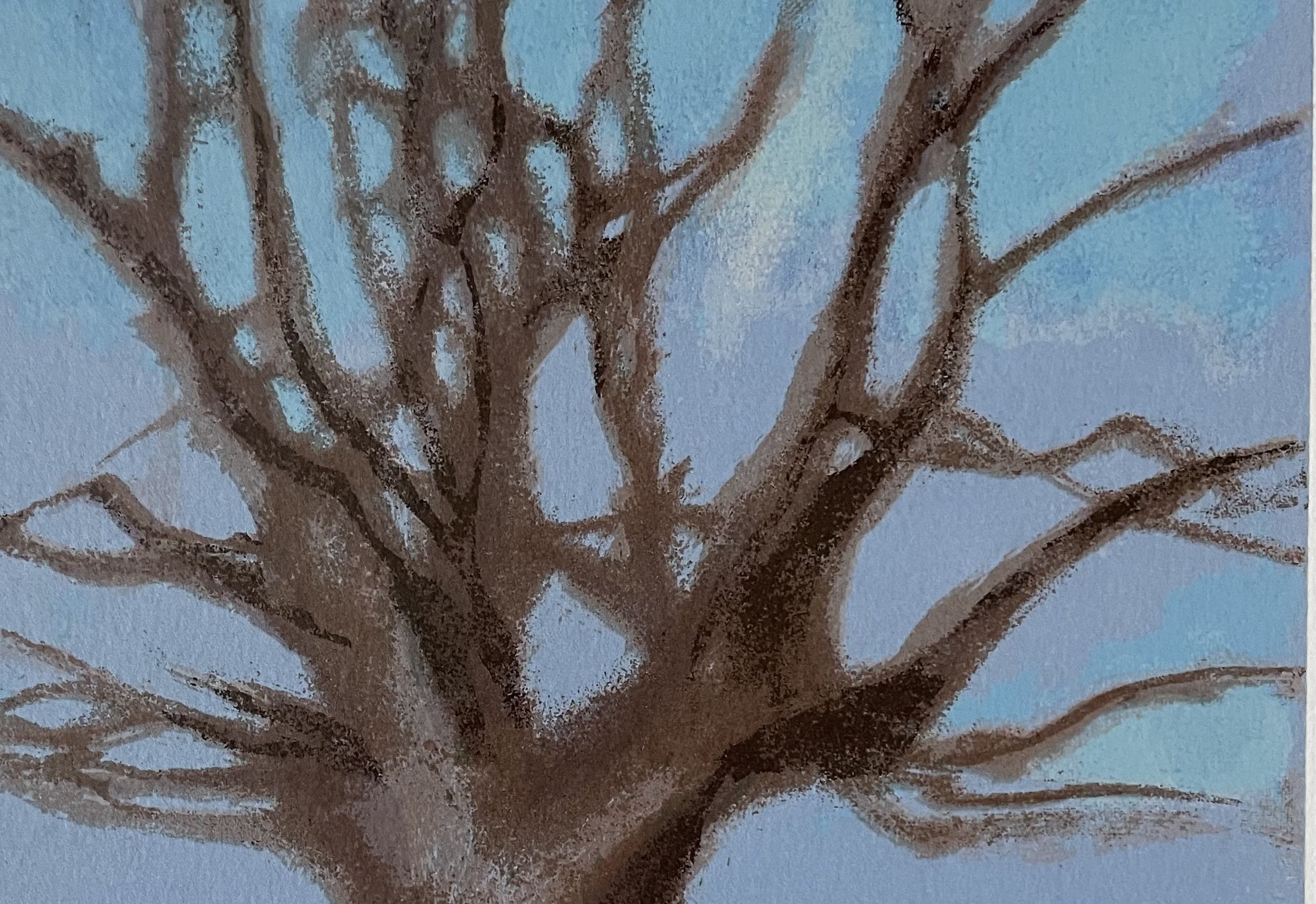
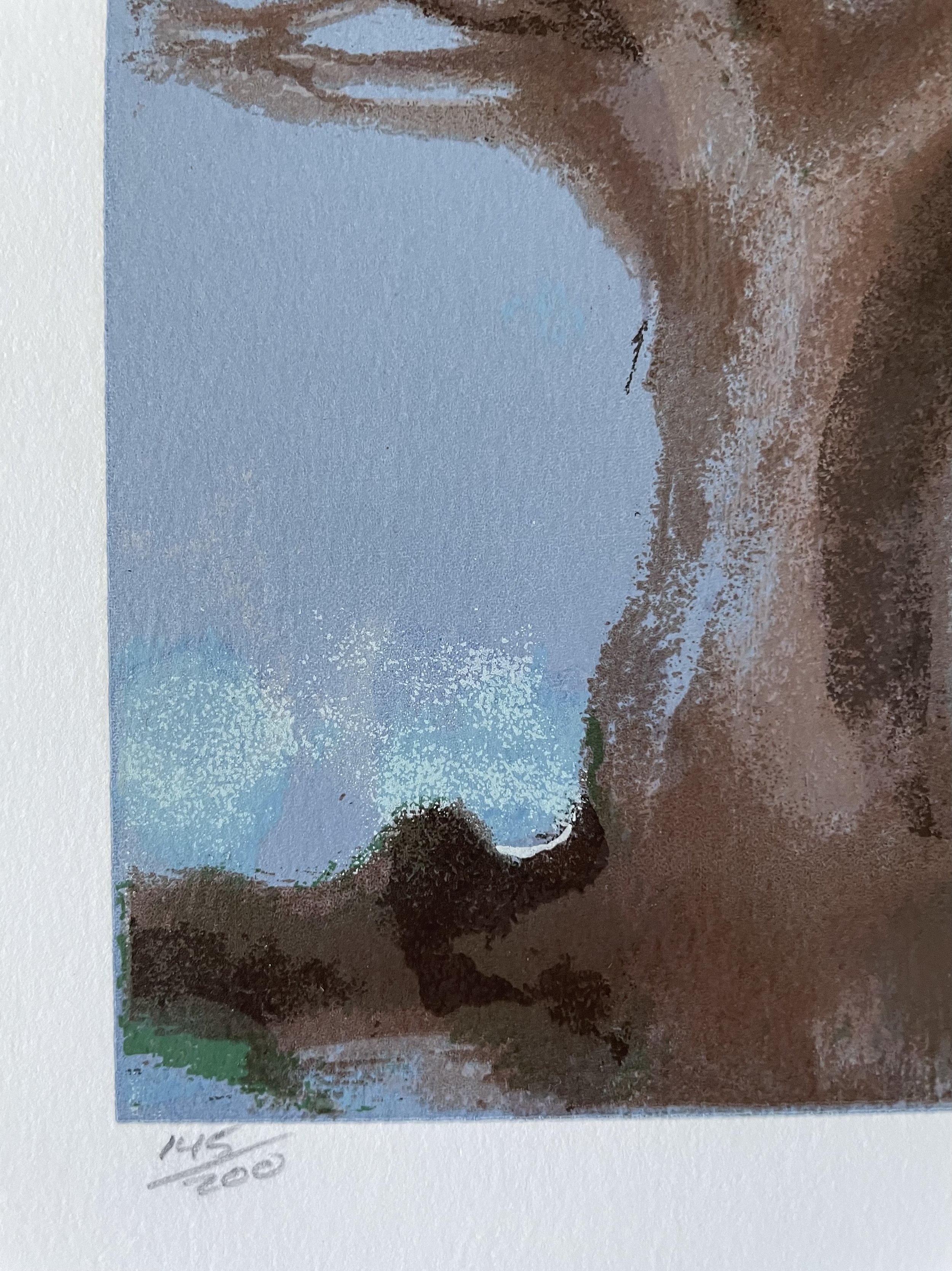
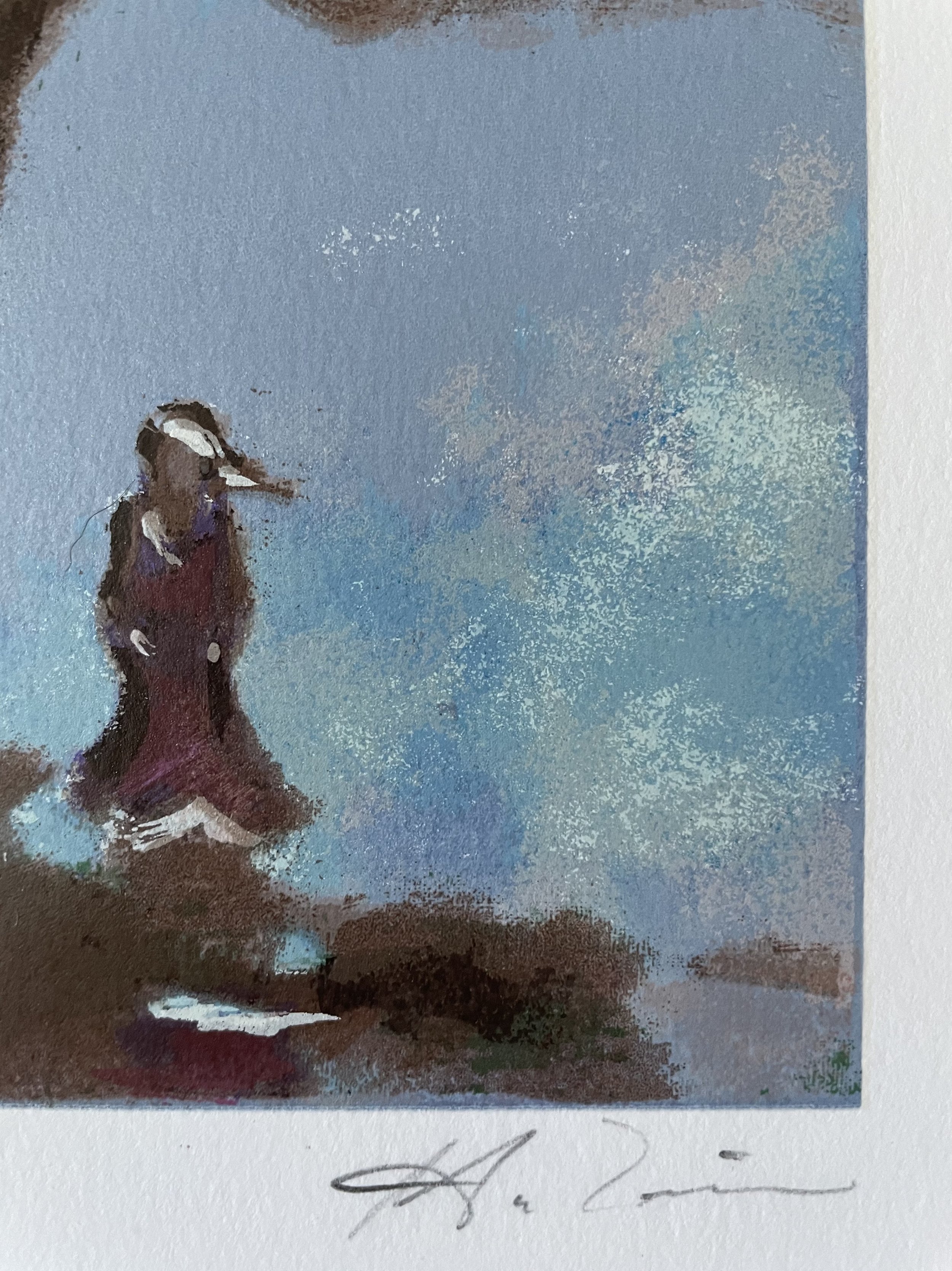
Cube Field, Marko Spalatin (Croatian/American, b. 1945), c. 1970s, serigraph on paper, 26 × 31 in., titled "cube field" lower left, numbered 36/50 center, pencil-signed lower right.

$1,800.00
Sold Out

Cube Field, Marko Spalatin (Croatian/American, b. 1945), c. 1970s, serigraph on paper, 26 × 31 in., titled "cube field" lower left, numbered 36/50 center, pencil-signed lower right.

Artwork Description

A masterwork of Op Art geometry — a precisely engineered serigraph depicting an infinite-seeming field of three-dimensional cubes receding toward a deep cobalt blue horizon, rendered in a two-tone palette of warm terracotta-orange and cool steel blue that creates a spatial illusion of extraordinary power and optical vibration.

The composition is built on a single, immensely effective visual conceit: a grid of identical flat-topped cubes, each rendered with three visible faces — top, left side, and right side — fills the entire picture plane, receding in isometric perspective from the large foreground forms to progressively smaller cubes in the distance until they dissolve into the deep blue background field. The cubes are divided between two colorways — warm orange-brown on the right and cool grey-blue on the left — with the transition between the two color zones running diagonally through the composition from lower left to upper right. This diagonal color division is not merely decorative. It activates the entire surface, preventing the isometric grid from reading as static and creating a secondary optical event — the perception of two separate fields, warm and cool, competing and interpenetrating — layered over the primary spatial recession.

The optical sophistication here is considerable. Isometric perspective — in which parallel lines remain parallel and do not converge at a vanishing point — creates a fundamentally ambiguous spatial experience: the cubes read simultaneously as a receding floor, a rising wall, and a flat pattern. The eye cannot settle on a single reading. It oscillates between figure and ground, between depth and surface, between the warm field and the cool field. This perpetual oscillation is not a flaw in the design — it is the design. It is Op Art in its purest form: a visual system engineered to produce a specific perceptual experience.

The serigraphic execution is flawless. The color areas are flat, precisely registered, and utterly clean — no gradients, no textures, no gestural marks. The entire image is built from the juxtaposition of flat color planes, demonstrating the serigraph's particular suitability for geometric Op Art: the medium's capacity for dense, opaque, perfectly edged color is uniquely suited to work that demands absolute precision.

The palette — deep cobalt blue background, warm terracotta-orange, and cool pale blue-grey — is characteristic of Spalatin's early 1970s cube series, a body of work that established him as one of America's leading Op Art printmakers.

Artist Biography

Marko Spalatin was born in Zagreb, Croatia and immigrated to the United States in the early 1960s. He earned both a BS and MFA from the University of Wisconsin in Madison Cumberland Gallery — an institution that during the late 1960s and early 1970s was a significant center for printmaking innovation and the development of the American serigraph as a fine art medium.

A leading American Op artist of the 1970s era and beyond, Spalatin came to the United States from Croatia in 1963. Since 1970 his art has been included in major exhibitions in New York, Chicago, Los Angeles, San Francisco, Washington, Paris, Montreal, and Beirut. Etsy

Spalatin has been exhibiting his artwork for over 40 years across the US as well as in France, Croatia, Canada, Lebanon, Italy, and Slovenia, and in numerous group exhibitions in 12 countries. Cumberland Gallery

His work is held in an extraordinary roster of permanent collections. His work is found in the collection of the Museum of Modern Art New York, the Tate Gallery, the Victoria and Albert Museum, the Musée d'Art Moderne Paris, the Brooklyn Museum, the Chicago Museum of Contemporary Art, the Philadelphia Museum of Art, the Cleveland Museum of Art, the Butler Institute of American Art, the Bibliothèque Nationale Paris, and the Library of Congress Washington DC. 1stDibs

Spalatin's work represents a continuous involvement with abstract geometric forms defined by careful manipulation of color and light. Cumberland Gallery In his own words: "The relationship between form and color within the pictorial field demands a visually symbiotic presence. The challenge revolves around the selection of a form as a vehicle for color, as well as choosing appropriate color and light for that form. This interplay creates a primary spatial illusion, along with secondary effects. I find that precisely defined areas of color, when placed against each other, compete for dominance."

The cube series — of which Cube Field is a prime example — dates from the early 1970s and represents the foundational body of work that established Spalatin's international reputation. Reviewed in the New York Times by John Canaday in 1972 and in Art News by Douglas Crimp the same year, his work attracted serious critical attention from the moment it reached New York's gallery circuit. The Cube Field serigraph, with its edition of 50, is among the most sought-after works from this period.

MARKO SPALATIN:  Born in 1945 in Zagreb, Croatia. He is well known for his colorful geometric designs in the form of limited edition prints and also original paintings. The movement of light through the world and across variegated surfaces and the relationship between them, is one of the focal points of Spalatin's work. “In general, my compositions remain formal and symmetrical in order to be set in motion by unexpected mutations of color and light. In some cases, the careful placement of small areas of saturated color against a backdrop of transitional grays creates an illusion of suspended particles. There is no doubt that in these images in particular, my sense of color and light is subconsciously influenced and sustained by many years of scuba diving in the waters of the Adriatic Sea and the Caribbean. I am intrigued by the relativity of color and by the mystery of light, and I am constantly challenged to explore their potentials. Every painting becomes a self-imposed visual problem, subjectively resolved in search of an objective truth.”His work has been featured in over 70 solo exhibitions and is represented in major museums and many private, corporate, and public collections, around the world. 

Cube Field, Marko Spalatin (Croatian/American, b. 1945), c. 1970s, serigraph on paper, 26 × 31 in., titled "cube field" lower left, numbered 36/50 center, pencil-signed lower right.

Artwork Description

A masterwork of Op Art geometry — a precisely engineered serigraph depicting an infinite-seeming field of three-dimensional cubes receding toward a deep cobalt blue horizon, rendered in a two-tone palette of warm terracotta-orange and cool steel blue that creates a spatial illusion of extraordinary power and optical vibration.

The composition is built on a single, immensely effective visual conceit: a grid of identical flat-topped cubes, each rendered with three visible faces — top, left side, and right side — fills the entire picture plane, receding in isometric perspective from the large foreground forms to progressively smaller cubes in the distance until they dissolve into the deep blue background field. The cubes are divided between two colorways — warm orange-brown on the right and cool grey-blue on the left — with the transition between the two color zones running diagonally through the composition from lower left to upper right. This diagonal color division is not merely decorative. It activates the entire surface, preventing the isometric grid from reading as static and creating a secondary optical event — the perception of two separate fields, warm and cool, competing and interpenetrating — layered over the primary spatial recession.

The optical sophistication here is considerable. Isometric perspective — in which parallel lines remain parallel and do not converge at a vanishing point — creates a fundamentally ambiguous spatial experience: the cubes read simultaneously as a receding floor, a rising wall, and a flat pattern. The eye cannot settle on a single reading. It oscillates between figure and ground, between depth and surface, between the warm field and the cool field. This perpetual oscillation is not a flaw in the design — it is the design. It is Op Art in its purest form: a visual system engineered to produce a specific perceptual experience.

The serigraphic execution is flawless. The color areas are flat, precisely registered, and utterly clean — no gradients, no textures, no gestural marks. The entire image is built from the juxtaposition of flat color planes, demonstrating the serigraph's particular suitability for geometric Op Art: the medium's capacity for dense, opaque, perfectly edged color is uniquely suited to work that demands absolute precision.

The palette — deep cobalt blue background, warm terracotta-orange, and cool pale blue-grey — is characteristic of Spalatin's early 1970s cube series, a body of work that established him as one of America's leading Op Art printmakers.

Artist Biography

Marko Spalatin was born in Zagreb, Croatia and immigrated to the United States in the early 1960s. He earned both a BS and MFA from the University of Wisconsin in Madison Cumberland Gallery — an institution that during the late 1960s and early 1970s was a significant center for printmaking innovation and the development of the American serigraph as a fine art medium.

A leading American Op artist of the 1970s era and beyond, Spalatin came to the United States from Croatia in 1963. Since 1970 his art has been included in major exhibitions in New York, Chicago, Los Angeles, San Francisco, Washington, Paris, Montreal, and Beirut. Etsy

Spalatin has been exhibiting his artwork for over 40 years across the US as well as in France, Croatia, Canada, Lebanon, Italy, and Slovenia, and in numerous group exhibitions in 12 countries. Cumberland Gallery

His work is held in an extraordinary roster of permanent collections. His work is found in the collection of the Museum of Modern Art New York, the Tate Gallery, the Victoria and Albert Museum, the Musée d'Art Moderne Paris, the Brooklyn Museum, the Chicago Museum of Contemporary Art, the Philadelphia Museum of Art, the Cleveland Museum of Art, the Butler Institute of American Art, the Bibliothèque Nationale Paris, and the Library of Congress Washington DC. 1stDibs

Spalatin's work represents a continuous involvement with abstract geometric forms defined by careful manipulation of color and light. Cumberland Gallery In his own words: "The relationship between form and color within the pictorial field demands a visually symbiotic presence. The challenge revolves around the selection of a form as a vehicle for color, as well as choosing appropriate color and light for that form. This interplay creates a primary spatial illusion, along with secondary effects. I find that precisely defined areas of color, when placed against each other, compete for dominance."

The cube series — of which Cube Field is a prime example — dates from the early 1970s and represents the foundational body of work that established Spalatin's international reputation. Reviewed in the New York Times by John Canaday in 1972 and in Art News by Douglas Crimp the same year, his work attracted serious critical attention from the moment it reached New York's gallery circuit. The Cube Field serigraph, with its edition of 50, is among the most sought-after works from this period.

MARKO SPALATIN:  Born in 1945 in Zagreb, Croatia. He is well known for his colorful geometric designs in the form of limited edition prints and also original paintings. The movement of light through the world and across variegated surfaces and the relationship between them, is one of the focal points of Spalatin's work. “In general, my compositions remain formal and symmetrical in order to be set in motion by unexpected mutations of color and light. In some cases, the careful placement of small areas of saturated color against a backdrop of transitional grays creates an illusion of suspended particles. There is no doubt that in these images in particular, my sense of color and light is subconsciously influenced and sustained by many years of scuba diving in the waters of the Adriatic Sea and the Caribbean. I am intrigued by the relativity of color and by the mystery of light, and I am constantly challenged to explore their potentials. Every painting becomes a self-imposed visual problem, subjectively resolved in search of an objective truth.”His work has been featured in over 70 solo exhibitions and is represented in major museums and many private, corporate, and public collections, around the world. 

“CUBE FIELD” -

MARKO SPALATIN - Serigraph - Signed & Numbered - 36/50

Image 25-1/2 x 20 inches (including signature and narrow white margin), paper 30-1/2 x 25-1/2 inches.  LIMITED EDITION HAND PULLED & DRAWN ORIGINAL SERIGRAPH, NUMBERED & HAND SIGNED BY ARTIST. From the retired Mitch Moore Gallery Inc, NYC. Unmatted, never framed or displayed. Image area is in very good frameable vintage condition. 

ARTISTS BIO:   Marko Spalatin:  Born in 1945 in Zagreb, Croatia, Marko Spalatin immigrated to the United States in 1963.   He studied at the University of Wisconsin at Madison, and earned a B.S. in Art in 1968 and a M.F.A. in 1971.   He is well known for his colorful geometric designs in the form of limited edition prints and also original paintings. The movement of light through the world and across variegated surfaces and the relationship between them, is one of the focal points of Spalatin's work. Although the paintings are inspired by nature, the specific source is finally not what is important. Spalatin's painting may inspire the viewer to recall the shifting brilliance of sunlight on summer's leaves, the swaying movements of a school of brightly colored tropical fish, the glittering reflections of moonlight on the ocean, or some other dazzling occurrence in nature. However, the viewer's task is not to figure out where a painting comes from, the to experience what it is.   His work is displayed in major museums around the world.  Read more about the artist and see a sampling of his other works on his website.  Search on Marko Spalatin. 

  • ARTIST'S STATEMENT: "My work represents a continuous involvement with abstract geometric forms defined by careful manipulation of color and light. The relationship between form and color within the pictorial field demands a visually symbiotic presence. The challenge revolves around the selection of a form as a vehicle for color, as well as choosing appropriate color and light for that form. This interplay creates a primary spatial illusion, along with secondary effects. I find that precisely defined areas of color, when placed against each other, compete for dominance. This activity, when further accentuated by tonal structure, produces multiple levels of perception. A given area of uniformly applied pigment loses its flat character through simultaneous contract with the surrounding colors. In many cases, the positive and negative spaces within the field become interchangeable. In more complex paintings, when the substructure is a series of repetitive modules, the color-light interplay reveals its polyphonic character. In general, my compositions remain formal and symmetrical in order to be set in motion by unexpected mutations of color and light. In some cases, the careful placement of small areas of saturated color against a backdrop of transitional grays creates an illusion of suspended particles. There is no doubt that in these images in particular, my sense of color and light is subconsciously influenced and sustained by many years of scuba diving in the waters of the Adriatic Sea and the Caribbean. I am intrigued by the relativity of color and by the mystery of light, and I am constantly challenged to explore their potentials. Every painting becomes a self-imposed visual problem, subjectively resolved in search of an objective truth."

  • His prints and paintings have been featured in over 70 solo exhibitions across the US, as well as in France, Croatia, Canada, Lebanon, Italy, and Slovenia, and in numerous group exhibitions in 12 countries. Spalatin’s work is represented in many private, corporate, and public collections, including:

COMMISSIONS AND PERMANENT COLLECTIONS

Museum of Modern Art, New York, NY

Musee d'Art Modern, Paris

Tate Gallery, London

Victoria and Albert Museum, London

Philadelphia Museum of Art, Philadelphia, PA

New York Public Library, New York City

Library of Congress, Washington, D.C.
Brooklyn Museum, Brooklyn, N.Y.
Akron Art Institute, Akron, Ohio

Oklahoma Art Center, Oklahoma City, Oklahoma

U.S. Steel Collection, Pittsburgh, PA

Pittsburgh National Bank, Pittsburgh, PA

Wisconsin Art Foundation

International Graphic Art Society, New York

American National Insurance Company, Galveston, Texas

Chase Manhattan Bank

Lessing J. Rosenwald Collection, Philadelphia, PA

Bibliotheque National, Paris, France

Museum of Contemporary Art-Chicago, Illinois

Metropolitan Museum-Manila, Philippines

Philadelphia Museum of Art-Philadelphia, Pennsylvania

The Butler Institute of American Art-Youngstown, Ohio

Museum of Modern Art-Belgrade, Yugoslavia

Milwaukee Art Museum-Milwaukee, Wisconsin

Lessing J. Rosenwald Collection-Philadelphia, Pennsylvania

Cleveland Museum of Art-Cleveland, Ohio

Elvehjem Museum of Art-Madison, Wisconsin

Museum of Modern Art-Novi Sad, Yugoslavia

Madison Art Center-Madison, Wisconsin

Masur Museum of Art-Monroe, Louisiana

National Arts Club-New York, New York

Albrecht Museum-St. Joseph, Missouri

Billings Art Center-Billings, Montana

National & University Library-Zagreb, Croatia

Rochester Museum of Art-Rochester, New York

Museum of Modern Art-Ljubljana, Slovenia

ONE MAN SHOWS

1971-Galerie Lahumiere, Paris

1971-University of Iowa, Iowa City, Iowa

1971-Madison Art Center, Madison, Wisconsin

1970-Fairwather Hardin Gallery, Chicago, Illinois

1070-Akron Art Institute, Akron, Ohio

GROUP SHOWS

1970-Venice Biennale, Venice, Italy

1970-Workd's Fair, Osaka Japan

1970-Phoenix Gallery, Berkeley, California

1970-New York State Council on the Arts travelling exhibition, in collaboration with the Brooklyn Museum

1970-Munson-Williams-Proctor Institute, Utica, New York

1969-Lincoln Memorial Art Center, Milwaukee, Wisconsin

1969-Madison Art Center, Madison, Wisconsin

1969-The Brooklyn Museum, Brooklyn, New York

1968-American Graphic Workshops Exhibition, Cincinnati, Ohio

AWARDS AND PRIZES

1971-Library of Congress, Washington, D.C.