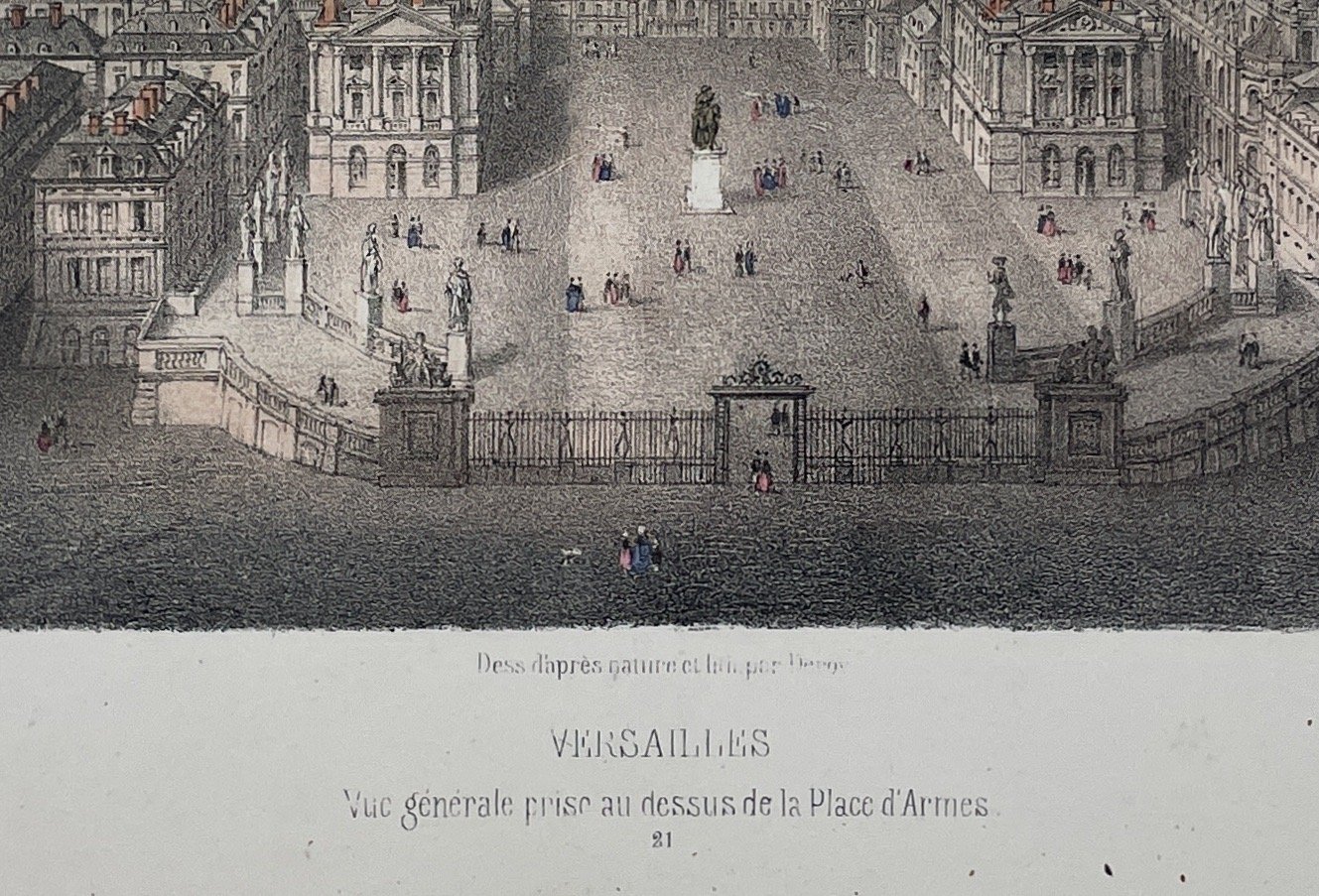
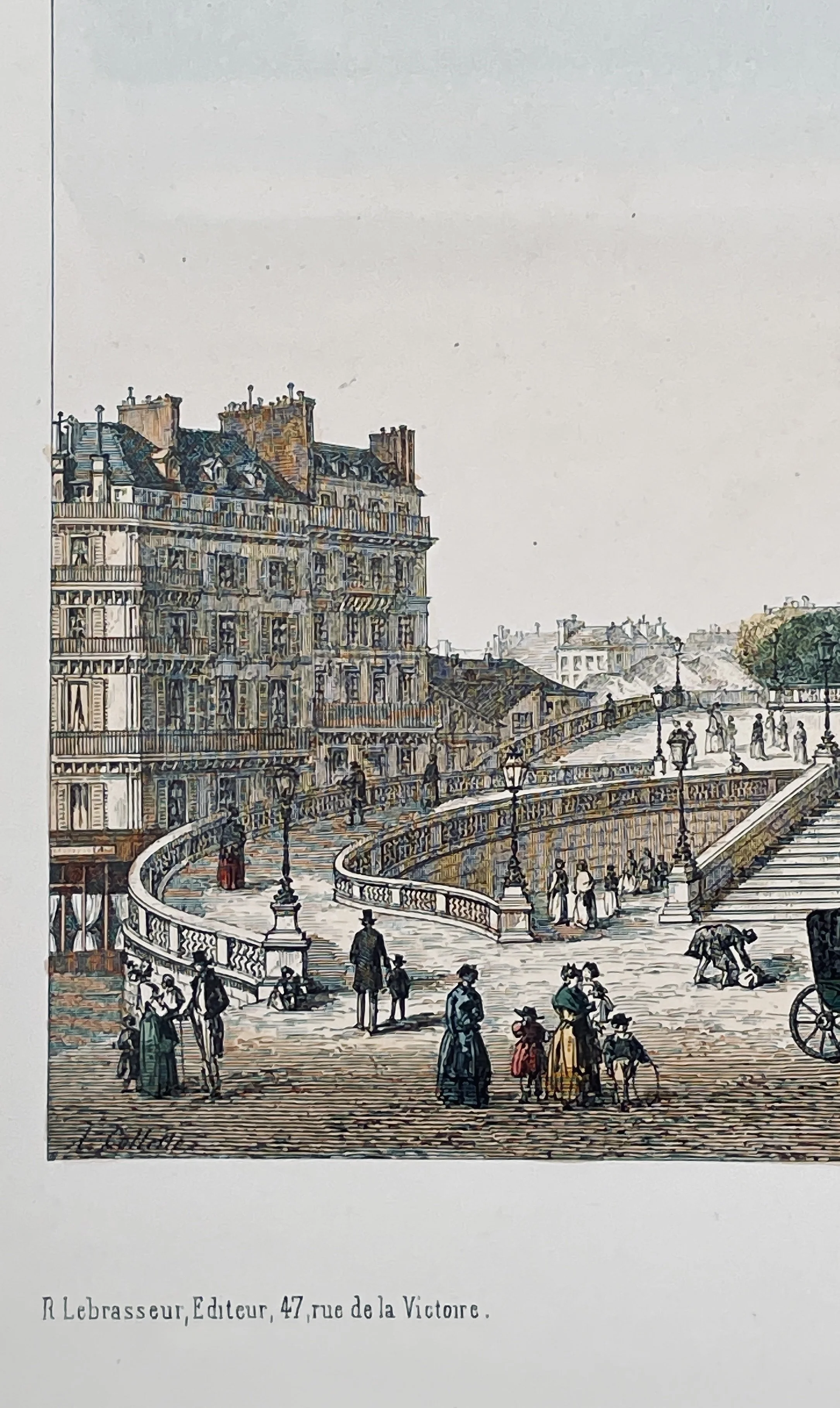
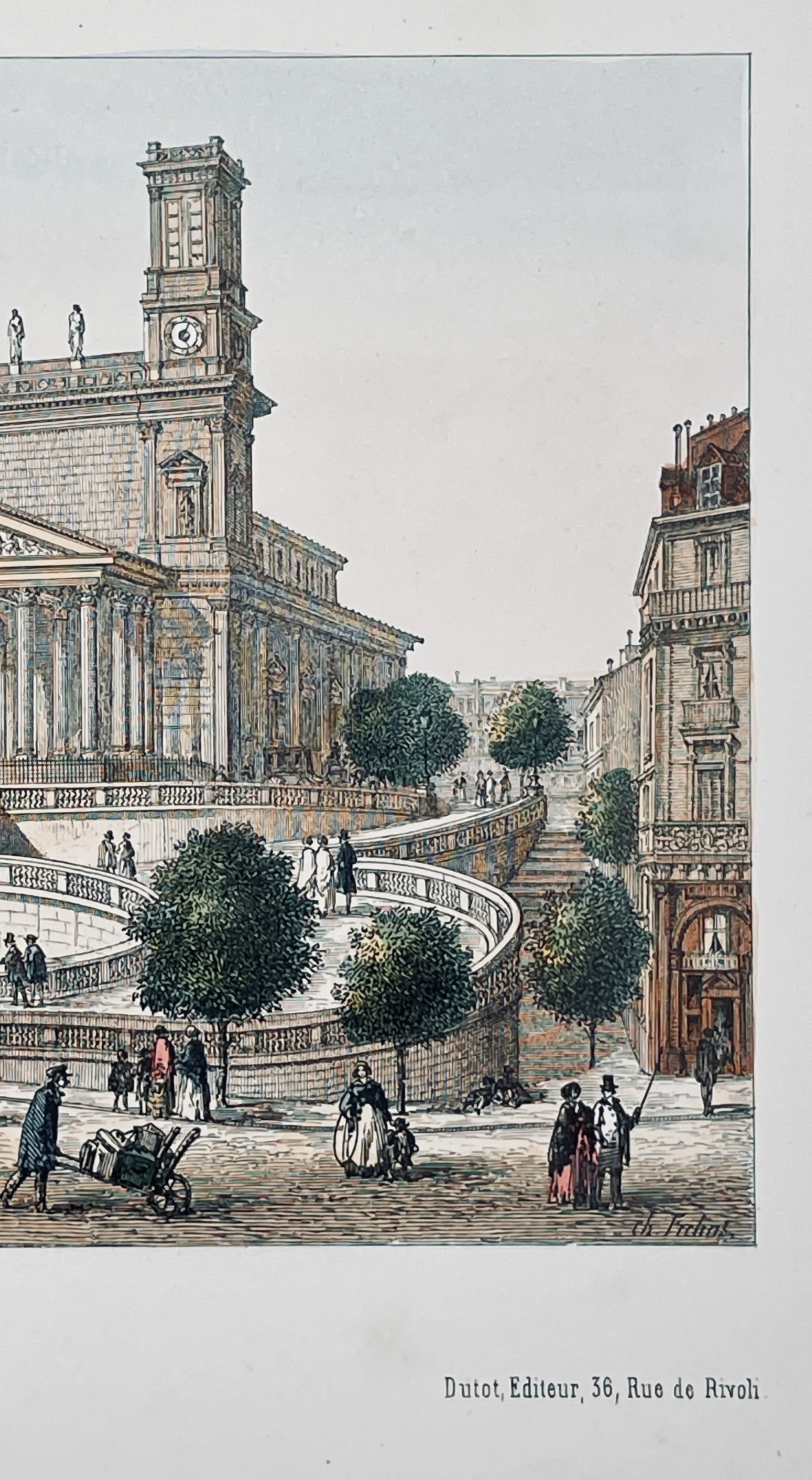
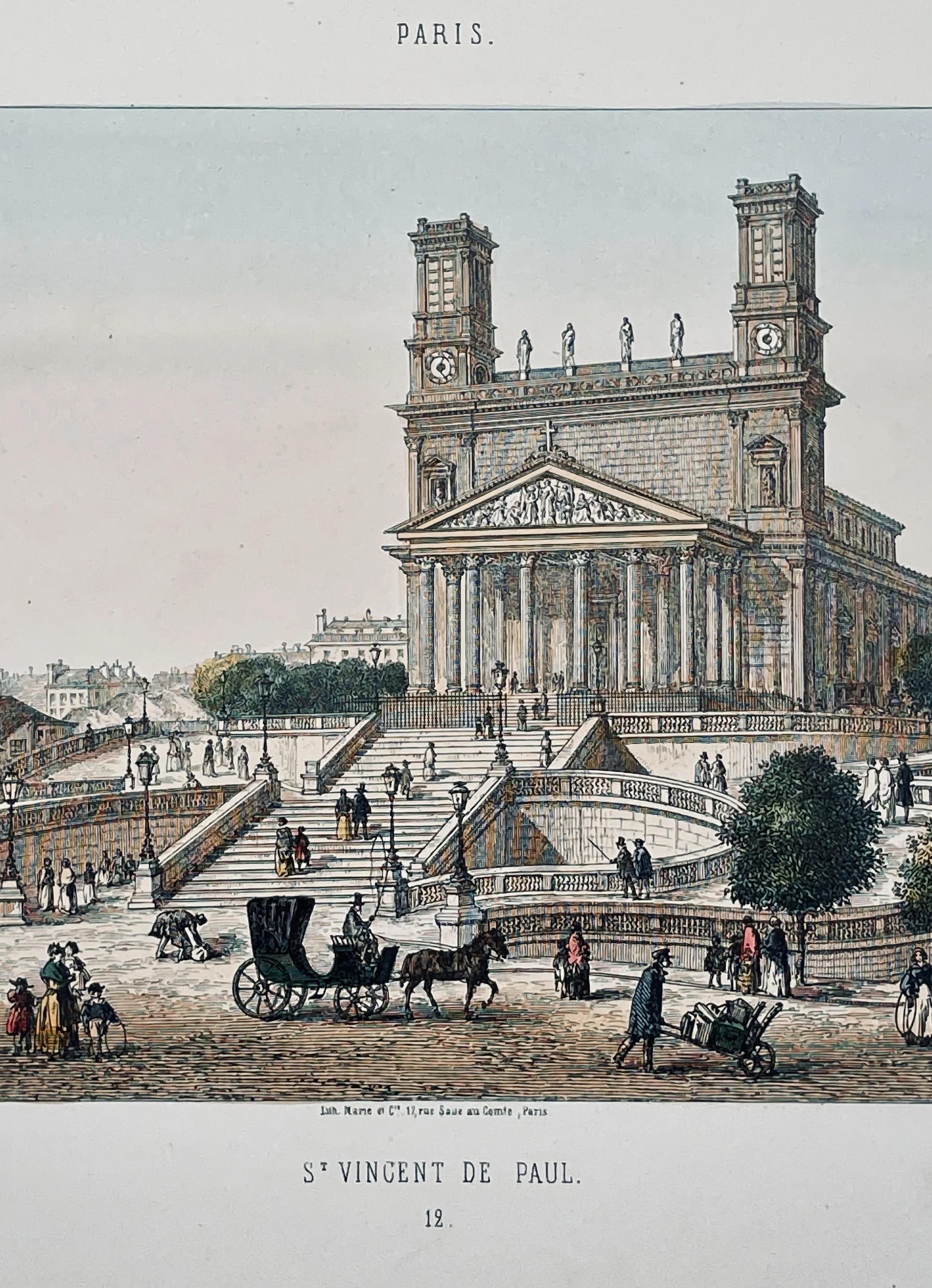
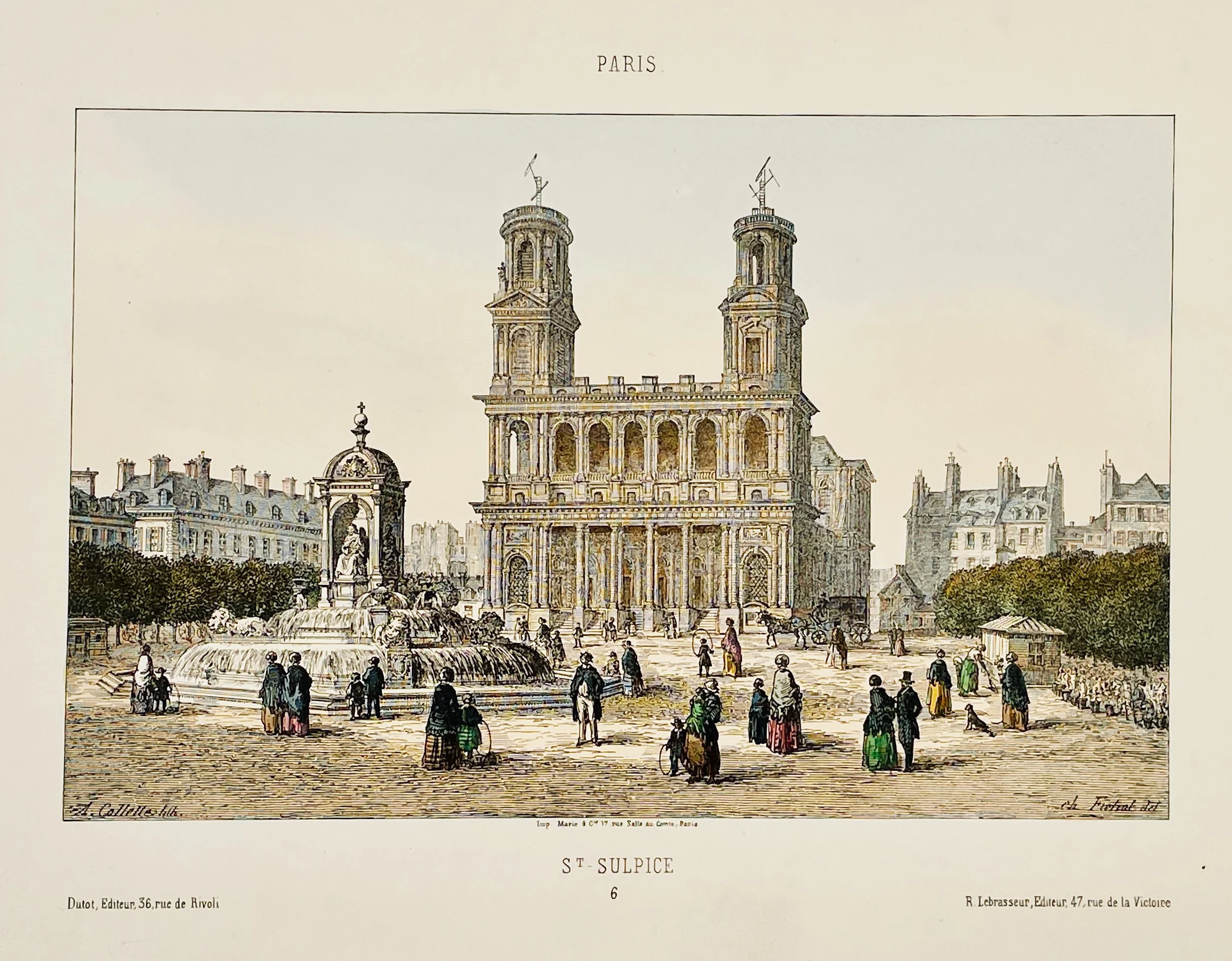
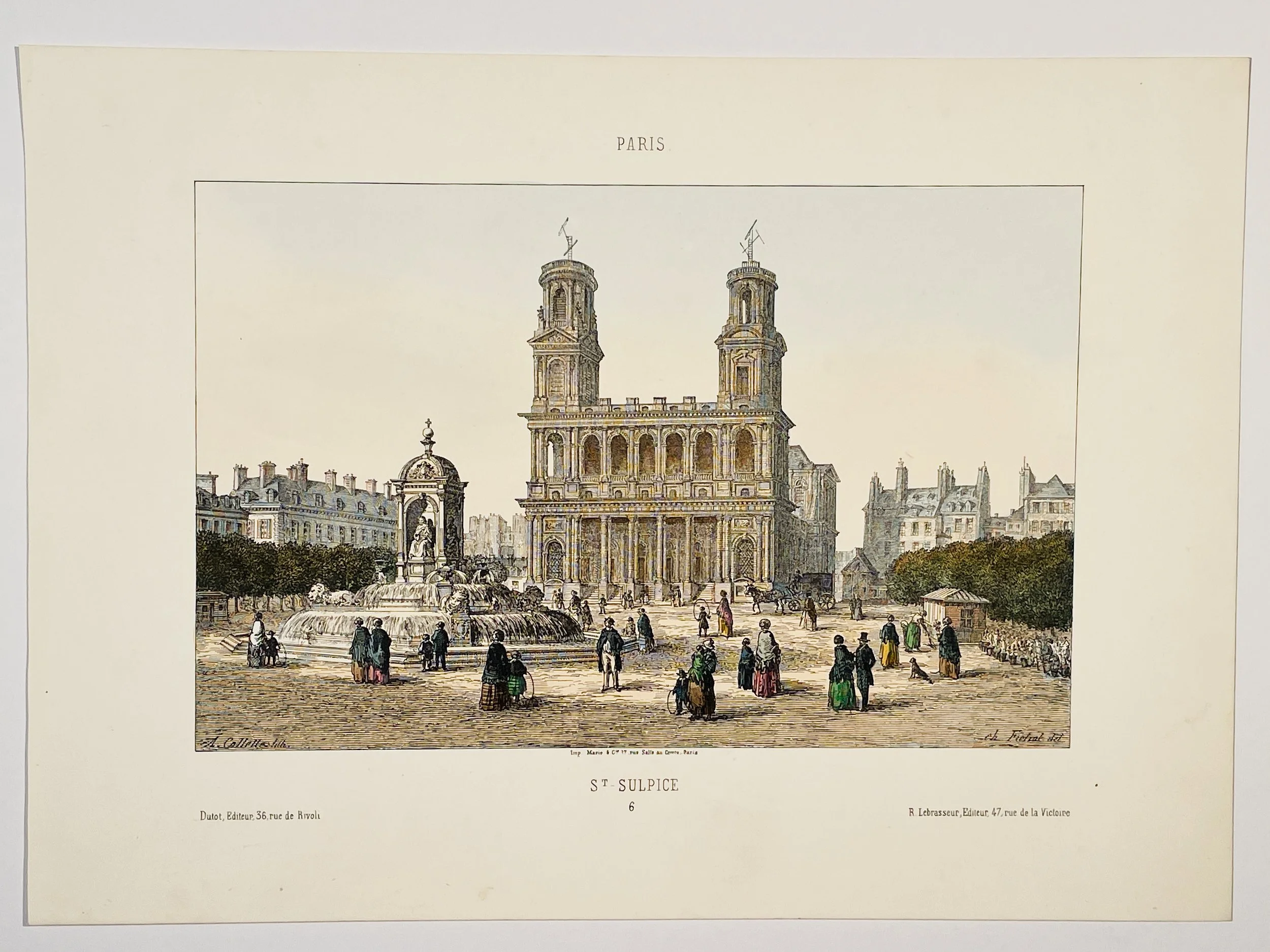
“Versailles (Vue générale prise au-dessus de la Place d’Armes),” Isidore-Laurent Deroy (French, 1797–1886), c. 1840s, hand-colored steel-engraved lithograph printed by Lemercier & Cie
“Versailles (Vue générale prise au-dessus de la Place d’Armes),” Isidore-Laurent Deroy (French, 1797–1886), c. 1840s, hand-colored steel-engraved lithograph printed by Lemercier & Cie and published by E. Morier, 10 x 6.5 in., unsigned in plate aside from publisher/printmaker credits.
This exquisite 19th-century hand-colored steel-engraved lithograph of Versailles, created by the celebrated French illustrator Isidore-Laurent Deroy and printed by the renowned atelier Lemercier & Cie, captures a sweeping panoramic view of the Place d’Armes and the Château de Versailles as part of the sought-after France en Miniatureseries. Rich period detailing, meticulous architectural draftsmanship, and delicate hand coloring make this an exceptional antique print ideal for collectors of historic French engravings, Versailles art, Grand Tour artworks, and 19th-century cartographic views.
Artwork Description
This steel-engraved, hand-colored lithograph presents a precise and elevated perspective of the Château de Versailles, viewed from above the Place d'Armes, as recorded in Deroy’s masterful architectural style. Published in the mid-19th century as part of France en Miniature, the print reflects the era’s fascination with documenting national monuments for educational and cultural dissemination.
Deroy’s fine linework—typical of steel-engraving—captures the strict geometry of the palace courtyard, the symmetry of the buildings, and the monumental approach toward the Avenue de Paris and distant forests. The hand-applied watercolor tints soften the scene, giving subtle life to the sky, figures, rooftops, and manicured grounds. The imprint line identifies “Imp. Lemercier, Paris,” one of the most important lithographic studios of the 19th century, while the publication line lists E. Morier, 5 rue du Pont de Lodi, a Parisian publisher known for fine architectural views.
This print is a testament to the 19th-century French effort to preserve national heritage through high-quality engraved views. It is both historically significant and visually refined—a classic representation of Versailles as it stood before major 20th-century restorations.
Artist & Printer Biographies
ISIDORE-LAURENT DEROY (1797–1886, France) – Artist
Isidore-Laurent Deroy was a distinguished French painter, draftsman, and lithographer born in Paris in 1797. He trained in the vibrant artistic circles of early 19th-century Paris, a period marked by the expansion of print culture and architectural documentation. Deroy became known for his precision, working extensively with publishers to create cityscapes, architectural views, and topographical scenes that were both educational and aesthetically sophisticated. His works frequently illustrated prestigious travel volumes, historical atlases, and monographs on French monuments.
Deroy collaborated with leading lithographers of his time, including Lemercier & Cie, whose advanced printing techniques allowed his drawings to be rendered with exceptional clarity. Throughout his career he produced views of Paris, Versailles, royal monuments, and provincial towns—reflecting a profound interest in national heritage at a moment when France was actively cataloging its architectural patrimony. Deroy exhibited in the Paris Salon and contributed to numerous engraved series circulated throughout Europe. His prints remain valuable for their documentary accuracy and refined composition.
LEMERCIER & CIE (Printer, Paris)
Founded by Rose-Joseph Lemercier in the early 19th century, Lemercier & Cie grew into one of Europe’s premier lithographic ateliers. By the 1830s–1850s, the firm was at the forefront of printmaking innovation, embracing large-scale color lithography and mastering fine steel-engraved transfer printing. They worked with France’s leading artists, publishers, and institutions, producing architectural plates, maps, posters, and illustrated books. Lemercier was awarded medals at industrial and universal exhibitions, cementing the atelier’s reputation as the gold standard of 19th-century French lithography.
E. MORIER (Publisher, Paris)
E. Morier operated from 5 rue du Pont de Lodi, Paris, specializing in architectural and educational engravings. Publishers like Morier played a crucial role in the dissemination of cultural knowledge during the 19th century by producing affordable but finely crafted prints of monuments, landscapes, and national treasures. Morier’s collaborations with Deroy and Lemercier resulted in some of the most elegant illustrated travel and reference plates of the era.
Isidore-Laurent Deroy (1797–1886), “Versailles – Vue générale prise au-dessus de la Place d’Armes,” c. 1840s. Steel-engraved lithograph with hand coloring, 10 x 6.5 in., printed by Lemercier & Cie, published by E. Morier. From the France en Miniature series. Very good antique condition.
CERTIFICATE OF VALUE & AUTHENTICATION
For Fine Art Appraisal / Insurance / Gallery Documentation
Artist: Isidore-Laurent Deroy (1797–1886)
Title: Versailles – Vue générale prise au-dessus de la Place d’Armes
Series: France en Miniature
Medium: Steel-engraved lithograph, hand colored
Printer: Lemercier & Cie, Paris
Publisher: E. Morier, 5 rue du Pont de Lodi, Paris
Date: c. 1840s
Dimensions: 10 x 6.5 inches
Authentication: Original 19th-century impression with period hand-applied coloring; publisher and printer imprints present; paper, printing technique, and style consistent with known works of the artist and atelier.
Current Owner: Artfind Gallery, Washington, DC
This document certifies the authenticity of the artwork described above as an original 19th-century print.
Provenance Chain
Publisher: E. Morier, Paris (c. 1840s)
Private Collection, Europe (19th–20th century)
Acquired in Europe (21st century)
Current Owner: Artfind Gallery, Washington, DC
Versailles
From France en Miniature
Isidore Laurent Deroy (Artist) | Lemercier & Cie (Printer) | E. Morier (Publisher)
c. 1840–1855
Steel-Engraved Lithograph, Hand-Colored
This finely detailed hand-colored lithograph depicts an elevated, panoramic view of the Palace of Versailles, one of France’s most magnificent symbols of royal power and architectural splendor. The viewer looks over the vast forecourt toward the palace’s main entrance, beyond which the carefully aligned Avenue de Paris and the distant Grand Perspective stretch toward the horizon. In the foreground, figures in period dress animate the marble forecourt and sculpture-lined terraces, while the surrounding architecture conveys the palace’s intricate geometry and stately rhythm.
Drawn by Isidore Laurent Deroy (1797–1886) — a French painter and lithographer celebrated for his topographical views and urban panoramas — this work is part of the series France en Miniature, which sought to document the architectural and cultural grandeur of the nation’s most important cities, monuments, and estates during the mid-19th century. Deroy’s mastery of linear perspective and atmospheric tone situates Versailles as both an emblem of royal absolutism and a marvel of design.
Printed by Lemercier & Cie, one of Paris’s most important 19th-century lithographic ateliers, the plate exemplifies the precision of steel-engraved lithography, a technique combining the fine line of engraving with the tonal range of lithographic printing. Each impression was then hand-colored, often by specialized colorists, to enhance the dimensionality of sky, stone, and greenery. The process reflected the golden age of French lithography, when publishers like E. Morier catered to an eager public fascinated by architectural beauty and national pride.
Historically, the Palace of Versailles was the central seat of power under Louis XIV, the “Sun King,” who transformed a modest hunting lodge into an opulent expression of divine monarchy between 1661 and 1710. The sweeping gardens designed by André Le Nôtre, visible in the print’s distant vista, became a model for formal landscape design across Europe. By the mid-19th century, when Deroy created this view, Versailles had evolved from royal residence to museum of French history — a transformation ordered by Louis-Philippe in 1837 — making it not only a site of regal memory but also of national heritage.
Through the precise linework, subtle color harmonies, and dramatic spatial depth, Deroy and Lemercier capture the enduring grandeur of Versailles — at once a monument to artistic ambition, political power, and the enduring ideal of France as la grande nation.
“Versailles (Vue générale prise au-dessus de la Place d’Armes),” Isidore-Laurent Deroy (French, 1797–1886), c. 1840s, hand-colored steel-engraved lithograph printed by Lemercier & Cie and published by E. Morier, 10 x 6.5 in., unsigned in plate aside from publisher/printmaker credits.
This exquisite 19th-century hand-colored steel-engraved lithograph of Versailles, created by the celebrated French illustrator Isidore-Laurent Deroy and printed by the renowned atelier Lemercier & Cie, captures a sweeping panoramic view of the Place d’Armes and the Château de Versailles as part of the sought-after France en Miniatureseries. Rich period detailing, meticulous architectural draftsmanship, and delicate hand coloring make this an exceptional antique print ideal for collectors of historic French engravings, Versailles art, Grand Tour artworks, and 19th-century cartographic views.
Artwork Description
This steel-engraved, hand-colored lithograph presents a precise and elevated perspective of the Château de Versailles, viewed from above the Place d'Armes, as recorded in Deroy’s masterful architectural style. Published in the mid-19th century as part of France en Miniature, the print reflects the era’s fascination with documenting national monuments for educational and cultural dissemination.
Deroy’s fine linework—typical of steel-engraving—captures the strict geometry of the palace courtyard, the symmetry of the buildings, and the monumental approach toward the Avenue de Paris and distant forests. The hand-applied watercolor tints soften the scene, giving subtle life to the sky, figures, rooftops, and manicured grounds. The imprint line identifies “Imp. Lemercier, Paris,” one of the most important lithographic studios of the 19th century, while the publication line lists E. Morier, 5 rue du Pont de Lodi, a Parisian publisher known for fine architectural views.
This print is a testament to the 19th-century French effort to preserve national heritage through high-quality engraved views. It is both historically significant and visually refined—a classic representation of Versailles as it stood before major 20th-century restorations.
Artist & Printer Biographies
ISIDORE-LAURENT DEROY (1797–1886, France) – Artist
Isidore-Laurent Deroy was a distinguished French painter, draftsman, and lithographer born in Paris in 1797. He trained in the vibrant artistic circles of early 19th-century Paris, a period marked by the expansion of print culture and architectural documentation. Deroy became known for his precision, working extensively with publishers to create cityscapes, architectural views, and topographical scenes that were both educational and aesthetically sophisticated. His works frequently illustrated prestigious travel volumes, historical atlases, and monographs on French monuments.
Deroy collaborated with leading lithographers of his time, including Lemercier & Cie, whose advanced printing techniques allowed his drawings to be rendered with exceptional clarity. Throughout his career he produced views of Paris, Versailles, royal monuments, and provincial towns—reflecting a profound interest in national heritage at a moment when France was actively cataloging its architectural patrimony. Deroy exhibited in the Paris Salon and contributed to numerous engraved series circulated throughout Europe. His prints remain valuable for their documentary accuracy and refined composition.
LEMERCIER & CIE (Printer, Paris)
Founded by Rose-Joseph Lemercier in the early 19th century, Lemercier & Cie grew into one of Europe’s premier lithographic ateliers. By the 1830s–1850s, the firm was at the forefront of printmaking innovation, embracing large-scale color lithography and mastering fine steel-engraved transfer printing. They worked with France’s leading artists, publishers, and institutions, producing architectural plates, maps, posters, and illustrated books. Lemercier was awarded medals at industrial and universal exhibitions, cementing the atelier’s reputation as the gold standard of 19th-century French lithography.
E. MORIER (Publisher, Paris)
E. Morier operated from 5 rue du Pont de Lodi, Paris, specializing in architectural and educational engravings. Publishers like Morier played a crucial role in the dissemination of cultural knowledge during the 19th century by producing affordable but finely crafted prints of monuments, landscapes, and national treasures. Morier’s collaborations with Deroy and Lemercier resulted in some of the most elegant illustrated travel and reference plates of the era.
Isidore-Laurent Deroy (1797–1886), “Versailles – Vue générale prise au-dessus de la Place d’Armes,” c. 1840s. Steel-engraved lithograph with hand coloring, 10 x 6.5 in., printed by Lemercier & Cie, published by E. Morier. From the France en Miniature series. Very good antique condition.
CERTIFICATE OF VALUE & AUTHENTICATION
For Fine Art Appraisal / Insurance / Gallery Documentation
Artist: Isidore-Laurent Deroy (1797–1886)
Title: Versailles – Vue générale prise au-dessus de la Place d’Armes
Series: France en Miniature
Medium: Steel-engraved lithograph, hand colored
Printer: Lemercier & Cie, Paris
Publisher: E. Morier, 5 rue du Pont de Lodi, Paris
Date: c. 1840s
Dimensions: 10 x 6.5 inches
Authentication: Original 19th-century impression with period hand-applied coloring; publisher and printer imprints present; paper, printing technique, and style consistent with known works of the artist and atelier.
Current Owner: Artfind Gallery, Washington, DC
This document certifies the authenticity of the artwork described above as an original 19th-century print.
Provenance Chain
Publisher: E. Morier, Paris (c. 1840s)
Private Collection, Europe (19th–20th century)
Acquired in Europe (21st century)
Current Owner: Artfind Gallery, Washington, DC
Versailles
From France en Miniature
Isidore Laurent Deroy (Artist) | Lemercier & Cie (Printer) | E. Morier (Publisher)
c. 1840–1855
Steel-Engraved Lithograph, Hand-Colored
This finely detailed hand-colored lithograph depicts an elevated, panoramic view of the Palace of Versailles, one of France’s most magnificent symbols of royal power and architectural splendor. The viewer looks over the vast forecourt toward the palace’s main entrance, beyond which the carefully aligned Avenue de Paris and the distant Grand Perspective stretch toward the horizon. In the foreground, figures in period dress animate the marble forecourt and sculpture-lined terraces, while the surrounding architecture conveys the palace’s intricate geometry and stately rhythm.
Drawn by Isidore Laurent Deroy (1797–1886) — a French painter and lithographer celebrated for his topographical views and urban panoramas — this work is part of the series France en Miniature, which sought to document the architectural and cultural grandeur of the nation’s most important cities, monuments, and estates during the mid-19th century. Deroy’s mastery of linear perspective and atmospheric tone situates Versailles as both an emblem of royal absolutism and a marvel of design.
Printed by Lemercier & Cie, one of Paris’s most important 19th-century lithographic ateliers, the plate exemplifies the precision of steel-engraved lithography, a technique combining the fine line of engraving with the tonal range of lithographic printing. Each impression was then hand-colored, often by specialized colorists, to enhance the dimensionality of sky, stone, and greenery. The process reflected the golden age of French lithography, when publishers like E. Morier catered to an eager public fascinated by architectural beauty and national pride.
Historically, the Palace of Versailles was the central seat of power under Louis XIV, the “Sun King,” who transformed a modest hunting lodge into an opulent expression of divine monarchy between 1661 and 1710. The sweeping gardens designed by André Le Nôtre, visible in the print’s distant vista, became a model for formal landscape design across Europe. By the mid-19th century, when Deroy created this view, Versailles had evolved from royal residence to museum of French history — a transformation ordered by Louis-Philippe in 1837 — making it not only a site of regal memory but also of national heritage.
Through the precise linework, subtle color harmonies, and dramatic spatial depth, Deroy and Lemercier capture the enduring grandeur of Versailles — at once a monument to artistic ambition, political power, and the enduring ideal of France as la grande nation.
“VERSAILLES” - “France En Miniature”
ISIDORE LAURENT DEROY (Artist); Lemercier & Cie (Printer); E Morier (Publisher) - Steel engraved Lithograph, Hand Colored
10 x 6.5 inches
From the retired Mitch Moore Gallery Inc, NYC. Unmatted, never framed or displayed. Image area is in very good frameable vintage condition.
In the first half of the 19th century, color images were usually printed in black and white and then colored by hand.
Steel Engravings
Another of the intaglio printmaking techniques, steel engraving produced illustrations based on steel, rather than copper. The method was first introduced in 1792 by American physicist, Jacob Perkins, for the printing of banknotes, and was later adapted in England by Charles Warren for Thomas Campbell’s 1820 poem ‘Pleasure of Hope’, which contained the first published plates engraved on steel.
Until this time, copper had been the preferred metal for engraving. The plates were soft, simple to carve, and were capable of producing a few hundred prints before re-engraving was required to sharpen the image. These characteristics made copper an attractive medium, particularly for mapmakers who frequently needed to update their prints when new land was discovered or existing land changed hands. By the 1820s, however, a shift towards steel for engravings began to emerge. Steel was cheaper than copper and the engraved plates produced much sharper and more distinct lines. The plates were also harder-wearing, resulting in thousands of prints before re-engraving became necessary. This hard nature allowed for much finer detail than copper and, for the first time, it was possible to achieve a beautiful pale grey in the final illustration. With its shimmering appearance, the steel engraving became instantly recognizable.
Though it looked more refined than its copperplate counterpart, the steel engraving was actually created in much the same way. The steel plate was engraved with a burin that produced thin, furrowed lines which, in turn, left behind a ‘burr’. This burr was then scraped away so as not to introduce unsightly spots into the final print. This process was not easy for the engraver. The steel was so hard that many turned to etching the plate instead; acid quickly created image outlines in the plate where ‘ground’ had been removed with an etching needle. Once the engraver was satisfied with their work, the plate’s surface was inked and wiped in a circular motion to push that ink in the incised lines. A piece of slightly dampened paper was then placed on top of the plate and the whole pressed with sufficient force to produce the final print. As in copperplate engraving, a plate mark or indentation in the paper remained visible around the edges of the illustration.
In its heyday of the 1820s-1840s, steel engraving was responsible for some of the most superb illustrations. Steel allowed engravers to push the craft to its absolute limits; in some prints it was only possible to see the individual lines with a magnifying glass. Some illustrations were so authentic, so real, that it was not impossible for the reader, particularly of travel books, to actually imagine themselves there.