 Image 1 of 6
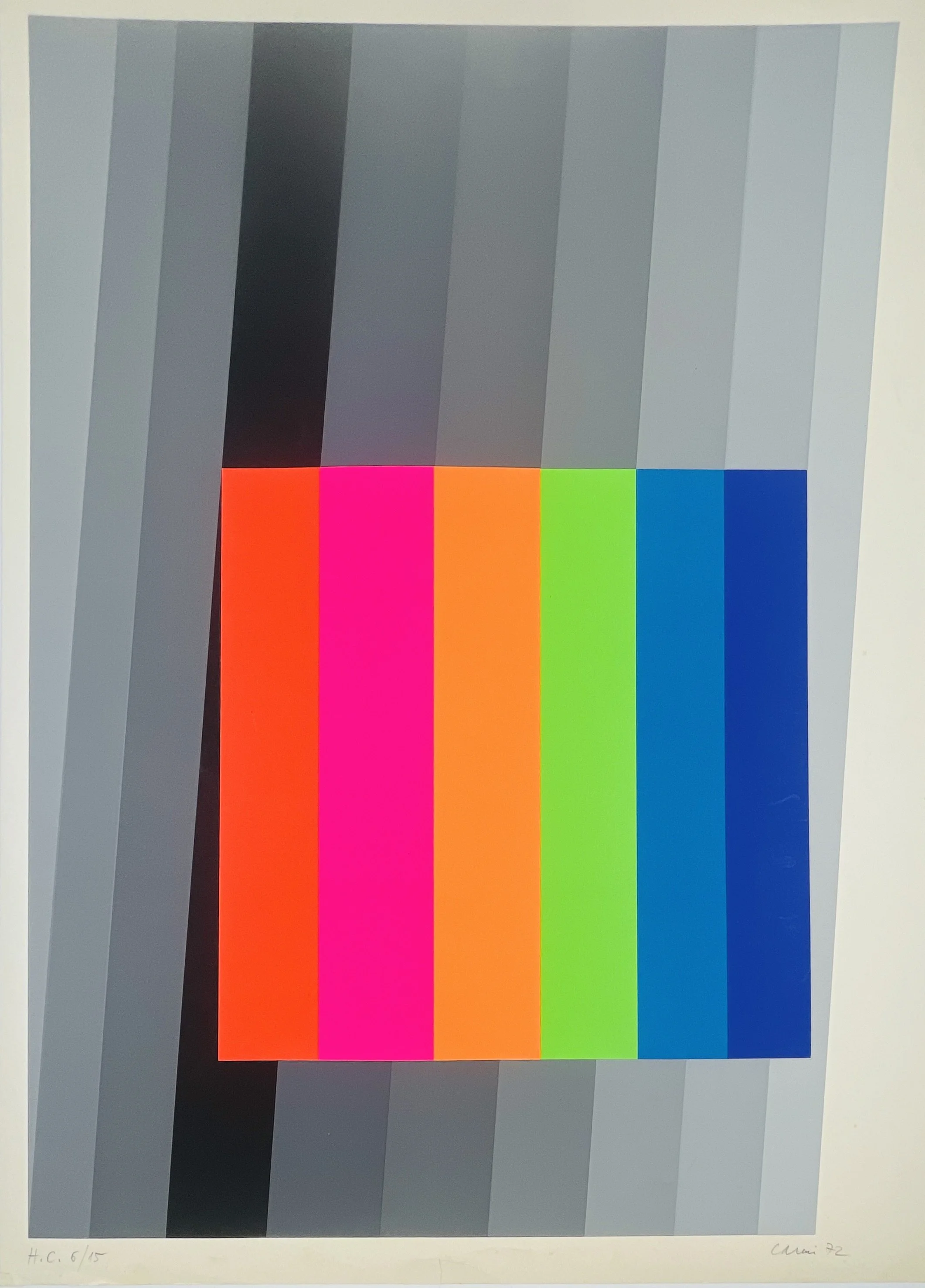 Image 2 of 6
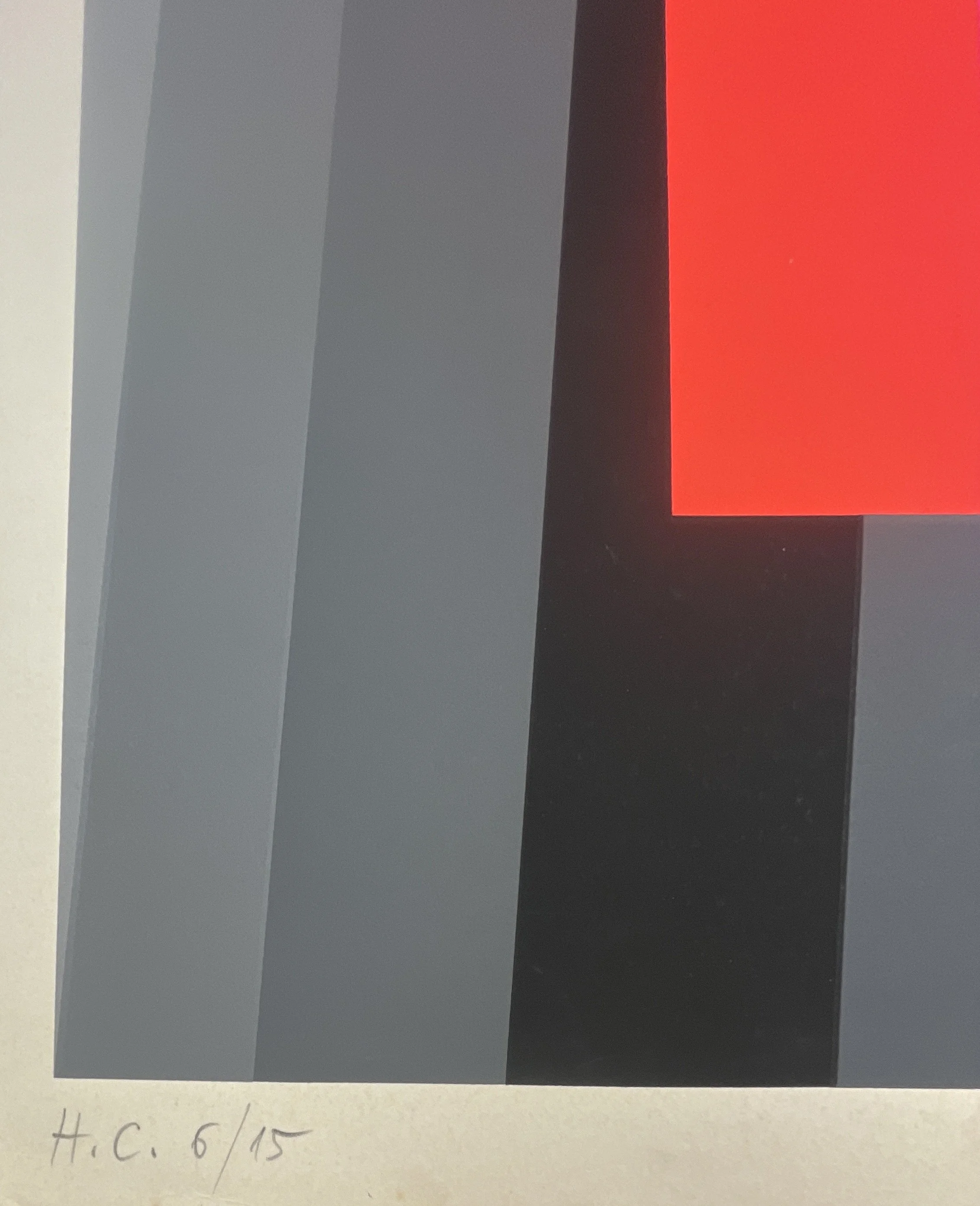 Image 3 of 6
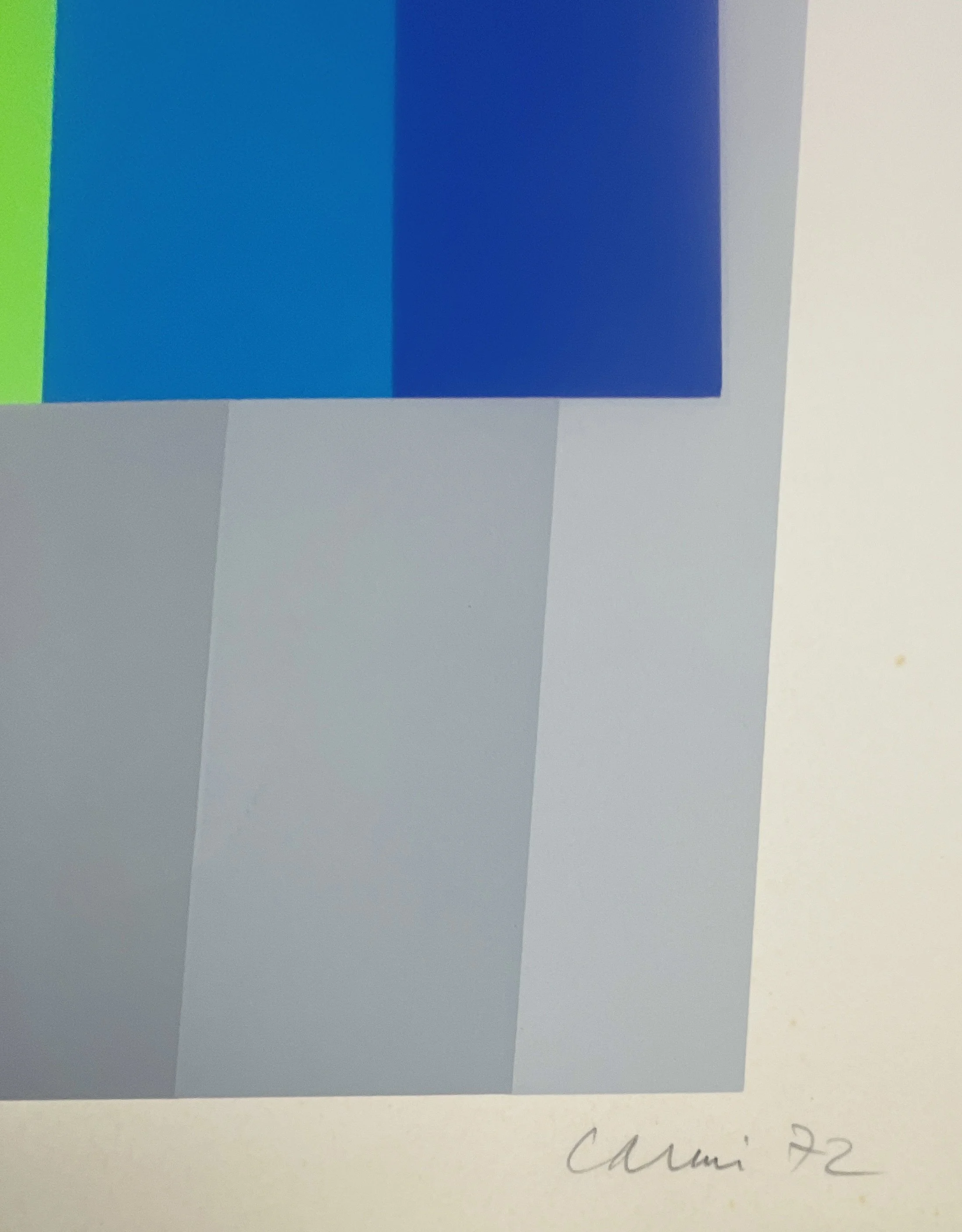 Image 4 of 6
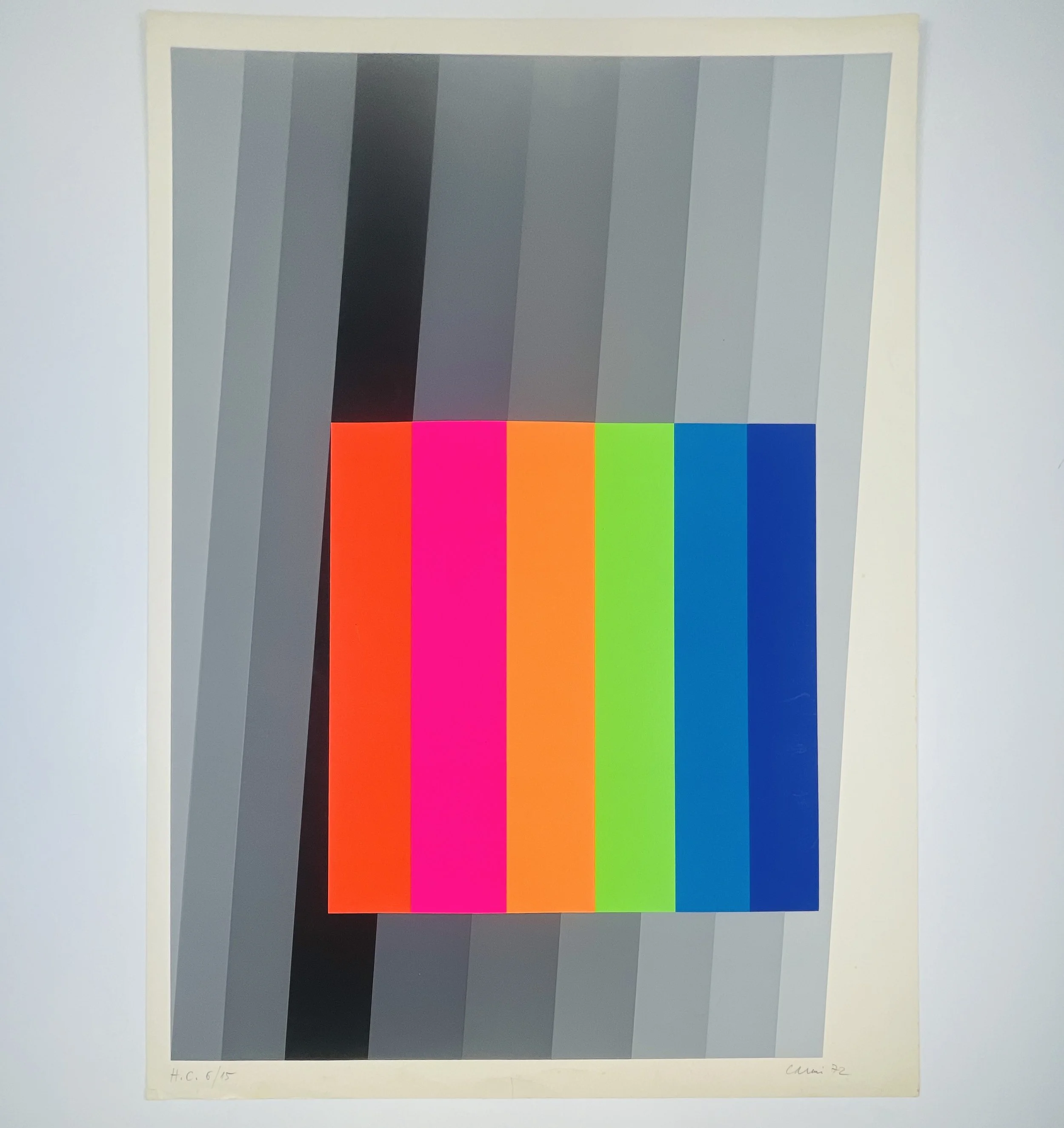 Image 5 of 6
 Image 6 of 6
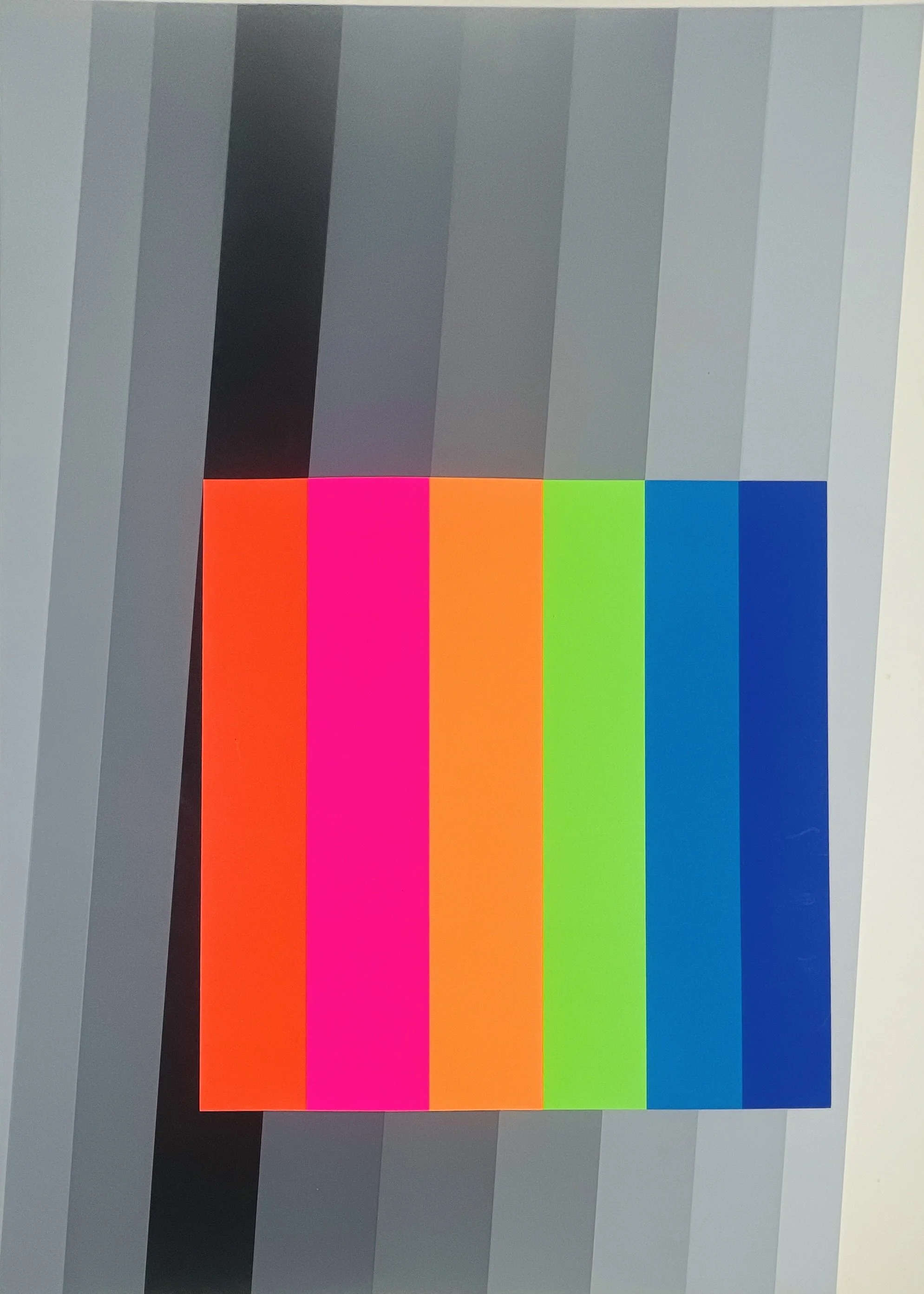
Untitled (Geometric Color Bands), Eugenio Carmi, 1972, serigraph on paper, 24 × 34 in., signed “Carmi ’72,” HC 6/15 proof.
Untitled (Geometric Color Bands), Eugenio Carmi, 1972, serigraph on paper, 24 × 34 in., signed “Carmi ’72,” HC 6/15 proof.
A striking 1972 geometric abstraction by Italian modernist Eugenio Carmi featuring fluorescent bands of color suspended against a rhythmic field of grey tonal stripes. This hand-signed HC proof exemplifies Carmi’s pioneering exploration of optical perception, kinetic balance, and the fusion of industrial color with precise modernist geometry.
Artwork Description
This 1972 abstract composition by Eugenio Carmi is a refined example of the artist’s exploration of geometric structure, color perception, and optical rhythm that defined his work during the late 1960s and early 1970s.
The image is constructed from a disciplined arrangement of vertical tonal bands rendered in gradations of grey. These subtle transitions create a soft atmospheric field that reads almost like light moving across brushed steel. Interrupting this quiet tonal rhythm is a sharply defined rectangular block of saturated color—orange, magenta, orange-yellow, neon green, cobalt blue, and ultramarine—stacked in luminous vertical bars. The color block floats slightly off center and intersects with a dark vertical band beneath it, creating a subtle sense of tension and equilibrium.
Carmi was deeply interested in the visual psychology of balance. In this work, the greys recede while the fluorescent spectrum appears to advance toward the viewer, creating an illusion of spatial vibration. The result is both calm and energetic: a restrained field interrupted by an intense chromatic pulse.
The work was produced in 1972, a period when Carmi was internationally recognized for his experiments with multiples, kinetic structures, and technologically influenced abstraction. The crisp edges and even color fields strongly suggest a serigraph (silkscreen) printing process, which allowed Carmi to achieve the intense saturation and precision required for his optical compositions.
The lower margin is signed in pencil “Carmi ’72,” and the left margin bears the notation “H.C. 6/15,” indicating a hors commerce (artist’s proof) impression outside the standard numbered edition. These proofs were typically reserved for the artist or publisher and are often considered particularly desirable among collectors.
The visual language of this work reflects Carmi’s broader artistic philosophy: the merging of art, design, science, and technology. The piece feels simultaneously mathematical and poetic, demonstrating how carefully calibrated color relationships can create emotional resonance within a rigorously structured composition.
Artist Biography
Eugenio Carmi was one of the most important figures in postwar Italian geometric abstraction and a pioneer in the use of industrial materials and technological concepts within contemporary art.
Born in Genoa, Italy in 1920, Carmi initially trained as an engineer before turning to art after World War II. This technical background would profoundly shape his artistic approach. His work consistently demonstrates a fascination with structure, systems, and the relationship between art and modern technology.
During the late 1950s Carmi began experimenting with enamel on steel and welded metal structures, producing works that bridged sculpture, industrial design, and painting. Between 1958 and 1965 he developed a series of works using industrial materials such as steel plates and enamel finishes, reflecting the optimism and visual language of the postwar industrial era.
By the early 1960s Carmi had emerged as a leading figure in Italian geometric abstraction. He began producing lithographed metal plates and multiples that explored the intersection of art, architecture, and industrial design. His work was exhibited internationally, including an important one-man exhibition at the Museum of Modern Art in Zagreb.
Carmi also collaborated with some of the most influential intellectual figures of the era. In 1966 he worked with writer and philosopher Umberto Eco and vocalist Cathy Berberian on the experimental book Strip-Sody, a landmark fusion of visual art, typography, and sound.
Throughout the late 1960s Carmi expanded into electronic and kinetic works. He participated in the landmark exhibition Cybernetic Serendipity at the Institute of Contemporary Arts in London, which explored the intersection of art and emerging computer technologies. During this period he created “electric imaginary signals,” works incorporating light, plexiglass, and aluminum.
His career quickly became international. Carmi exhibited widely across Europe and beyond, including the Venice Biennale, the British International Print Biennale in Bradford, and international print biennials in Krakow and Tokyo. One-man exhibitions were held in Milan, Paris, Zurich, and other major cultural centers.
In addition to his artistic practice, Carmi was active as a lecturer and educator. He delivered lectures in the United States, including at Rhode Island University, and participated in numerous educational programs in Europe. He was also a founding member of the Gruppo Cooperativo di Boccadasse in Genoa and collaborated with experimental television programs in Italy.
Carmi’s work often explored themes of visual communication and industrial design. He produced safety posters for factories, public art installations, and experimental environments that integrated light, movement, and architectural space.
In 1972 he published The White Book, further demonstrating his interest in the relationship between language, structure, and visual perception.
Over the following decades Carmi continued to produce paintings, prints, and sculptural works that fused rigorous geometry with luminous color fields. His art sits at the intersection of Op Art, kinetic art, and Constructivist abstraction, yet retains a uniquely poetic sensibility rooted in Italian design culture.
Today Carmi’s works are held in numerous international collections and are recognized as important contributions to the evolution of postwar European abstraction.
Eugenio Carmi (1920–2016)
Untitled Geometric Composition, 1972
Serigraph on paper
24 × 34 inches
Hand-signed “Carmi ’72” lower right
H.C. 6/15 artist’s proof
Italian geometric abstraction / Op Art period.
Certificate of Authentication
This certifies that the artwork titled Untitled (Geometric Color Bands) is an original serigraph created by Eugenio Carmi in 1972.
Medium: Serigraph on paper
Dimensions: 24 × 34 inches
Signature: Hand signed “Carmi ’72” lower right
Edition: H.C. 6/15 (Hors Commerce proof)
This impression was published during the artist’s active printmaking period and represents an authentic example of Carmi’s geometric abstraction work from the early 1970s.
Provenance confirms acquisition through Mitch Morse Gallery with subsequent transfer to Artfind Gallery, Washington DC.
Condition
Very good vintage condition.
Minor age toning visible along the margins and slight paper discoloration consistent with works on paper from the early 1970s. Image area remains strong and vibrant with excellent color saturation. No visible tears or restoration.
Provenance
Artist: Eugenio Carmi, Milan / Genoa
Schwarz Editions / European print publishers, early 1970s period
Mitch Morse Gallery, New York
Acquired through Mitch Morse Gallery from sources in New York and Europe
Artfind Gallery, Washington DC (current owner)
Untitled (Geometric Color Bands), Eugenio Carmi, 1972, serigraph on paper, 24 × 34 in., signed “Carmi ’72,” HC 6/15 proof.
A striking 1972 geometric abstraction by Italian modernist Eugenio Carmi featuring fluorescent bands of color suspended against a rhythmic field of grey tonal stripes. This hand-signed HC proof exemplifies Carmi’s pioneering exploration of optical perception, kinetic balance, and the fusion of industrial color with precise modernist geometry.
Artwork Description
This 1972 abstract composition by Eugenio Carmi is a refined example of the artist’s exploration of geometric structure, color perception, and optical rhythm that defined his work during the late 1960s and early 1970s.
The image is constructed from a disciplined arrangement of vertical tonal bands rendered in gradations of grey. These subtle transitions create a soft atmospheric field that reads almost like light moving across brushed steel. Interrupting this quiet tonal rhythm is a sharply defined rectangular block of saturated color—orange, magenta, orange-yellow, neon green, cobalt blue, and ultramarine—stacked in luminous vertical bars. The color block floats slightly off center and intersects with a dark vertical band beneath it, creating a subtle sense of tension and equilibrium.
Carmi was deeply interested in the visual psychology of balance. In this work, the greys recede while the fluorescent spectrum appears to advance toward the viewer, creating an illusion of spatial vibration. The result is both calm and energetic: a restrained field interrupted by an intense chromatic pulse.
The work was produced in 1972, a period when Carmi was internationally recognized for his experiments with multiples, kinetic structures, and technologically influenced abstraction. The crisp edges and even color fields strongly suggest a serigraph (silkscreen) printing process, which allowed Carmi to achieve the intense saturation and precision required for his optical compositions.
The lower margin is signed in pencil “Carmi ’72,” and the left margin bears the notation “H.C. 6/15,” indicating a hors commerce (artist’s proof) impression outside the standard numbered edition. These proofs were typically reserved for the artist or publisher and are often considered particularly desirable among collectors.
The visual language of this work reflects Carmi’s broader artistic philosophy: the merging of art, design, science, and technology. The piece feels simultaneously mathematical and poetic, demonstrating how carefully calibrated color relationships can create emotional resonance within a rigorously structured composition.
Artist Biography
Eugenio Carmi was one of the most important figures in postwar Italian geometric abstraction and a pioneer in the use of industrial materials and technological concepts within contemporary art.
Born in Genoa, Italy in 1920, Carmi initially trained as an engineer before turning to art after World War II. This technical background would profoundly shape his artistic approach. His work consistently demonstrates a fascination with structure, systems, and the relationship between art and modern technology.
During the late 1950s Carmi began experimenting with enamel on steel and welded metal structures, producing works that bridged sculpture, industrial design, and painting. Between 1958 and 1965 he developed a series of works using industrial materials such as steel plates and enamel finishes, reflecting the optimism and visual language of the postwar industrial era.
By the early 1960s Carmi had emerged as a leading figure in Italian geometric abstraction. He began producing lithographed metal plates and multiples that explored the intersection of art, architecture, and industrial design. His work was exhibited internationally, including an important one-man exhibition at the Museum of Modern Art in Zagreb.
Carmi also collaborated with some of the most influential intellectual figures of the era. In 1966 he worked with writer and philosopher Umberto Eco and vocalist Cathy Berberian on the experimental book Strip-Sody, a landmark fusion of visual art, typography, and sound.
Throughout the late 1960s Carmi expanded into electronic and kinetic works. He participated in the landmark exhibition Cybernetic Serendipity at the Institute of Contemporary Arts in London, which explored the intersection of art and emerging computer technologies. During this period he created “electric imaginary signals,” works incorporating light, plexiglass, and aluminum.
His career quickly became international. Carmi exhibited widely across Europe and beyond, including the Venice Biennale, the British International Print Biennale in Bradford, and international print biennials in Krakow and Tokyo. One-man exhibitions were held in Milan, Paris, Zurich, and other major cultural centers.
In addition to his artistic practice, Carmi was active as a lecturer and educator. He delivered lectures in the United States, including at Rhode Island University, and participated in numerous educational programs in Europe. He was also a founding member of the Gruppo Cooperativo di Boccadasse in Genoa and collaborated with experimental television programs in Italy.
Carmi’s work often explored themes of visual communication and industrial design. He produced safety posters for factories, public art installations, and experimental environments that integrated light, movement, and architectural space.
In 1972 he published The White Book, further demonstrating his interest in the relationship between language, structure, and visual perception.
Over the following decades Carmi continued to produce paintings, prints, and sculptural works that fused rigorous geometry with luminous color fields. His art sits at the intersection of Op Art, kinetic art, and Constructivist abstraction, yet retains a uniquely poetic sensibility rooted in Italian design culture.
Today Carmi’s works are held in numerous international collections and are recognized as important contributions to the evolution of postwar European abstraction.
Eugenio Carmi (1920–2016)
Untitled Geometric Composition, 1972
Serigraph on paper
24 × 34 inches
Hand-signed “Carmi ’72” lower right
H.C. 6/15 artist’s proof
Italian geometric abstraction / Op Art period.
Certificate of Authentication
This certifies that the artwork titled Untitled (Geometric Color Bands) is an original serigraph created by Eugenio Carmi in 1972.
Medium: Serigraph on paper
Dimensions: 24 × 34 inches
Signature: Hand signed “Carmi ’72” lower right
Edition: H.C. 6/15 (Hors Commerce proof)
This impression was published during the artist’s active printmaking period and represents an authentic example of Carmi’s geometric abstraction work from the early 1970s.
Provenance confirms acquisition through Mitch Morse Gallery with subsequent transfer to Artfind Gallery, Washington DC.
Condition
Very good vintage condition.
Minor age toning visible along the margins and slight paper discoloration consistent with works on paper from the early 1970s. Image area remains strong and vibrant with excellent color saturation. No visible tears or restoration.
Provenance
Artist: Eugenio Carmi, Milan / Genoa
Schwarz Editions / European print publishers, early 1970s period
Mitch Morse Gallery, New York
Acquired through Mitch Morse Gallery from sources in New York and Europe
Artfind Gallery, Washington DC (current owner)