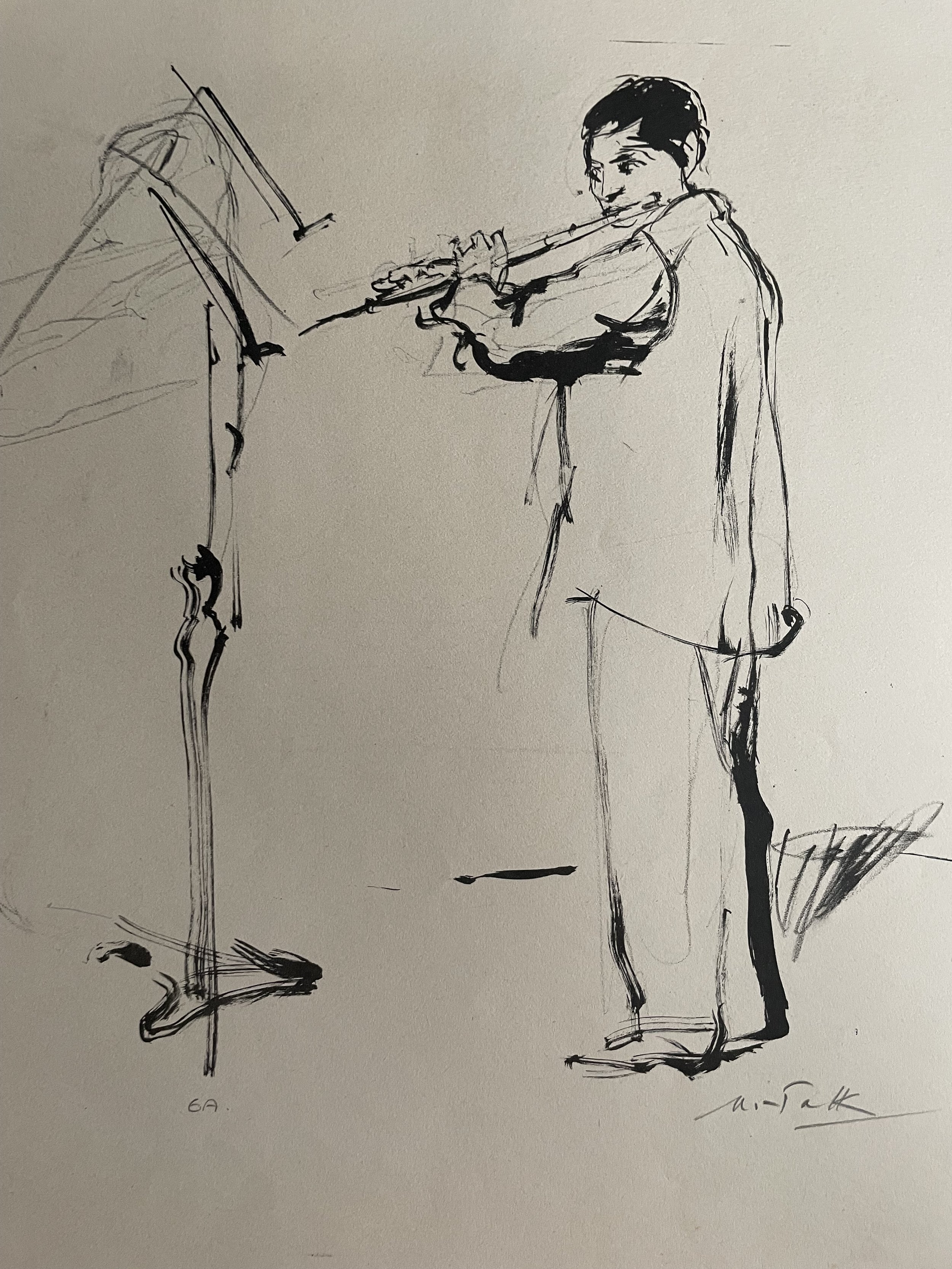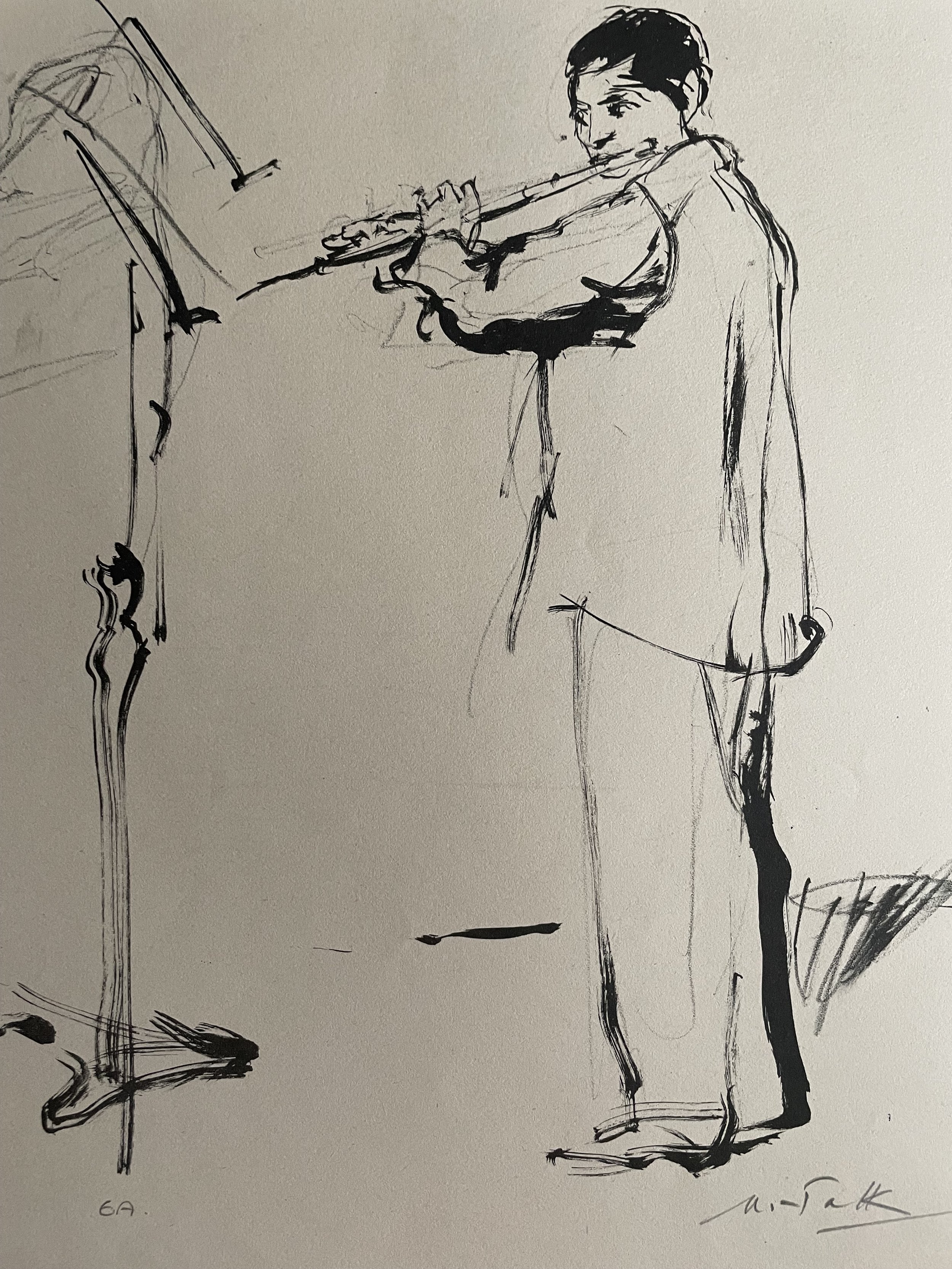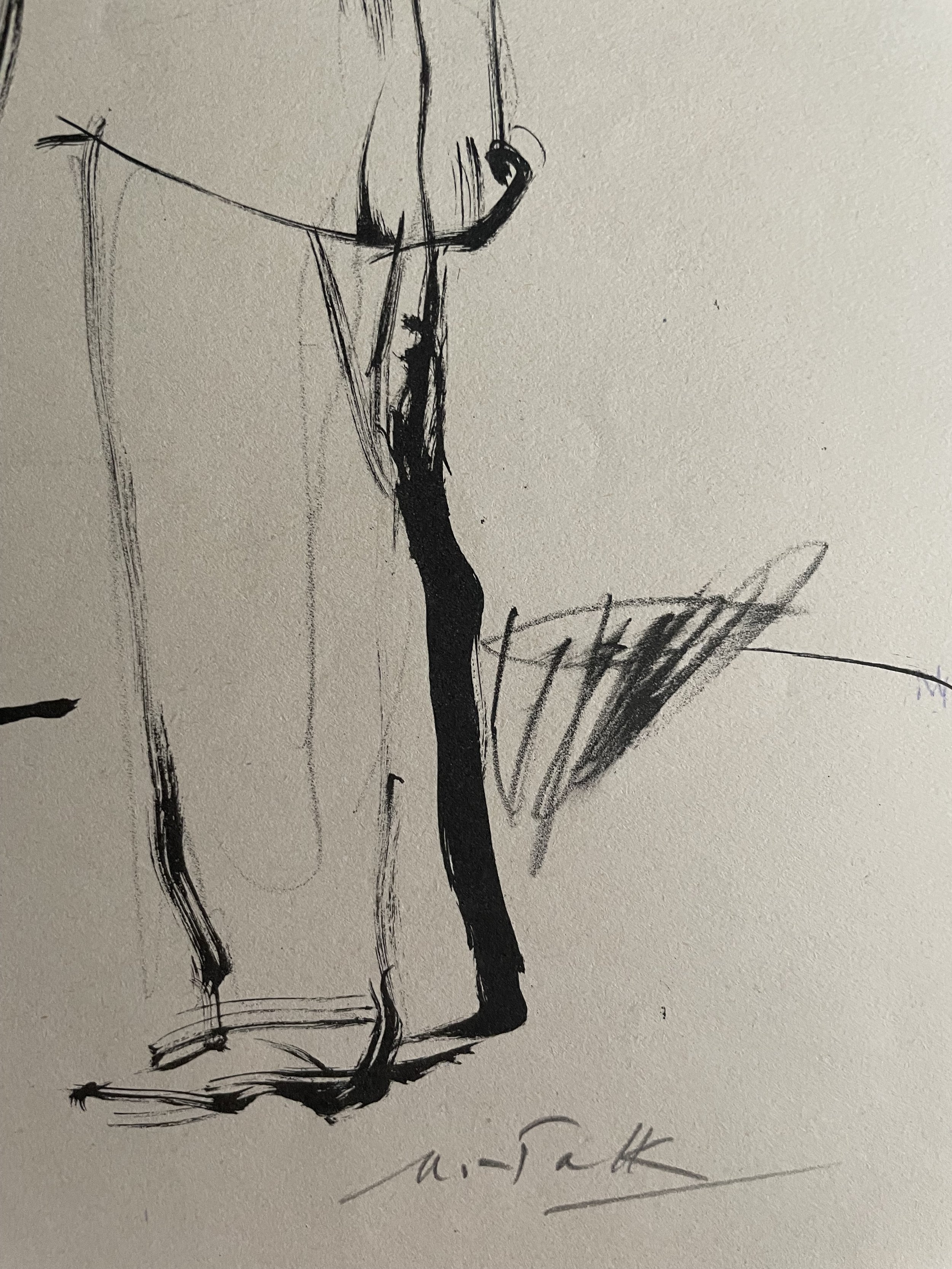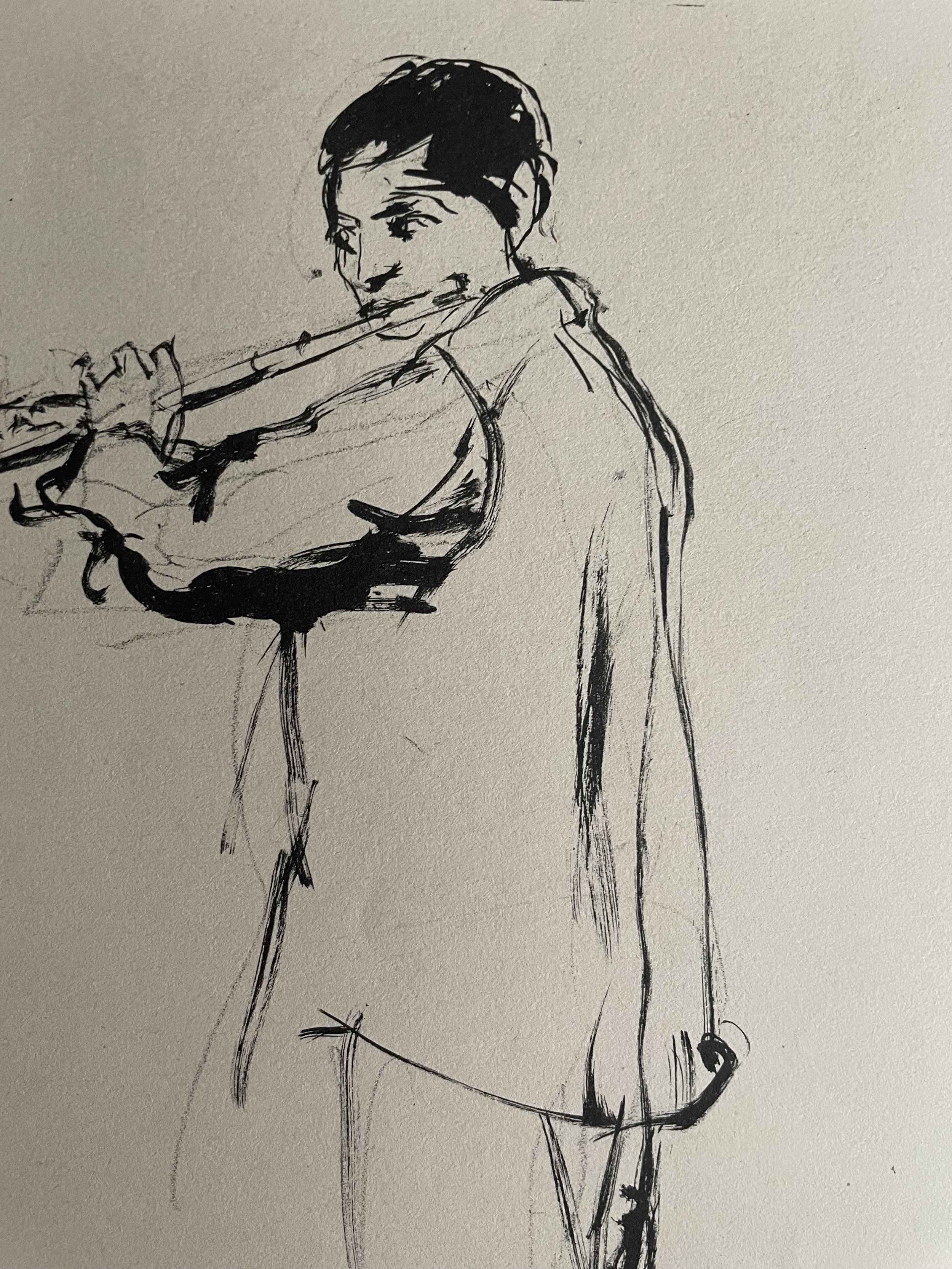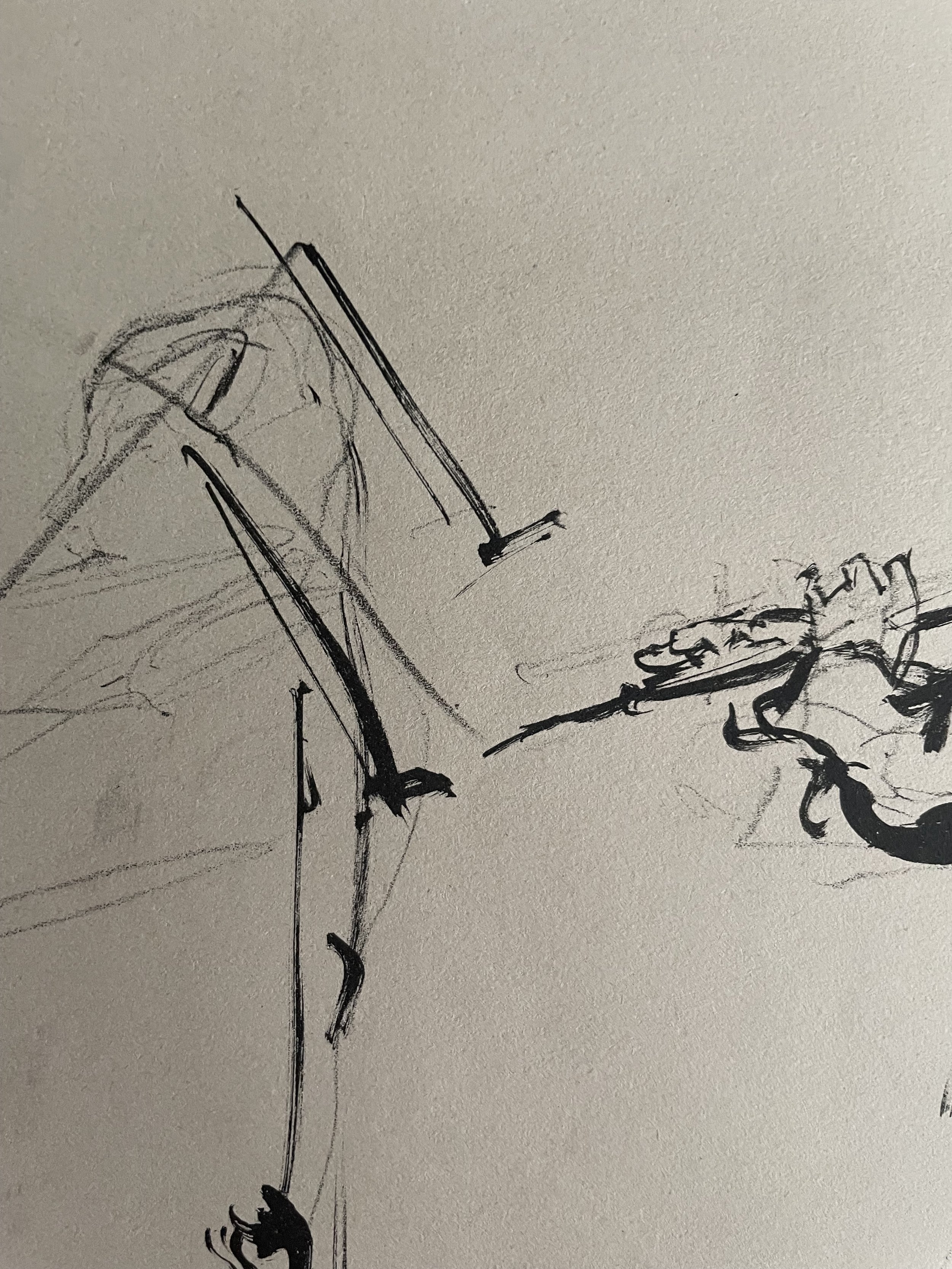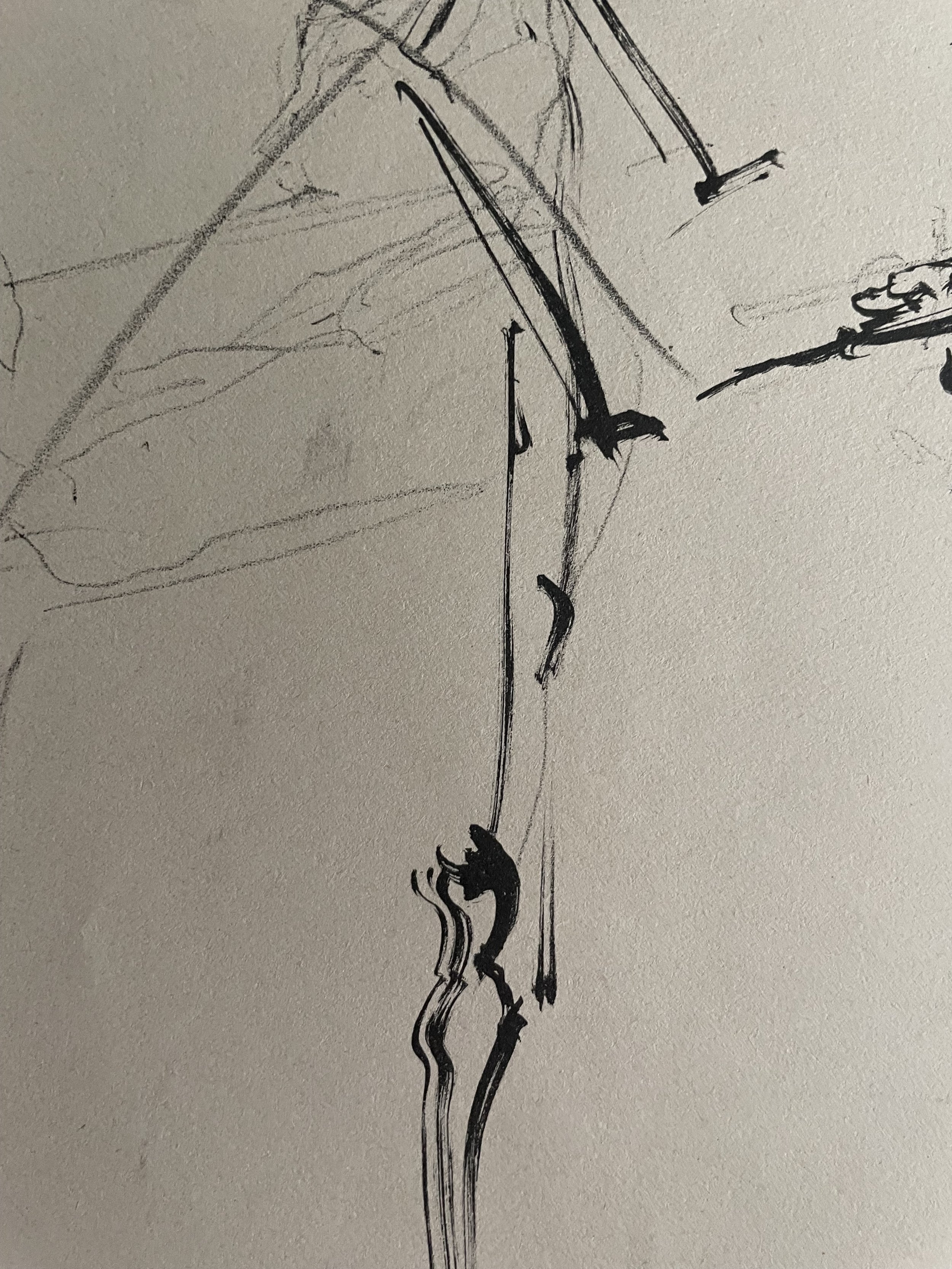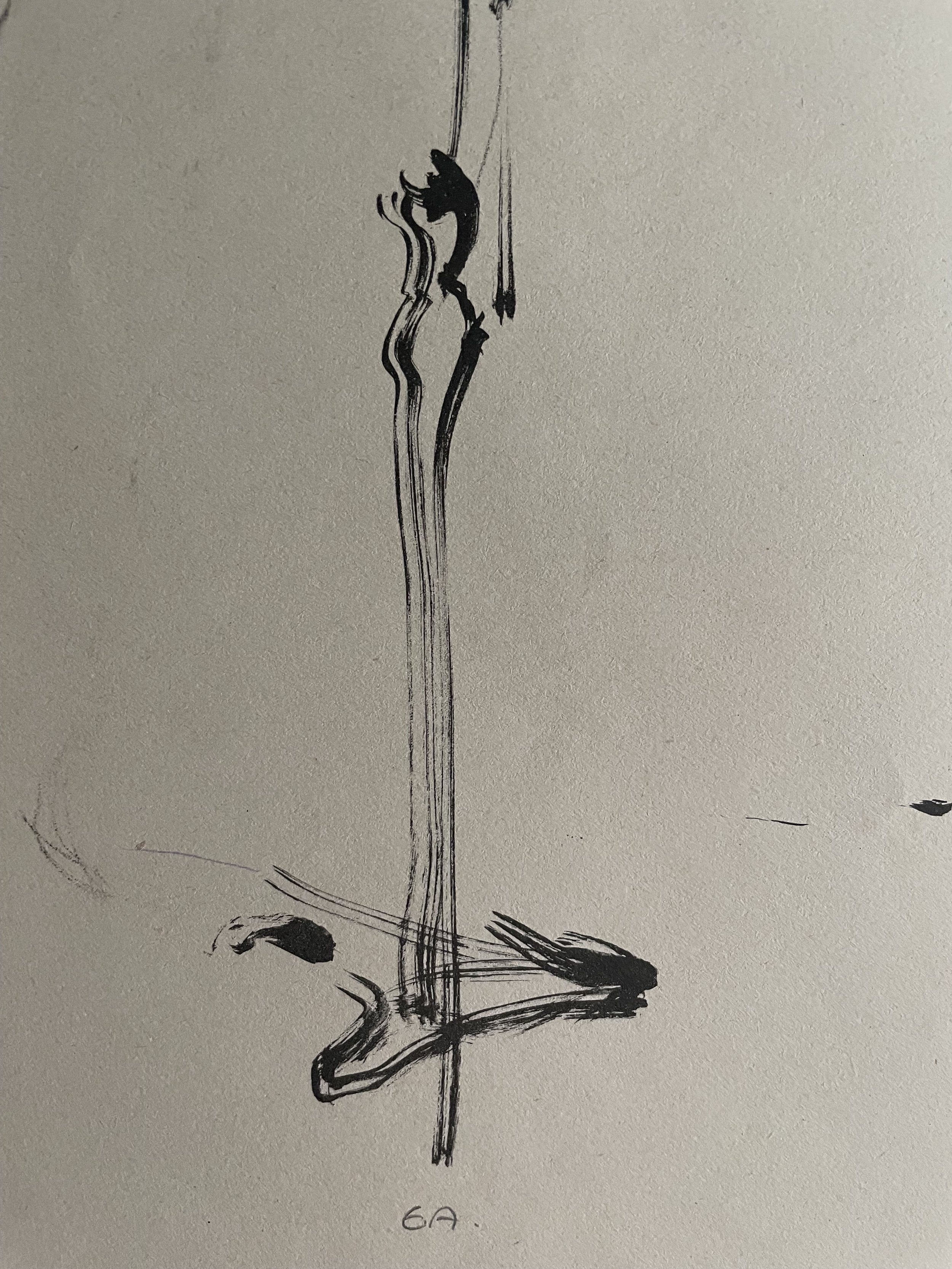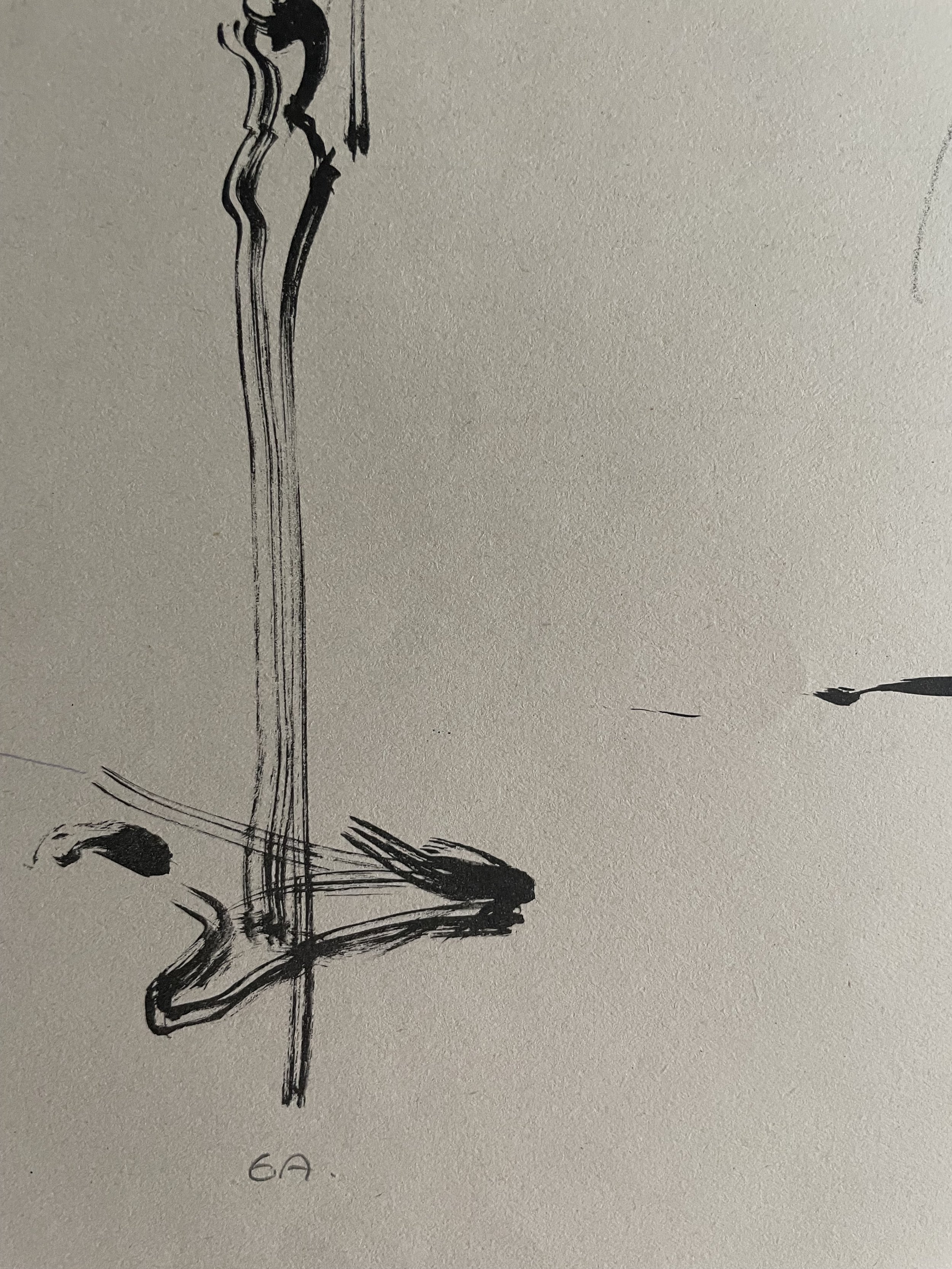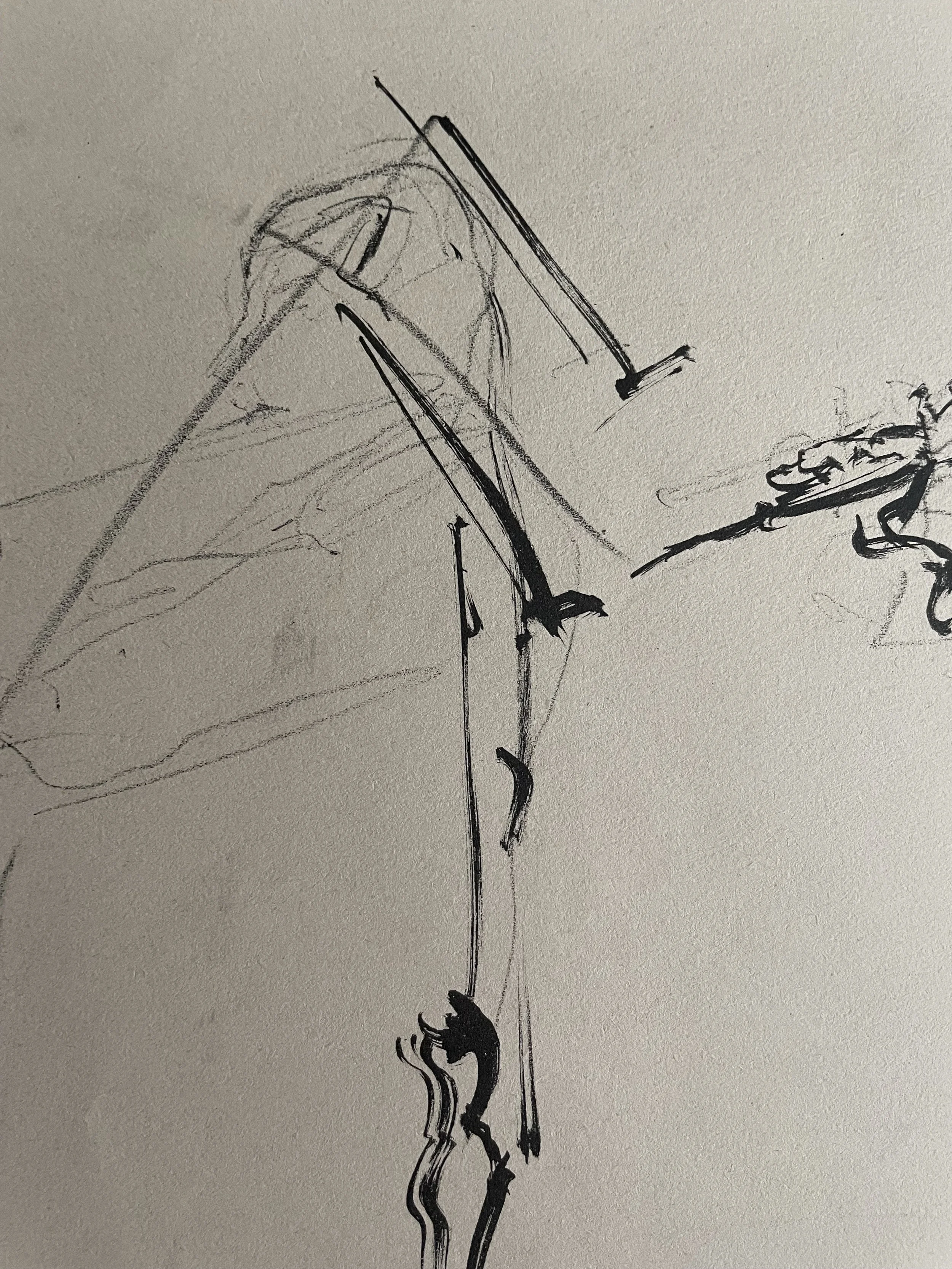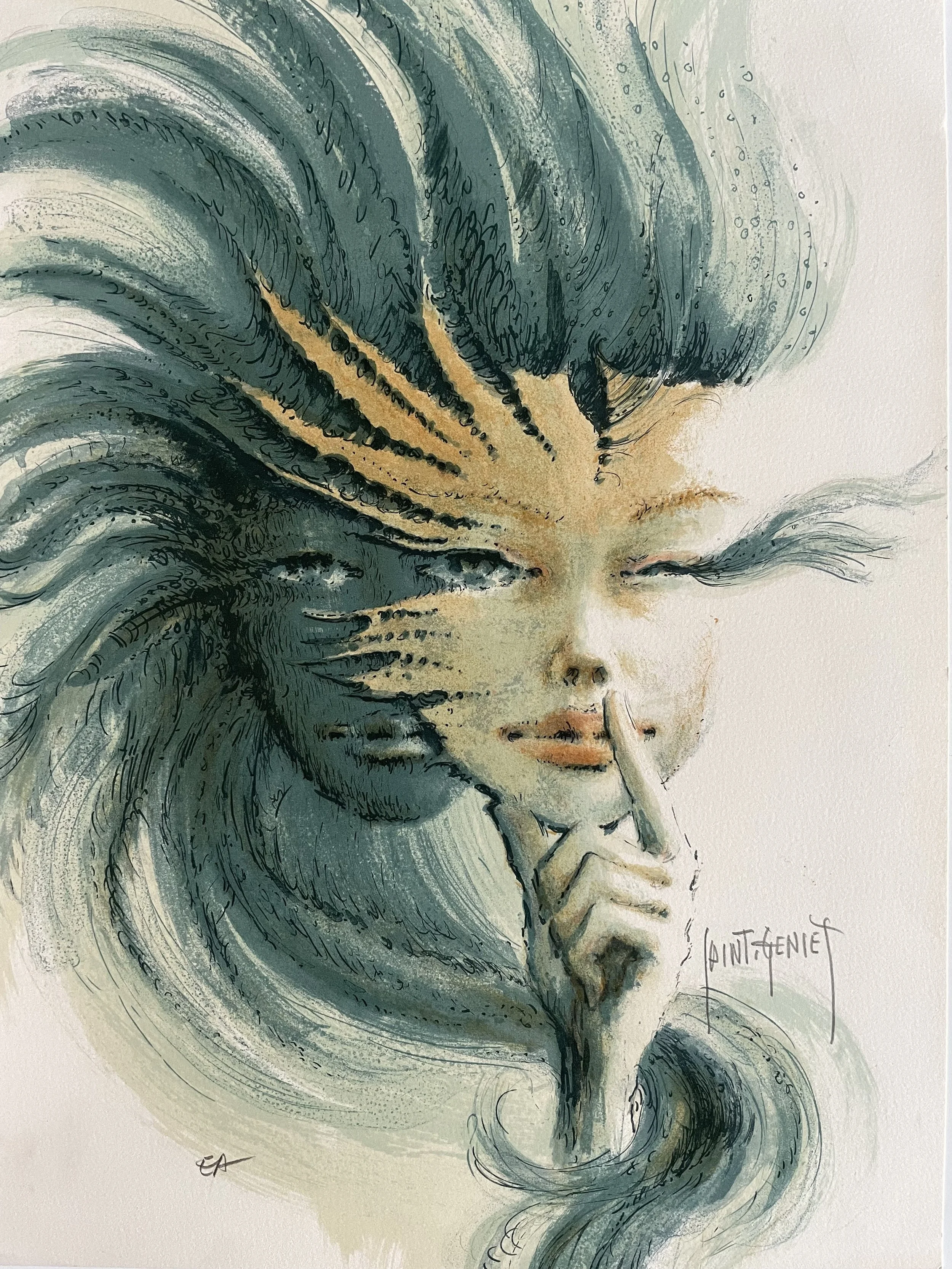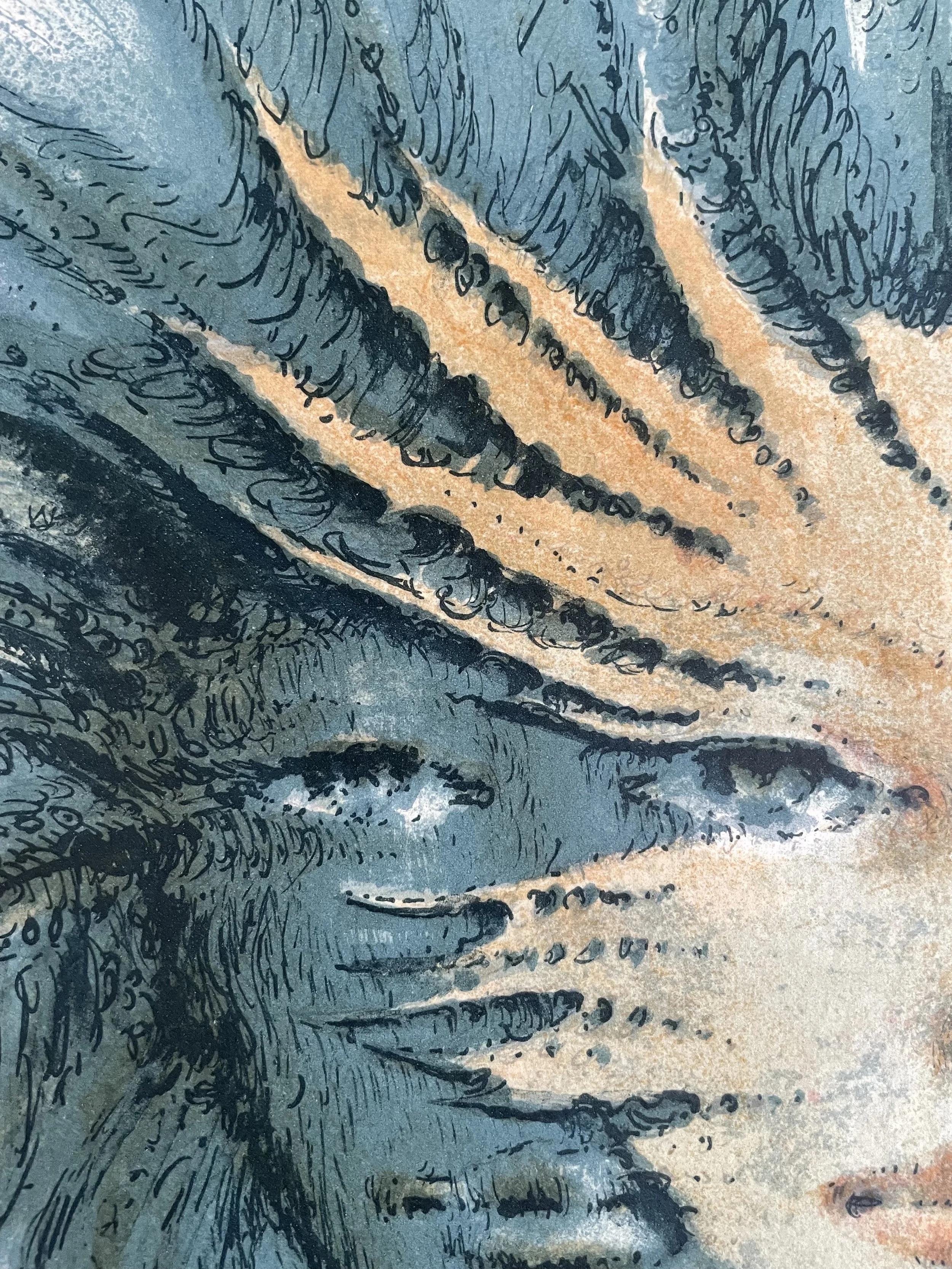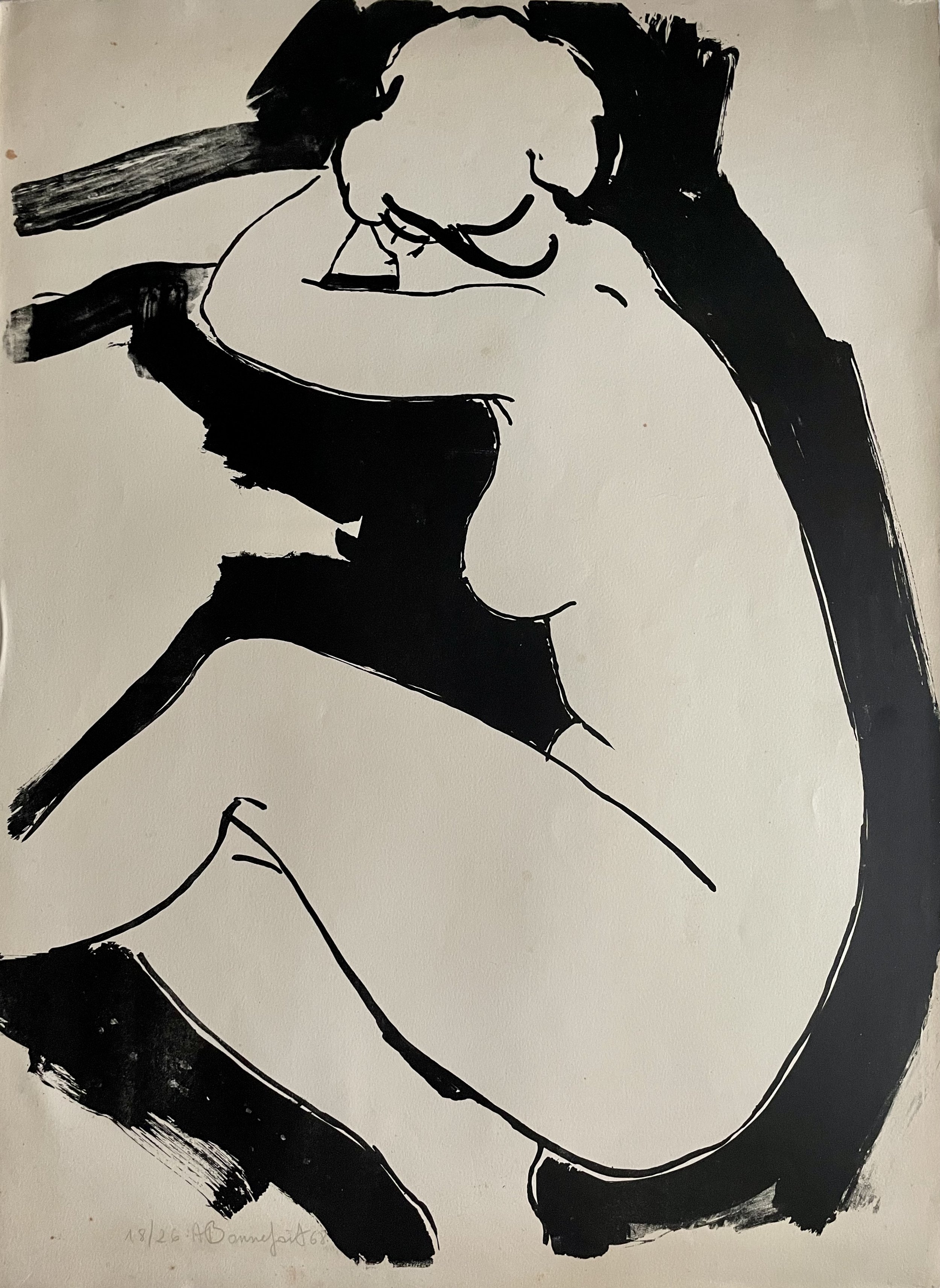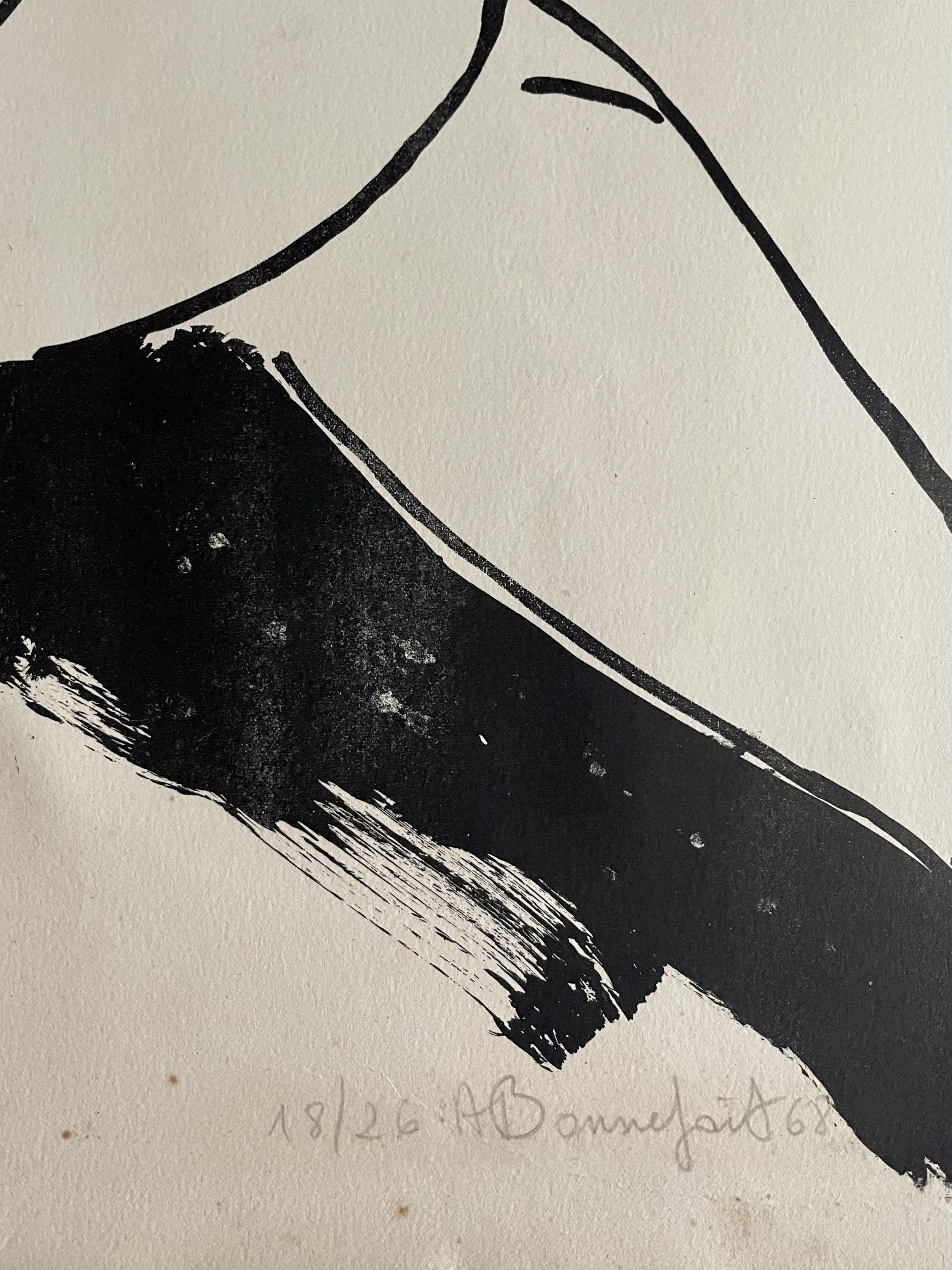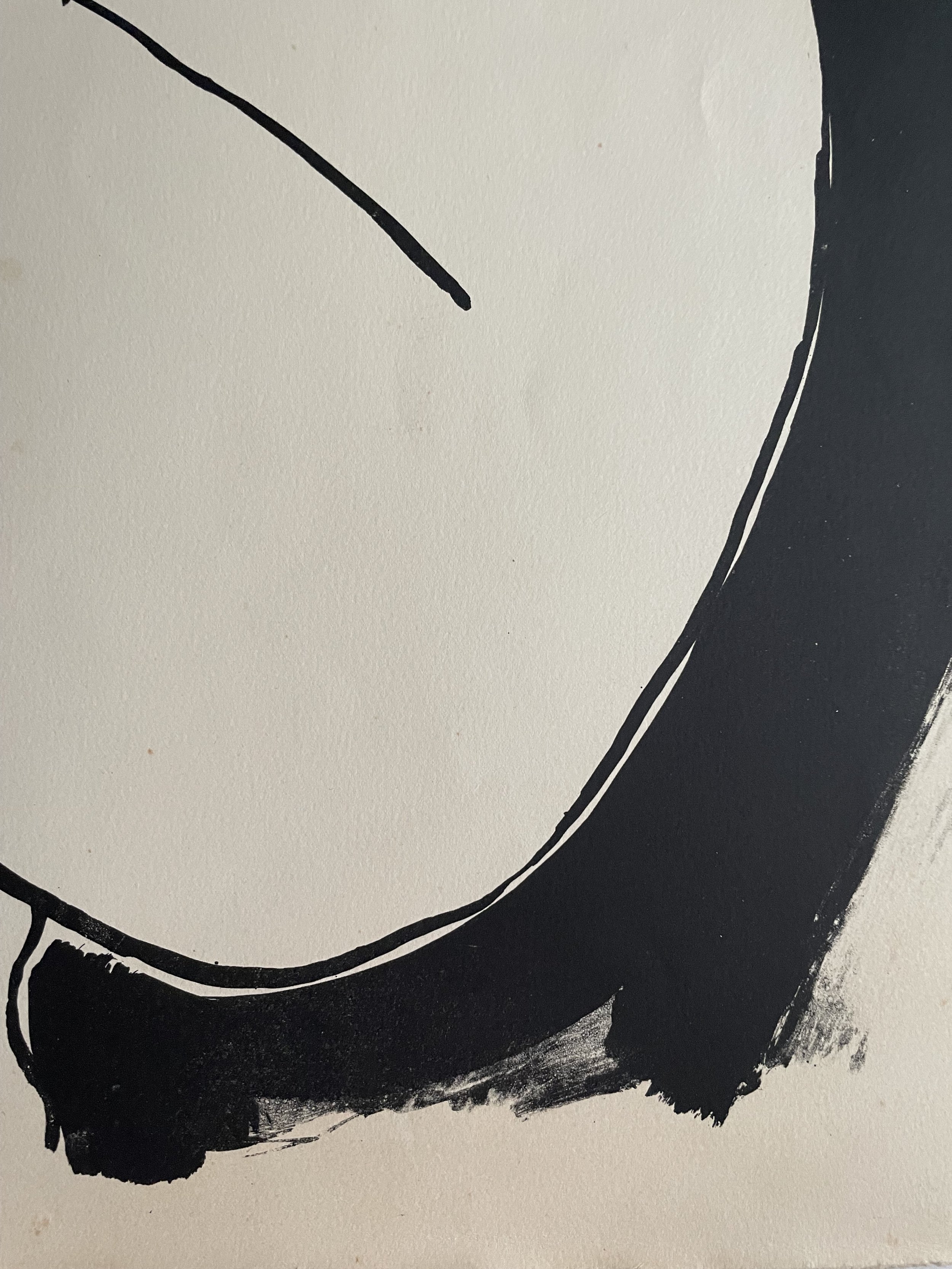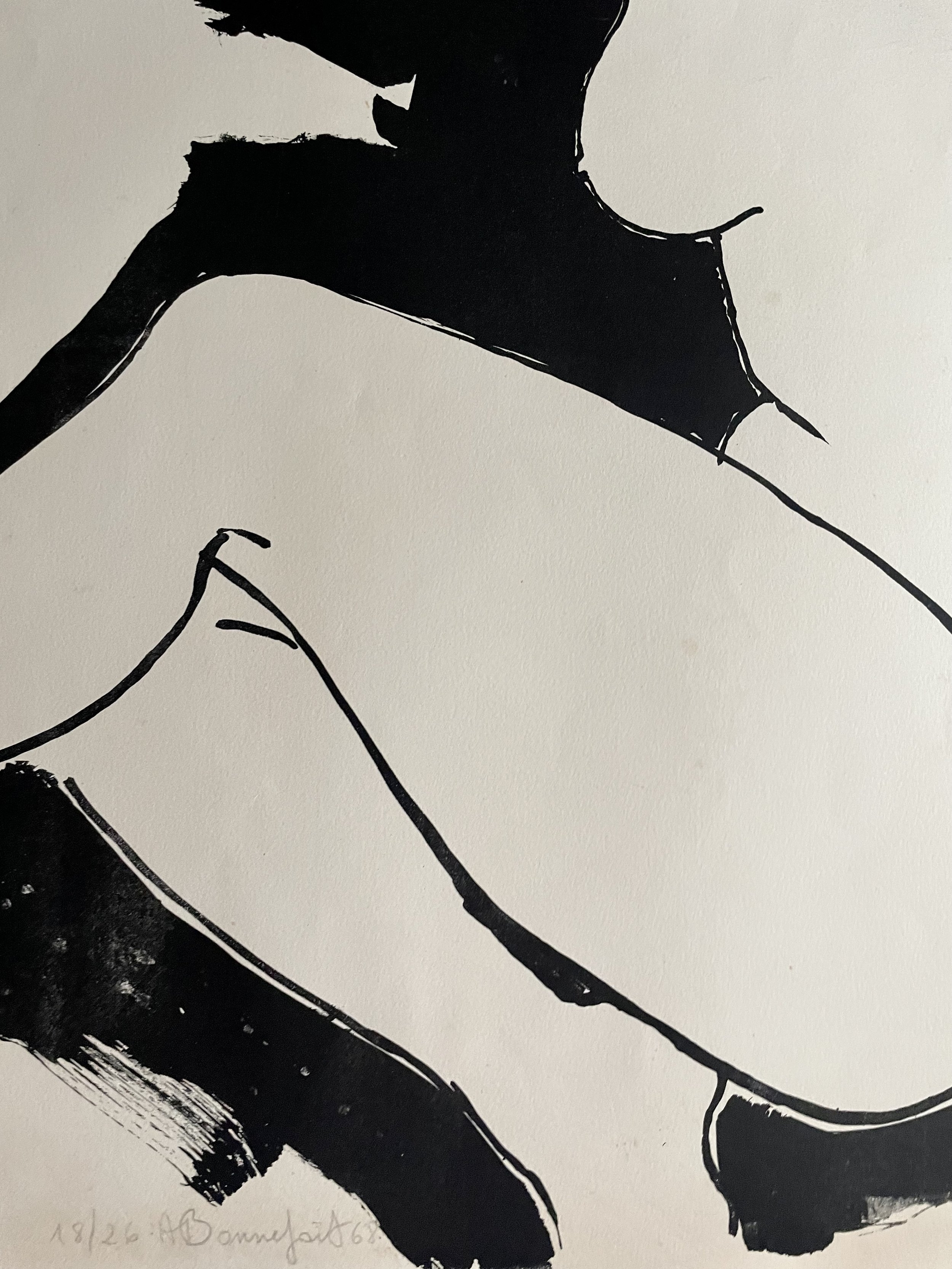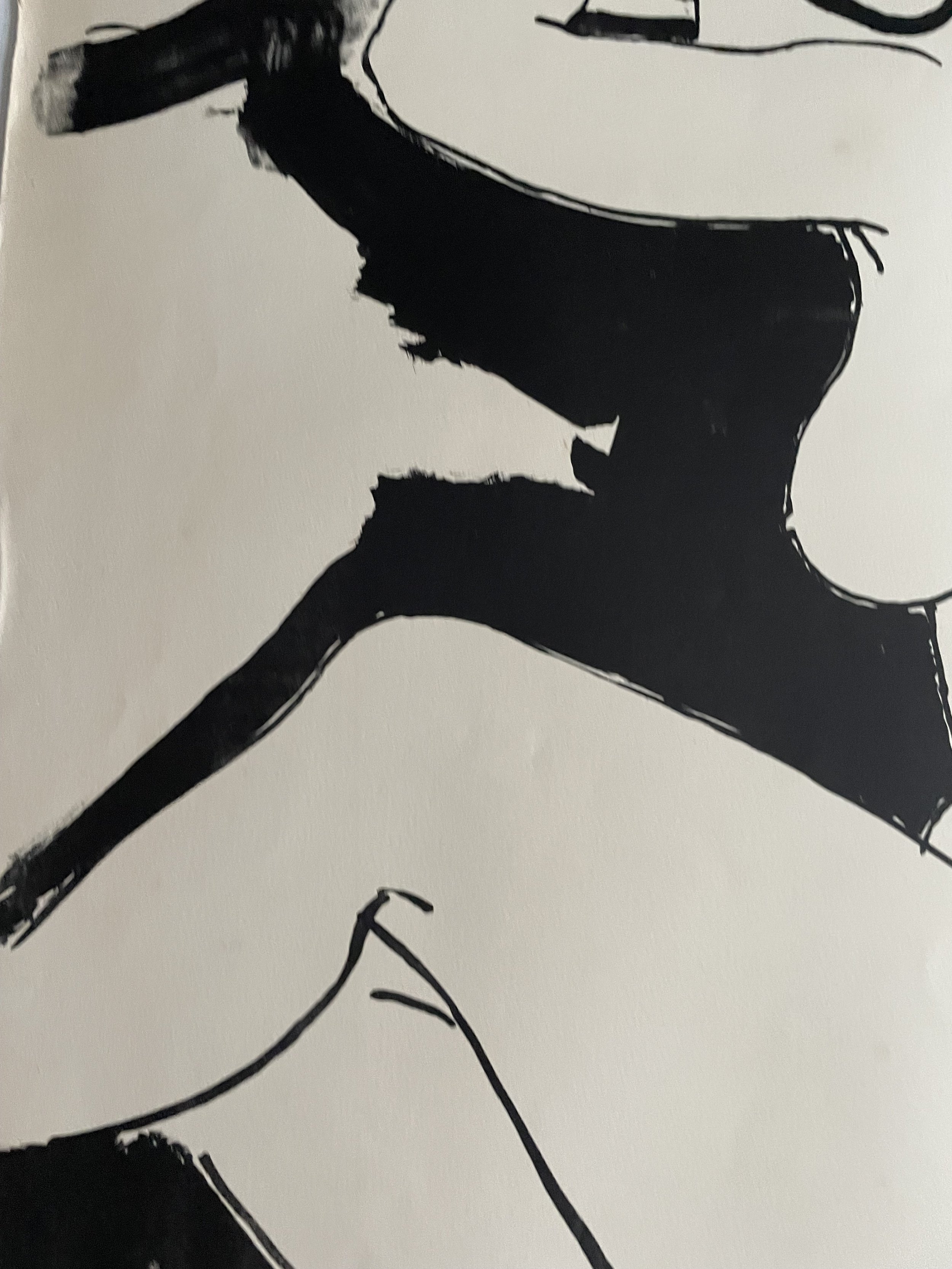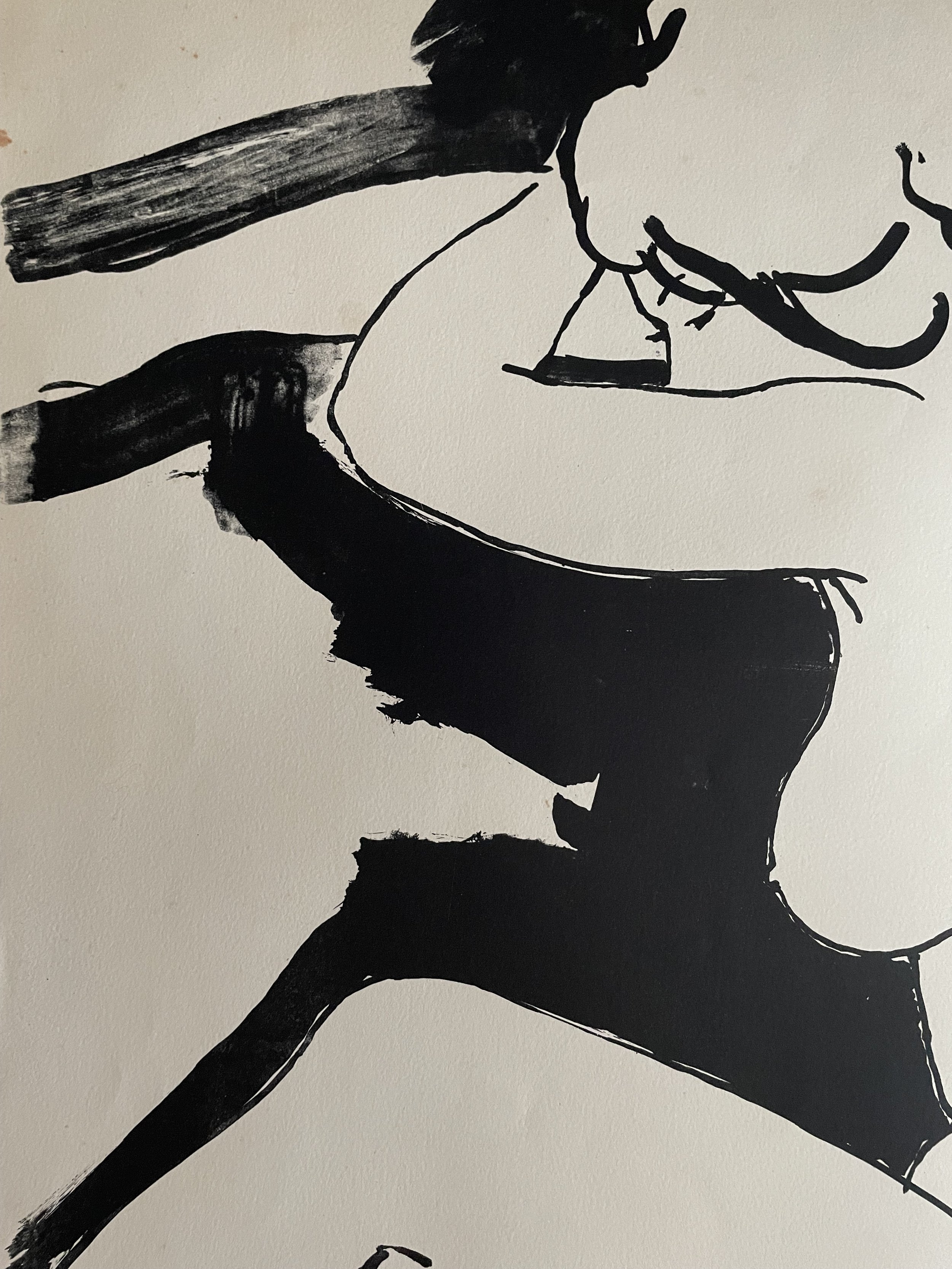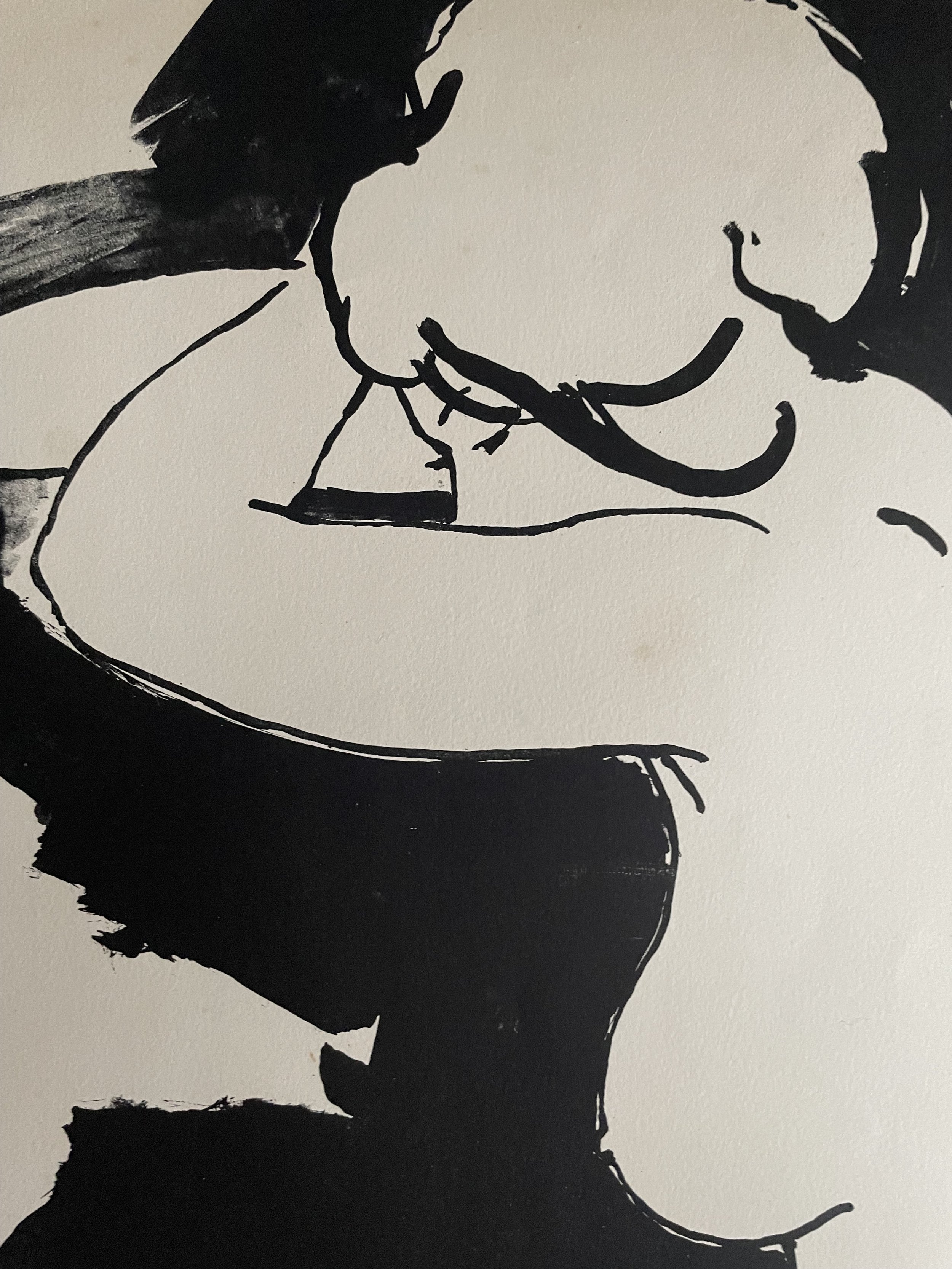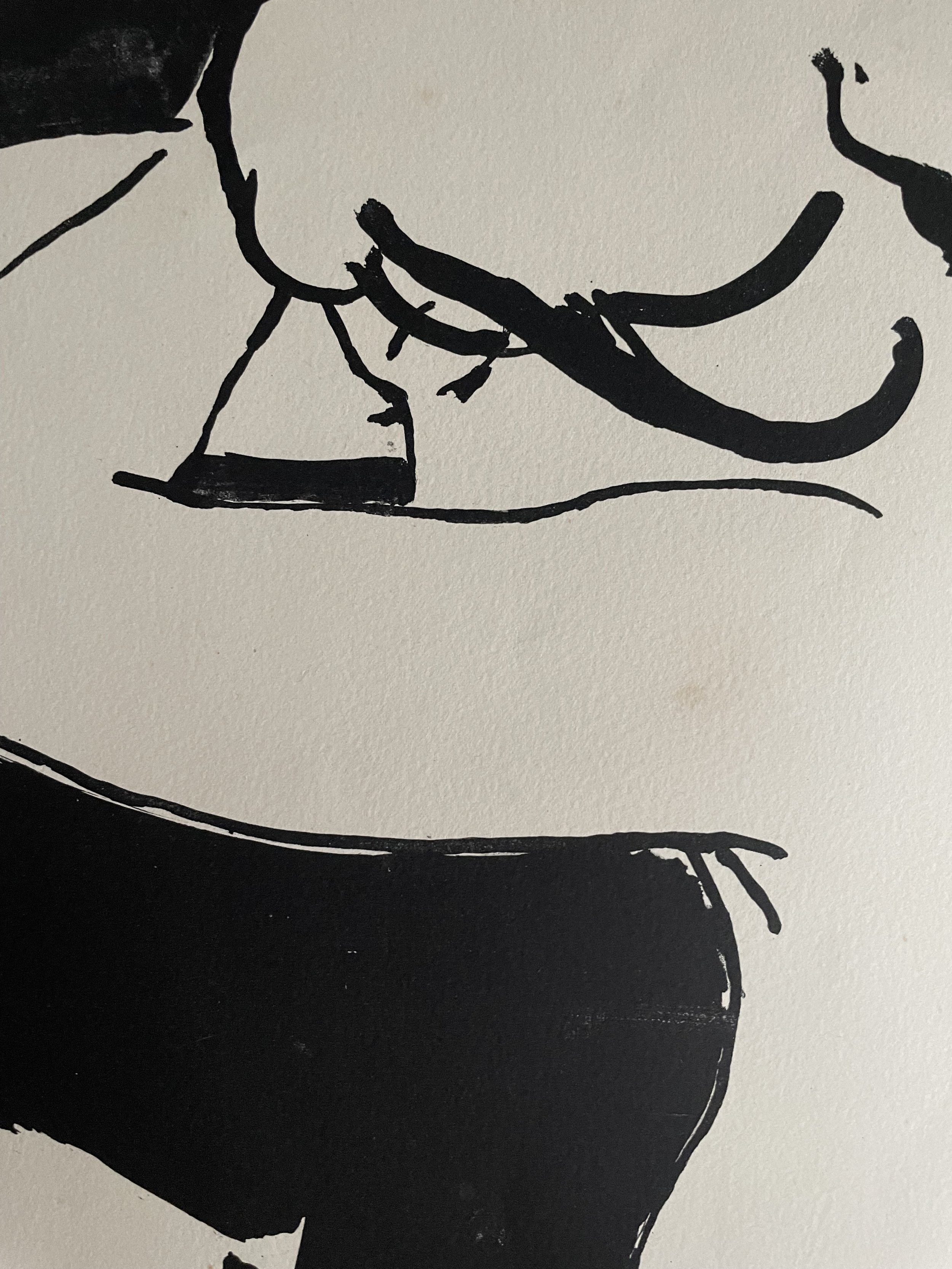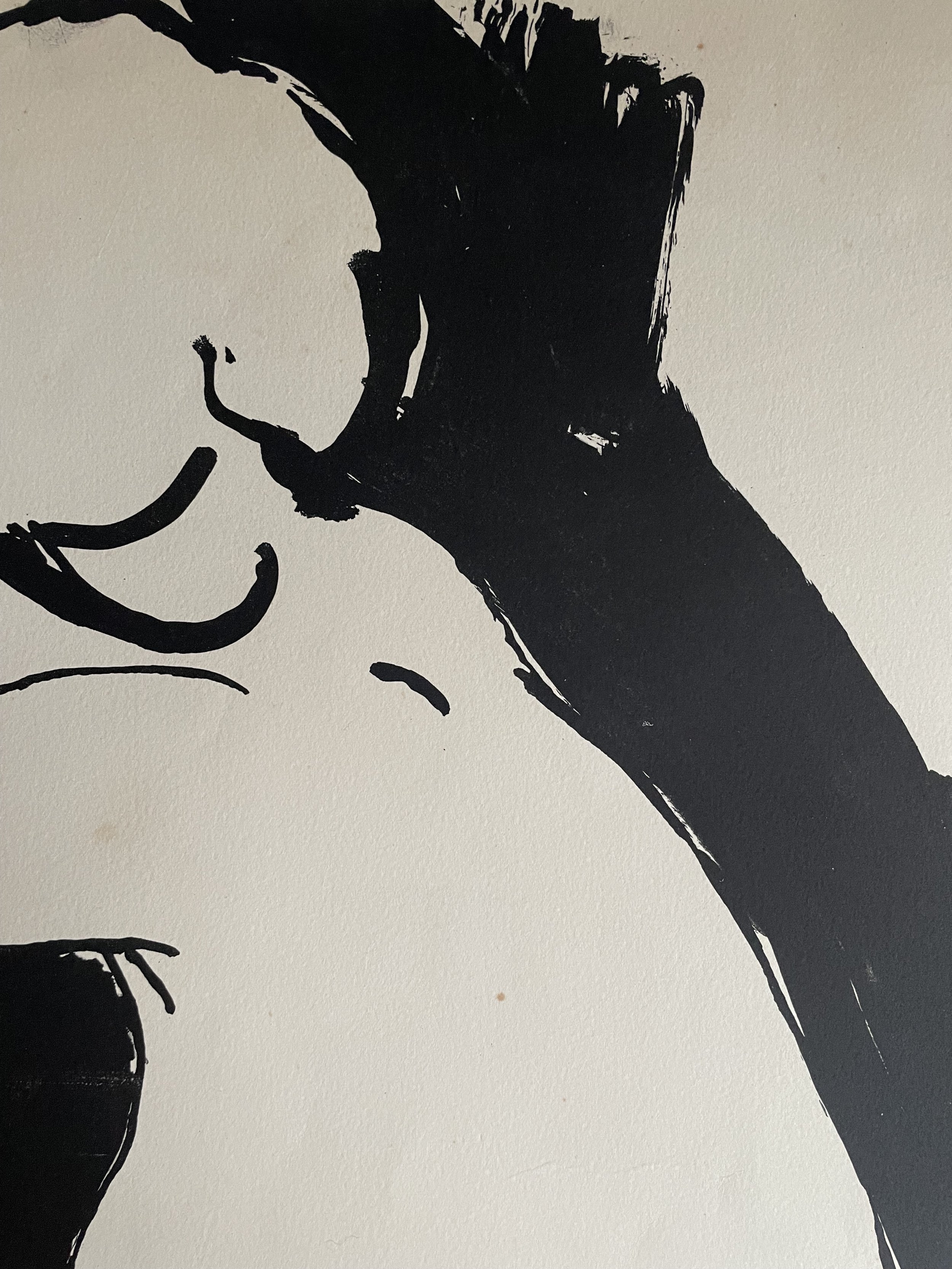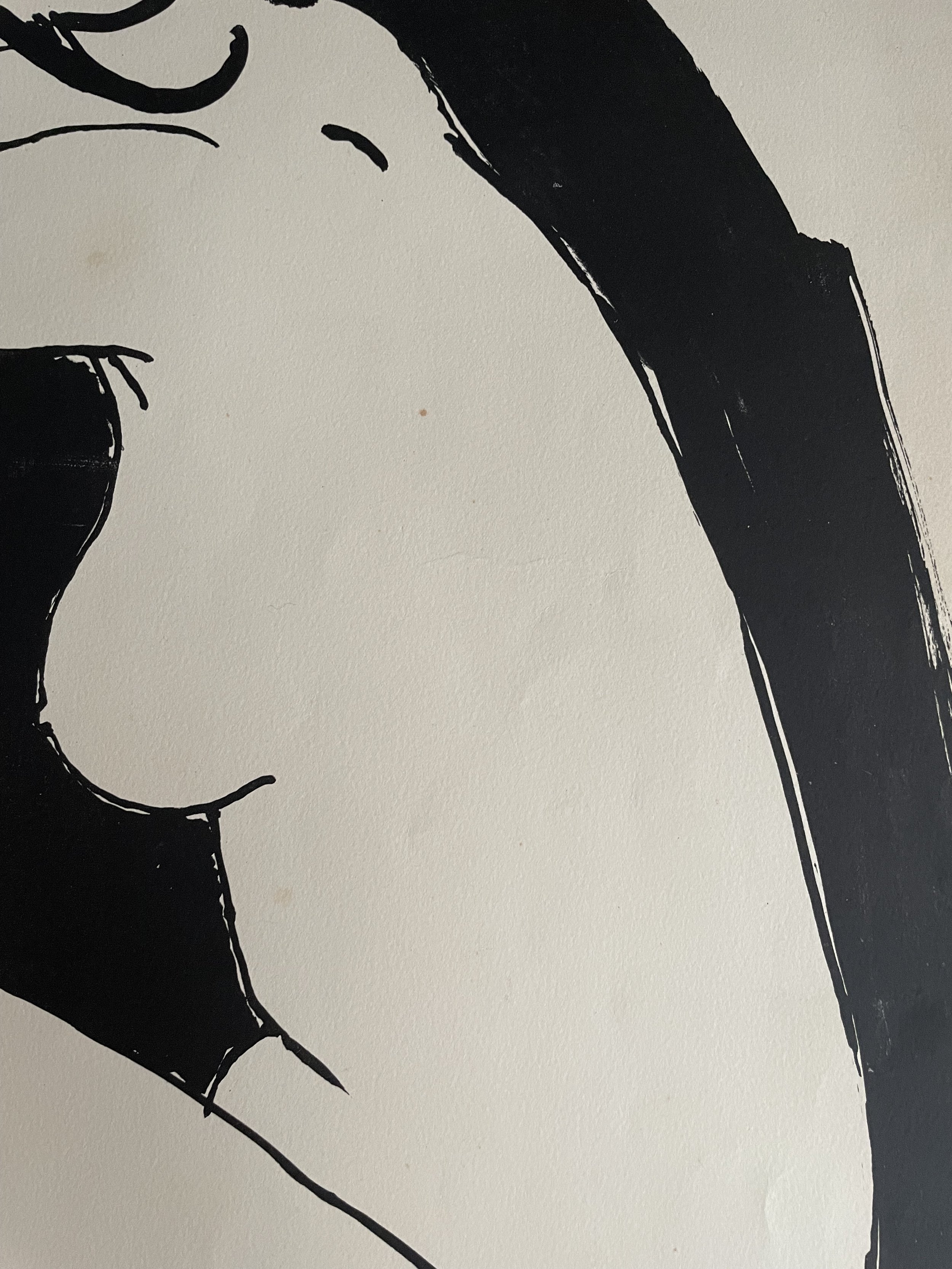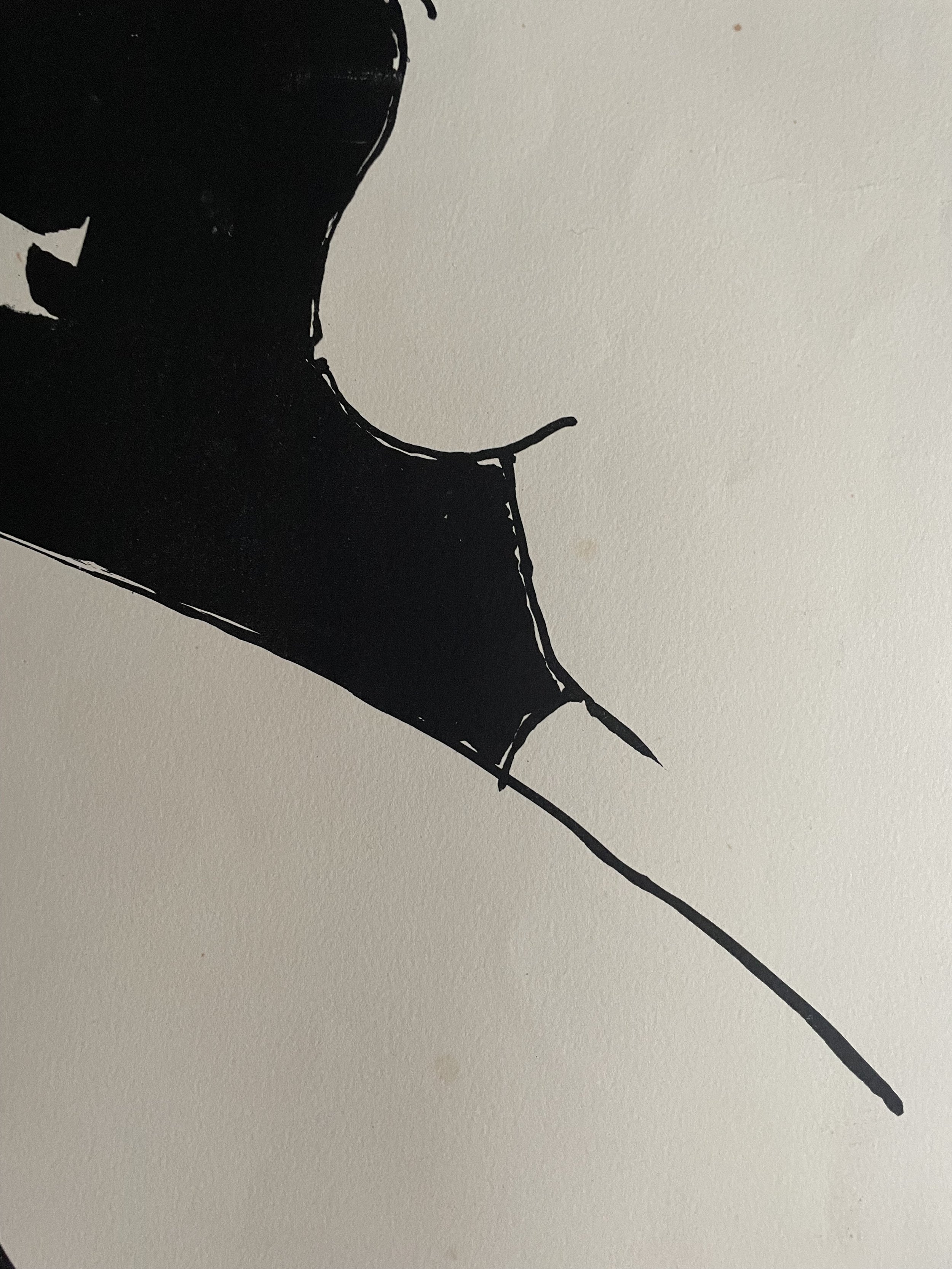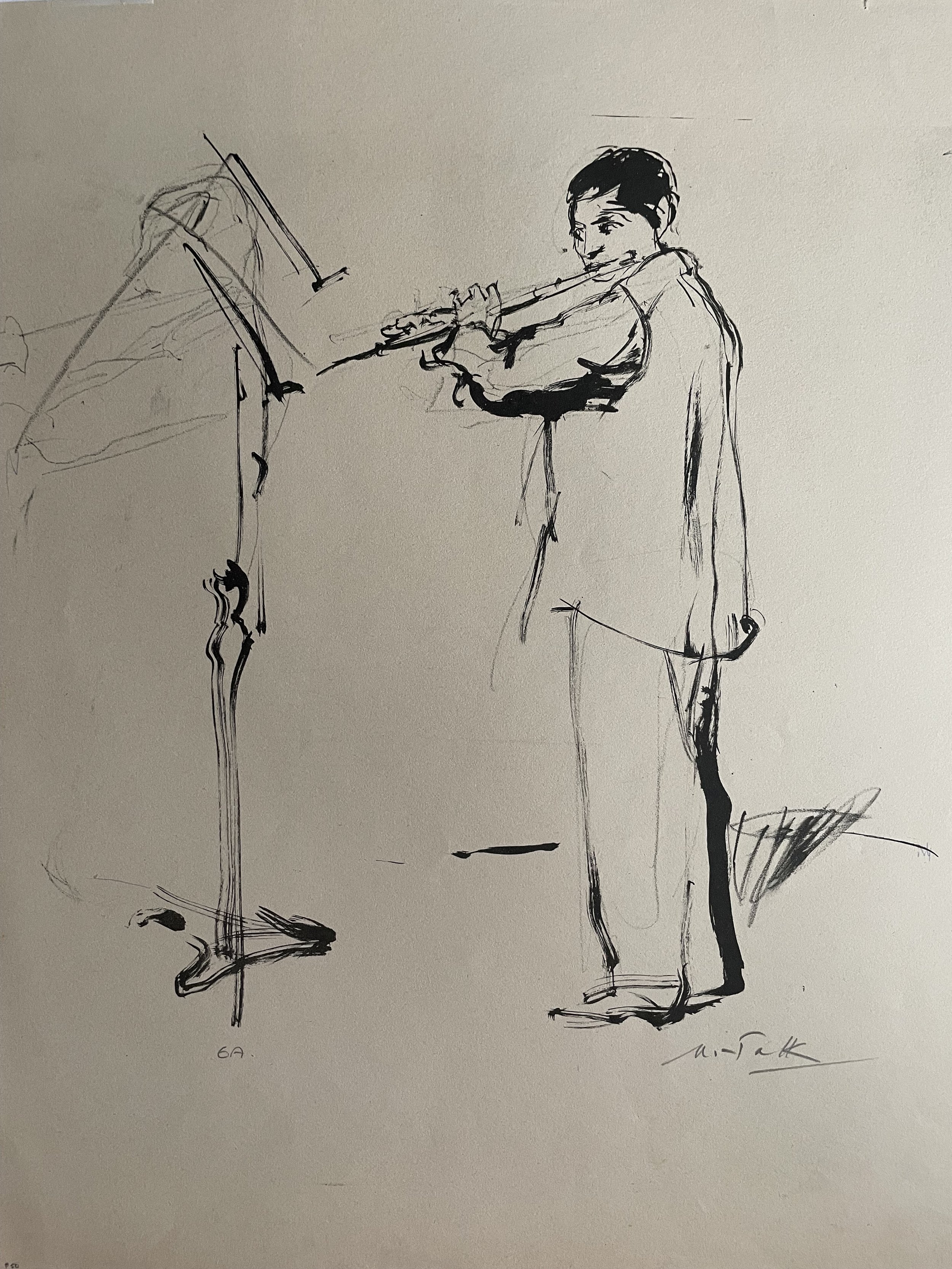
Untitled (Violinist), Hans Falk (Swiss, 1918–2002), c.1960s, lithograph, 13×15 in, signed & numbered E.A. (artist’s proof).

$1,400.00
Sold Out

Untitled (Violinist), Hans Falk (Swiss, 1918–2002), c.1960s, lithograph, 13×15 in, signed & numbered E.A. (artist’s proof).

Minimalist 1960s Swiss lithograph by Hans Falk (1918–2002), signed E.A. artist’s proof, capturing a violinist at a music stand in expressive black line—mid-century modern European figurative drawing by a celebrated Swiss poster master and painter.

Artwork Description

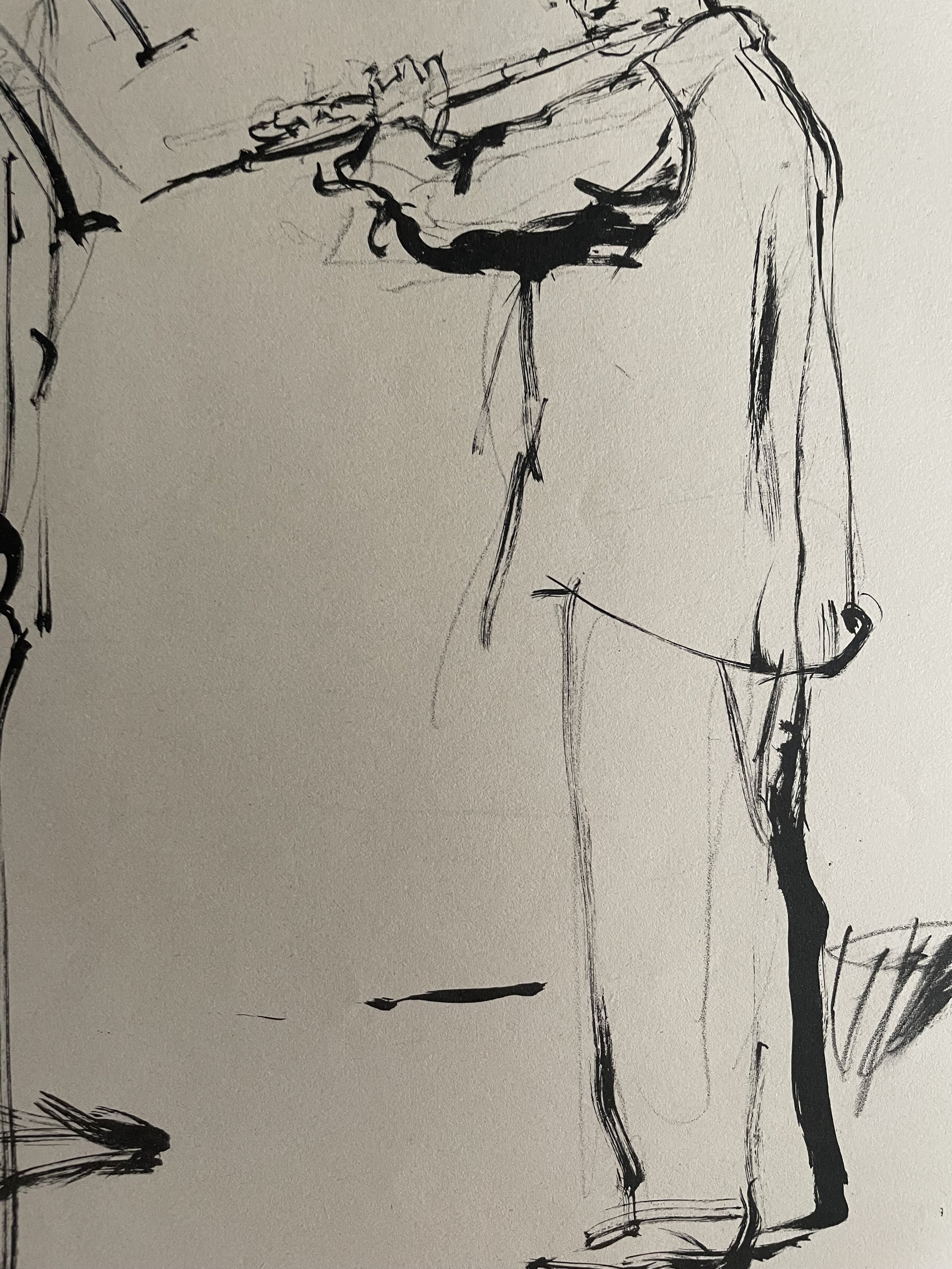
This spare, elegant lithograph distills a musical moment into pure gesture: a violinist, lightly turned toward the viewer, plays beside a simplified music stand rendered in a few decisive strokes. Falk uses negative space as an active element—most of the sheet remains open, allowing the figure’s posture, the instrument’s angle, and the dark accents at the sleeve and leg to carry the full emotional weight.

Style & period: The work aligns with Falk’s mid-century modern sensibility—economical, graphic, and psychologically direct. It feels like a live observation captured quickly (stage sketch energy), yet resolved with the compositional intelligence of a master poster designer. The minimalism heightens intimacy: the performer seems suspended in concentration, with the music implied rather than shown.

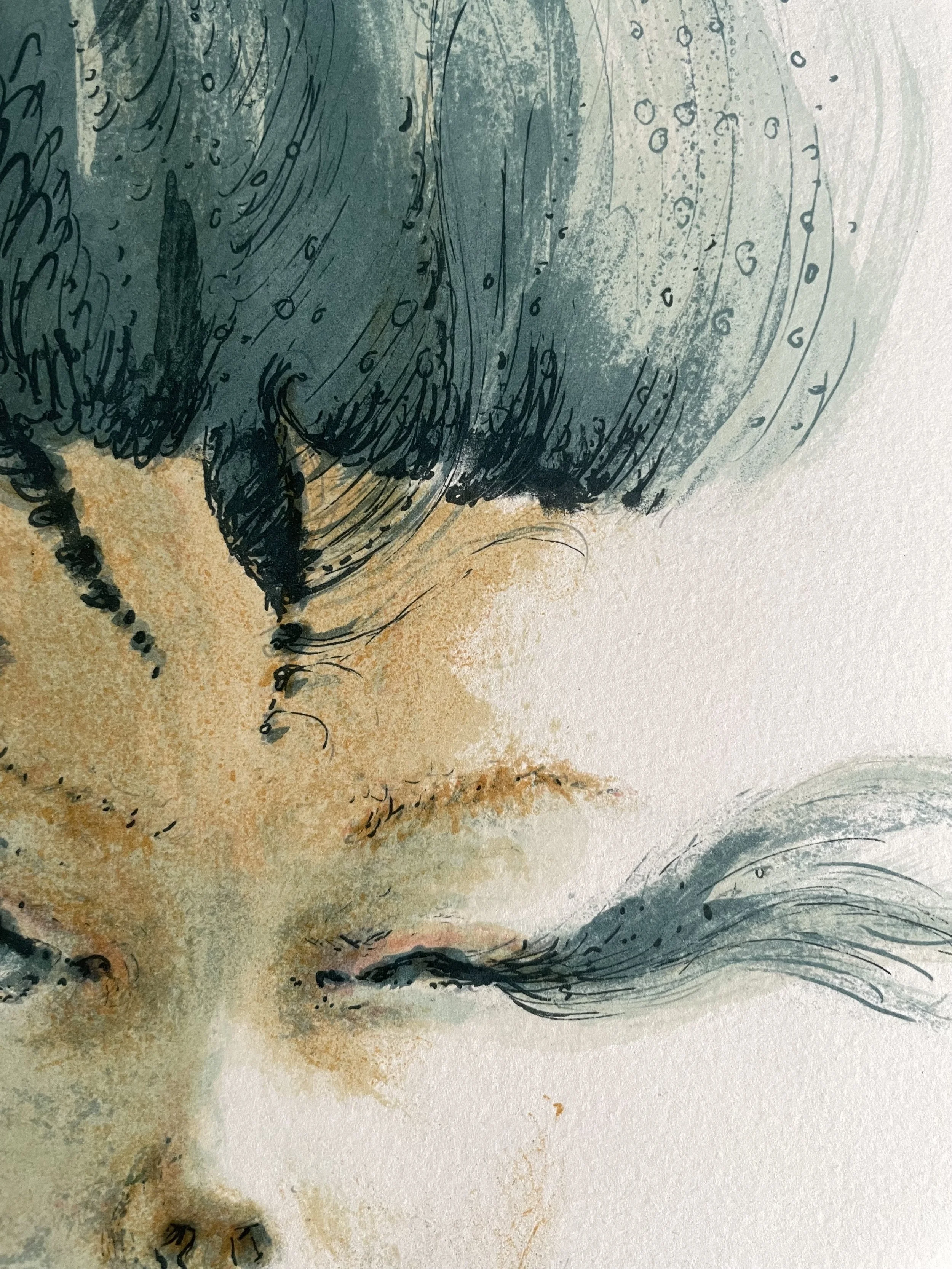
Medium & technique: As a lithograph, the drawing-like marks read as fluid and immediate—fine linear notation, occasional bold blacks, and purposeful “unfinished” passages that preserve spontaneity. The overall impression suggests a hand-drawn original translated into lithographic print with the intent of keeping the line’s velocity intact.

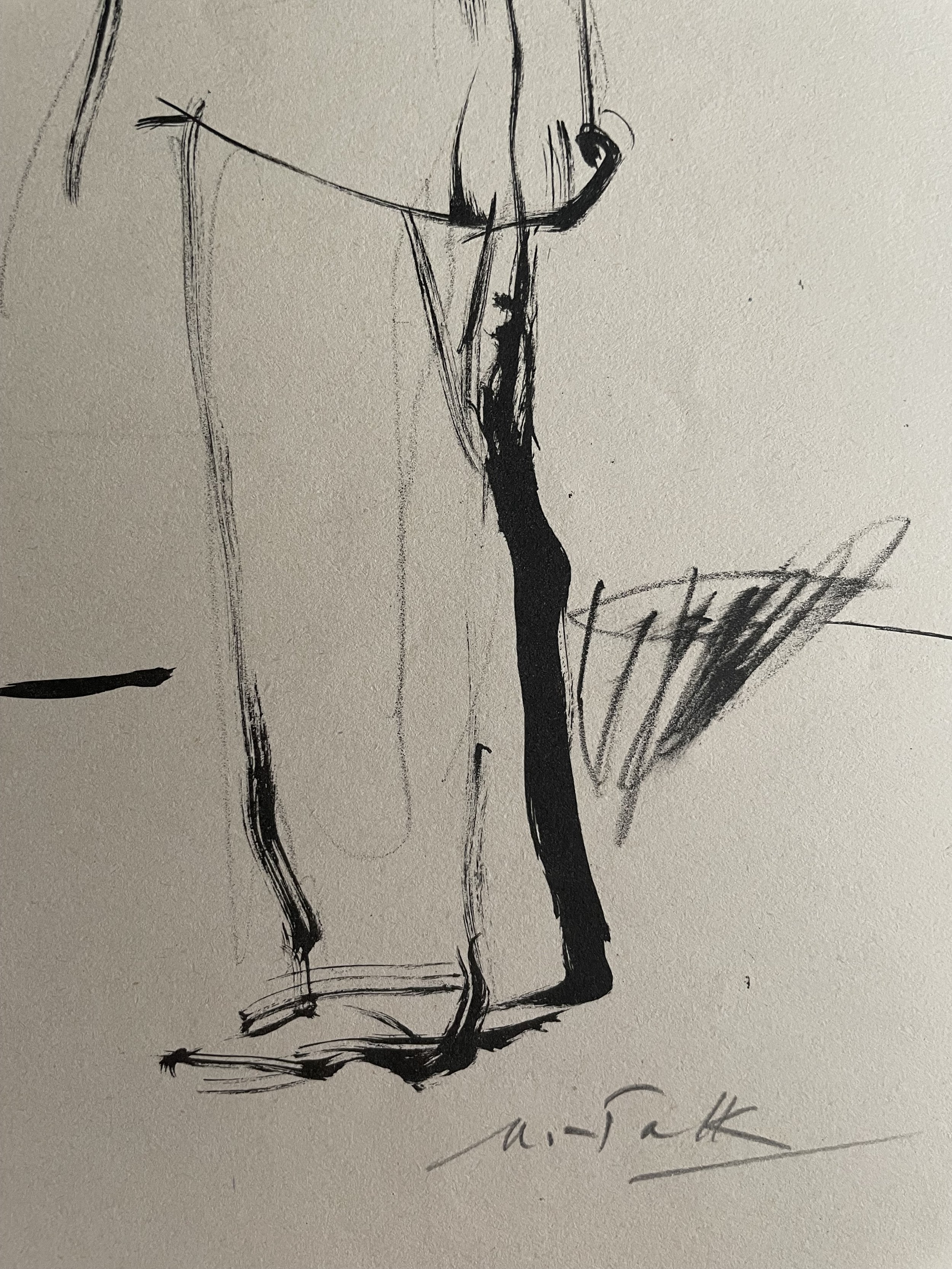
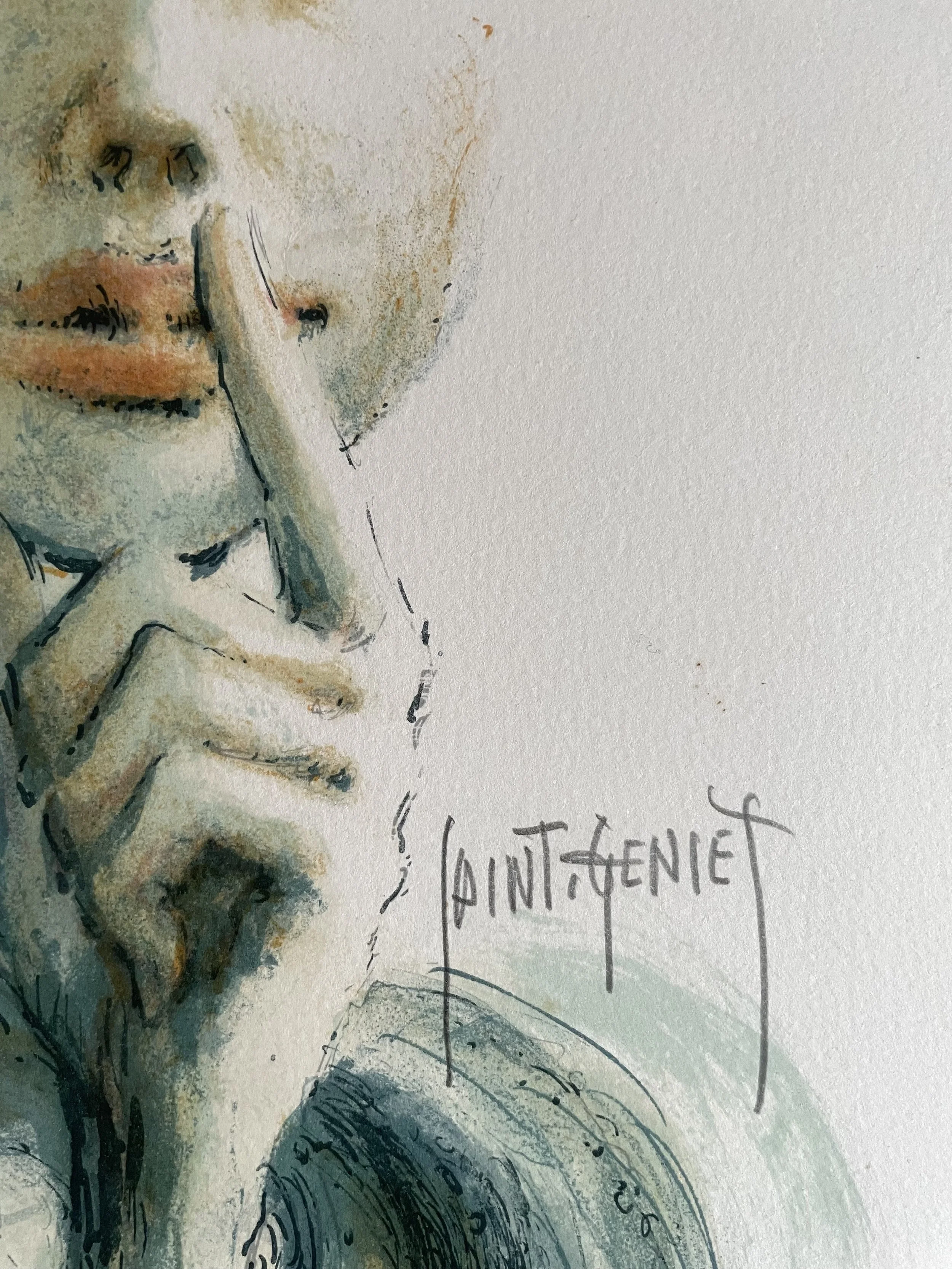
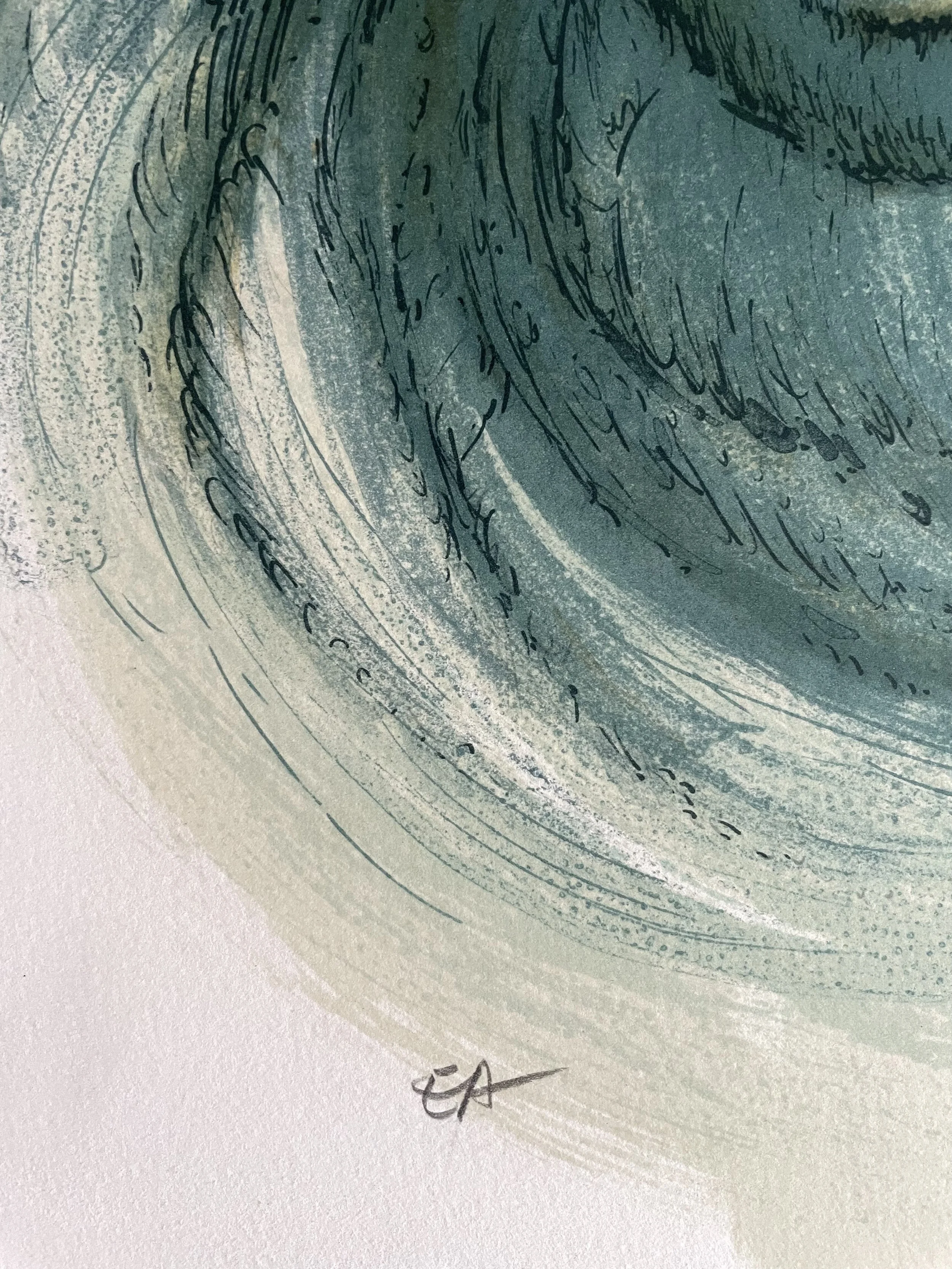
Signature & edition: The print is hand-signed in pencil at the lower right and marked E.A. (Épreuve d’Artiste / Artist’s Proof) at lower left, a designation typically reserved for proof impressions outside the standard numbered edition—often scarcer and highly collectible.

Inspiration / story behind the work: Music is a recurring world in Falk’s life and work—he repeatedly drew performers and live scenes (circus, clubs, theater), treating the stage as a laboratory for observing movement, tension, and human presence. This violinist image reads as a quiet counterpart to those more crowded environments: a single figure, a single instrument, and the discipline of practice distilled into line.

Biography of the Artist

Hans Falk was born 16 August 1918 in Zurich, Switzerland, and became one of the most significant Swiss artists of the postwar period, spanning painting, drawing, printmaking, and graphic design. He spent parts of his childhood in Lucerne and began formal training at the Lucerne School of Applied Arts, studying with Joseph and Max von Moos, and later continued at Zurich’s applied arts school environment.

Falk first achieved national prominence as a poster and graphic designer, producing a substantial body of Swiss posters—many recognized as “best posters”—and winning major competitions. A defining milestone was his commission to create seven posters for the 1964 Swiss National Exhibition (Expo 64), a now highly sought-after series that also marked his increasingly painterly, experimental approach to public graphic art.

While professionally successful in design, Falk consistently pushed toward the tools of the painter and draftsman. He drew obsessively from life in socially and emotionally charged environments—hospitals, eldercare and disability settings, theaters and cabarets—using drawing as a direct, humane record of presence and vulnerability. He also produced lithographs for bibliophile editions and portfolios, connecting his graphic mastery to fine-art printmaking.

From the late 1940s onward, Falk traveled widely, and by the late 1950s he began extended stays abroad that reshaped his art. He lived in England and encountered figures associated with the St Ives circle and modern abstraction; he later spent major periods on Stromboli, Italy, where the harsh terrain and volcanic environment fed a raw, experimental language aligned with Art Informel and intuitive mark-making.

Falk also lived and worked in New York City for extended periods, creating bodies of work responsive to urban decay, nightlife, and contemporary culture; his practice expanded into objects and collage-like constructions as well as paintings and works on paper. Later, he returned repeatedly to Stromboli while exhibiting across Europe. He died in 2002.

Today, Falk is recognized not only for iconic Swiss poster design but also for an expressive fine-art oeuvre—drawings and prints of striking economy and intensity, and paintings shaped by travel, experimentation, and an unflinching look at modern life.

Hans Falk (Swiss, 1918–2002), Untitled (Violinist), c.1960s, lithograph, E.A. artist’s proof, pencil-signed, 13×15 in; minimalist mid-century modern figurative work.

Certificate of Value & Authentication

This certifies that the accompanying artwork is an original lithograph attributed to Hans Falk (Swiss, 1918–2002), created circa the 1960s, measuring 13×15 inches. The print bears the artist’s pencil signature at lower right and is marked E.A. (Épreuve d’Artiste / Artist’s Proof) at lower left, consistent with recognized artist-proof conventions in European printmaking. The subject, line quality, and presentation align with Falk’s known graphic and fine-art practice. Valuation reflects comparable market results for signed Falk works on paper, considering condition, rarity of proof impressions, and provenance.

Untitled (Violinist), Hans Falk (Swiss, 1918–2002), c.1960s, lithograph, 13×15 in, signed & numbered E.A. (artist’s proof).

Minimalist 1960s Swiss lithograph by Hans Falk (1918–2002), signed E.A. artist’s proof, capturing a violinist at a music stand in expressive black line—mid-century modern European figurative drawing by a celebrated Swiss poster master and painter.

Artwork Description

This spare, elegant lithograph distills a musical moment into pure gesture: a violinist, lightly turned toward the viewer, plays beside a simplified music stand rendered in a few decisive strokes. Falk uses negative space as an active element—most of the sheet remains open, allowing the figure’s posture, the instrument’s angle, and the dark accents at the sleeve and leg to carry the full emotional weight.

Style & period: The work aligns with Falk’s mid-century modern sensibility—economical, graphic, and psychologically direct. It feels like a live observation captured quickly (stage sketch energy), yet resolved with the compositional intelligence of a master poster designer. The minimalism heightens intimacy: the performer seems suspended in concentration, with the music implied rather than shown.

Medium & technique: As a lithograph, the drawing-like marks read as fluid and immediate—fine linear notation, occasional bold blacks, and purposeful “unfinished” passages that preserve spontaneity. The overall impression suggests a hand-drawn original translated into lithographic print with the intent of keeping the line’s velocity intact.

Signature & edition: The print is hand-signed in pencil at the lower right and marked E.A. (Épreuve d’Artiste / Artist’s Proof) at lower left, a designation typically reserved for proof impressions outside the standard numbered edition—often scarcer and highly collectible.

Inspiration / story behind the work: Music is a recurring world in Falk’s life and work—he repeatedly drew performers and live scenes (circus, clubs, theater), treating the stage as a laboratory for observing movement, tension, and human presence. This violinist image reads as a quiet counterpart to those more crowded environments: a single figure, a single instrument, and the discipline of practice distilled into line.

Biography of the Artist

Hans Falk was born 16 August 1918 in Zurich, Switzerland, and became one of the most significant Swiss artists of the postwar period, spanning painting, drawing, printmaking, and graphic design. He spent parts of his childhood in Lucerne and began formal training at the Lucerne School of Applied Arts, studying with Joseph and Max von Moos, and later continued at Zurich’s applied arts school environment.

Falk first achieved national prominence as a poster and graphic designer, producing a substantial body of Swiss posters—many recognized as “best posters”—and winning major competitions. A defining milestone was his commission to create seven posters for the 1964 Swiss National Exhibition (Expo 64), a now highly sought-after series that also marked his increasingly painterly, experimental approach to public graphic art.

While professionally successful in design, Falk consistently pushed toward the tools of the painter and draftsman. He drew obsessively from life in socially and emotionally charged environments—hospitals, eldercare and disability settings, theaters and cabarets—using drawing as a direct, humane record of presence and vulnerability. He also produced lithographs for bibliophile editions and portfolios, connecting his graphic mastery to fine-art printmaking.

From the late 1940s onward, Falk traveled widely, and by the late 1950s he began extended stays abroad that reshaped his art. He lived in England and encountered figures associated with the St Ives circle and modern abstraction; he later spent major periods on Stromboli, Italy, where the harsh terrain and volcanic environment fed a raw, experimental language aligned with Art Informel and intuitive mark-making.

Falk also lived and worked in New York City for extended periods, creating bodies of work responsive to urban decay, nightlife, and contemporary culture; his practice expanded into objects and collage-like constructions as well as paintings and works on paper. Later, he returned repeatedly to Stromboli while exhibiting across Europe. He died in 2002.

Today, Falk is recognized not only for iconic Swiss poster design but also for an expressive fine-art oeuvre—drawings and prints of striking economy and intensity, and paintings shaped by travel, experimentation, and an unflinching look at modern life.

Hans Falk (Swiss, 1918–2002), Untitled (Violinist), c.1960s, lithograph, E.A. artist’s proof, pencil-signed, 13×15 in; minimalist mid-century modern figurative work.

Certificate of Value & Authentication

This certifies that the accompanying artwork is an original lithograph attributed to Hans Falk (Swiss, 1918–2002), created circa the 1960s, measuring 13×15 inches. The print bears the artist’s pencil signature at lower right and is marked E.A. (Épreuve d’Artiste / Artist’s Proof) at lower left, consistent with recognized artist-proof conventions in European printmaking. The subject, line quality, and presentation align with Falk’s known graphic and fine-art practice. Valuation reflects comparable market results for signed Falk works on paper, considering condition, rarity of proof impressions, and provenance.

Biography

1918 Hans Falk is born in Zurich on 16 August 1918, spending his childhood in Lucerne with father Julius, mother Anna, identical twin Arthur, and younger brother Jules. While attending secondary school in Zurich, Hans lives with his uncle, who works on the trams and encourages his nephew’s interest in art.

1934–35 Falk attends Lucerne School of Applied Arts, where he is a student of Joseph and Max von Moos.

1935–39 Hans Falk trains as a graphic designer with Albert Rüegg in Zurich. Following his apprenticeship he is given a four-year contract with Amstutz & Herdeg, the firm that later goes on to publish the magazine Graphis. Falk’s employment is interrupted when World War II breaks out. He sees active service as a medical orderly.

1938 Falk comes second out of 900 entries in the competition to design the official poster for the 1939 Swiss National Exhibition.

1942 Hans Falk’s pastel-colored poster Ferien (Holidays) goes into production, bringing a mood of gaiety and optimism to the difficult war years.

1942–43 Falk attends the Zurich School of Applied Arts as a student of Max Gubler and Walter Roshardt.

1943–64 Hans Falk designs 58 posters, 26 of which are named “best posters” by the Swiss Federal Department of Home Affairs. He takes part in dozens of competitions for posters on socially critical, cultural and political themes. He is constantly seeking a way of expressing his subjects using the artistic tools of the painter and drawer. Competitions give him the necessary freedom to do so. Falk does drawings in homes for the elderly and the disabled, hospitals, mental asylums, cabaret clubs, and theaters. His lithographs appear in bibliophile editions and art portfolios.

1945 Falk marries Charlotte Lustenberger. In December the couple travel by train to Venice through the ruins of war-torn Italy. It is their first and much yearned-for trip abroad since the outbreak of war in 1939.

1947–48 Falk makes study trips to Spanish Morocco, Italy and the North Cape. Shunning the picturesque Mediterranean idyll, he is more drawn to barren landscapes where life is difficult.

1950–55 Hans Falk teaches animal drawing at the Zurich School of Applied Arts.

1951–58 In 1951 Falk embarks on an extended trip through the Middle East to Persia. In the period until 1958 he also has prolonged stays in Cadaqués, Catalonia and Sète, southern France (1954), Algeciras and Aguilas, southern Spain (1955/56), Tripoli, Libya (1956), Greek Macedonia and the United States (1957/58).

1952 Falk’s daughter, Cornelia, is born.

1957 Falk’s son, Konstantin, is born.

1958 Hans Falk’s commissioned work as a successful poster and graphic artist leaves him little time for painting. He gives up the security of his work as a graphic designer, leaves his familiar surroundings behind, and travels with his family to England.

His stays abroad take on a different rhythm. Rather than longer trips lasting only a few months, they are now extended sojourns in unfamiliar territory. This creates new challenges for the artist. In England the family lives near Land’s End on the southwest coast of Cornwall. Falk meets Alan Davie and representatives of the St. Ives School (abstract expressionism).

1959 Achill Island: Ireland’s largest island is dominated by inhospitable nature, the rawness of the sea, and architectural remnants of a Celtic past. Falk frees himself of all ties to the figurative and representational.

“December 20, 1959. I often think how I’d like to paint in the water, watching as the paint reforms into pools of colorful, organic life, only deciding the moment to stop; pouring on more paint, allowing the image, now detached from me, to live on; never again painting excerpts – outside the viewfinder of a camera, there are no excerpts.”

1959–60 Hans Falk builds a studio in Urdorf near Zurich.

1960–68 Stromboli, Italy: In 1960 Hans Falk acquires a ruined house on the abandoned volcanic island, which he starts converting in 1963.
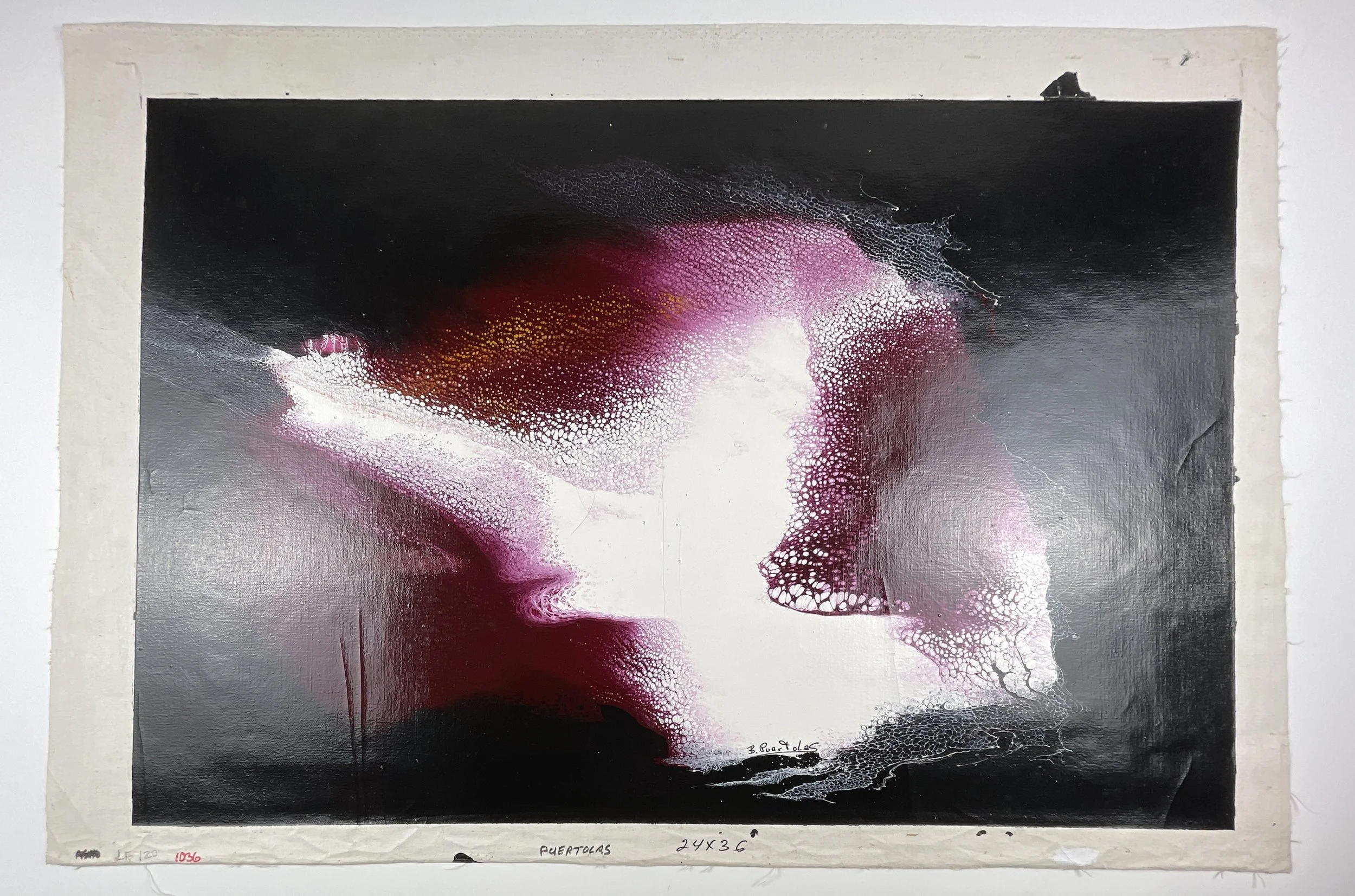
Driven by the need to allow colors, forms and lines to create their own effect, Falk draws on techniques of the international Art Informel movement. He places the canvas in front of him on trestles, or on the ground, to get as close to the picture as possible. In the act of painting, colors and imagined signs are applied intuitively and spontaneously. He often uses materials found around the place as structures in his pictures. He frequently changes the location of his studio, often working in abandoned storehouses or derelict houses.
“My workspace is a gray expanse of rubble. I often work in the open air. It seldom rains. There’s no respite in this harsh sun. It gets as intense as the heat of the desert, which I know first-hand. Its rays scorch and dry out. Mortar trickles from the walls, great islands of lime cling on. [...] I want to keep on here; in my studio of ruins I find concentration.”

1961 At the Society of Illustrators exhibition in New York, Falk receives the Award for Excellence for his “Marcel Marceau” bibliophile series.

1963 Falk wins the competition and is commissioned to produce seven posters for the 1964 Swiss National Exhibition. The posters, painted in tachiste style, meet with public disdain, but become highly sought-after collector’s items among connoisseurs.

Falk begins work for the bibliophile edition of The Visit (Der Besuch der alten Dame) by Friedrich Dürrenmatt.

1967 Stromboli: Randomly found materials of all kinds inspire Hans Falk to create a series of plastic compositions. The result is fantastic, colorful

1968 1969–73

sculptures made of bones, lava stone and wooden relics from the former fishing and winegrowing communities.

“My objects are formed from found household objects. I’m constantly changing their form by destroying it – for me they’re not essentially any different from what I’m expressing in my painting. Since they’re repeatedly waxing and waning, I’m going through the constant process of releasing what’s deep inside me, just as in my painting.”

Falk marries Thea Yvonne Heinl.

England: In Swinging London, Hans Falk experiences a time of political and musical happenings. He goes to musicals and live performances, where he also makes drawings, and uses text and images from newspapers and magazines in large-format pictures.

“I like showing society as it is: in complete putrefaction. But because it’s quite a comfortable putrefaction, it’s really exhilarating to paint it.”

There are signs of a return to the figurative; the representational and figurative overlap and merge. After four years, Falk has had enough. He is drawn to New York, the center of contemporary art.

New York, USA: Falk has a studio at the Bowery, Lower East Side. He is commissioned by Fortune Magazine to produce illustrations of regional stock exchanges in the United States.

He then moves to the Hotel Woodstock on 43rd Street and Times Square. For thirteen years, Falk lives and works in the Woodstock, formerly an elegant hotel, now dilapidated. He is particularly interested in the disused, rotten floors.

“I have nineteen rooms at my disposal on this floor. In 1974 a fire completed the destruction. [...] But all of this fails to disgust me, and I’m not yet so scared that I have to run away. I work for hours into the night. I’m setting something in opposition to this decay – including myself.”

This is where Falk creates his container pictures: receptacles for the remains of human existence, and witnesses to a brutal present that is the daily reality for people living in the megalopolis.

Hans Falk accompanies Circus Knie on tour around Switzerland in his own trailer, following the shows and the work of the artistes for three months each season. This results in far more than a thousand drawings.

“I felt that I was caught up in this fascinating interplay, that I was expanding my formal alphabet in the C-I-R-C-U-S. All the practicing, the vaulting, walking the tightrope, climbing up to it, and falling off it – it was always with me.”

Falk produces lithographs for the bibliophile edition of Henry Miller’s The Smile at the Foot of the Ladder (1948).

Visits to the glamorous New York nightclub GG’s Barnum Room inspire Falk to produce sketches and studies of the New York transvestite scene. He draws young men in their clubs and apartments in the Bronx, Brooklyn

1973–85

1977–80

1978

From 1979

and Manhattan.

1982 Hans Falk finds a new life partner, Romy Fiechter.

1985–86 Ennetbaden, Switzerland: Hans Falk spends a working year in Switzerland, transforming Walo Steiner’s lithographic workshops into a wellspring of productivity. Instead of drawing on printing plates, he uses Rives paper and cardboard, as well as zinc plates, as a base material and collage element for free compositions.

“I have spent eight hours at a time taking away or adding, drawing and etching in between, finding connections to the picture lying beside it – I’ve found the courage to go over a picture that seems finished to me, even at the risk of standing there empty-handed with the whole chaos around me, the dirty brushes, the filthy paint pots, the materials that have fallen by the wayside, and with my own disappointment”.

1987–2002 Return to Stromboli, Italy: Hans Falk no longer works in ruins. He lives and works in a house and studio that has been reduced to its Moorish forms. Another creative period begins. Falk revisits colors and forms from his first Stromboli period, but they have now changed and are more condensed.

For a few months each year he interrupts his sojourn on the island to create exhibitions all over Europe. He also illustrates and designs various books and magazines, and a series of postage stamps for Swiss Post.

2002 After an intense period of work on Stromboli, on 19 April Hans Falk dies in Zurich aged 83.