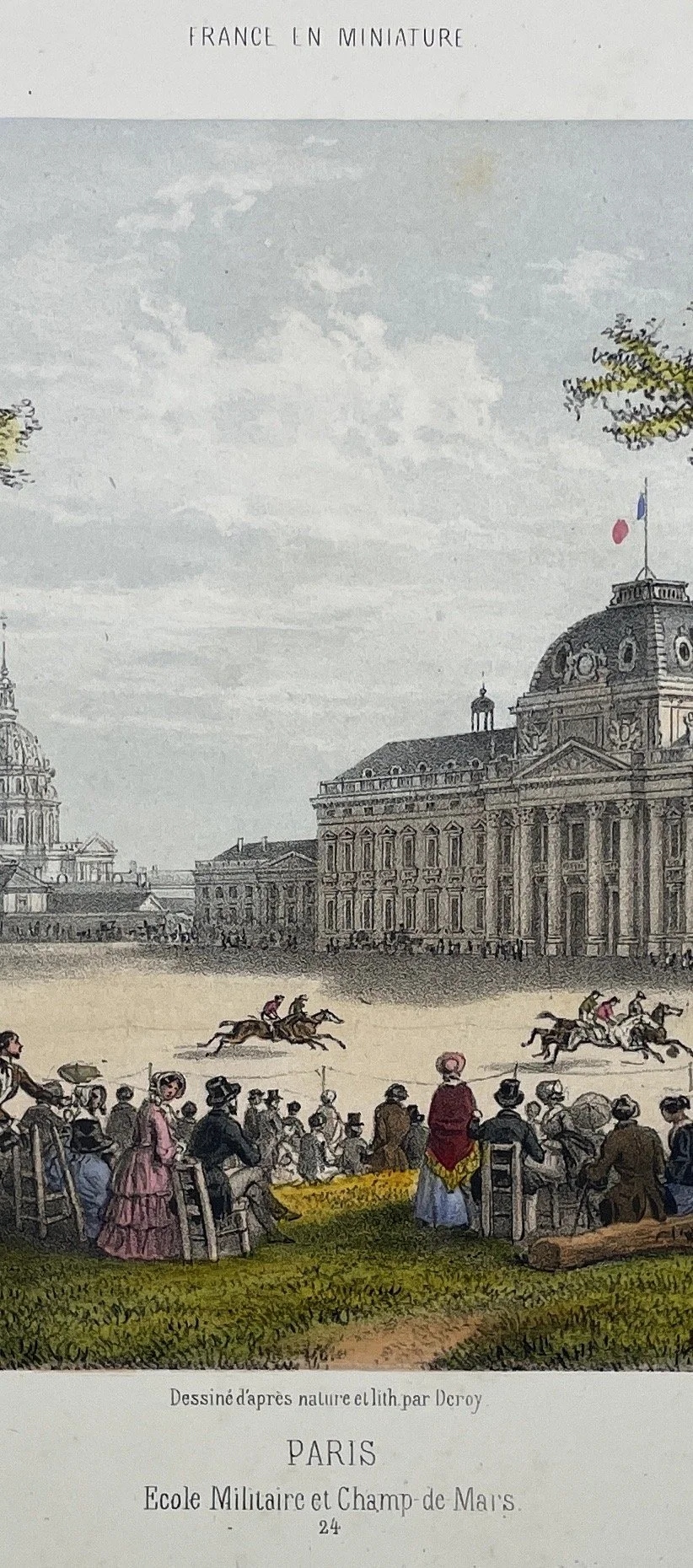
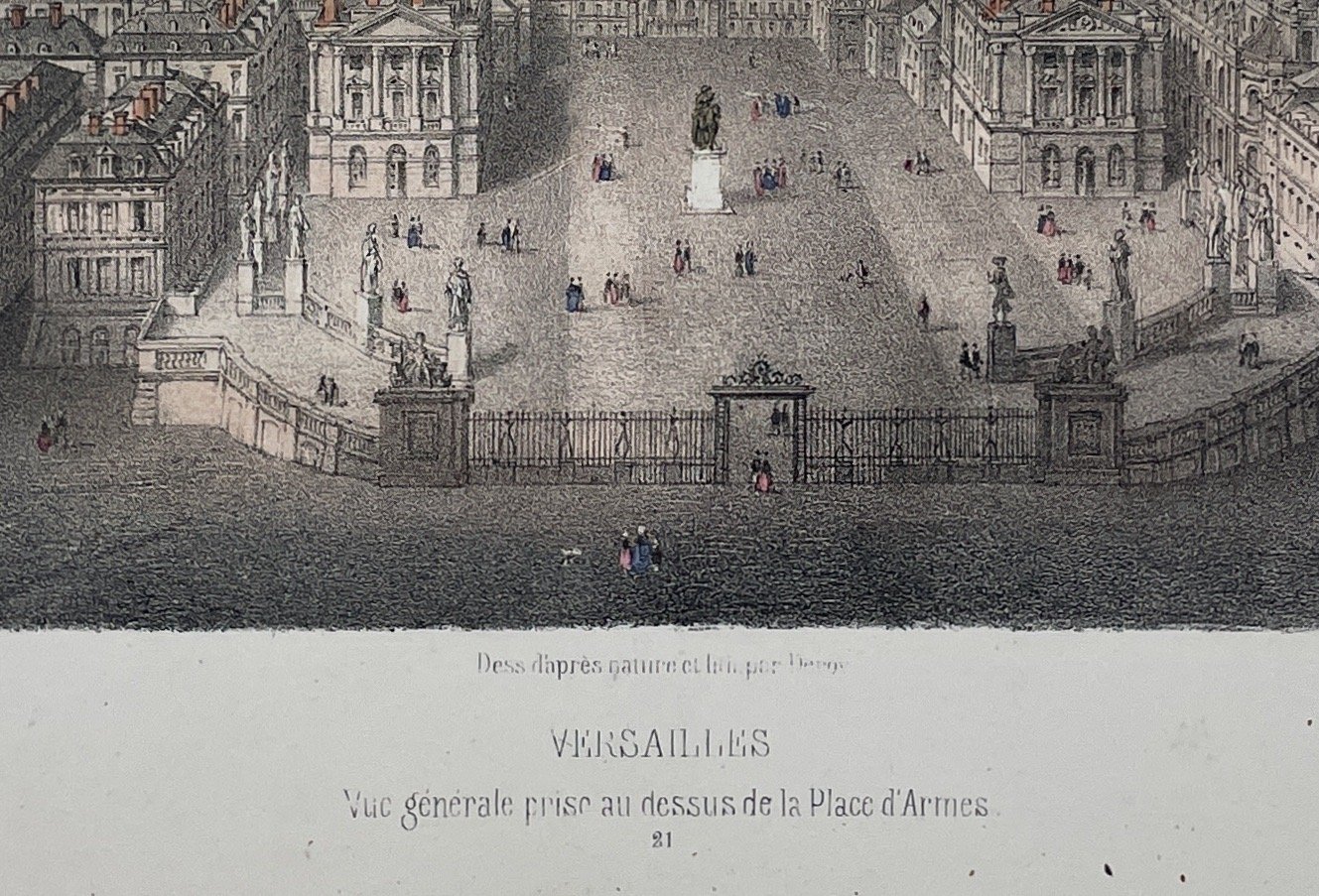
“Fontainebleau – Vue générale prise au-dessus du parterre,” Isidore-Laurent Deroy (French, 1797–1886), c. 1840s, hand-colored steel-engraved lithograph from France en Miniature, printed by Lemercier & Cie and published by E. Morier, approx. 10 × 6.5 in., with original period imprints.
This elegant 19th-century hand-colored steel-engraved lithograph of the Château de Fontainebleau, created by noted illustrator Isidore-Laurent Deroy and printed by the premier Paris atelier Lemercier & Cie, forms part of the esteemed France en Miniature series published by E. Morier. Capturing a sweeping aerial view of the palace, gardens, and surrounding parkland, this antique print is ideal for collectors of French architectural history, palace views, antique lithographs, and 19th-century topographical prints.
Artwork Description
This finely engraved and delicately hand-colored lithograph presents a panoramic elevated view of Château de Fontainebleau, one of France’s most important royal residences, inhabited by monarchs from Louis VII through Napoleon III. Deroy carefully captures the architectural sprawl of the estate—the wings, courtyards, formal parterres, long alleys, and reflective water basins that characterize the site’s rich spatial geometry.
The perspective looks down from above the parterre, revealing visitors strolling the grounds, the grand forecourt, and the vast landscaped surroundings. The tranquil lake and small boat at left provide contrast to the dense architectural complexity of the palace. The hand-applied colors add atmospheric greens, blues, and soft ochres, enriching the engraved detail without overwhelming it.
The print features the period imprints:
“Dess. et lith. d’après nature par Deroy” — Deroy drew and lithographed the view from nature.
“Paris E. Morier, 5 rue du Pont de Lodi” — the publisher responsible for the France en Miniature series.
“Imp. Lemercier, Paris” — confirming production at the leading lithographic workshop of the 19th century.
As with the finest works in the France en Miniature series, this print blends documentary precision with artistic refinement, offering a detailed and historically valuable portrait of one of France’s greatest palatial complexes as it appeared in the mid-19th century.
Artist, Printer & Publisher Biographies
ISIDORE-LAURENT DEROY (1797–1886) – Artist
Deroy was a Paris-born French painter, lithographer, and illustrator known for his architectural and landscape views. During the 19th century—a period when lithography flourished as both an artistic and documentary medium—Deroy created numerous views of French cities, monuments, and royal estates. His works were frequently featured in atlases, travel publications, and prestigious print series such as France en Miniature. Deroy’s drawings are admired for their precision, clarity, and atmospheric subtlety, and his printed works remain important historical records of French urban and architectural heritage.
LEMERCIER & CIE (Printer, Paris)
Lemercier & Cie was one of Europe’s foremost lithographic establishments during the 1800s, renowned for technical excellence, color innovation, and faithful reproduction of detail. The studio printed works for many of the era’s leading artists and publishers. Their imprint is regarded as a hallmark of high-quality 19th-century lithography.
E. MORIER (Publisher, Paris)
Located at 5 rue du Pont de Lodi, E. Morier specialized in finely crafted architectural and topographical prints. As the publisher of the France en Miniature series, Morier collaborated with Deroy and Lemercier to produce some of the most refined engraved views of France’s national monuments and landscapes.
Isidore-Laurent Deroy (1797–1886), “Fontainebleau – Vue générale prise au-dessus du parterre,” c. 1840s. Steel-engraved lithograph with period hand coloring, from France en Miniature. Printed by Lemercier & Cie, published by E. Morier. Very good antique condition with strong detail.
CERTIFICATE OF VALUE & AUTHENTICATION
For Fine Art Appraisal / Insurance / Gallery Documentation
Artist: Isidore-Laurent Deroy (1797–1886)
Title: Fontainebleau – Vue générale prise au-dessus du parterre
Series: France en Miniature
Medium: Steel-engraved lithograph with period hand coloring
Printer: Lemercier & Cie, Paris
Publisher: E. Morier, 5 rue du Pont de Lodi
Date: c. 1840s
Dimensions: Approx. 10 × 6.5 inches
Condition: Very good antique condition; original hand coloring and clear lines; light, expected age toning.
Current Owner: Artfind Gallery, Washington, DC
Authentication: Verified as an original 19th-century impression from the France en Miniature series with authentic publisher and printer imprints.
Provenance Chain (Collector Format)
Published by E. Morier, Paris (c. 1840s)
Private European Collection
Acquired in Europe (21st century)
Current Owner: Artfind Gallery, Washington, DC
These Hand-Coloured Steel Engraved historic lithograph prints are noted for their precise printing and rich colouring and are most sought after. The designs were drawn by Isidore Laurent Deroy and printed from steel engraved plates by Lemercier & Cie and published by E Morier - (See more at the British Museum). Beautiful topographic representations of historical French monuments. A Great piece for any decor - give your space a unique story to tell…
“Fontainebleau – Vue générale prise au-dessus du parterre,” Isidore-Laurent Deroy (French, 1797–1886), c. 1840s, hand-colored steel-engraved lithograph from France en Miniature, printed by Lemercier & Cie and published by E. Morier, approx. 10 × 6.5 in., with original period imprints.
This elegant 19th-century hand-colored steel-engraved lithograph of the Château de Fontainebleau, created by noted illustrator Isidore-Laurent Deroy and printed by the premier Paris atelier Lemercier & Cie, forms part of the esteemed France en Miniature series published by E. Morier. Capturing a sweeping aerial view of the palace, gardens, and surrounding parkland, this antique print is ideal for collectors of French architectural history, palace views, antique lithographs, and 19th-century topographical prints.
Artwork Description
This finely engraved and delicately hand-colored lithograph presents a panoramic elevated view of Château de Fontainebleau, one of France’s most important royal residences, inhabited by monarchs from Louis VII through Napoleon III. Deroy carefully captures the architectural sprawl of the estate—the wings, courtyards, formal parterres, long alleys, and reflective water basins that characterize the site’s rich spatial geometry.
The perspective looks down from above the parterre, revealing visitors strolling the grounds, the grand forecourt, and the vast landscaped surroundings. The tranquil lake and small boat at left provide contrast to the dense architectural complexity of the palace. The hand-applied colors add atmospheric greens, blues, and soft ochres, enriching the engraved detail without overwhelming it.
The print features the period imprints:
“Dess. et lith. d’après nature par Deroy” — Deroy drew and lithographed the view from nature.
“Paris E. Morier, 5 rue du Pont de Lodi” — the publisher responsible for the France en Miniature series.
“Imp. Lemercier, Paris” — confirming production at the leading lithographic workshop of the 19th century.
As with the finest works in the France en Miniature series, this print blends documentary precision with artistic refinement, offering a detailed and historically valuable portrait of one of France’s greatest palatial complexes as it appeared in the mid-19th century.
Artist, Printer & Publisher Biographies
ISIDORE-LAURENT DEROY (1797–1886) – Artist
Deroy was a Paris-born French painter, lithographer, and illustrator known for his architectural and landscape views. During the 19th century—a period when lithography flourished as both an artistic and documentary medium—Deroy created numerous views of French cities, monuments, and royal estates. His works were frequently featured in atlases, travel publications, and prestigious print series such as France en Miniature. Deroy’s drawings are admired for their precision, clarity, and atmospheric subtlety, and his printed works remain important historical records of French urban and architectural heritage.
LEMERCIER & CIE (Printer, Paris)
Lemercier & Cie was one of Europe’s foremost lithographic establishments during the 1800s, renowned for technical excellence, color innovation, and faithful reproduction of detail. The studio printed works for many of the era’s leading artists and publishers. Their imprint is regarded as a hallmark of high-quality 19th-century lithography.
E. MORIER (Publisher, Paris)
Located at 5 rue du Pont de Lodi, E. Morier specialized in finely crafted architectural and topographical prints. As the publisher of the France en Miniature series, Morier collaborated with Deroy and Lemercier to produce some of the most refined engraved views of France’s national monuments and landscapes.
Isidore-Laurent Deroy (1797–1886), “Fontainebleau – Vue générale prise au-dessus du parterre,” c. 1840s. Steel-engraved lithograph with period hand coloring, from France en Miniature. Printed by Lemercier & Cie, published by E. Morier. Very good antique condition with strong detail.
CERTIFICATE OF VALUE & AUTHENTICATION
For Fine Art Appraisal / Insurance / Gallery Documentation
Artist: Isidore-Laurent Deroy (1797–1886)
Title: Fontainebleau – Vue générale prise au-dessus du parterre
Series: France en Miniature
Medium: Steel-engraved lithograph with period hand coloring
Printer: Lemercier & Cie, Paris
Publisher: E. Morier, 5 rue du Pont de Lodi
Date: c. 1840s
Dimensions: Approx. 10 × 6.5 inches
Condition: Very good antique condition; original hand coloring and clear lines; light, expected age toning.
Current Owner: Artfind Gallery, Washington, DC
Authentication: Verified as an original 19th-century impression from the France en Miniature series with authentic publisher and printer imprints.
Provenance Chain (Collector Format)
Published by E. Morier, Paris (c. 1840s)
Private European Collection
Acquired in Europe (21st century)
Current Owner: Artfind Gallery, Washington, DC
These Hand-Coloured Steel Engraved historic lithograph prints are noted for their precise printing and rich colouring and are most sought after. The designs were drawn by Isidore Laurent Deroy and printed from steel engraved plates by Lemercier & Cie and published by E Morier - (See more at the British Museum). Beautiful topographic representations of historical French monuments. A Great piece for any decor - give your space a unique story to tell…
 Image 1 of 8
 Image 2 of 8
 Image 3 of 8
 Image 4 of 8
 Image 5 of 8
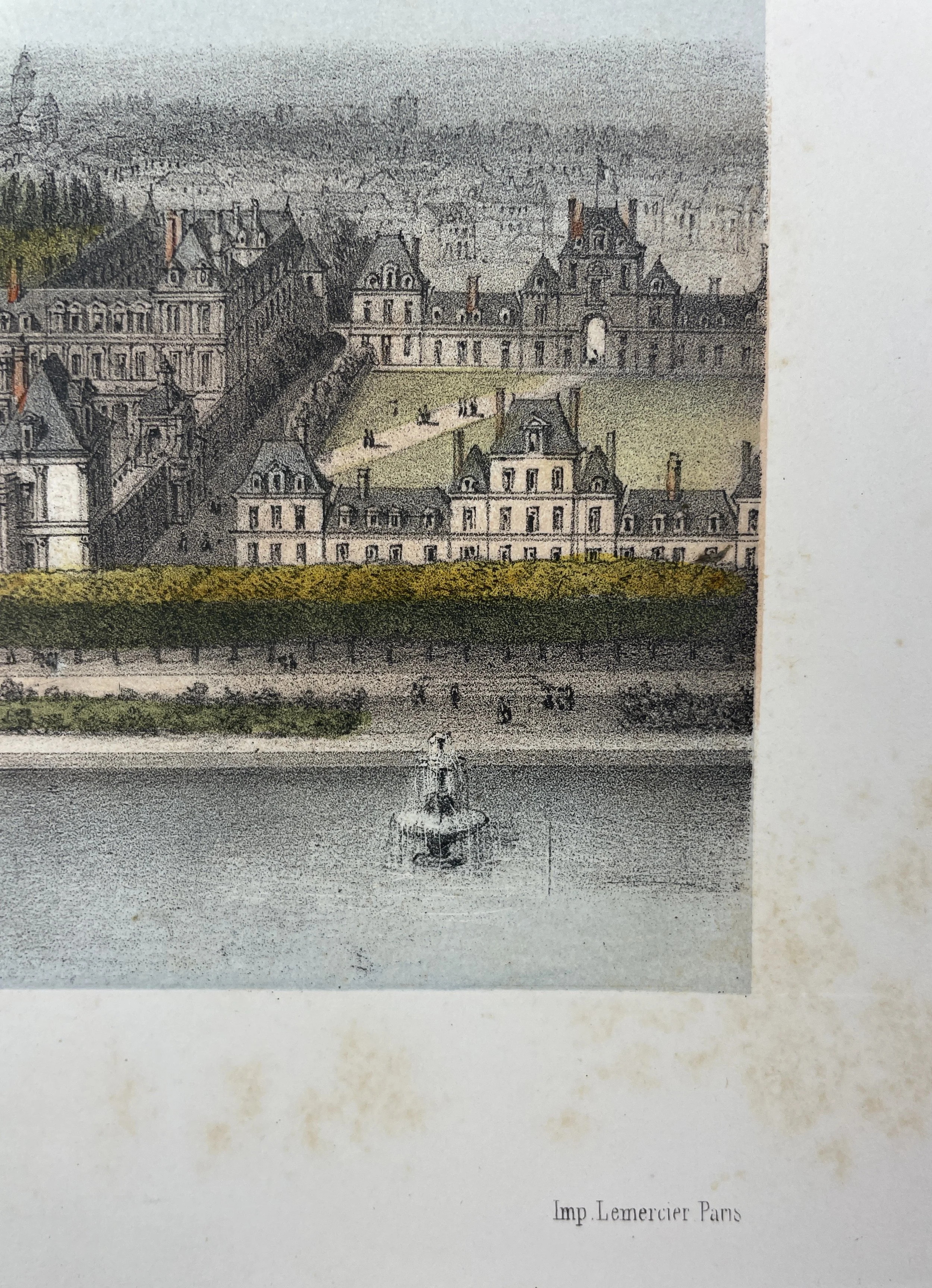 Image 6 of 8
 Image 7 of 8
 Image 8 of 8