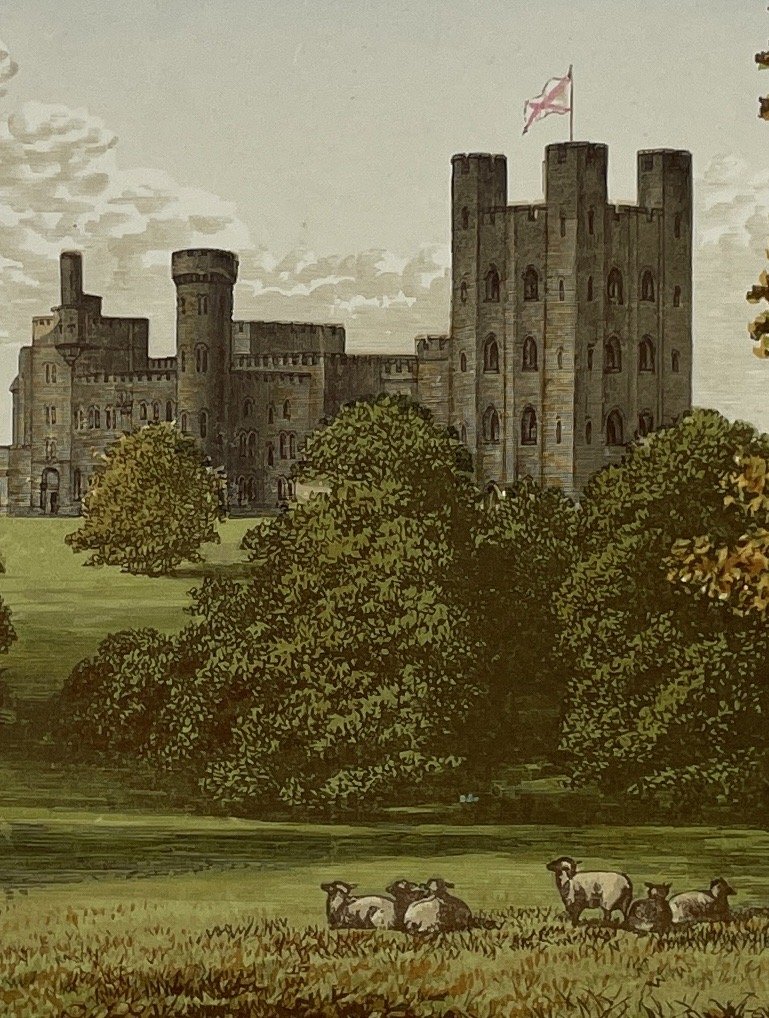
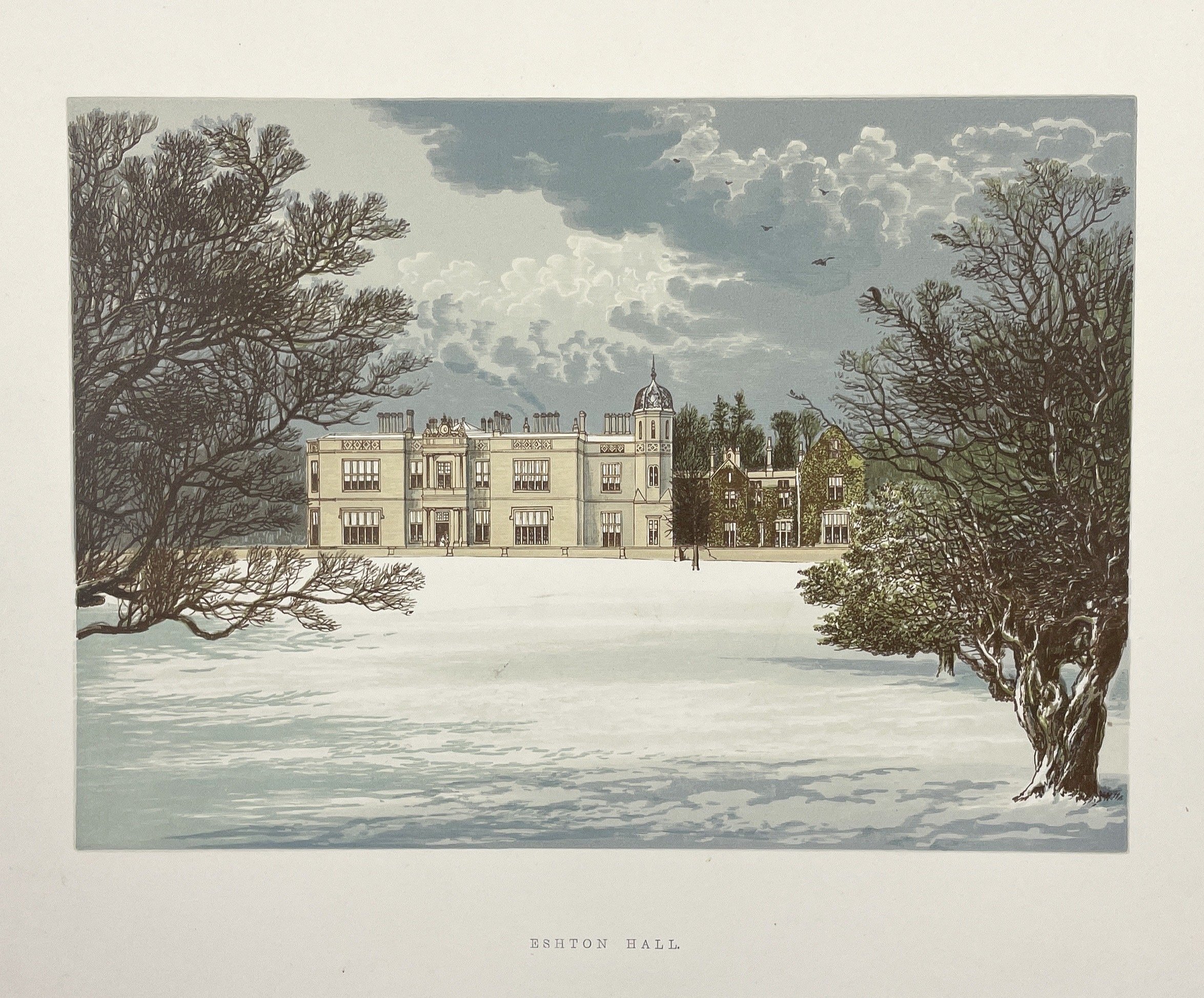
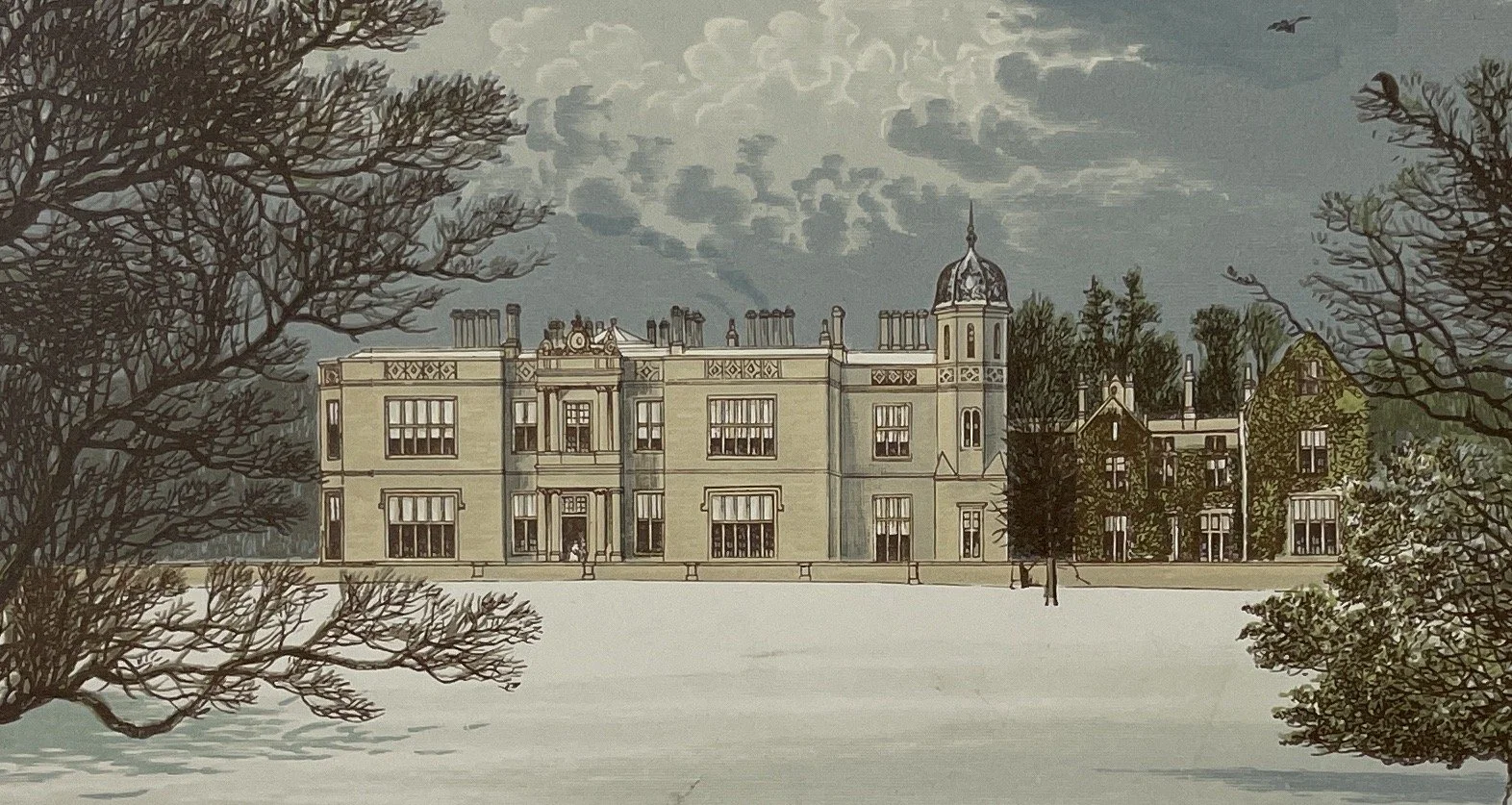
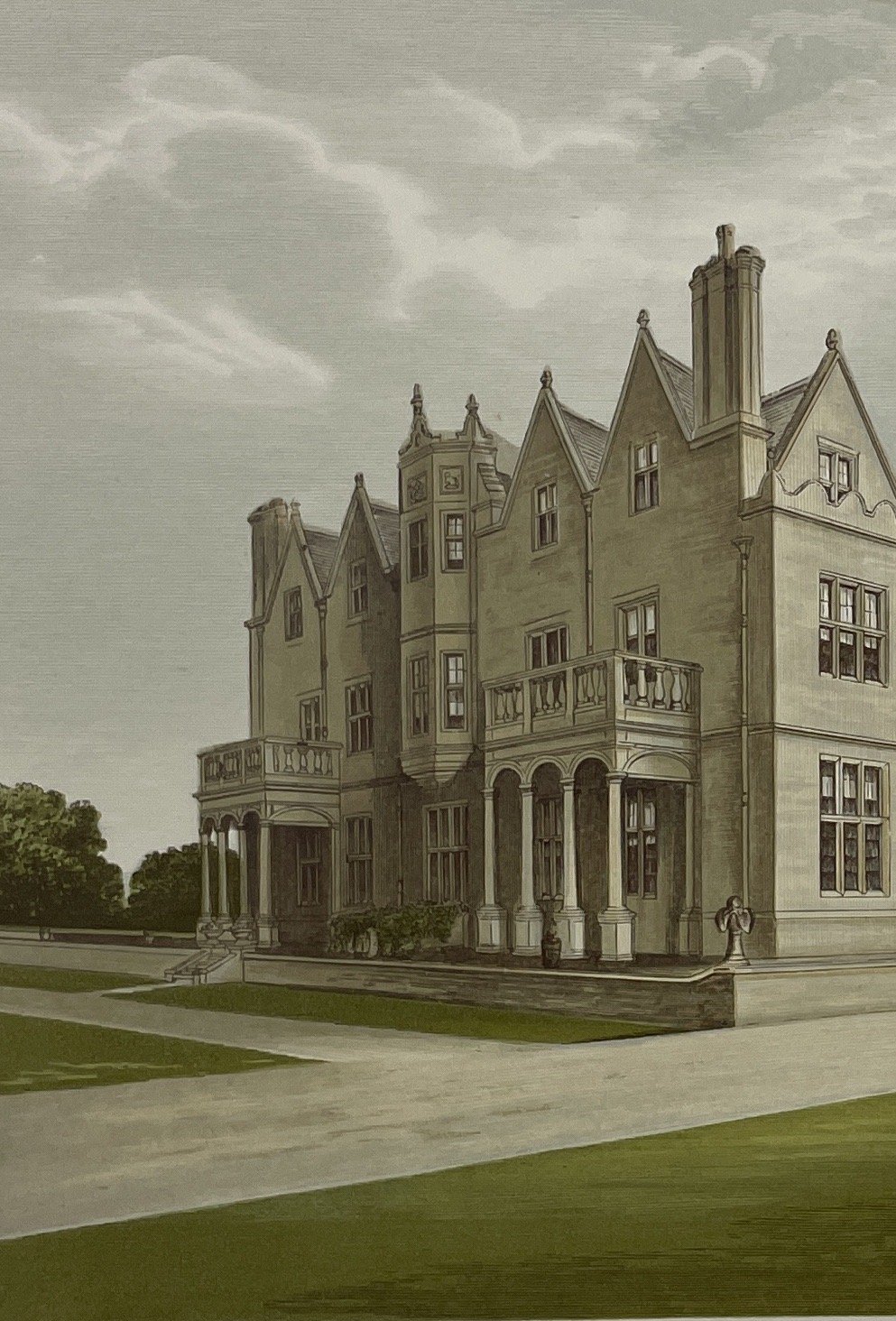
“Hughenden Manor,” Alexander Francis Lydon (1836–1917), c. 1880, Baxter-process colored woodblock engraving printed by Benjamin Fawcett (1808–1893), published by William Mackenzie, London; sheet 10½ × 8 in., image approx. 7¼ × 5⅛ in., unsigned as issued.
This elegant Victorian Baxter-process colored woodblock engraving of Hughenden Manor, illustrated by Alexander Francis Lydon and printed by the master color-printer Benjamin Fawcett, was created for the celebrated A Series of Picturesque Views of Seats of the Noblemen and Gentlemen of Great Britain and Ireland (c. 1880). Featuring the historic country house closely associated with Prime Minister Benjamin Disraeli, this plate is highly desirable to collectors of British political history, Victorian estate art, architectural prints, and 19th-century woodblock color engravings.
Artwork Description
This beautifully detailed engraving portrays Hughenden Manor, the distinguished Buckinghamshire estate best known as the longtime home of Benjamin Disraeli, 1st Earl of Beaconsfield, one of Victorian Britain’s most influential statesmen. The manor is presented in its mid-19th-century Gothic Revival form, complete with crenellated parapets, pointed-arch details, pinnacles, and ivy-draped façade.
Alexander Francis Lydon captures the manor frontally, framed by symmetrical lawns and manicured gardens. A sweeping circular flower bed and a long curving drive lead the viewer’s eye toward the entrance, emphasizing the estate’s order, refinement, and grandeur. Mature trees on either side create a natural proscenium, giving the central architecture a stately prominence.
The sky—rendered in soft blues, golds, and greys—features dynamic, rolling cloud formations that add atmosphere and depth, a hallmark of Lydon’s landscape style.
Printed using Benjamin Fawcett’s Baxter-process, the image was produced via multiple transparently inked woodblocks, often eight or more. This method creates subtle tonal transitions, crisp architectural detail, and a beautifully harmonious color palette. Fawcett’s craftsmanship brings out the warm stone coloring of the manor, the lush greens of the landscape, and the gentle interplay of sunlight and shadow.
As part of William Mackenzie’s Picturesque Views, this plate serves not only as a decorative Victorian print but as a significant historical document of a major political figure’s residence.
Artist & Printer Biographies
ALEXANDER FRANCIS LYDON (1836–1917) — Illustrator
Lydon was one of Victorian England’s foremost architectural and topographical illustrators. Trained under printer Benjamin Fawcett, he mastered crisp linear drawing and atmospheric landscape rendering—qualities evident in his depictions of stately homes and country estates. His extensive collaborations with Fawcett and Rev. F.O. Morris remain central to the history of 19th-century British illustrated books.
BENJAMIN FAWCETT (1808–1893) — Printer
A pioneering British printer, Fawcett was renowned for his refinement of the Baxter-process, using multiple color woodblocks to create richly layered, transparent tones. Working from Driffield, Yorkshire, he produced some of the finest Victorian color plates in natural history, architecture, and landscape art. His technical mastery is clearly demonstrated in the nuanced color work of this Hughenden Manor engraving.
WILLIAM MACKENZIE — Publisher
Mackenzie was a major Victorian publisher of luxurious illustrated volumes, including natural history, topography, and architectural surveys. His Picturesque Views of Seats series is one of the most important visual records of aristocratic and politically significant estates from the late 19th century.
Alexander Francis Lydon (illustrator), Benjamin Fawcett (printer), “Hughenden Manor,” c. 1880. Baxter-process colored woodblock engraving from Picturesque Views of Seats of the Noblemen and Gentlemen of Great Britain and Ireland. Image approx. 7¼ × 5⅛ in.; sheet 10½ × 8 in. Strong color; excellent detail; very good vintage condition.
CERTIFICATE OF VALUE & AUTHENTICATION
For Fine Art Appraisal / Insurance / Gallery Documentation
Title: Hughenden Manor
Illustrator: Alexander Francis Lydon (1836–1917)
Printer: Benjamin Fawcett (1808–1893)
Publisher: William Mackenzie, London / Edinburgh / Dublin
Date: c. 1880
Medium: Baxter-process colored woodblock engraving (multi-block, approx. 8 colors)
Sheet Size: 10½ × 8 inches
Image Size: approx. 7¼ × 5⅛ inches
Condition: Excellent original color; clean margins; crisp architectural detail; never framed or displayed
Current Owner: Artfind Gallery, Washington, DC
Authentication: Confirmed period production consistent with Lydon–Fawcett techniques and Mackenzie publication characteristics.
Provenance Chain
Published by William Mackenzie, London / Edinburgh / Dublin (c. 1880)
Private British Collection
Mitch Moore Gallery Inc., NYC (retired inventory)
Current Owner: Artfind Gallery, Washington, DC
“Hughenden Manor,” Alexander Francis Lydon (1836–1917), c. 1880, Baxter-process colored woodblock engraving printed by Benjamin Fawcett (1808–1893), published by William Mackenzie, London; sheet 10½ × 8 in., image approx. 7¼ × 5⅛ in., unsigned as issued.
This elegant Victorian Baxter-process colored woodblock engraving of Hughenden Manor, illustrated by Alexander Francis Lydon and printed by the master color-printer Benjamin Fawcett, was created for the celebrated A Series of Picturesque Views of Seats of the Noblemen and Gentlemen of Great Britain and Ireland (c. 1880). Featuring the historic country house closely associated with Prime Minister Benjamin Disraeli, this plate is highly desirable to collectors of British political history, Victorian estate art, architectural prints, and 19th-century woodblock color engravings.
Artwork Description
This beautifully detailed engraving portrays Hughenden Manor, the distinguished Buckinghamshire estate best known as the longtime home of Benjamin Disraeli, 1st Earl of Beaconsfield, one of Victorian Britain’s most influential statesmen. The manor is presented in its mid-19th-century Gothic Revival form, complete with crenellated parapets, pointed-arch details, pinnacles, and ivy-draped façade.
Alexander Francis Lydon captures the manor frontally, framed by symmetrical lawns and manicured gardens. A sweeping circular flower bed and a long curving drive lead the viewer’s eye toward the entrance, emphasizing the estate’s order, refinement, and grandeur. Mature trees on either side create a natural proscenium, giving the central architecture a stately prominence.
The sky—rendered in soft blues, golds, and greys—features dynamic, rolling cloud formations that add atmosphere and depth, a hallmark of Lydon’s landscape style.
Printed using Benjamin Fawcett’s Baxter-process, the image was produced via multiple transparently inked woodblocks, often eight or more. This method creates subtle tonal transitions, crisp architectural detail, and a beautifully harmonious color palette. Fawcett’s craftsmanship brings out the warm stone coloring of the manor, the lush greens of the landscape, and the gentle interplay of sunlight and shadow.
As part of William Mackenzie’s Picturesque Views, this plate serves not only as a decorative Victorian print but as a significant historical document of a major political figure’s residence.
Artist & Printer Biographies
ALEXANDER FRANCIS LYDON (1836–1917) — Illustrator
Lydon was one of Victorian England’s foremost architectural and topographical illustrators. Trained under printer Benjamin Fawcett, he mastered crisp linear drawing and atmospheric landscape rendering—qualities evident in his depictions of stately homes and country estates. His extensive collaborations with Fawcett and Rev. F.O. Morris remain central to the history of 19th-century British illustrated books.
BENJAMIN FAWCETT (1808–1893) — Printer
A pioneering British printer, Fawcett was renowned for his refinement of the Baxter-process, using multiple color woodblocks to create richly layered, transparent tones. Working from Driffield, Yorkshire, he produced some of the finest Victorian color plates in natural history, architecture, and landscape art. His technical mastery is clearly demonstrated in the nuanced color work of this Hughenden Manor engraving.
WILLIAM MACKENZIE — Publisher
Mackenzie was a major Victorian publisher of luxurious illustrated volumes, including natural history, topography, and architectural surveys. His Picturesque Views of Seats series is one of the most important visual records of aristocratic and politically significant estates from the late 19th century.
Alexander Francis Lydon (illustrator), Benjamin Fawcett (printer), “Hughenden Manor,” c. 1880. Baxter-process colored woodblock engraving from Picturesque Views of Seats of the Noblemen and Gentlemen of Great Britain and Ireland. Image approx. 7¼ × 5⅛ in.; sheet 10½ × 8 in. Strong color; excellent detail; very good vintage condition.
CERTIFICATE OF VALUE & AUTHENTICATION
For Fine Art Appraisal / Insurance / Gallery Documentation
Title: Hughenden Manor
Illustrator: Alexander Francis Lydon (1836–1917)
Printer: Benjamin Fawcett (1808–1893)
Publisher: William Mackenzie, London / Edinburgh / Dublin
Date: c. 1880
Medium: Baxter-process colored woodblock engraving (multi-block, approx. 8 colors)
Sheet Size: 10½ × 8 inches
Image Size: approx. 7¼ × 5⅛ inches
Condition: Excellent original color; clean margins; crisp architectural detail; never framed or displayed
Current Owner: Artfind Gallery, Washington, DC
Authentication: Confirmed period production consistent with Lydon–Fawcett techniques and Mackenzie publication characteristics.
Provenance Chain
Published by William Mackenzie, London / Edinburgh / Dublin (c. 1880)
Private British Collection
Mitch Moore Gallery Inc., NYC (retired inventory)
Current Owner: Artfind Gallery, Washington, DC
 Image 1 of 7
 Image 2 of 7
 Image 3 of 7
 Image 4 of 7
 Image 5 of 7
 Image 6 of 7
 Image 7 of 7