 Image 1 of 5
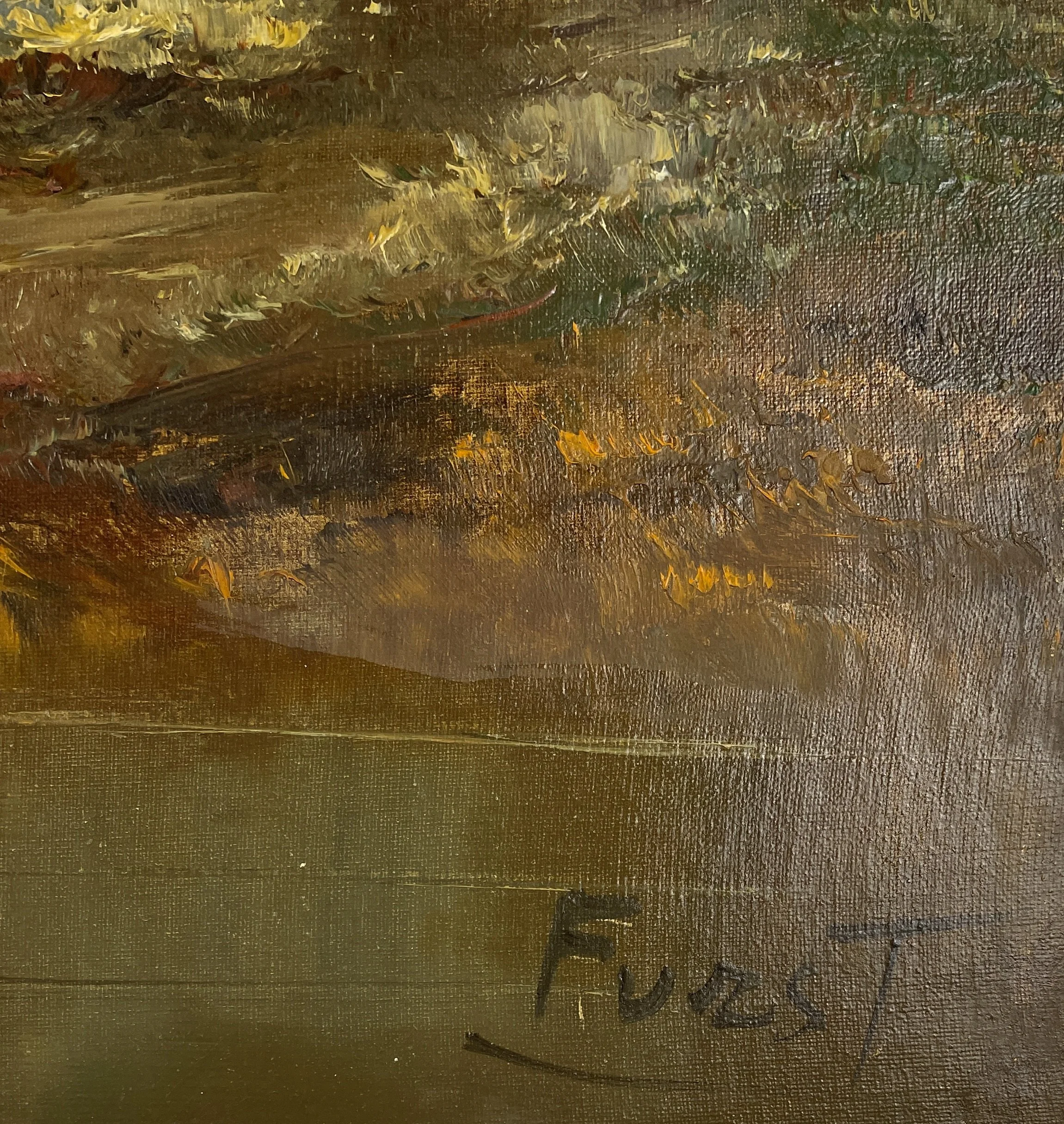 Image 2 of 5
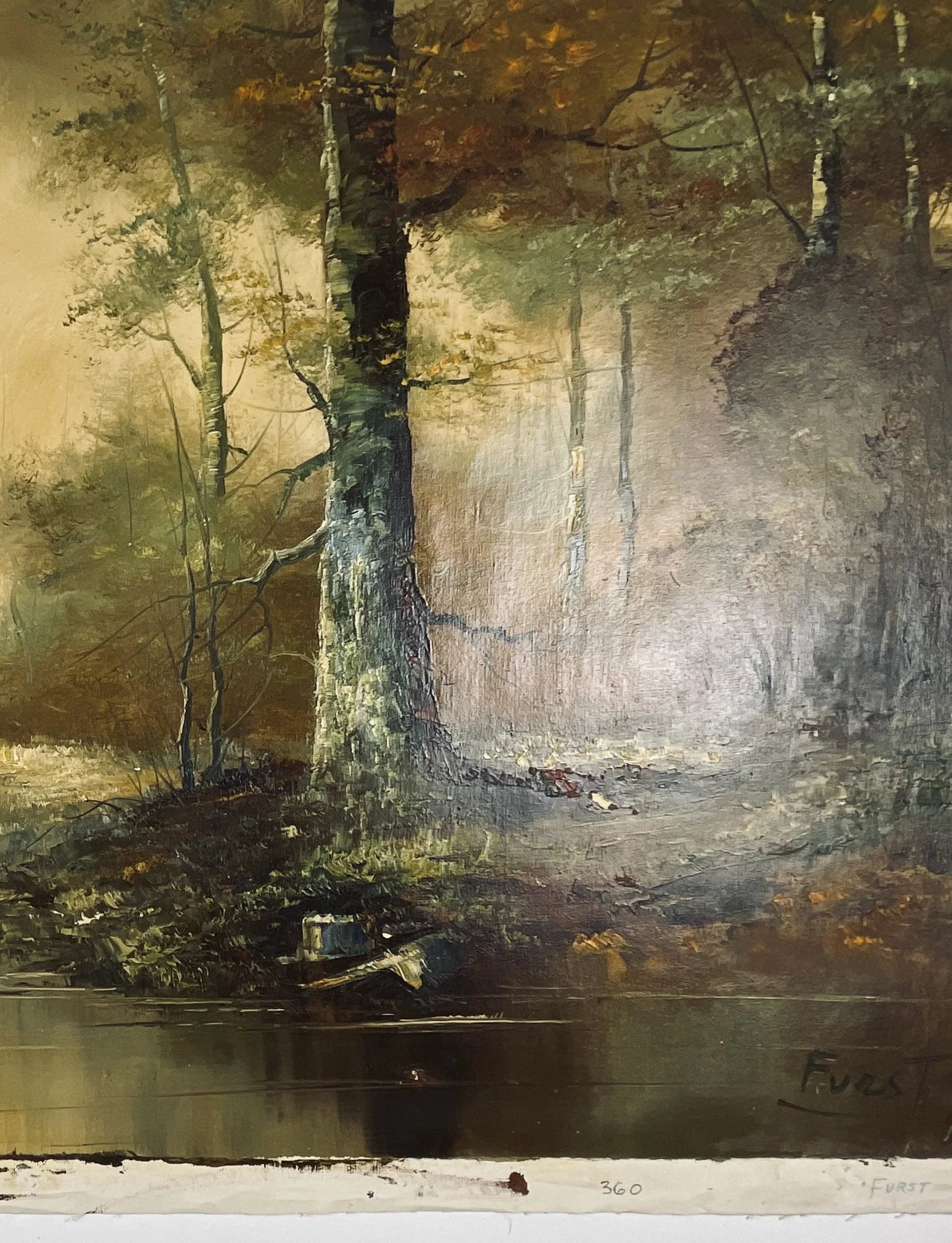 Image 3 of 5
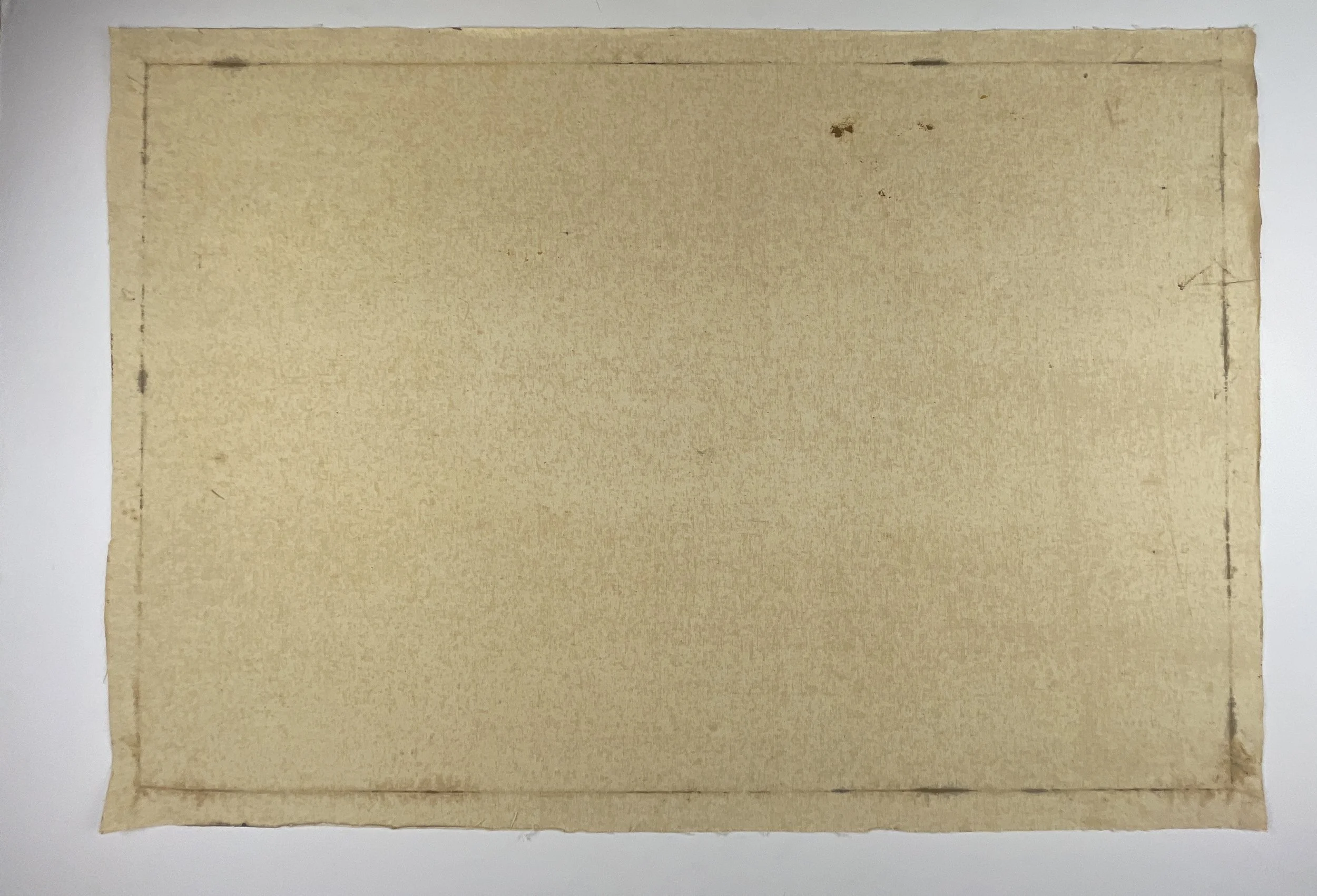 Image 4 of 5
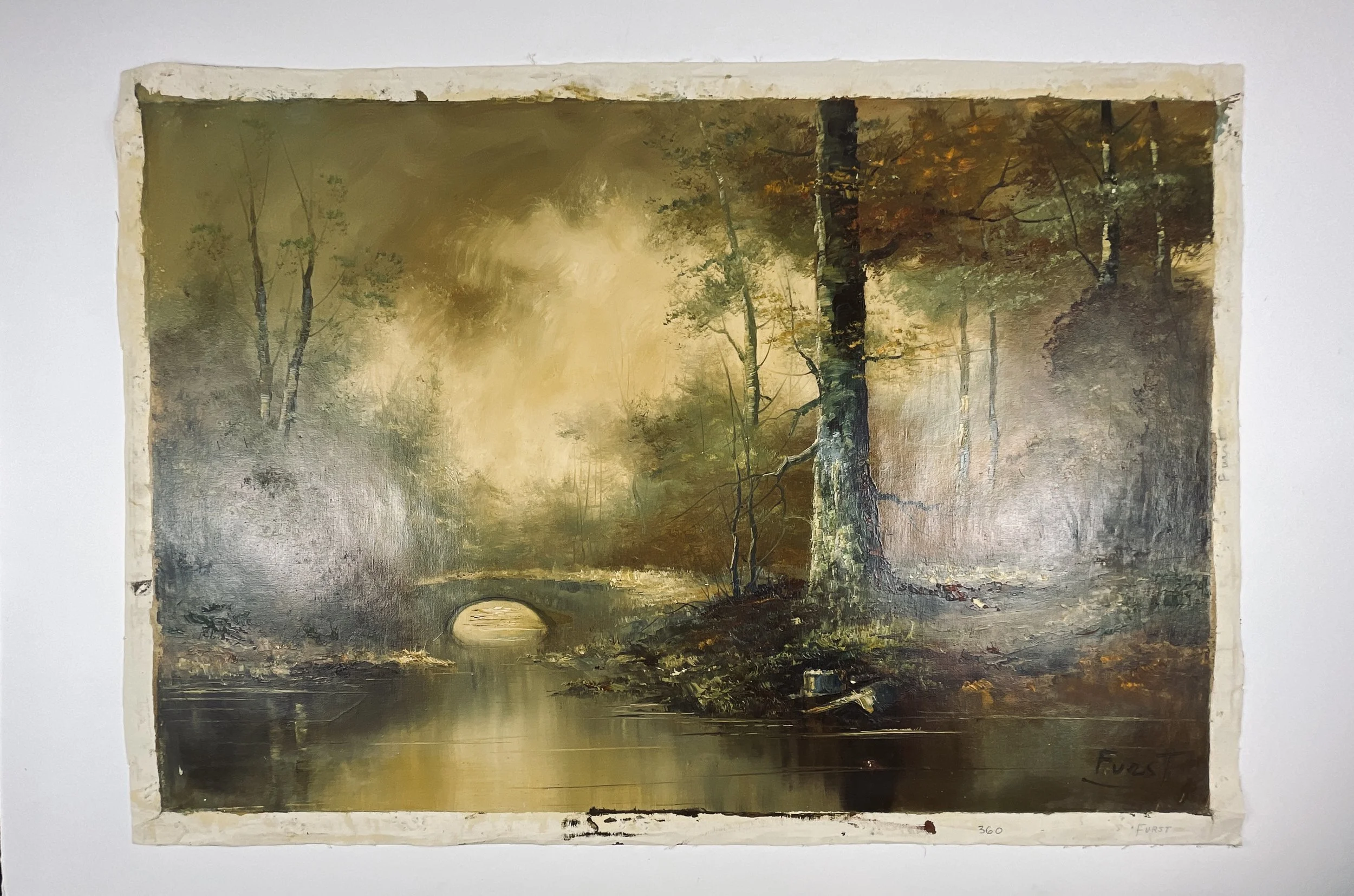 Image 5 of 5
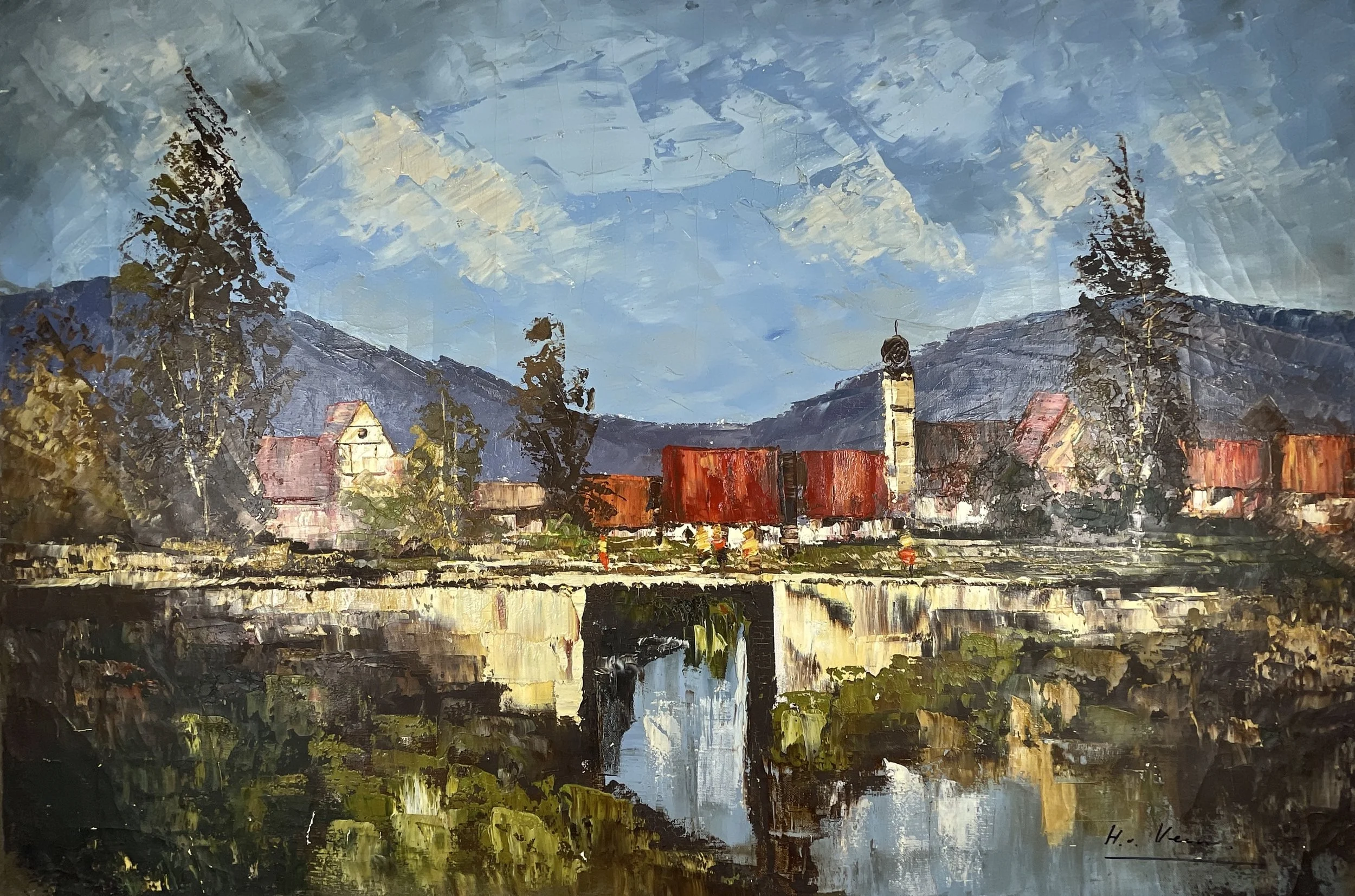
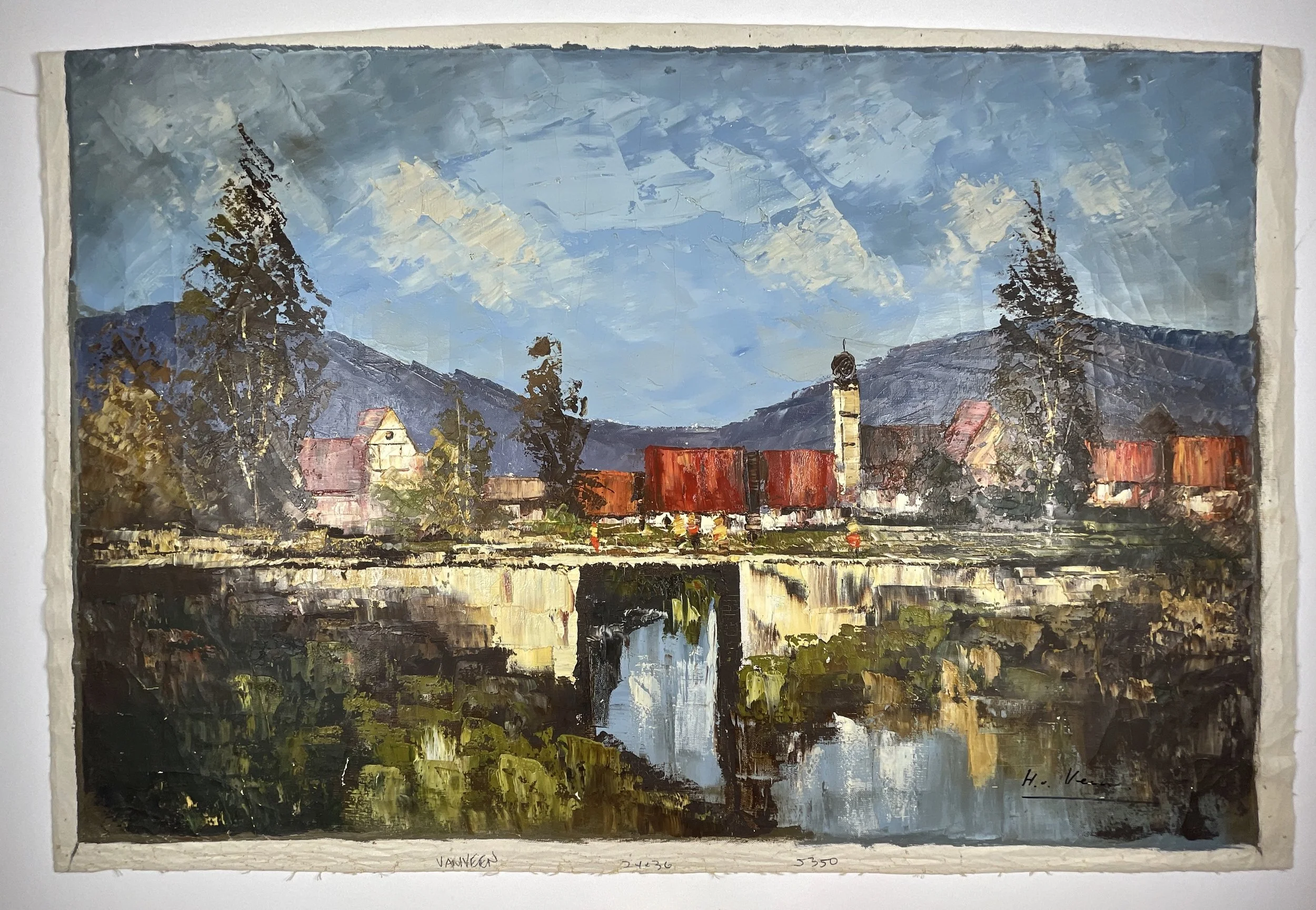
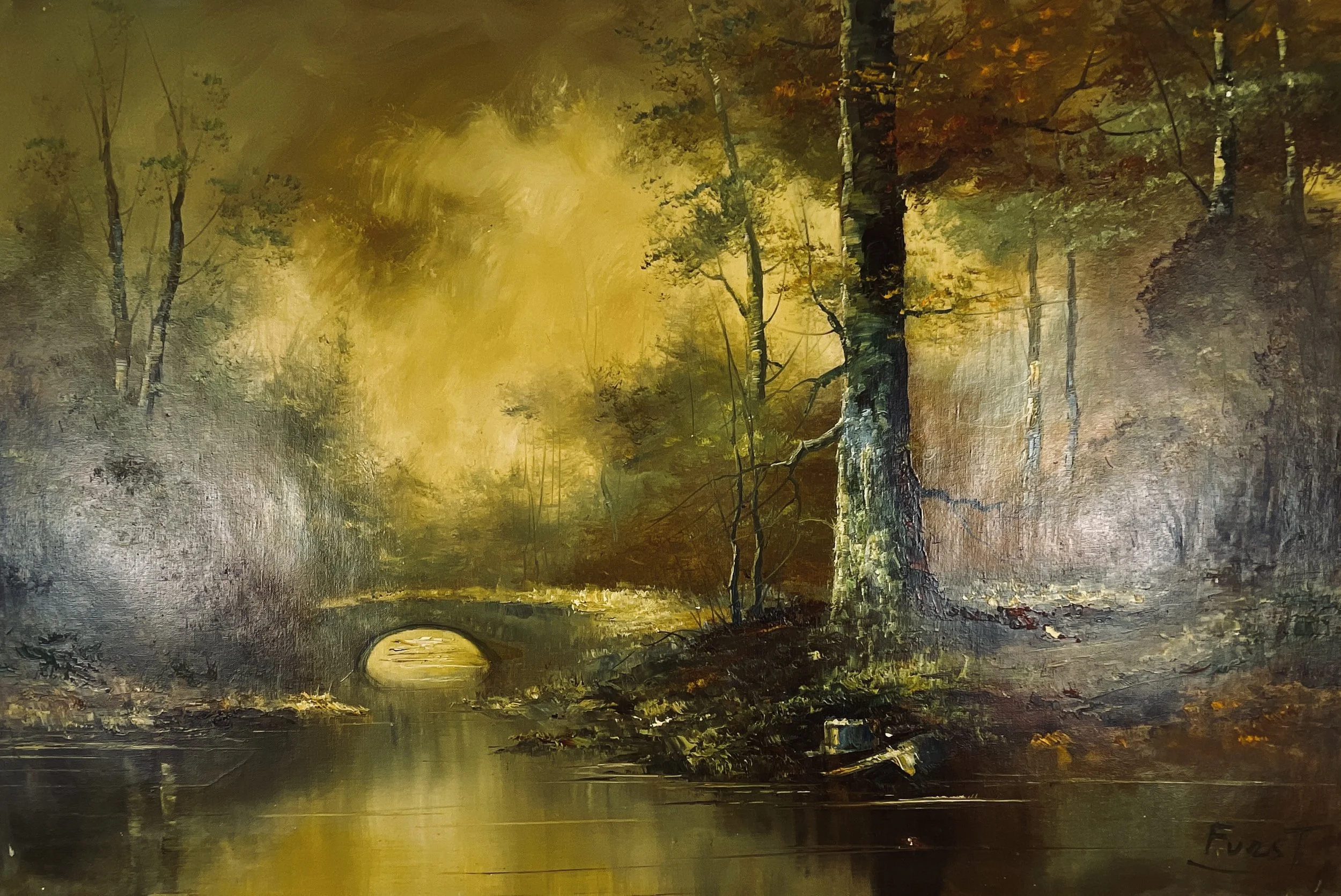
This evocative woodland landscape attributed to the artist Furst captures a mist-laden forest scene illuminated by warm autumn light. Executed in rich oil impasto, the composition centers on a tranquil stream crossed by a small stone bridge, framed by towering trees and glowing foliage. The palette of amber, olive, and ochre tones creates a luminous atmospheric depth reminiscent of mid-20th-century decorative landscape painting popular in American and European galleries during the 1960s–1970s. The artist employs layered brushwork and textured highlights to suggest drifting mist and reflected light across the water’s surface. Signed lower right and presented on canvas measuring 36 × 24 inches, the work embodies the period’s fascination with romanticized natural settings and painterly surface texture.
Artwork Description
This atmospheric oil painting attributed to the artist Furst depicts a quiet woodland scene at the edge of autumn. A calm stream occupies the foreground, reflecting the muted golds and greens of the surrounding forest. Rising from the right bank is a tall tree trunk rendered in thick impasto, its textured bark catching the warm light that filters through the canopy. Beyond the water, a small arched stone bridge leads into the distance, disappearing into a softly diffused woodland path.
The composition is built through layered oil paint applied with both brush and palette knife, creating tactile surface relief typical of mid-century decorative landscape painting. The artist’s technique emphasizes tonal transitions rather than sharp outlines; forms emerge from haze and mist, suggesting early morning light or the fading glow of late afternoon. This method allows the central glow of the clearing to serve as a focal point while darker foliage and shadowed trunks frame the composition.
The painting’s color structure relies heavily on ochres, umbers, olive greens, and golden yellows. These tones produce a harmonious autumnal atmosphere and contribute to the sense of quiet reflection. The impasto technique appears most prominently along the tree trunk and foliage highlights, where thicker paint catches light and enhances dimensionality.
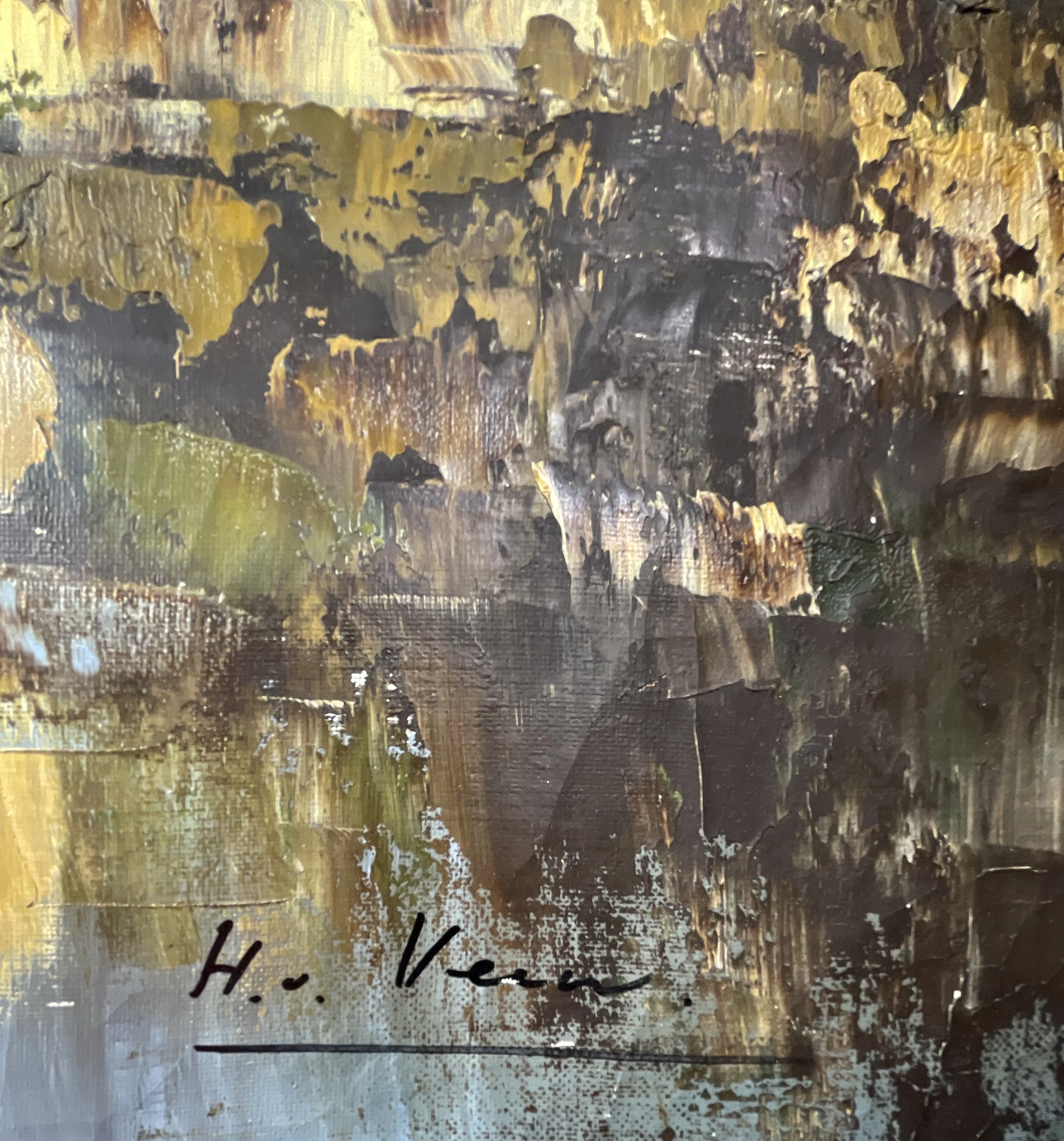
Signed “Furst” in the lower right corner, the painting aligns stylistically with decorative tonal landscapes produced for gallery and interior design markets during the late twentieth century. Works of this type were often distributed through regional galleries and publishers, including those associated with Art Spectrum and Mitch Morse Gallery networks that introduced numerous European and American painters to collectors in the United States.
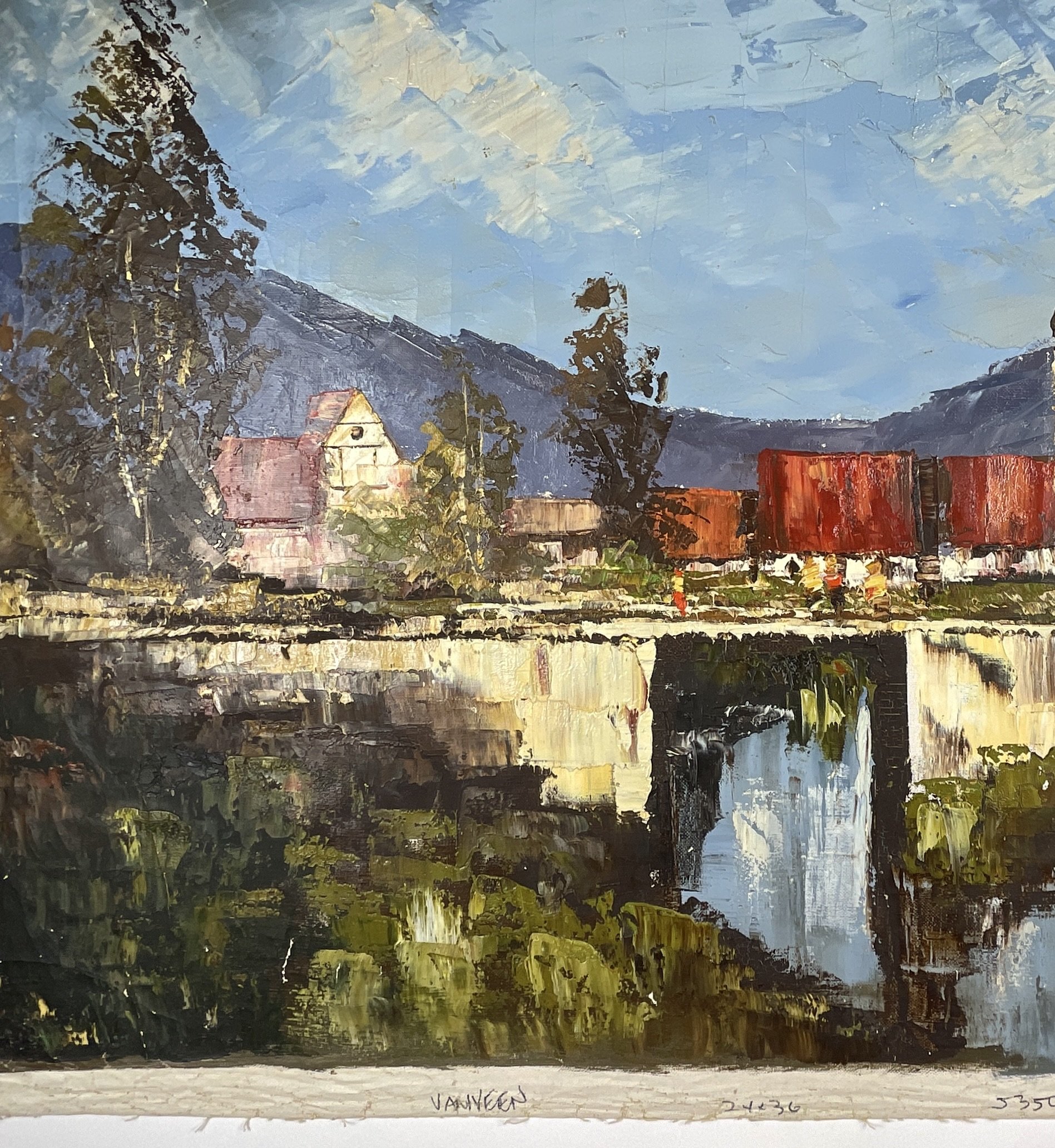
Despite some visible edge wear and surface abrasions consistent with age and handling, the painting retains strong visual presence. Its luminous atmosphere and romantic woodland subject remain highly decorative, making it particularly suited for collectors drawn to traditional landscape imagery and textured oil technique.
Artist Biography
The painter identified as Furst appears to have been part of the broader network of mid- to late-twentieth-century landscape artists whose work circulated through gallery publishers and design-oriented art distributors during the 1960s through the 1980s. While detailed archival records remain limited, paintings signed “Furst” have appeared periodically in secondary art markets and gallery inventories, typically depicting atmospheric forest scenes, pastoral waterways, and romantic European-style landscapes rendered in oil.
Artists working in this genre frequently trained within academic or studio traditions emphasizing tonal landscape painting, drawing influence from nineteenth-century European Romantic and Barbizon schools. These traditions favored atmospheric light, woodland imagery, and soft tonal transitions—qualities clearly visible in the present painting. Rather than pursuing avant-garde abstraction, painters in this circle focused on producing richly textured landscapes that appealed to collectors seeking decorative yet painterly works for residential and corporate interiors.
During the latter half of the twentieth century, American galleries increasingly imported or represented European-trained painters who specialized in romantic landscape imagery. Many of these artists worked in oil impasto techniques designed to enhance surface texture and visual depth under gallery lighting. Such works were frequently sold through curated gallery networks in major art centers including New York, Chicago, and Los Angeles.
Paintings attributed to Furst typically share several identifiable characteristics: dense woodland compositions, warm autumn palettes, reflective waterways, and painterly impasto highlights on tree trunks and foliage. The emphasis on mood and atmosphere aligns with the enduring tradition of tonal landscape painting that bridges nineteenth-century Romanticism with twentieth-century decorative art markets.
Although the artist remains somewhat obscure within formal museum histories, works signed Furst continue to appear in private collections and gallery inventories, suggesting a modest but consistent collector interest in these atmospheric landscapes. Today these paintings are appreciated primarily for their craftsmanship, nostalgic imagery, and decorative versatility within traditional and transitional interiors.
Furst (20th century), Autumn Bridge Landscape (attributed), oil impasto on canvas, 36 × 24 in, signed lower right. Atmospheric woodland scene with arched bridge and reflective stream. Provenance: Mitch Morse Gallery network.
Certificate of Authentication
This certifies that the artwork titled Autumn Bridge Landscape (attributed) is an original oil painting attributed to the artist Furst. The work is executed in oil on canvas and measures approximately 36 × 24 inches. The painting bears the signature “Furst” in the lower right corner and displays characteristics consistent with mid- to late-twentieth-century tonal landscape painting.
This artwork was acquired through Mitch Morse Gallery distribution channels and is currently held in the collection of Artfind Gallery, Washington, DC.
Issued by Artfind Gallery as a statement of authenticity based on visual examination and provenance documentation.
Condition
Overall good vintage condition with visible wear consistent with age and handling. Edge abrasions and minor paint loss are present along the margins of the canvas, particularly at corners. Surface shows light scuffs and small areas of paint disturbance. The impasto paint layers remain stable, and the composition retains strong visual clarity and color. The painting would benefit from professional stretching or framing to conceal edge wear.
Provenance
Mitch Morse Gallery, Woodstock, New York
Acquired by Mitch Morse Gallery through art networks in New York, the United States, and Europe
Artfind Gallery, Washington, DC (current owner)
Provenance Note: Mitch Morse Gallery Collection
This artwork originates from the inventory of Mitch Morse Gallery, a respected New York–based gallery and publisher active during the mid-to-late 20th century. Mitch Morse was an established figure in the American art market, serving as an artist’s agent, publisher of original graphics, art dealer, distributor, and fine art restorer. He was also a Design Affiliate of A.S.I.D., listed in Who’s Who in the East, and a guest lecturer in graphics at New York University, with appearances on radio and television discussing art and design.
Through his gallery and associated publishing operations, Morse acquired paintings, prints, and original works from artists and studios across New York, Europe, and international art markets, assembling a broad inventory representing a wide range of artistic traditions and mediums. Works from this collection circulated through galleries and collectors throughout the United States.
The present painting was acquired through this network and is now held in the collection of Artfind Gallery, Washington DC, continuing the documented chain of gallery provenance from Mitch Morse’s original acquisitions.
This evocative woodland landscape attributed to the artist Furst captures a mist-laden forest scene illuminated by warm autumn light. Executed in rich oil impasto, the composition centers on a tranquil stream crossed by a small stone bridge, framed by towering trees and glowing foliage. The palette of amber, olive, and ochre tones creates a luminous atmospheric depth reminiscent of mid-20th-century decorative landscape painting popular in American and European galleries during the 1960s–1970s. The artist employs layered brushwork and textured highlights to suggest drifting mist and reflected light across the water’s surface. Signed lower right and presented on canvas measuring 36 × 24 inches, the work embodies the period’s fascination with romanticized natural settings and painterly surface texture.
Artwork Description
This atmospheric oil painting attributed to the artist Furst depicts a quiet woodland scene at the edge of autumn. A calm stream occupies the foreground, reflecting the muted golds and greens of the surrounding forest. Rising from the right bank is a tall tree trunk rendered in thick impasto, its textured bark catching the warm light that filters through the canopy. Beyond the water, a small arched stone bridge leads into the distance, disappearing into a softly diffused woodland path.
The composition is built through layered oil paint applied with both brush and palette knife, creating tactile surface relief typical of mid-century decorative landscape painting. The artist’s technique emphasizes tonal transitions rather than sharp outlines; forms emerge from haze and mist, suggesting early morning light or the fading glow of late afternoon. This method allows the central glow of the clearing to serve as a focal point while darker foliage and shadowed trunks frame the composition.
The painting’s color structure relies heavily on ochres, umbers, olive greens, and golden yellows. These tones produce a harmonious autumnal atmosphere and contribute to the sense of quiet reflection. The impasto technique appears most prominently along the tree trunk and foliage highlights, where thicker paint catches light and enhances dimensionality.
Signed “Furst” in the lower right corner, the painting aligns stylistically with decorative tonal landscapes produced for gallery and interior design markets during the late twentieth century. Works of this type were often distributed through regional galleries and publishers, including those associated with Art Spectrum and Mitch Morse Gallery networks that introduced numerous European and American painters to collectors in the United States.
Despite some visible edge wear and surface abrasions consistent with age and handling, the painting retains strong visual presence. Its luminous atmosphere and romantic woodland subject remain highly decorative, making it particularly suited for collectors drawn to traditional landscape imagery and textured oil technique.
Artist Biography
The painter identified as Furst appears to have been part of the broader network of mid- to late-twentieth-century landscape artists whose work circulated through gallery publishers and design-oriented art distributors during the 1960s through the 1980s. While detailed archival records remain limited, paintings signed “Furst” have appeared periodically in secondary art markets and gallery inventories, typically depicting atmospheric forest scenes, pastoral waterways, and romantic European-style landscapes rendered in oil.
Artists working in this genre frequently trained within academic or studio traditions emphasizing tonal landscape painting, drawing influence from nineteenth-century European Romantic and Barbizon schools. These traditions favored atmospheric light, woodland imagery, and soft tonal transitions—qualities clearly visible in the present painting. Rather than pursuing avant-garde abstraction, painters in this circle focused on producing richly textured landscapes that appealed to collectors seeking decorative yet painterly works for residential and corporate interiors.
During the latter half of the twentieth century, American galleries increasingly imported or represented European-trained painters who specialized in romantic landscape imagery. Many of these artists worked in oil impasto techniques designed to enhance surface texture and visual depth under gallery lighting. Such works were frequently sold through curated gallery networks in major art centers including New York, Chicago, and Los Angeles.
Paintings attributed to Furst typically share several identifiable characteristics: dense woodland compositions, warm autumn palettes, reflective waterways, and painterly impasto highlights on tree trunks and foliage. The emphasis on mood and atmosphere aligns with the enduring tradition of tonal landscape painting that bridges nineteenth-century Romanticism with twentieth-century decorative art markets.
Although the artist remains somewhat obscure within formal museum histories, works signed Furst continue to appear in private collections and gallery inventories, suggesting a modest but consistent collector interest in these atmospheric landscapes. Today these paintings are appreciated primarily for their craftsmanship, nostalgic imagery, and decorative versatility within traditional and transitional interiors.
Furst (20th century), Autumn Bridge Landscape (attributed), oil impasto on canvas, 36 × 24 in, signed lower right. Atmospheric woodland scene with arched bridge and reflective stream. Provenance: Mitch Morse Gallery network.
Certificate of Authentication
This certifies that the artwork titled Autumn Bridge Landscape (attributed) is an original oil painting attributed to the artist Furst. The work is executed in oil on canvas and measures approximately 36 × 24 inches. The painting bears the signature “Furst” in the lower right corner and displays characteristics consistent with mid- to late-twentieth-century tonal landscape painting.
This artwork was acquired through Mitch Morse Gallery distribution channels and is currently held in the collection of Artfind Gallery, Washington, DC.
Issued by Artfind Gallery as a statement of authenticity based on visual examination and provenance documentation.
Condition
Overall good vintage condition with visible wear consistent with age and handling. Edge abrasions and minor paint loss are present along the margins of the canvas, particularly at corners. Surface shows light scuffs and small areas of paint disturbance. The impasto paint layers remain stable, and the composition retains strong visual clarity and color. The painting would benefit from professional stretching or framing to conceal edge wear.
Provenance
Mitch Morse Gallery, Woodstock, New York
Acquired by Mitch Morse Gallery through art networks in New York, the United States, and Europe
Artfind Gallery, Washington, DC (current owner)
Provenance Note: Mitch Morse Gallery Collection
This artwork originates from the inventory of Mitch Morse Gallery, a respected New York–based gallery and publisher active during the mid-to-late 20th century. Mitch Morse was an established figure in the American art market, serving as an artist’s agent, publisher of original graphics, art dealer, distributor, and fine art restorer. He was also a Design Affiliate of A.S.I.D., listed in Who’s Who in the East, and a guest lecturer in graphics at New York University, with appearances on radio and television discussing art and design.
Through his gallery and associated publishing operations, Morse acquired paintings, prints, and original works from artists and studios across New York, Europe, and international art markets, assembling a broad inventory representing a wide range of artistic traditions and mediums. Works from this collection circulated through galleries and collectors throughout the United States.
The present painting was acquired through this network and is now held in the collection of Artfind Gallery, Washington DC, continuing the documented chain of gallery provenance from Mitch Morse’s original acquisitions.