 Image 1 of 5
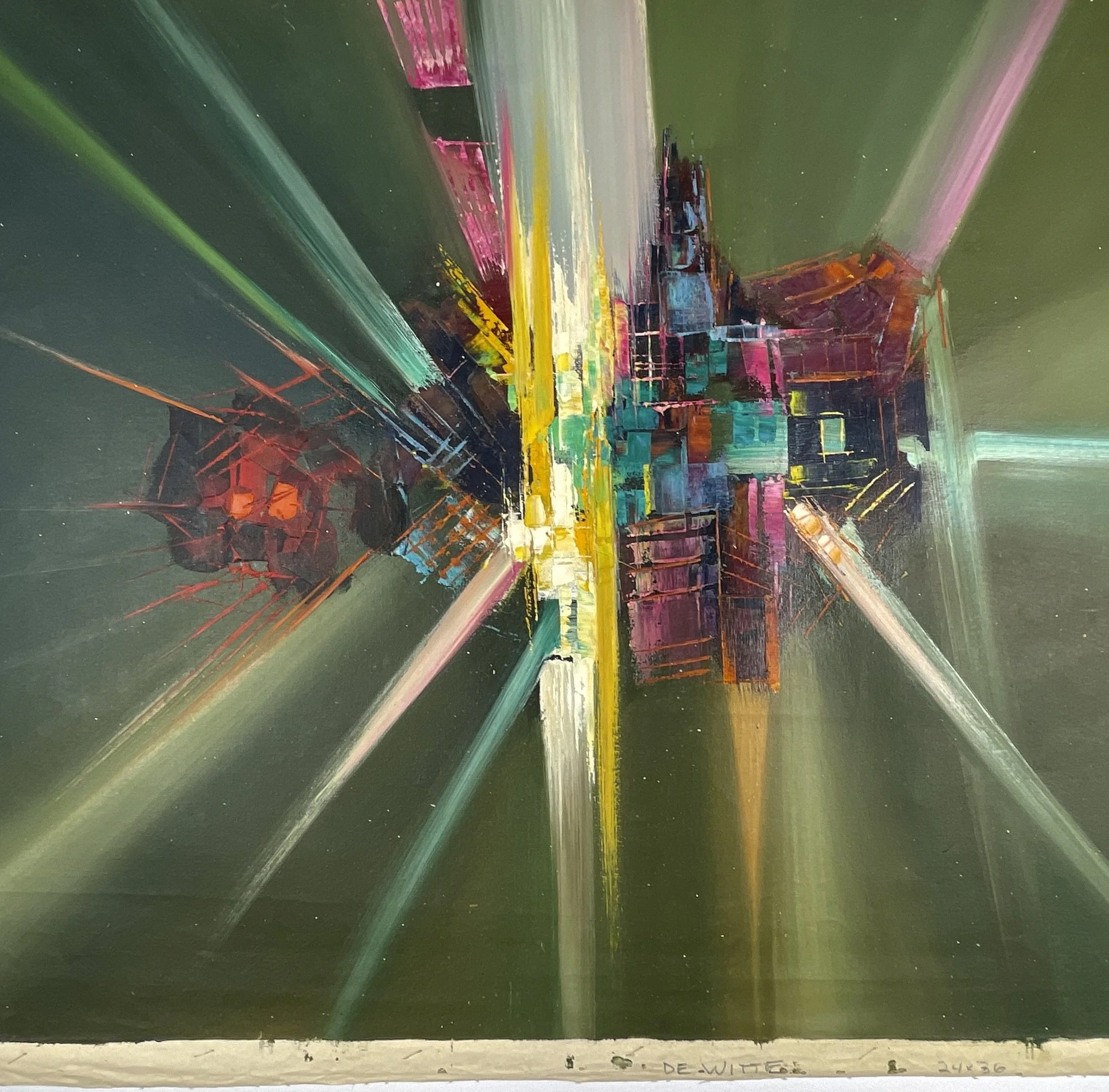 Image 2 of 5
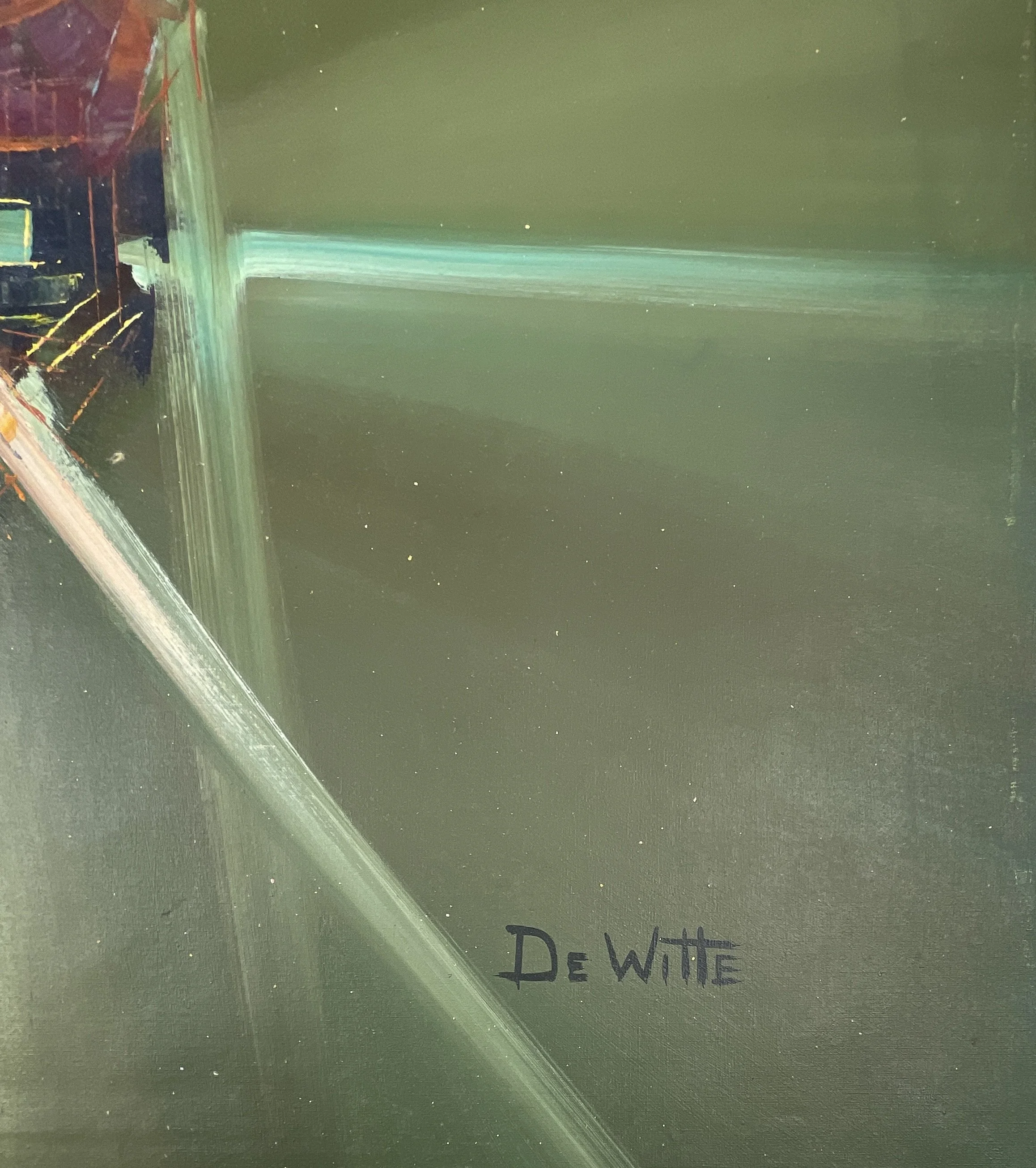 Image 3 of 5
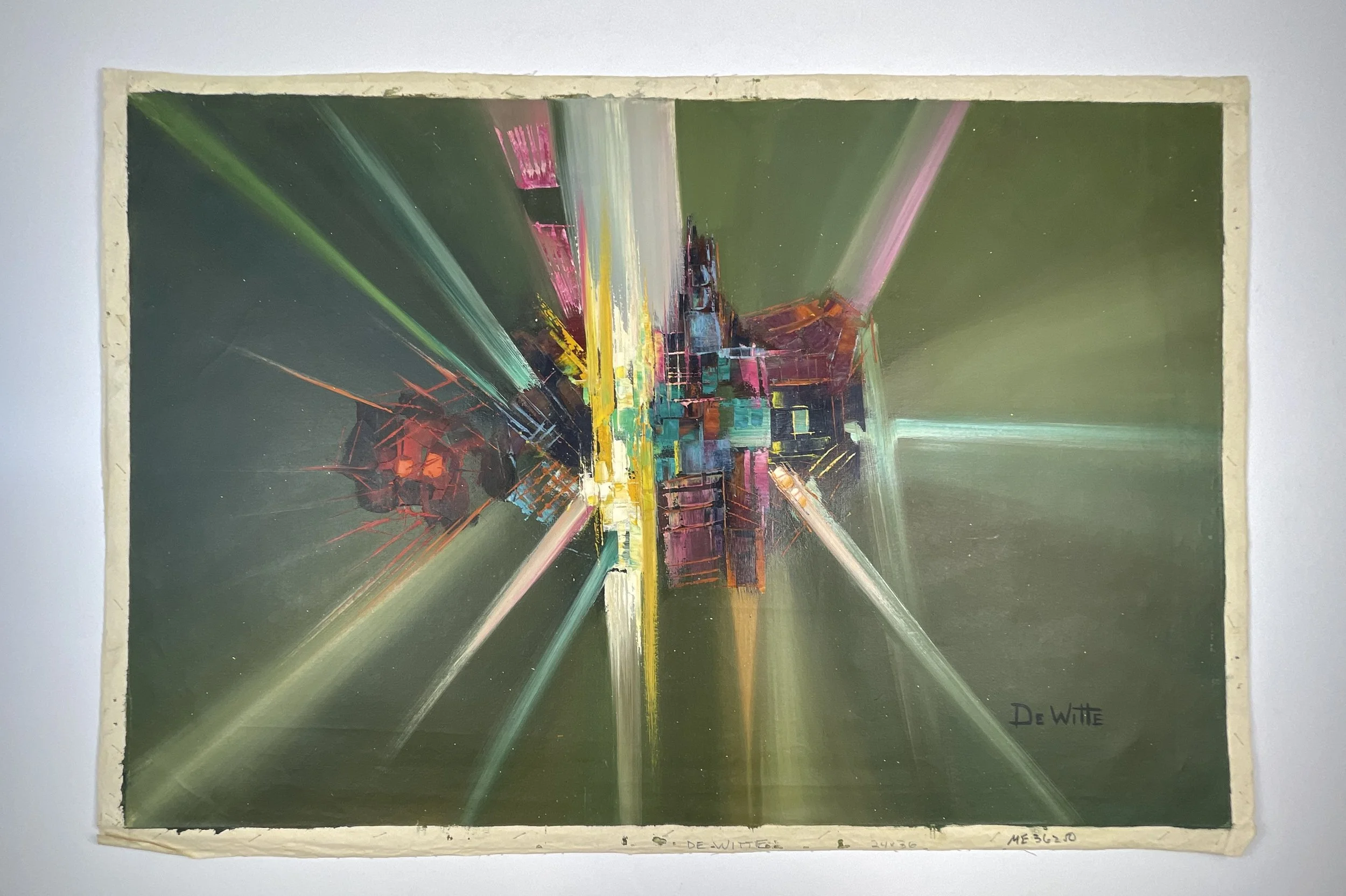 Image 4 of 5
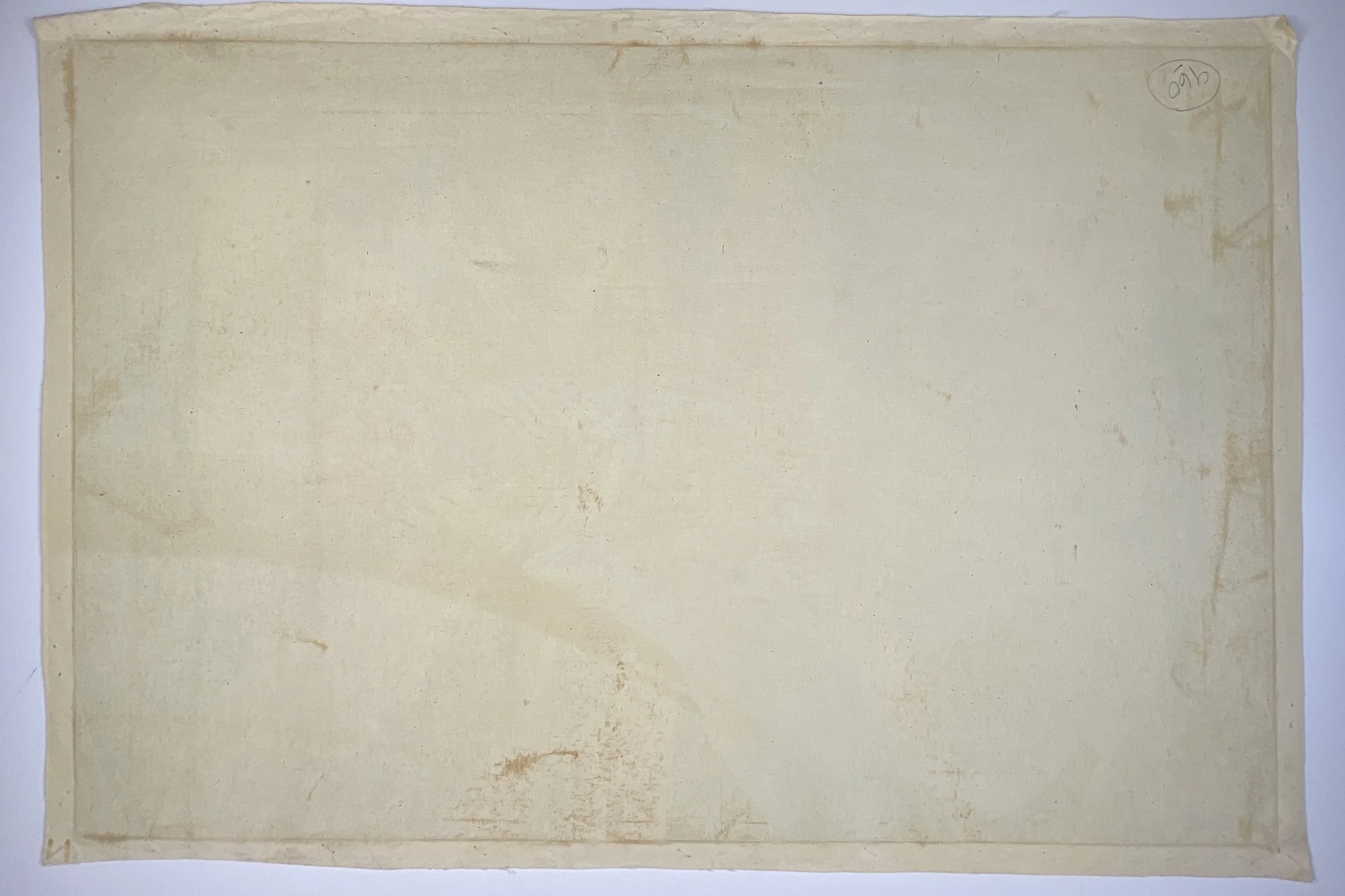 Image 5 of 5
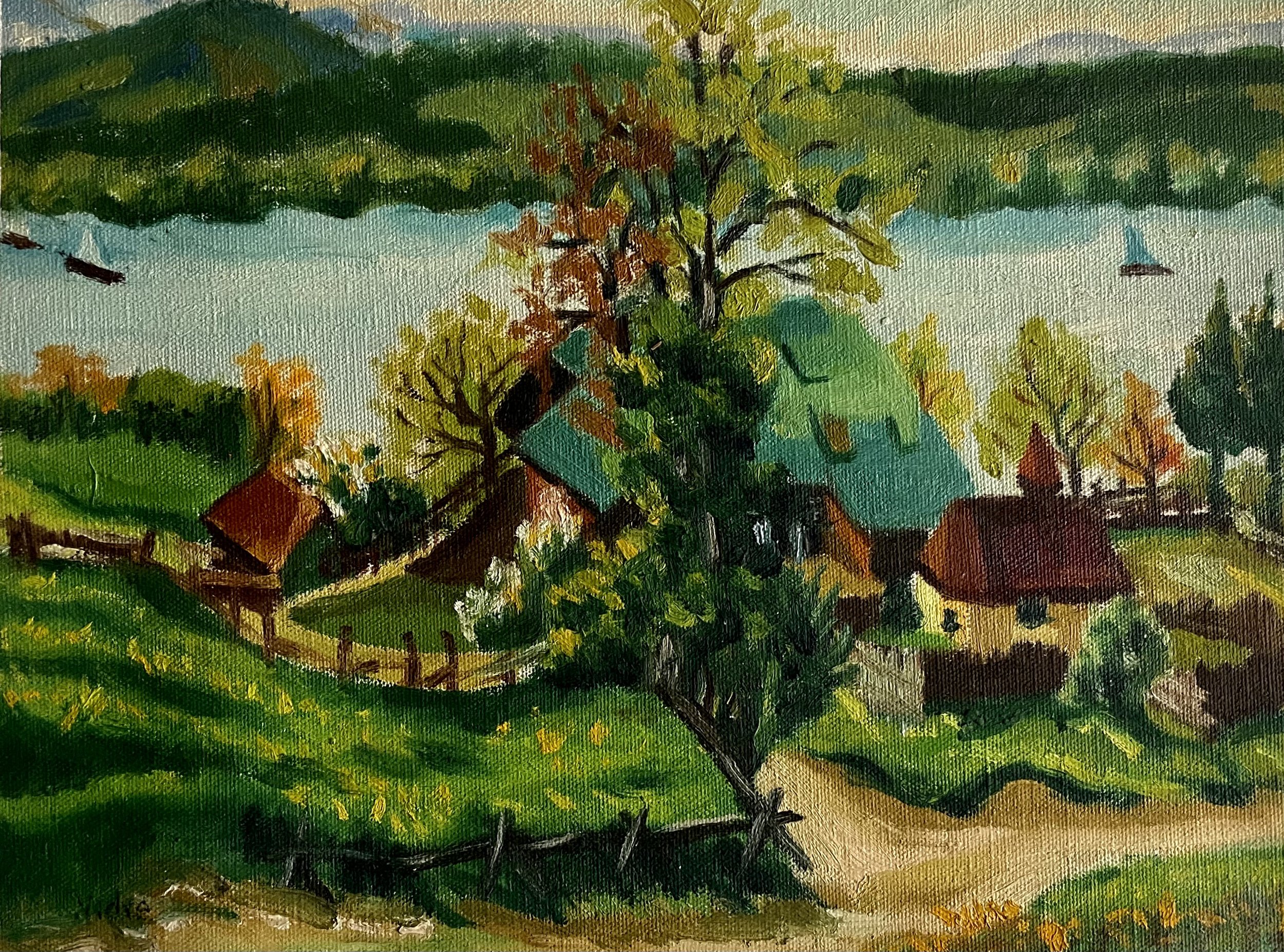
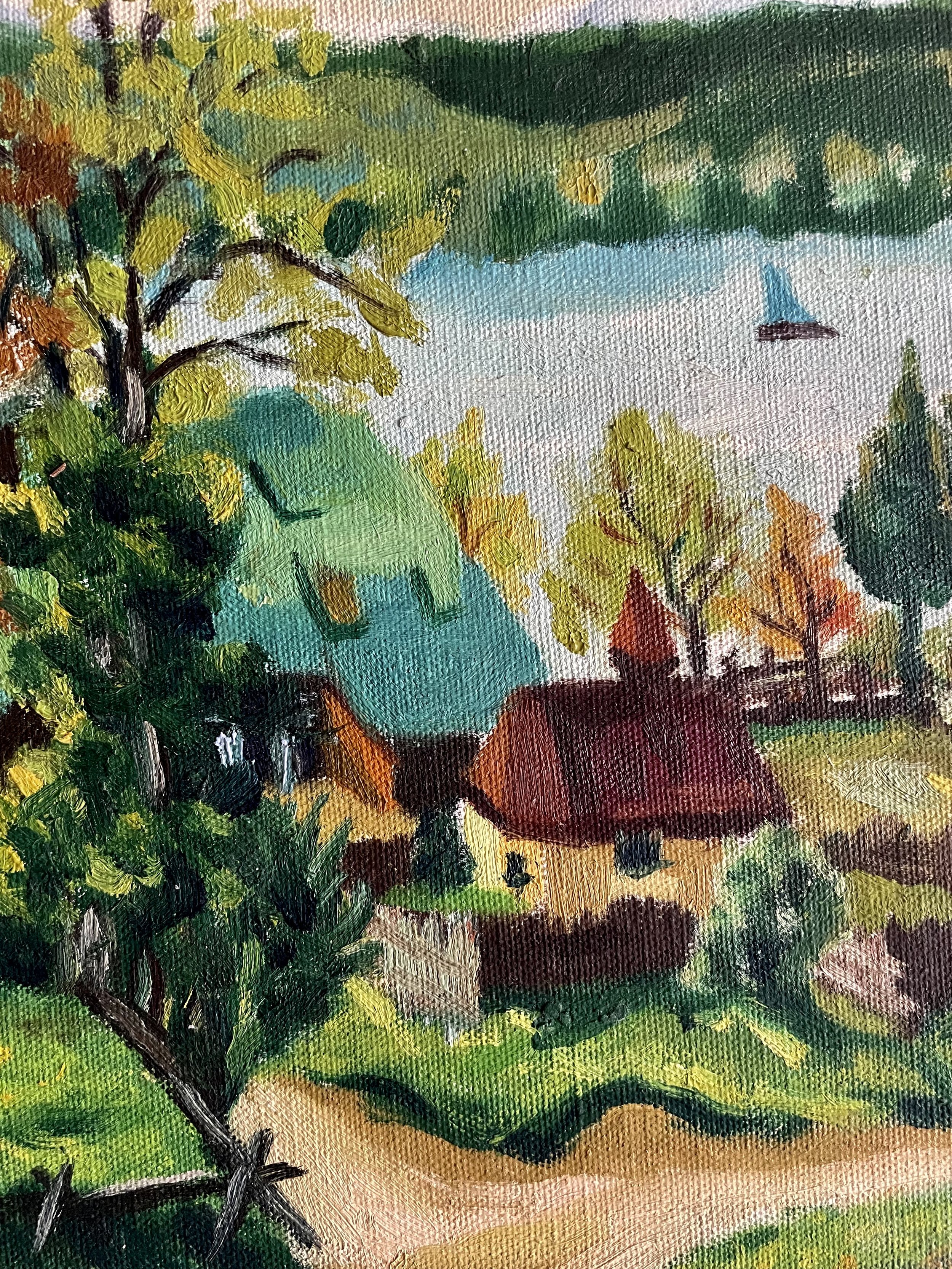
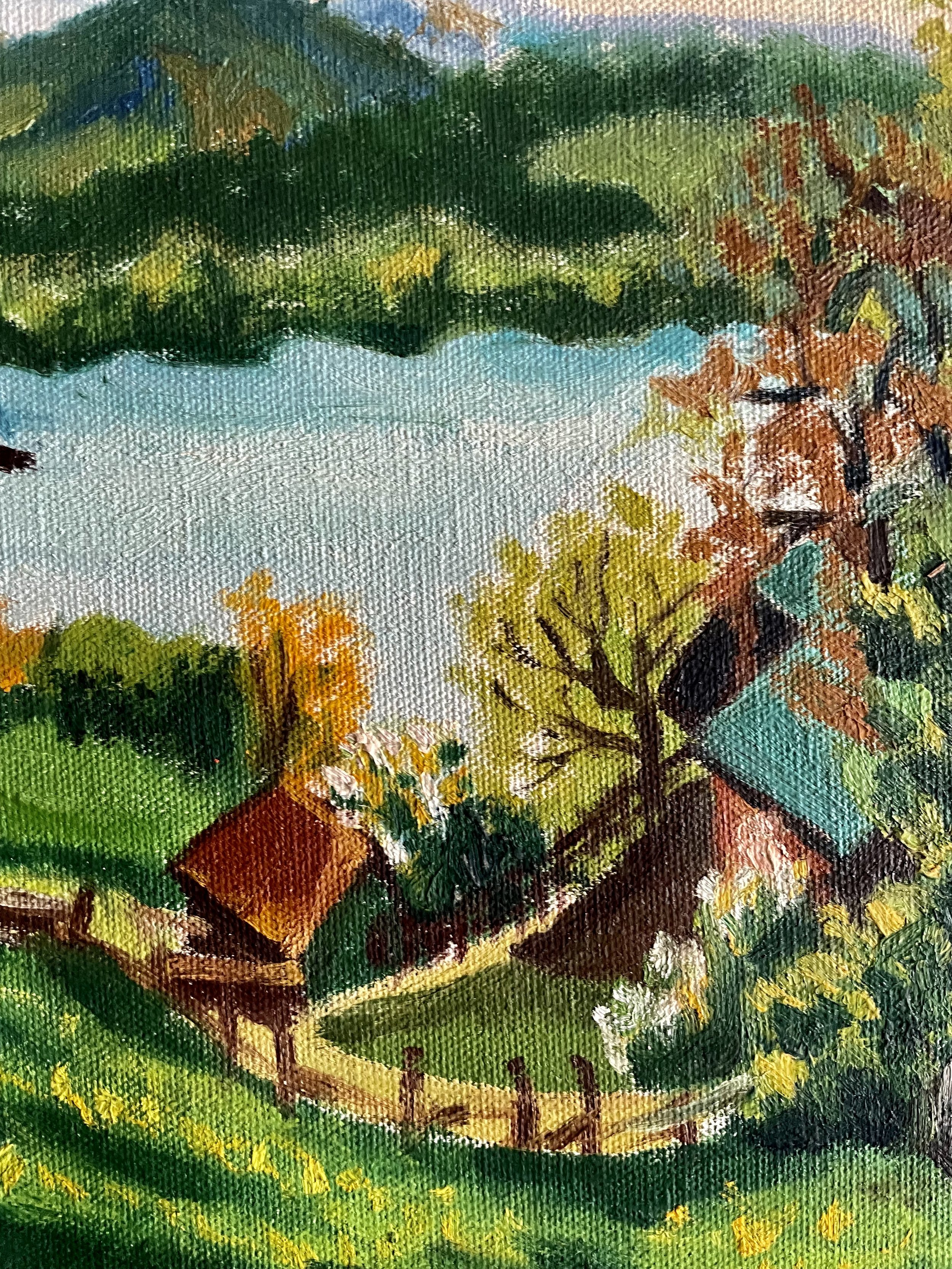
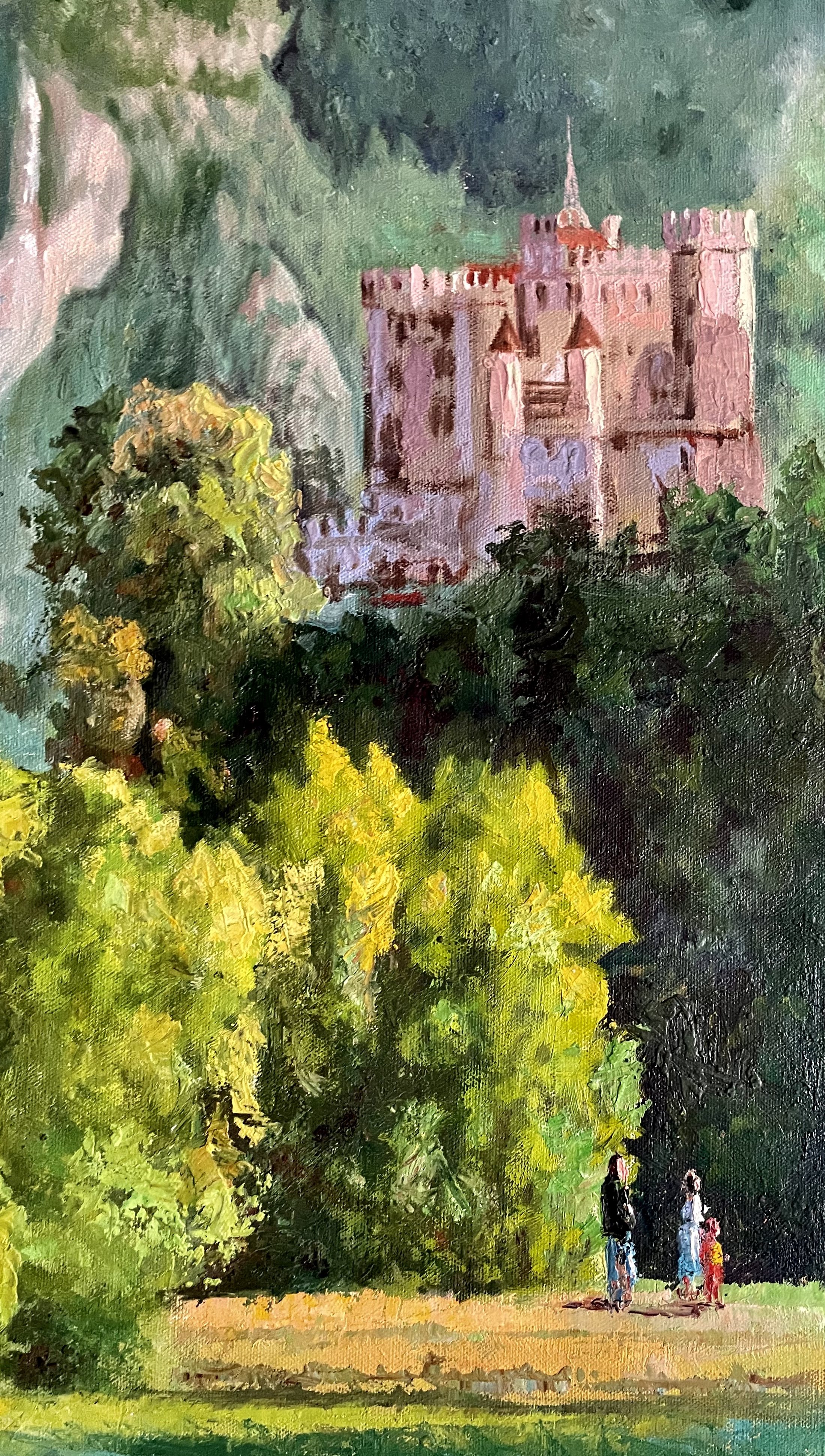
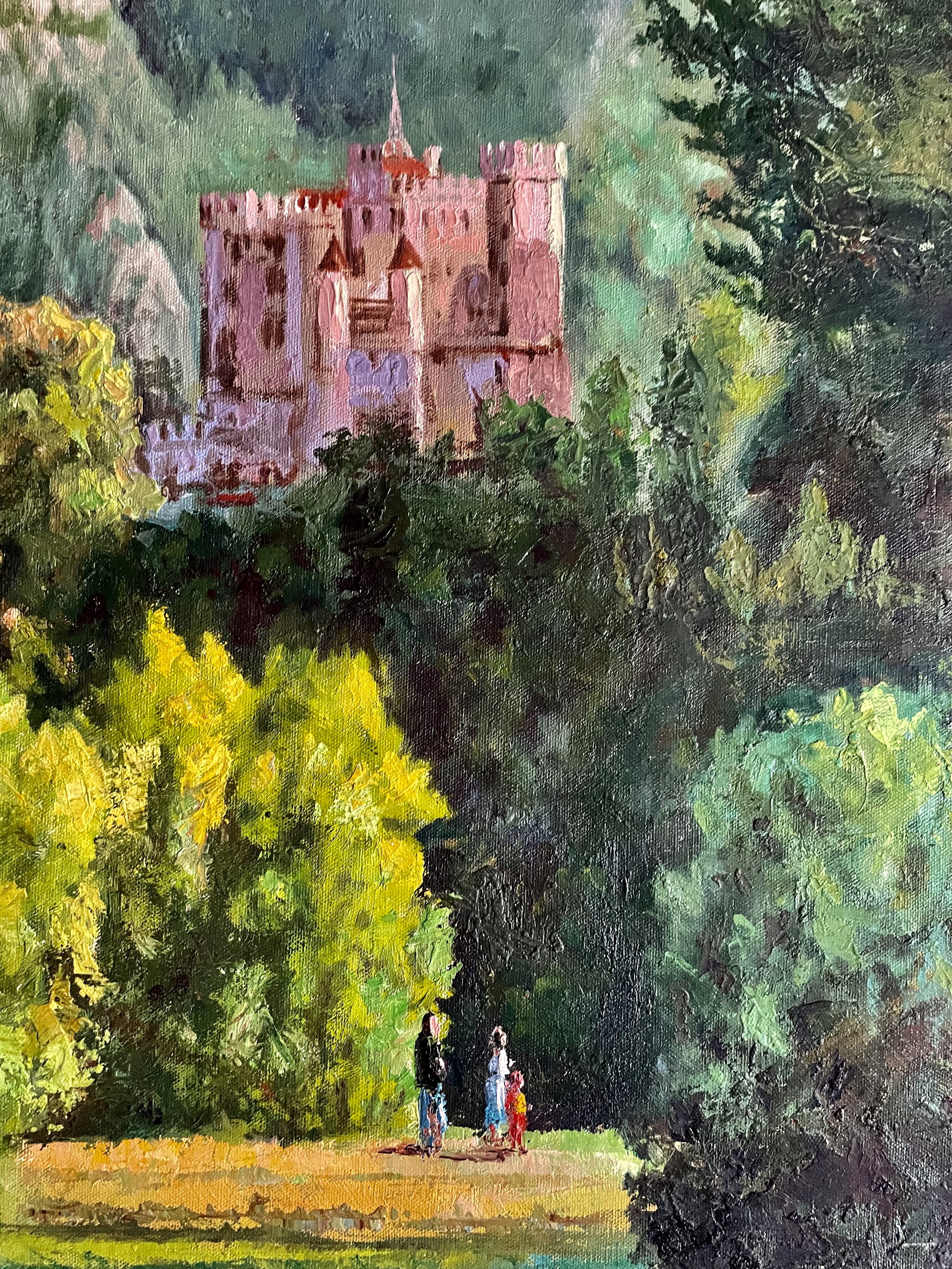
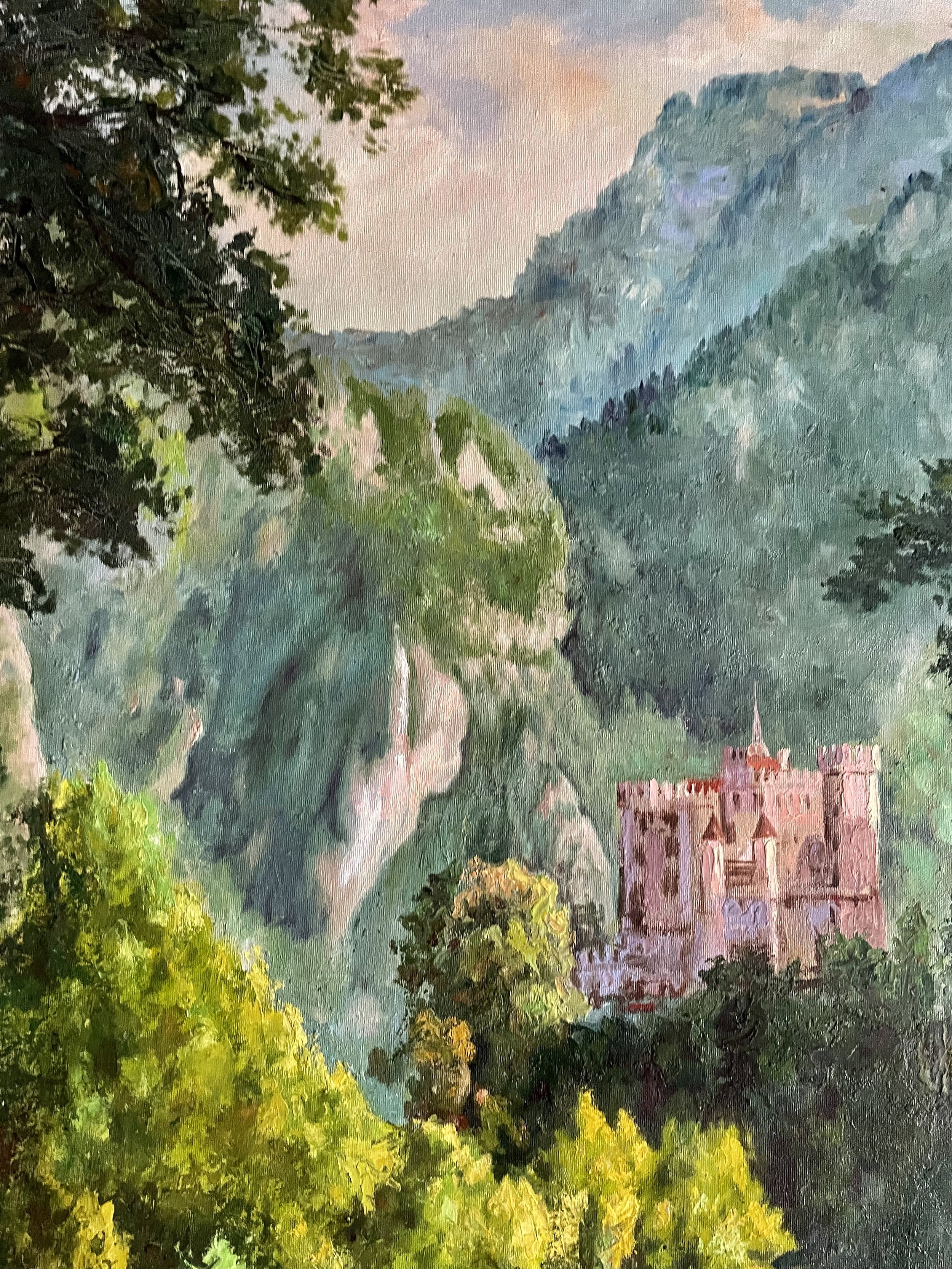
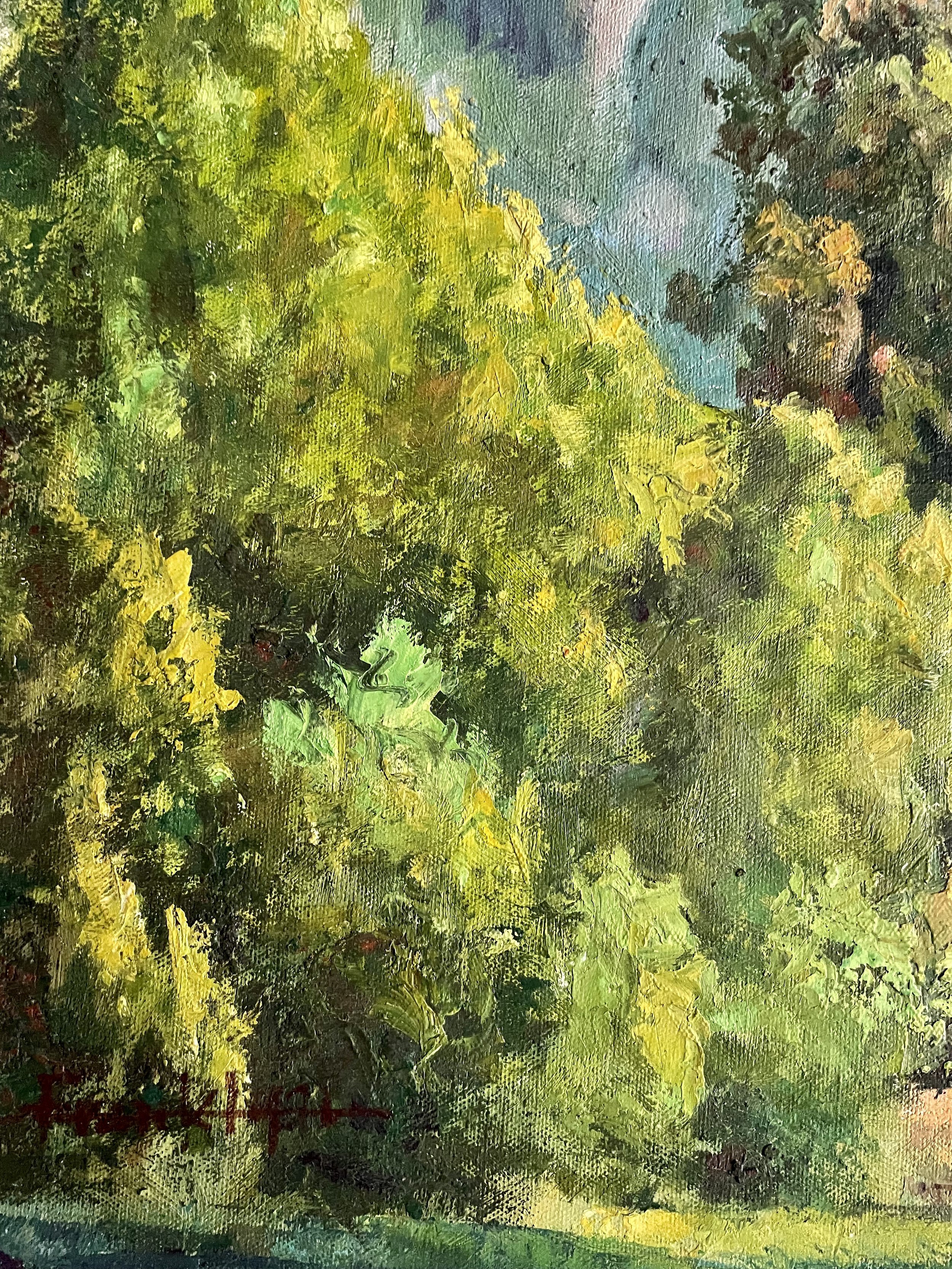
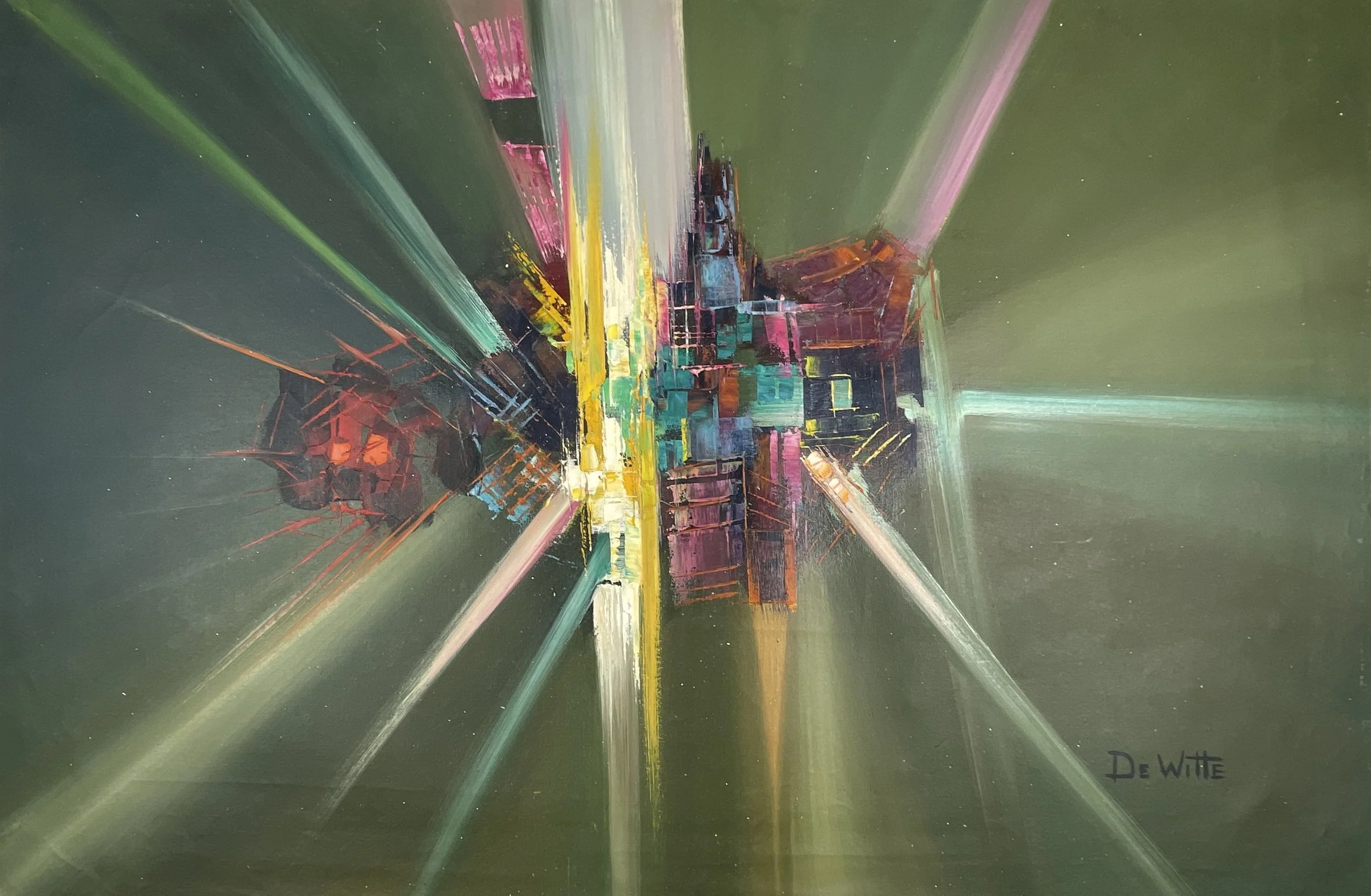
Cosmic Structure (attributed), De Witte (20th century), c.1965–1975, oil on canvas, 36 × 24 in., signed lower right.
Mid-century abstract cosmic cityscape by De Witte featuring radiant light beams and architectural forms in oil on canvas. Dynamic space-age modernist composition with vivid color and dramatic perspective.
Artwork Description
This striking mid-century abstract composition by De Witte presents a dramatic convergence of radiant light beams and geometric architectural forms that appear to erupt outward from the center of the canvas. Executed in bold color and dynamic perspective, the work evokes both futuristic city structures and cosmic energy fields, creating a powerful sense of motion and spatial expansion.
The composition is organized around a central vertical axis of luminous yellow and white light. From this axis, elongated beams of green, turquoise, pink, and white radiate outward in multiple directions, forming an energetic cross-like structure that divides the space of the canvas. These streaking forms create the sensation of movement through space, reminiscent of the visual language associated with the technological optimism and space-age imagination of the 1960s and 1970s.
At the center, clusters of angular geometric structures appear to represent futuristic architecture or industrial forms. These elements are rendered with short, layered brushstrokes in vibrant colors including magenta, turquoise, crimson, and cobalt. The overlapping planes suggest illuminated buildings or mechanical frameworks emerging from a burst of light. On the left side of the composition, a darker spherical form with radiating linear marks introduces an additional cosmic element, suggesting a planet or mechanical node within the abstract environment.
The background field is painted in atmospheric tones of deep olive and forest green, providing contrast to the intense luminosity of the central structures. Fine speckling across the surface evokes distant stars or particles suspended in space, reinforcing the painting’s celestial or futuristic narrative.
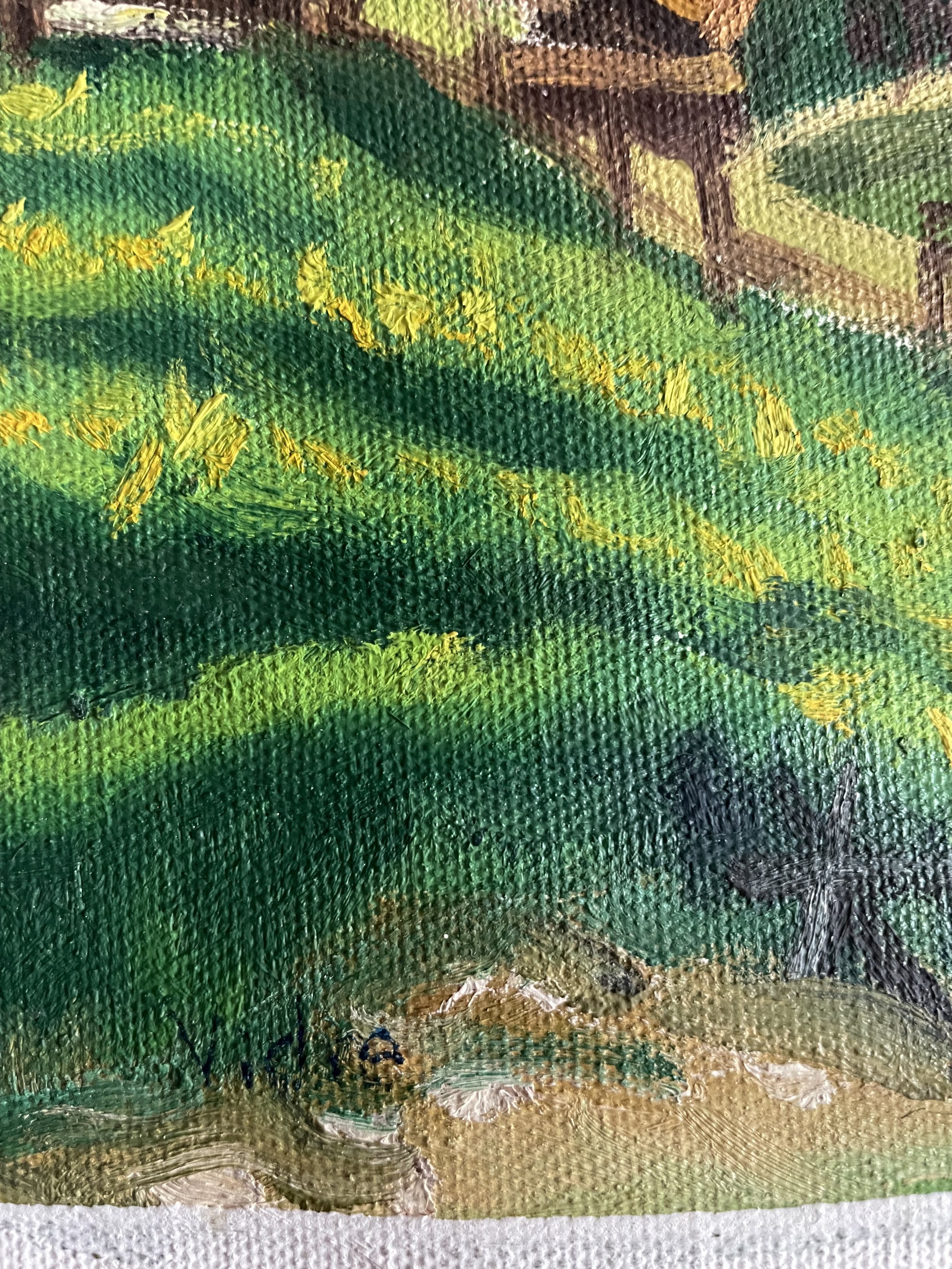
The medium appears consistent with oil on canvas. The paint surface exhibits soft blending in the background and more textural impasto in the central architectural elements. Oil paint would allow the artist to achieve the gradual tonal transitions and luminous color layering evident throughout the composition.
The painting is signed “De Witte” at the lower right. The format, palette, and subject matter strongly align with the visual vocabulary of mid-century modern abstraction influenced by the space race, technological innovation, and visionary architectural concepts that captivated artists during the 1960s and early 1970s.
Artist Biography
The artist known as De Witte appears to have been active during the mid-twentieth century, producing abstract compositions that reflect the experimental and forward-looking aesthetic currents of the postwar period. Although documentation about the artist remains limited, the stylistic characteristics of this work suggest a painter engaged with the visual language of modernist abstraction and the technological imagination that permeated art during the height of the space age.
During the decades following World War II, artists across Europe and the United States began exploring abstract visual systems that incorporated architectural structures, radiant energy forms, and cosmic imagery. These themes reflected both the optimism and uncertainty of a world increasingly defined by scientific advancement, aerospace exploration, and new industrial technologies. The space race between the United States and the Soviet Union, along with rapid developments in electronics and engineering, profoundly influenced visual culture.
The composition attributed to De Witte demonstrates a clear engagement with these ideas. The radiant beams, geometric constructions, and star-like spatial environment suggest an artist interested in translating technological imagery into expressive painterly form. The work bridges several overlapping movements of the era, including abstract expressionism’s emphasis on energy and gesture, as well as the more structured geometric abstraction associated with visionary architecture and futuristic design.
Artists exploring similar territory during this period often drew inspiration from aerospace imagery, urban planning concepts, and the emerging aesthetics of modern engineering. The use of intense color contrasts, radiant perspective lines, and centralized bursts of energy became a recurring motif within space-age abstraction.
While De Witte’s biography remains only partially documented, works attributed to the artist reveal a consistent fascination with light, structure, and the visual metaphor of expanding space. These compositions capture a moment in twentieth-century art when painters were actively responding to humanity’s expanding understanding of the universe and the technological forces reshaping modern life.
Today such works are appreciated for their vivid color, dramatic spatial effects, and their embodiment of the optimistic futurism that characterized much mid-century modern art.
De Witte abstract cosmic modernist painting, oil on canvas, signed, dynamic space-age architectural composition, 36 × 24 in.
Certificate of Authentication
Artist: De Witte
Title: Cosmic Structure (attributed)
Medium: Oil on canvas
Dimensions: 36 × 24 inches
Signature: Signed “De Witte” lower right
Date: circa 1965–1975
This work is believed to be an original painting by the artist De Witte based on the visible signature and stylistic characteristics consistent with mid-century abstract space-age painting.
Condition
Good vintage condition. Canvas remains stable with light handling wear along edges from previous mounting. Minor surface speckling consistent with age and studio environment. No major paint loss observed.
Provenance
Artist studio or early private collection
Mitch Morse Gallery, New York (artist’s agent, publisher, art dealer and distributor)
Private collection acquired through Mitch Morse Gallery
Artfind Gallery, Washington DC (current owner)
All works acquired through Mitch Morse Gallery, which sourced artworks throughout New York, the United States, and Europe.
Provenance Note: Mitch Morse Gallery Collection
This artwork originates from the inventory of Mitch Morse Gallery, a respected New York–based gallery and publisher active during the mid-to-late 20th century. Mitch Morse was an established figure in the American art market, serving as an artist’s agent, publisher of original graphics, art dealer, distributor, and fine art restorer. He was also a Design Affiliate of A.S.I.D., listed in Who’s Who in the East, and a guest lecturer in graphics at New York University, with appearances on radio and television discussing art and design.
Through his gallery and associated publishing operations, Morse acquired paintings, prints, and original works from artists and studios across New York, Europe, and international art markets, assembling a broad inventory representing a wide range of artistic traditions and mediums. Works from this collection circulated through galleries and collectors throughout the United States.
The present painting was acquired through this network and is now held in the collection of Artfind Gallery, Washington DC, continuing the documented chain of gallery provenance from Mitch Morse’s original acquisitions.
Cosmic Structure (attributed), De Witte (20th century), c.1965–1975, oil on canvas, 36 × 24 in., signed lower right.
Mid-century abstract cosmic cityscape by De Witte featuring radiant light beams and architectural forms in oil on canvas. Dynamic space-age modernist composition with vivid color and dramatic perspective.
Artwork Description
This striking mid-century abstract composition by De Witte presents a dramatic convergence of radiant light beams and geometric architectural forms that appear to erupt outward from the center of the canvas. Executed in bold color and dynamic perspective, the work evokes both futuristic city structures and cosmic energy fields, creating a powerful sense of motion and spatial expansion.
The composition is organized around a central vertical axis of luminous yellow and white light. From this axis, elongated beams of green, turquoise, pink, and white radiate outward in multiple directions, forming an energetic cross-like structure that divides the space of the canvas. These streaking forms create the sensation of movement through space, reminiscent of the visual language associated with the technological optimism and space-age imagination of the 1960s and 1970s.
At the center, clusters of angular geometric structures appear to represent futuristic architecture or industrial forms. These elements are rendered with short, layered brushstrokes in vibrant colors including magenta, turquoise, crimson, and cobalt. The overlapping planes suggest illuminated buildings or mechanical frameworks emerging from a burst of light. On the left side of the composition, a darker spherical form with radiating linear marks introduces an additional cosmic element, suggesting a planet or mechanical node within the abstract environment.
The background field is painted in atmospheric tones of deep olive and forest green, providing contrast to the intense luminosity of the central structures. Fine speckling across the surface evokes distant stars or particles suspended in space, reinforcing the painting’s celestial or futuristic narrative.
The medium appears consistent with oil on canvas. The paint surface exhibits soft blending in the background and more textural impasto in the central architectural elements. Oil paint would allow the artist to achieve the gradual tonal transitions and luminous color layering evident throughout the composition.
The painting is signed “De Witte” at the lower right. The format, palette, and subject matter strongly align with the visual vocabulary of mid-century modern abstraction influenced by the space race, technological innovation, and visionary architectural concepts that captivated artists during the 1960s and early 1970s.
Artist Biography
The artist known as De Witte appears to have been active during the mid-twentieth century, producing abstract compositions that reflect the experimental and forward-looking aesthetic currents of the postwar period. Although documentation about the artist remains limited, the stylistic characteristics of this work suggest a painter engaged with the visual language of modernist abstraction and the technological imagination that permeated art during the height of the space age.
During the decades following World War II, artists across Europe and the United States began exploring abstract visual systems that incorporated architectural structures, radiant energy forms, and cosmic imagery. These themes reflected both the optimism and uncertainty of a world increasingly defined by scientific advancement, aerospace exploration, and new industrial technologies. The space race between the United States and the Soviet Union, along with rapid developments in electronics and engineering, profoundly influenced visual culture.
The composition attributed to De Witte demonstrates a clear engagement with these ideas. The radiant beams, geometric constructions, and star-like spatial environment suggest an artist interested in translating technological imagery into expressive painterly form. The work bridges several overlapping movements of the era, including abstract expressionism’s emphasis on energy and gesture, as well as the more structured geometric abstraction associated with visionary architecture and futuristic design.
Artists exploring similar territory during this period often drew inspiration from aerospace imagery, urban planning concepts, and the emerging aesthetics of modern engineering. The use of intense color contrasts, radiant perspective lines, and centralized bursts of energy became a recurring motif within space-age abstraction.
While De Witte’s biography remains only partially documented, works attributed to the artist reveal a consistent fascination with light, structure, and the visual metaphor of expanding space. These compositions capture a moment in twentieth-century art when painters were actively responding to humanity’s expanding understanding of the universe and the technological forces reshaping modern life.
Today such works are appreciated for their vivid color, dramatic spatial effects, and their embodiment of the optimistic futurism that characterized much mid-century modern art.
De Witte abstract cosmic modernist painting, oil on canvas, signed, dynamic space-age architectural composition, 36 × 24 in.
Certificate of Authentication
Artist: De Witte
Title: Cosmic Structure (attributed)
Medium: Oil on canvas
Dimensions: 36 × 24 inches
Signature: Signed “De Witte” lower right
Date: circa 1965–1975
This work is believed to be an original painting by the artist De Witte based on the visible signature and stylistic characteristics consistent with mid-century abstract space-age painting.
Condition
Good vintage condition. Canvas remains stable with light handling wear along edges from previous mounting. Minor surface speckling consistent with age and studio environment. No major paint loss observed.
Provenance
Artist studio or early private collection
Mitch Morse Gallery, New York (artist’s agent, publisher, art dealer and distributor)
Private collection acquired through Mitch Morse Gallery
Artfind Gallery, Washington DC (current owner)
All works acquired through Mitch Morse Gallery, which sourced artworks throughout New York, the United States, and Europe.
Provenance Note: Mitch Morse Gallery Collection
This artwork originates from the inventory of Mitch Morse Gallery, a respected New York–based gallery and publisher active during the mid-to-late 20th century. Mitch Morse was an established figure in the American art market, serving as an artist’s agent, publisher of original graphics, art dealer, distributor, and fine art restorer. He was also a Design Affiliate of A.S.I.D., listed in Who’s Who in the East, and a guest lecturer in graphics at New York University, with appearances on radio and television discussing art and design.
Through his gallery and associated publishing operations, Morse acquired paintings, prints, and original works from artists and studios across New York, Europe, and international art markets, assembling a broad inventory representing a wide range of artistic traditions and mediums. Works from this collection circulated through galleries and collectors throughout the United States.
The present painting was acquired through this network and is now held in the collection of Artfind Gallery, Washington DC, continuing the documented chain of gallery provenance from Mitch Morse’s original acquisitions.