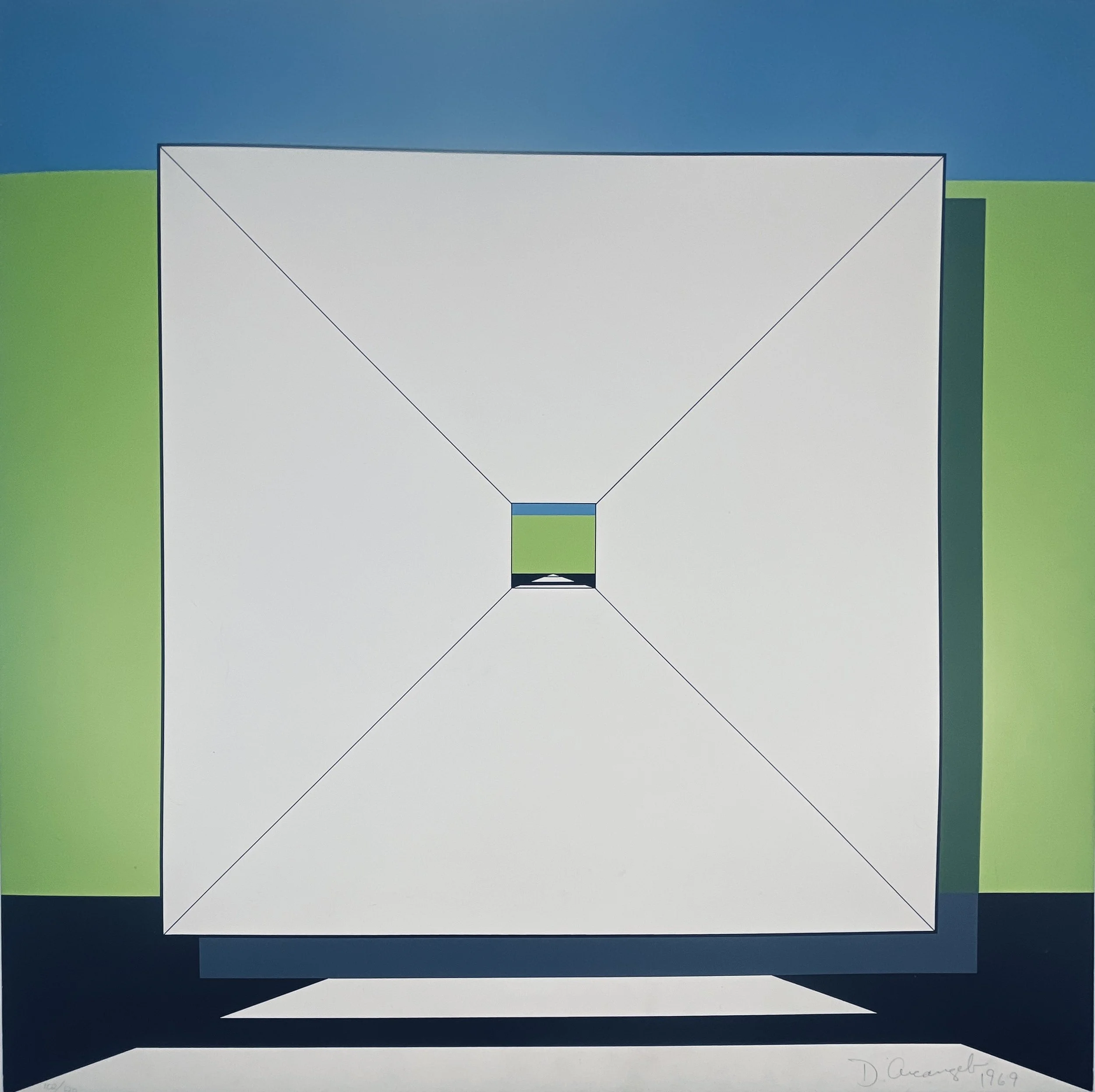
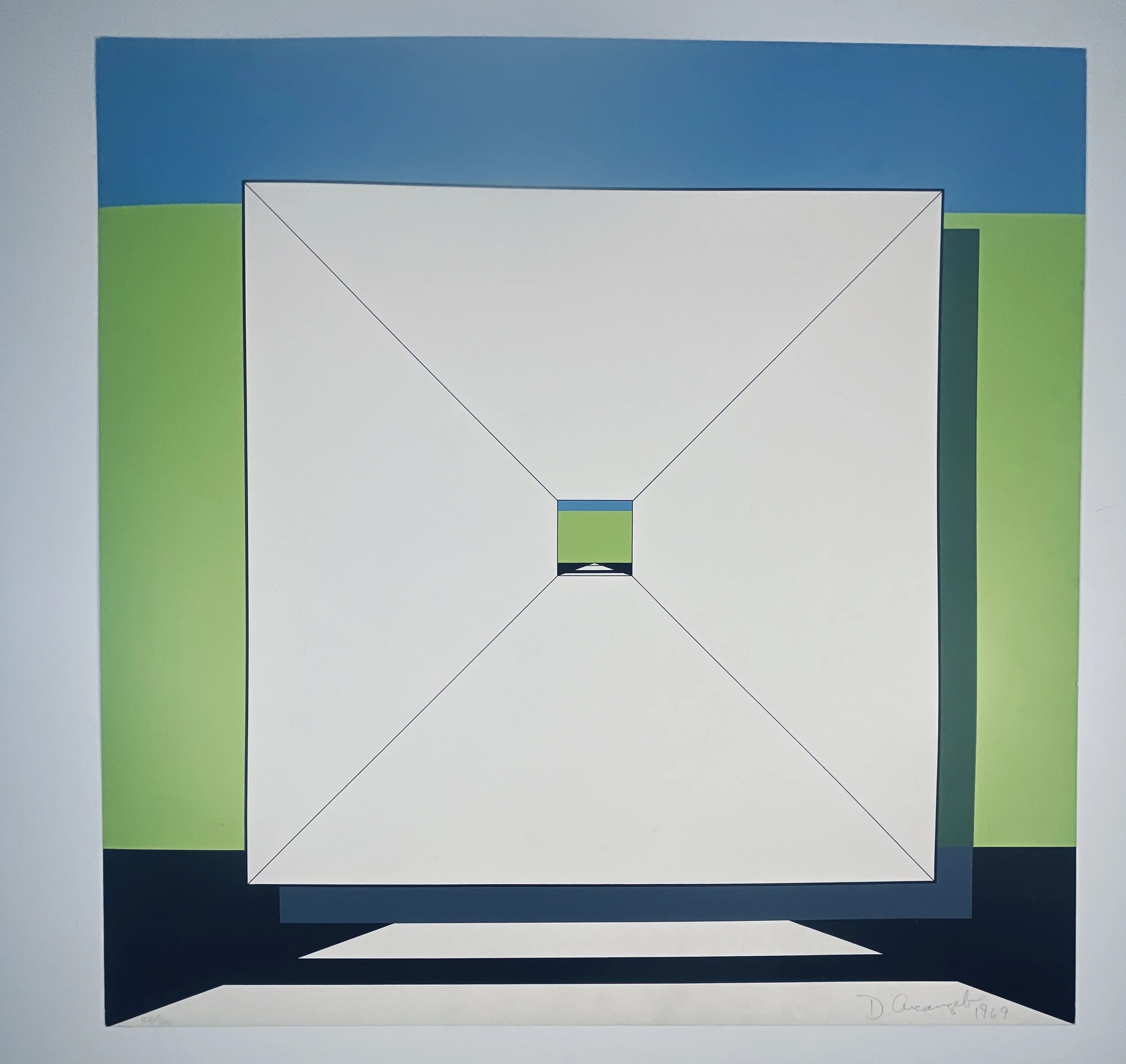
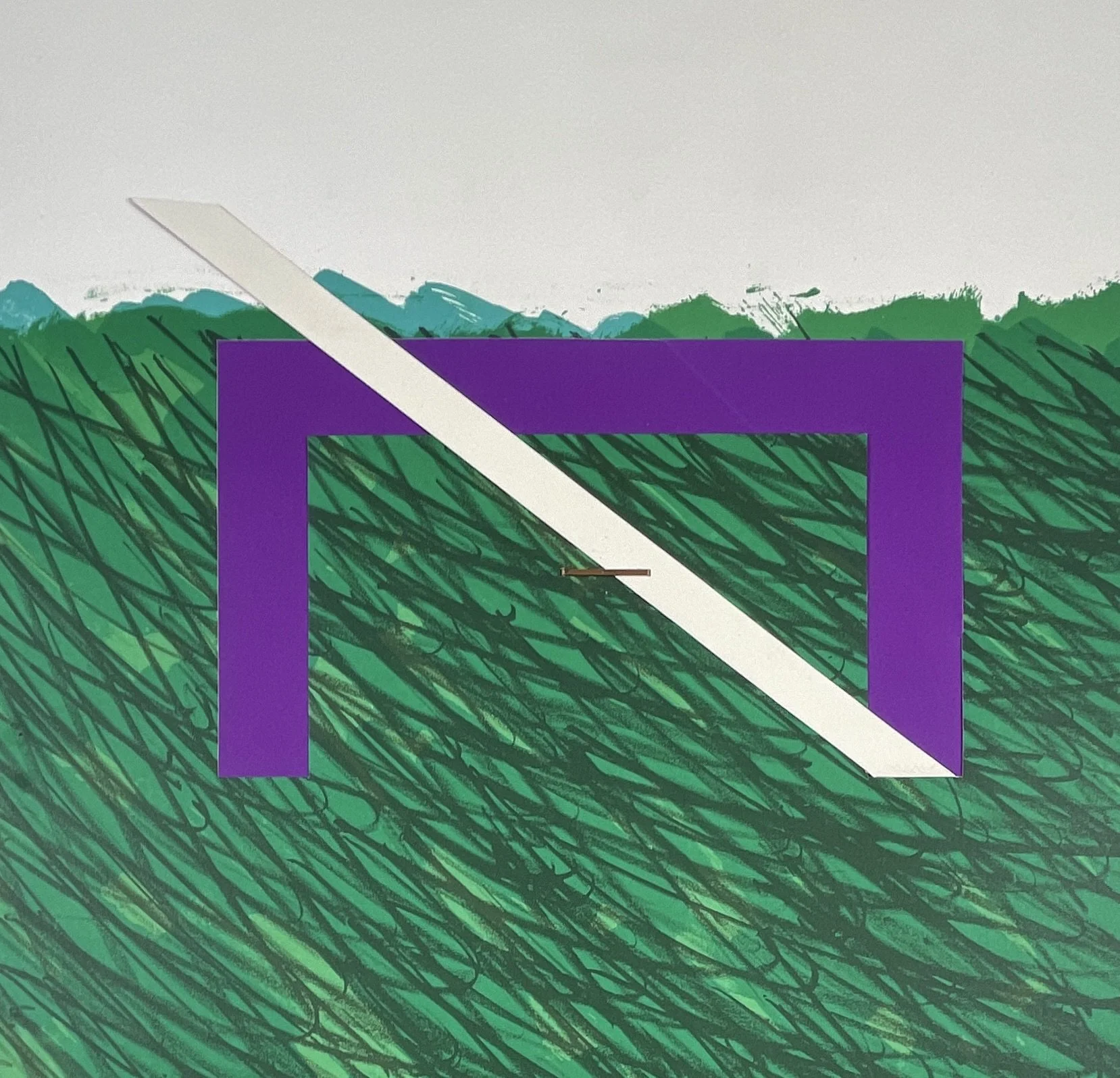
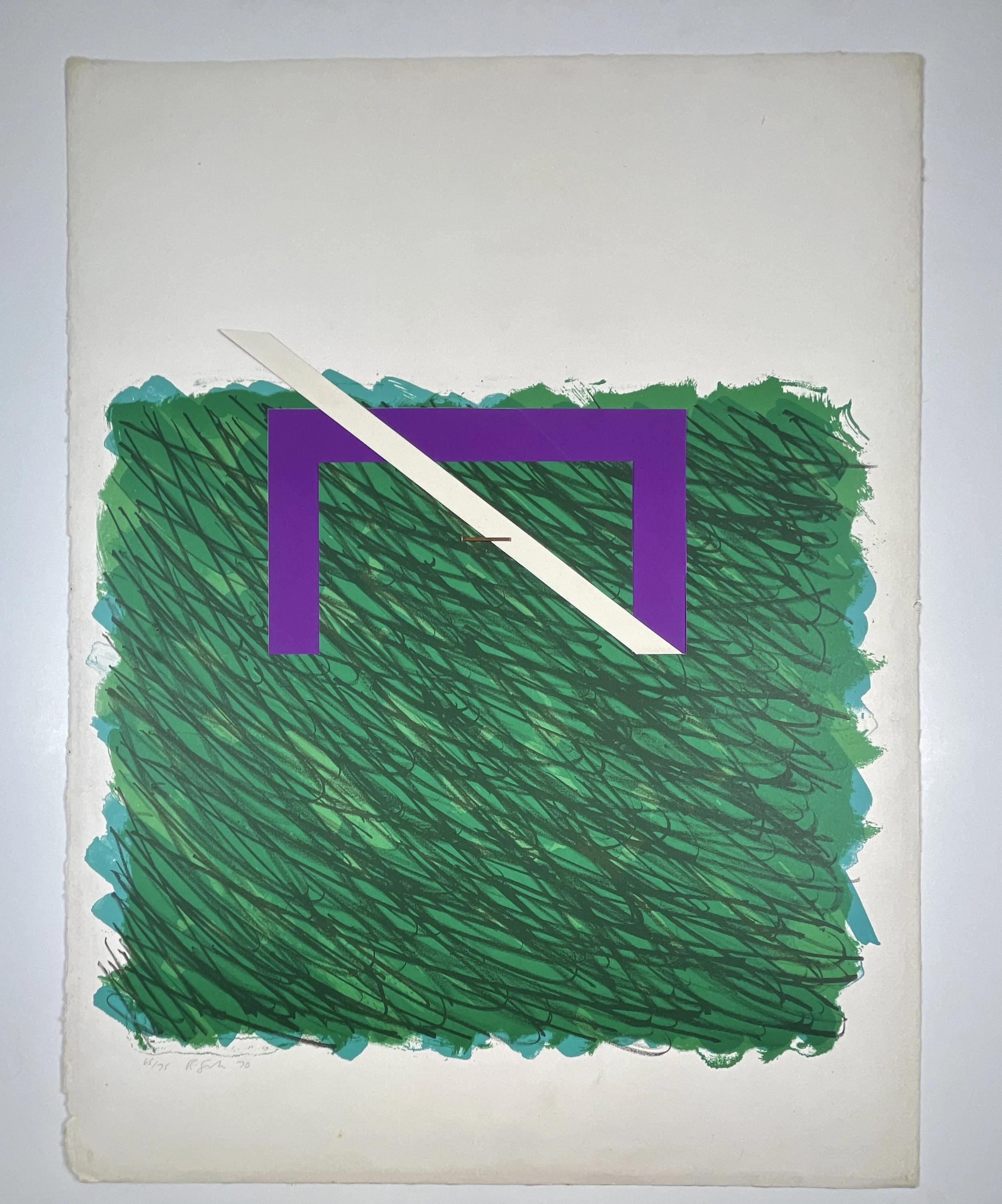
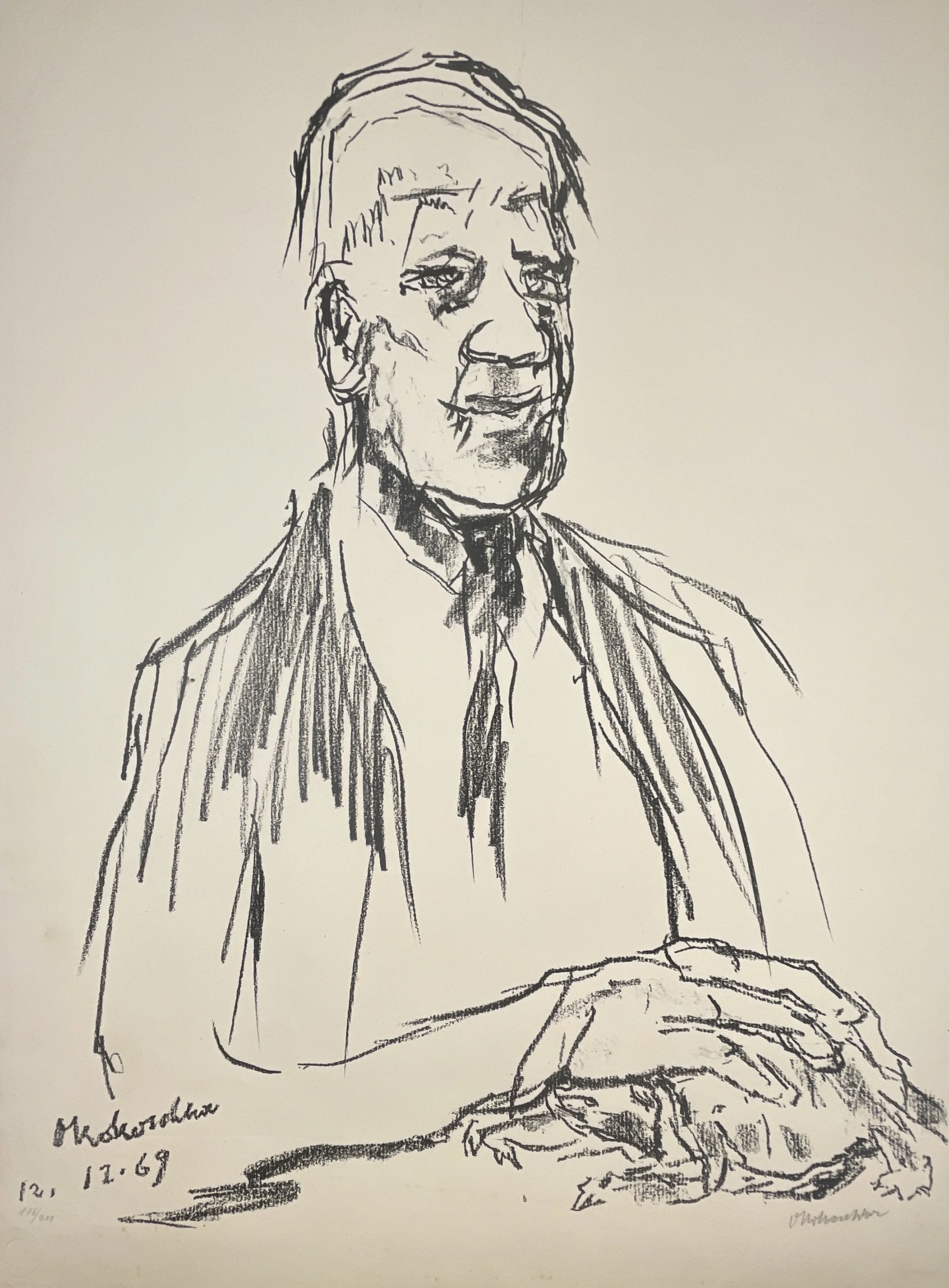
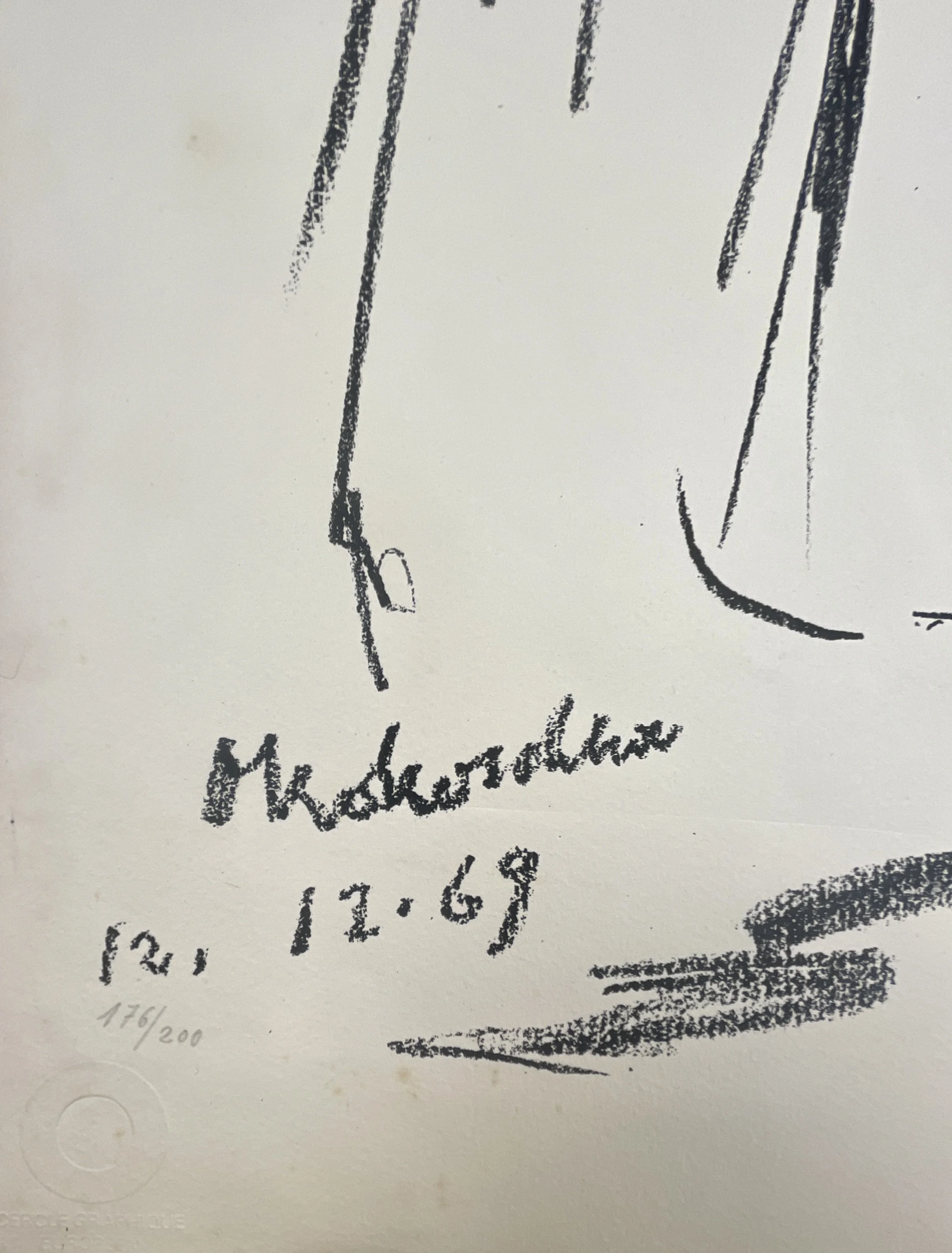
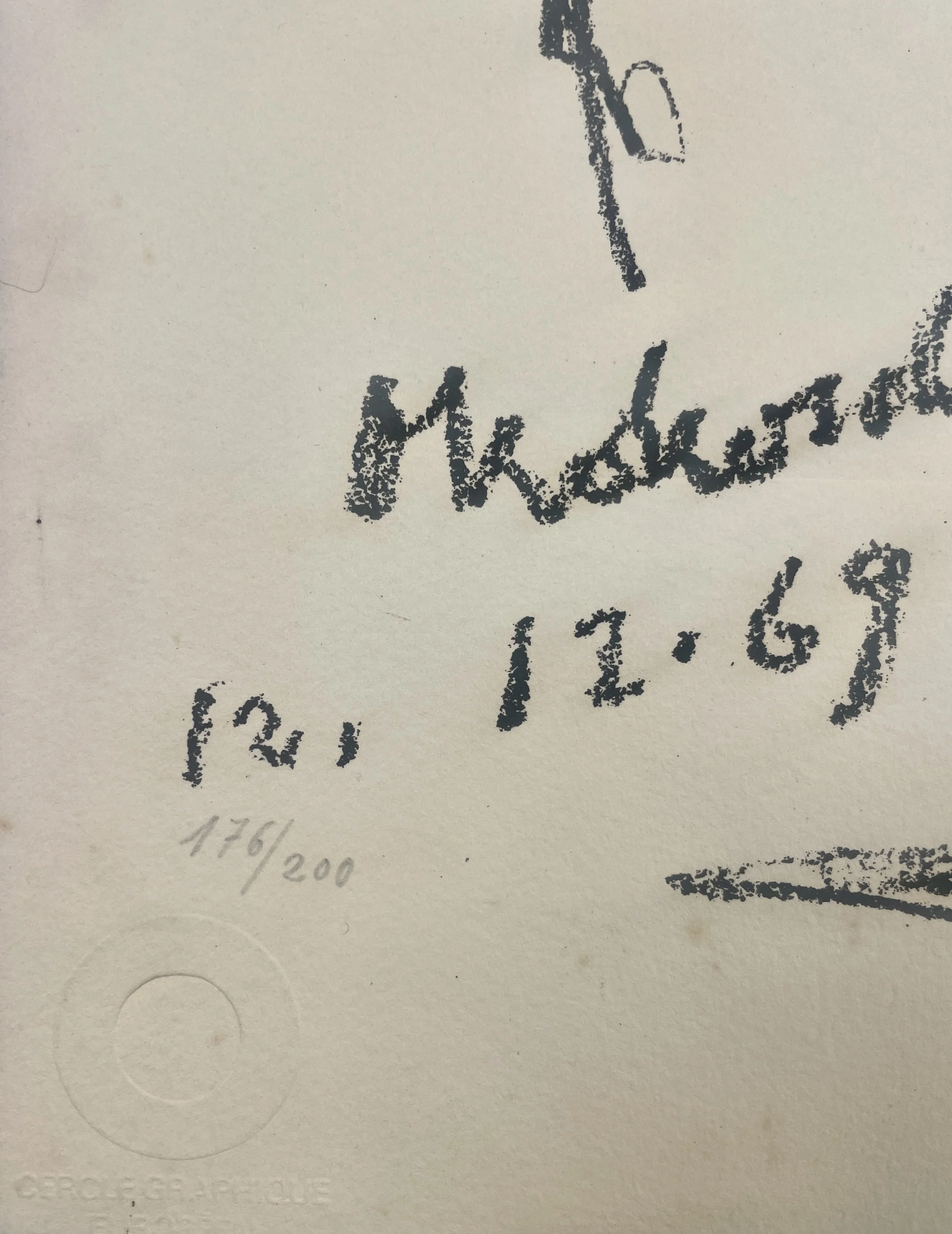
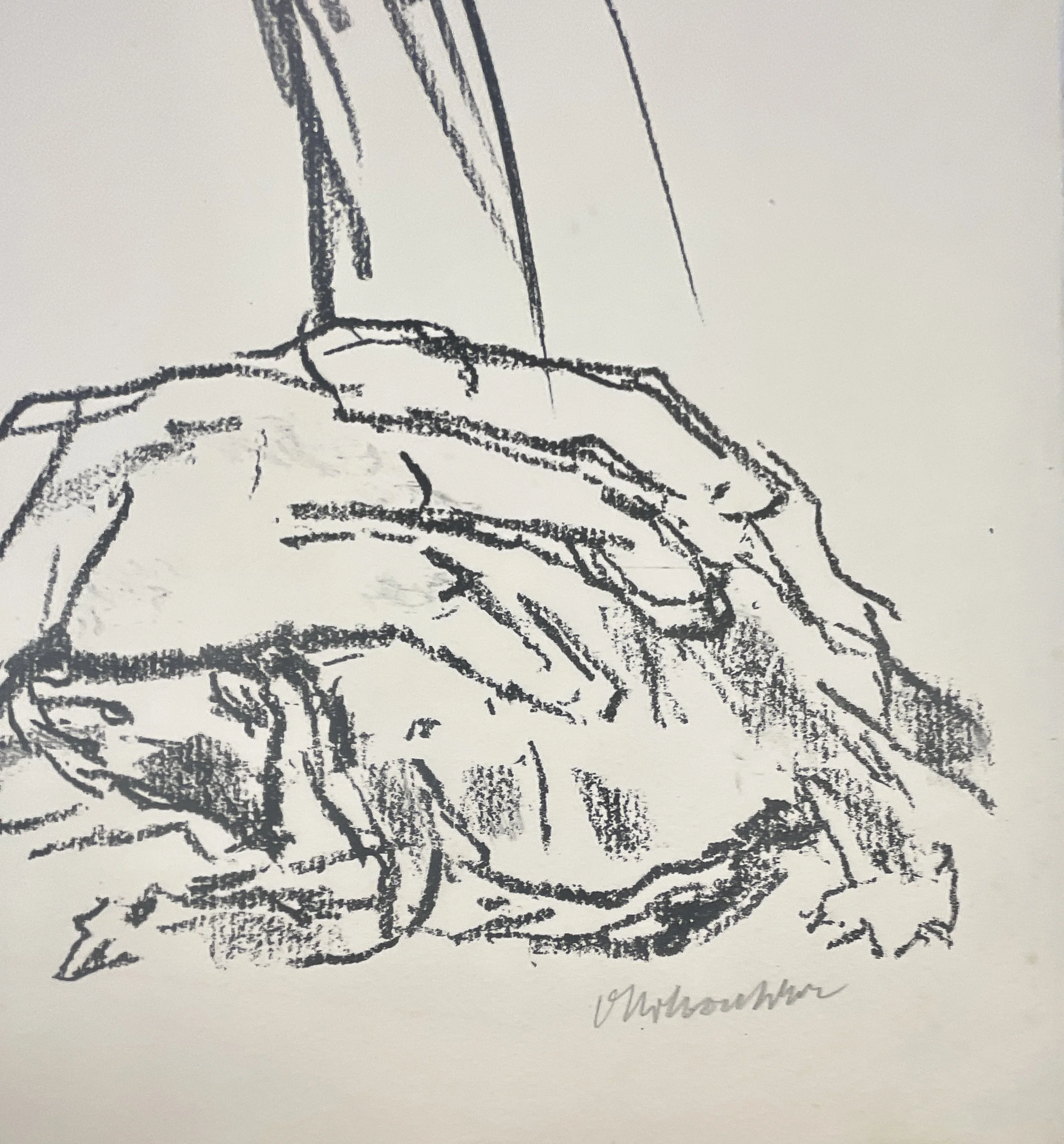
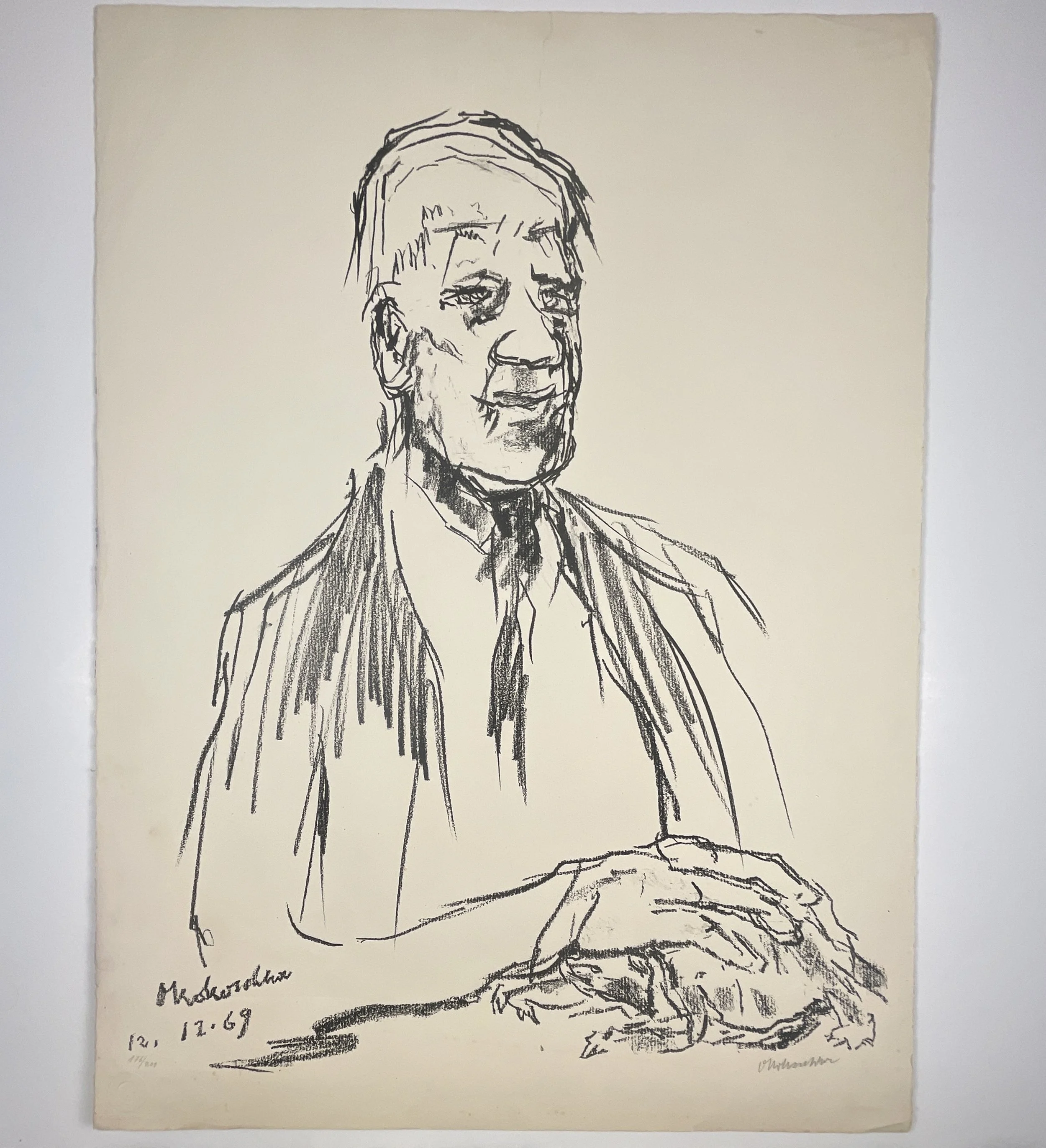
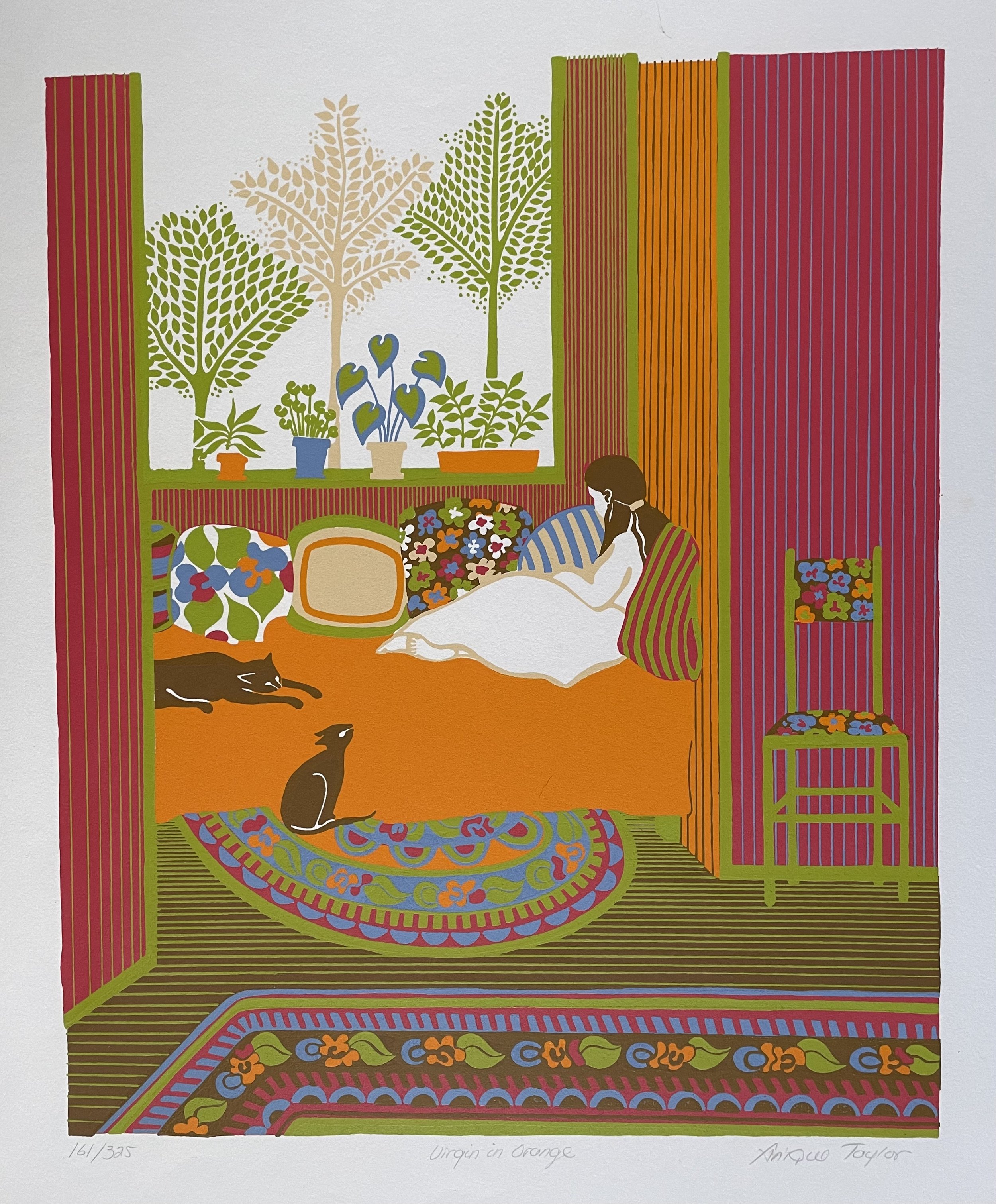
Procession Beneath Tall Trees, attributed to Frank Brangwyn (1867–1956) & Yoshijiro Urushibara (1888–1953), c.1920s, 16x23 in. color woodblock, pencil-signed with red seal.
A dramatic early 20th-century color woodblock print, Procession Beneath Tall Trees is attributed to the celebrated Anglo-Japanese collaboration of Frank Brangwyn and Yoshijiro Urushibara. Towering trunks arch overhead as a small procession of cloaked figures moves along a sun-dappled path, rendered in rich olive, umber, teal and soft ochre. Printed on delicate Japanese paper with a red artist’s seal and faint graphite signature in the lower margin, this large work captures the best of the Brangwyn–Urushibara partnership: vigorous drawing, complex layered color and a striking fusion of Western composition with Japanese woodblock technique. A rare, atmospheric print for collectors of Japonisme, Arts & Crafts and modernist woodcuts.
Detailed artwork description
This large 16 x 23 inch composition presents a grove of monumental trees whose pale trunks twist upward into a dark, leafy canopy. At ground level a group of small figures—some mounted, some on foot—gathers and processes along a curving path, their simplified silhouettes emphasizing the vertical drama of the trees above. The palette combines deep forest greens and umbers with warm ochres and muted blues; the sky is left as a soft, unprinted gray that allows the foliage and figures to dominate.
The print is executed as a multi-block color woodcut on thin, fibrous Japanese paper. Registration is subtly offset in places, creating a gentle vibration along contours that enhances the sense of movement in the leaves and drapery. Areas of flat color are combined with expressive, calligraphic carving—especially in the foliage and bark—typical of Frank Brangwyn’s vigorous draughtsmanship translated into wood by Yoshijiro Urushibara.
In the lower left image corner appears a red rectangular seal consistent with Urushibara’s personal chop; in the lower margin a very faint graphite signature likely reads “F. Brangwyn,” though the paper’s age and toning make full confirmation difficult. Based on stylistic comparison with documented Brangwyn–Urushibara prints such as Wall of Avignon and the 1924 folio Ten Woodcuts (designs by Brangwyn, printed by Urushibara), this work is best described as “attributed to Frank Brangwyn and Yoshijiro Urushibara.”
The mood is contemplative and almost liturgical: the towering trees form a natural nave under which the small group gathers, suggesting a religious procession or a community gathering at twilight. The dynamic upward sweep of the trunks and the compressed band of figures gives the work a powerful, cinematic rhythm characteristic of Brangwyn’s landscapes and mural designs, while the subtle overlay of transparent color blocks reflects Urushibara’s mastery of Japanese printmaking.
Condition is typical for an early 20th-century sheet of this size on delicate paper: full margins with creases, soft folds, and minor edge tears, but an image area that remains rich and presentable when properly matted and framed.
Artist attribution & biography (Brangwyn & Urushibara)
Frank Brangwyn (1867–1956) was born in Bruges, Belgium, to British parents and raised in London. Entirely self-taught as an artist, he began as an apprentice in William Morris’s decorative arts workshops, absorbing the Arts & Crafts movement’s emphasis on bold design and craftsmanship. Brangwyn became internationally known as a muralist, painter and printmaker, exhibiting at the Royal Academy, the Venice Biennale and major salons across Europe and the United States. His style is robust and expressive: powerful compositions, strong silhouettes and richly textured surfaces, often depicting laborers, harbors, architectural subjects and dramatic landscapes.
By the early 20th century Brangwyn was exploring etching, lithography and woodcut as democratic, collectible forms of art. His designs were sought out by publishers and printmakers, leading to a pivotal collaboration with the Japanese print artist Yoshijiro Urushibara in London.
Yoshijiro Urushibara (Mokuchu, 1888–1953) was born in Tokyo and trained from a young age in traditional Japanese woodblock techniques. He moved to London around 1908 to demonstrate color printing at the British Museum, remaining there for several decades. Urushibara became renowned as a master printer, collaborating with Western artists who were inspired by Japanese methods. His partnership with Frank Brangwyn, beginning around 1917, is among the most celebrated: Brangwyn supplied drawings and watercolor designs; Urushibara translated them into multi-block color woodcuts, often signing with his red seal and sometimes co-signing in Roman letters.
Together they produced notable portfolios such as Ten Woodcuts (1924) and stand-alone prints like Wall of Avignon and The Bridge at Predikherenrei. These works merge Brangwyn’s muscular Western composition with Urushibara’s subtle layering of transparent inks and sensitive carving, creating a distinctive hybrid language within the broader Japonisme movement.
Attributed to Frank Brangwyn (1867–1956) & Yoshijiro Urushibara (1888–1953), Procession Beneath Tall Trees, c.1920s. Color woodblock on Japanese paper, 16 x 23 in. (sheet). Red Urushibara seal lower left, indistinct graphite signature in margin. Large atmospheric grove scene with procession of figures under towering trees. Condition: full margins with creases, soft folds and minor edge tears; image strong. Provenance: acquired in Japan; Artfind Gallery, Washington, DC.
CERTIFICATE OF VALUE & AUTHENTICATION
For Fine Art Appraisal / Insurance / Gallery Documentation
Artist: Attributed to Frank Brangwyn (British, 1867–1956) & Yoshijiro Urushibara (Japanese, 1888–1953)
Title: Procession Beneath Tall Trees (descriptive title)
Date: Circa 1920s–1930s
Medium: Multi-color woodblock print on Japanese wove paper
Image / Sheet Size: Approx. 16 x 23 inches (sheet, full margins)
Signature & Marks: Red rectangular Urushibara seal in lower left image; faint graphite signature in lower margin likely reading “F. Brangwyn” (not fully legible).
Edition: Undocumented; likely small edition typical of Brangwyn–Urushibara collaborations.
Condition: Vintage condition with overall toning, marginal creases, soft folds, and small edge tears; image area visually strong and suitable for archival framing.
Attribution & Authentication Opinion
Based on stylistic analysis, paper, printing technique and comparison with known collaborations between Frank Brangwyn and Yoshijiro Urushibara (including documented works such as Wall of Avignon and the 1924 Ten Woodcutsfolio), this print is in my opinion an authentic period woodblock attributed to Brangwyn (design) and Urushibara (woodblock cutting/printing). Title and edition remain unrecorded; future research may refine this attribution.
Provenance
Possibly private collection, Japan (early–mid 20th century)
Acquired in Japan by a later collector (date unknown)
Subsequently imported to Europe (20th century)
Current owner: Artfind Gallery, Washington, DC
Procession Beneath Tall Trees, attributed to Frank Brangwyn (1867–1956) & Yoshijiro Urushibara (1888–1953), c.1920s, 16x23 in. color woodblock, pencil-signed with red seal.
A dramatic early 20th-century color woodblock print, Procession Beneath Tall Trees is attributed to the celebrated Anglo-Japanese collaboration of Frank Brangwyn and Yoshijiro Urushibara. Towering trunks arch overhead as a small procession of cloaked figures moves along a sun-dappled path, rendered in rich olive, umber, teal and soft ochre. Printed on delicate Japanese paper with a red artist’s seal and faint graphite signature in the lower margin, this large work captures the best of the Brangwyn–Urushibara partnership: vigorous drawing, complex layered color and a striking fusion of Western composition with Japanese woodblock technique. A rare, atmospheric print for collectors of Japonisme, Arts & Crafts and modernist woodcuts.
Detailed artwork description
This large 16 x 23 inch composition presents a grove of monumental trees whose pale trunks twist upward into a dark, leafy canopy. At ground level a group of small figures—some mounted, some on foot—gathers and processes along a curving path, their simplified silhouettes emphasizing the vertical drama of the trees above. The palette combines deep forest greens and umbers with warm ochres and muted blues; the sky is left as a soft, unprinted gray that allows the foliage and figures to dominate.
The print is executed as a multi-block color woodcut on thin, fibrous Japanese paper. Registration is subtly offset in places, creating a gentle vibration along contours that enhances the sense of movement in the leaves and drapery. Areas of flat color are combined with expressive, calligraphic carving—especially in the foliage and bark—typical of Frank Brangwyn’s vigorous draughtsmanship translated into wood by Yoshijiro Urushibara.
In the lower left image corner appears a red rectangular seal consistent with Urushibara’s personal chop; in the lower margin a very faint graphite signature likely reads “F. Brangwyn,” though the paper’s age and toning make full confirmation difficult. Based on stylistic comparison with documented Brangwyn–Urushibara prints such as Wall of Avignon and the 1924 folio Ten Woodcuts (designs by Brangwyn, printed by Urushibara), this work is best described as “attributed to Frank Brangwyn and Yoshijiro Urushibara.”
The mood is contemplative and almost liturgical: the towering trees form a natural nave under which the small group gathers, suggesting a religious procession or a community gathering at twilight. The dynamic upward sweep of the trunks and the compressed band of figures gives the work a powerful, cinematic rhythm characteristic of Brangwyn’s landscapes and mural designs, while the subtle overlay of transparent color blocks reflects Urushibara’s mastery of Japanese printmaking.
Condition is typical for an early 20th-century sheet of this size on delicate paper: full margins with creases, soft folds, and minor edge tears, but an image area that remains rich and presentable when properly matted and framed.
Artist attribution & biography (Brangwyn & Urushibara)
Frank Brangwyn (1867–1956) was born in Bruges, Belgium, to British parents and raised in London. Entirely self-taught as an artist, he began as an apprentice in William Morris’s decorative arts workshops, absorbing the Arts & Crafts movement’s emphasis on bold design and craftsmanship. Brangwyn became internationally known as a muralist, painter and printmaker, exhibiting at the Royal Academy, the Venice Biennale and major salons across Europe and the United States. His style is robust and expressive: powerful compositions, strong silhouettes and richly textured surfaces, often depicting laborers, harbors, architectural subjects and dramatic landscapes.
By the early 20th century Brangwyn was exploring etching, lithography and woodcut as democratic, collectible forms of art. His designs were sought out by publishers and printmakers, leading to a pivotal collaboration with the Japanese print artist Yoshijiro Urushibara in London.
Yoshijiro Urushibara (Mokuchu, 1888–1953) was born in Tokyo and trained from a young age in traditional Japanese woodblock techniques. He moved to London around 1908 to demonstrate color printing at the British Museum, remaining there for several decades. Urushibara became renowned as a master printer, collaborating with Western artists who were inspired by Japanese methods. His partnership with Frank Brangwyn, beginning around 1917, is among the most celebrated: Brangwyn supplied drawings and watercolor designs; Urushibara translated them into multi-block color woodcuts, often signing with his red seal and sometimes co-signing in Roman letters.
Together they produced notable portfolios such as Ten Woodcuts (1924) and stand-alone prints like Wall of Avignon and The Bridge at Predikherenrei. These works merge Brangwyn’s muscular Western composition with Urushibara’s subtle layering of transparent inks and sensitive carving, creating a distinctive hybrid language within the broader Japonisme movement.
Attributed to Frank Brangwyn (1867–1956) & Yoshijiro Urushibara (1888–1953), Procession Beneath Tall Trees, c.1920s. Color woodblock on Japanese paper, 16 x 23 in. (sheet). Red Urushibara seal lower left, indistinct graphite signature in margin. Large atmospheric grove scene with procession of figures under towering trees. Condition: full margins with creases, soft folds and minor edge tears; image strong. Provenance: acquired in Japan; Artfind Gallery, Washington, DC.
CERTIFICATE OF VALUE & AUTHENTICATION
For Fine Art Appraisal / Insurance / Gallery Documentation
Artist: Attributed to Frank Brangwyn (British, 1867–1956) & Yoshijiro Urushibara (Japanese, 1888–1953)
Title: Procession Beneath Tall Trees (descriptive title)
Date: Circa 1920s–1930s
Medium: Multi-color woodblock print on Japanese wove paper
Image / Sheet Size: Approx. 16 x 23 inches (sheet, full margins)
Signature & Marks: Red rectangular Urushibara seal in lower left image; faint graphite signature in lower margin likely reading “F. Brangwyn” (not fully legible).
Edition: Undocumented; likely small edition typical of Brangwyn–Urushibara collaborations.
Condition: Vintage condition with overall toning, marginal creases, soft folds, and small edge tears; image area visually strong and suitable for archival framing.
Attribution & Authentication Opinion
Based on stylistic analysis, paper, printing technique and comparison with known collaborations between Frank Brangwyn and Yoshijiro Urushibara (including documented works such as Wall of Avignon and the 1924 Ten Woodcutsfolio), this print is in my opinion an authentic period woodblock attributed to Brangwyn (design) and Urushibara (woodblock cutting/printing). Title and edition remain unrecorded; future research may refine this attribution.
Provenance
Possibly private collection, Japan (early–mid 20th century)
Acquired in Japan by a later collector (date unknown)
Subsequently imported to Europe (20th century)
Current owner: Artfind Gallery, Washington, DC
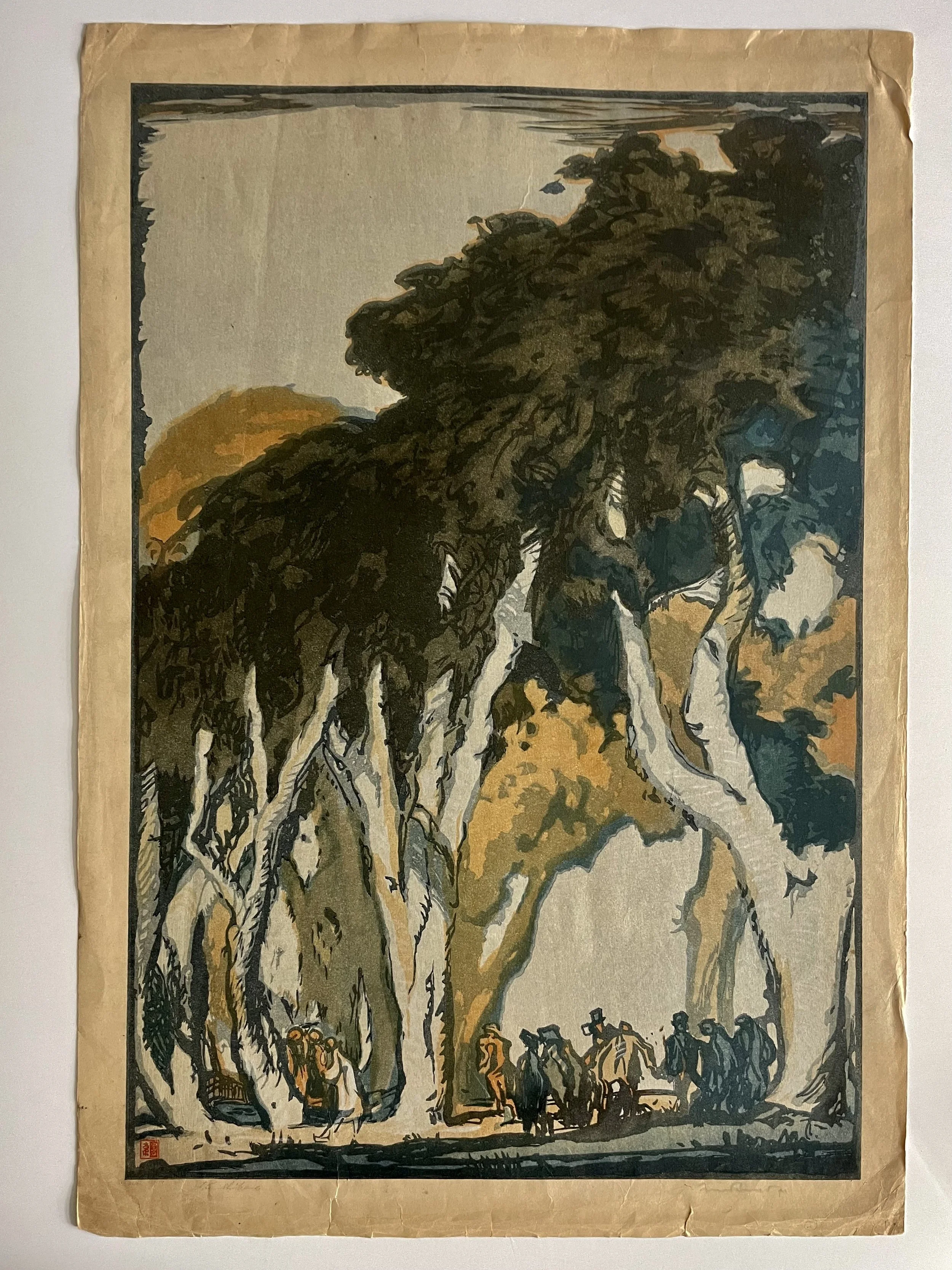 Image 1 of 11
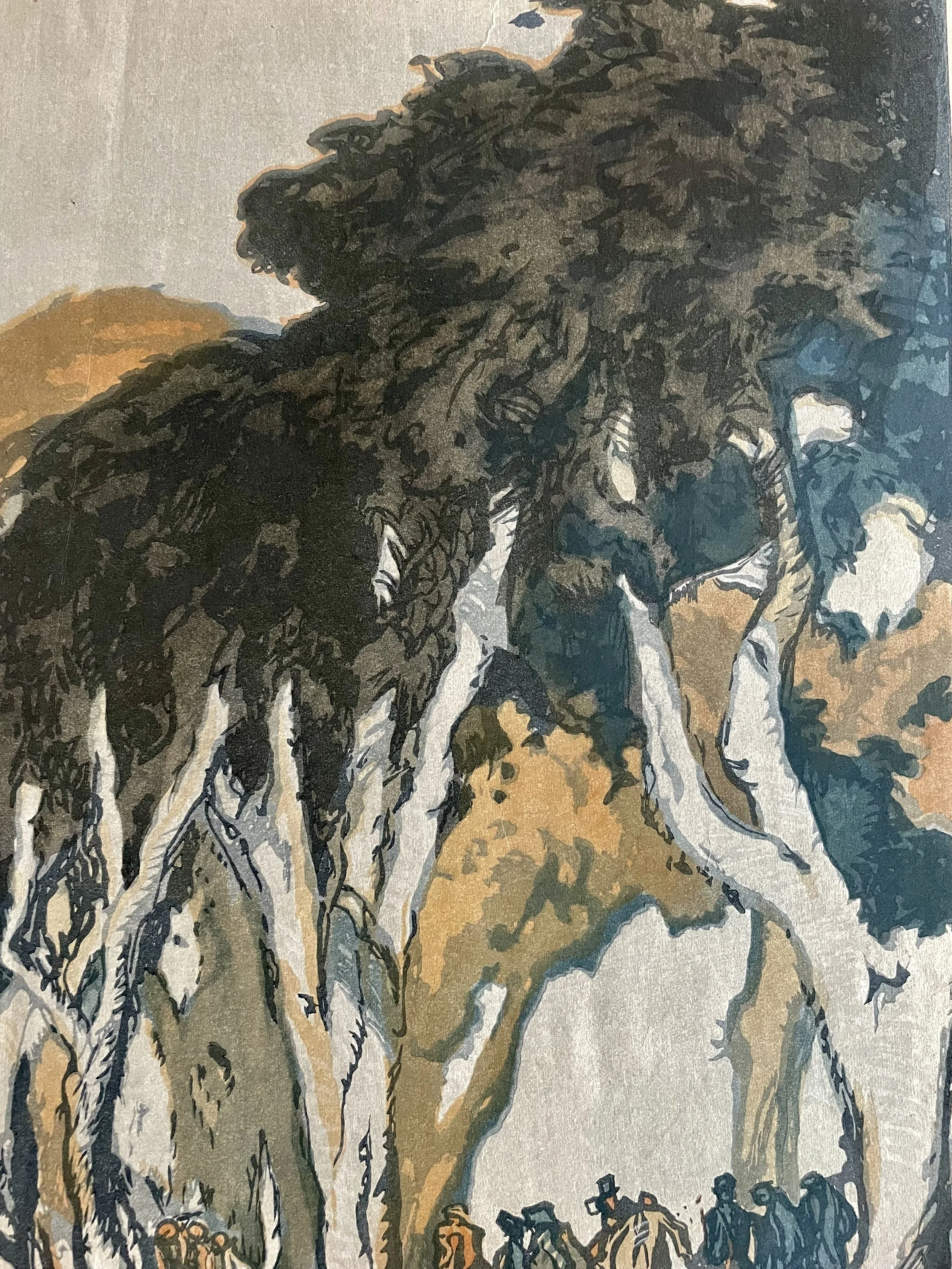 Image 2 of 11
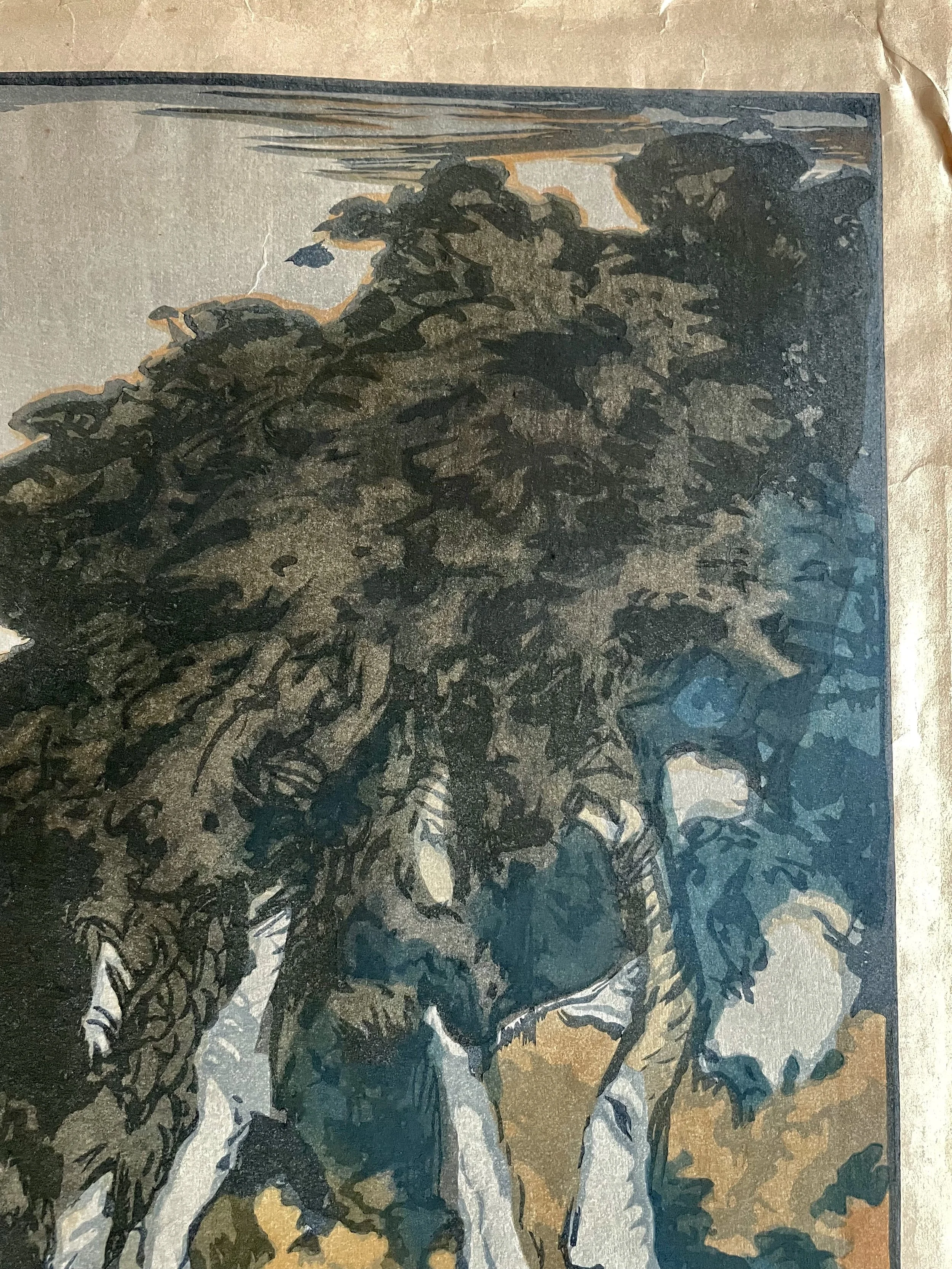 Image 3 of 11
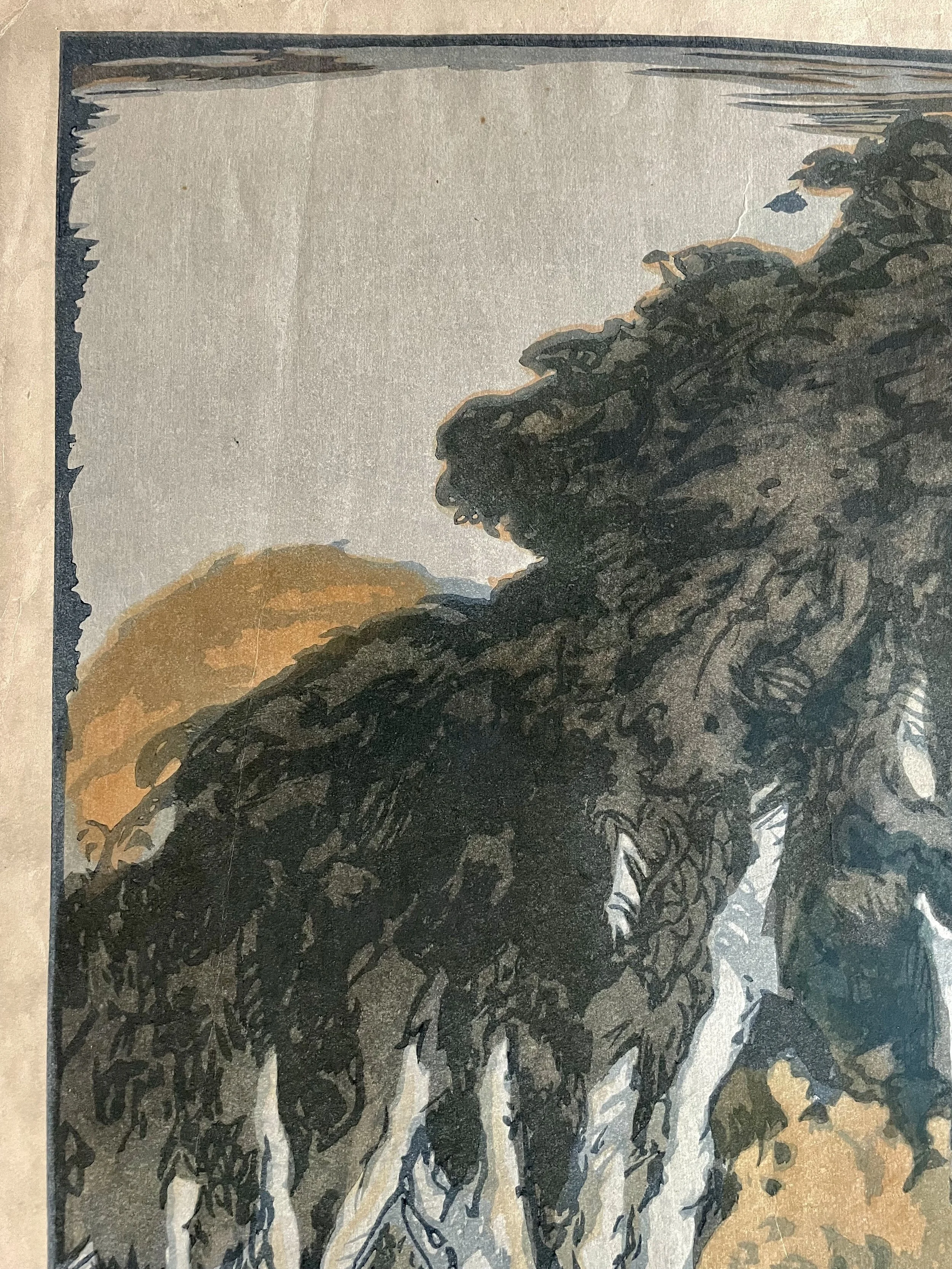 Image 4 of 11
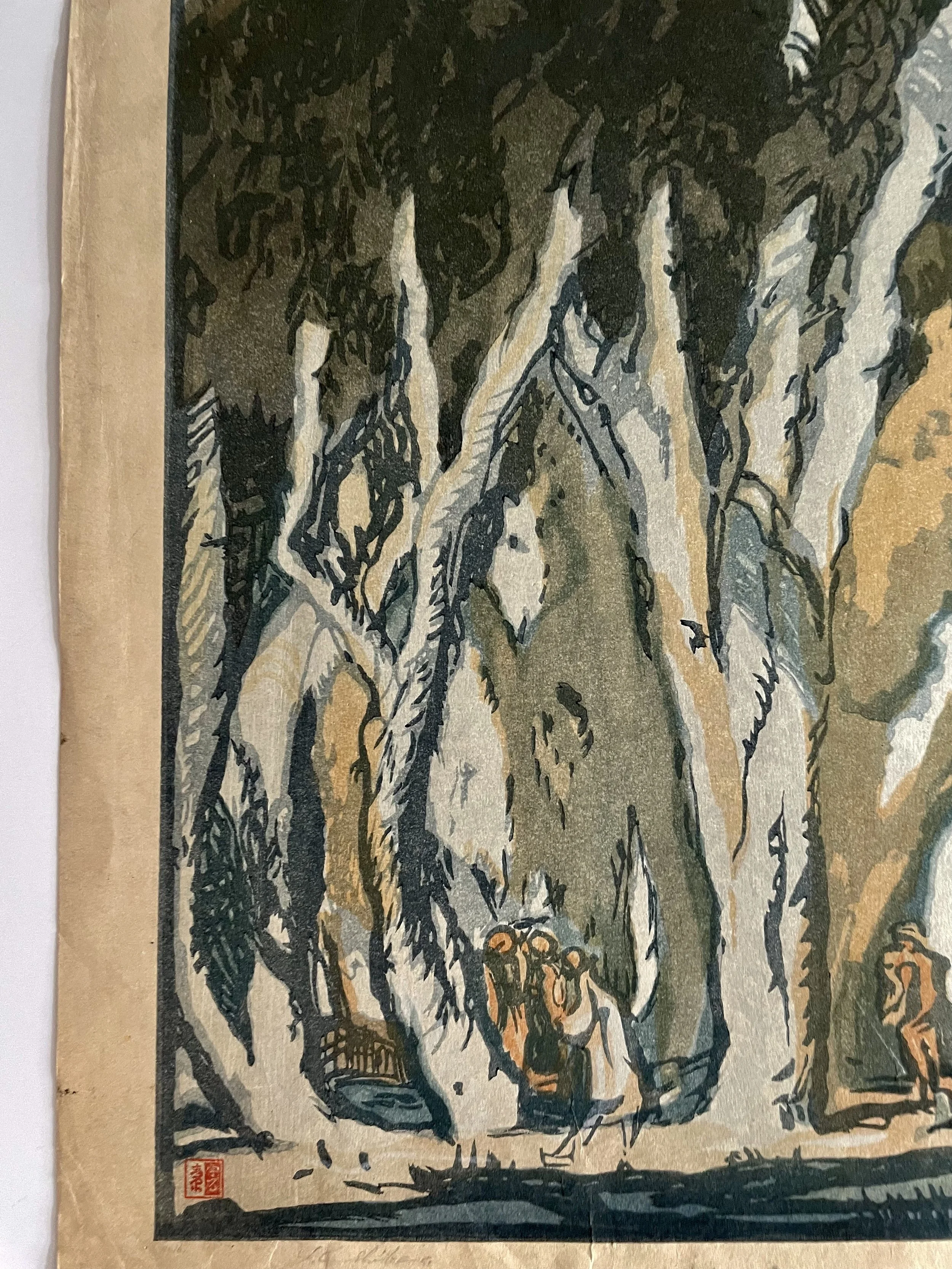 Image 5 of 11
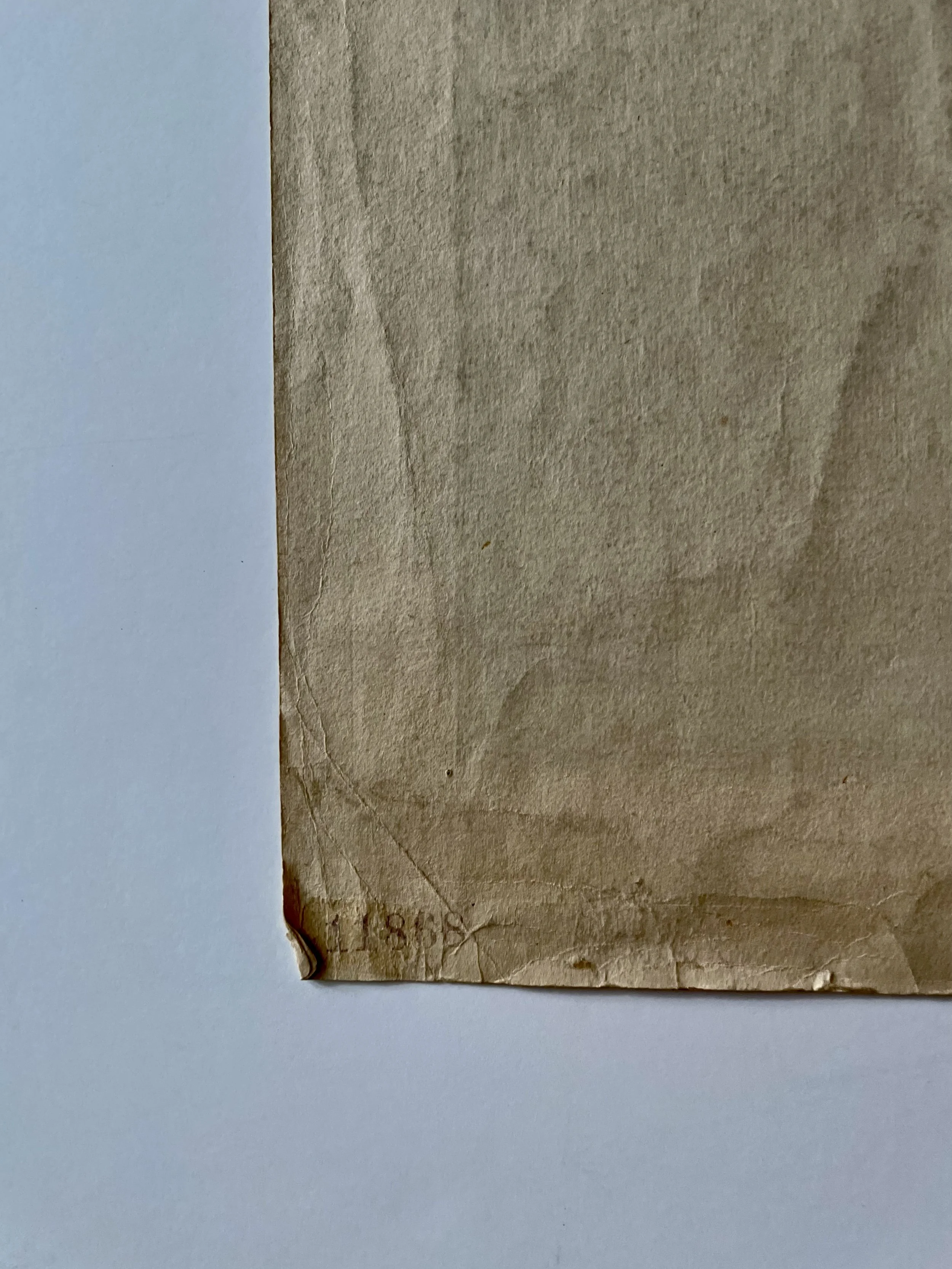 Image 6 of 11
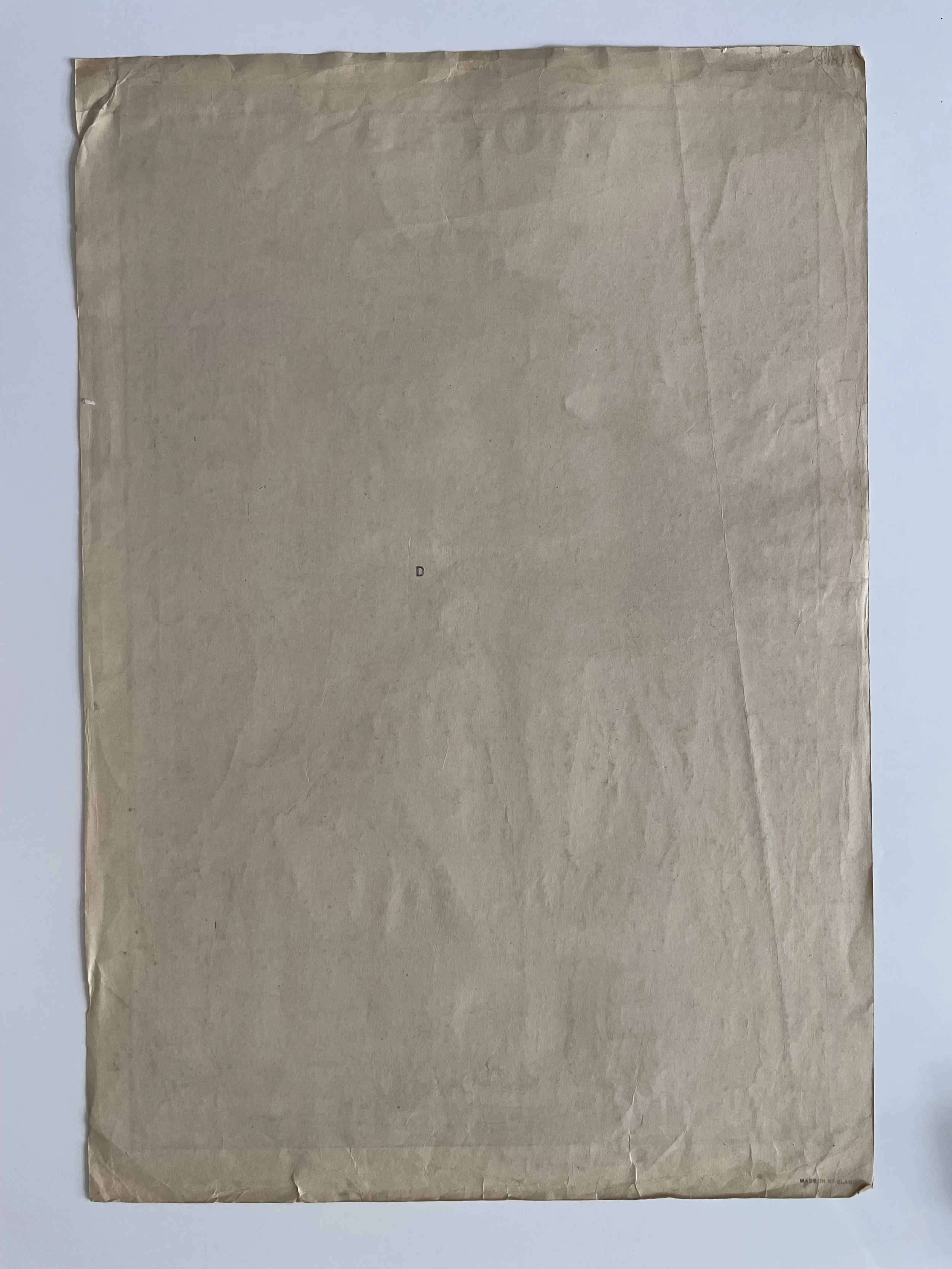 Image 7 of 11
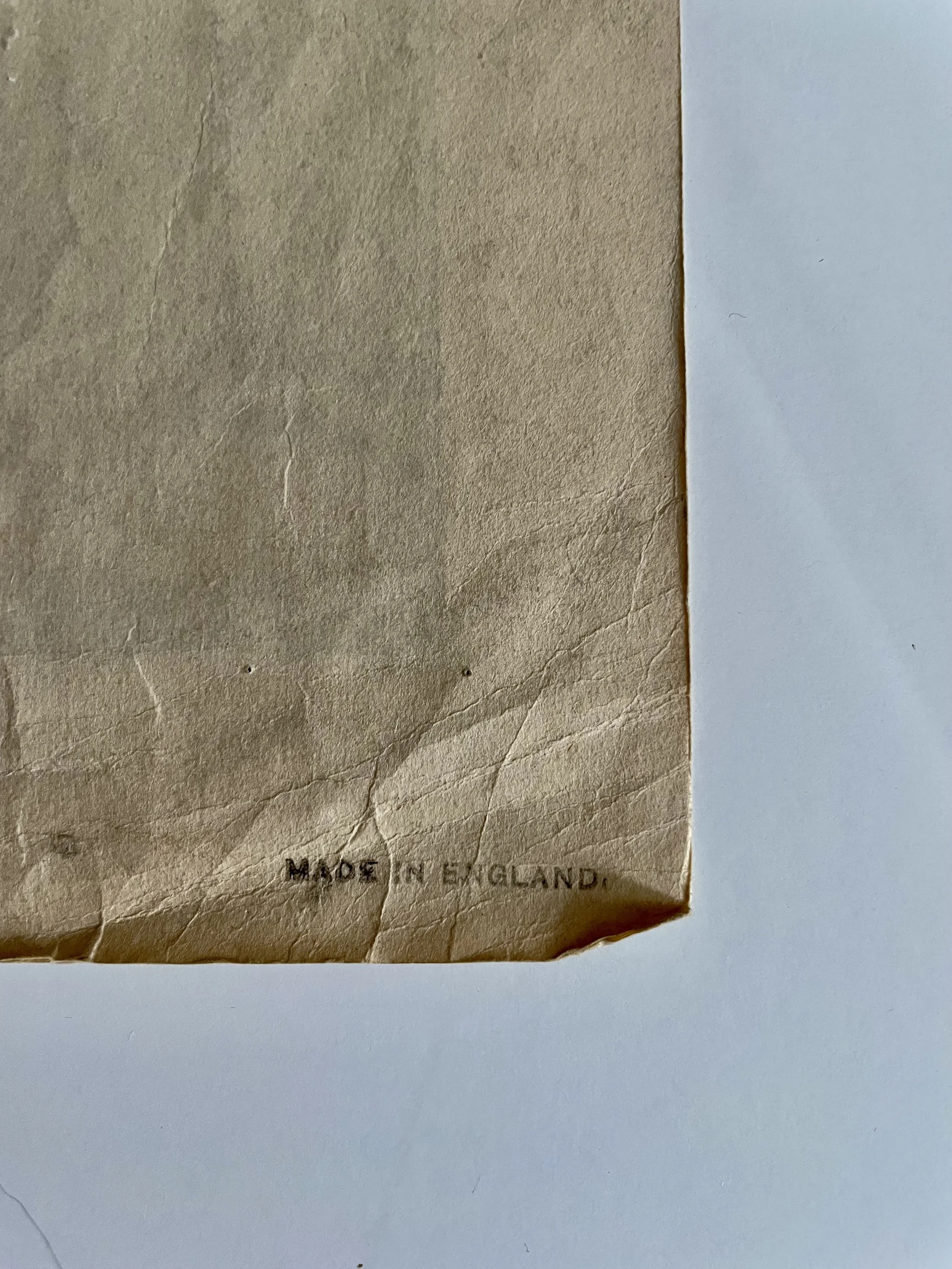 Image 8 of 11
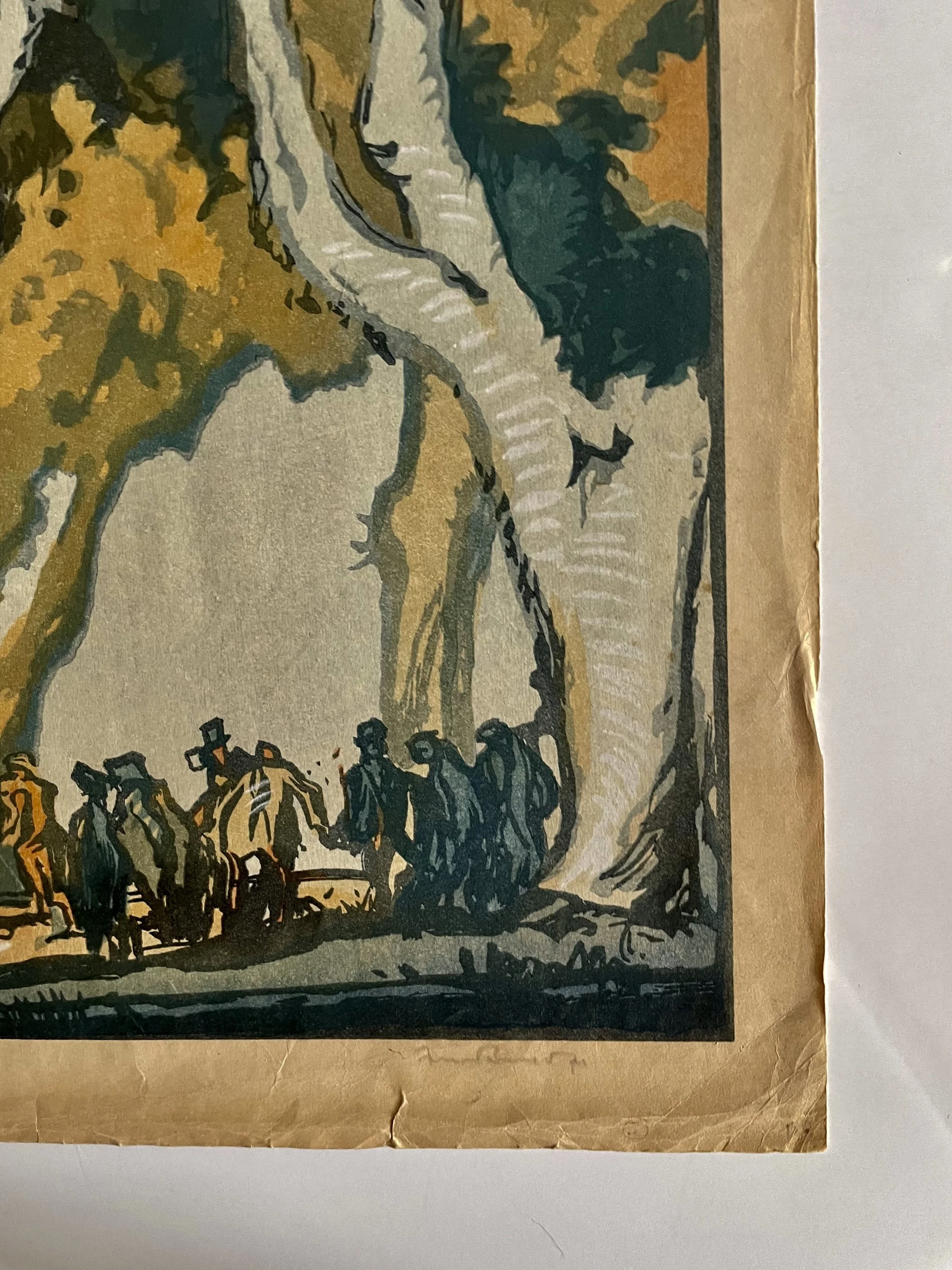 Image 9 of 11
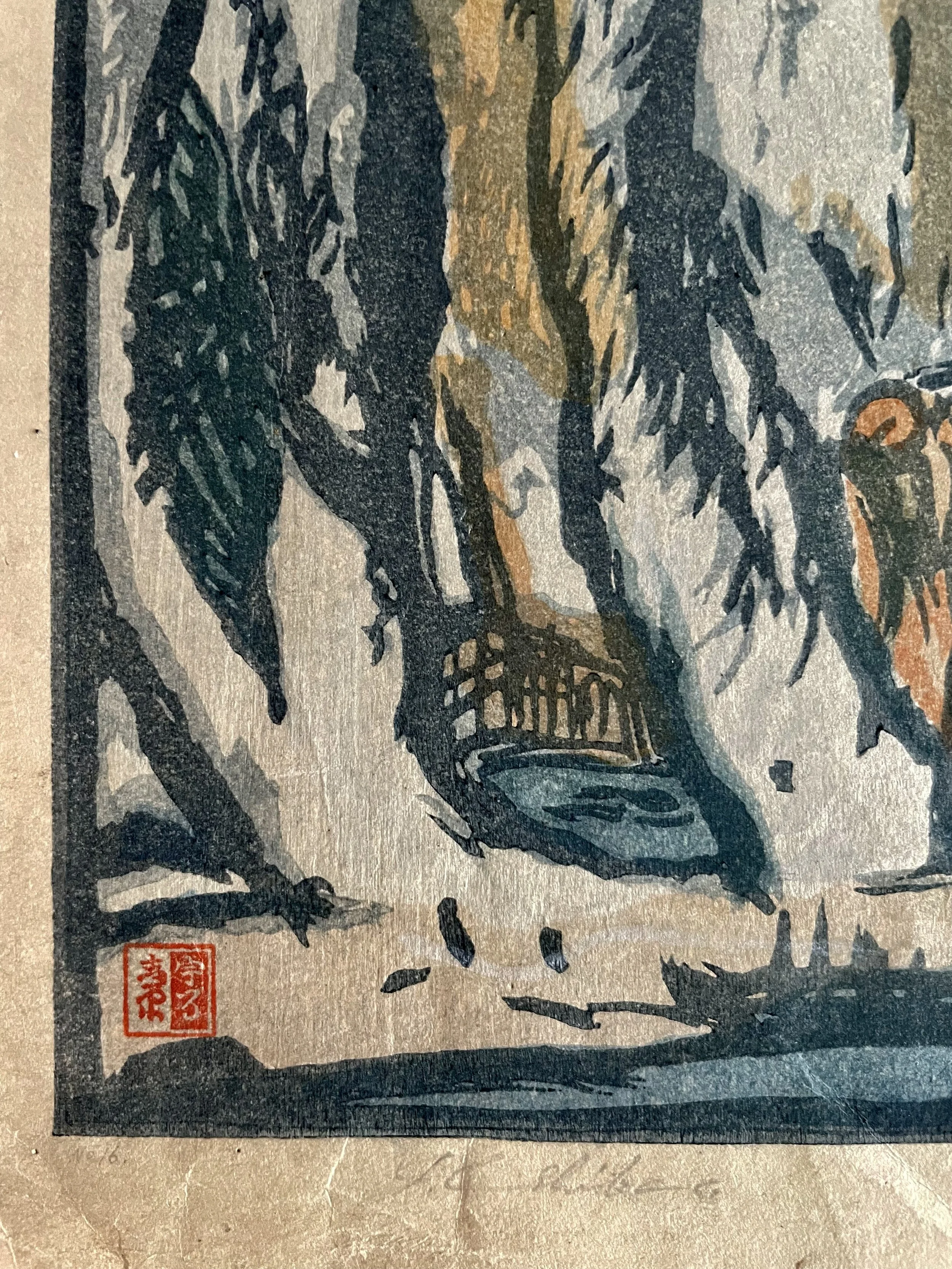 Image 10 of 11
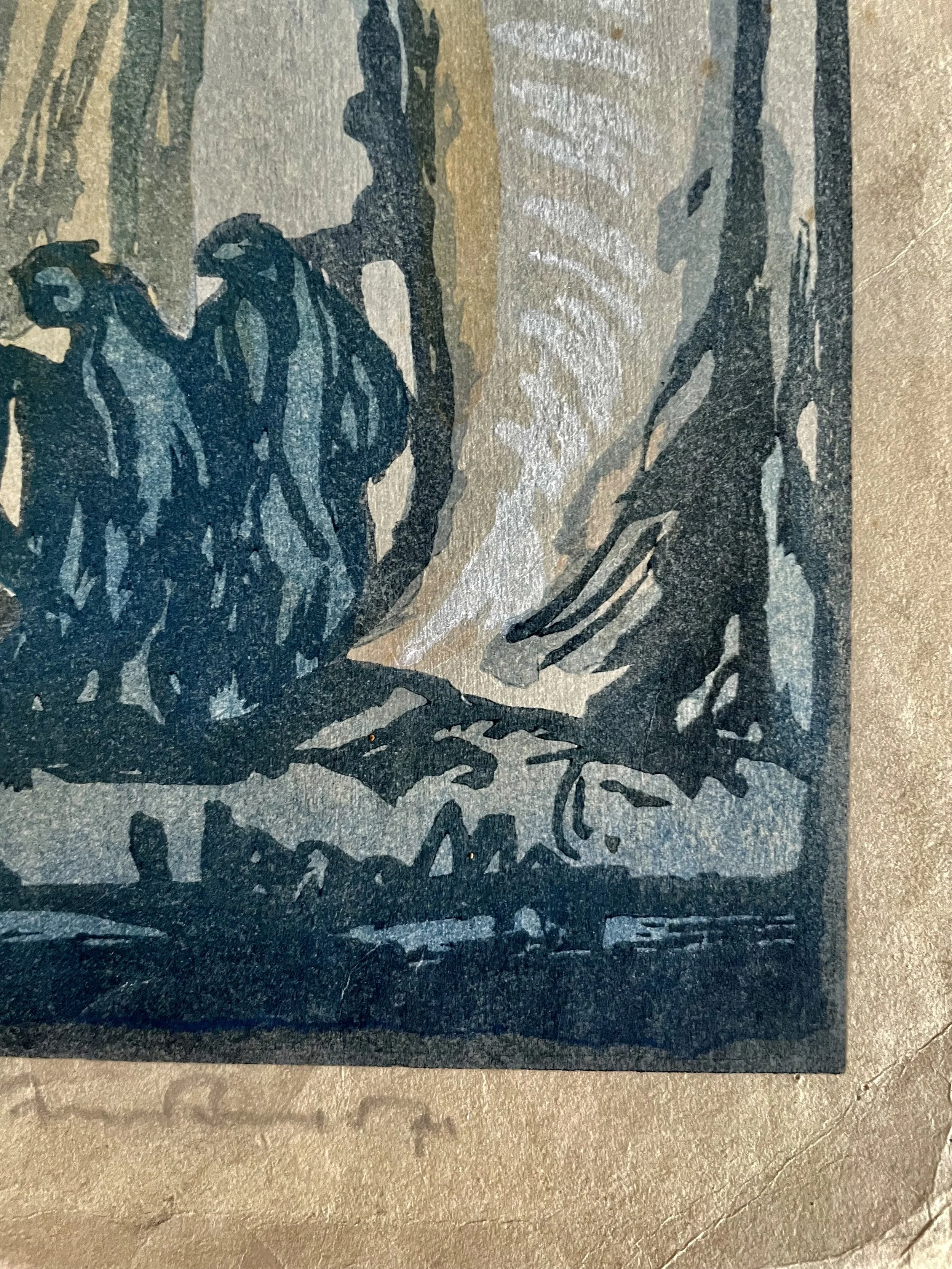 Image 11 of 11