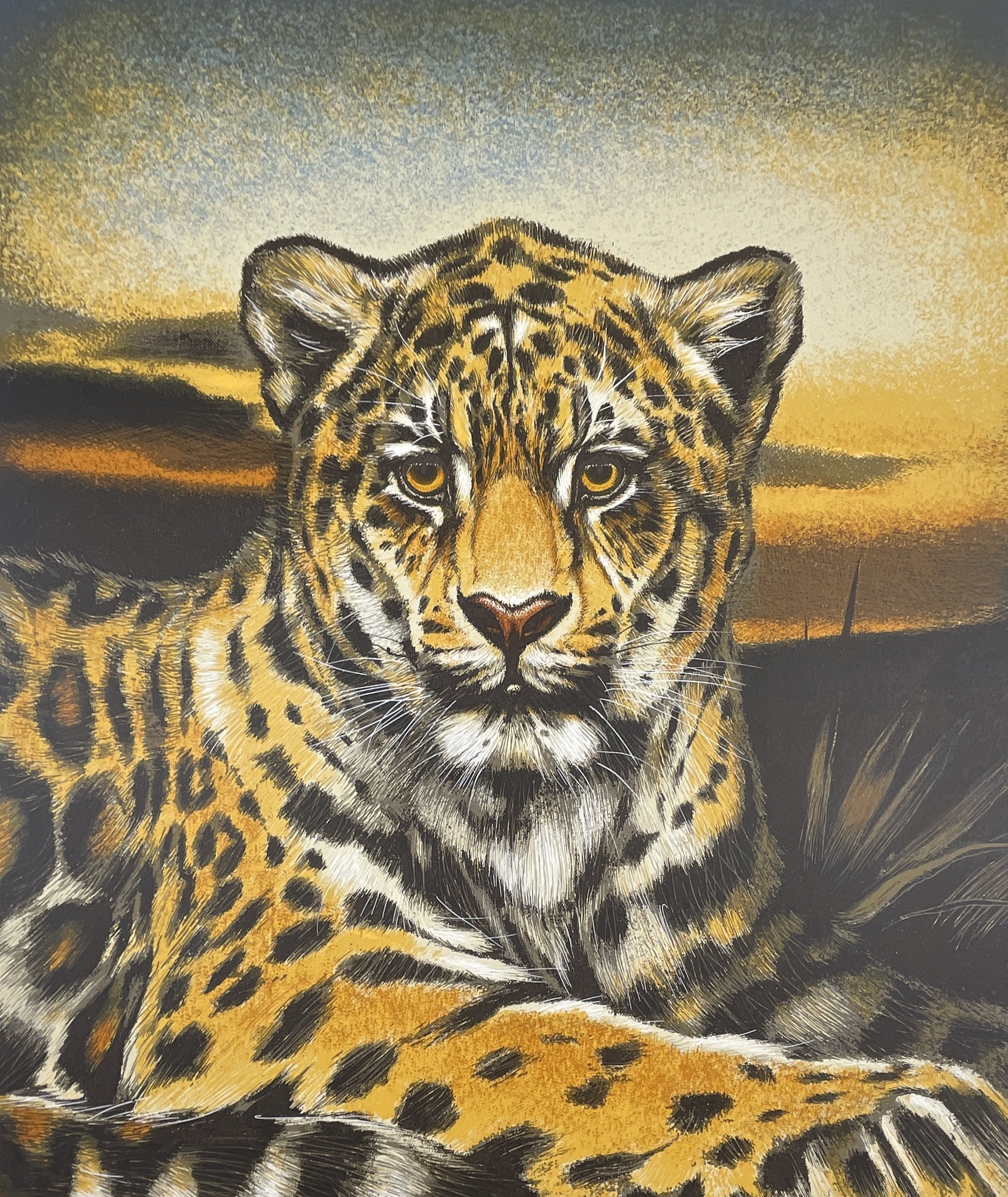
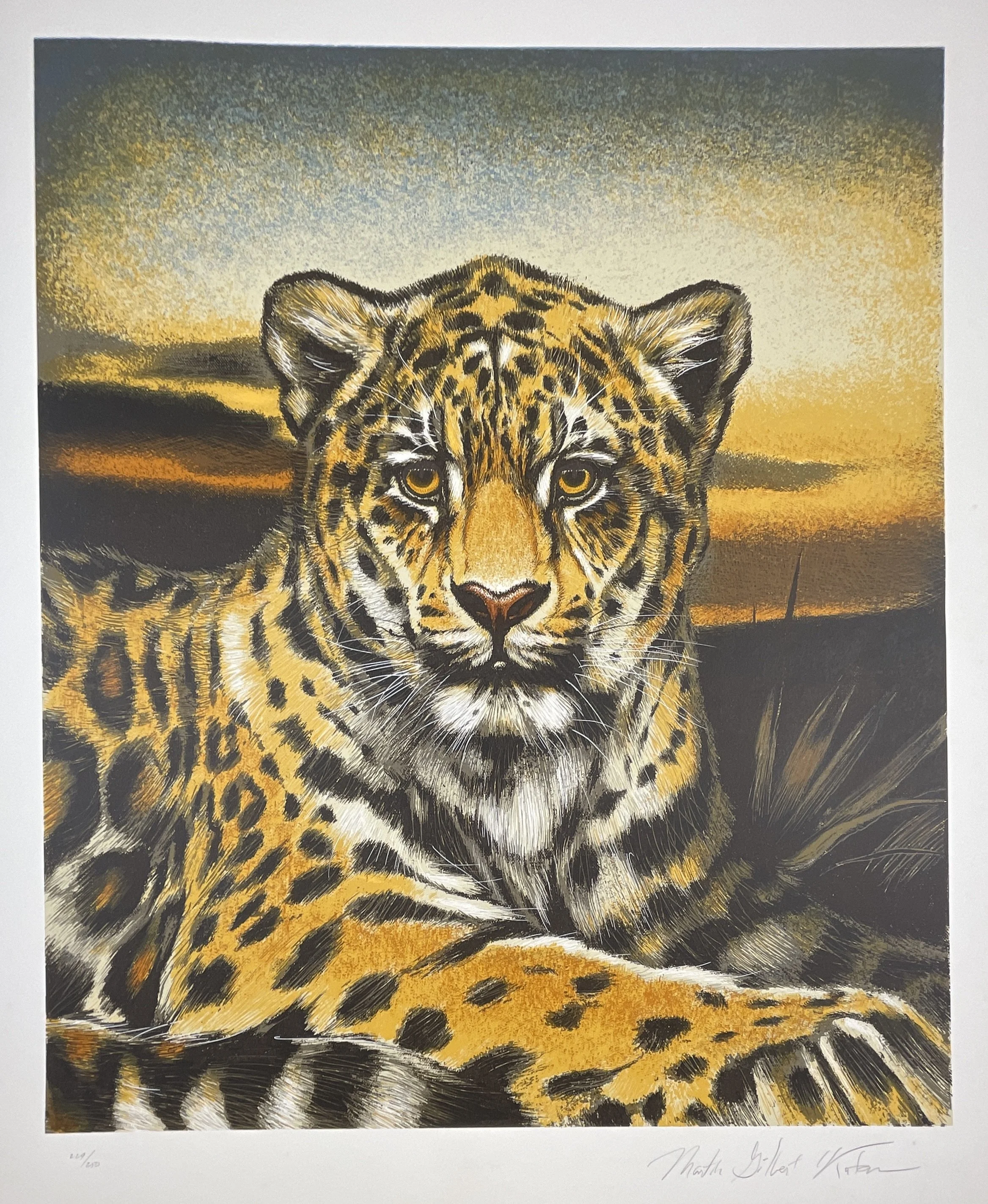
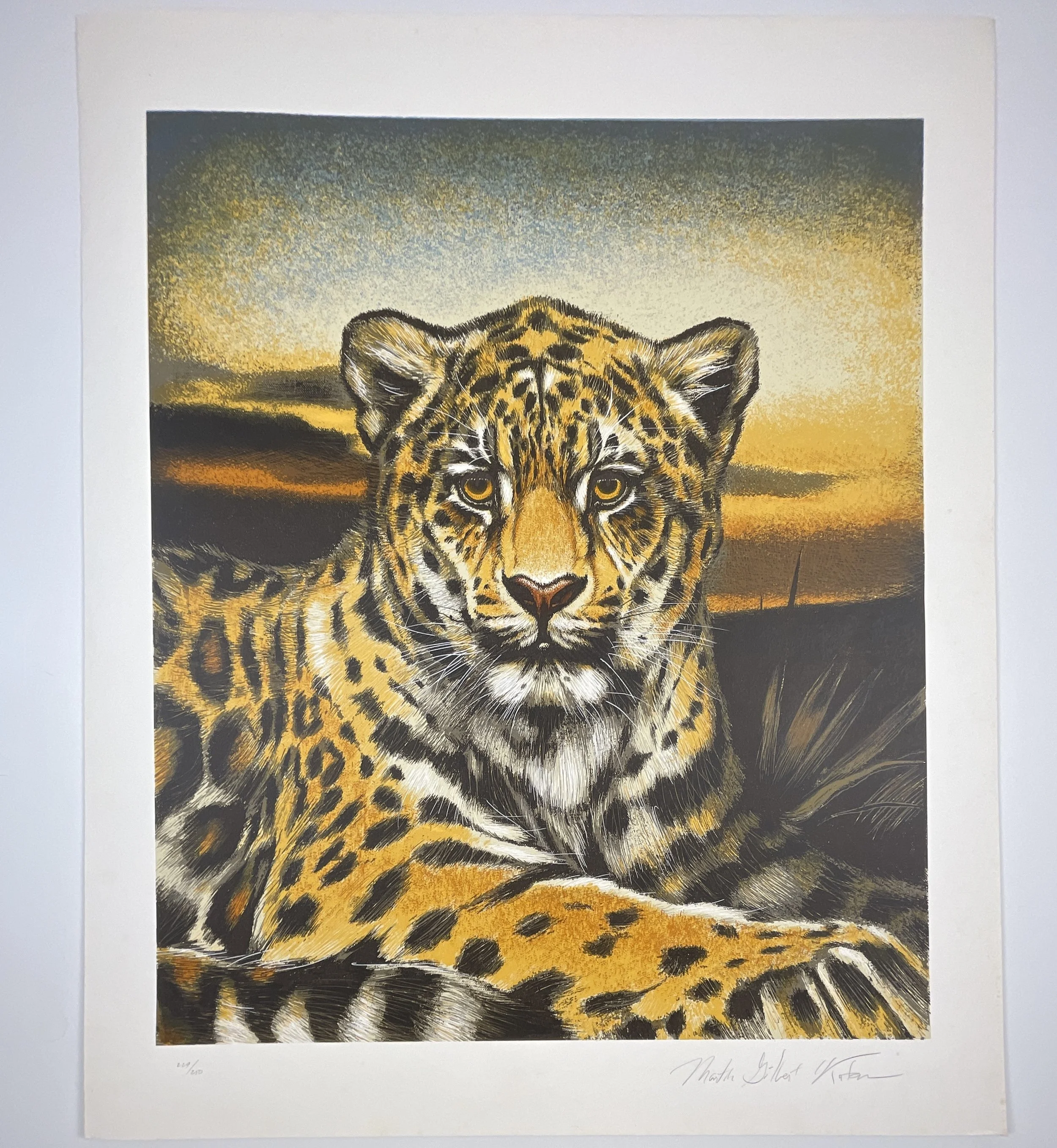
Lion Cub, Martin G. Katon, c.1970s, color lithograph, 18 x 22 inches, pencil signed and numbered 80/300 wildlife cub portrait.
A finely rendered wildlife lithograph depicting a young lion cub emerging from golden savanna grasses beneath a warm African sunset. Executed with delicate etched linework and layered tonal color, the print captures the quiet alertness and innocence of the animal while maintaining the dramatic atmosphere associated with classic wildlife illustration. Pencil signed and numbered by Martin G. Katon, the work represents the artist’s detailed naturalist style that became popular among collectors of wildlife prints in the late twentieth century.
Artwork Description
Lion Cub presents an intimate portrait of one of Africa’s most iconic animals, rendered with remarkable sensitivity and observational detail. The young lion sits partially concealed within tall savanna grasses, its gaze directed outward toward the viewer with a mixture of curiosity and alert awareness. The warm amber sky behind the animal evokes the low light of dusk or dawn on the African plains, bathing the scene in a rich golden atmosphere.
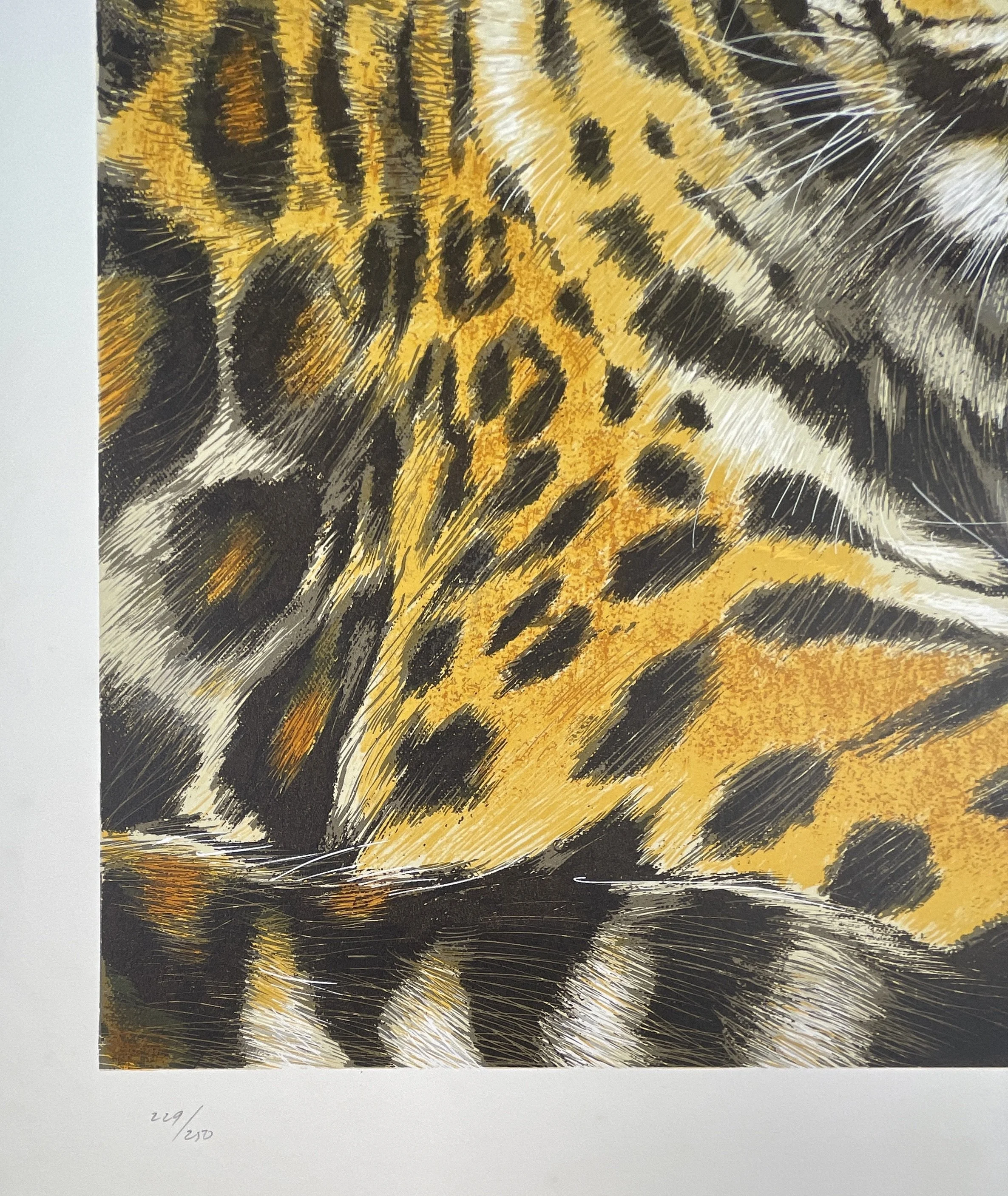
The cub is constructed through dense linear mark-making and layered tonal shading that gives the fur convincing texture and volume. Fine incised-style lines describe the contours of the animal’s face, the subtle patterning of its coat, and the delicate whiskers that extend outward into the surrounding space. The eyes are particularly striking, rendered in luminous amber tones that mirror the colors of the sunset sky and create a powerful focal point within the composition.
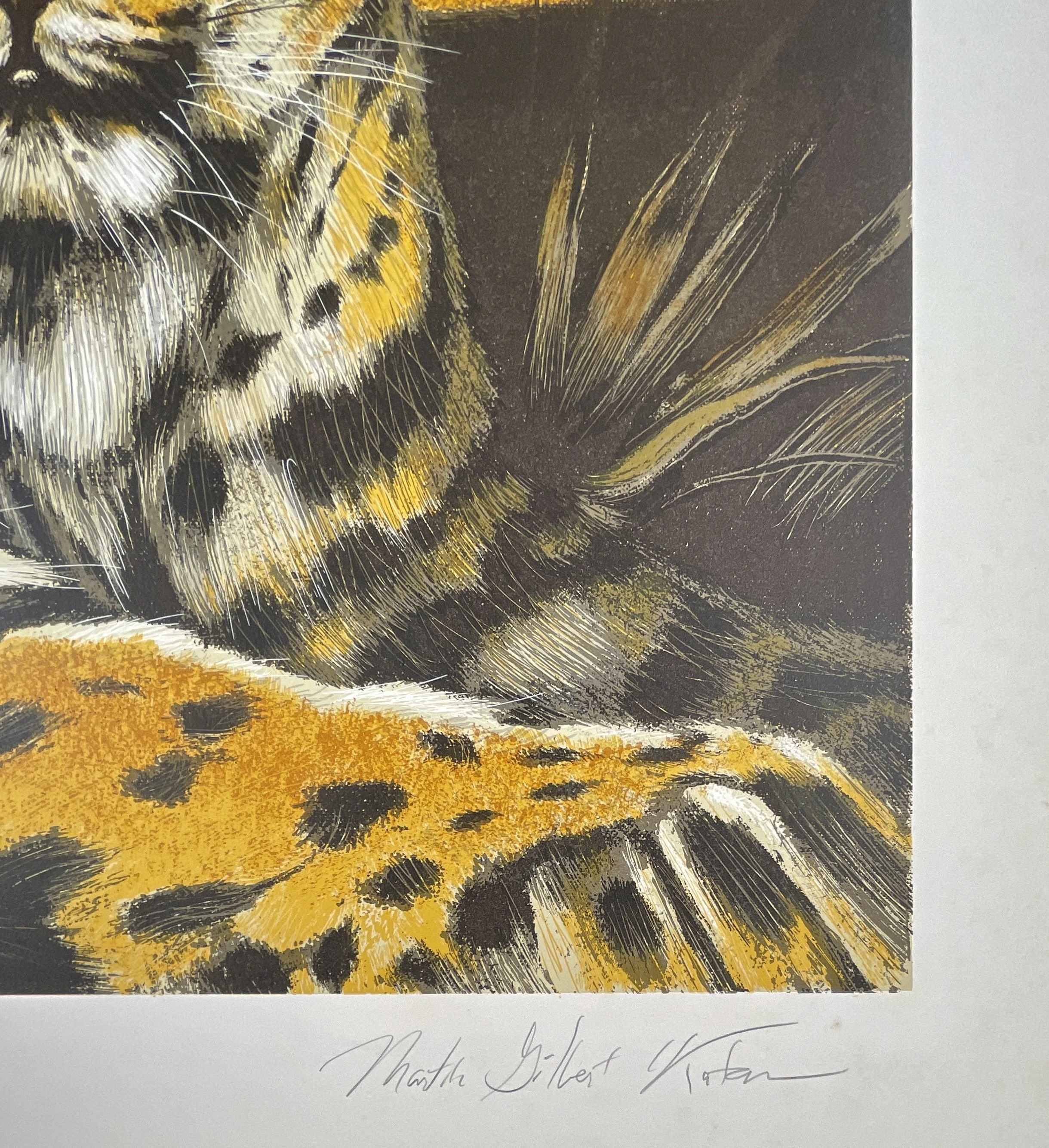
Tall grasses frame the animal and reinforce the natural setting. Their sweeping diagonal lines add rhythm to the otherwise centered composition and subtly guide the viewer’s eye back toward the cub’s face. The background landscape is simplified into horizontal bands of color, suggesting distant plains without distracting from the primary subject.
The print reflects the strong tradition of wildlife illustration that flourished during the mid-to-late twentieth century, when artists sought to combine scientific observation with painterly composition. The balance of fine line drawing and soft atmospheric color indicates a lithographic or mixed printmaking process in which drawn detail is combined with tonal washes to achieve depth.
This edition is pencil signed by the artist and numbered 80 from an edition of 300, confirming its status as a limited edition print intended for collectors. The work’s warm palette, approachable subject matter, and refined draftsmanship exemplify the decorative wildlife prints that became widely collected in North America and Europe during the period.
Dimensions: 18 x 22 inches
Medium: color lithograph
Edition: 80/300
Signature: pencil signed lower right by the artist
Artist Biography
Martin G. Katon emerged during the late twentieth century as a wildlife illustrator and printmaker known for carefully observed animal subjects and detailed naturalistic drawing. His work belongs to a long lineage of artists who devoted their careers to depicting animals within their natural habitats while combining scientific observation with artistic interpretation.
Little biographical documentation survives regarding Katon’s early life, but his work reflects formal training in traditional draftsmanship and printmaking techniques that emphasize controlled line, tonal layering, and anatomical accuracy. Artists working in this tradition frequently studied classical drawing methods and wildlife anatomy in order to capture the structure and movement of animals with convincing realism.
Katon’s prints typically focus on intimate portraits of animals rather than large narrative landscapes. This approach allows the viewer to encounter the subject directly and emphasizes expression, gaze, and subtle behavioral details. Lions, big cats, and other wildlife subjects appear frequently in twentieth-century wildlife printmaking because they combine visual drama with universal symbolism associated with strength, survival, and the natural world.
During the 1970s and 1980s a significant market developed for limited edition wildlife prints. Advances in lithographic printing allowed artists and publishers to produce finely detailed editions that remained accessible to collectors. Galleries throughout the United States and Europe distributed such prints, often through specialized art publishers and gallery networks.
Katon’s work fits squarely within this movement. His prints combine strong graphic linework with atmospheric coloration, creating images that function both as naturalistic studies and as decorative works suitable for residential and gallery settings. The careful rendering of fur, whiskers, and vegetation demonstrates a disciplined observational approach typical of artists influenced by both wildlife illustration and classical engraving traditions.
Although Katon did not achieve the international institutional recognition of major wildlife painters, his prints remain representative of the period’s broader appreciation for nature subjects and collectible limited editions. Works such as Lion Cub capture the quiet dignity and vulnerability of young animals while presenting them with a clarity and immediacy that continues to resonate with collectors.
Today Katon’s limited edition prints circulate through private collections and gallery inventories associated with late twentieth-century wildlife art. They remain appreciated for their craftsmanship, warm natural palettes, and their ability to bring a sense of the natural world into interior spaces.
Martin G. Katon
Lion Cub
Color lithograph
Edition 80/300
18 x 22 inches
Pencil signed lower right
Limited edition wildlife print depicting a young lion cub in savanna grasses at sunset.
Certificate of Authentication
Artist: Martin G. Katon
Title: Lion Cub
Medium: Color Lithograph
Dimensions: 18 x 22 inches
Edition: 80/300
Signature: Pencil signed by the artist
This document certifies that the artwork described above is an authentic limited edition print created by Martin G. Katon.
Condition
Very good vintage condition. Paper remains stable with strong color saturation. Minor age-related toning and small scattered handling marks visible in the margins consistent with normal storage. Image area remains clean and vibrant.
Provenance
Mitch Morse Gallery, New York
Acquired by Mitch Morse through sources in New York, the United States, and Europe
Private Collection
Artfind Gallery, Washington DC (current owner)
Citations
Benezit Dictionary of Artists
Oxford Art Online – wildlife illustration and printmaking traditions
International Fine Print Dealers Association – limited edition print practices
Library of Congress resources on wildlife illustration history
Lion Cub, Martin G. Katon, c.1970s, color lithograph, 18 x 22 inches, pencil signed and numbered 80/300 wildlife cub portrait.
A finely rendered wildlife lithograph depicting a young lion cub emerging from golden savanna grasses beneath a warm African sunset. Executed with delicate etched linework and layered tonal color, the print captures the quiet alertness and innocence of the animal while maintaining the dramatic atmosphere associated with classic wildlife illustration. Pencil signed and numbered by Martin G. Katon, the work represents the artist’s detailed naturalist style that became popular among collectors of wildlife prints in the late twentieth century.
Artwork Description
Lion Cub presents an intimate portrait of one of Africa’s most iconic animals, rendered with remarkable sensitivity and observational detail. The young lion sits partially concealed within tall savanna grasses, its gaze directed outward toward the viewer with a mixture of curiosity and alert awareness. The warm amber sky behind the animal evokes the low light of dusk or dawn on the African plains, bathing the scene in a rich golden atmosphere.
The cub is constructed through dense linear mark-making and layered tonal shading that gives the fur convincing texture and volume. Fine incised-style lines describe the contours of the animal’s face, the subtle patterning of its coat, and the delicate whiskers that extend outward into the surrounding space. The eyes are particularly striking, rendered in luminous amber tones that mirror the colors of the sunset sky and create a powerful focal point within the composition.
Tall grasses frame the animal and reinforce the natural setting. Their sweeping diagonal lines add rhythm to the otherwise centered composition and subtly guide the viewer’s eye back toward the cub’s face. The background landscape is simplified into horizontal bands of color, suggesting distant plains without distracting from the primary subject.
The print reflects the strong tradition of wildlife illustration that flourished during the mid-to-late twentieth century, when artists sought to combine scientific observation with painterly composition. The balance of fine line drawing and soft atmospheric color indicates a lithographic or mixed printmaking process in which drawn detail is combined with tonal washes to achieve depth.
This edition is pencil signed by the artist and numbered 80 from an edition of 300, confirming its status as a limited edition print intended for collectors. The work’s warm palette, approachable subject matter, and refined draftsmanship exemplify the decorative wildlife prints that became widely collected in North America and Europe during the period.
Dimensions: 18 x 22 inches
Medium: color lithograph
Edition: 80/300
Signature: pencil signed lower right by the artist
Artist Biography
Martin G. Katon emerged during the late twentieth century as a wildlife illustrator and printmaker known for carefully observed animal subjects and detailed naturalistic drawing. His work belongs to a long lineage of artists who devoted their careers to depicting animals within their natural habitats while combining scientific observation with artistic interpretation.
Little biographical documentation survives regarding Katon’s early life, but his work reflects formal training in traditional draftsmanship and printmaking techniques that emphasize controlled line, tonal layering, and anatomical accuracy. Artists working in this tradition frequently studied classical drawing methods and wildlife anatomy in order to capture the structure and movement of animals with convincing realism.
Katon’s prints typically focus on intimate portraits of animals rather than large narrative landscapes. This approach allows the viewer to encounter the subject directly and emphasizes expression, gaze, and subtle behavioral details. Lions, big cats, and other wildlife subjects appear frequently in twentieth-century wildlife printmaking because they combine visual drama with universal symbolism associated with strength, survival, and the natural world.
During the 1970s and 1980s a significant market developed for limited edition wildlife prints. Advances in lithographic printing allowed artists and publishers to produce finely detailed editions that remained accessible to collectors. Galleries throughout the United States and Europe distributed such prints, often through specialized art publishers and gallery networks.
Katon’s work fits squarely within this movement. His prints combine strong graphic linework with atmospheric coloration, creating images that function both as naturalistic studies and as decorative works suitable for residential and gallery settings. The careful rendering of fur, whiskers, and vegetation demonstrates a disciplined observational approach typical of artists influenced by both wildlife illustration and classical engraving traditions.
Although Katon did not achieve the international institutional recognition of major wildlife painters, his prints remain representative of the period’s broader appreciation for nature subjects and collectible limited editions. Works such as Lion Cub capture the quiet dignity and vulnerability of young animals while presenting them with a clarity and immediacy that continues to resonate with collectors.
Today Katon’s limited edition prints circulate through private collections and gallery inventories associated with late twentieth-century wildlife art. They remain appreciated for their craftsmanship, warm natural palettes, and their ability to bring a sense of the natural world into interior spaces.
Martin G. Katon
Lion Cub
Color lithograph
Edition 80/300
18 x 22 inches
Pencil signed lower right
Limited edition wildlife print depicting a young lion cub in savanna grasses at sunset.
Certificate of Authentication
Artist: Martin G. Katon
Title: Lion Cub
Medium: Color Lithograph
Dimensions: 18 x 22 inches
Edition: 80/300
Signature: Pencil signed by the artist
This document certifies that the artwork described above is an authentic limited edition print created by Martin G. Katon.
Condition
Very good vintage condition. Paper remains stable with strong color saturation. Minor age-related toning and small scattered handling marks visible in the margins consistent with normal storage. Image area remains clean and vibrant.
Provenance
Mitch Morse Gallery, New York
Acquired by Mitch Morse through sources in New York, the United States, and Europe
Private Collection
Artfind Gallery, Washington DC (current owner)
Citations
Benezit Dictionary of Artists
Oxford Art Online – wildlife illustration and printmaking traditions
International Fine Print Dealers Association – limited edition print practices
Library of Congress resources on wildlife illustration history
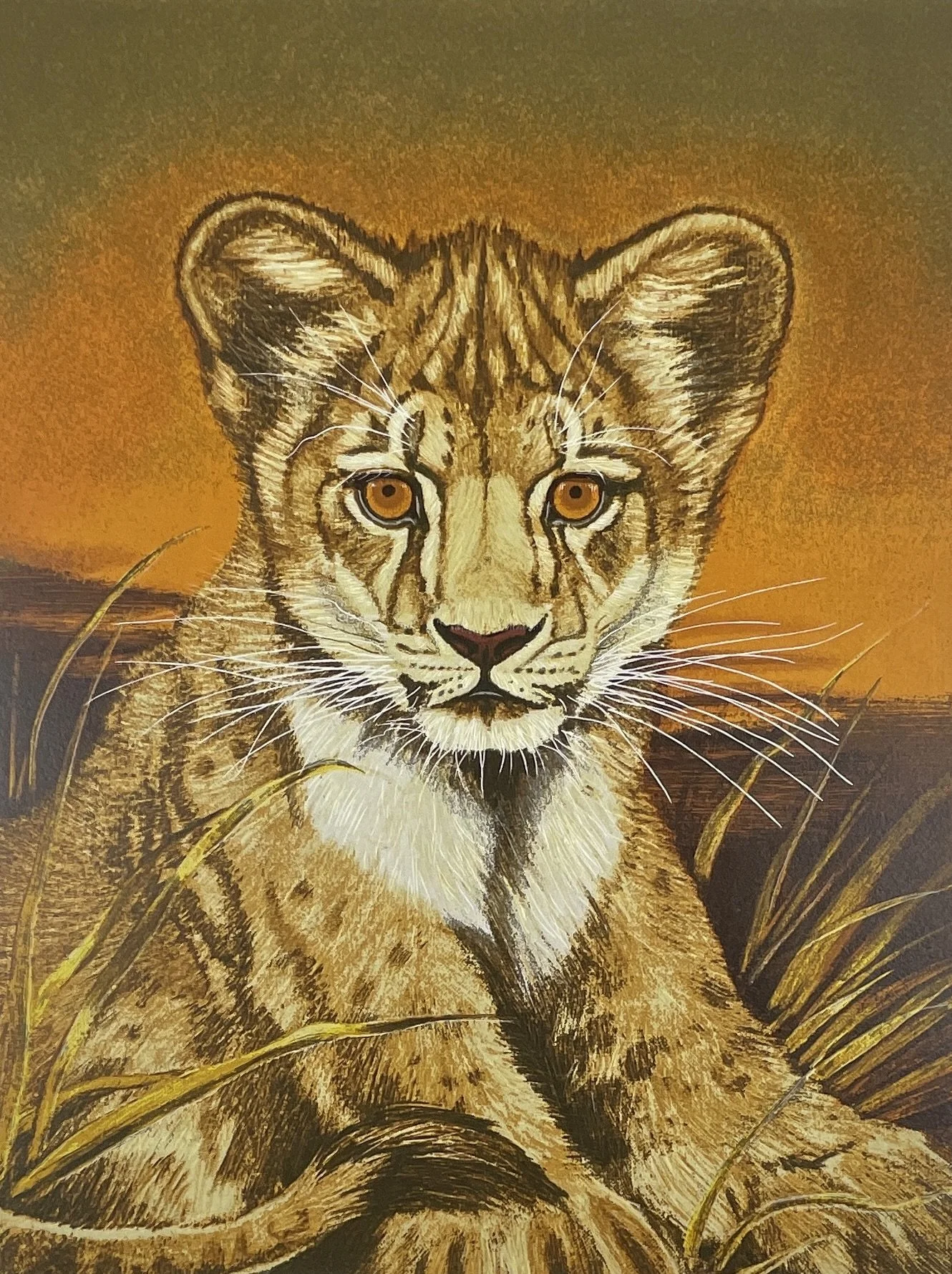 Image 1 of 6
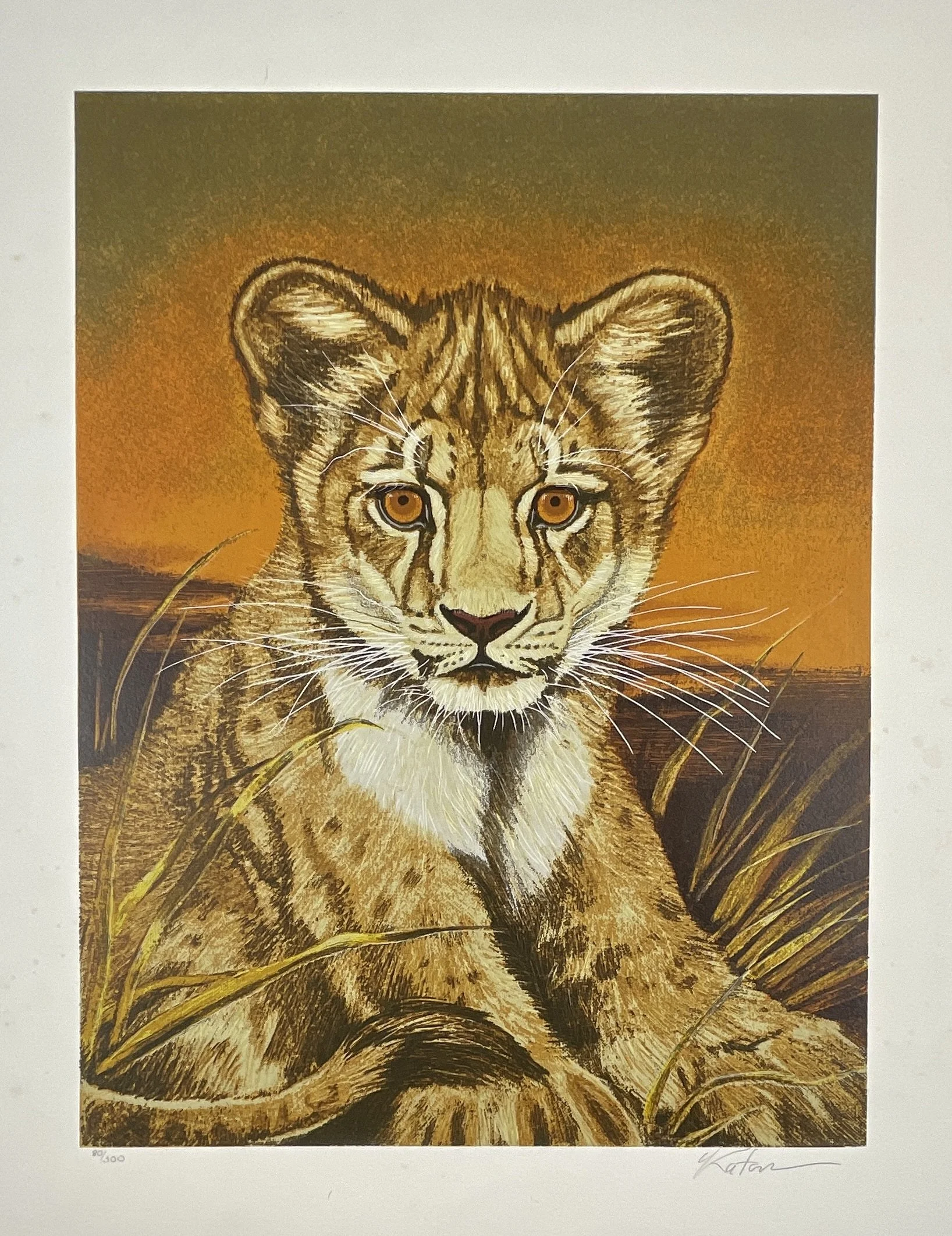 Image 2 of 6
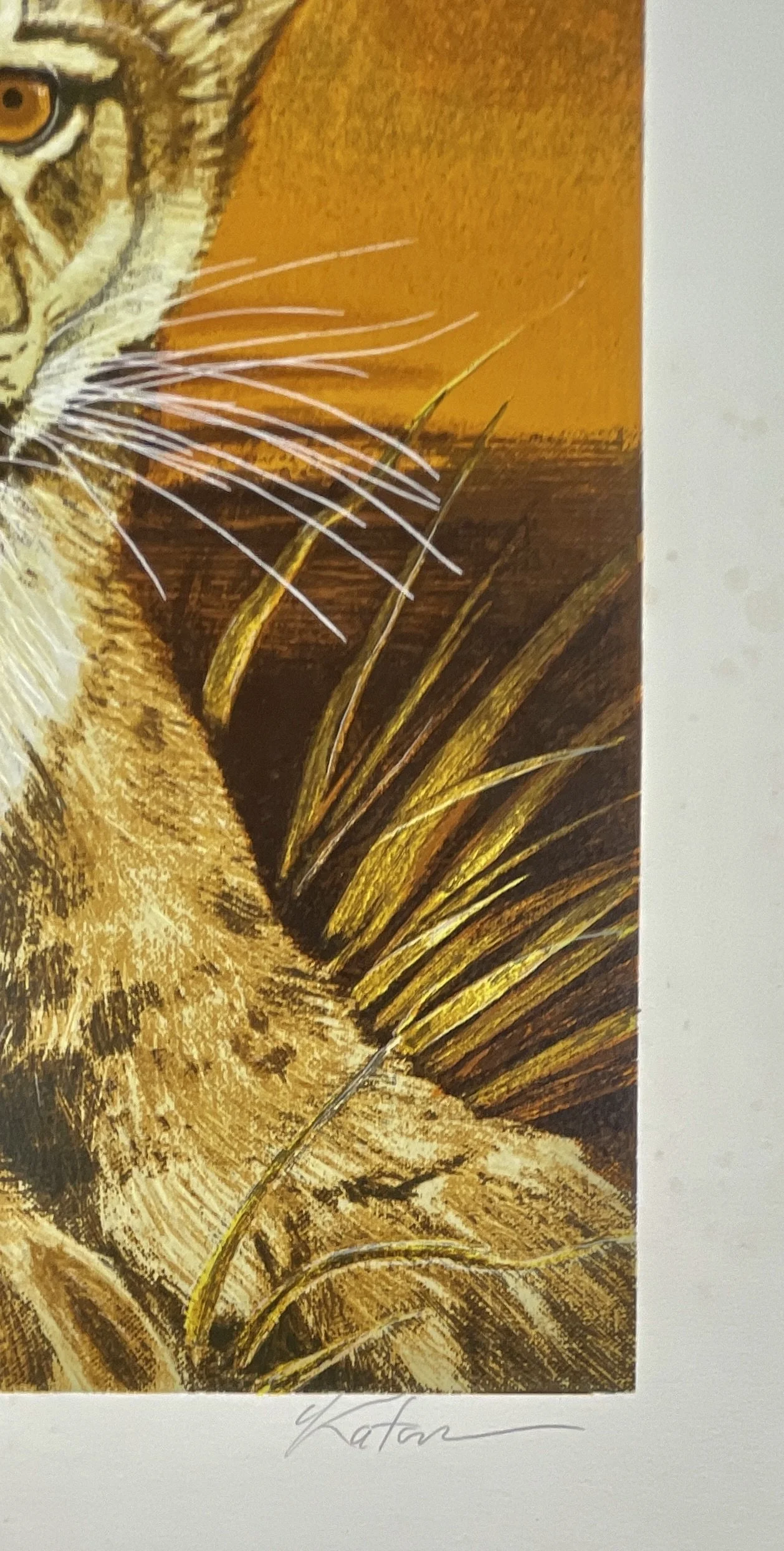 Image 3 of 6
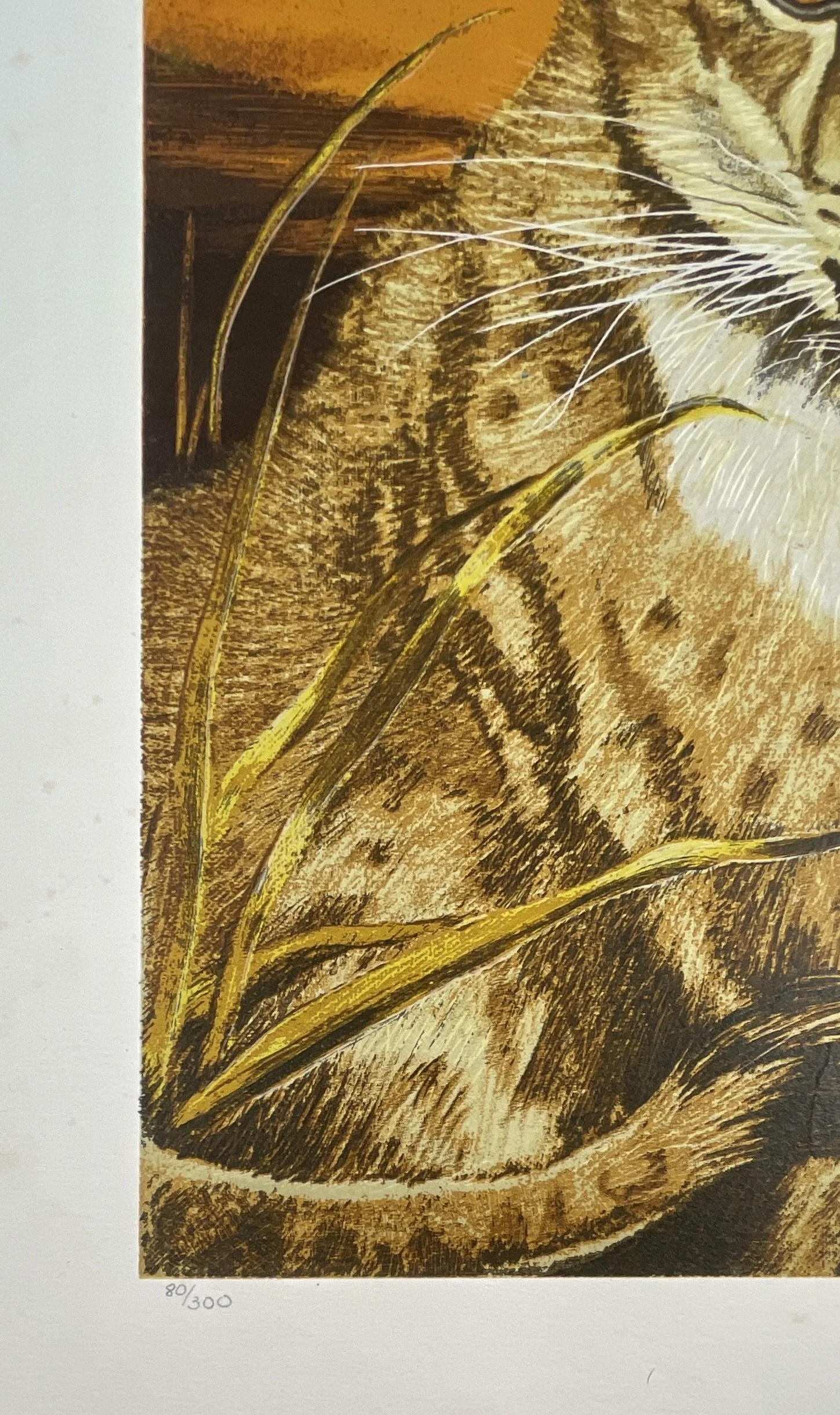 Image 4 of 6
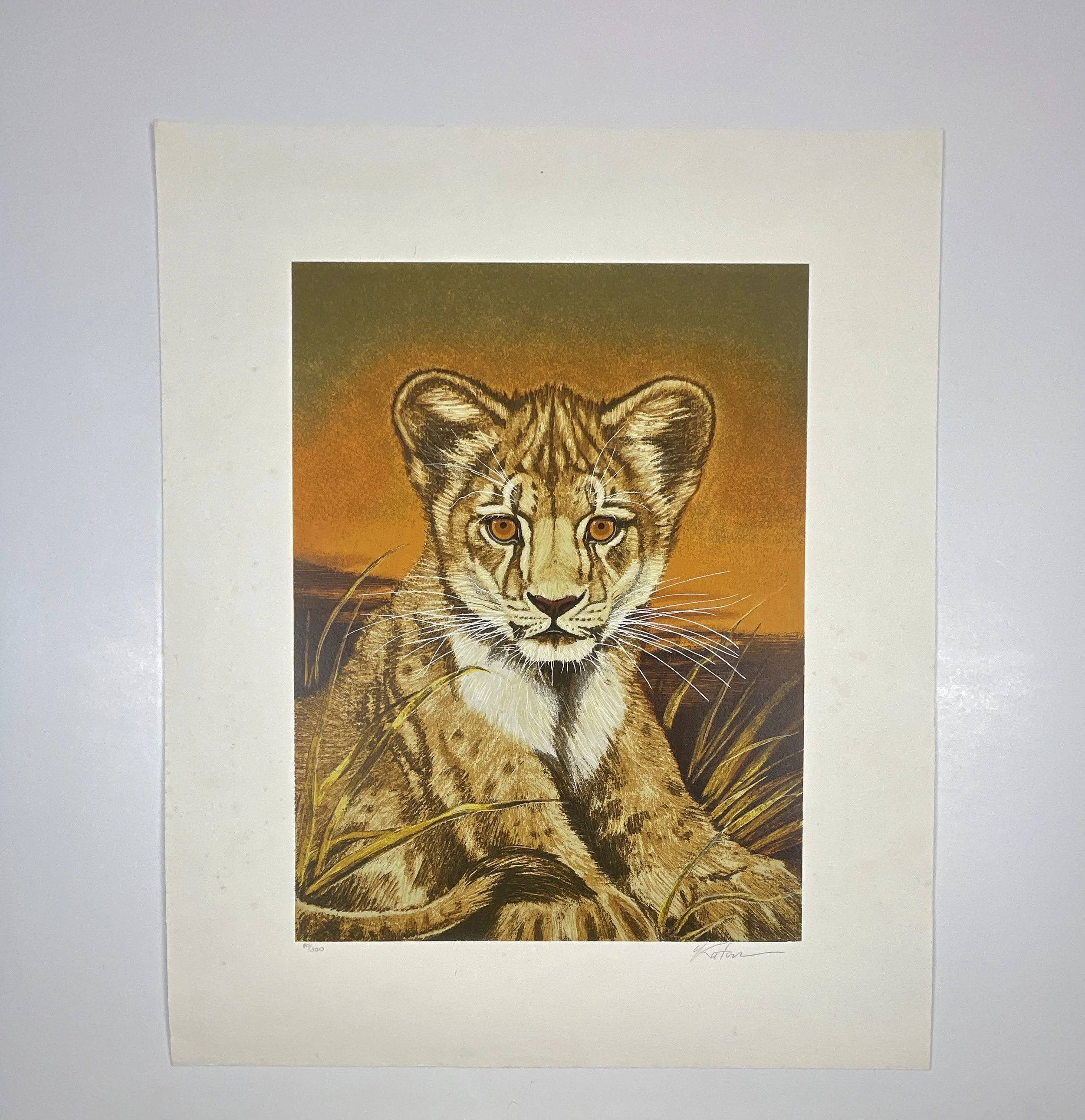 Image 5 of 6
 Image 6 of 6