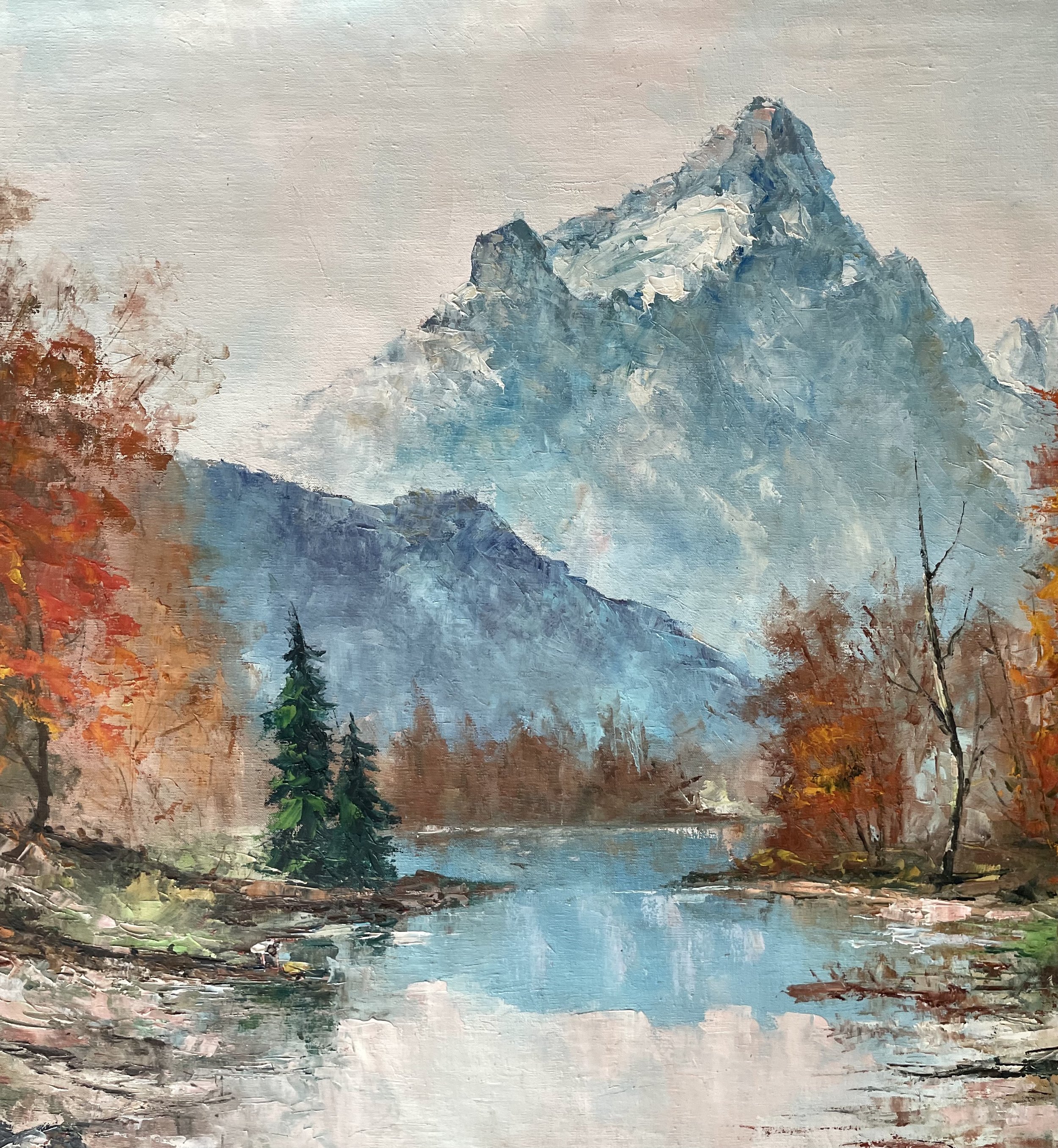
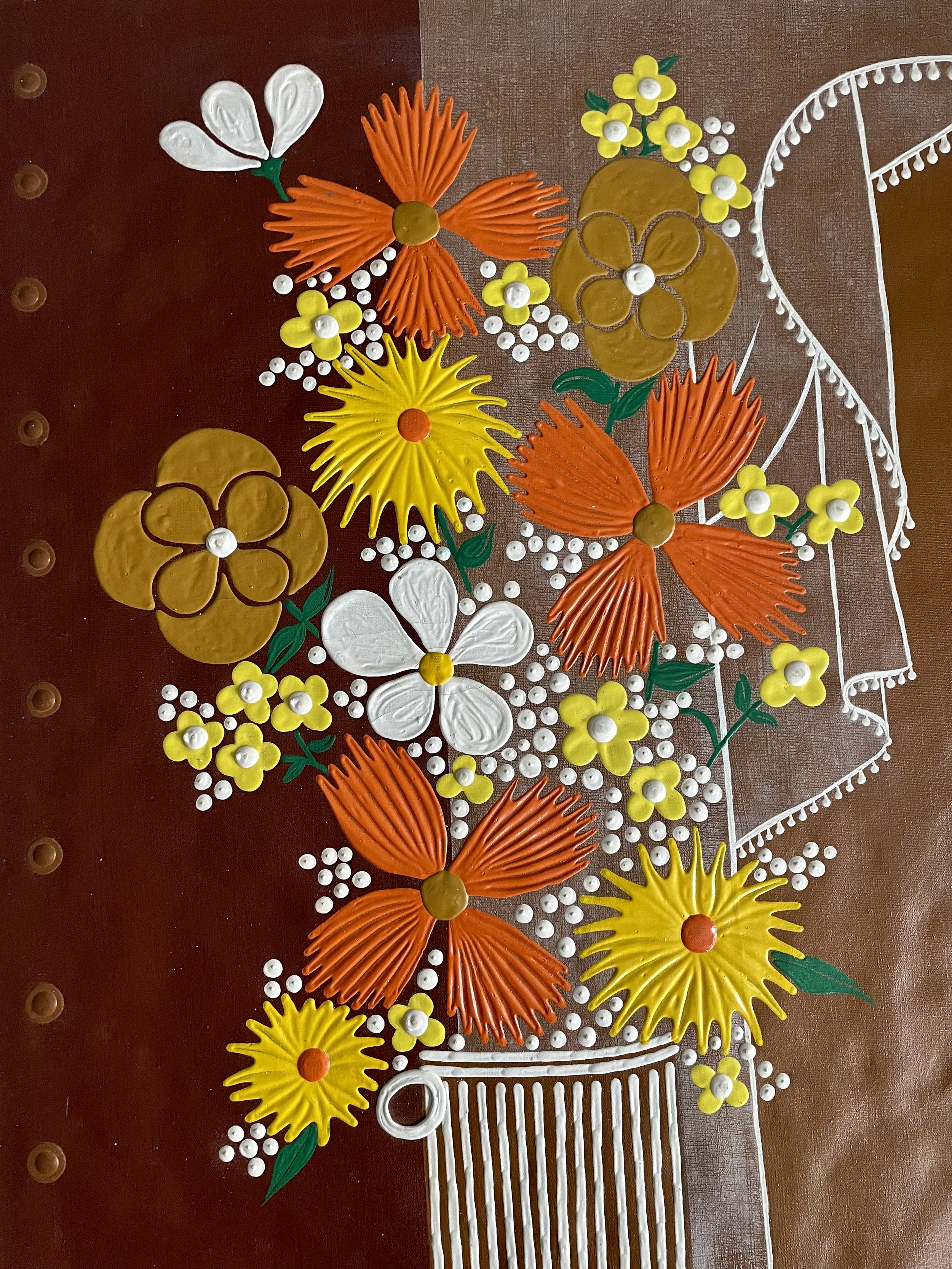
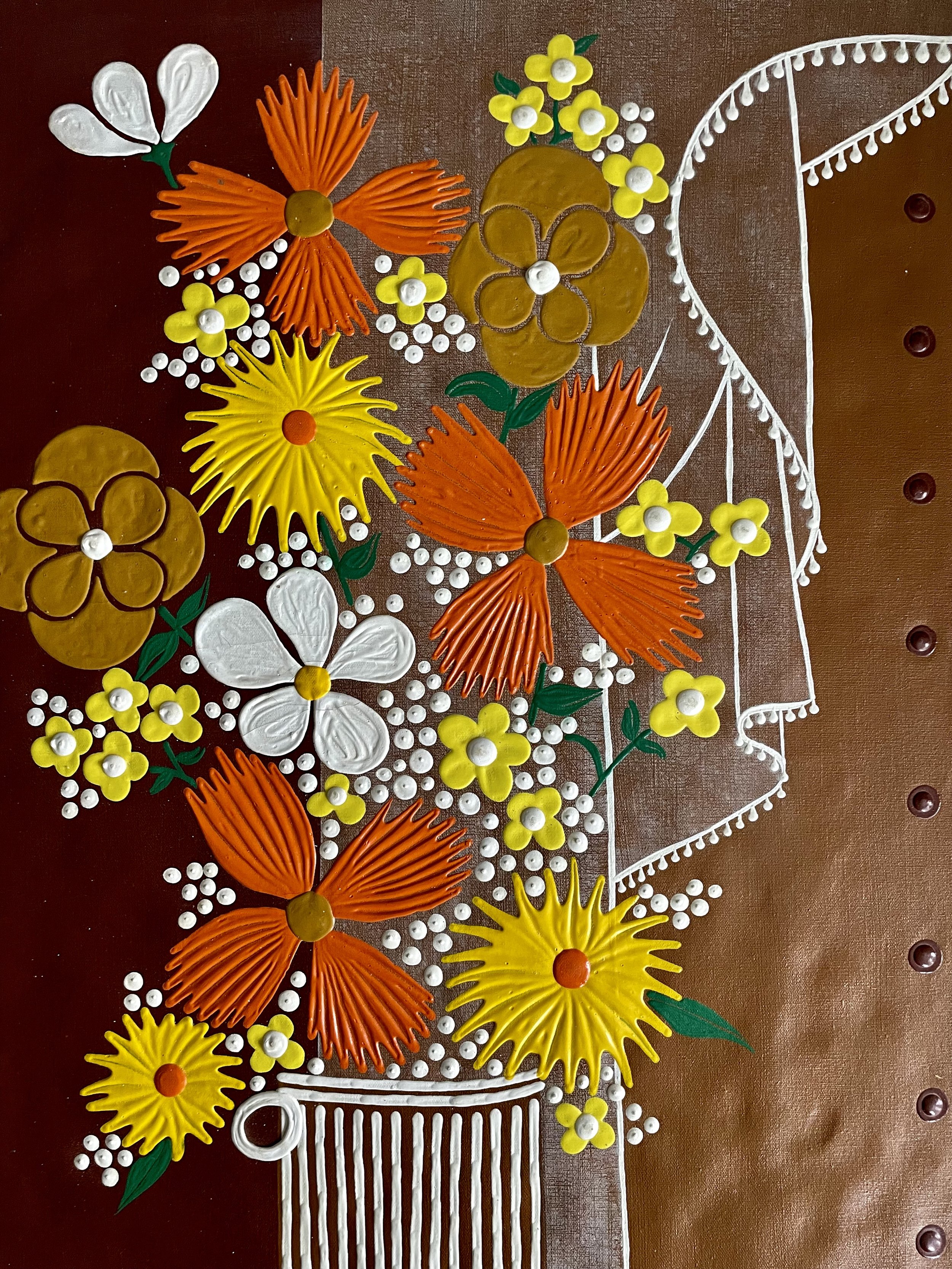
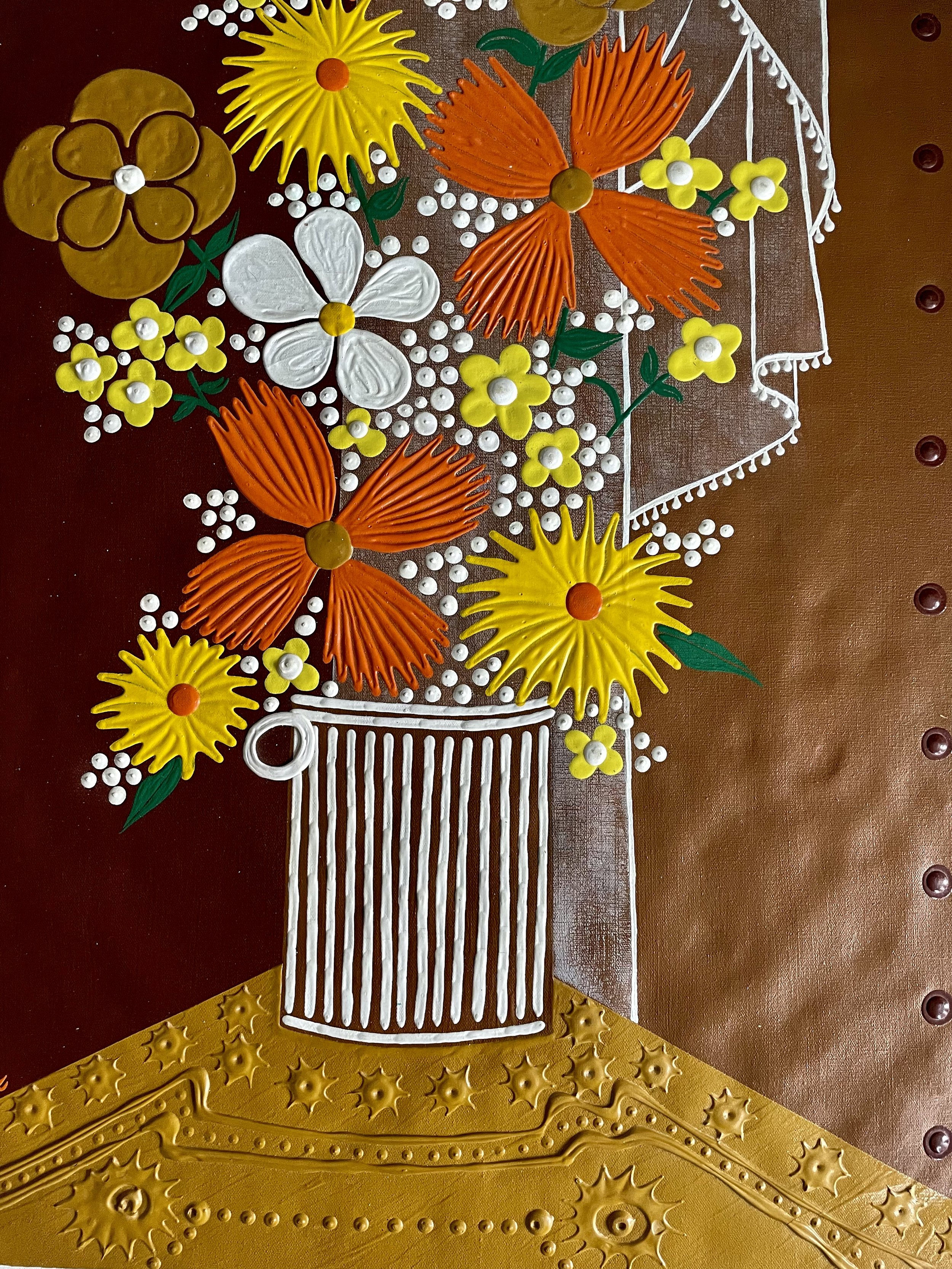
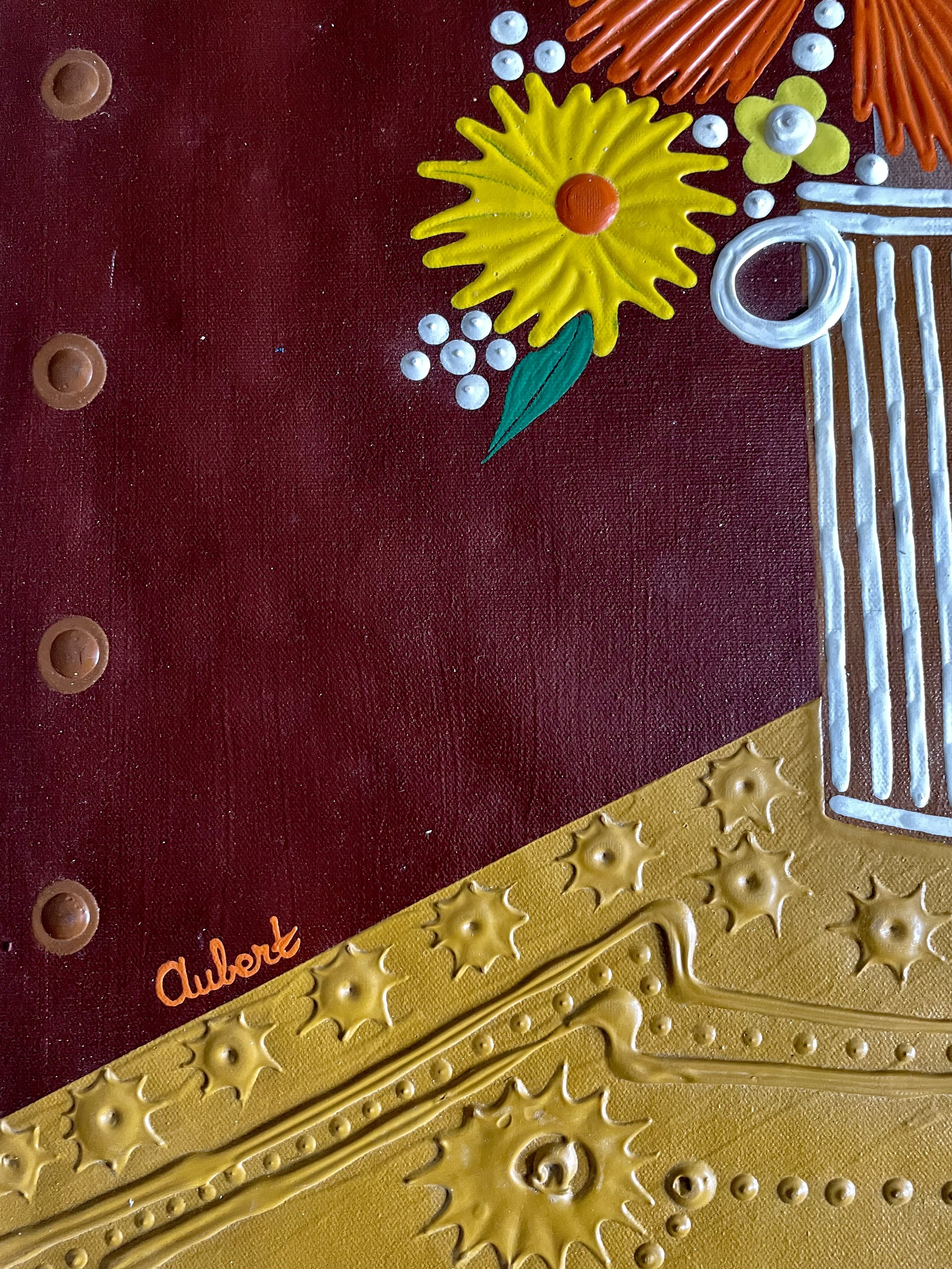
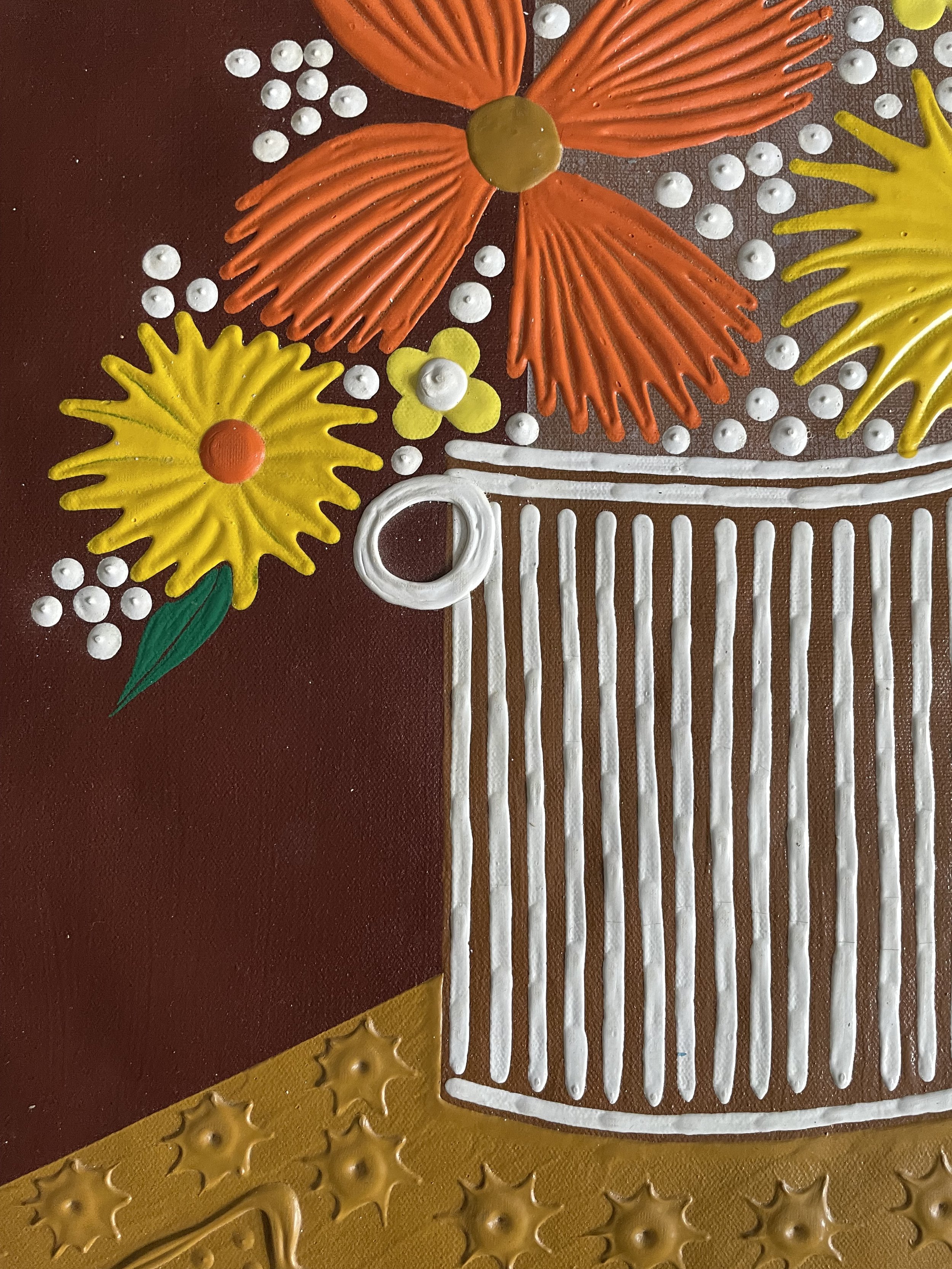
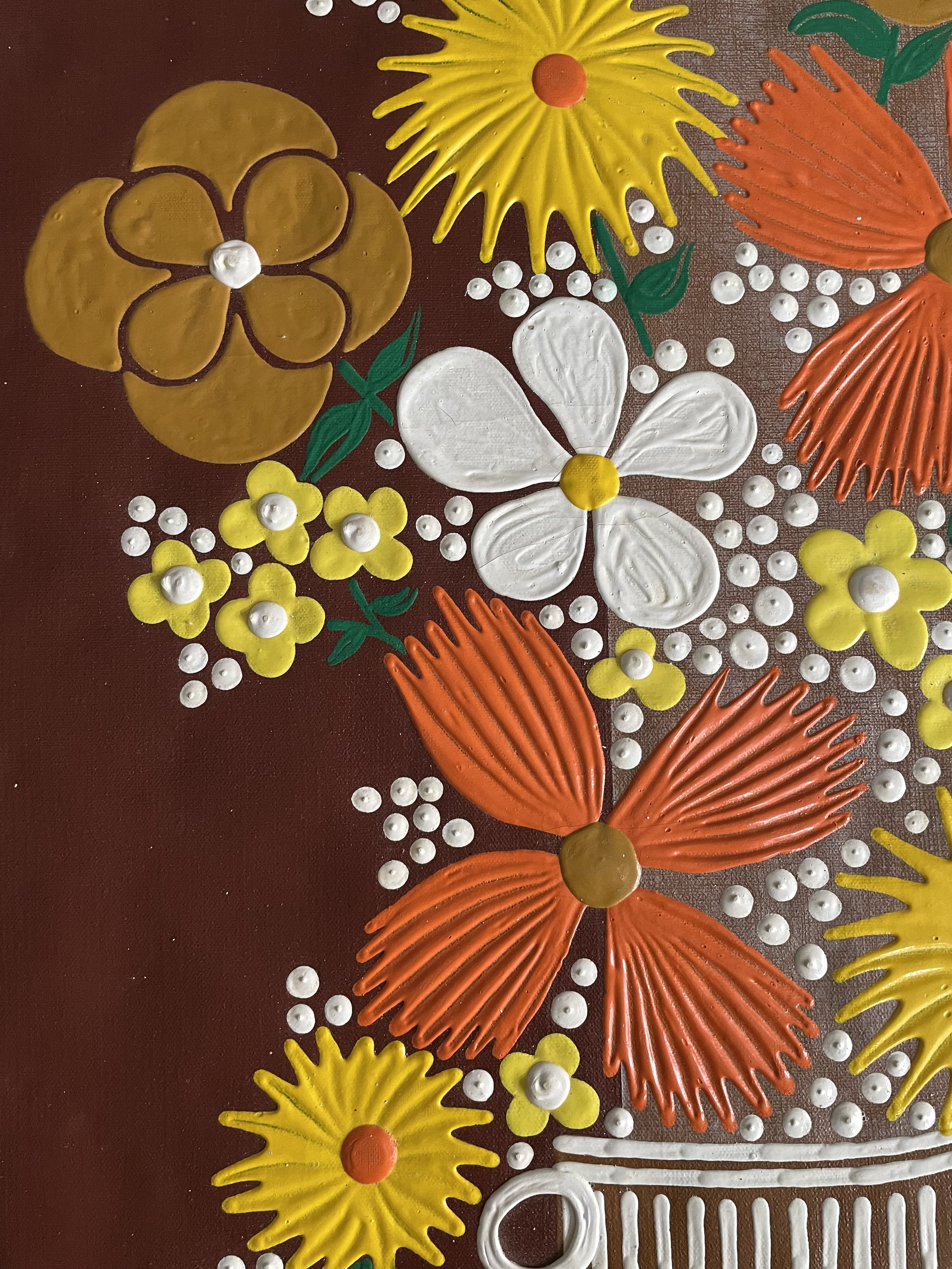
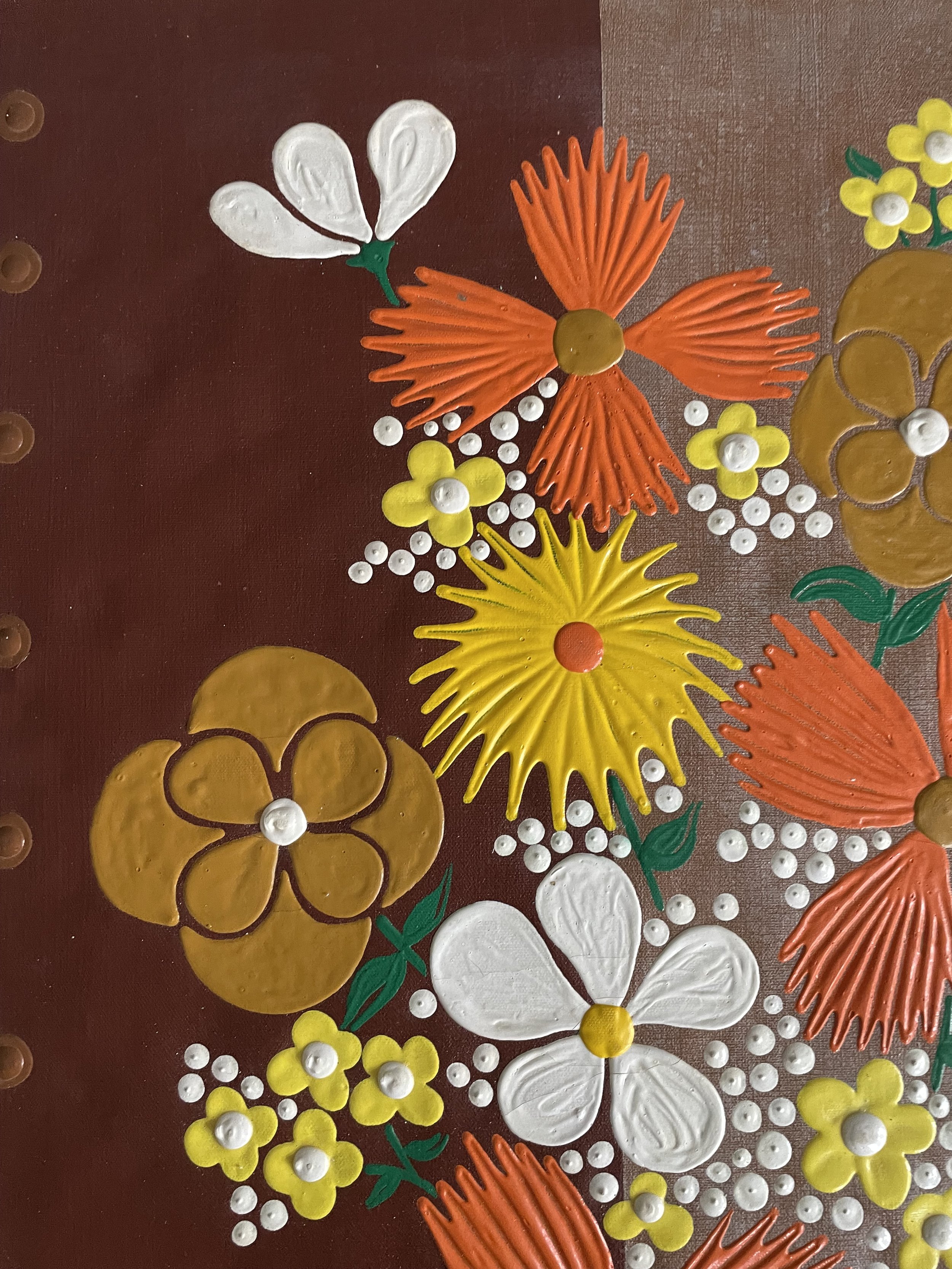
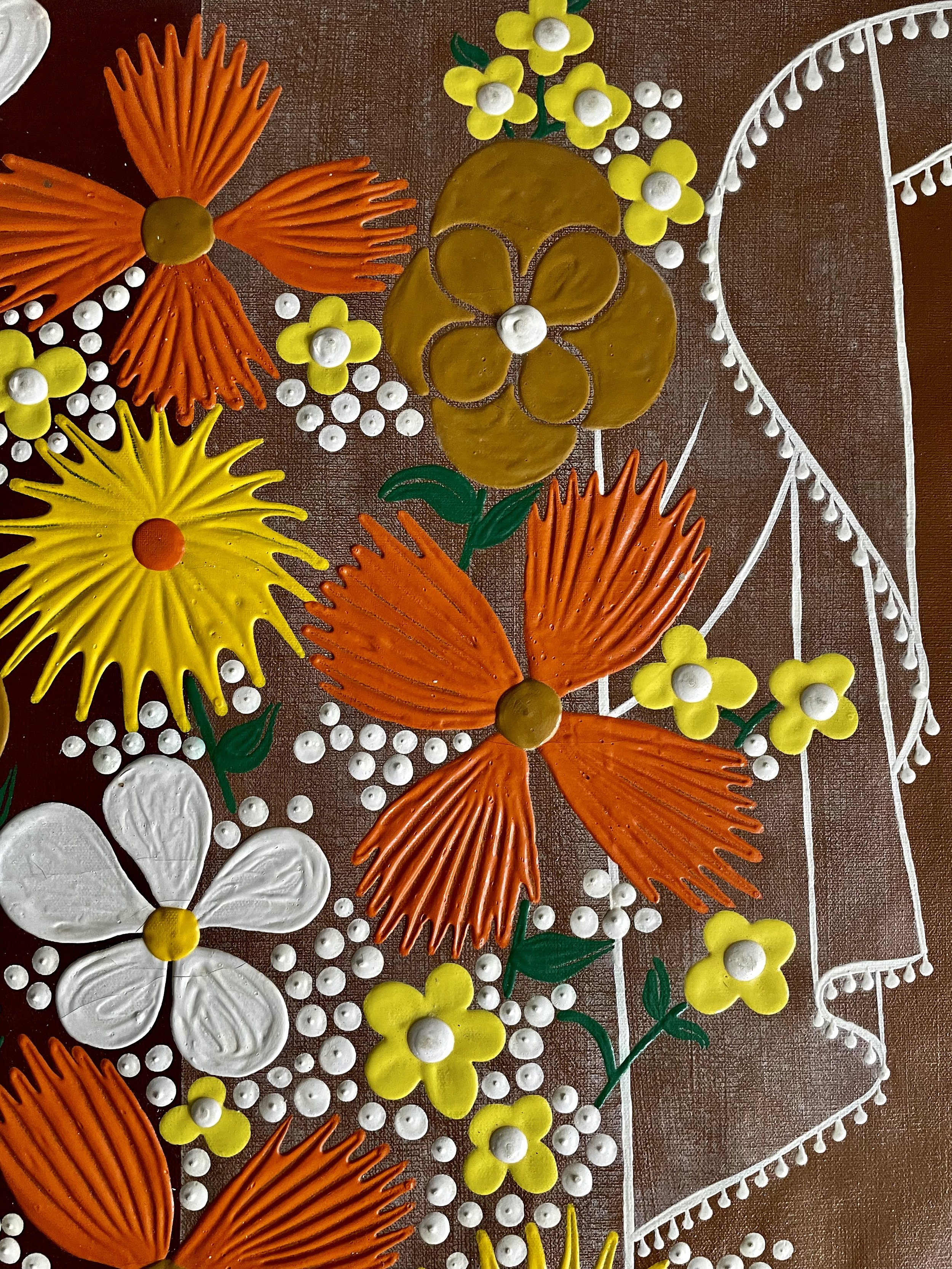
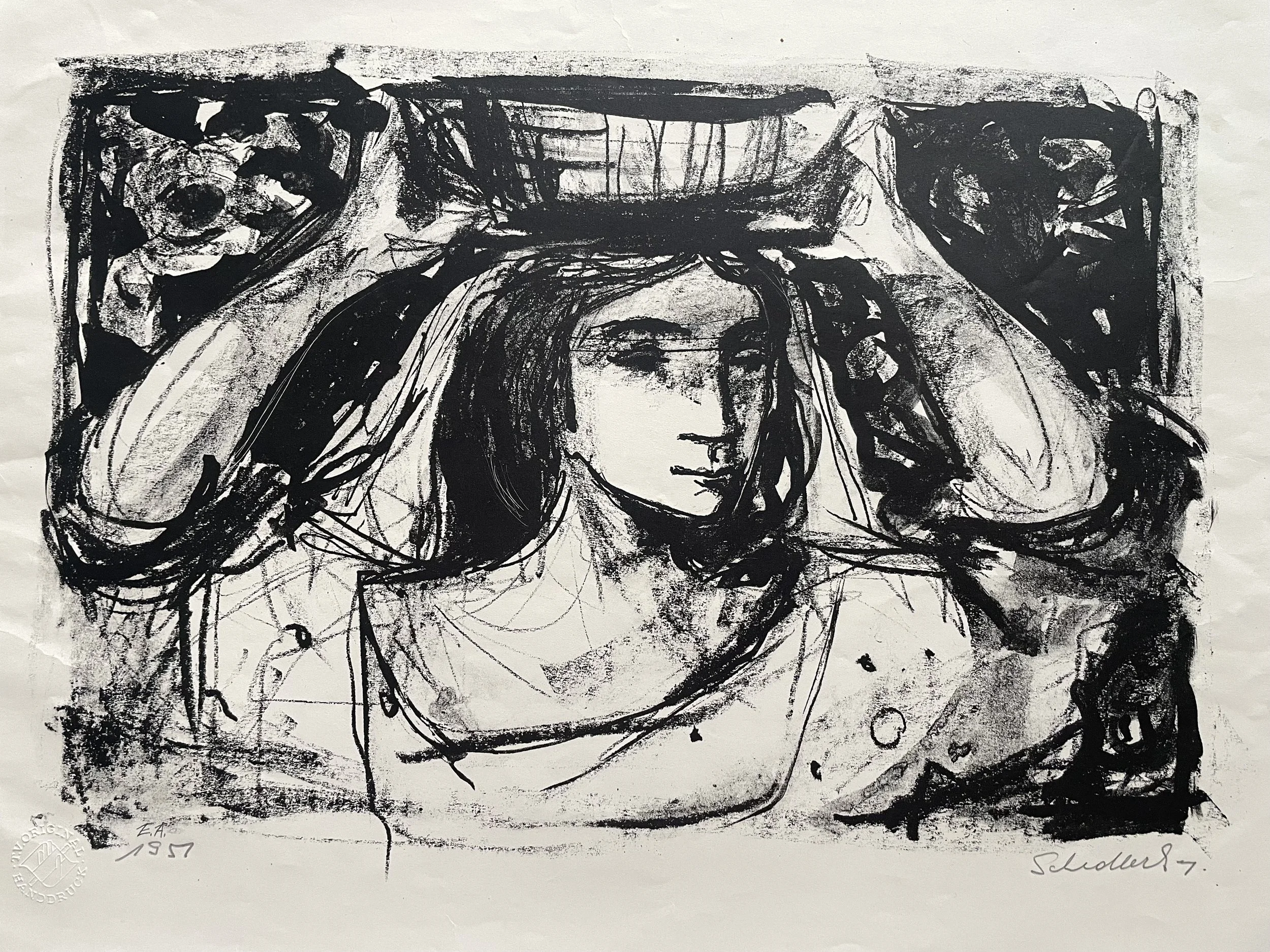
“Mariposa de Villa Serrana,” Rimer Cardillo (Uruguayan, b.1944), c.1978 aquatint etching with embossing on paper, 22×30 in, pencil-signed, ed. 10/50.
“Mariposa de Villa Serrana” is a large, hand-pulled aquatint etching with embossing by Uruguayan master printmaker Rimer Cardillo, an internationally acclaimed artist whose works reside in MoMA, the Art Institute of Chicago, and major museums across the Americas and Europe.
Created in the late 1970s as part of Cardillo’s celebrated nature series, this 22×30 inch sheet features a monumental leaf rendered with exquisite detail, its surface bearing subtle color shifts and two inset butterfly reserves that allude to the rich biodiversity of Villa Serrana in Uruguay. Numbered 10/50 and signed in pencil with the artist’s blind-stamped seal, this original print combines ecological symbolism, archaeological memory, and sophisticated intaglio craft—an ideal centerpiece for collectors of Latin American art, contemporary printmaking, and environmentally engaged work.
Artwork description
This impression of “Mariposa de Villa Serrana” presents a single, oversized leaf floating against a pristine, unprinted field. The leaf nearly fills the vertical composition, its broad, heart-shaped form anchored by a dark stem that descends to the bottom margin. Cardillo has articulated the intricate vein structure with fine etched and aquatint lines, creating a web of branching paths that suggest both botanical anatomy and cartographic mapping.
The surface of the leaf carries a muted, iridescent palette—browns, purples, and olive tones that subtly shift as the paper catches the light, a hallmark of Cardillo’s aquatint technique in this period. Within the leaf are two small, inset areas of pale green, each containing a delicately engraved butterfly wing, directly connecting the imagery to the title “Mariposa” (Spanish for butterfly). These inset “windows” feel almost like specimens pinned within a herbarium sheet, fusing botanical study and entomological collection.
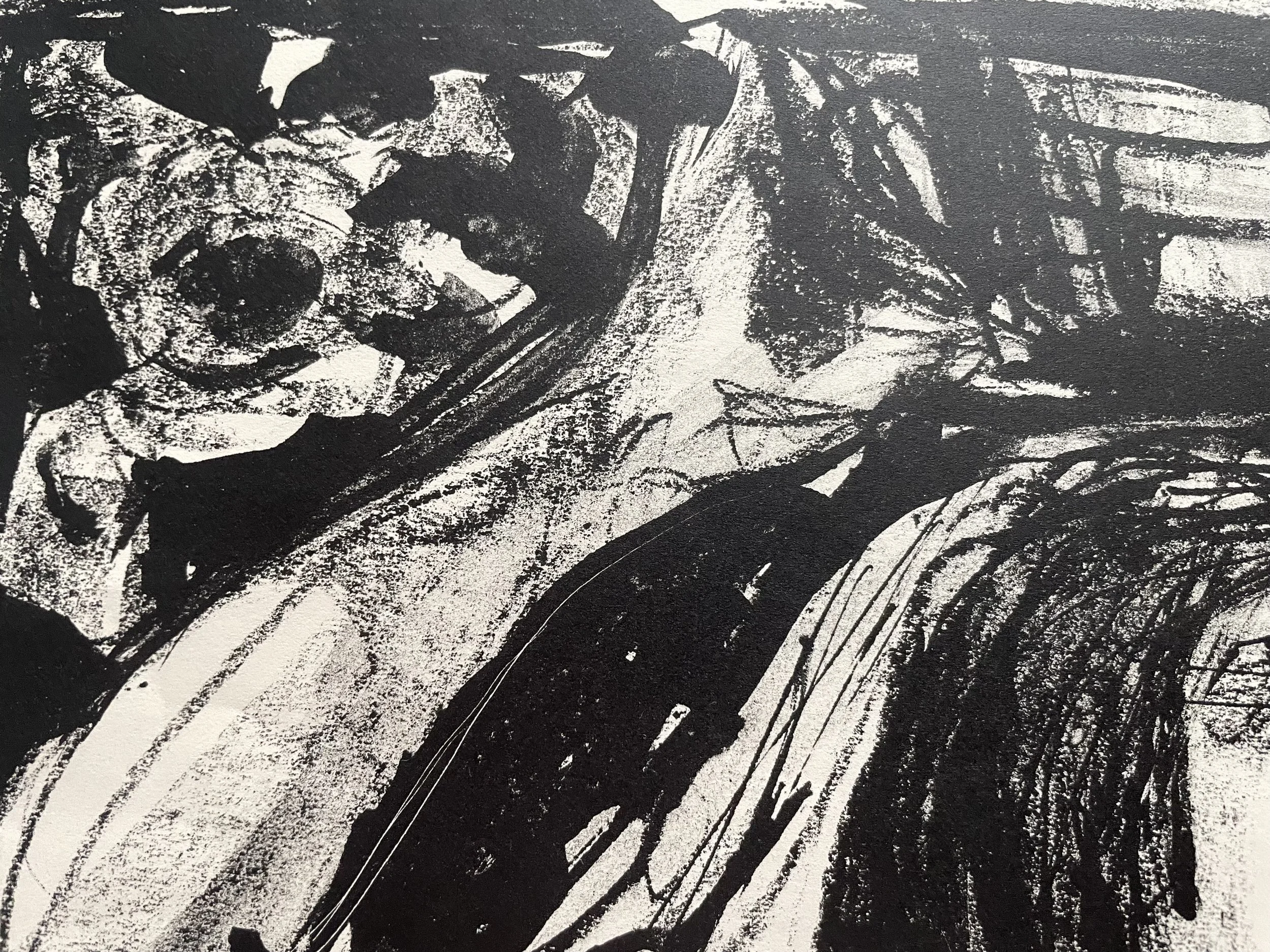
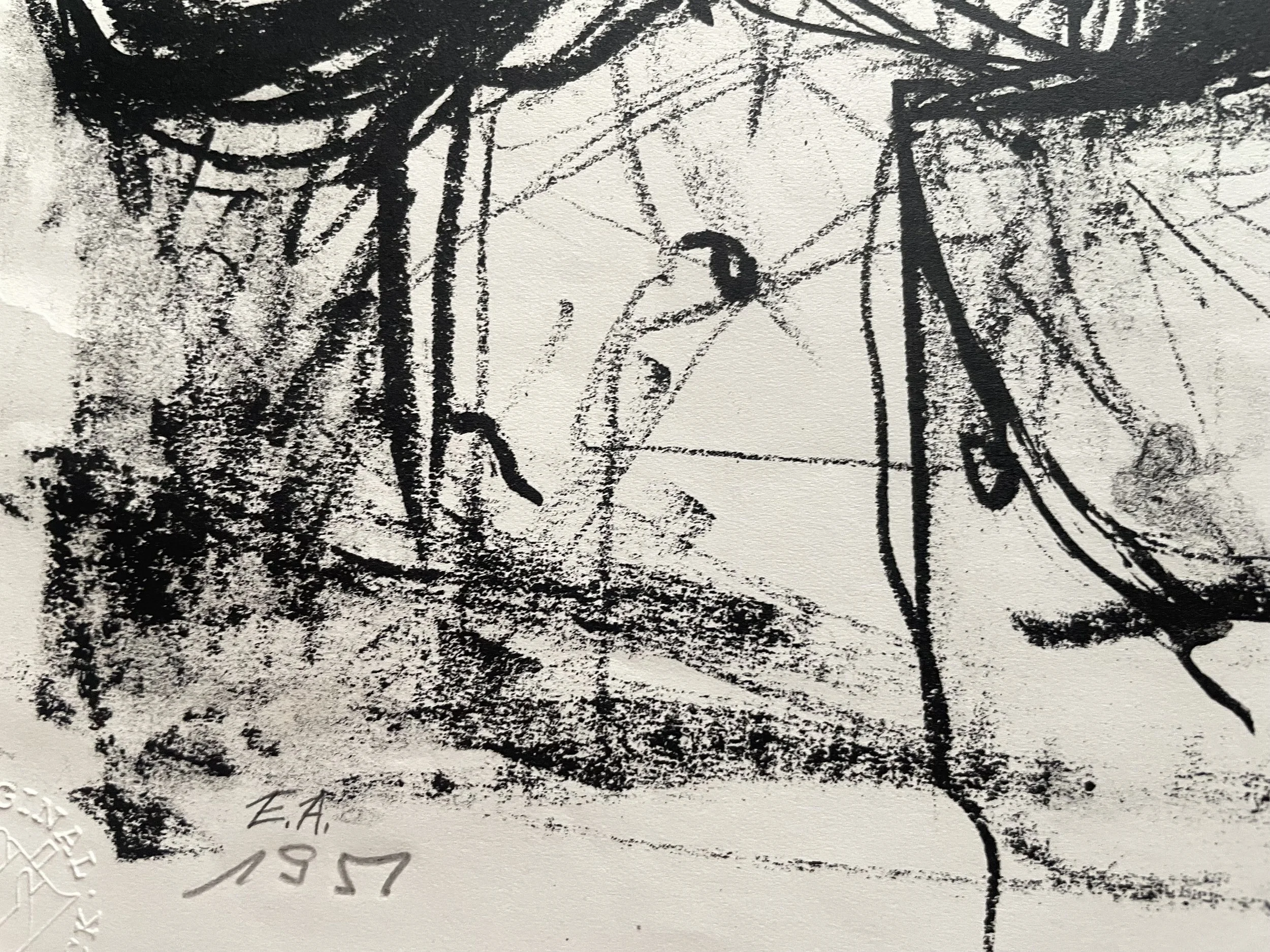
Technically, the print is best described as an aquatint etching with embossing. Cardillo is known for combining engraved zinc or copper plates with cast polyester resin plates to create richly textured, three-dimensional impressions. Here, the leaf form is slightly raised, and the artist’s circular blind stamp—bearing his emblematic insect motif and surrounding text—is deeply embossed in the lower margin. The paper is a heavy, cream, mould-made sheet, typical of the fine print papers he favored in the 1970s.
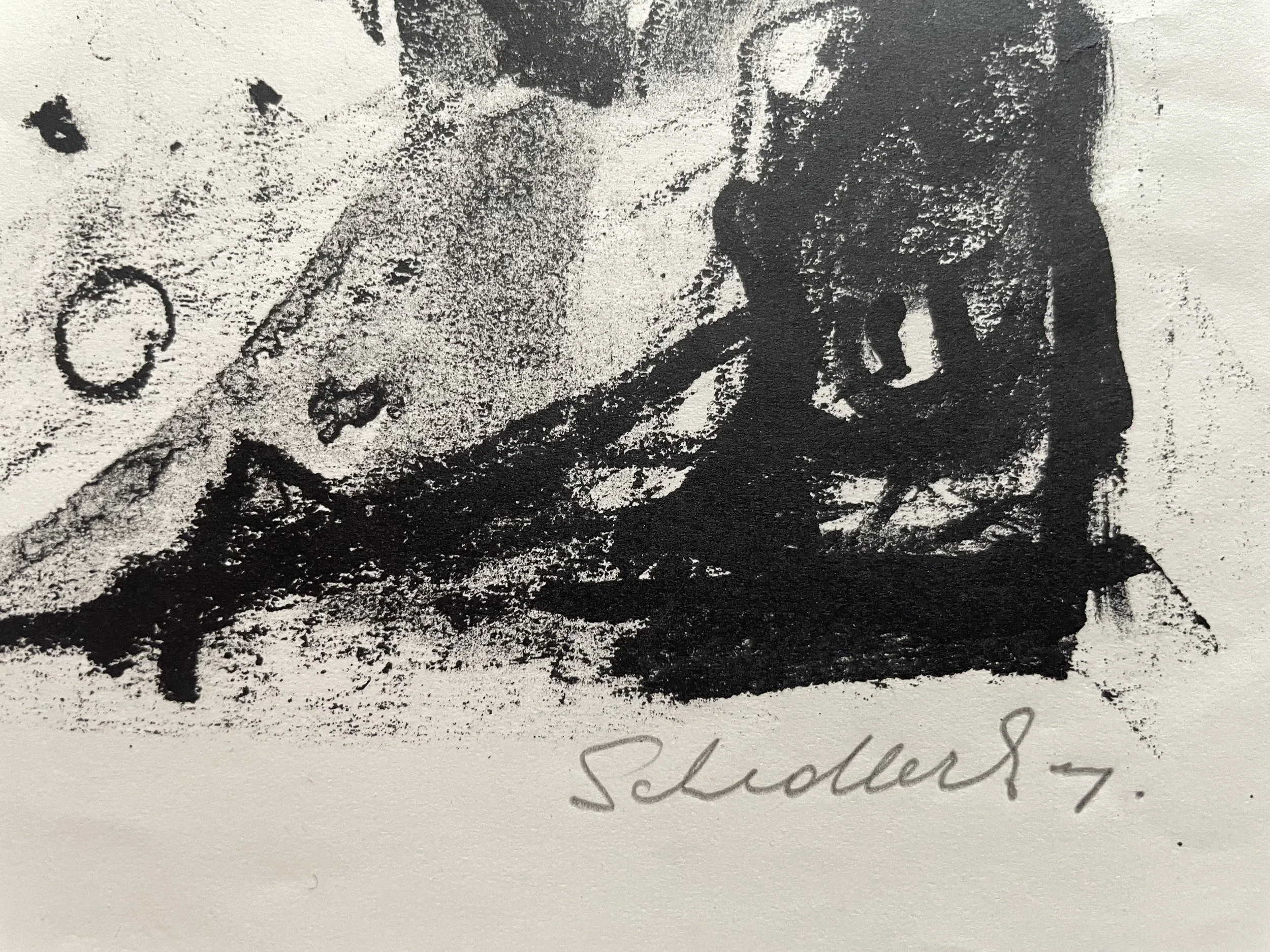
In the lower margin, the work is numbered “10/50” at left, stamped with the circular blind seal near center, titled “Mariposa de Villa Serrana” in graphite, and signed “Cardillo” at right. The sheet measures approximately 22×30 inches, consistent with other leaf and butterfly plates in this series.
Conceptually, Cardillo’s leaf and butterfly works of the late 1970s belong to a broader project in which he investigates nature, memory, and ecological loss. Since early in his career, he has used engravings and embossed prints to evoke natural “fossils”—traces of animals and plants that point to both biological fragility and cultural history. The reference to Villa Serrana, a rural hill town in Uruguay, situates this print in a specific landscape, turning the leaf into a kind of reliquary for a threatened ecosystem. The butterflies embedded within the leaf suggest species at risk, preserved as images even as their habitats are altered or erased.
As with many of Cardillo’s works, “Mariposa de Villa Serrana” balances austerity and richness: a single isolated form, yet dense with etched information and layered meaning. The result is a quietly powerful piece that rewards close viewing and resonates strongly with contemporary concerns about biodiversity and environmental stewardship.
Artist biography – Rimer Cardillo (b. 1944)
Early life and education
Rimer Cardillo was born on 17 August 1944 in Montevideo, Uruguay. He studied at the National School of Fine Arts (Escuela Nacional de Bellas Artes) in Montevideo, receiving his degree in 1968 with a focus on printmaking. Shortly afterward, he undertook postgraduate studies in what was then East Germany, training at the Weißensee School of Art and Architecture in Berlin and the Leipzig School of Graphic Art between 1969 and 1971. This period was crucial for his mastery of intaglio techniques—etching, aquatint, drypoint, and embossing—and exposed him to European experiments in conceptual and ecological art.
Professional development and teaching
Back in Uruguay in the early 1970s, Cardillo became deeply involved with the Montevideo Engraving Club (Club de Grabado de Montevideo), an influential cooperative that democratized access to art through affordable prints. He taught printmaking workshops and mentored a generation of artists, emphasizing technical rigor and a socially engaged understanding of image-making.
In 1979, Cardillo relocated to the United States, eventually settling in the Hudson Valley of New York. He joined the faculty of the State University of New York at New Paltz, where he became professor of printmaking and later Professor Emeritus, directing the university’s graphic arts program and building a renowned print studio.
Artistic themes and style
Across more than five decades, Cardillo has developed a body of work encompassing engravings, aquatint etchings, photo-silkscreens, sculptures, and large-scale installations. A constant thread is his preoccupation with nature, archaeology, and memory. His prints often depict insects, leaves, seeds, and animal forms that appear fossilized or relic-like, reinforcing the idea of nature as an archive of time.
In three-dimensional works, Cardillo constructs earth mounds, boat forms, and reliquary boxes that evoke pre-Hispanic burial sites and indigenous landscapes of the Río de la Plata region. Critics have noted how these sites function as metaphors for collective memory and historical trauma, particularly the impact of Uruguay’s 1970s military dictatorship and broader patterns of cultural erasure in Latin America.
Since the late 1970s, environmental concerns—biodiversity loss, habitat destruction, and what he calls a “deep ecology of sacred nature”—have been central to his practice. Works like the Mariposa series (butterflies associated with specific places) fuse scientific observation with poetic, place-based titles, turning each image into a tribute to threatened ecologies.
Exhibitions, recognition, and collections
Cardillo has exhibited widely in the Americas and Europe. Major milestones include representing Uruguay at the 49th Venice Biennale (2001), and retrospectives at the Samuel Dorsky Museum of Art (SUNY New Paltz, 2004) and the Nassau County Museum of Art in Long Island (2011). The Art Museum of the Americas (OAS) in Washington, D.C., mounted the exhibition A Journey to Ombú Bellaumbra in 2016, emphasizing his ecological and archaeological themes. Recent shows, such as …and the deep ecology of a sacred nature at the Taubman Museum of Art and Deep Ecology: Layered Vestiges at the North Dakota Museum of Art and Plains Art Museum, underline his continuing relevance to contemporary environmental discourse.
Cardillo has received numerous honors, including a John Simon Guggenheim Memorial Foundation Fellowship (1997) and Uruguay’s prestigious Figari Award (2002) for lifetime achievement.
His works are held in many important museum collections, among them the Museum of Modern Art (New York), the Art Institute of Chicago, the Bibliothèque nationale de France, the Art Museum of the Americas (OAS), the Allen Memorial Art Museum at Oberlin College, and the Museo Nacional de Artes Visuales in Montevideo.
Connection to this artwork
“Mariposa de Villa Serrana” belongs to a group of leaf-and-insect works that Cardillo developed in the late 1970s, often listing specific locales—Makanda, Espinillo, San Francisco, Matogrosso, Villa Serrana—in their titles. These prints and reliefs encapsulate his belief that each plant or insect carries a geographic and cultural story, turning the humble leaf into a map of memory and ecological concern.
Rimer Cardillo (Uruguayan, b.1944)
Mariposa de Villa Serrana, c.1978
Aquatint etching with embossing on paper
Sheet: 22 × 30 in (55.9 × 76.2 cm)
Edition: 10/50, pencil-numbered lower left
Embossed artist’s seal, titled and signed “Cardillo” in pencil lower margin
Unframed; very good original condition.
Provenance:
The artist;
Mitch Morse Gallery, New York, NY;
Artfind Gallery, Washington, DC.
Certificate of Value & Authentication
Artist: Rimer Cardillo (Uruguayan, b.1944)
Title:Mariposa de Villa Serrana
Date: c.1978–79 (leaf and butterfly series)
Medium: Original aquatint etching with embossing on paper
Dimensions: Sheet approx. 22 × 30 in
Edition: 10/50 (pencil-inscribed)
Signatures & Marks:
Numbered “10/50” in graphite, lower left
Embossed circular artist’s seal in lower margin
Titled “Mariposa de Villa Serrana” in graphite
Signed “Cardillo” in graphite, lower right
Technique & paper:
Hand-pulled intaglio print employing aquatint, engraving, and embossing, consistent with Cardillo’s documented methods in his butterfly and leaf series of the late 1970s.
Provenance (documented by gallery):
Rimer Cardillo, Montevideo / New York (artist)
Mitch Morse Gallery, New York, NY, USA – acquired directly from the artist as part of his nature-series editions
Artfind Gallery, Washington, DC, USA – acquired from the retired inventory of Mitch Morse Gallery; current owner
Assessment of authenticity:
Signature, handwriting, blind stamp, and edition format match authenticated examples of Cardillo’s aquatint etchings and engraved leaf works from the 1970s.
The title Mariposa de Villa Serrana corresponds to recorded auction lots of the same work (engraving, 75 × 55 cm, signed A/P) at Subastas Castells and other venues, confirming the existence of this plate and series.
Provenance chain formatted for collectors
Rimer Cardillo (Montevideo, Uruguay, b.1944) – artist and printer of the edition, c.1978–79
Mitch Morse Gallery, New York, NY, USA – acquired directly from the artist as part of his nature-series etchings (1970s–1980s)
Artfind Gallery, Washington, DC, USA – acquired from the retired Mitch Morse Gallery inventory; current owner
“Mariposa de Villa Serrana,” Rimer Cardillo (Uruguayan, b.1944), c.1978 aquatint etching with embossing on paper, 22×30 in, pencil-signed, ed. 10/50.
“Mariposa de Villa Serrana” is a large, hand-pulled aquatint etching with embossing by Uruguayan master printmaker Rimer Cardillo, an internationally acclaimed artist whose works reside in MoMA, the Art Institute of Chicago, and major museums across the Americas and Europe.
Created in the late 1970s as part of Cardillo’s celebrated nature series, this 22×30 inch sheet features a monumental leaf rendered with exquisite detail, its surface bearing subtle color shifts and two inset butterfly reserves that allude to the rich biodiversity of Villa Serrana in Uruguay. Numbered 10/50 and signed in pencil with the artist’s blind-stamped seal, this original print combines ecological symbolism, archaeological memory, and sophisticated intaglio craft—an ideal centerpiece for collectors of Latin American art, contemporary printmaking, and environmentally engaged work.
Artwork description
This impression of “Mariposa de Villa Serrana” presents a single, oversized leaf floating against a pristine, unprinted field. The leaf nearly fills the vertical composition, its broad, heart-shaped form anchored by a dark stem that descends to the bottom margin. Cardillo has articulated the intricate vein structure with fine etched and aquatint lines, creating a web of branching paths that suggest both botanical anatomy and cartographic mapping.
The surface of the leaf carries a muted, iridescent palette—browns, purples, and olive tones that subtly shift as the paper catches the light, a hallmark of Cardillo’s aquatint technique in this period. Within the leaf are two small, inset areas of pale green, each containing a delicately engraved butterfly wing, directly connecting the imagery to the title “Mariposa” (Spanish for butterfly). These inset “windows” feel almost like specimens pinned within a herbarium sheet, fusing botanical study and entomological collection.
Technically, the print is best described as an aquatint etching with embossing. Cardillo is known for combining engraved zinc or copper plates with cast polyester resin plates to create richly textured, three-dimensional impressions. Here, the leaf form is slightly raised, and the artist’s circular blind stamp—bearing his emblematic insect motif and surrounding text—is deeply embossed in the lower margin. The paper is a heavy, cream, mould-made sheet, typical of the fine print papers he favored in the 1970s.
In the lower margin, the work is numbered “10/50” at left, stamped with the circular blind seal near center, titled “Mariposa de Villa Serrana” in graphite, and signed “Cardillo” at right. The sheet measures approximately 22×30 inches, consistent with other leaf and butterfly plates in this series.
Conceptually, Cardillo’s leaf and butterfly works of the late 1970s belong to a broader project in which he investigates nature, memory, and ecological loss. Since early in his career, he has used engravings and embossed prints to evoke natural “fossils”—traces of animals and plants that point to both biological fragility and cultural history. The reference to Villa Serrana, a rural hill town in Uruguay, situates this print in a specific landscape, turning the leaf into a kind of reliquary for a threatened ecosystem. The butterflies embedded within the leaf suggest species at risk, preserved as images even as their habitats are altered or erased.
As with many of Cardillo’s works, “Mariposa de Villa Serrana” balances austerity and richness: a single isolated form, yet dense with etched information and layered meaning. The result is a quietly powerful piece that rewards close viewing and resonates strongly with contemporary concerns about biodiversity and environmental stewardship.
Artist biography – Rimer Cardillo (b. 1944)
Early life and education
Rimer Cardillo was born on 17 August 1944 in Montevideo, Uruguay. He studied at the National School of Fine Arts (Escuela Nacional de Bellas Artes) in Montevideo, receiving his degree in 1968 with a focus on printmaking. Shortly afterward, he undertook postgraduate studies in what was then East Germany, training at the Weißensee School of Art and Architecture in Berlin and the Leipzig School of Graphic Art between 1969 and 1971. This period was crucial for his mastery of intaglio techniques—etching, aquatint, drypoint, and embossing—and exposed him to European experiments in conceptual and ecological art.
Professional development and teaching
Back in Uruguay in the early 1970s, Cardillo became deeply involved with the Montevideo Engraving Club (Club de Grabado de Montevideo), an influential cooperative that democratized access to art through affordable prints. He taught printmaking workshops and mentored a generation of artists, emphasizing technical rigor and a socially engaged understanding of image-making.
In 1979, Cardillo relocated to the United States, eventually settling in the Hudson Valley of New York. He joined the faculty of the State University of New York at New Paltz, where he became professor of printmaking and later Professor Emeritus, directing the university’s graphic arts program and building a renowned print studio.
Artistic themes and style
Across more than five decades, Cardillo has developed a body of work encompassing engravings, aquatint etchings, photo-silkscreens, sculptures, and large-scale installations. A constant thread is his preoccupation with nature, archaeology, and memory. His prints often depict insects, leaves, seeds, and animal forms that appear fossilized or relic-like, reinforcing the idea of nature as an archive of time.
In three-dimensional works, Cardillo constructs earth mounds, boat forms, and reliquary boxes that evoke pre-Hispanic burial sites and indigenous landscapes of the Río de la Plata region. Critics have noted how these sites function as metaphors for collective memory and historical trauma, particularly the impact of Uruguay’s 1970s military dictatorship and broader patterns of cultural erasure in Latin America.
Since the late 1970s, environmental concerns—biodiversity loss, habitat destruction, and what he calls a “deep ecology of sacred nature”—have been central to his practice. Works like the Mariposa series (butterflies associated with specific places) fuse scientific observation with poetic, place-based titles, turning each image into a tribute to threatened ecologies.
Exhibitions, recognition, and collections
Cardillo has exhibited widely in the Americas and Europe. Major milestones include representing Uruguay at the 49th Venice Biennale (2001), and retrospectives at the Samuel Dorsky Museum of Art (SUNY New Paltz, 2004) and the Nassau County Museum of Art in Long Island (2011). The Art Museum of the Americas (OAS) in Washington, D.C., mounted the exhibition A Journey to Ombú Bellaumbra in 2016, emphasizing his ecological and archaeological themes. Recent shows, such as …and the deep ecology of a sacred nature at the Taubman Museum of Art and Deep Ecology: Layered Vestiges at the North Dakota Museum of Art and Plains Art Museum, underline his continuing relevance to contemporary environmental discourse.
Cardillo has received numerous honors, including a John Simon Guggenheim Memorial Foundation Fellowship (1997) and Uruguay’s prestigious Figari Award (2002) for lifetime achievement.
His works are held in many important museum collections, among them the Museum of Modern Art (New York), the Art Institute of Chicago, the Bibliothèque nationale de France, the Art Museum of the Americas (OAS), the Allen Memorial Art Museum at Oberlin College, and the Museo Nacional de Artes Visuales in Montevideo.
Connection to this artwork
“Mariposa de Villa Serrana” belongs to a group of leaf-and-insect works that Cardillo developed in the late 1970s, often listing specific locales—Makanda, Espinillo, San Francisco, Matogrosso, Villa Serrana—in their titles. These prints and reliefs encapsulate his belief that each plant or insect carries a geographic and cultural story, turning the humble leaf into a map of memory and ecological concern.
Rimer Cardillo (Uruguayan, b.1944)
Mariposa de Villa Serrana, c.1978
Aquatint etching with embossing on paper
Sheet: 22 × 30 in (55.9 × 76.2 cm)
Edition: 10/50, pencil-numbered lower left
Embossed artist’s seal, titled and signed “Cardillo” in pencil lower margin
Unframed; very good original condition.
Provenance:
The artist;
Mitch Morse Gallery, New York, NY;
Artfind Gallery, Washington, DC.
Certificate of Value & Authentication
Artist: Rimer Cardillo (Uruguayan, b.1944)
Title:Mariposa de Villa Serrana
Date: c.1978–79 (leaf and butterfly series)
Medium: Original aquatint etching with embossing on paper
Dimensions: Sheet approx. 22 × 30 in
Edition: 10/50 (pencil-inscribed)
Signatures & Marks:
Numbered “10/50” in graphite, lower left
Embossed circular artist’s seal in lower margin
Titled “Mariposa de Villa Serrana” in graphite
Signed “Cardillo” in graphite, lower right
Technique & paper:
Hand-pulled intaglio print employing aquatint, engraving, and embossing, consistent with Cardillo’s documented methods in his butterfly and leaf series of the late 1970s.
Provenance (documented by gallery):
Rimer Cardillo, Montevideo / New York (artist)
Mitch Morse Gallery, New York, NY, USA – acquired directly from the artist as part of his nature-series editions
Artfind Gallery, Washington, DC, USA – acquired from the retired inventory of Mitch Morse Gallery; current owner
Assessment of authenticity:
Signature, handwriting, blind stamp, and edition format match authenticated examples of Cardillo’s aquatint etchings and engraved leaf works from the 1970s.
The title Mariposa de Villa Serrana corresponds to recorded auction lots of the same work (engraving, 75 × 55 cm, signed A/P) at Subastas Castells and other venues, confirming the existence of this plate and series.
Provenance chain formatted for collectors
Rimer Cardillo (Montevideo, Uruguay, b.1944) – artist and printer of the edition, c.1978–79
Mitch Morse Gallery, New York, NY, USA – acquired directly from the artist as part of his nature-series etchings (1970s–1980s)
Artfind Gallery, Washington, DC, USA – acquired from the retired Mitch Morse Gallery inventory; current owner
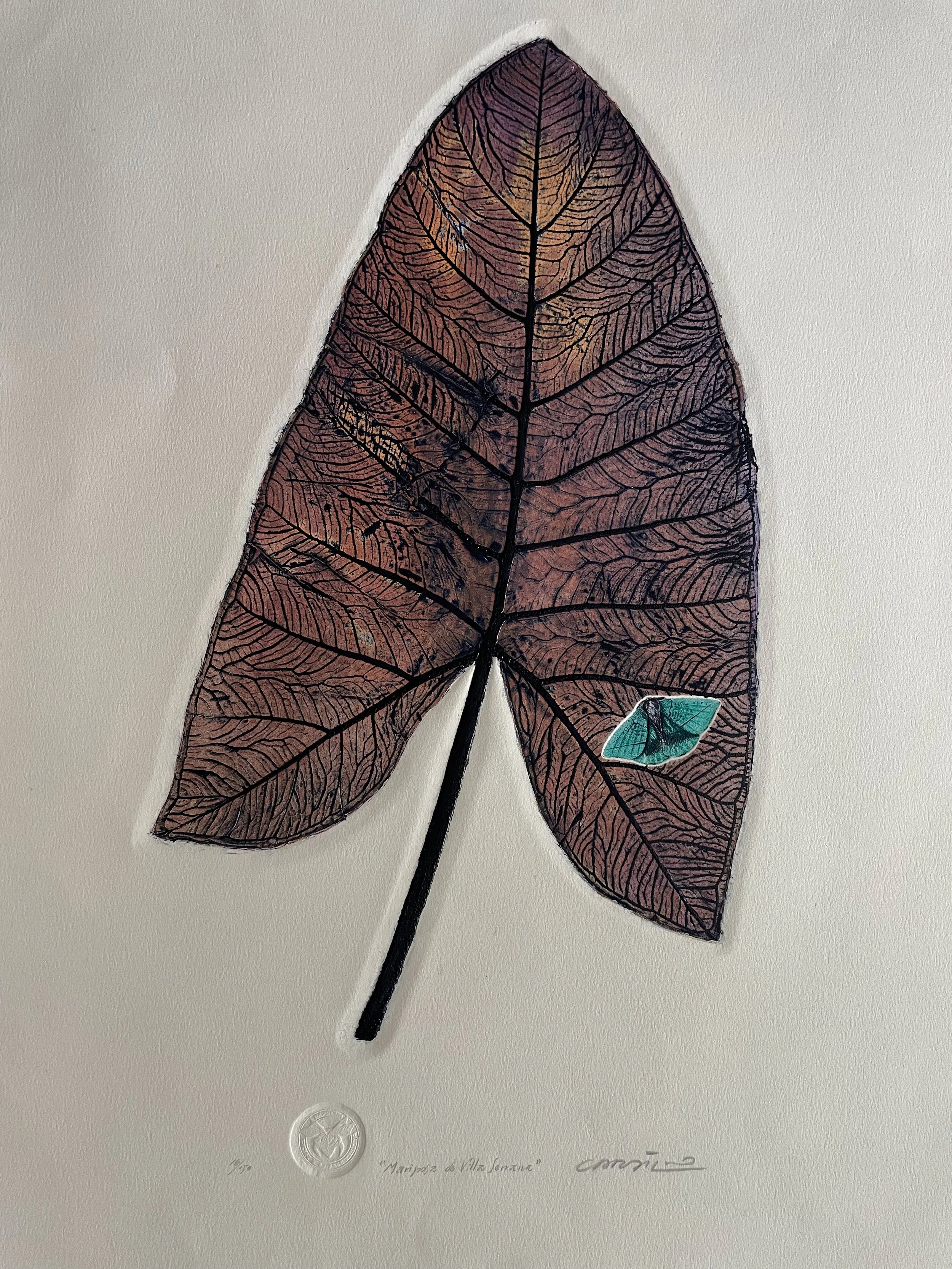 Image 1 of 7
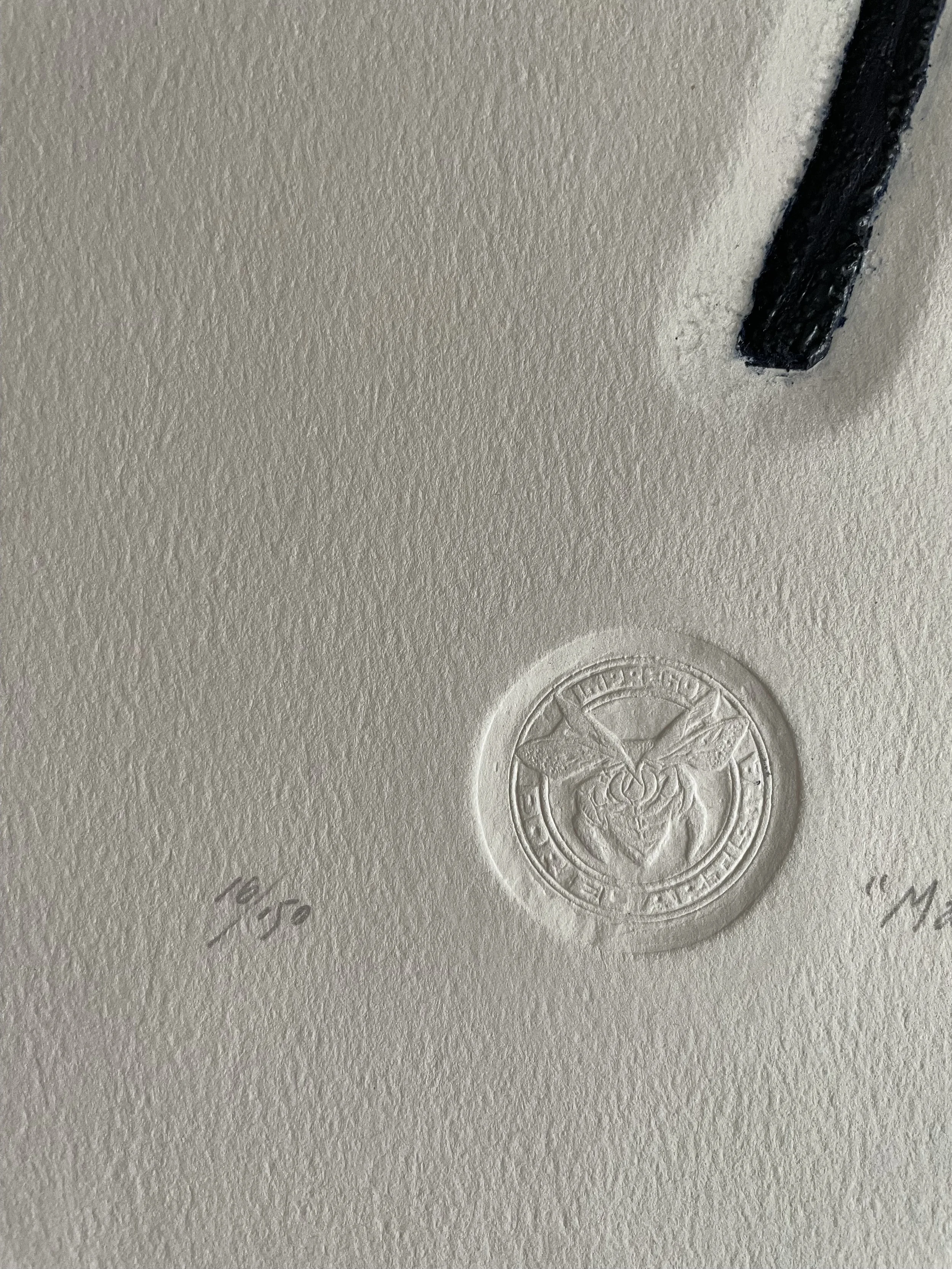 Image 2 of 7
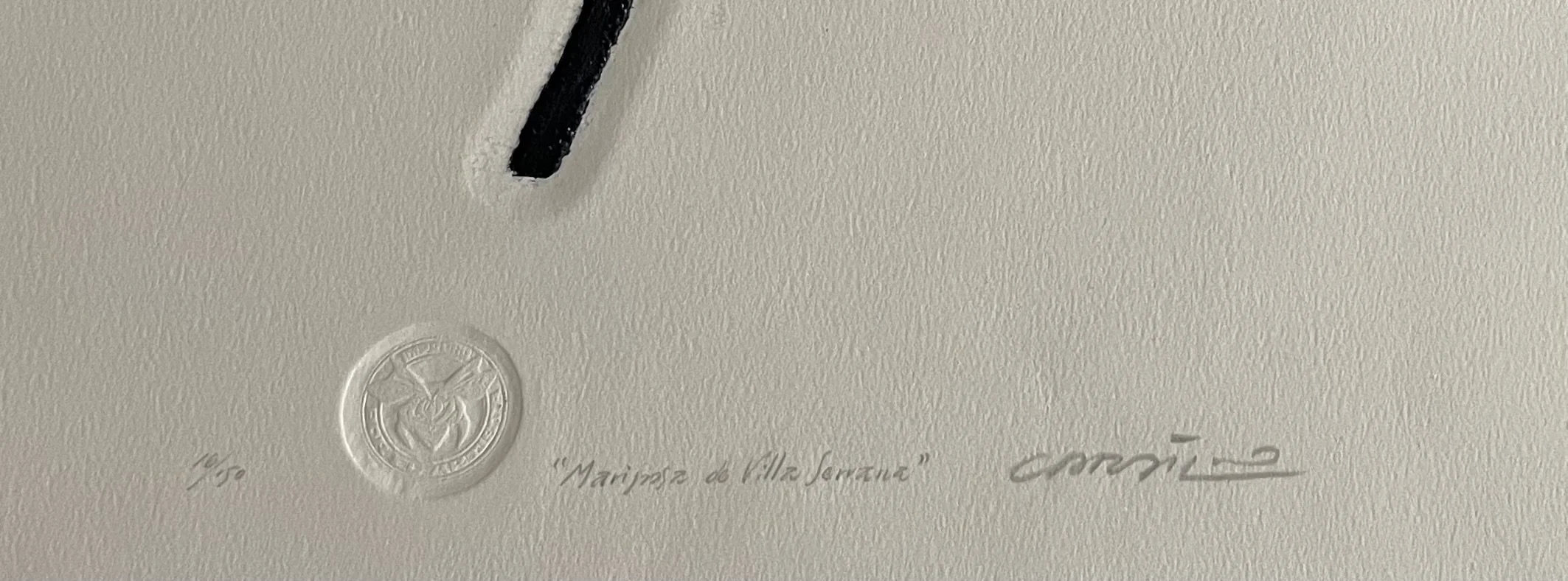 Image 3 of 7
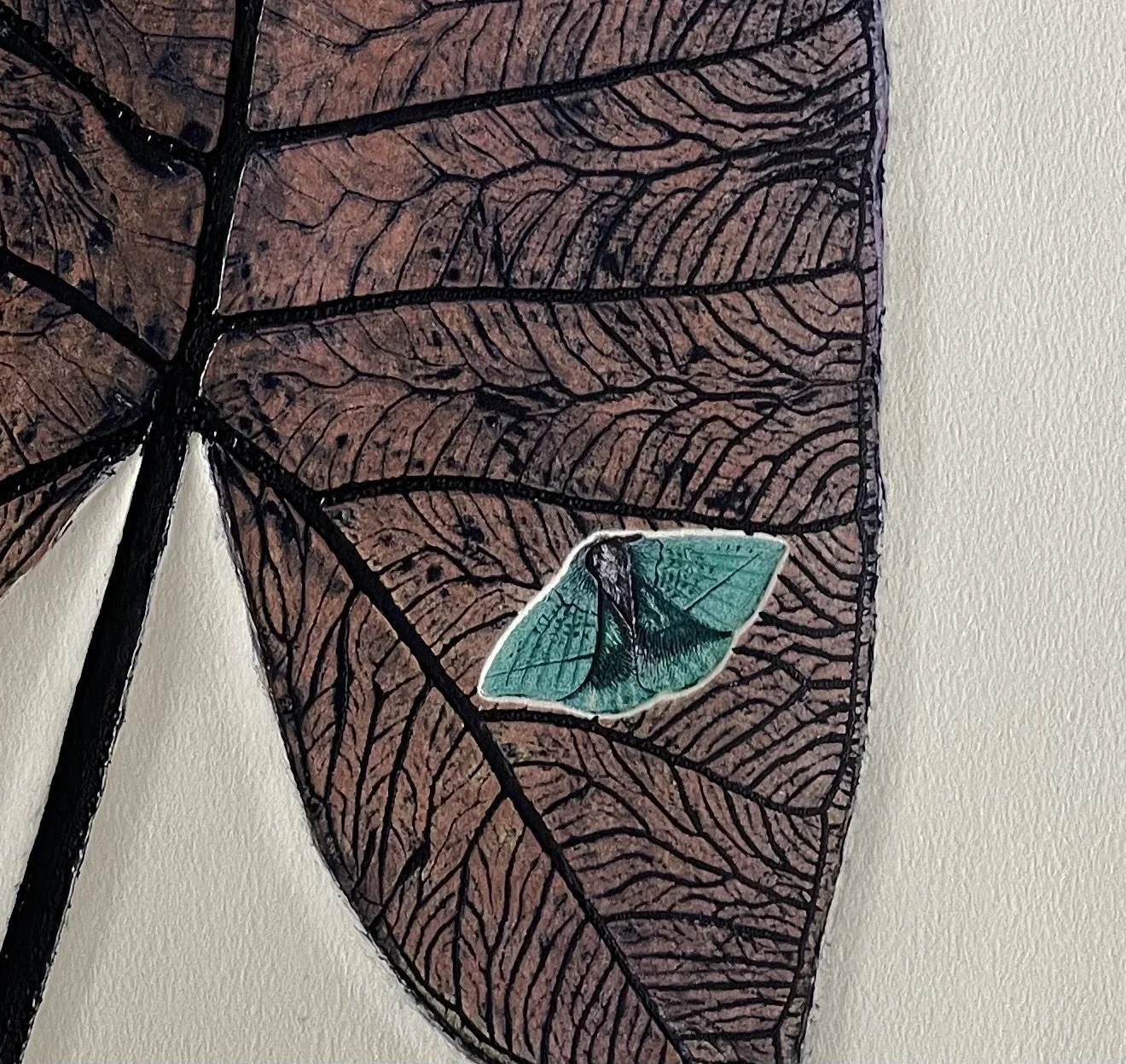 Image 4 of 7
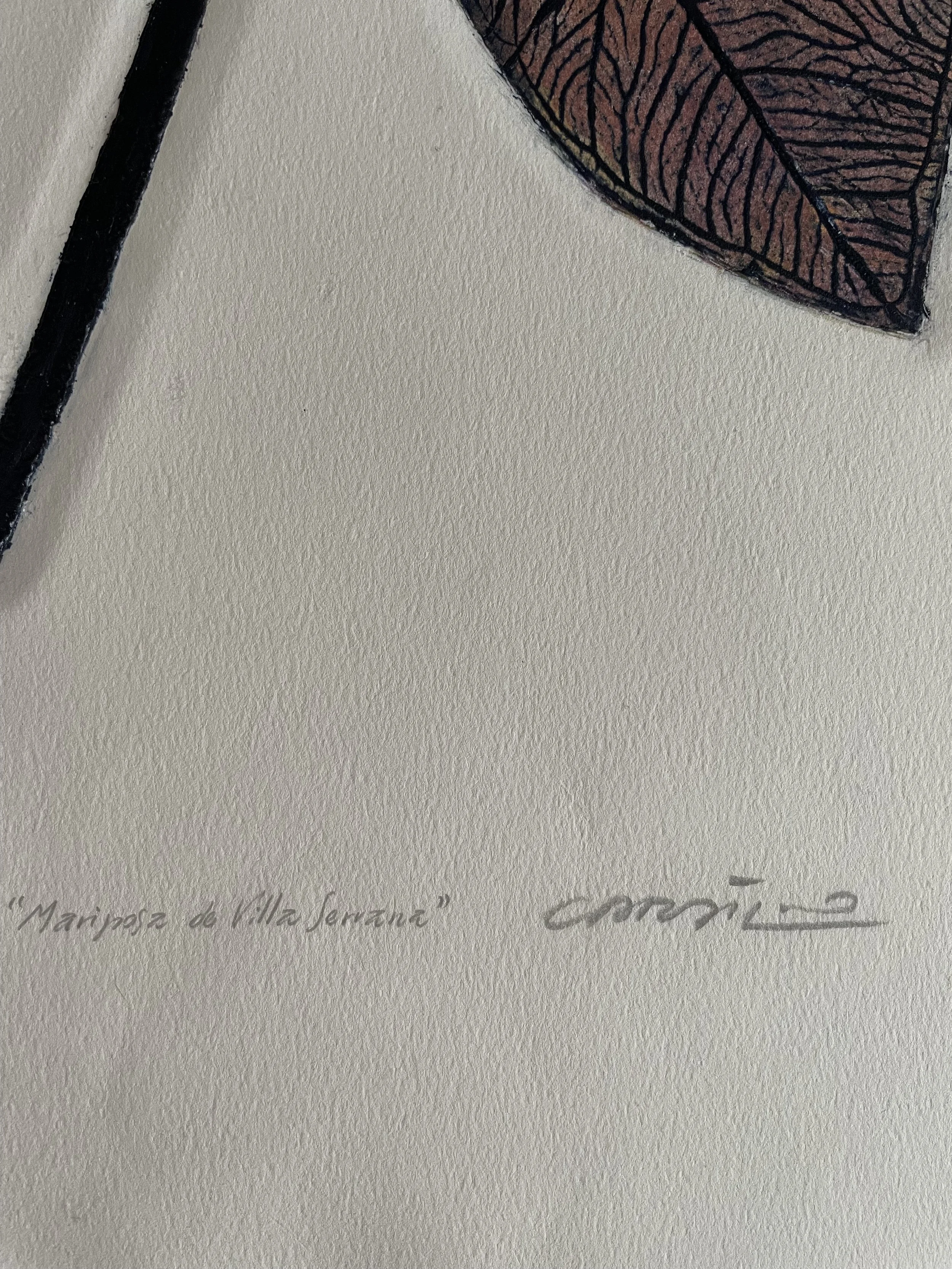 Image 5 of 7
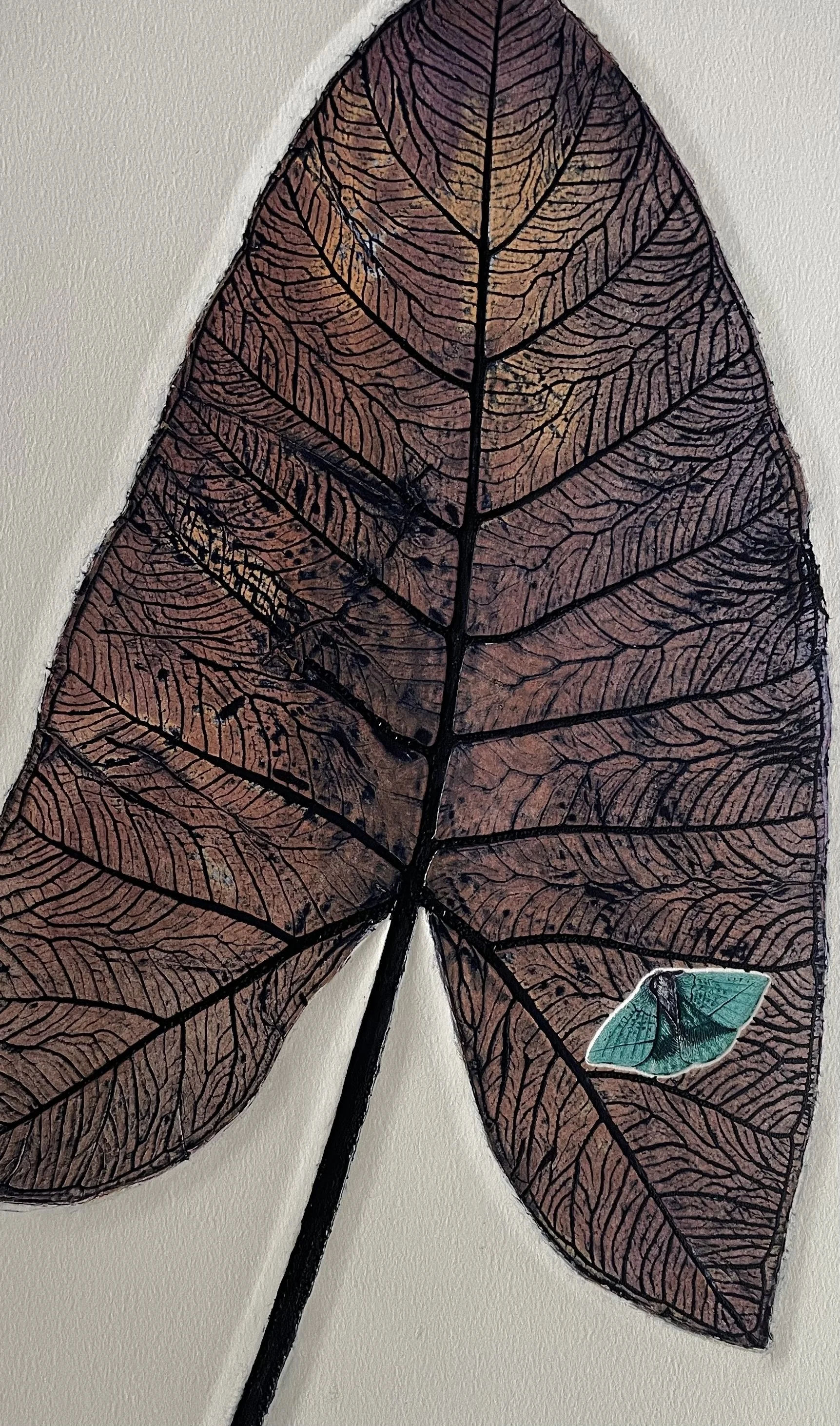 Image 6 of 7
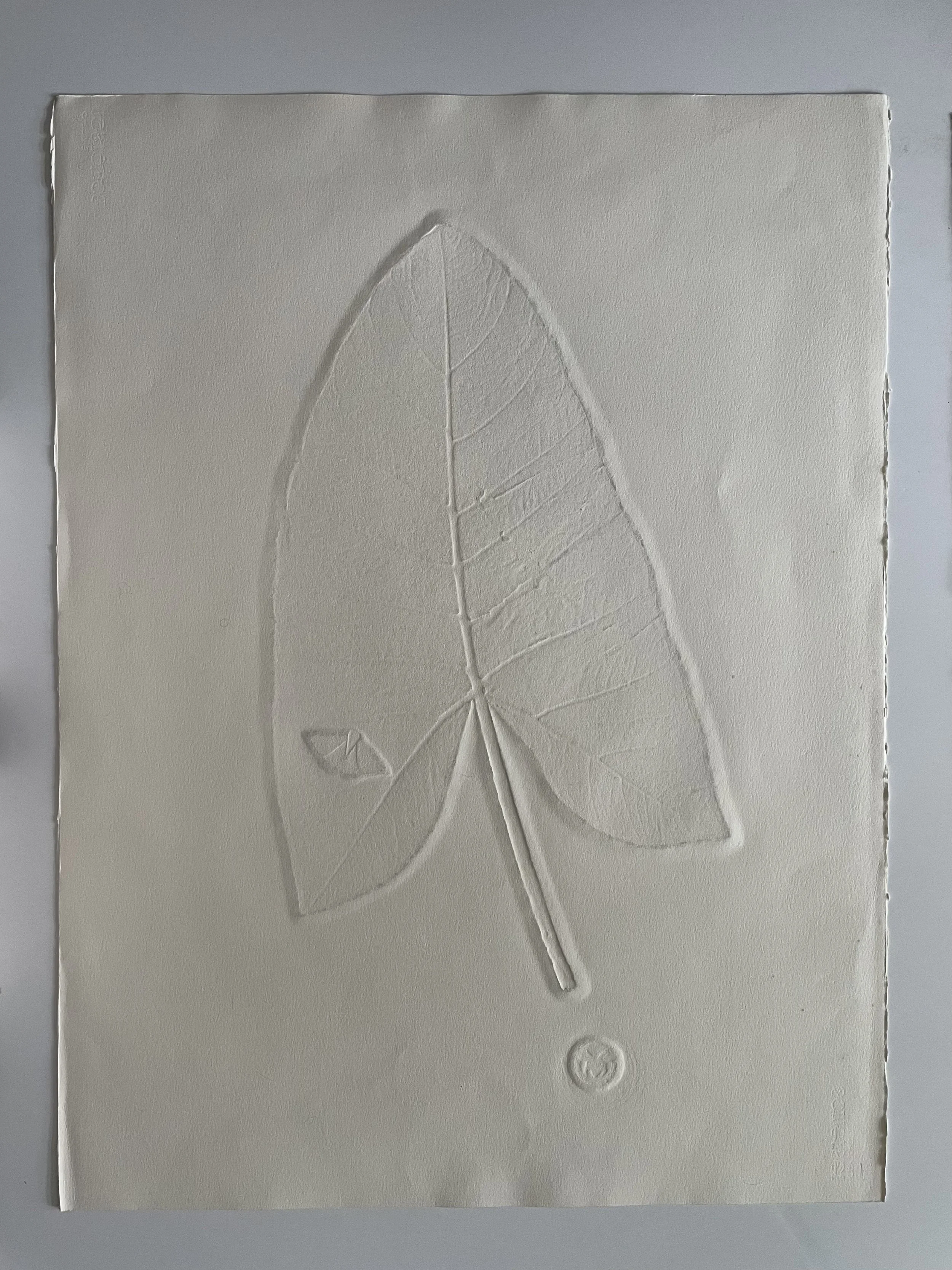 Image 7 of 7