 Image 1 of 4
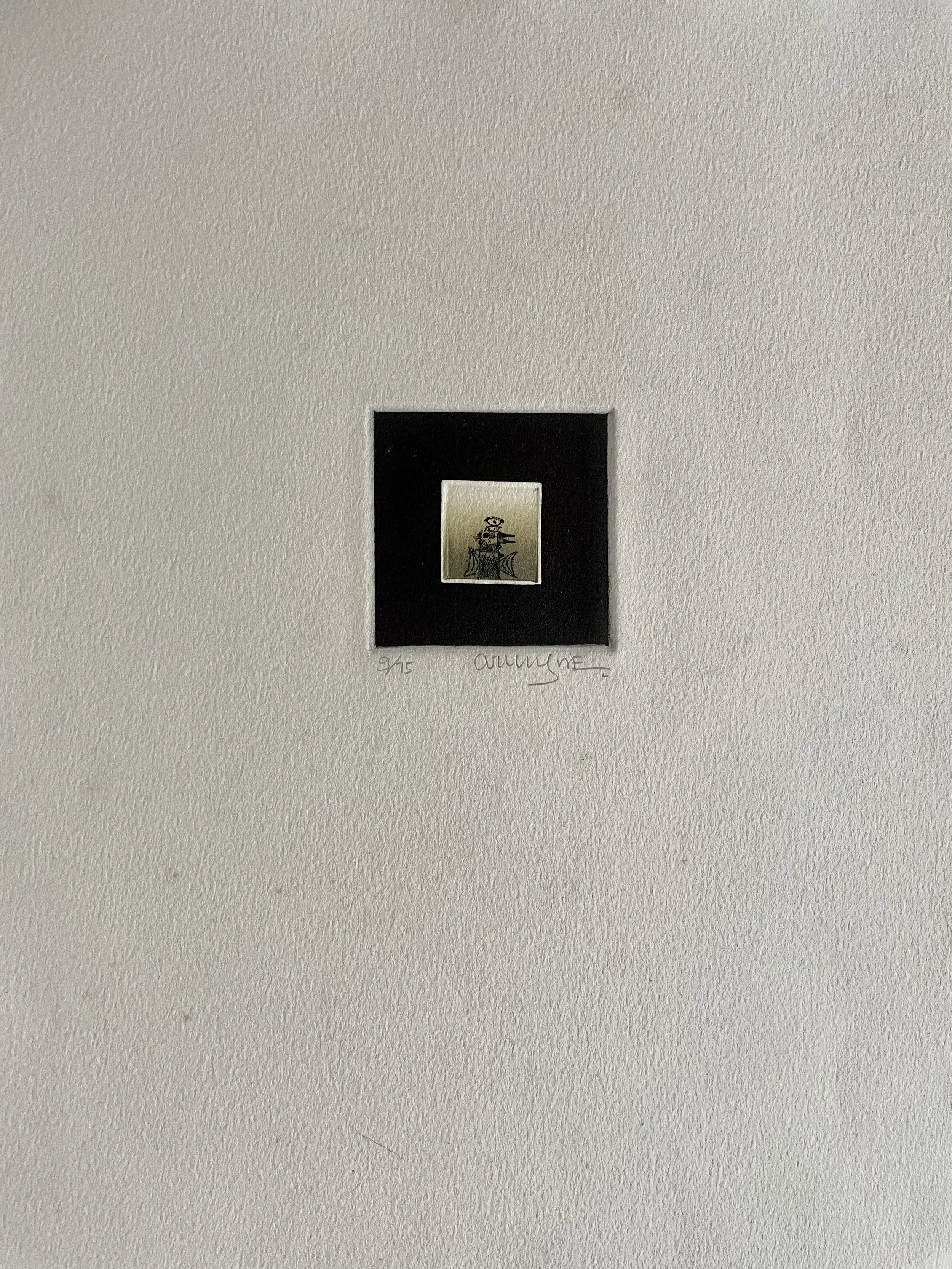 Image 2 of 4
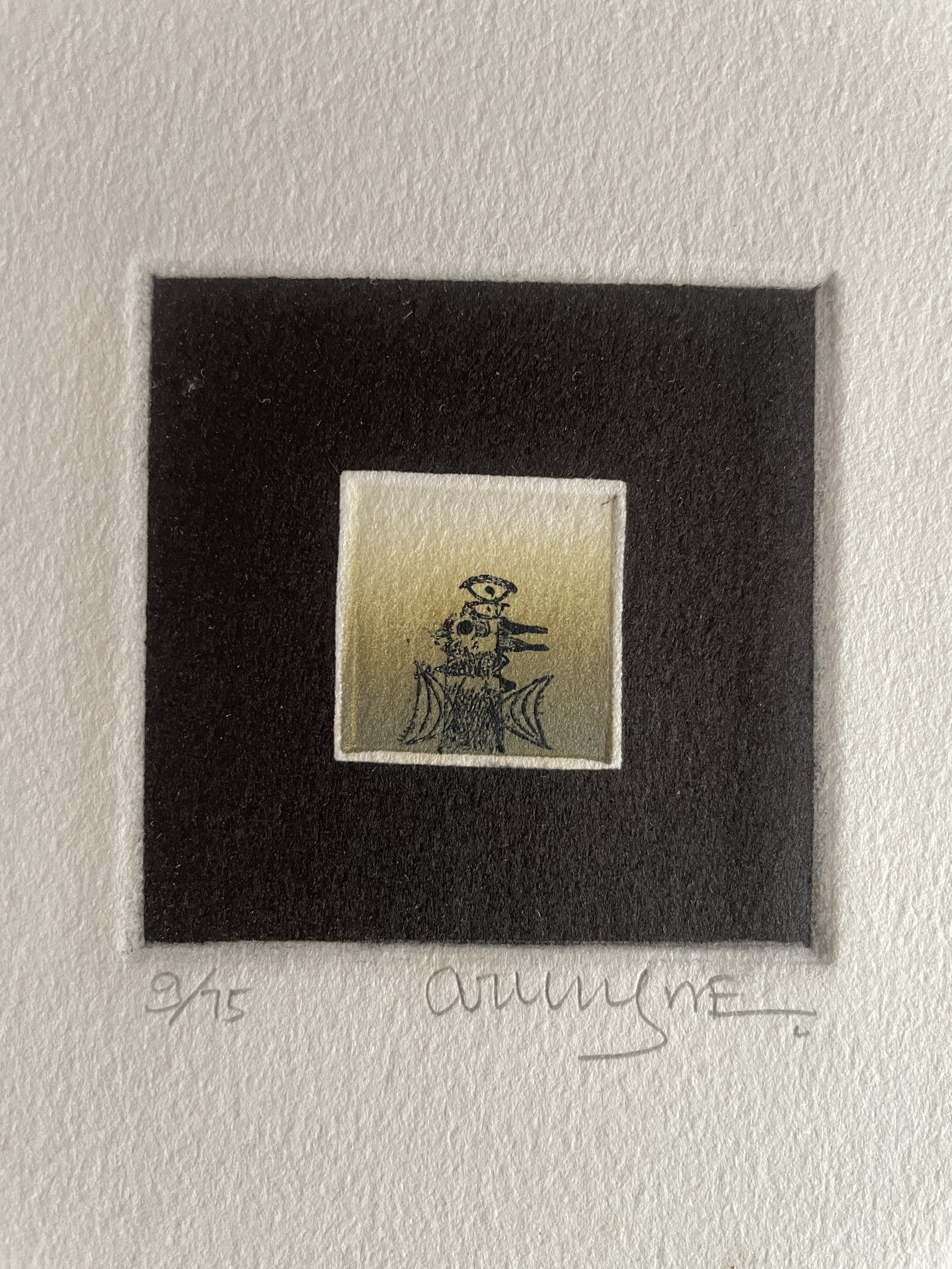 Image 3 of 4
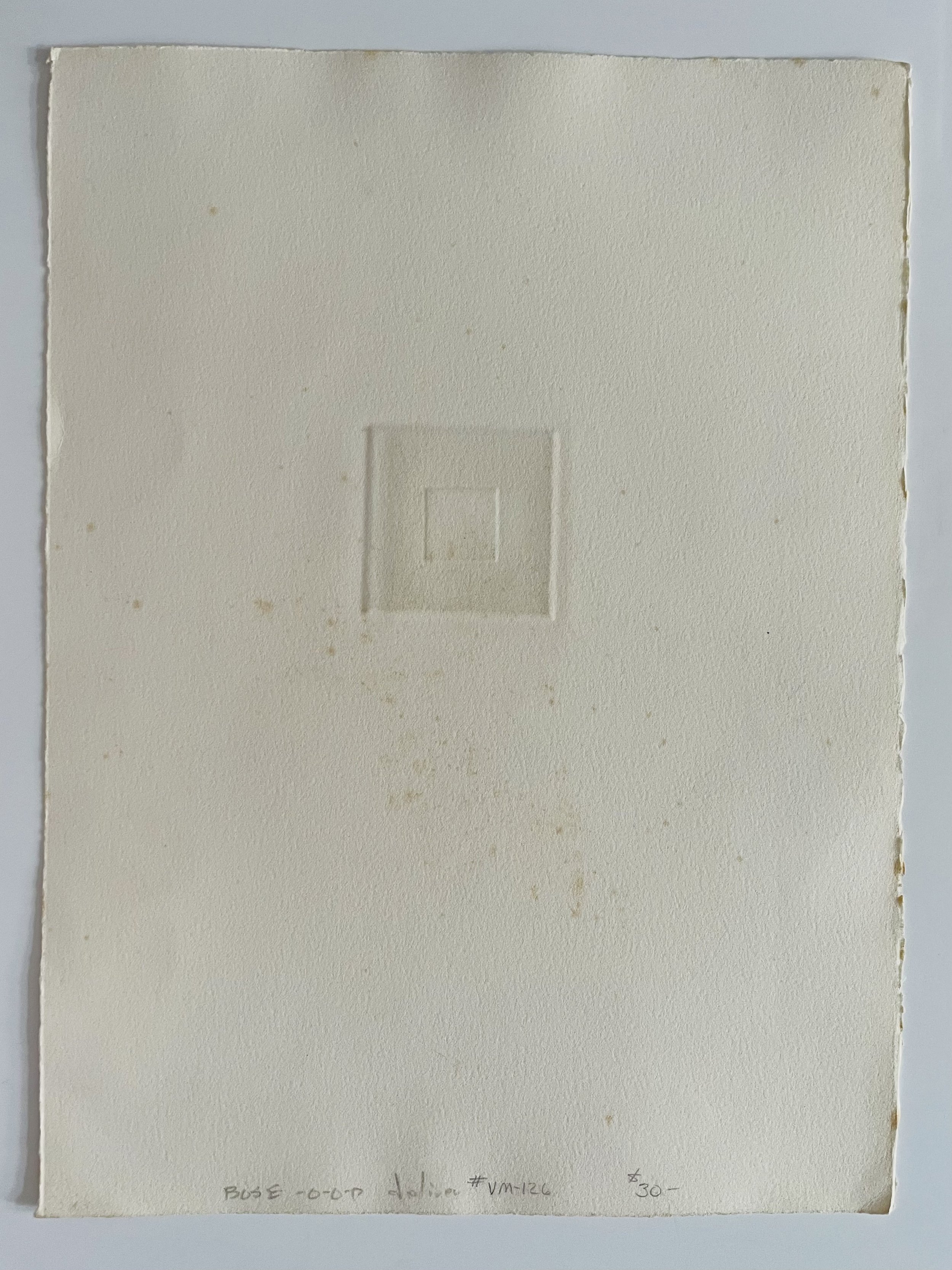 Image 4 of 4
“Miniature Bird” is a rare 1973 etching with aquatint by celebrated Indian-American printmaking pioneer Arun Bose, created while he was perfecting his signature Atelier 17–inspired viscosity and tonal techniques. This exquisite jewel of a print—only 2.5 × 2.5 inches on a full 11 × 15 inch sheet—combines meticulous line with soft aquatint tone, signed and numbered 9/75, and is a museum-worthy example of Bose’s intimate, imaginative work on paper.
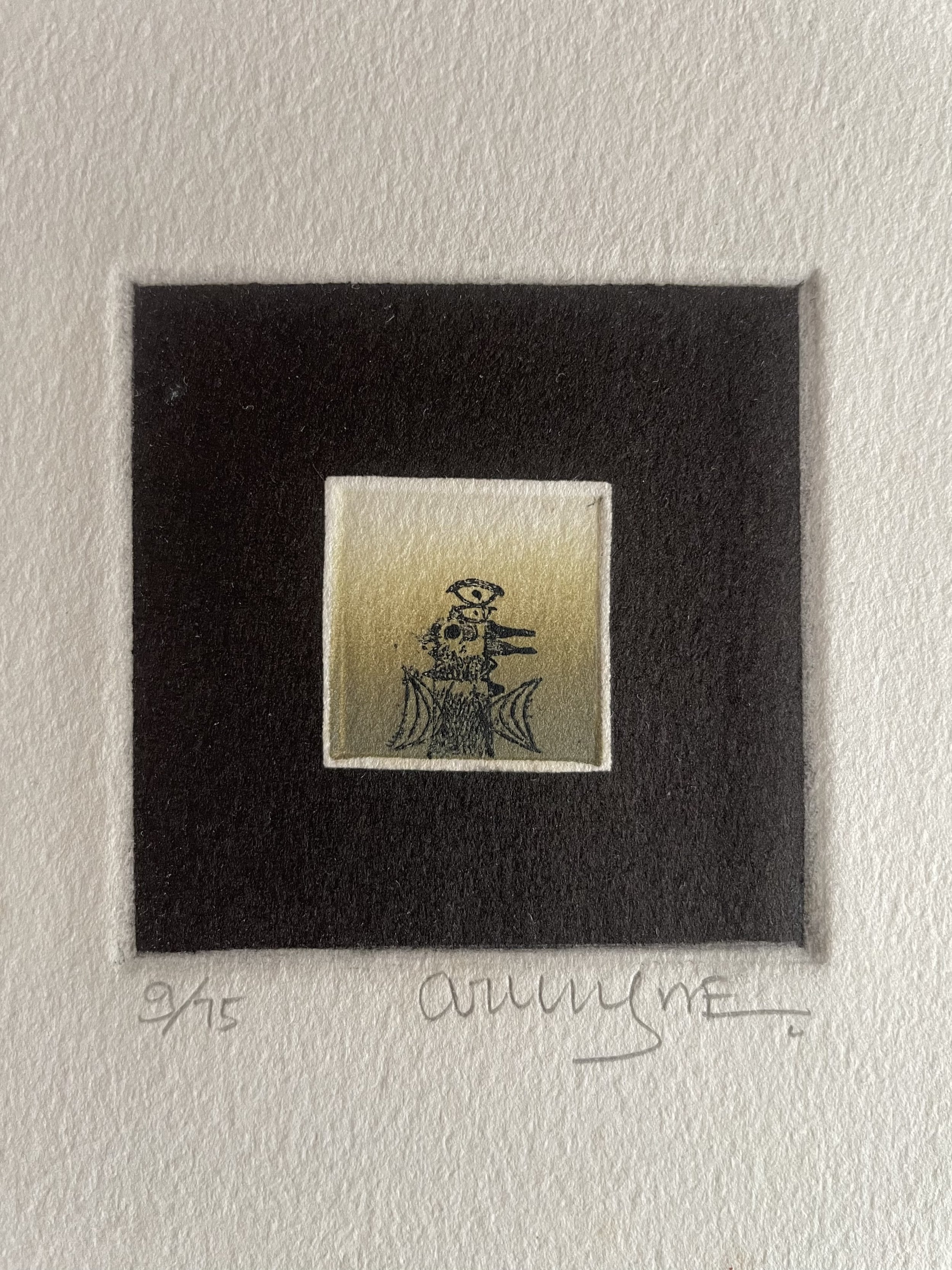
This work, often referred to as “Miniature Bird,” is a tiny yet powerful etching with aquatint printed in 1973. At the center of a deep black square sits a minuscule plate depicting a stylized bird-figure—part costume, part totem—drawn with the intricate, calligraphic line for which Bose is known. The small inner plate is inked in a soft graduated tone that shifts from pale ivory to a gentle olive or smoky hue, allowing the bird form to hover between graphic emblem and luminous apparition.
The surrounding black field is its own printed plate, not merely a drawn border; together the two plates create a double emboss visible on the verso. This layered structure is very much in keeping with Bose’s Atelier 17 training, where experimental intaglio and complex plate constructions were encouraged.
Printed on a full sheet of fine, deckle-edged wove paper approximately 11 × 15 inches, the composition intentionally isolates the image in an expanse of untouched paper, emphasizing its precious, icon-like scale. The sheet bears the edition number “9/75” at lower left and Bose’s graphite signature at lower right.
Conceptually, the piece links to Bose’s ongoing fascination with hybrid creatures, costumes, and archetypal figures—motifs that recur in larger works like Bird Costume, Elephant Ride and the Songs of Veda suite. Here the “miniature bird” reads like a fragment from a myth or ritual, condensed into a postage-stamp-sized stage. The tiny format invites close viewing and rewards it with crisp detail and subtle tonal variation, demonstrating the artist’s technical control at a very small scale.
Arun Bose (1934–2007) was an Indian-American painter and master printmaker whose career bridged Calcutta, Paris, and New York, and whose experimental intaglio techniques made him one of the important—if still under-recognized—figures of postwar printmaking.
Bose was born in Dacca (now Dhaka), then part of British India and today in Bangladesh, in 1934. He studied at the Government College of Art & Craft, Calcutta (Kolkata), graduating in 1955, and remained active there for about seven years as both artist and teacher.
In 1962, supported by a French Government scholarship, he moved to Paris. There he studied graphic art at Atelier 17under legendary printmaker Stanley William Hayter, and fresco painting at the École Nationale Supérieure des Beaux-Arts under Jane Aujame. At Atelier 17 he encountered the newly developed color-viscosity intaglio process, working alongside fellow Indian printmaker Krishna Reddy, then associate director of the studio. This experience shaped his lifelong commitment to complex, multi-plate and viscosity printing.
Around 1964–1968 Bose returned to Calcutta, teaching and exhibiting while helping anchor a new generation of Indian modernist printmakers.
In 1968 he moved to New York, where he studied at the Pratt Graphic Art Center and received a prestigious John D. Rockefeller III Fund Fellowship. He also worked at the Robert Blackburn Printmaking Workshop, a vital hub for experimental printmaking, and began teaching within the City University of New York system, most notably at Lehman College for roughly 35 years.
Bose’s art—both prints and paintings—is rooted in memories of Kolkata’s architecture, courtyards, terraces, and old stone surfaces, often suffused with a mysterious golden light and populated by birds, animals, musicians, and mythic figures. His prints typically employ etching with aquatint and color-viscosity inking, allowing multiple colors and tonalities to be printed from a single plate or layered plates.
He described his aim not as psychological excavation but as visual delight and mystery, saying: “My art is a visual experience that delights the senses and gives us a moment of beauty,” and, in another interview, emphasizing his fascination with shadow: “If I see shadow, only the silhouette – the rest you imagine. I like mystery.”
Bose exhibited widely in India, Europe, and the United States, including solo and group shows in Calcutta, Paris, London, Lugano, São Paulo, Tokyo, New York, and Chile, as evidenced by his early résumé and later gallery records. His work is held in important collections such as the National Gallery of Modern Art, New Delhi, the Academy of Fine Arts, Calcutta, and various European and American museums and corporate collections.
At auction, Bose’s prints and paintings have realized prices ranging from modest sums to several thousand dollars, with large, richly colored etchings such as No. VII and major suites like Songs of Veda and Suite I commanding strong results.
He died in New York in 2007, remembered as a “pioneer printmaker” who spent much of his life teaching and inspiring younger artists while maintaining a distinctive, personal vocabulary that blended Indian memory with Western modernist experimentation.
“Miniature Bird,” with its tiny, iconic image, embodies his interest in hybrid animal figures, layered intaglio techniques, and the tension between intimate scale and expansive imagination.
Arun Bose (Indian/American, 1934–2007), “Miniature Bird,” 1973, tiny etching with aquatint, image 2.5×2.5 in. on 11×15 in. sheet, signed and numbered 9/75 in pencil. Provenance: Mitch Morse Gallery; Artfind Gallery, Washington, DC.
ARTFIND GALLERY – CERTIFICATE OF VALUE & AUTHENTICATION
Artist: Arun Bose (1934–2007)
Title:Miniature Bird (attributed title)
Date: 1973
Medium: Etching with aquatint on wove paper
Image Size: approx. 2.5 × 2.5 in.
Sheet Size: approx. 11 × 15 in.
Edition: 9/75
Markings: Signed “Arun Bose” in pencil at lower right; numbered “9/75” at lower left; double plate mark visible recto and verso.
Technique: Intaglio etching with aquatint, printed in tonal ink, reflecting Bose’s Atelier 17–influenced viscosity and multi-plate methods. hammondmuseum.org+1
Provenance: Mitch Morse Gallery (NYC/Europe); acquired by Artfind Gallery, Washington, DC.
Authenticity: Signature, editioning, paper, plate marks, and technique are consistent with documented 1970s etchings by Arun Bose. Comparable works include Ducks, Temple, No. VII, and the Songs of Veda suite. Invaluable+1
Certified by Artfind Gallery, Washington, DC.
1973 – Artist’s studio, New York – printed and signed by Arun Bose, edition 9/75.
c. 1970s–80s – Mitch Morse Gallery, NYC / Europe – acquired directly from the artist or his dealers; held in gallery inventory.
Later 20th century – Private and dealer holdings via Mitch Morse Gallery.
Current owner – Artfind Gallery, Washington, DC.
Aquatint, an etching process that creates exquisite tonal effects involves treating a metal plate with fine particles of an acid-resistant material, such as powdered resin. Once the plate is prepared, it is immersed in an acid bath. The acid works its magic, biting into the exposed areas of the plate between the grains of resin, resulting in a finely textured surface. When printed, this technique yields a rich array of tiny spots, evoking the soft, flowing tones reminiscent of a watercolor wash. This intricate method reflects the artist's mastery, honed during their studies at the Pratt Graphic Center and enriched by a prestigious John D. Rockefeller 3rd Fund Fellowship in 1968. Their experience at the Robert Blackburn Printmaking Workshop further deepened their appreciation for the art of etching, allowing them to blend traditional techniques with unique, modern expressions.
“Miniature Bird” is a rare 1973 etching with aquatint by celebrated Indian-American printmaking pioneer Arun Bose, created while he was perfecting his signature Atelier 17–inspired viscosity and tonal techniques. This exquisite jewel of a print—only 2.5 × 2.5 inches on a full 11 × 15 inch sheet—combines meticulous line with soft aquatint tone, signed and numbered 9/75, and is a museum-worthy example of Bose’s intimate, imaginative work on paper.
This work, often referred to as “Miniature Bird,” is a tiny yet powerful etching with aquatint printed in 1973. At the center of a deep black square sits a minuscule plate depicting a stylized bird-figure—part costume, part totem—drawn with the intricate, calligraphic line for which Bose is known. The small inner plate is inked in a soft graduated tone that shifts from pale ivory to a gentle olive or smoky hue, allowing the bird form to hover between graphic emblem and luminous apparition.
The surrounding black field is its own printed plate, not merely a drawn border; together the two plates create a double emboss visible on the verso. This layered structure is very much in keeping with Bose’s Atelier 17 training, where experimental intaglio and complex plate constructions were encouraged.
Printed on a full sheet of fine, deckle-edged wove paper approximately 11 × 15 inches, the composition intentionally isolates the image in an expanse of untouched paper, emphasizing its precious, icon-like scale. The sheet bears the edition number “9/75” at lower left and Bose’s graphite signature at lower right.
Conceptually, the piece links to Bose’s ongoing fascination with hybrid creatures, costumes, and archetypal figures—motifs that recur in larger works like Bird Costume, Elephant Ride and the Songs of Veda suite. Here the “miniature bird” reads like a fragment from a myth or ritual, condensed into a postage-stamp-sized stage. The tiny format invites close viewing and rewards it with crisp detail and subtle tonal variation, demonstrating the artist’s technical control at a very small scale.
Arun Bose (1934–2007) was an Indian-American painter and master printmaker whose career bridged Calcutta, Paris, and New York, and whose experimental intaglio techniques made him one of the important—if still under-recognized—figures of postwar printmaking.
Bose was born in Dacca (now Dhaka), then part of British India and today in Bangladesh, in 1934. He studied at the Government College of Art & Craft, Calcutta (Kolkata), graduating in 1955, and remained active there for about seven years as both artist and teacher.
In 1962, supported by a French Government scholarship, he moved to Paris. There he studied graphic art at Atelier 17under legendary printmaker Stanley William Hayter, and fresco painting at the École Nationale Supérieure des Beaux-Arts under Jane Aujame. At Atelier 17 he encountered the newly developed color-viscosity intaglio process, working alongside fellow Indian printmaker Krishna Reddy, then associate director of the studio. This experience shaped his lifelong commitment to complex, multi-plate and viscosity printing.
Around 1964–1968 Bose returned to Calcutta, teaching and exhibiting while helping anchor a new generation of Indian modernist printmakers.
In 1968 he moved to New York, where he studied at the Pratt Graphic Art Center and received a prestigious John D. Rockefeller III Fund Fellowship. He also worked at the Robert Blackburn Printmaking Workshop, a vital hub for experimental printmaking, and began teaching within the City University of New York system, most notably at Lehman College for roughly 35 years.
Bose’s art—both prints and paintings—is rooted in memories of Kolkata’s architecture, courtyards, terraces, and old stone surfaces, often suffused with a mysterious golden light and populated by birds, animals, musicians, and mythic figures. His prints typically employ etching with aquatint and color-viscosity inking, allowing multiple colors and tonalities to be printed from a single plate or layered plates.
He described his aim not as psychological excavation but as visual delight and mystery, saying: “My art is a visual experience that delights the senses and gives us a moment of beauty,” and, in another interview, emphasizing his fascination with shadow: “If I see shadow, only the silhouette – the rest you imagine. I like mystery.”
Bose exhibited widely in India, Europe, and the United States, including solo and group shows in Calcutta, Paris, London, Lugano, São Paulo, Tokyo, New York, and Chile, as evidenced by his early résumé and later gallery records. His work is held in important collections such as the National Gallery of Modern Art, New Delhi, the Academy of Fine Arts, Calcutta, and various European and American museums and corporate collections.
At auction, Bose’s prints and paintings have realized prices ranging from modest sums to several thousand dollars, with large, richly colored etchings such as No. VII and major suites like Songs of Veda and Suite I commanding strong results.
He died in New York in 2007, remembered as a “pioneer printmaker” who spent much of his life teaching and inspiring younger artists while maintaining a distinctive, personal vocabulary that blended Indian memory with Western modernist experimentation.
“Miniature Bird,” with its tiny, iconic image, embodies his interest in hybrid animal figures, layered intaglio techniques, and the tension between intimate scale and expansive imagination.
Arun Bose (Indian/American, 1934–2007), “Miniature Bird,” 1973, tiny etching with aquatint, image 2.5×2.5 in. on 11×15 in. sheet, signed and numbered 9/75 in pencil. Provenance: Mitch Morse Gallery; Artfind Gallery, Washington, DC.
ARTFIND GALLERY – CERTIFICATE OF VALUE & AUTHENTICATION
Artist: Arun Bose (1934–2007)
Title:Miniature Bird (attributed title)
Date: 1973
Medium: Etching with aquatint on wove paper
Image Size: approx. 2.5 × 2.5 in.
Sheet Size: approx. 11 × 15 in.
Edition: 9/75
Markings: Signed “Arun Bose” in pencil at lower right; numbered “9/75” at lower left; double plate mark visible recto and verso.
Technique: Intaglio etching with aquatint, printed in tonal ink, reflecting Bose’s Atelier 17–influenced viscosity and multi-plate methods. hammondmuseum.org+1
Provenance: Mitch Morse Gallery (NYC/Europe); acquired by Artfind Gallery, Washington, DC.
Authenticity: Signature, editioning, paper, plate marks, and technique are consistent with documented 1970s etchings by Arun Bose. Comparable works include Ducks, Temple, No. VII, and the Songs of Veda suite. Invaluable+1
Certified by Artfind Gallery, Washington, DC.
1973 – Artist’s studio, New York – printed and signed by Arun Bose, edition 9/75.
c. 1970s–80s – Mitch Morse Gallery, NYC / Europe – acquired directly from the artist or his dealers; held in gallery inventory.
Later 20th century – Private and dealer holdings via Mitch Morse Gallery.
Current owner – Artfind Gallery, Washington, DC.
Aquatint, an etching process that creates exquisite tonal effects involves treating a metal plate with fine particles of an acid-resistant material, such as powdered resin. Once the plate is prepared, it is immersed in an acid bath. The acid works its magic, biting into the exposed areas of the plate between the grains of resin, resulting in a finely textured surface. When printed, this technique yields a rich array of tiny spots, evoking the soft, flowing tones reminiscent of a watercolor wash. This intricate method reflects the artist's mastery, honed during their studies at the Pratt Graphic Center and enriched by a prestigious John D. Rockefeller 3rd Fund Fellowship in 1968. Their experience at the Robert Blackburn Printmaking Workshop further deepened their appreciation for the art of etching, allowing them to blend traditional techniques with unique, modern expressions.