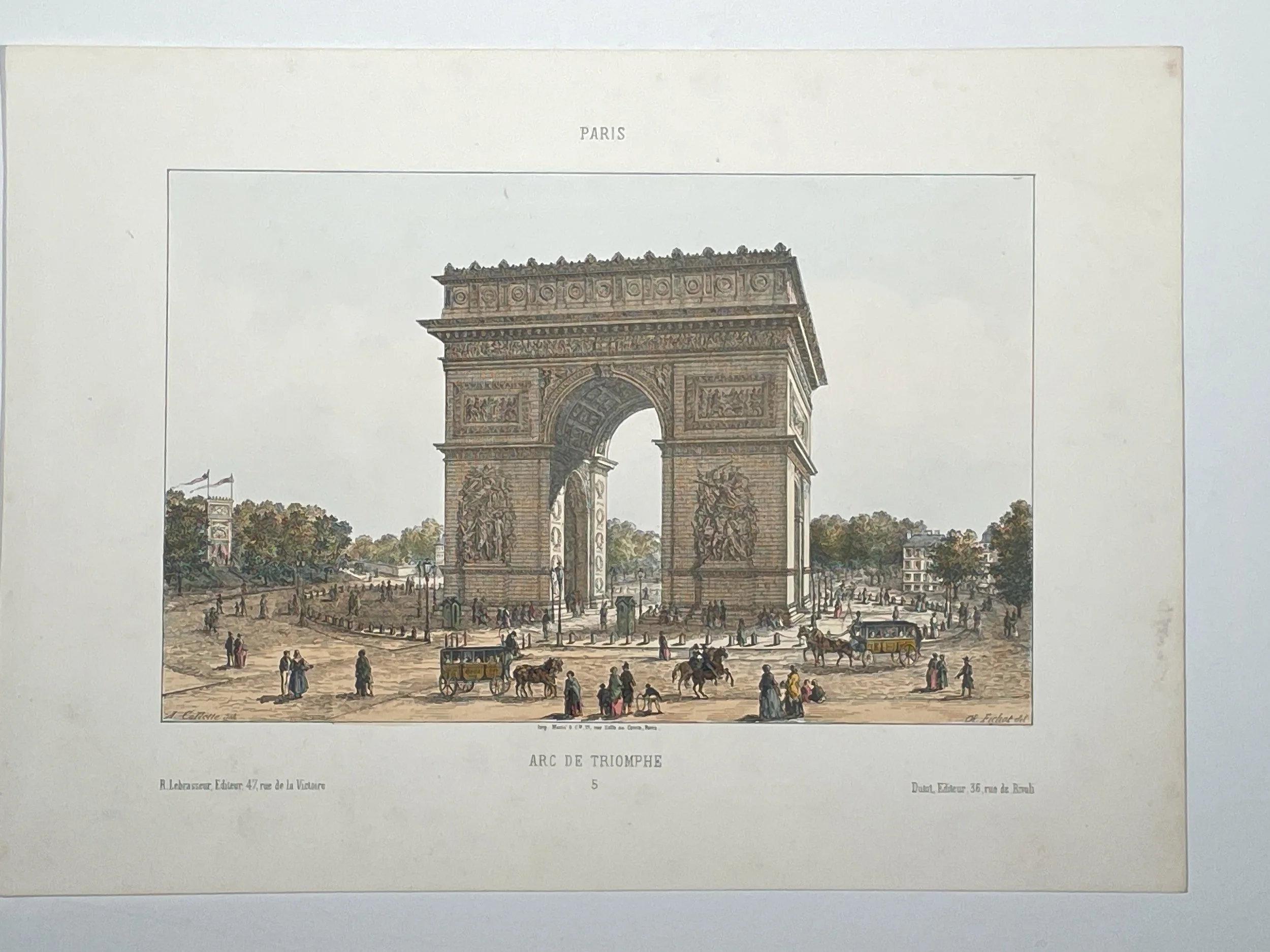
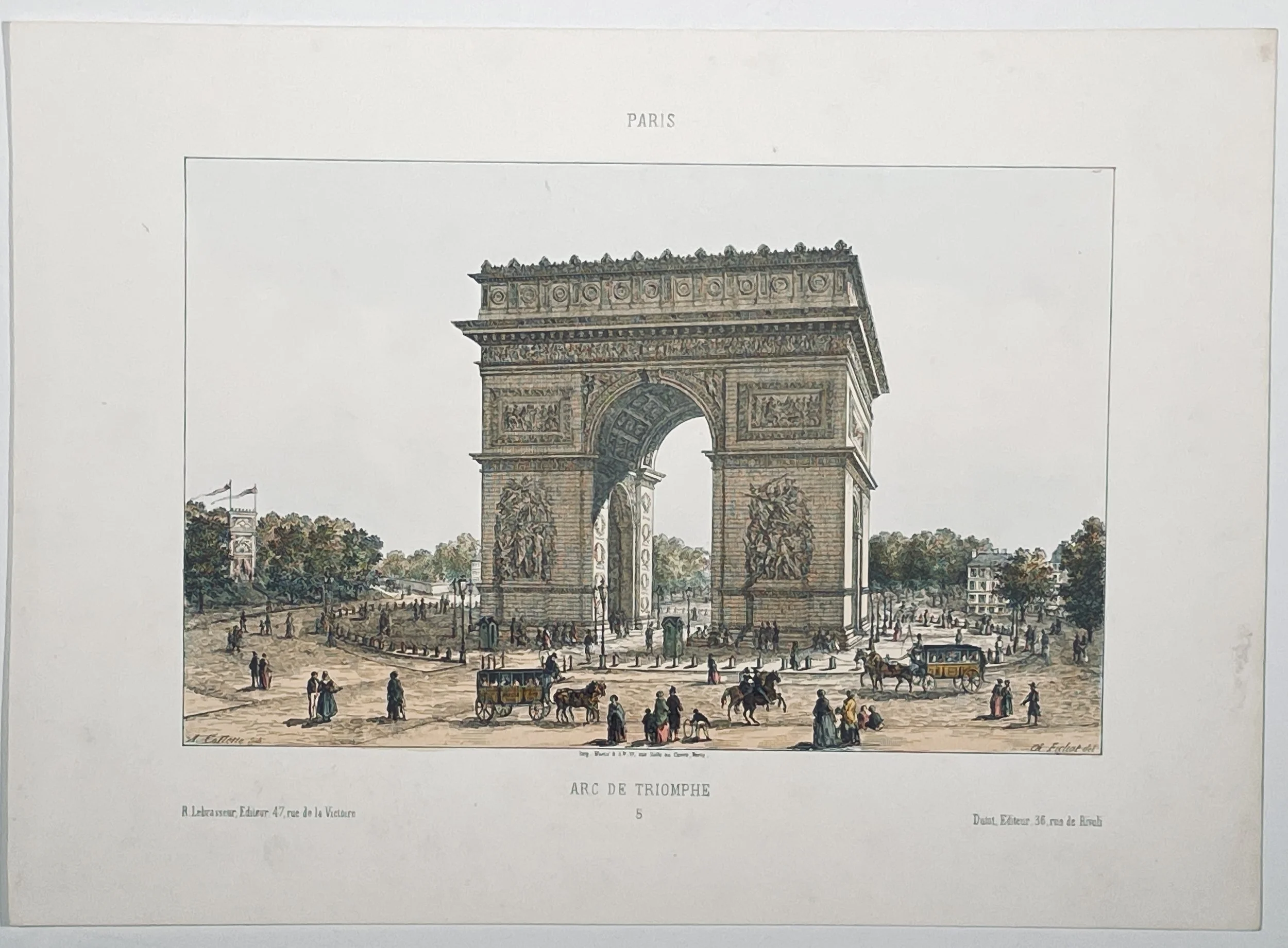
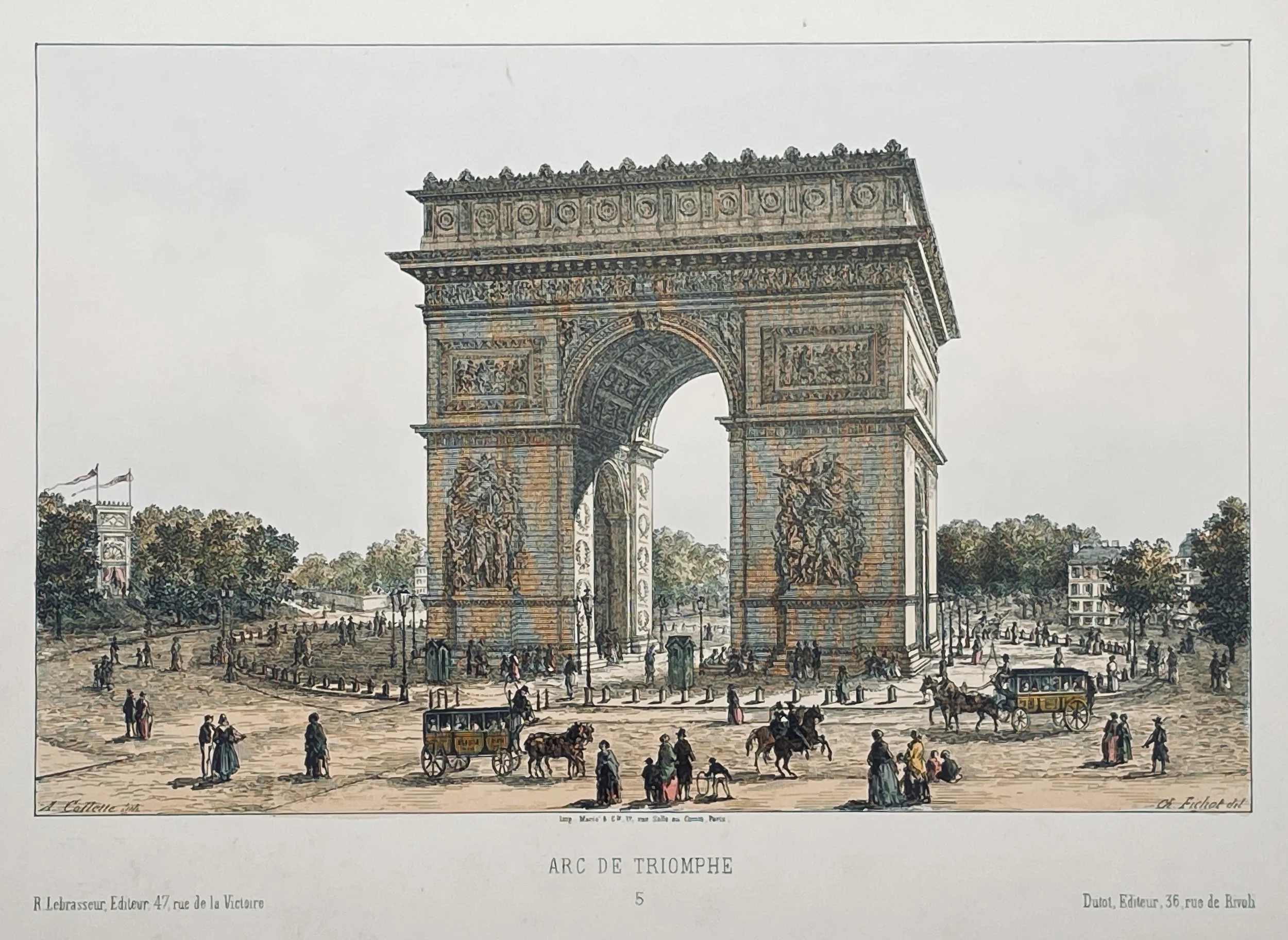
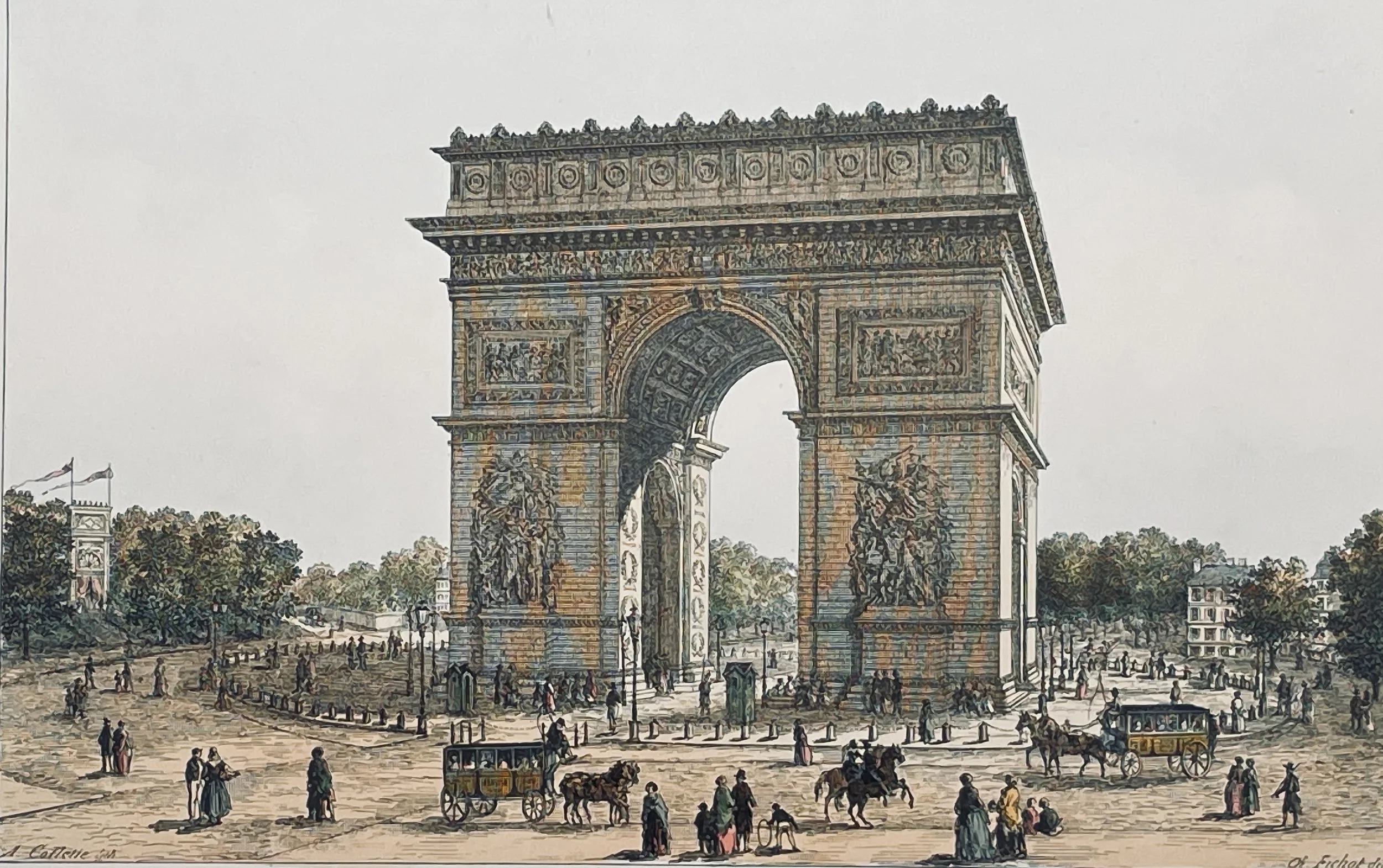
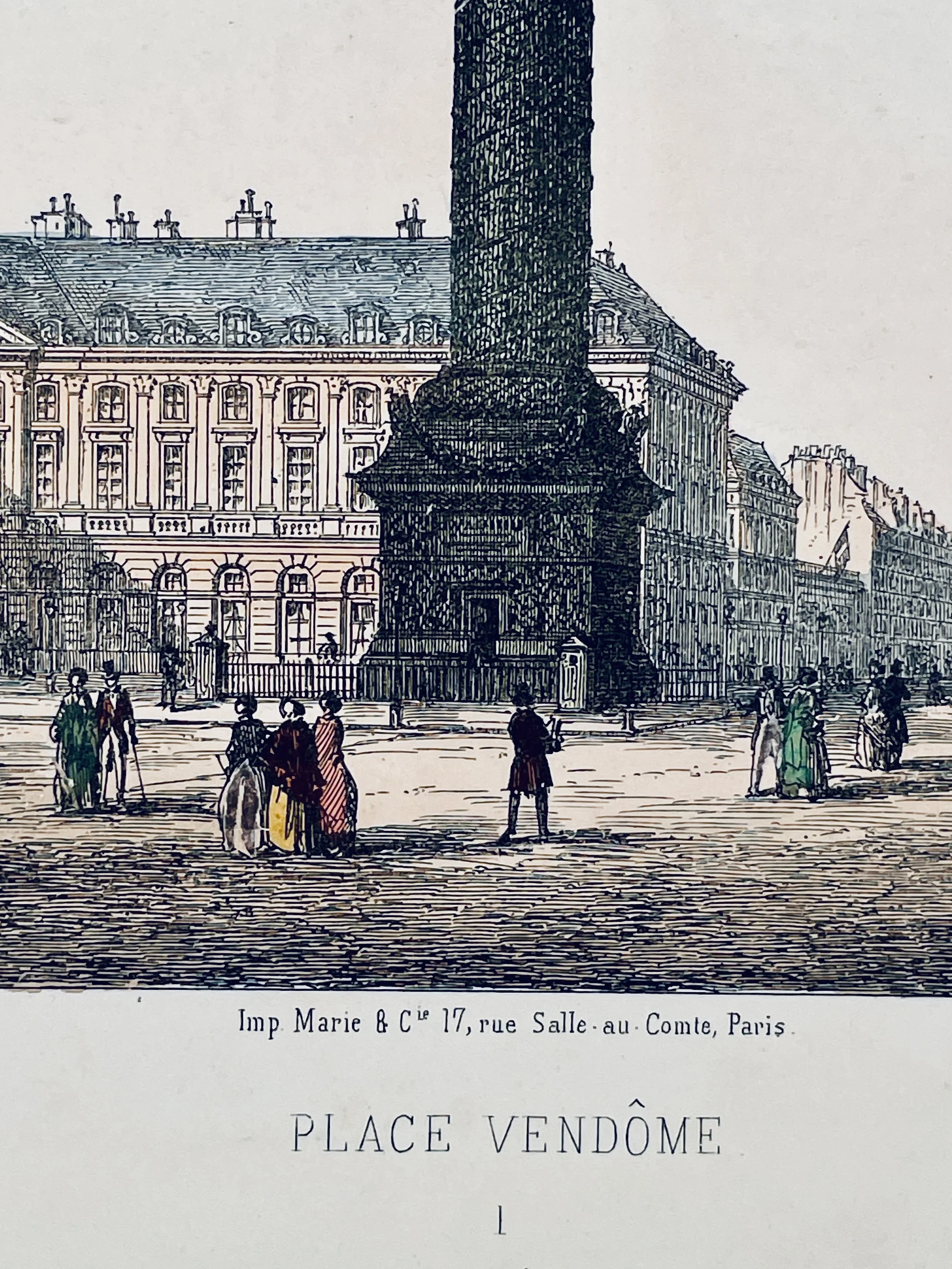
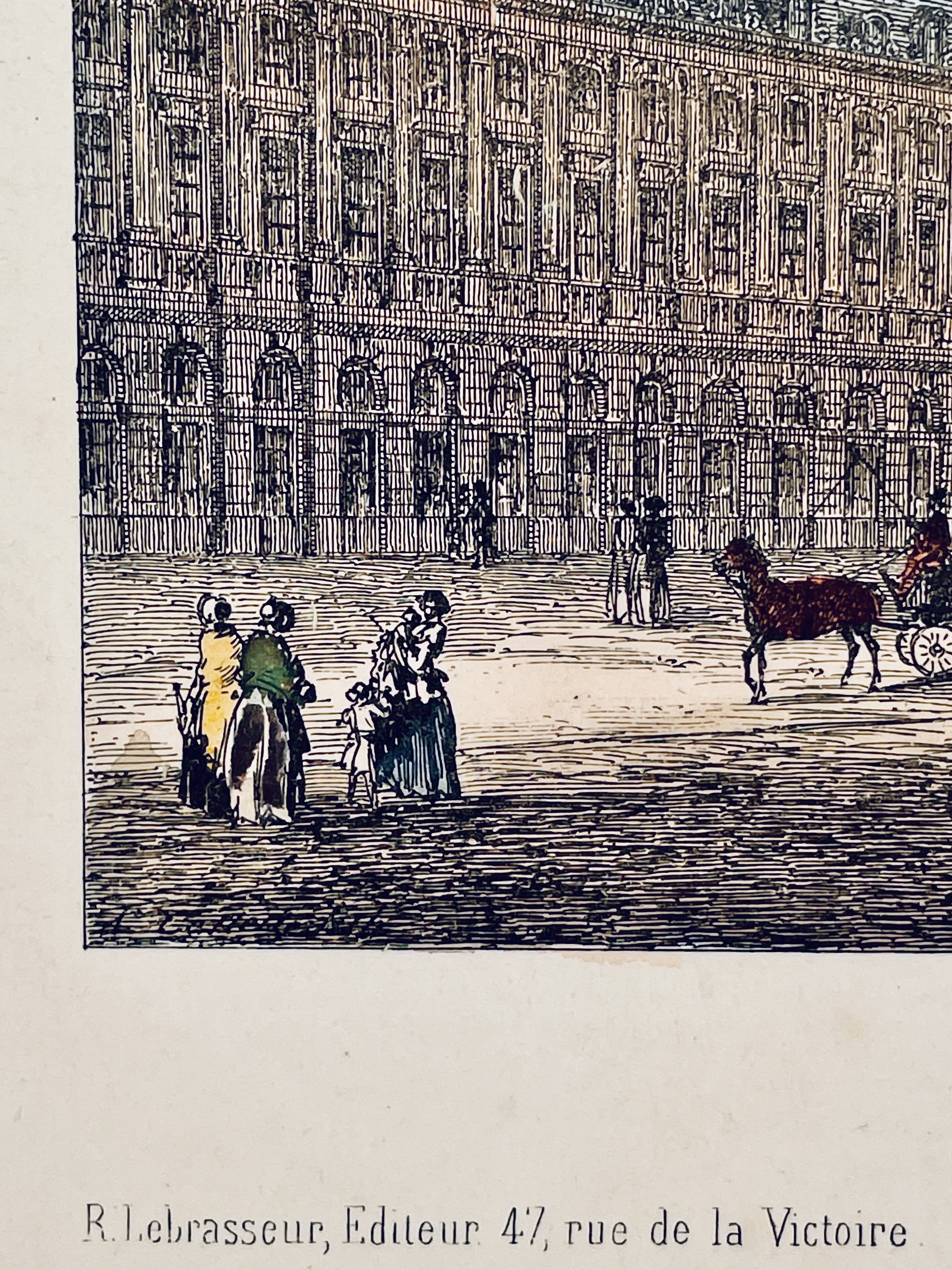
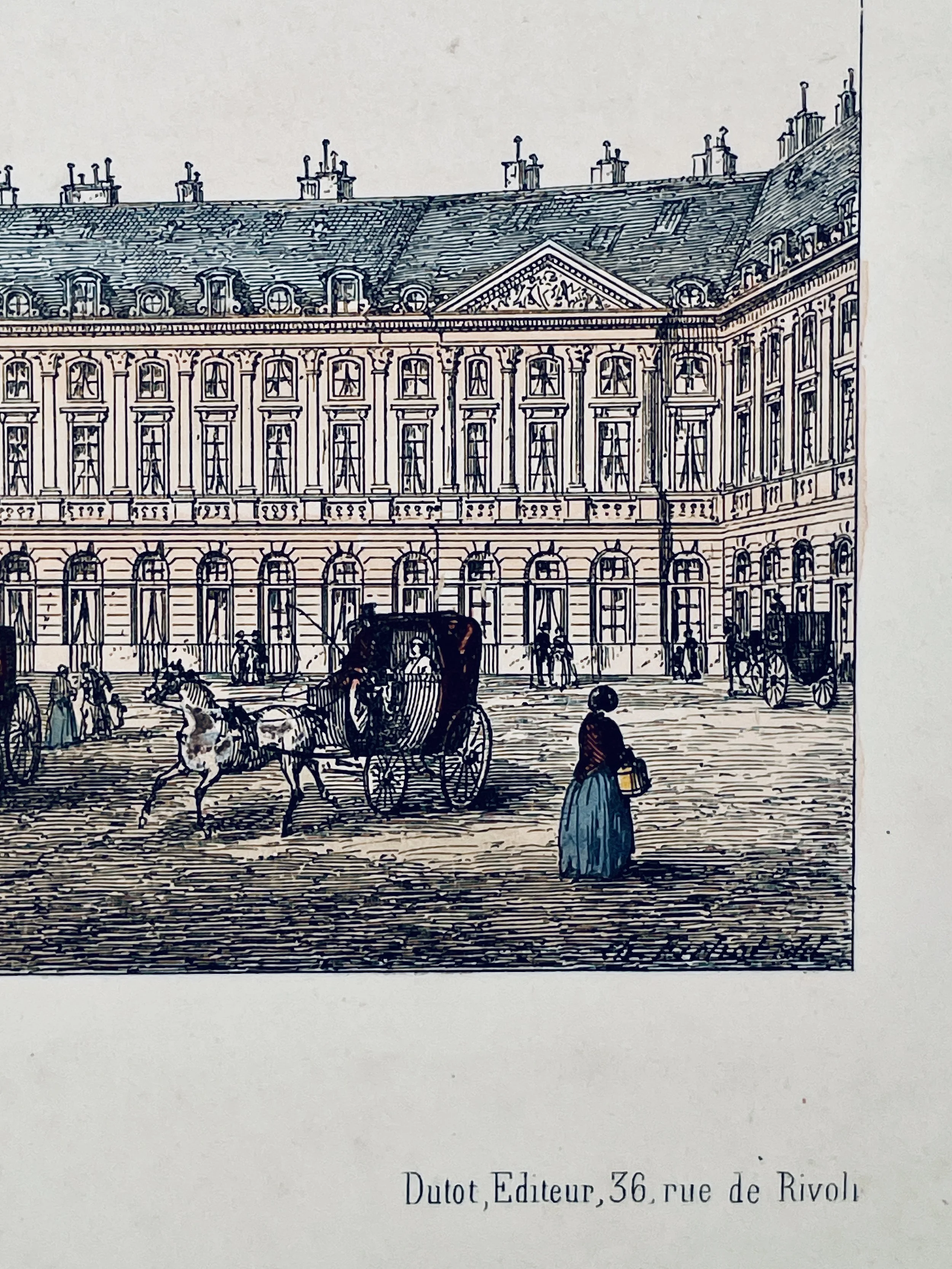
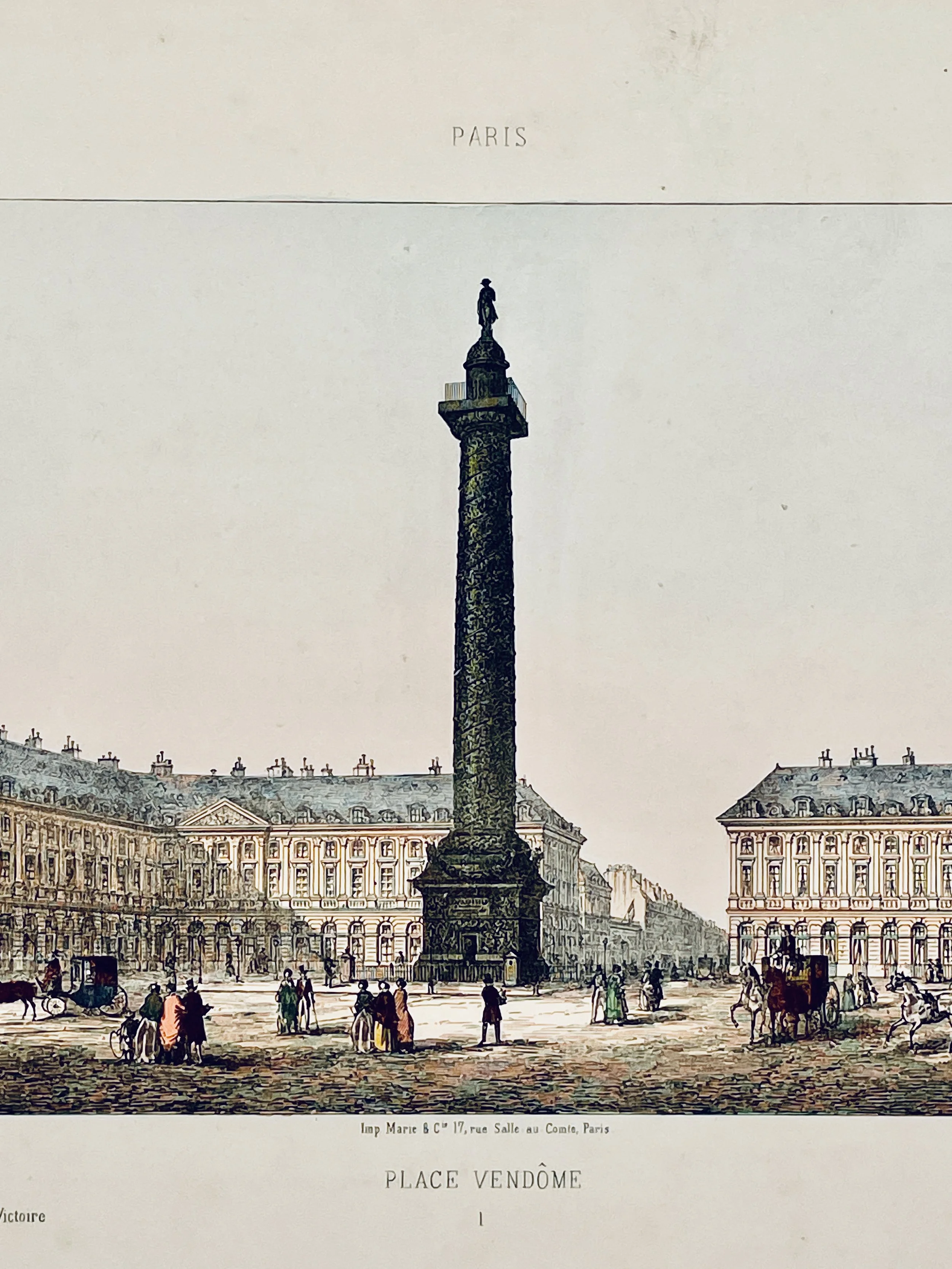
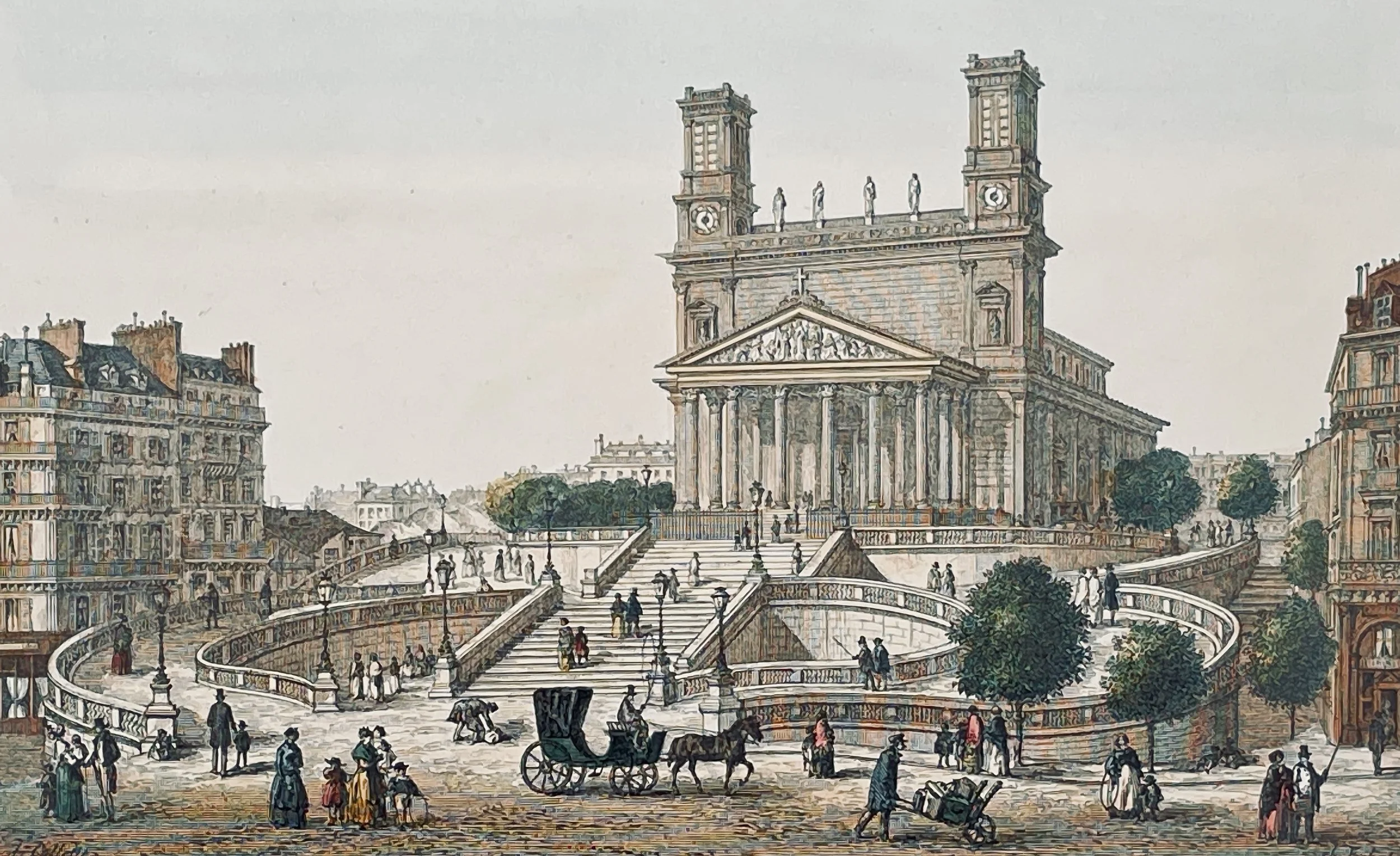
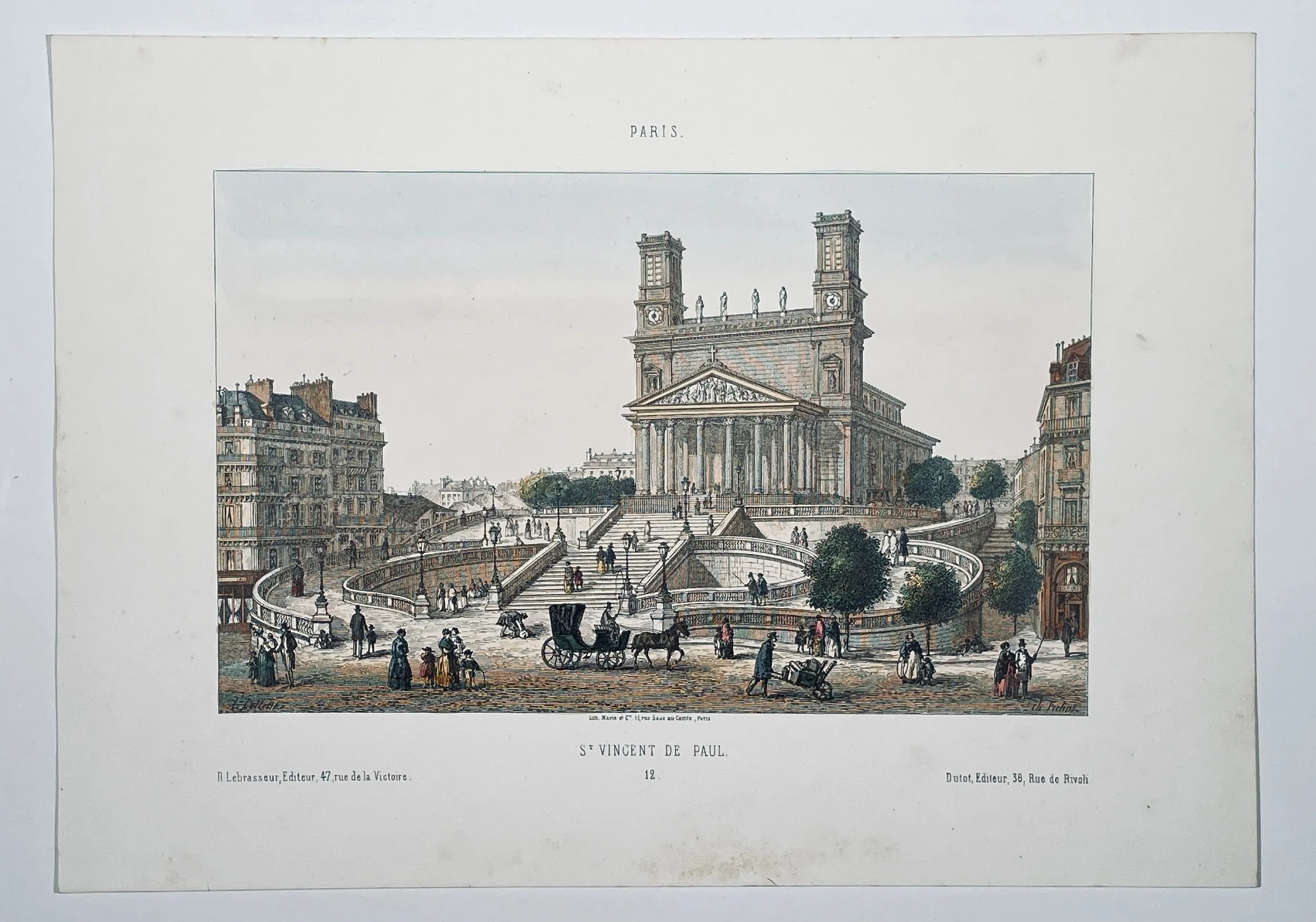
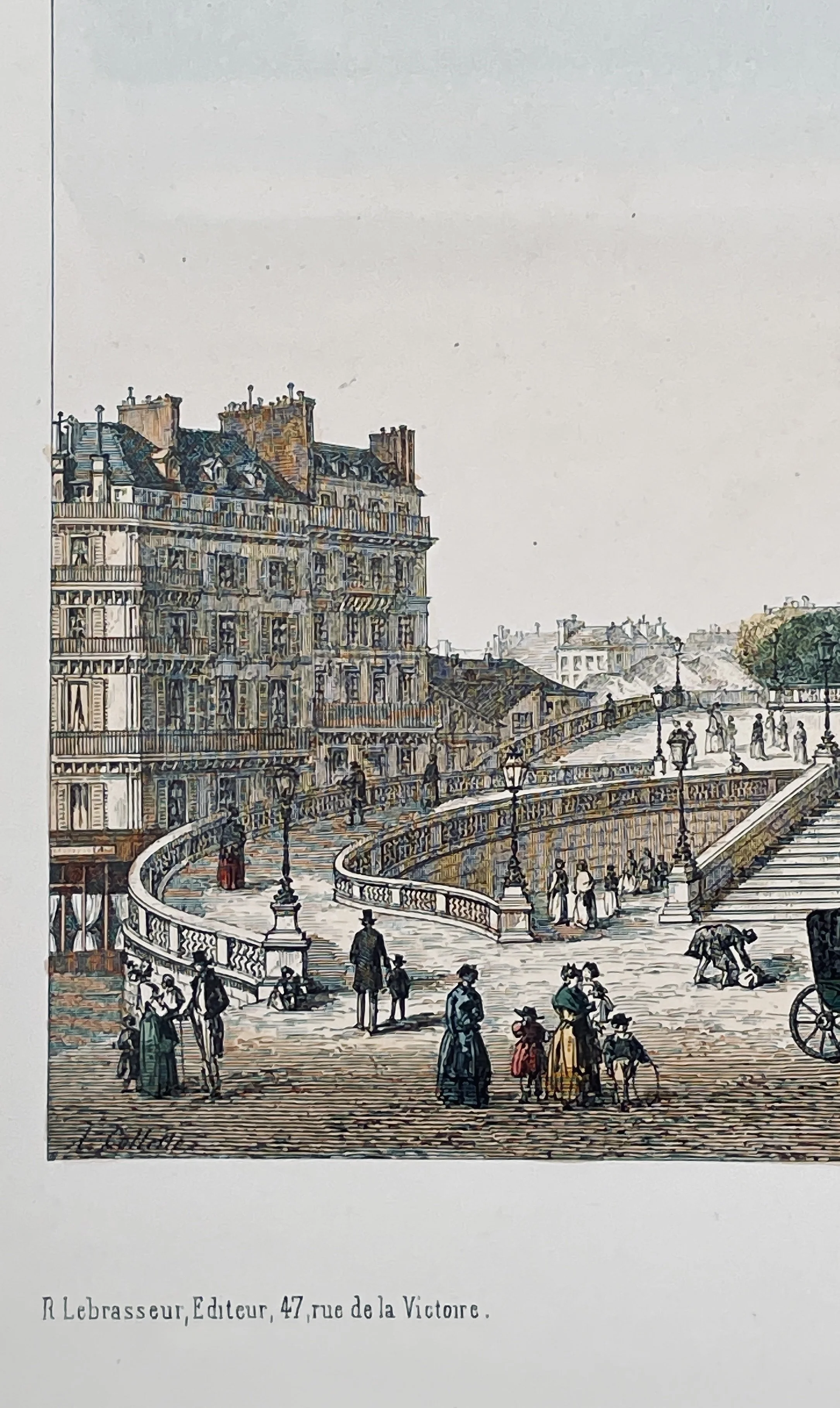
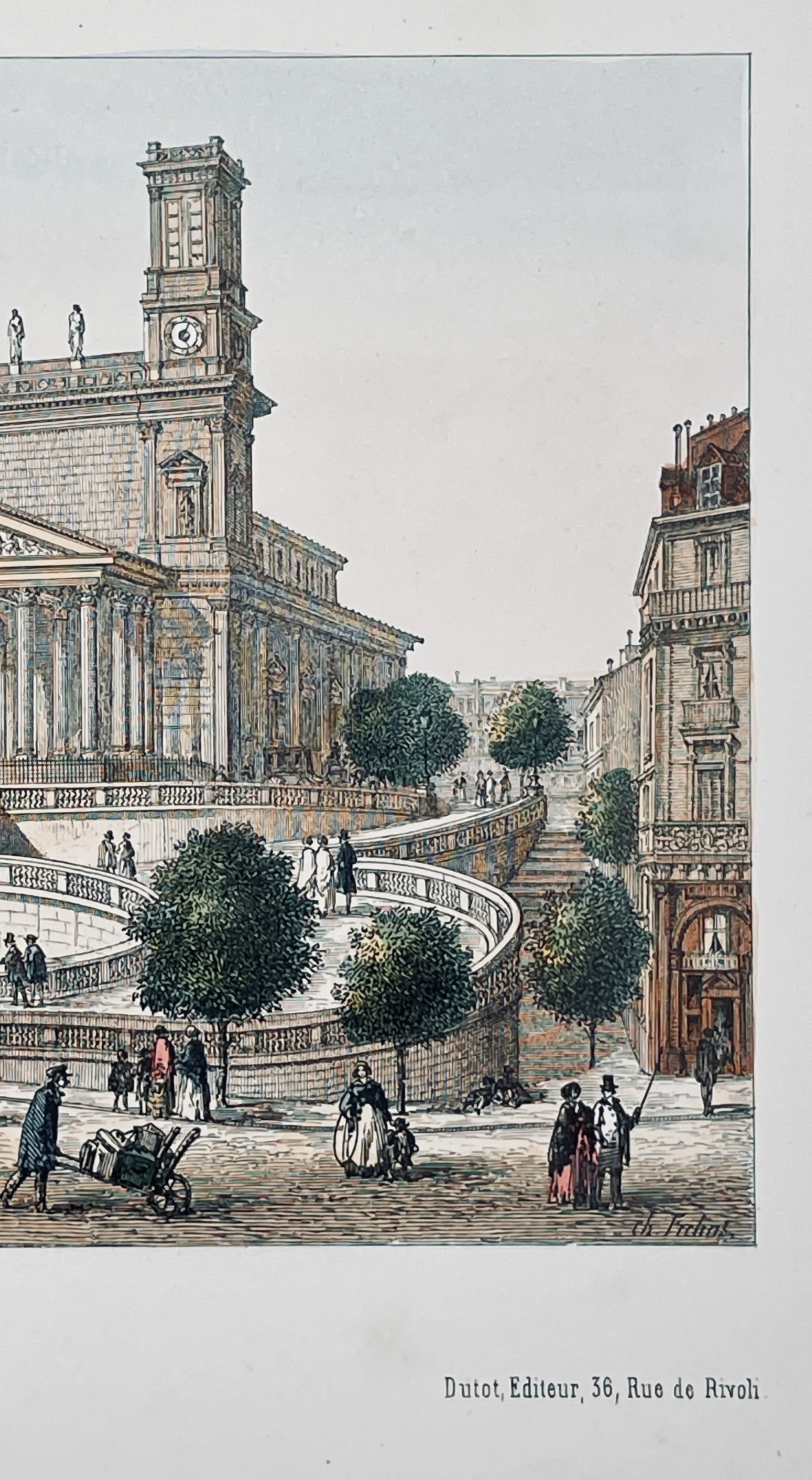
Paris, École Militaire et Champ de Mars — Isidore Laurent Deroy (1797–1886), c.1845–1860, hand-colored lithograph, France en Miniature.
Original 19th-century French hand-colored lithograph by Isidore Laurent Deroy depicting the École Militaire and Champ de Mars, Paris. From the France en Miniature series, drawn and lithographed from nature, published by E. Morier and printed by Lemercier & Cie. A lively Second Empire city view blending architecture, civic life, and leisure culture.
Artwork Description
This animated Parisian scene presents the École Militaire and the Champ de Mars, one of the capital’s most important ceremonial and recreational spaces during the 19th century. Deroy captures the broad expanse of the Champ de Mars as a stage for public spectacle, with the monumental École Militaire anchoring the background and asserting the state’s presence within the urban landscape.
In the foreground, elegantly dressed spectators gather beneath framing trees to watch mounted riders gallop across the open field. Seated figures, standing onlookers, and fashionable families create a vivid tableau of Parisian leisure culture, reflecting the era’s fascination with equestrian display, military drill, and public entertainment. The distant architecture—precisely rendered yet softened by atmospheric perspective—reinforces Deroy’s mastery of spatial depth and urban coherence.
The inscription “Dessiné d’après nature et lith. par Deroy” confirms that the artist both drew and lithographed the composition directly from observation. Fine lithographic linework delivers crisp architectural detail, while hand-applied watercolor enlivens the scene with subtle greens, warm earth tones, and carefully modulated sky hues. The restrained palette enhances realism while preserving decorative harmony.
As part of the France en Miniature series, this work functions as both a collectible artwork and a historical document, preserving the appearance and social rhythms of Paris before the sweeping transformations of the later 19th century. It exemplifies French topographical lithography at its most accomplished, where technical precision and narrative vitality coexist seamlessly.
Artist Biography
Isidore Laurent Deroy (Paris, 1797–1886) was a French painter, draftsman, and prolific lithographer renowned for his architectural and topographical views. Born in Paris, he studied under Louis-François Cassas, whose emphasis on archaeological accuracy, classical proportion, and observational rigor profoundly shaped Deroy’s artistic approach.
Deroy exhibited regularly at the Paris Salon from 1822 to 1866, gaining recognition for his ability to render monumental architecture with exacting fidelity while animating civic spaces with scenes of everyday life. Working primarily in Paris, he collaborated with leading publishers and printers to document France during a period of political upheaval, modernization, and urban expansion.
His work is characterized by precise perspective, balanced composition, and an atmospheric sensitivity that bridges documentation and artistry. Deroy’s lithographs are held in major institutional collections, including the Metropolitan Museum of Art and the Smithsonian Institution. His sons, Émile Deroy and Auguste-Victor Deroy, continued the family’s artistic legacy.
LEMERCIER & CIE (Printer, Paris)
Lemercier & Cie, founded by Rose-Joseph Lemercier, became one of Europe’s greatest lithographic establishments during the 19th century. The studio pioneered advancements in chromolithography, architectural plate printing, and high-precision transfer techniques, enabling exceptional clarity and tonal control.
Working with leading artists, government agencies, and major publishers, Lemercier produced some of the finest illustrated books and engraved views of the century. Their imprint is widely regarded as a hallmark of technical excellence and confirms this work as a period, museum-quality lithograph, not a later decorative reproduction.
Imprint on this sheet appears as:“Imp. Lemercier, r. de Seine, Paris.”
E. MORIER (Publisher, Paris)
Operating from 5 rue du Pont de Lodi, Paris, E. Morier specialized in illustrated travel plates, architectural engravings, and cultural imagery aimed at the educated middle-class market for decorative and instructional prints.
Morier’s collaborations with Deroy and Lemercier resulted in exquisitely crafted plates—particularly within the France en Miniature series—that remain highly sought after by collectors of French topographical and architectural art.
Isidore Laurent Deroy (1797–1886), Paris, École Militaire et Champ de Mars, c.1845–1860. Hand-colored lithograph from the France en Miniature series. Drawn and lithographed from nature; published by E. Morier; printed by Lemercier & Cie, Paris.
Certificate of Value & Authentication
This certifies that Paris, École Militaire et Champ de Mars is an authentic 19th-century hand-colored lithograph by Isidore Laurent Deroy (1797–1886). The work bears period inscriptions confirming authorship, publisher (E. Morier), and printer (Lemercier & Cie). Based on stylistic, technical, and historical evaluation, the artwork is verified as original and authentic.
Provenance Chain
(Collector Format)
Mitch Morse Gallery, New York (acquired in NYC and Europe)
Private Collection
Current Owner: Artfind Gallery, Washington, DC
Paris, École Militaire et Champ de Mars — Isidore Laurent Deroy (1797–1886), c.1845–1860, hand-colored lithograph, France en Miniature.
Original 19th-century French hand-colored lithograph by Isidore Laurent Deroy depicting the École Militaire and Champ de Mars, Paris. From the France en Miniature series, drawn and lithographed from nature, published by E. Morier and printed by Lemercier & Cie. A lively Second Empire city view blending architecture, civic life, and leisure culture.
Artwork Description
This animated Parisian scene presents the École Militaire and the Champ de Mars, one of the capital’s most important ceremonial and recreational spaces during the 19th century. Deroy captures the broad expanse of the Champ de Mars as a stage for public spectacle, with the monumental École Militaire anchoring the background and asserting the state’s presence within the urban landscape.
In the foreground, elegantly dressed spectators gather beneath framing trees to watch mounted riders gallop across the open field. Seated figures, standing onlookers, and fashionable families create a vivid tableau of Parisian leisure culture, reflecting the era’s fascination with equestrian display, military drill, and public entertainment. The distant architecture—precisely rendered yet softened by atmospheric perspective—reinforces Deroy’s mastery of spatial depth and urban coherence.
The inscription “Dessiné d’après nature et lith. par Deroy” confirms that the artist both drew and lithographed the composition directly from observation. Fine lithographic linework delivers crisp architectural detail, while hand-applied watercolor enlivens the scene with subtle greens, warm earth tones, and carefully modulated sky hues. The restrained palette enhances realism while preserving decorative harmony.
As part of the France en Miniature series, this work functions as both a collectible artwork and a historical document, preserving the appearance and social rhythms of Paris before the sweeping transformations of the later 19th century. It exemplifies French topographical lithography at its most accomplished, where technical precision and narrative vitality coexist seamlessly.
Artist Biography
Isidore Laurent Deroy (Paris, 1797–1886) was a French painter, draftsman, and prolific lithographer renowned for his architectural and topographical views. Born in Paris, he studied under Louis-François Cassas, whose emphasis on archaeological accuracy, classical proportion, and observational rigor profoundly shaped Deroy’s artistic approach.
Deroy exhibited regularly at the Paris Salon from 1822 to 1866, gaining recognition for his ability to render monumental architecture with exacting fidelity while animating civic spaces with scenes of everyday life. Working primarily in Paris, he collaborated with leading publishers and printers to document France during a period of political upheaval, modernization, and urban expansion.
His work is characterized by precise perspective, balanced composition, and an atmospheric sensitivity that bridges documentation and artistry. Deroy’s lithographs are held in major institutional collections, including the Metropolitan Museum of Art and the Smithsonian Institution. His sons, Émile Deroy and Auguste-Victor Deroy, continued the family’s artistic legacy.
LEMERCIER & CIE (Printer, Paris)
Lemercier & Cie, founded by Rose-Joseph Lemercier, became one of Europe’s greatest lithographic establishments during the 19th century. The studio pioneered advancements in chromolithography, architectural plate printing, and high-precision transfer techniques, enabling exceptional clarity and tonal control.
Working with leading artists, government agencies, and major publishers, Lemercier produced some of the finest illustrated books and engraved views of the century. Their imprint is widely regarded as a hallmark of technical excellence and confirms this work as a period, museum-quality lithograph, not a later decorative reproduction.
Imprint on this sheet appears as:“Imp. Lemercier, r. de Seine, Paris.”
E. MORIER (Publisher, Paris)
Operating from 5 rue du Pont de Lodi, Paris, E. Morier specialized in illustrated travel plates, architectural engravings, and cultural imagery aimed at the educated middle-class market for decorative and instructional prints.
Morier’s collaborations with Deroy and Lemercier resulted in exquisitely crafted plates—particularly within the France en Miniature series—that remain highly sought after by collectors of French topographical and architectural art.
Isidore Laurent Deroy (1797–1886), Paris, École Militaire et Champ de Mars, c.1845–1860. Hand-colored lithograph from the France en Miniature series. Drawn and lithographed from nature; published by E. Morier; printed by Lemercier & Cie, Paris.
Certificate of Value & Authentication
This certifies that Paris, École Militaire et Champ de Mars is an authentic 19th-century hand-colored lithograph by Isidore Laurent Deroy (1797–1886). The work bears period inscriptions confirming authorship, publisher (E. Morier), and printer (Lemercier & Cie). Based on stylistic, technical, and historical evaluation, the artwork is verified as original and authentic.
Provenance Chain
(Collector Format)
Mitch Morse Gallery, New York (acquired in NYC and Europe)
Private Collection
Current Owner: Artfind Gallery, Washington, DC
 Image 1 of 9
 Image 2 of 9
 Image 3 of 9
 Image 4 of 9
 Image 5 of 9
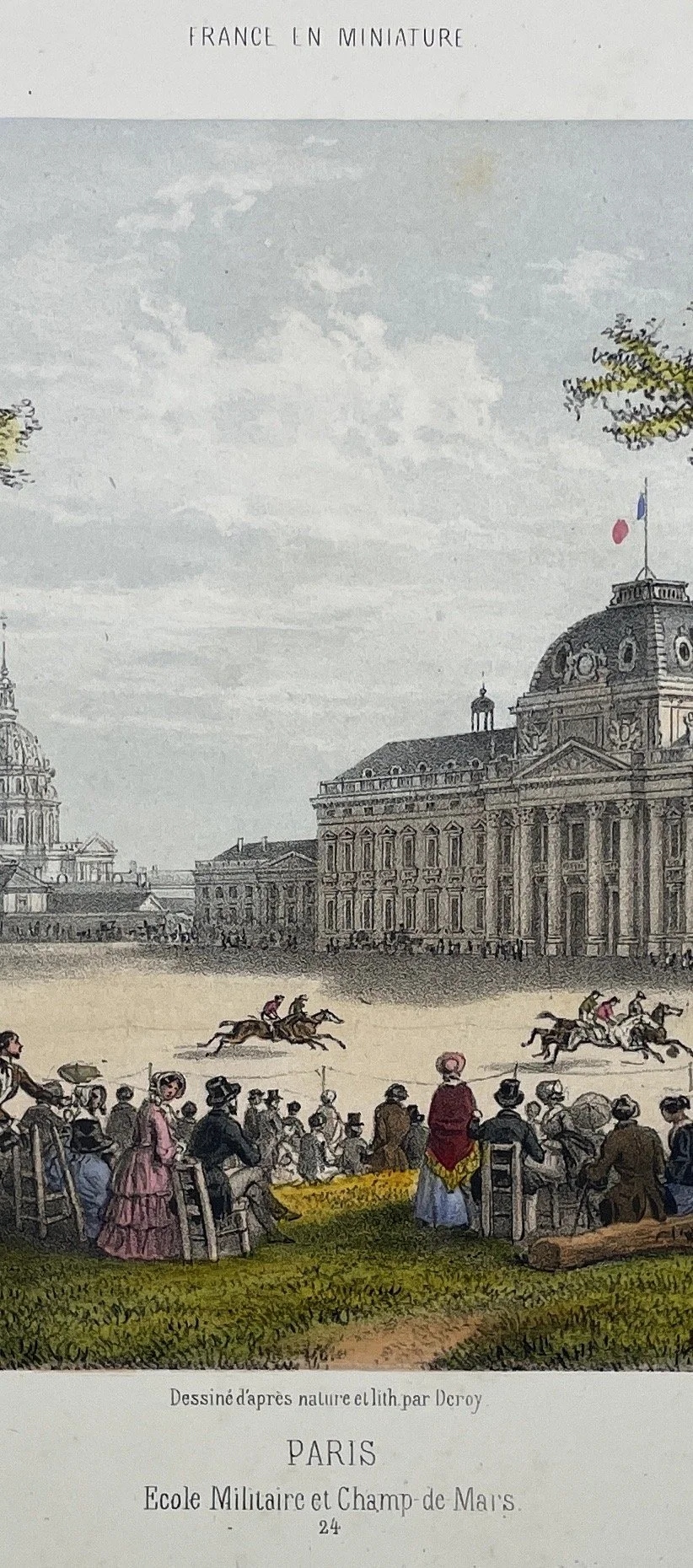 Image 6 of 9
 Image 7 of 9
 Image 8 of 9
 Image 9 of 9