“Penrhyn Castle,” Alexander Francis Lydon (1836–1917), c. 1880, Baxter-process colored woodblock engraving printed by Benjamin Fawcett (1808–1893), published by William Mackenzie, London; sheet 10½ × 8 in., image approx. 7¼ × 5⅛ in., unsigned as issued.
This magnificent Victorian Baxter-process colored woodblock engraving of Penrhyn Castle, illustrated by Alexander Francis Lydon and printed by color-master Benjamin Fawcett, was produced for the celebrated 1880 volume A Series of Picturesque Views of Seats of the Noblemen and Gentlemen of Great Britain and Ireland. Featuring the imposing Neo-Norman stronghold set amid rolling parkland and grazing sheep, this print is highly sought after by collectors of castle art, British architectural history, Victorian landscape prints, and 19th-century color woodblock engravings.
Artwork Description
This handsome engraving features Penrhyn Castle, one of Wales’s most dramatic and architecturally significant estates. Rebuilt in the early 19th century in a bold Neo-Norman style under architect Thomas Hopper, the castle is depicted here in all its fortress-like grandeur—massive round towers, battlements, machicolations, and long sightlines giving it a commanding, almost regal presence.
Alexander Francis Lydon situates the castle within an expansive pastoral landscape typical of North Wales: mature trees in warm late-summer tones frame the composition, while a flock of grazing sheep animates the foreground, reinforcing the idyllic rural atmosphere. Light filters through soft cloud formations, creating balanced contrast between the monumental stone structure and the lush, rolling greenery surrounding it.
Printed using Benjamin Fawcett’s Baxter-process color woodblock method, the plate showcases multiple layers of transparent pigments—often eight or more blocks—to achieve its rich naturalistic hues. The technique highlights the earthy stone textures, the warm natural light, the depth of shadow beneath the trees, and the atmospheric sky. This harmonious combination of precise architectural detail and gentle landscape ambiance is characteristic of the finest Lydon–Fawcett collaborations.
As part of Mackenzie’s landmark Picturesque Views series, this engraving serves not only as a decorative Victorian print but also as an important historical image documenting one of Britain’s most distinctive castle estates.
Artist & Printer Biographies
ALEXANDER FRANCIS LYDON (1836–1917) — Illustrator
Lydon was a leading Victorian illustrator celebrated for his architectural accuracy, delicate landscapes, and refined composition. Trained in Benjamin Fawcett’s workshop, he became a central figure in 19th-century illustrated volumes, especially those produced with Fawcett and Rev. Francis Orpen Morris. His country-house plates remain treasured for their clarity, historical value, and artistic craftsmanship.
BENJAMIN FAWCETT (1808–1893) — Printer
Fawcett was a pioneer in advanced woodblock color printing and a master adapter of the Baxter-process. Operating from Driffield, Yorkshire, he produced some of the most technically exquisite color illustrations of the Victorian era. His work is defined by exceptional registration accuracy, transparent tonal layering, and crisp architectural rendering—qualities clearly visible in this Penrhyn Castle plate.
WILLIAM MACKENZIE — Publisher
A leading Victorian publisher of grand illustrated volumes, Mackenzie issued richly bound works featuring detailed architectural, natural history, and geographical illustrations. His Picturesque Views of Seats of the Noblemen and Gentlemen of Great Britain and Ireland is a cornerstone of 19th-century topographical documentation.
Alexander Francis Lydon (illustrator), Benjamin Fawcett (printer), “Penrhyn Castle,” c. 1880. Baxter-process colored woodblock engraving from Picturesque Views of Seats of the Noblemen and Gentlemen of Great Britain and Ireland. Image approx. 7¼ × 5⅛ in.; sheet 10½ × 8 in. Vivid color; excellent condition; strong impression.
CERTIFICATE OF VALUE & AUTHENTICATION
For Fine Art Appraisal / Insurance / Gallery Documentation
Title: Penrhyn Castle
Illustrator: Alexander Francis Lydon (1836–1917)
Printer: Benjamin Fawcett (1808–1893)
Publisher: William Mackenzie, London / Edinburgh / Dublin
Date: c. 1880
Medium: Baxter-process colored woodblock engraving (multi-block; approx. 8 colors)
Sheet Size: 10½ × 8 inches
Image Size: approx. 7¼ × 5⅛ inches
Condition: Exceptional color; clean margins; crisp detail; never framed or displayed
Current Owner: Artfind Gallery, Washington, DC
Authentication: Verified Victorian production consistent with Lydon–Fawcett technical and stylistic standards.
Provenance Chain
Published by William Mackenzie, London / Edinburgh / Dublin (c. 1880)
Private British Collection
Mitch Moore Gallery Inc., NYC (retired inventory)
Current Owner: Artfind Gallery, Washington, DC
“Penrhyn Castle,” Alexander Francis Lydon (1836–1917), c. 1880, Baxter-process colored woodblock engraving printed by Benjamin Fawcett (1808–1893), published by William Mackenzie, London; sheet 10½ × 8 in., image approx. 7¼ × 5⅛ in., unsigned as issued.
This magnificent Victorian Baxter-process colored woodblock engraving of Penrhyn Castle, illustrated by Alexander Francis Lydon and printed by color-master Benjamin Fawcett, was produced for the celebrated 1880 volume A Series of Picturesque Views of Seats of the Noblemen and Gentlemen of Great Britain and Ireland. Featuring the imposing Neo-Norman stronghold set amid rolling parkland and grazing sheep, this print is highly sought after by collectors of castle art, British architectural history, Victorian landscape prints, and 19th-century color woodblock engravings.
Artwork Description
This handsome engraving features Penrhyn Castle, one of Wales’s most dramatic and architecturally significant estates. Rebuilt in the early 19th century in a bold Neo-Norman style under architect Thomas Hopper, the castle is depicted here in all its fortress-like grandeur—massive round towers, battlements, machicolations, and long sightlines giving it a commanding, almost regal presence.
Alexander Francis Lydon situates the castle within an expansive pastoral landscape typical of North Wales: mature trees in warm late-summer tones frame the composition, while a flock of grazing sheep animates the foreground, reinforcing the idyllic rural atmosphere. Light filters through soft cloud formations, creating balanced contrast between the monumental stone structure and the lush, rolling greenery surrounding it.
Printed using Benjamin Fawcett’s Baxter-process color woodblock method, the plate showcases multiple layers of transparent pigments—often eight or more blocks—to achieve its rich naturalistic hues. The technique highlights the earthy stone textures, the warm natural light, the depth of shadow beneath the trees, and the atmospheric sky. This harmonious combination of precise architectural detail and gentle landscape ambiance is characteristic of the finest Lydon–Fawcett collaborations.
As part of Mackenzie’s landmark Picturesque Views series, this engraving serves not only as a decorative Victorian print but also as an important historical image documenting one of Britain’s most distinctive castle estates.
Artist & Printer Biographies
ALEXANDER FRANCIS LYDON (1836–1917) — Illustrator
Lydon was a leading Victorian illustrator celebrated for his architectural accuracy, delicate landscapes, and refined composition. Trained in Benjamin Fawcett’s workshop, he became a central figure in 19th-century illustrated volumes, especially those produced with Fawcett and Rev. Francis Orpen Morris. His country-house plates remain treasured for their clarity, historical value, and artistic craftsmanship.
BENJAMIN FAWCETT (1808–1893) — Printer
Fawcett was a pioneer in advanced woodblock color printing and a master adapter of the Baxter-process. Operating from Driffield, Yorkshire, he produced some of the most technically exquisite color illustrations of the Victorian era. His work is defined by exceptional registration accuracy, transparent tonal layering, and crisp architectural rendering—qualities clearly visible in this Penrhyn Castle plate.
WILLIAM MACKENZIE — Publisher
A leading Victorian publisher of grand illustrated volumes, Mackenzie issued richly bound works featuring detailed architectural, natural history, and geographical illustrations. His Picturesque Views of Seats of the Noblemen and Gentlemen of Great Britain and Ireland is a cornerstone of 19th-century topographical documentation.
Alexander Francis Lydon (illustrator), Benjamin Fawcett (printer), “Penrhyn Castle,” c. 1880. Baxter-process colored woodblock engraving from Picturesque Views of Seats of the Noblemen and Gentlemen of Great Britain and Ireland. Image approx. 7¼ × 5⅛ in.; sheet 10½ × 8 in. Vivid color; excellent condition; strong impression.
CERTIFICATE OF VALUE & AUTHENTICATION
For Fine Art Appraisal / Insurance / Gallery Documentation
Title: Penrhyn Castle
Illustrator: Alexander Francis Lydon (1836–1917)
Printer: Benjamin Fawcett (1808–1893)
Publisher: William Mackenzie, London / Edinburgh / Dublin
Date: c. 1880
Medium: Baxter-process colored woodblock engraving (multi-block; approx. 8 colors)
Sheet Size: 10½ × 8 inches
Image Size: approx. 7¼ × 5⅛ inches
Condition: Exceptional color; clean margins; crisp detail; never framed or displayed
Current Owner: Artfind Gallery, Washington, DC
Authentication: Verified Victorian production consistent with Lydon–Fawcett technical and stylistic standards.
Provenance Chain
Published by William Mackenzie, London / Edinburgh / Dublin (c. 1880)
Private British Collection
Mitch Moore Gallery Inc., NYC (retired inventory)
Current Owner: Artfind Gallery, Washington, DC
 Image 1 of 7
 Image 2 of 7
 Image 3 of 7
 Image 4 of 7
 Image 5 of 7
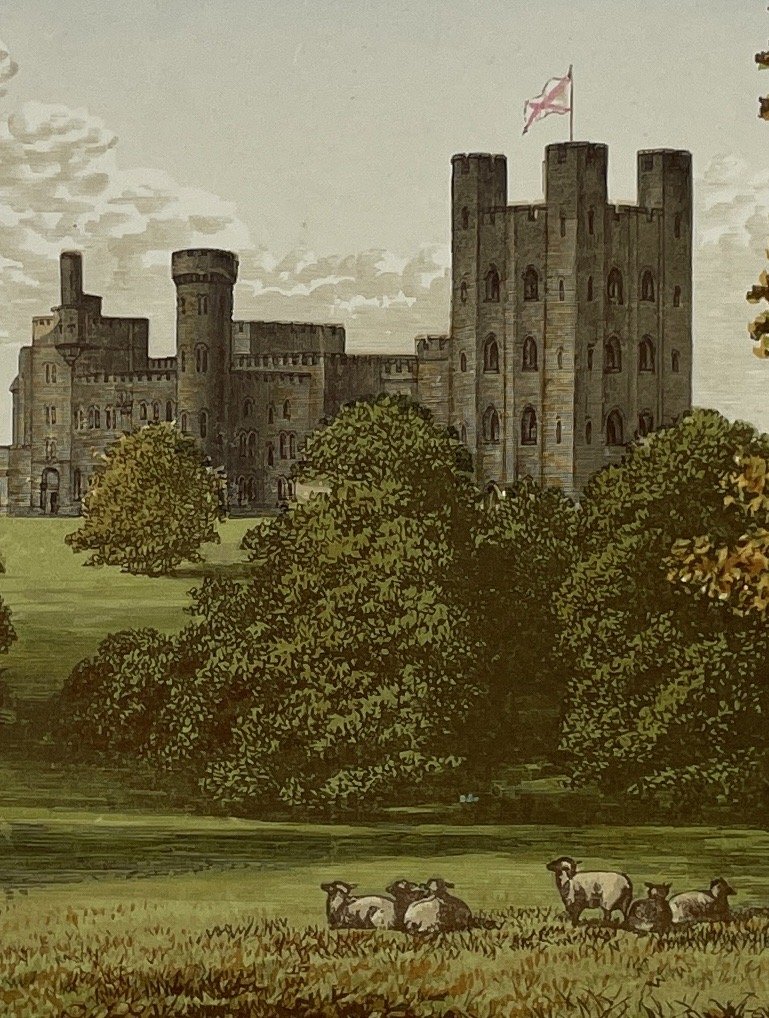 Image 6 of 7
 Image 7 of 7


