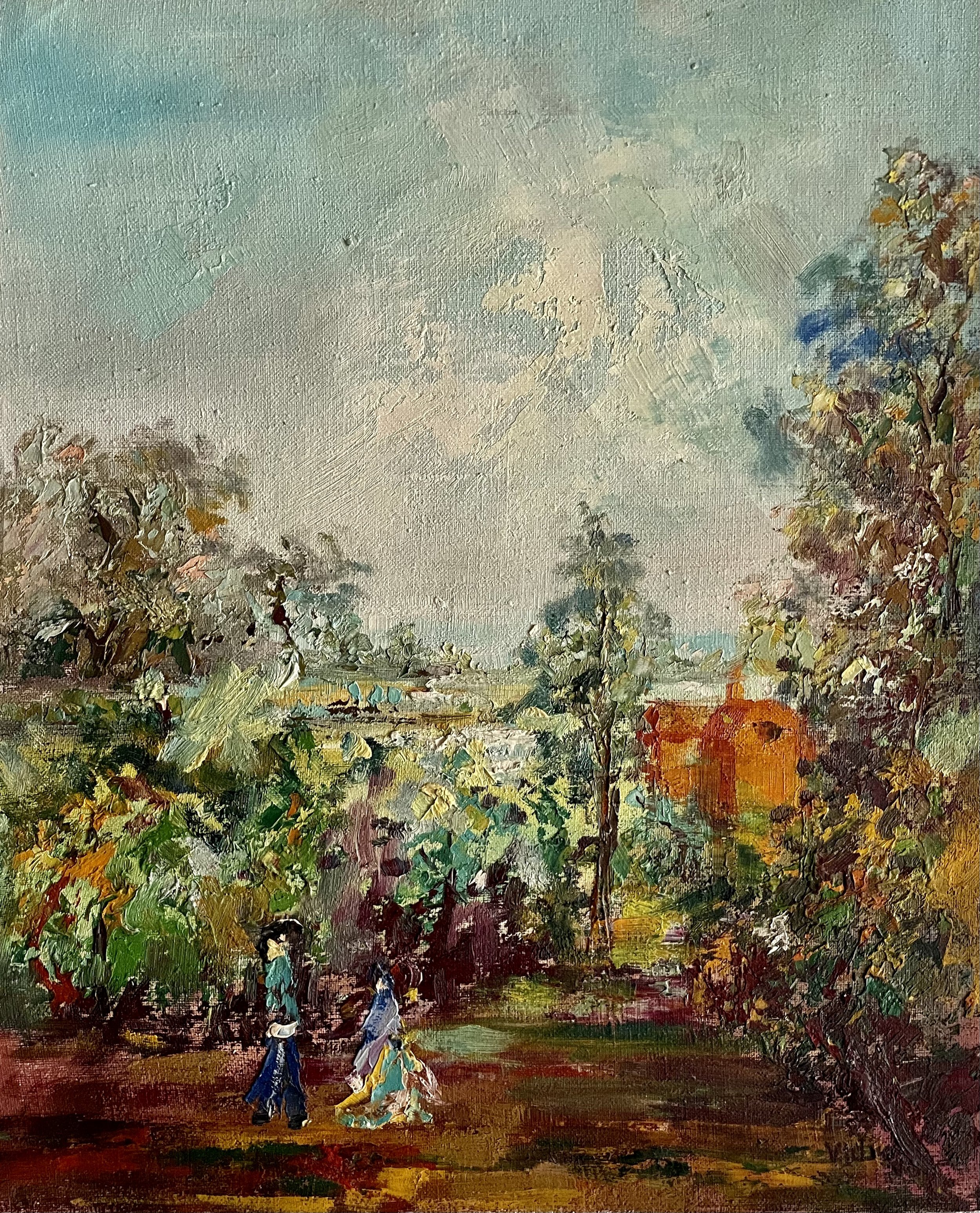
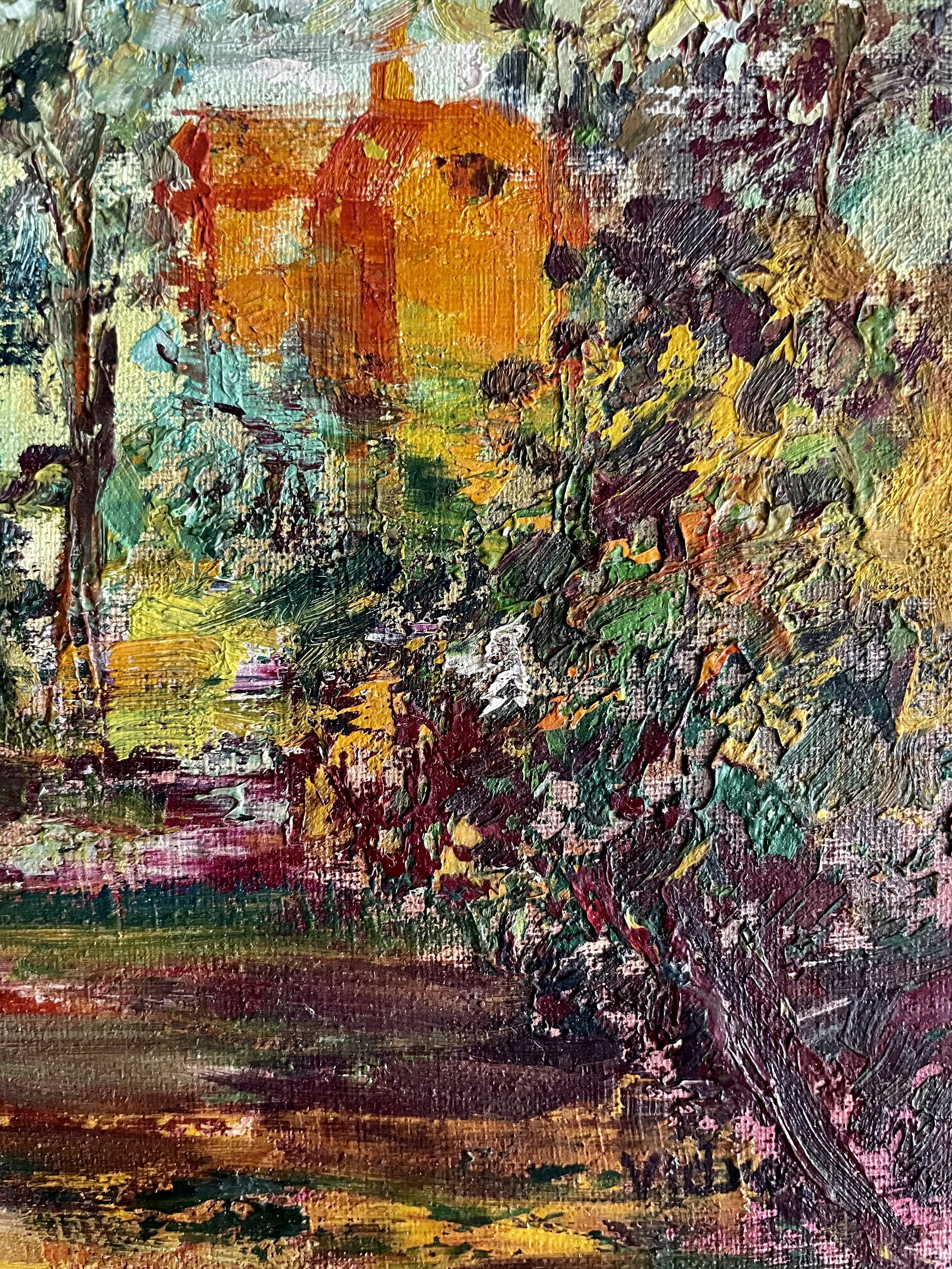
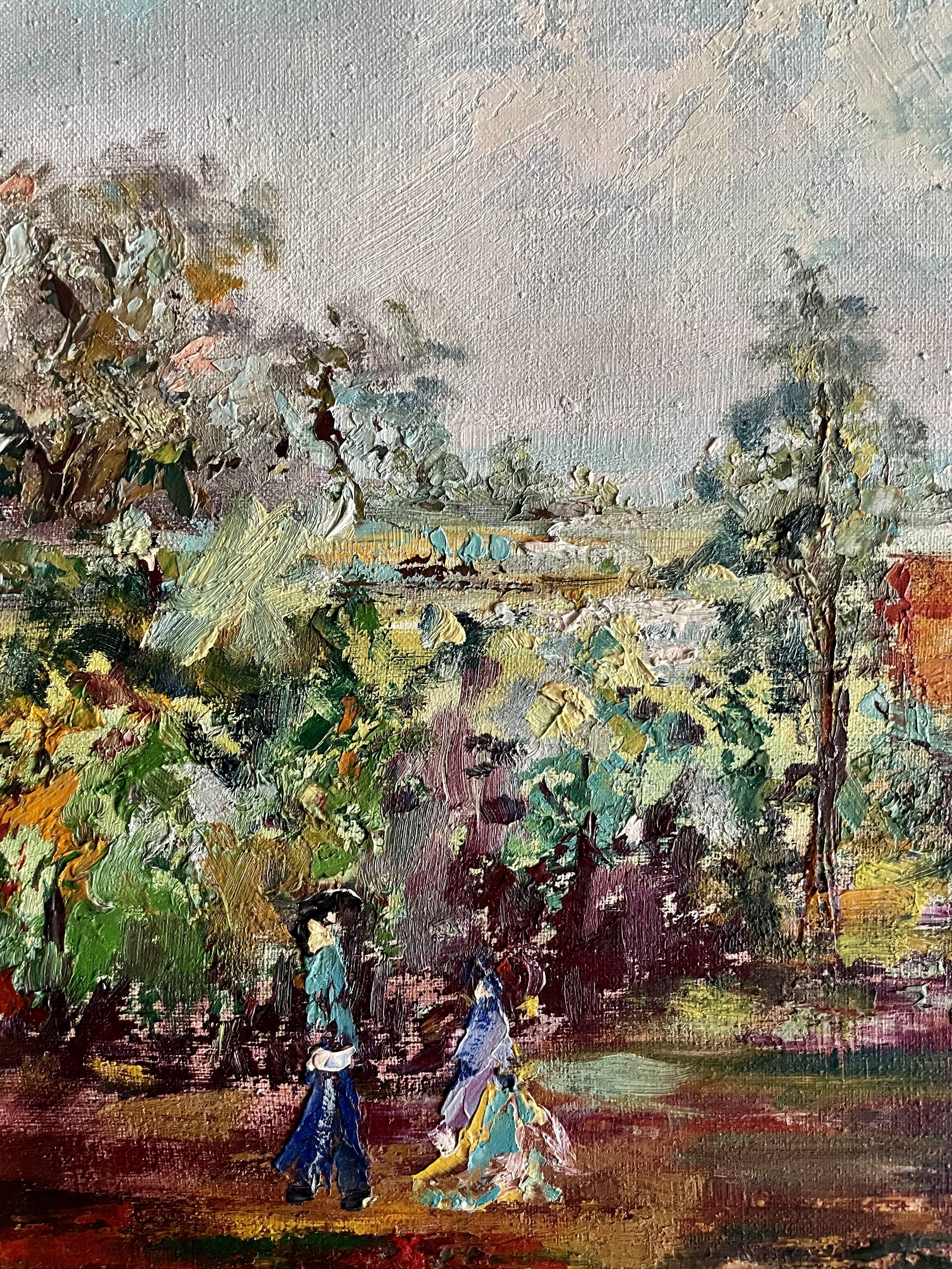
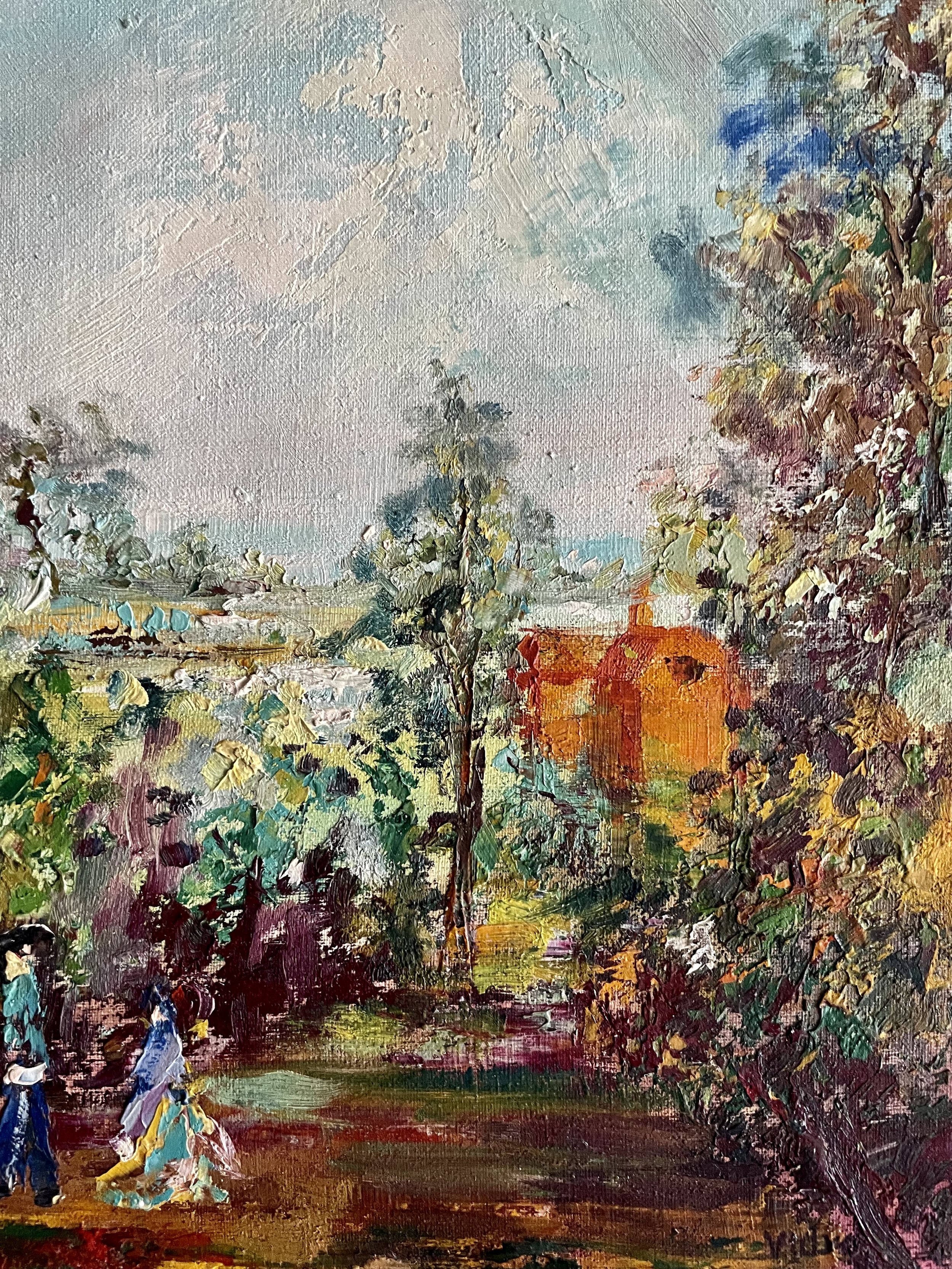
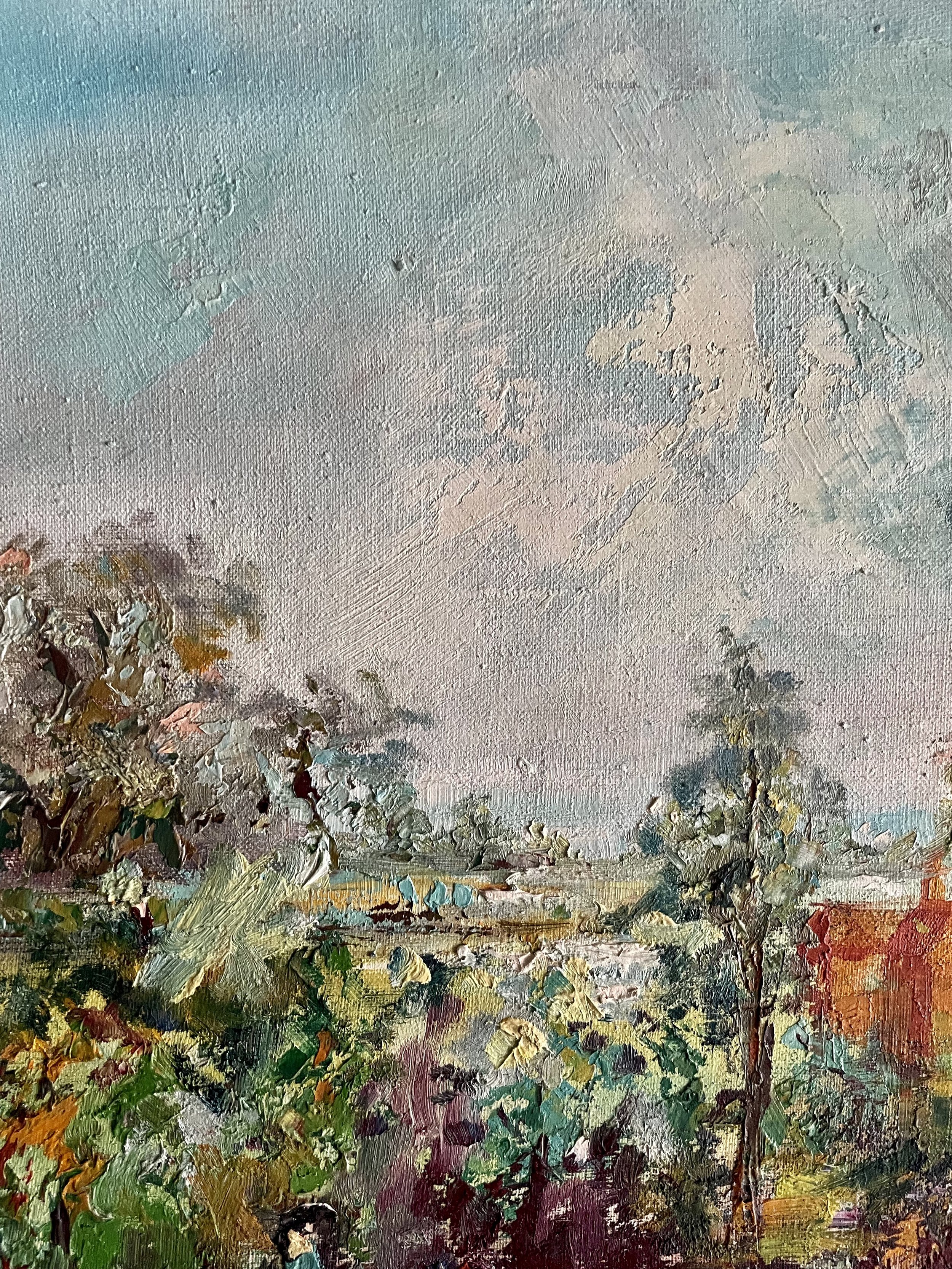
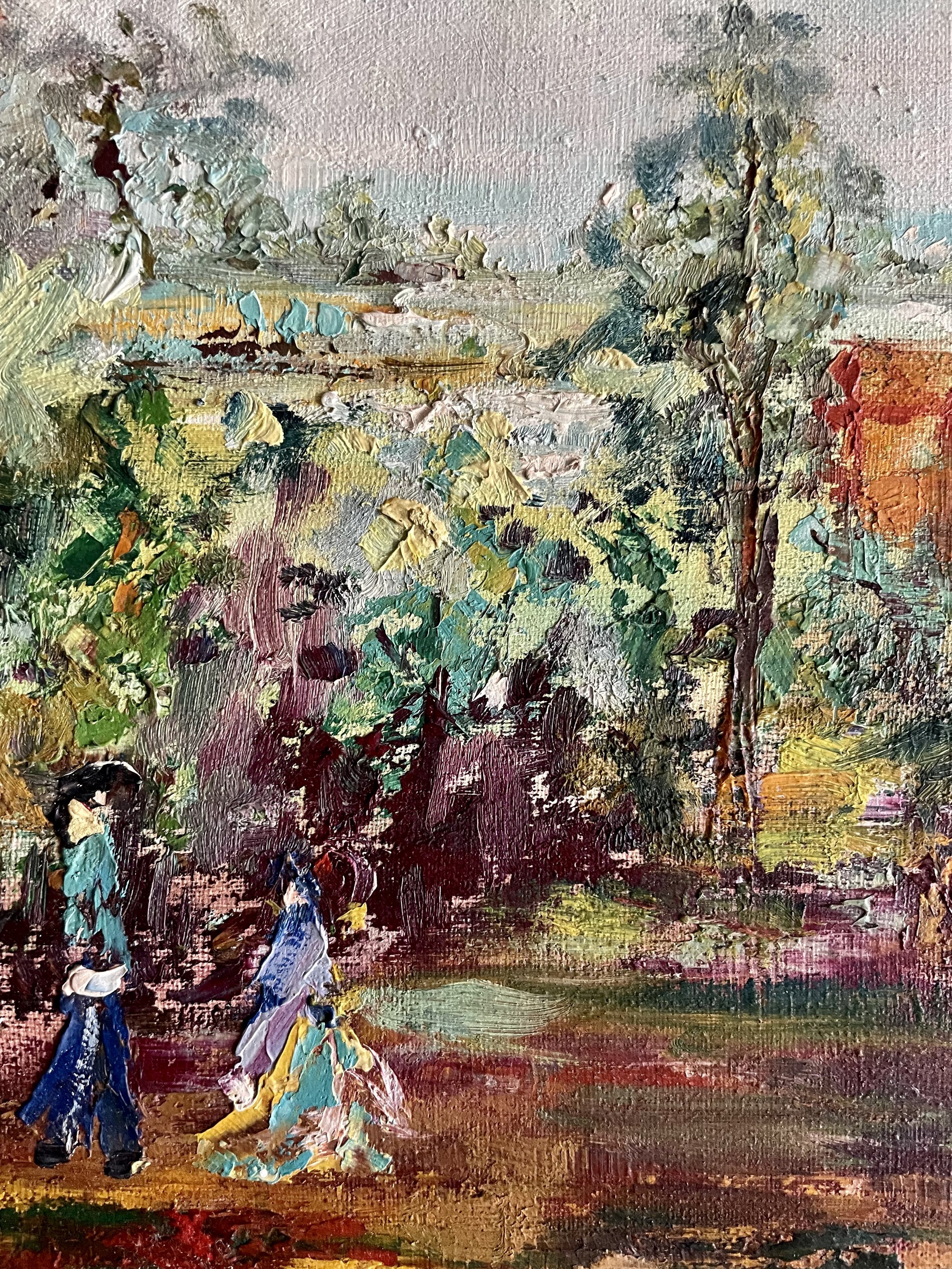
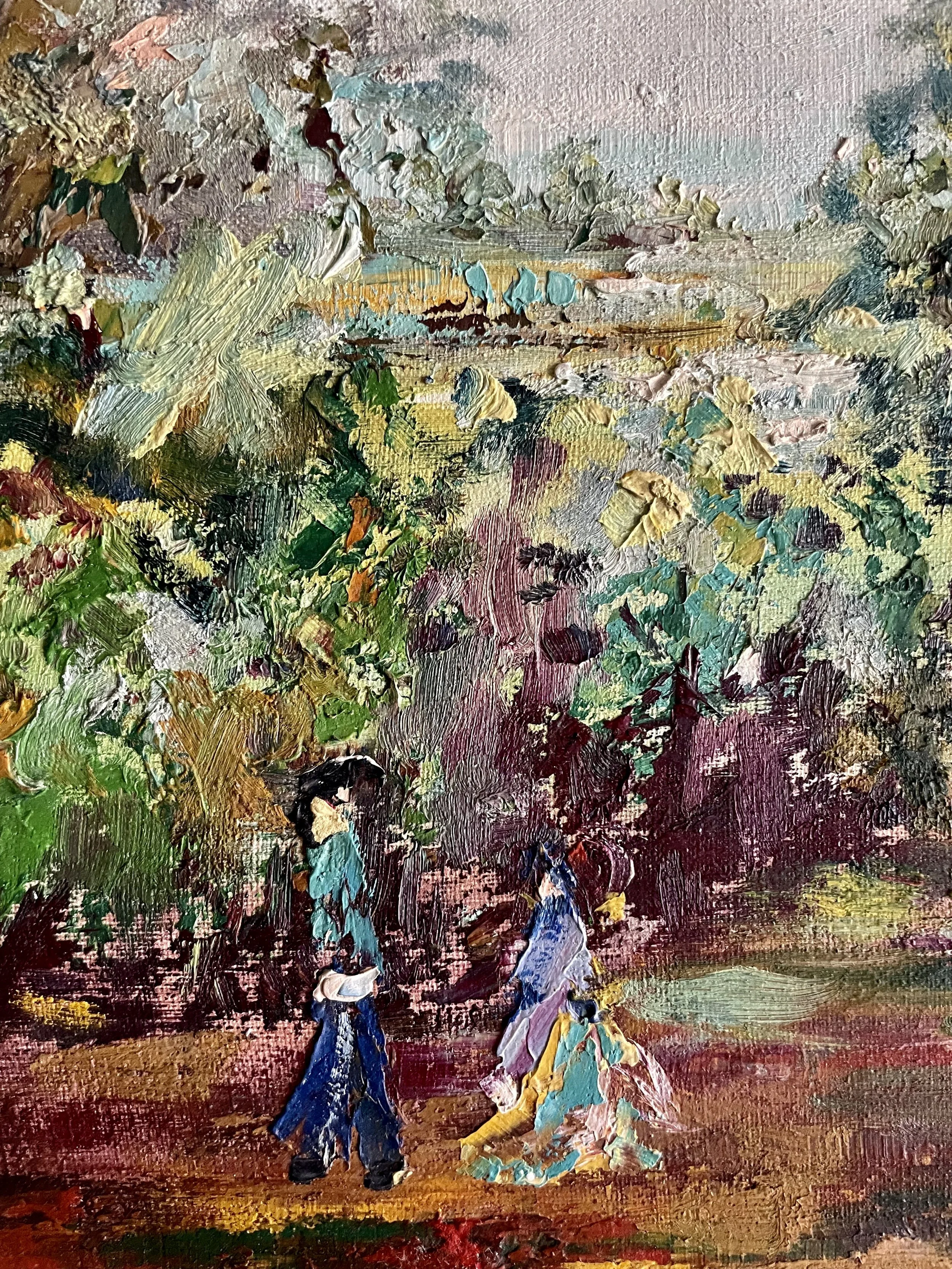
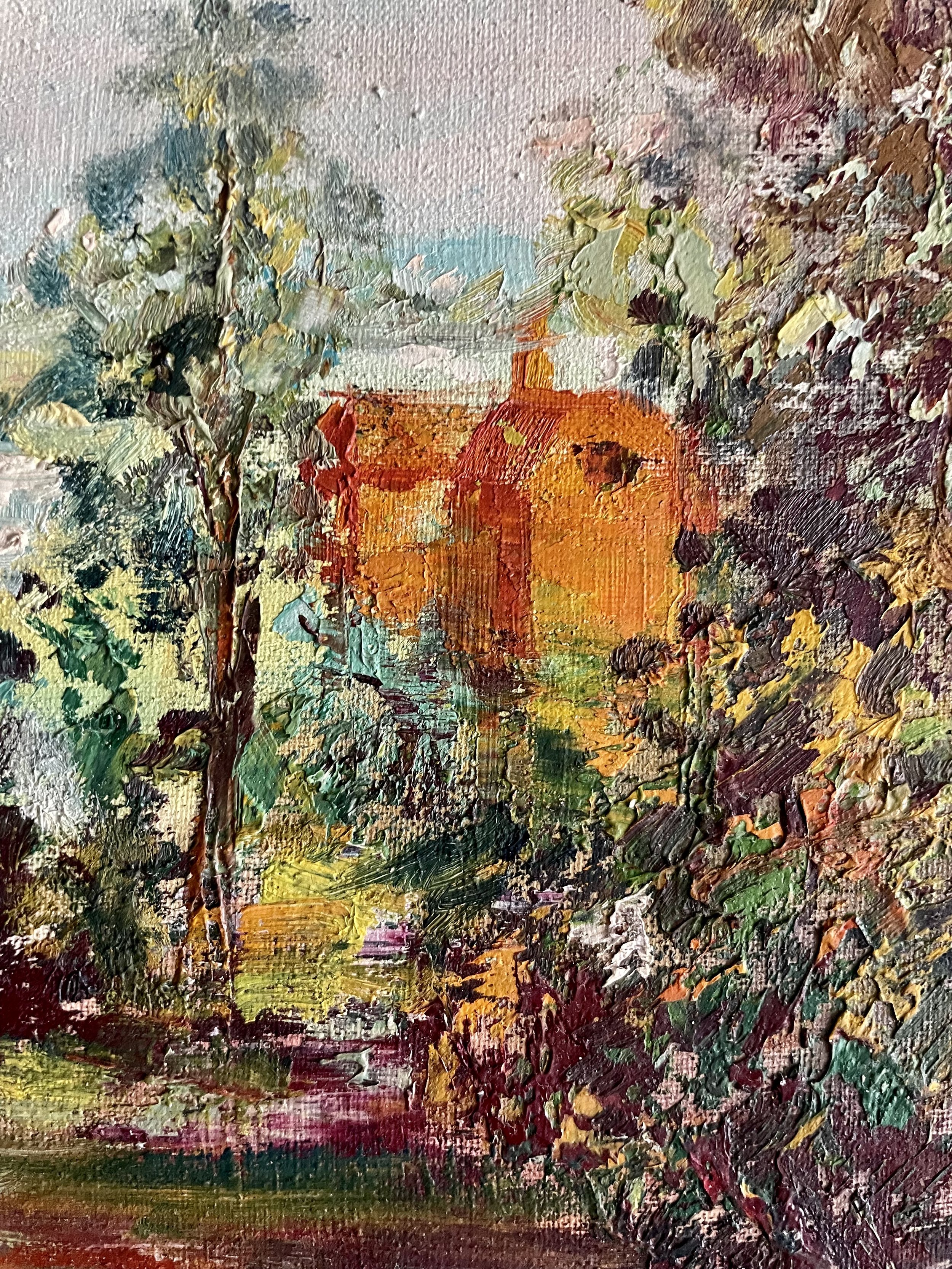
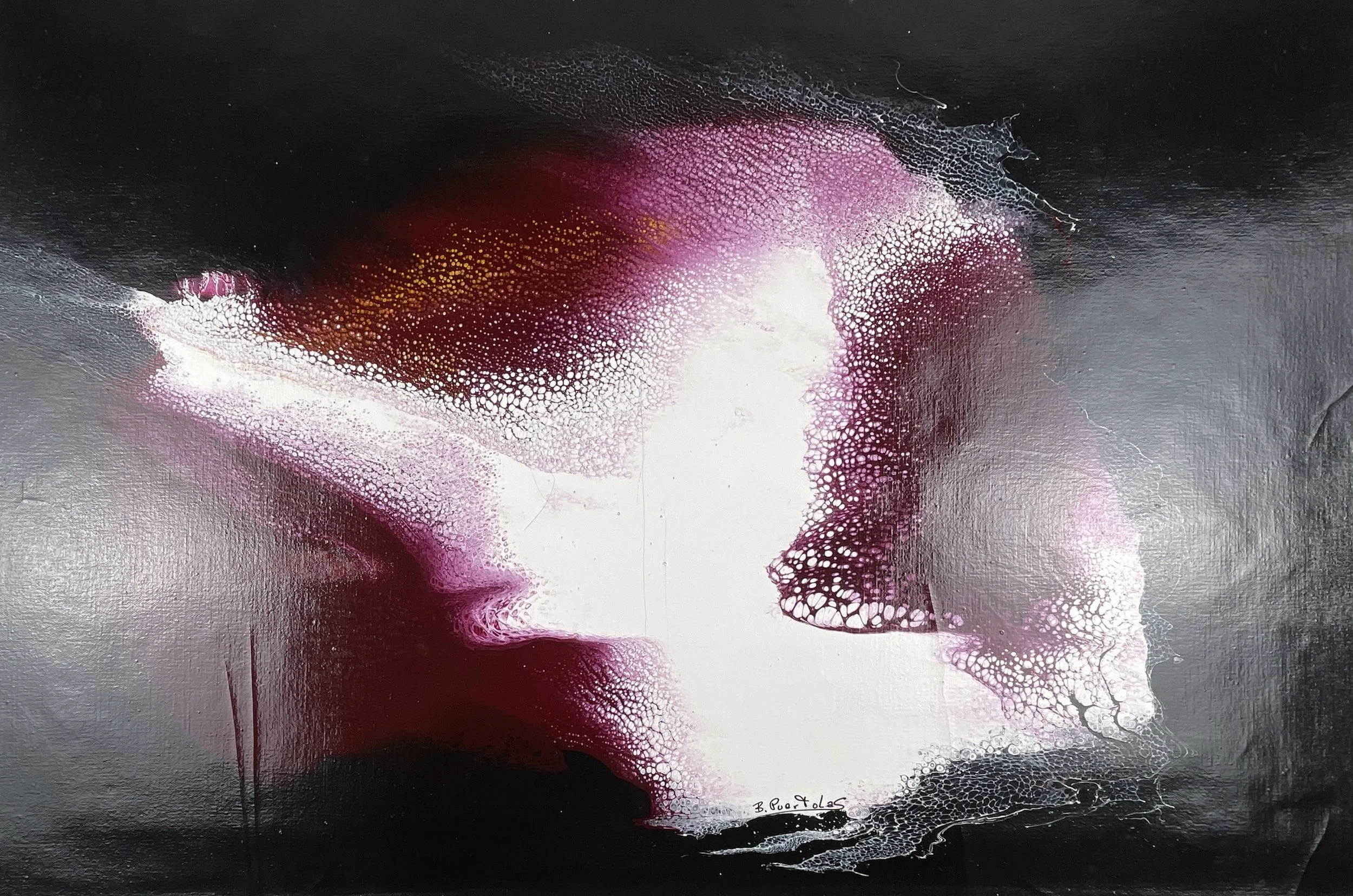
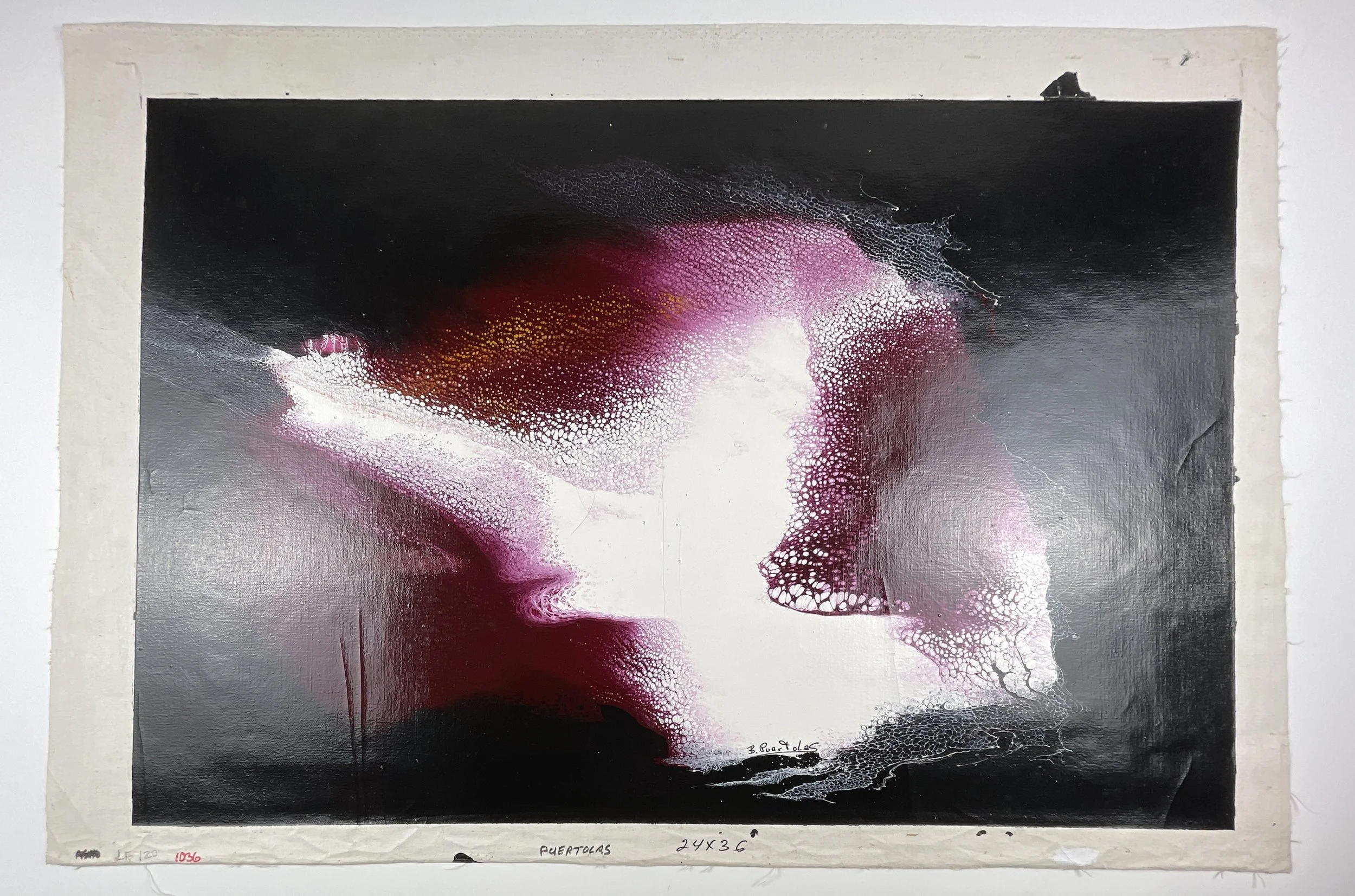
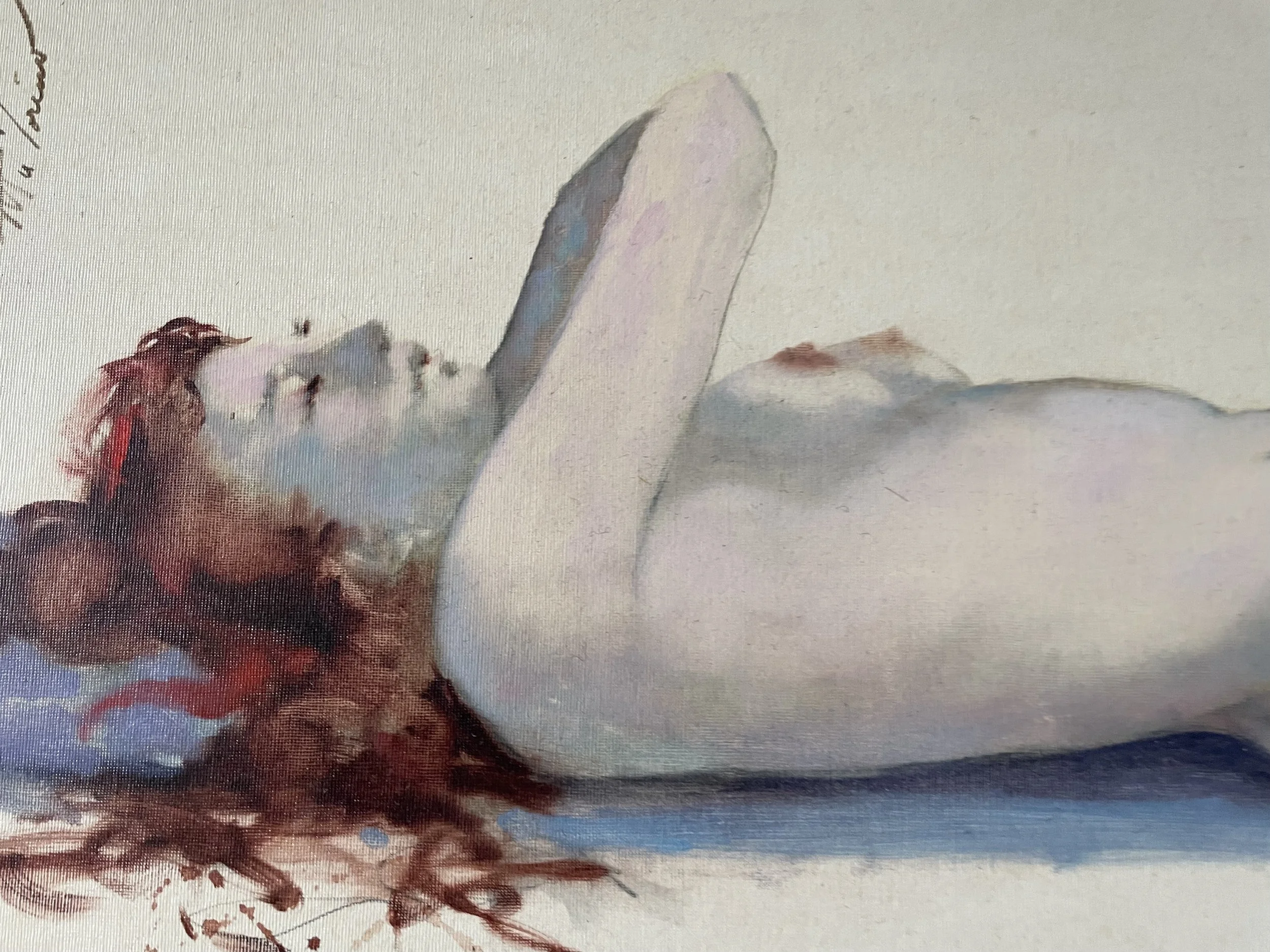
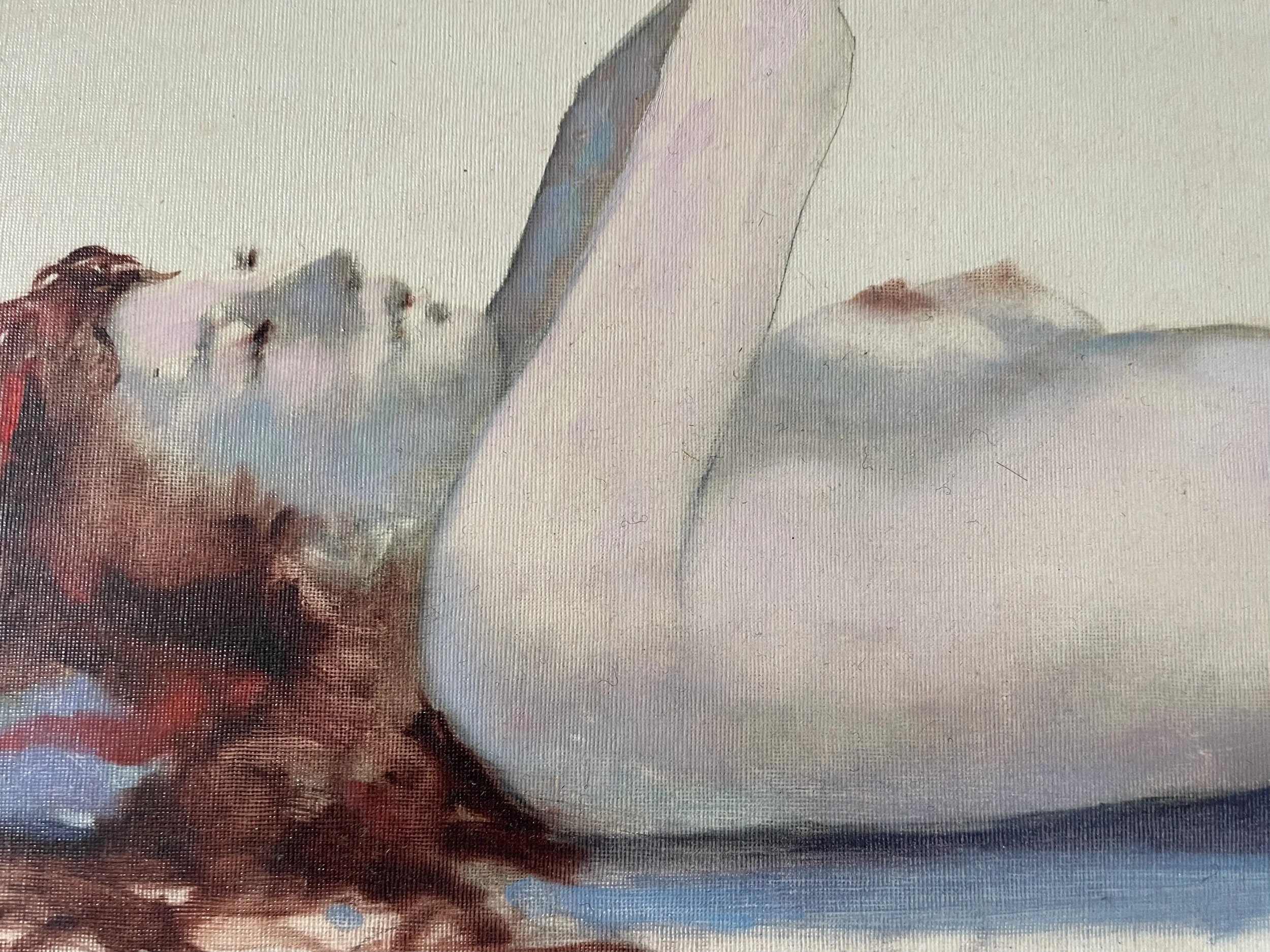
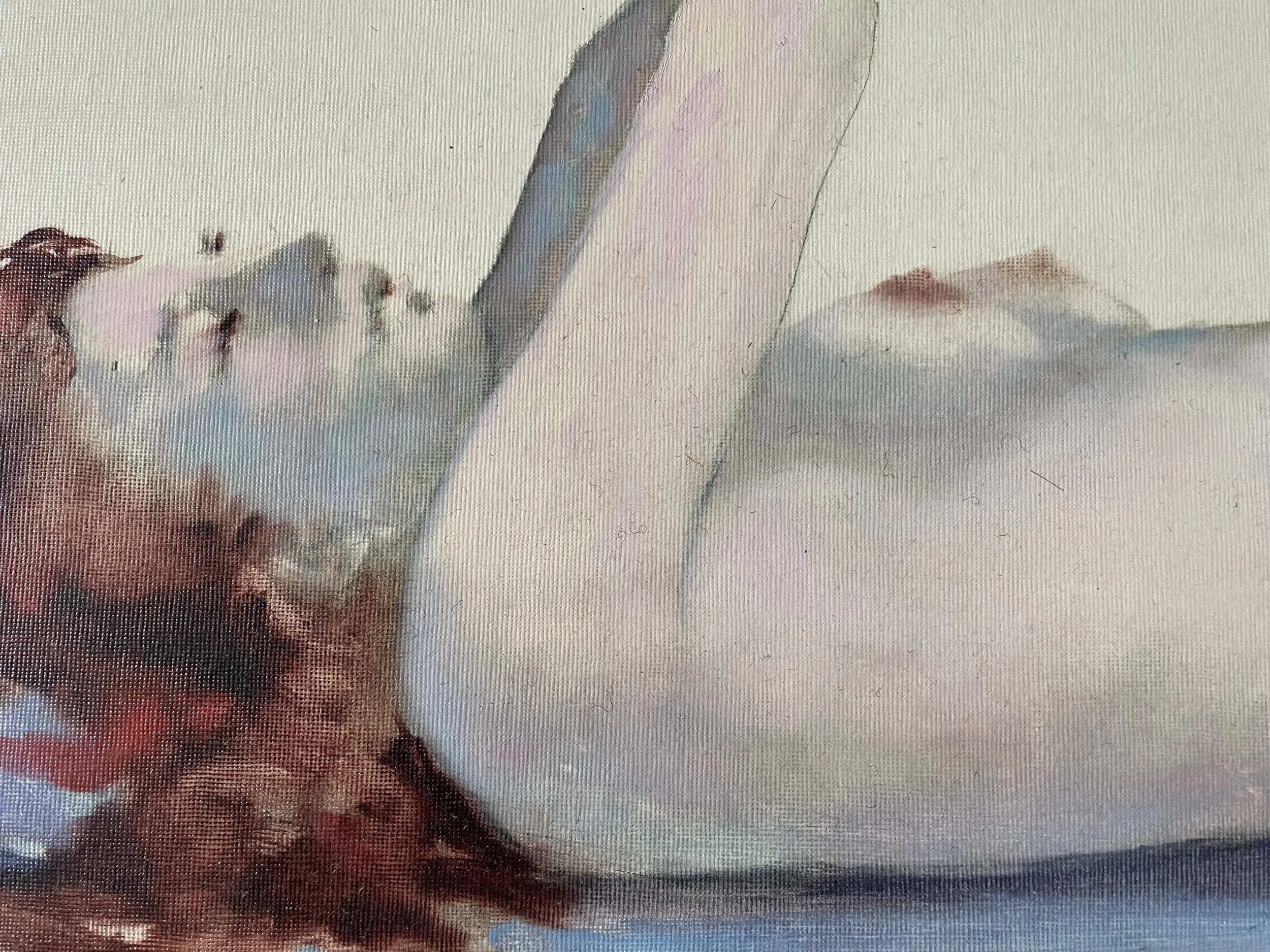
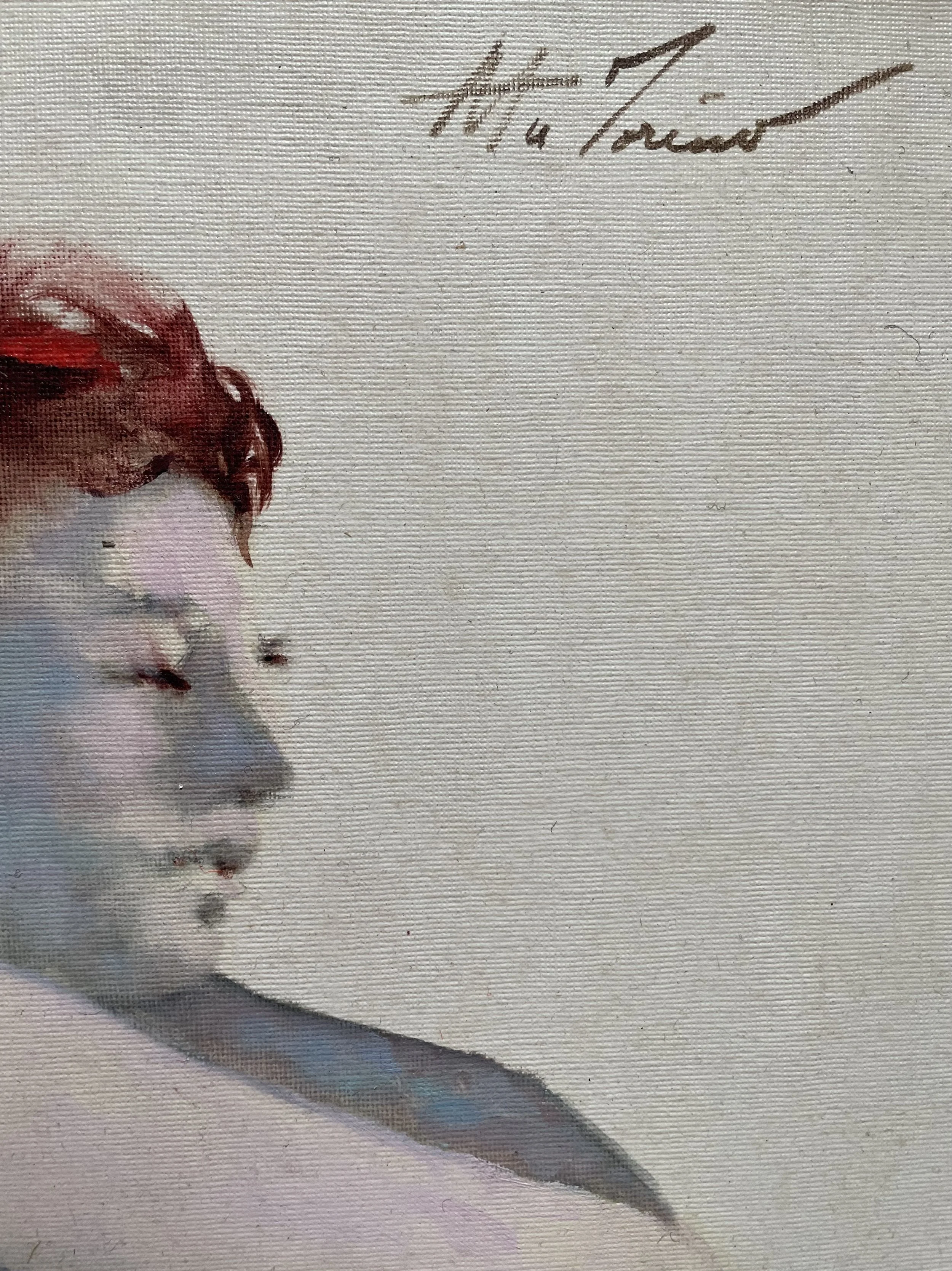
Streetscape Paris (Montmartre), Jenkins, c. 1960s–1980s, impasto oil on canvas, 23 × 36 in., signed lower right.
Artwork Description
A vigorously executed impasto oil painting depicting a bustling street scene in the Montmartre district of Paris, with the distinctive white domes of the Basilique du Sacré-Cœur rising through the trees in the upper left background — the unmistakable landmark that anchors this composition geographically and emotionally in the 18th arrondissement.
The painting is alive with commercial and social energy. The street is lined with the signage of Parisian daily life — a coiffeur, a bistro, a bar, the Café d'Alsace, the Hôtel Paris, Chez Pierre, Vin Rouge — the lettered signs painted directly into the composition with bold, confident strokes that function both as urban documentary and as a compositional device, creating horizontal bands of color and text across the middle ground. The palette knife and brush handling is energetic throughout — thick ridges of paint build up the tree trunks, storefronts, and architectural facades, while the crowd below is rendered in loose, colorful dabs of pink, teal, yellow, and red suggesting figures rather than describing them.
The foreground is a wet, reflective pavement — silvery grey impasto laid with broad strokes suggesting the characteristic damp light of a Paris street after rain. Figures move through this light-saturated ground in both directions, the pavement reflecting their colored forms. The trees, rendered with nervous, animated brushwork in olive, yellow-green, and dark brown, frame the composition vertically and create a sense of depth that draws the eye back toward the Sacré-Cœur.
The composition follows the well-established conventions of the mid-century Parisian street scene genre — a genre that counted Édouard Cortès, Antoine Blanchard, and their many contemporaries and followers among its most prolific practitioners. What distinguishes this example is the particular energy and freedom of the impasto handling — the paint surface is genuinely three-dimensional, built up with palette knife and brush in a manner that catches light differently at different viewing angles, giving the work a physical presence beyond the merely decorative.
At 23 × 36 inches this is a substantial canvas — a scale that allowed the artist to develop the composition's spatial depth and the crowd's animated energy with confidence and authority.
Artist Biography
Jenkins (active c. 1960s–1980s). The single surname signature is consistent with practice among many mid-century painters working in the commercially successful Parisian street scene genre — a tradition with deep roots in the work of Édouard Cortès (1882–1969) and Eugène Galien-Laloue (1854–1941), carried forward by dozens of painters working in Paris and beyond who found a ready international market for atmospheric city views through gallery, hotel, and dealer networks of the kind operated by Mitch Morse Gallery.
The technical confidence of this work — particularly the handling of impasto, the assured lettered signage, and the spatial construction — suggests an artist with genuine academic training working fluently within this genre. The Montmartre subject with Sacré-Cœur was among the most commercially sought-after in this tradition, and the scale and execution of this canvas positions it among the more ambitious examples.
Acquired through Mitch Morse Gallery, New York. Further biographical research in progress — inquiries from researchers with knowledge of this artist are welcomed.
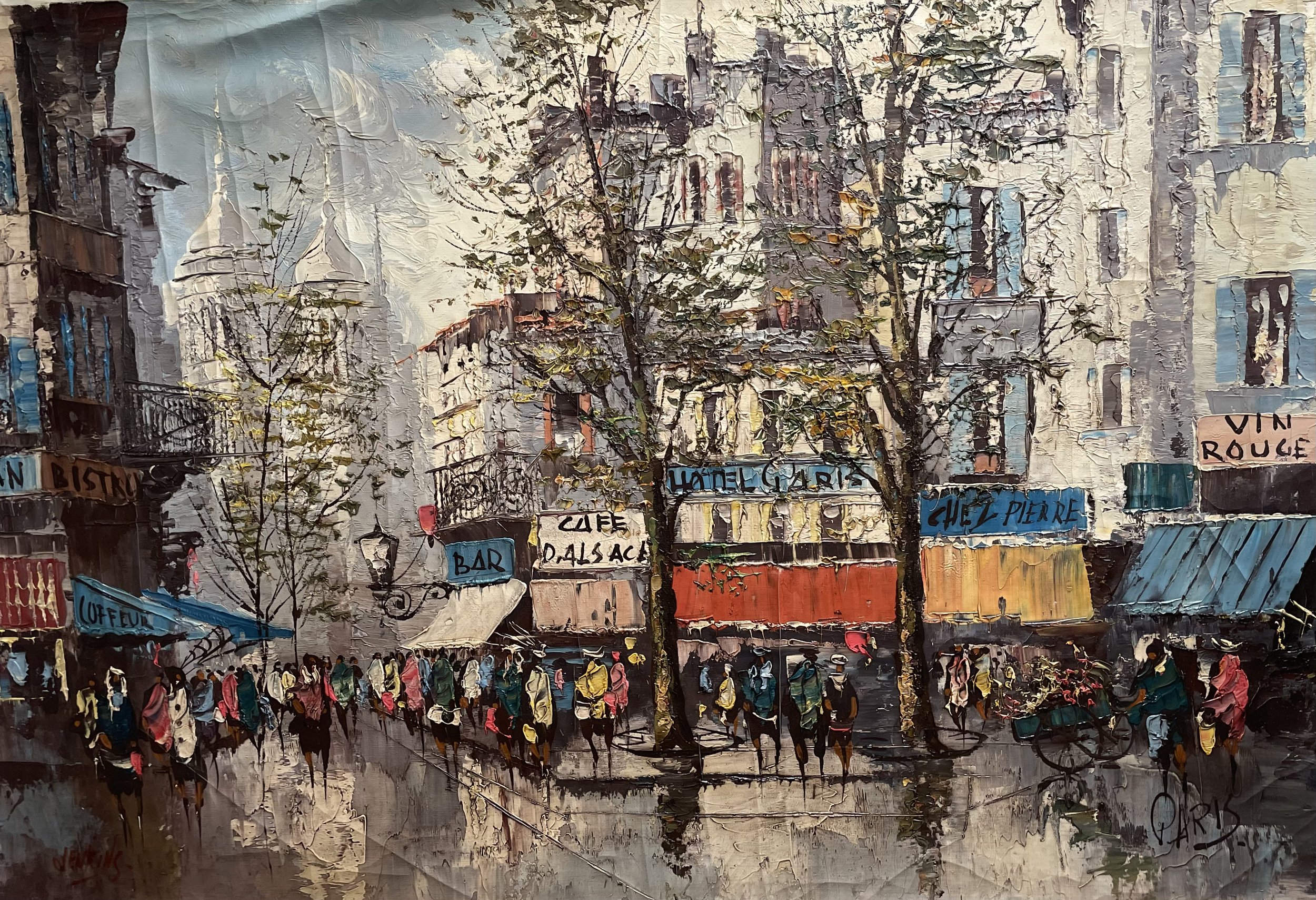 Image 1 of 13
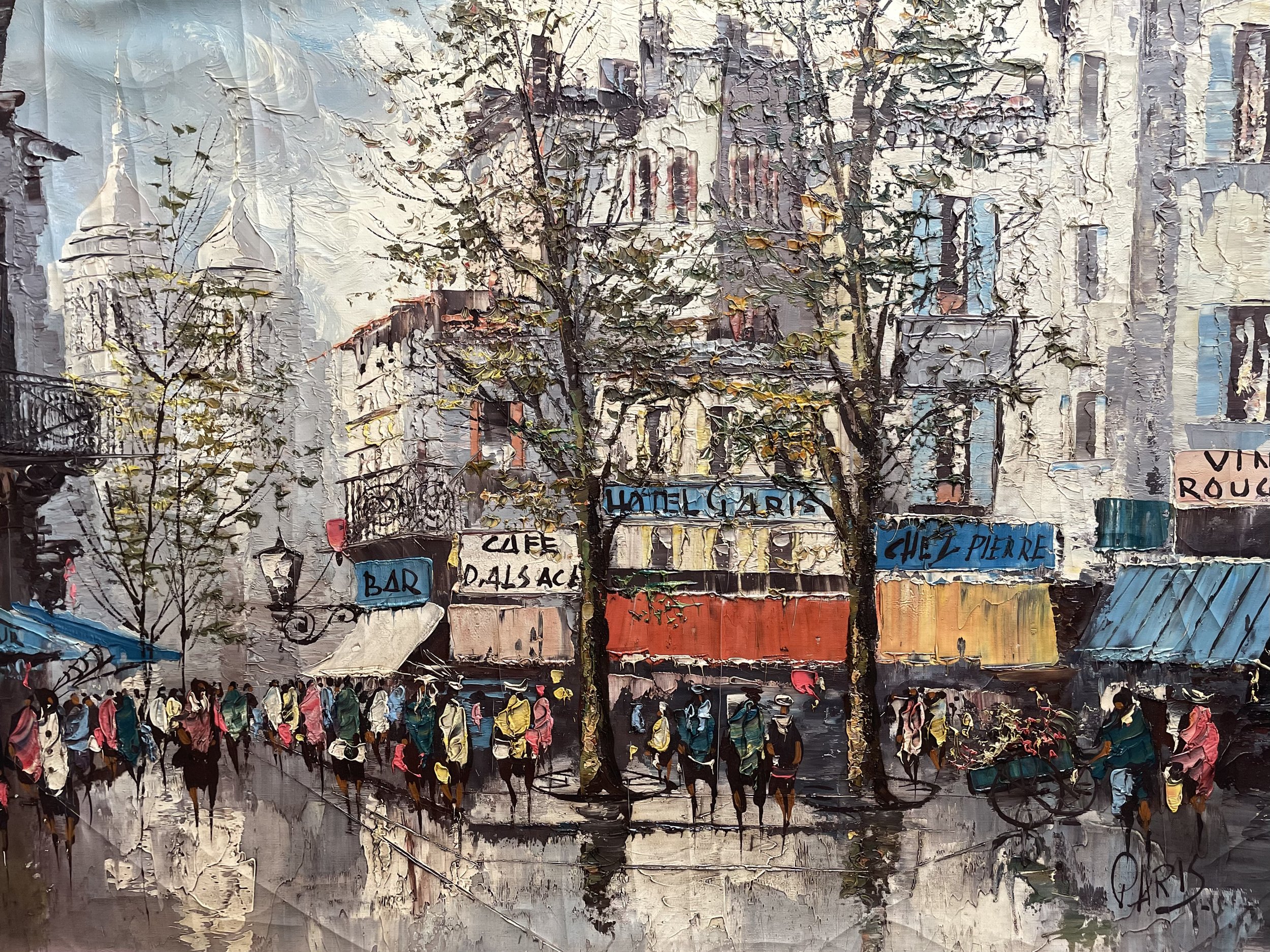 Image 2 of 13
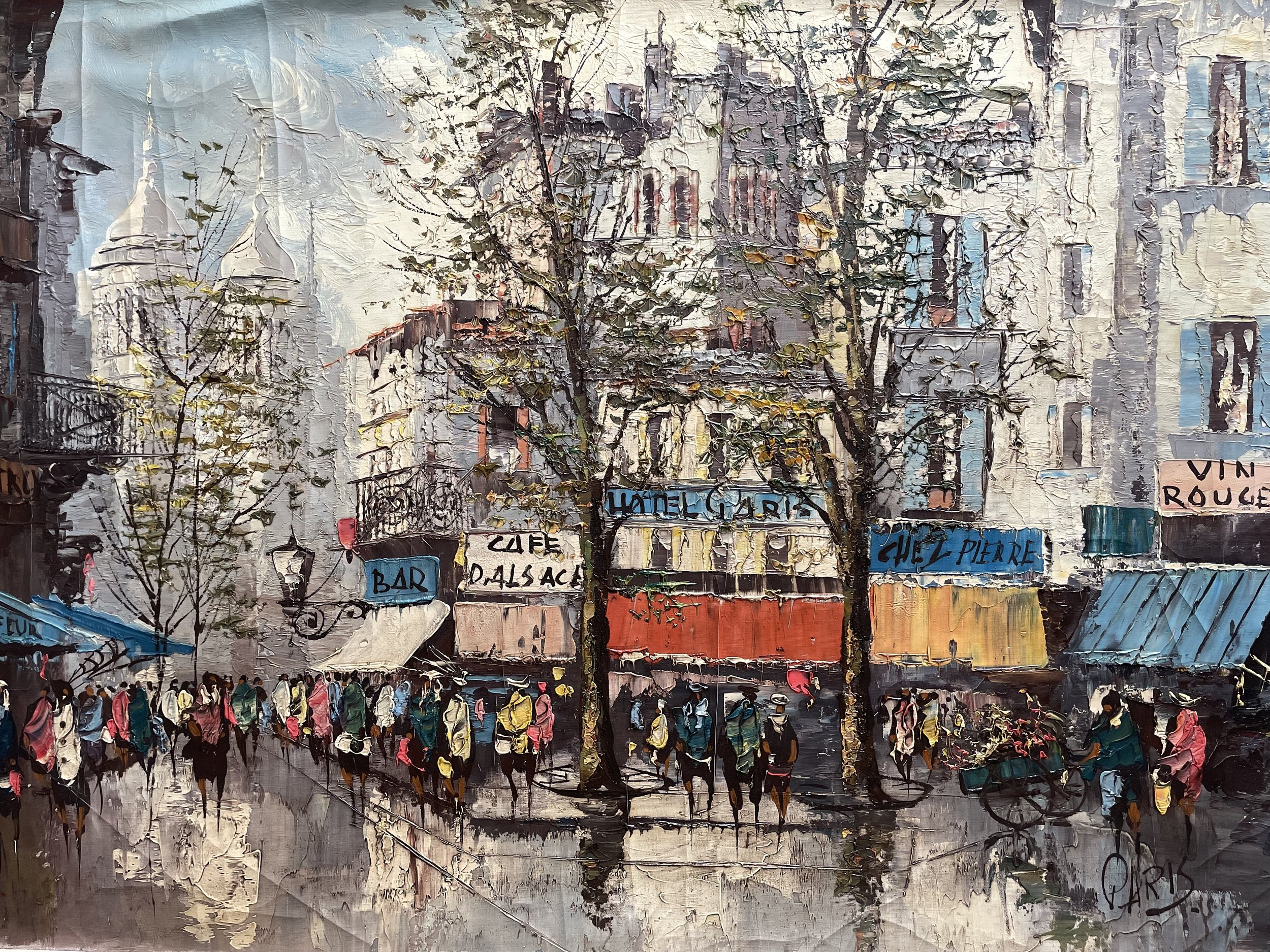 Image 3 of 13
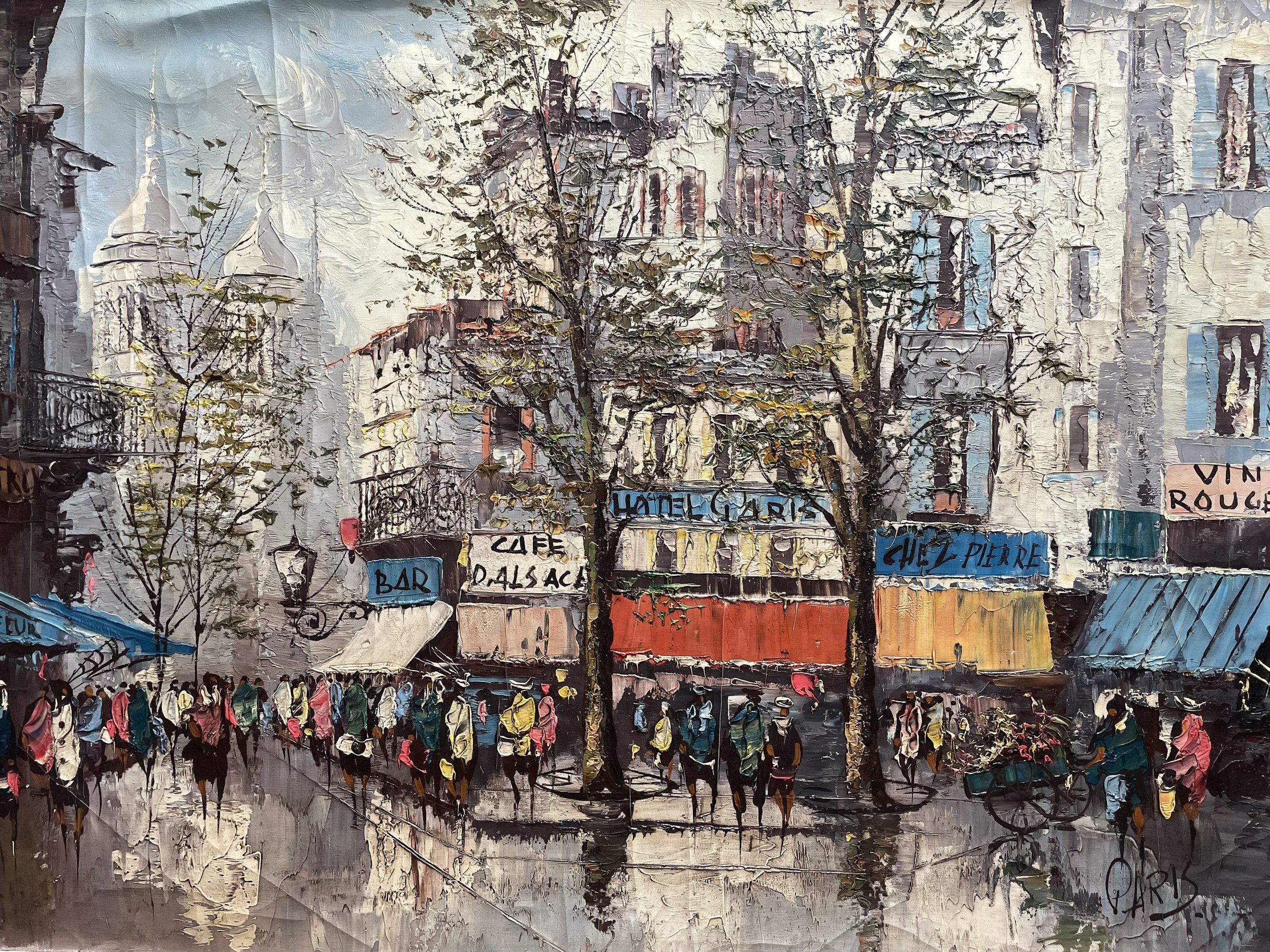 Image 4 of 13
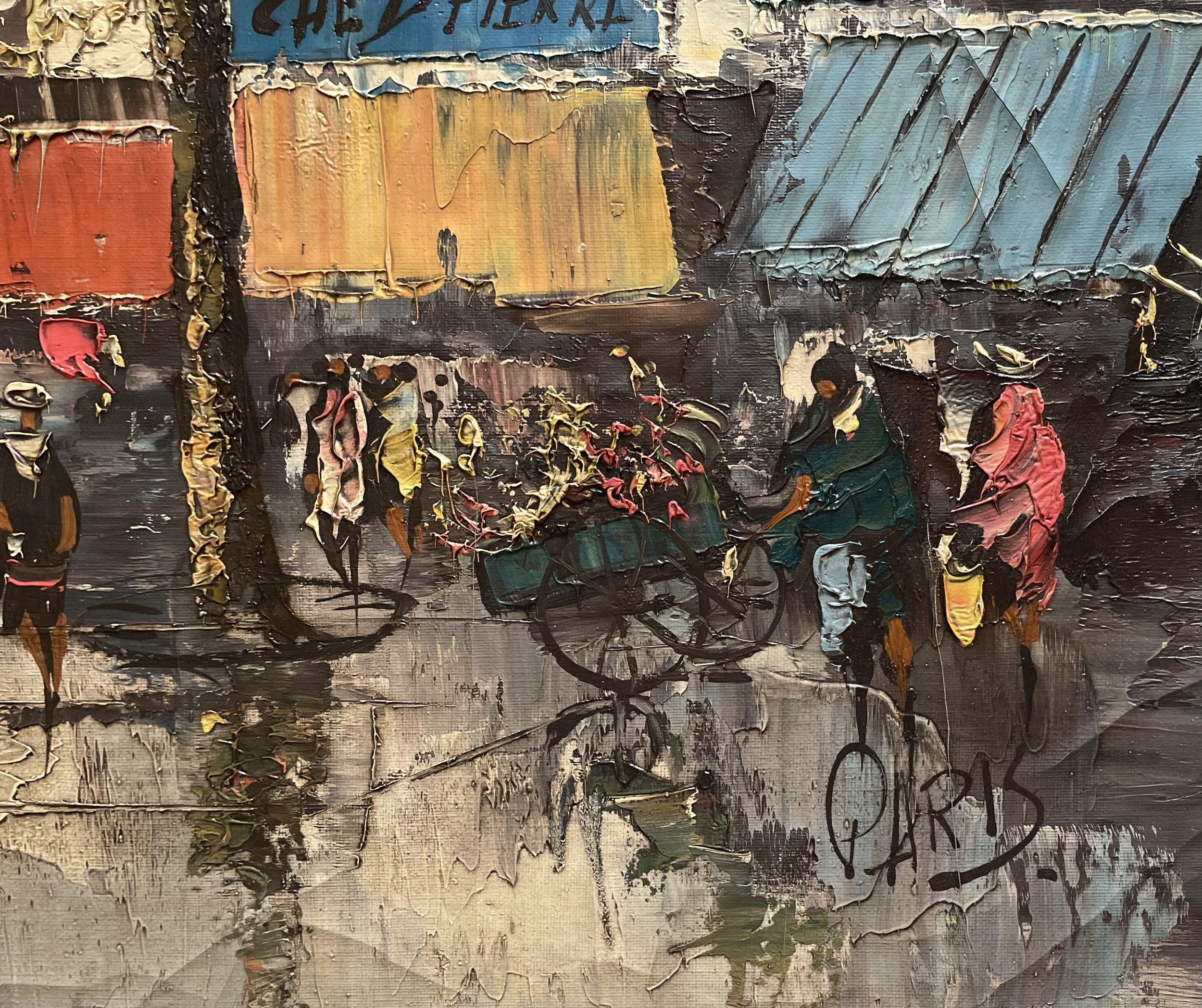 Image 5 of 13
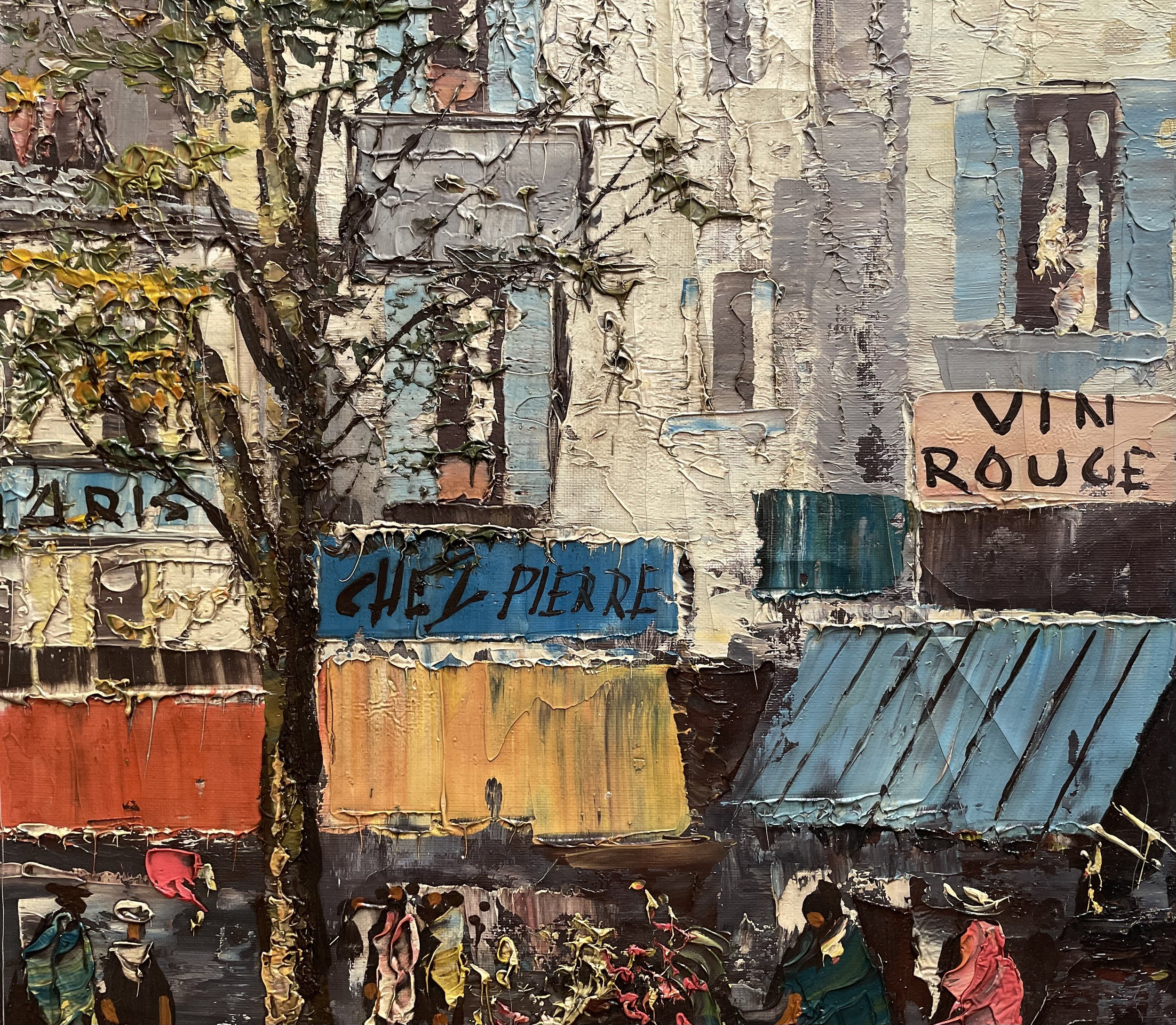 Image 6 of 13
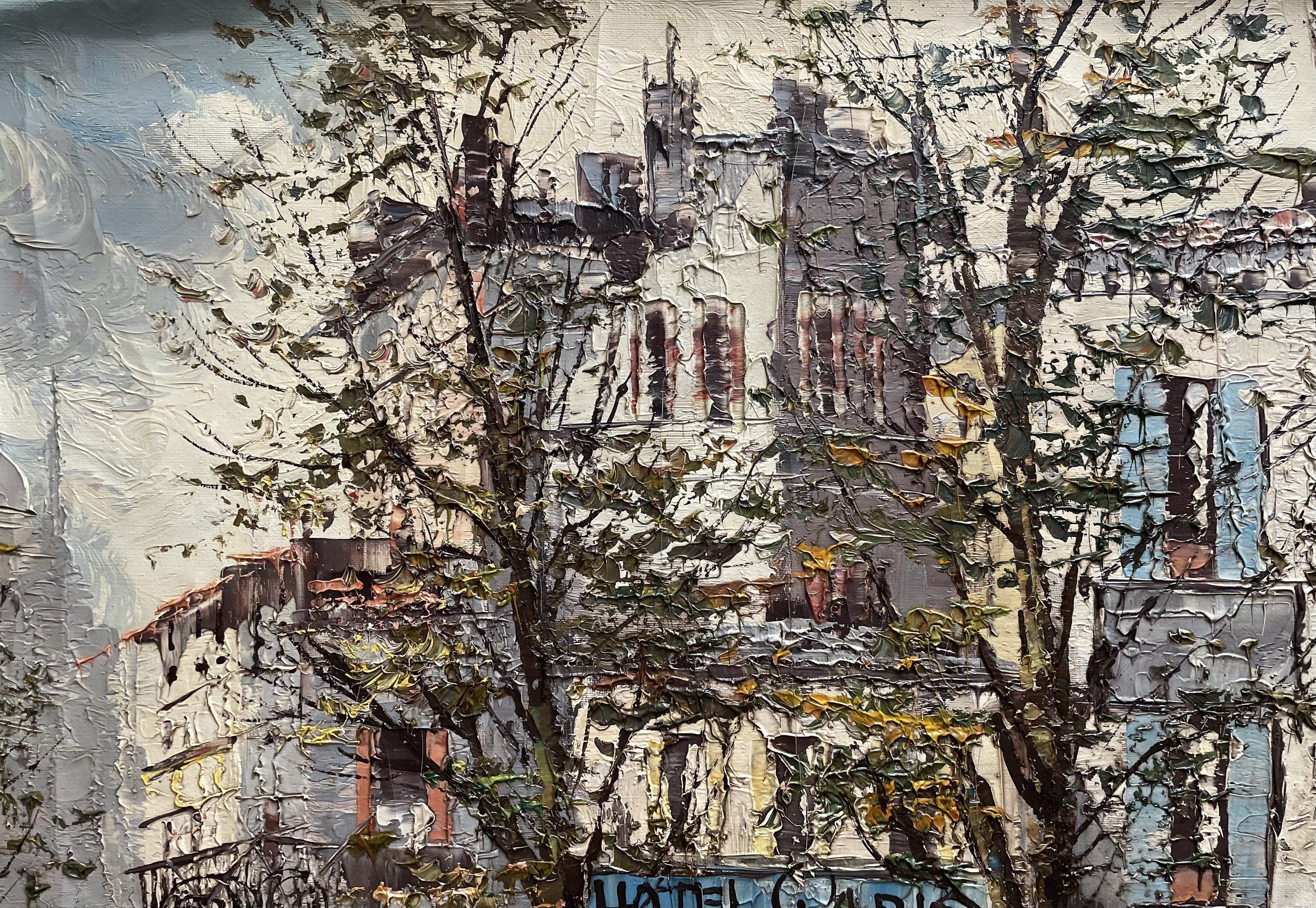 Image 7 of 13
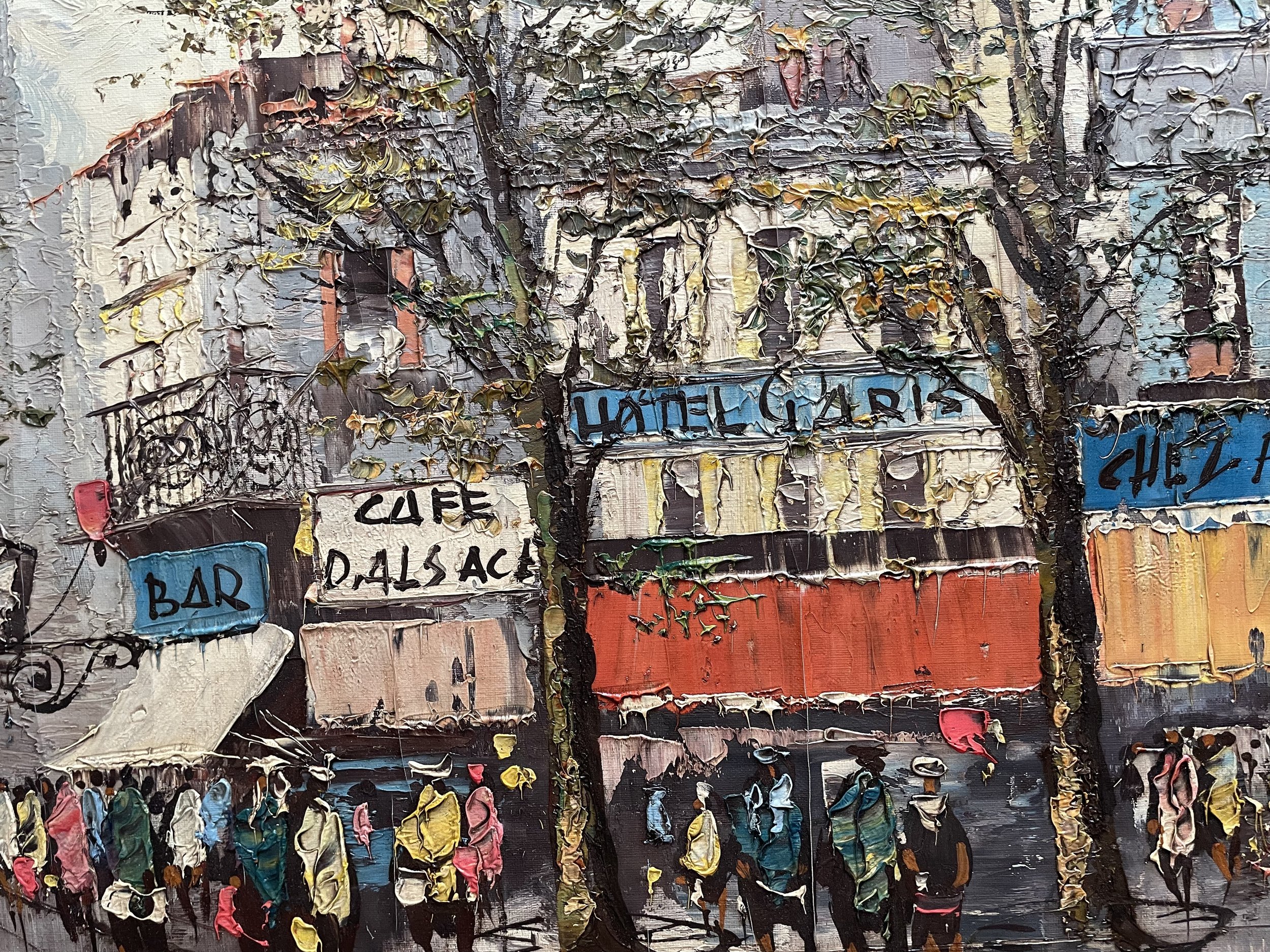 Image 8 of 13
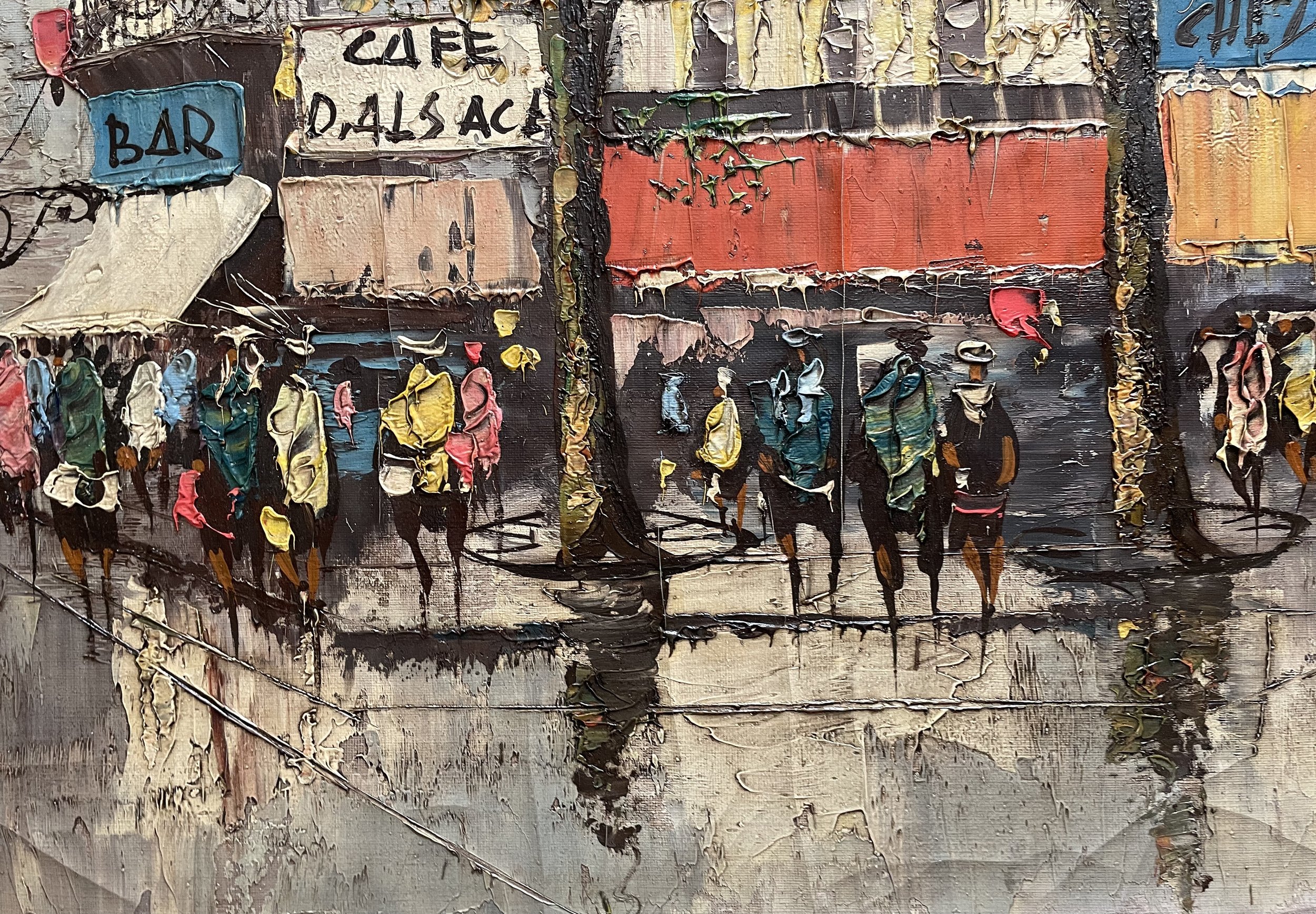 Image 9 of 13
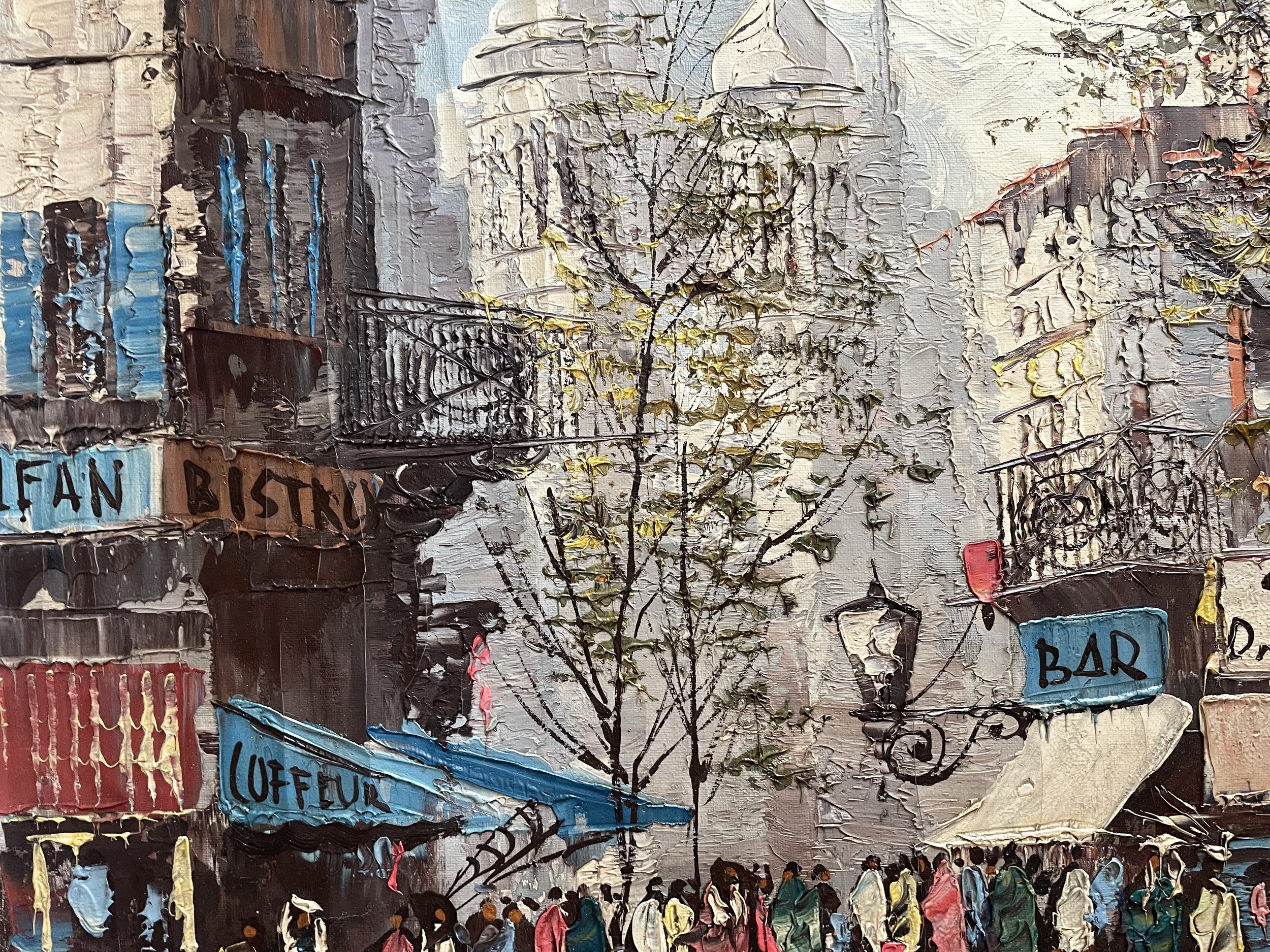 Image 10 of 13
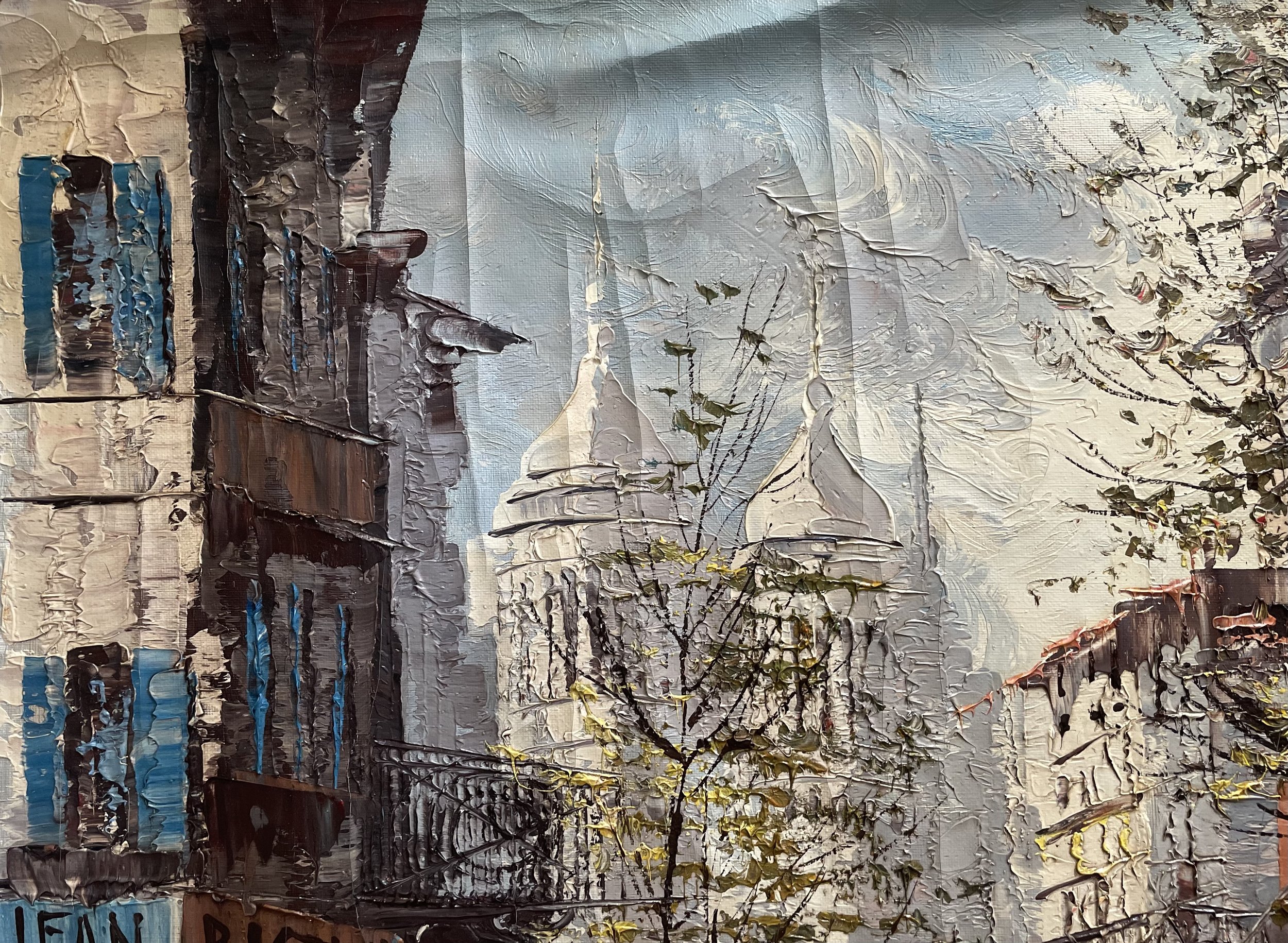 Image 11 of 13
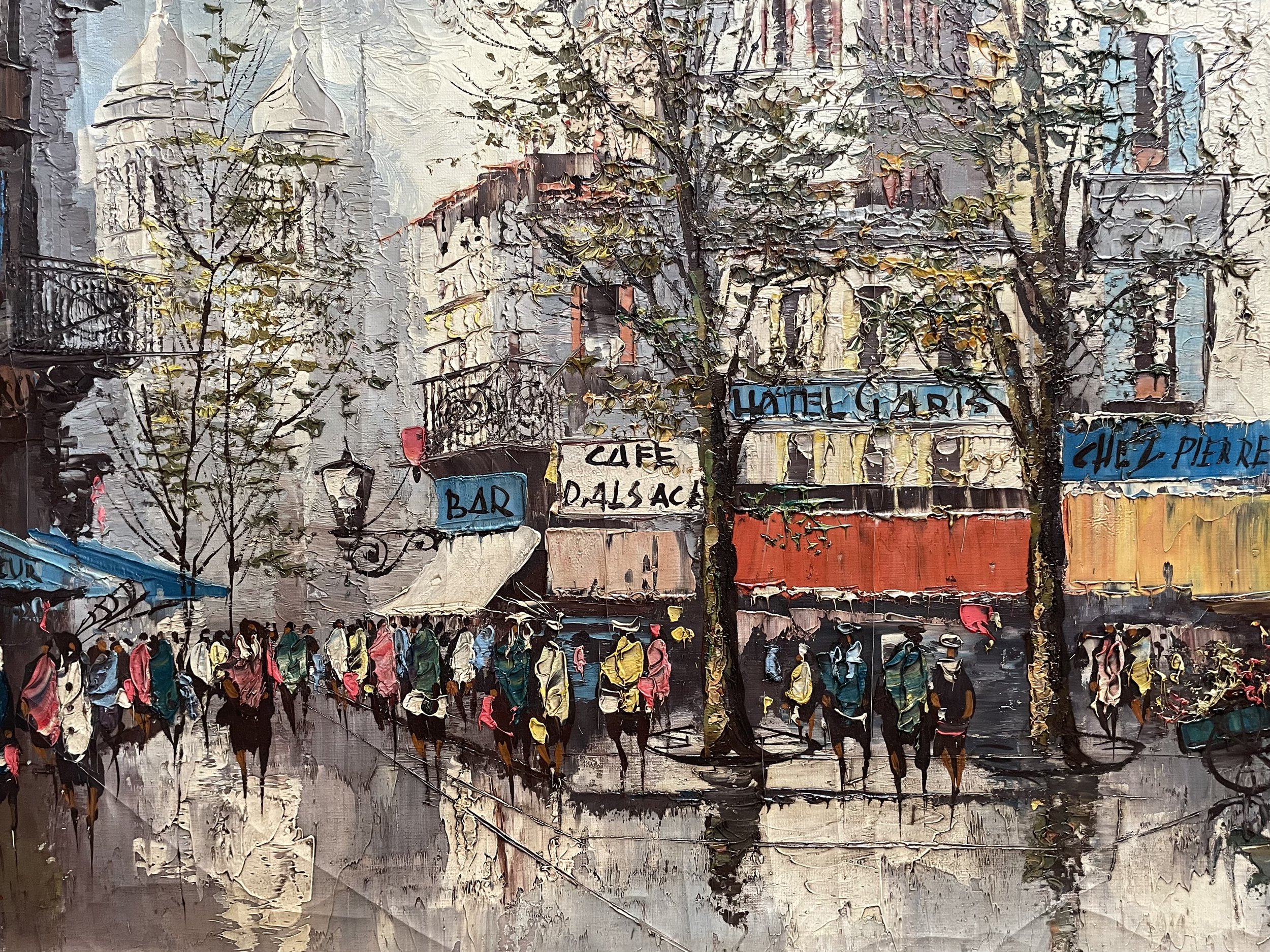 Image 12 of 13
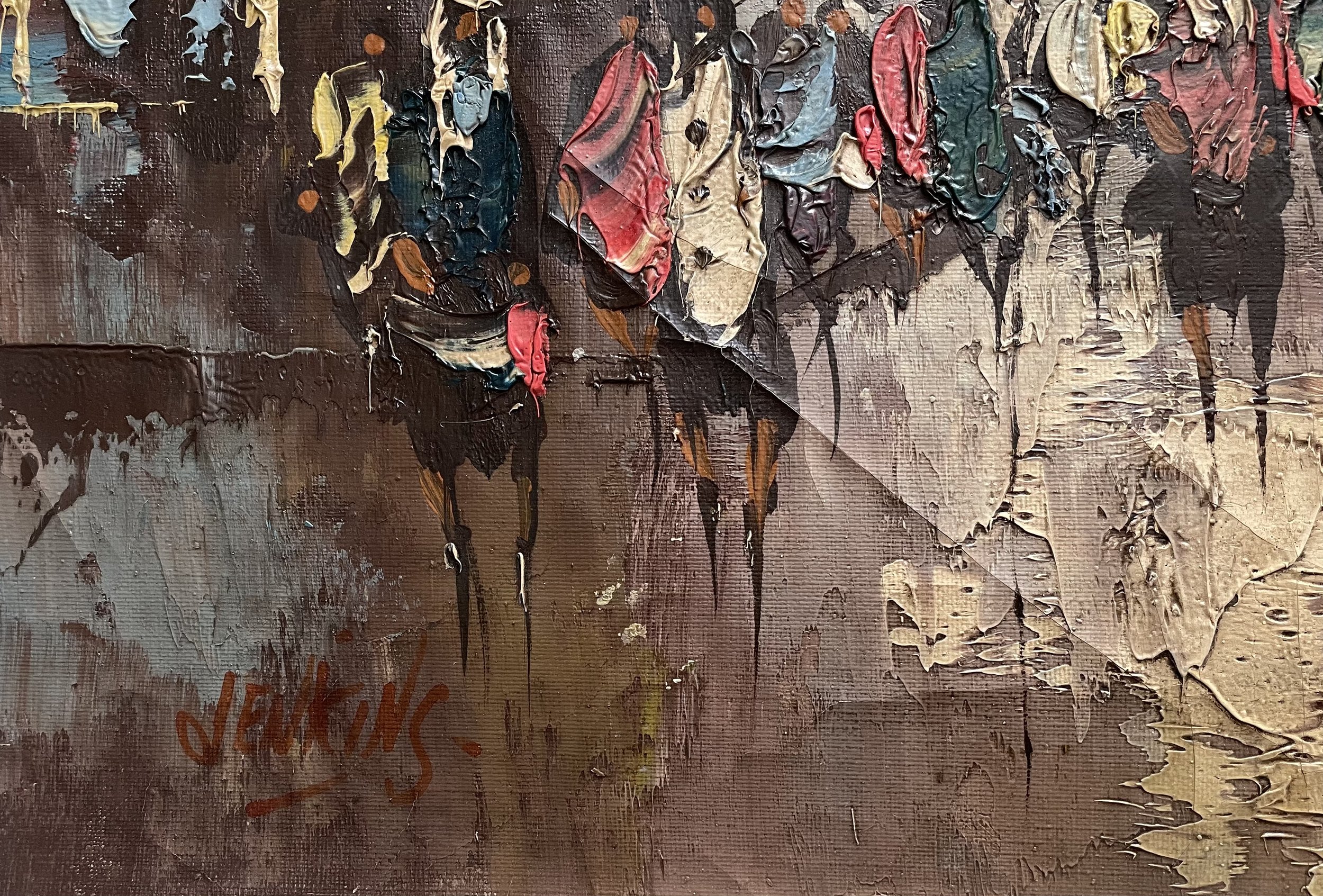 Image 13 of 13