 Image 1 of 3
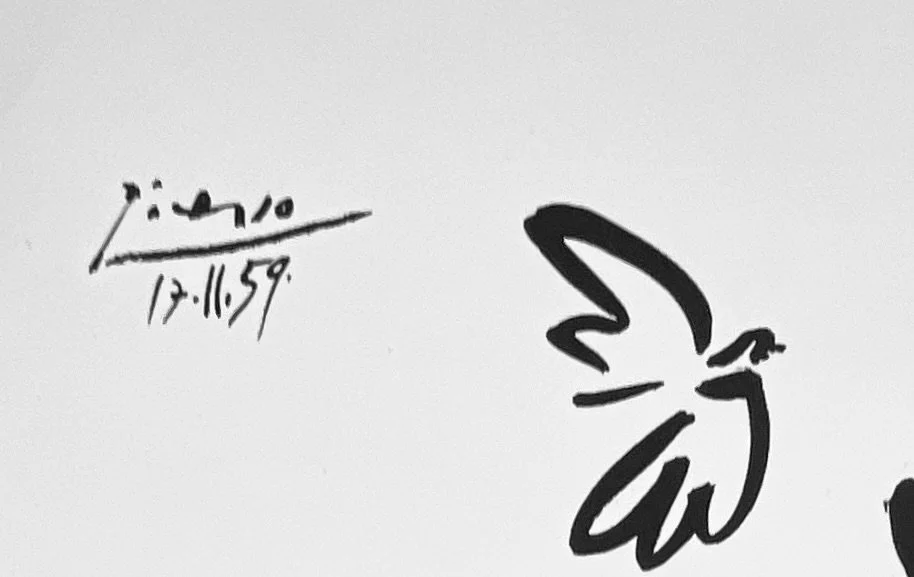 Image 2 of 3
 Image 3 of 3
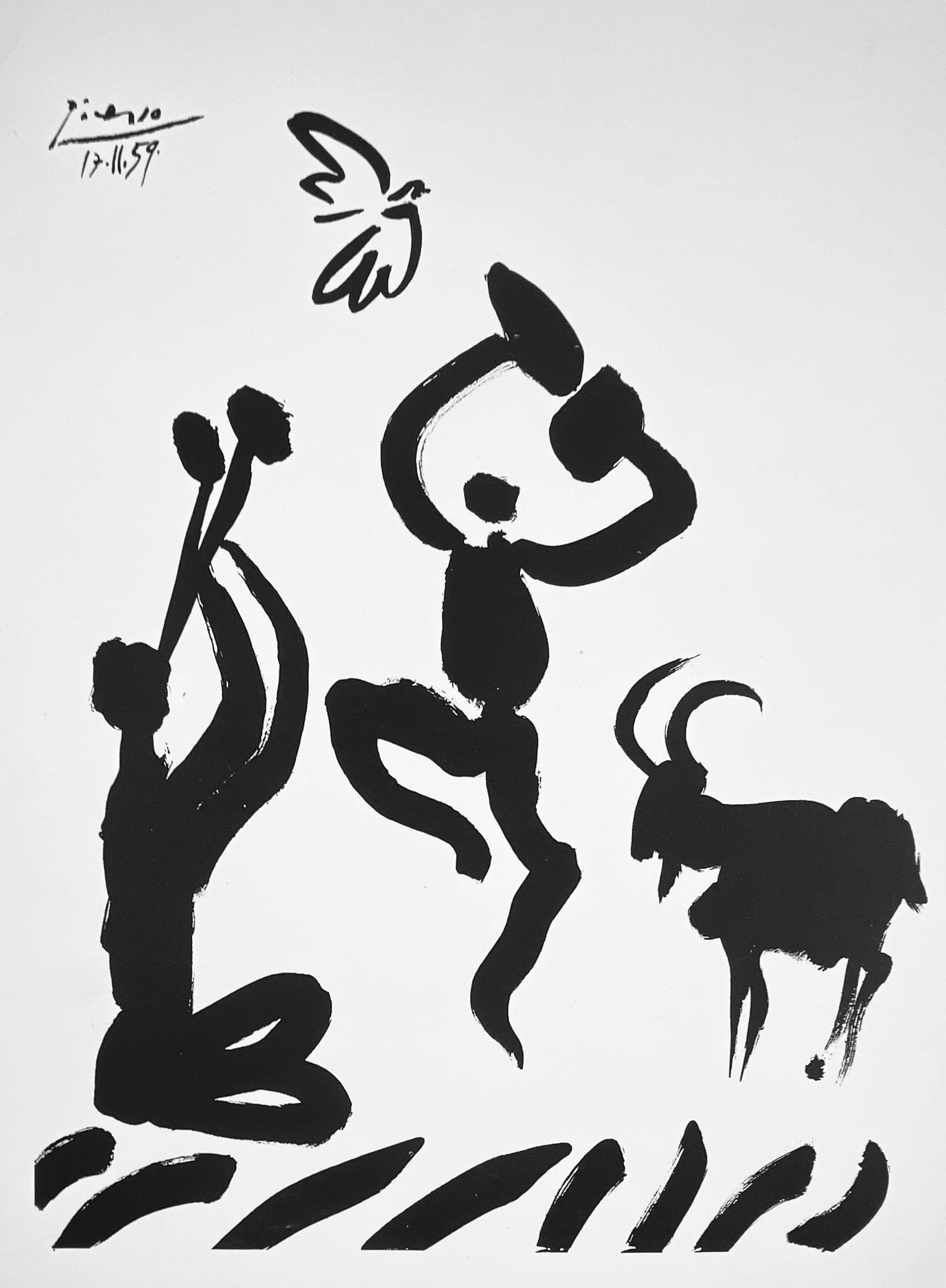
Fawn with Satyrs, Pablo Picasso, dated 17 Nov 1959, lithograph after ink drawing, 15 x 22 in., plate-signed and dated in image.
A striking modernist lithograph after a 1959 drawing by Pablo Picasso depicting mythological satyrs and a faun rendered in bold black brush forms. The composition exemplifies Picasso’s late-career fascination with classical mythology, expressed through spontaneous calligraphic line and playful figuration. The print captures the immediacy of the artist’s ink drawing style, presenting satyrs in lively interaction with a goatlike faun beneath a hovering dove motif. A vivid example of Picasso’s mythological imagery translated into graphic printmaking.
Artwork Description
Fawn with Satyrs is a dynamic mythological composition derived from a drawing by Pablo Picasso dated 17 November 1959. Executed in bold, gestural black forms against a stark white field, the image captures the immediacy and spontaneity that defined Picasso’s late graphic works.
Three simplified figures animate the scene. Two satyrs—mythological woodland beings associated with Dionysian revelry—raise their arms in rhythmic gestures that suggest dance or celebration. Between them, a central figure leaps upward with exaggerated movement, emphasizing the playful, almost theatrical energy that permeates the composition. At the right stands a goatlike faun rendered in a few confident strokes, its curved horns and compact body balancing the composition.
Above the figures appears a small bird motif resembling the dove that Picasso frequently used as a symbol of peace and creative spirit. The entire image is composed through fluid brushlike strokes that demonstrate Picasso’s mastery of economy of line. Each mark carries expressive weight, transforming simple silhouettes into animated characters.
The composition reflects Picasso’s enduring fascination with classical antiquity. Throughout the 1950s and 1960s he repeatedly returned to mythological themes—satyrs, fauns, bacchanalian scenes, and Mediterranean pastoral imagery—interpreting them with humor and expressive freedom. These subjects allowed him to explore the human body in motion while referencing ancient Greek and Roman traditions.
Prints based on Picasso’s ink drawings from this period were often produced as lithographs or reproduction prints to preserve the immediacy of the original brushwork. In such works the bold contrast between black ink and white paper emphasizes the graphic power of Picasso’s late style.
Signed and dated within the image, the composition stands as a vivid example of Picasso’s mythological imagery and his remarkable ability to convey movement, narrative, and emotion with the most economical of visual means.
Medium: Lithograph after an original drawing
Dimensions: 15 x 22 inches
Signature: Plate-signed and dated 17.11.59 within the image
Date of original composition: 1959
Artist Biography
Pablo Picasso stands among the most influential artists in the history of modern art. Born in Málaga, Spain, in 1881, Picasso demonstrated extraordinary artistic ability from an early age under the guidance of his father, José Ruiz Blasco, an art teacher and painter. After formal study in Barcelona and Madrid, he moved to Paris in 1904, where he became part of the avant-garde community that would reshape twentieth-century art.
Picasso’s career is marked by continual reinvention. His early Blue Period and Rose Period explored emotional expression through color and symbolism. By 1907 he had begun developing Cubism with Georges Braque, revolutionizing the representation of form by fragmenting objects into geometric planes and presenting multiple viewpoints simultaneously. This radical approach altered the course of modern art and influenced generations of artists.
Beyond painting, Picasso worked prolifically in sculpture, ceramics, stage design, drawing, and printmaking. Printmaking in particular became one of his most important mediums. Over his lifetime he produced thousands of etchings, lithographs, linocuts, and other graphic works. These prints allowed him to experiment freely with line and form while reaching a wider audience.
During the 1940s and 1950s Picasso increasingly turned toward themes drawn from classical mythology. Satyrs, fauns, minotaurs, and bacchanalian scenes became recurring motifs. These subjects reflected his lifelong engagement with Mediterranean culture and the ancient world. Rather than treating mythology with academic seriousness, Picasso approached it playfully, using simplified forms and expressive gestures that echoed children’s drawings while retaining profound emotional depth.
In his later years Picasso embraced a remarkably free and calligraphic drawing style. Works from the late 1950s and early 1960s often consist of rapid brush or ink lines that capture figures in motion with extraordinary economy. These drawings were frequently translated into lithographs and other print forms, preserving the immediacy of the artist’s hand.
Picasso remained intensely productive until his death in 1973 at the age of ninety-one. His work today is represented in every major museum collection worldwide, including the Louvre, the Museum of Modern Art in New York, the Tate, and the Museo Nacional Centro de Arte Reina Sofía. His influence extends far beyond painting, shaping modern sculpture, graphic art, and the broader visual culture of the twentieth century.
Pablo Picasso (1881–1973)
Fawn with Satyrs
Lithograph after 1959 drawing
15 x 22 inches
Plate-signed and dated within image
Certificate of Authentication
Artist: Pablo Picasso (1881–1973)
Title: Fawn with Satyrs
Medium: Lithograph after original ink drawing
Dimensions: 15 x 22 inches
Signature: Plate-signed and dated 17.11.59
This document certifies that the artwork described above is a lithographic print after a drawing by Pablo Picasso.
Condition
Overall very good condition. Image strong and clean with bold black printing. Minor handling wear and light surface marks consistent with age may be present. No major structural issues observed.
Provenance
Mitch Morse Gallery, New York
Acquired by Mitch Morse through sources in New York, the United States, and Europe
Private collection
Artfind Gallery, Washington DC (current owner)
Citations
The Museum of Modern Art artist archive
Tate Modern artist biography
Oxford Art Online / Grove Dictionary of Art entry on Pablo Picasso
Museo Nacional Centro de Arte Reina Sofía Picasso research materials
Fawn with Satyrs, Pablo Picasso, dated 17 Nov 1959, lithograph after ink drawing, 15 x 22 in., plate-signed and dated in image.
A striking modernist lithograph after a 1959 drawing by Pablo Picasso depicting mythological satyrs and a faun rendered in bold black brush forms. The composition exemplifies Picasso’s late-career fascination with classical mythology, expressed through spontaneous calligraphic line and playful figuration. The print captures the immediacy of the artist’s ink drawing style, presenting satyrs in lively interaction with a goatlike faun beneath a hovering dove motif. A vivid example of Picasso’s mythological imagery translated into graphic printmaking.
Artwork Description
Fawn with Satyrs is a dynamic mythological composition derived from a drawing by Pablo Picasso dated 17 November 1959. Executed in bold, gestural black forms against a stark white field, the image captures the immediacy and spontaneity that defined Picasso’s late graphic works.
Three simplified figures animate the scene. Two satyrs—mythological woodland beings associated with Dionysian revelry—raise their arms in rhythmic gestures that suggest dance or celebration. Between them, a central figure leaps upward with exaggerated movement, emphasizing the playful, almost theatrical energy that permeates the composition. At the right stands a goatlike faun rendered in a few confident strokes, its curved horns and compact body balancing the composition.
Above the figures appears a small bird motif resembling the dove that Picasso frequently used as a symbol of peace and creative spirit. The entire image is composed through fluid brushlike strokes that demonstrate Picasso’s mastery of economy of line. Each mark carries expressive weight, transforming simple silhouettes into animated characters.
The composition reflects Picasso’s enduring fascination with classical antiquity. Throughout the 1950s and 1960s he repeatedly returned to mythological themes—satyrs, fauns, bacchanalian scenes, and Mediterranean pastoral imagery—interpreting them with humor and expressive freedom. These subjects allowed him to explore the human body in motion while referencing ancient Greek and Roman traditions.
Prints based on Picasso’s ink drawings from this period were often produced as lithographs or reproduction prints to preserve the immediacy of the original brushwork. In such works the bold contrast between black ink and white paper emphasizes the graphic power of Picasso’s late style.
Signed and dated within the image, the composition stands as a vivid example of Picasso’s mythological imagery and his remarkable ability to convey movement, narrative, and emotion with the most economical of visual means.
Medium: Lithograph after an original drawing
Dimensions: 15 x 22 inches
Signature: Plate-signed and dated 17.11.59 within the image
Date of original composition: 1959
Artist Biography
Pablo Picasso stands among the most influential artists in the history of modern art. Born in Málaga, Spain, in 1881, Picasso demonstrated extraordinary artistic ability from an early age under the guidance of his father, José Ruiz Blasco, an art teacher and painter. After formal study in Barcelona and Madrid, he moved to Paris in 1904, where he became part of the avant-garde community that would reshape twentieth-century art.
Picasso’s career is marked by continual reinvention. His early Blue Period and Rose Period explored emotional expression through color and symbolism. By 1907 he had begun developing Cubism with Georges Braque, revolutionizing the representation of form by fragmenting objects into geometric planes and presenting multiple viewpoints simultaneously. This radical approach altered the course of modern art and influenced generations of artists.
Beyond painting, Picasso worked prolifically in sculpture, ceramics, stage design, drawing, and printmaking. Printmaking in particular became one of his most important mediums. Over his lifetime he produced thousands of etchings, lithographs, linocuts, and other graphic works. These prints allowed him to experiment freely with line and form while reaching a wider audience.
During the 1940s and 1950s Picasso increasingly turned toward themes drawn from classical mythology. Satyrs, fauns, minotaurs, and bacchanalian scenes became recurring motifs. These subjects reflected his lifelong engagement with Mediterranean culture and the ancient world. Rather than treating mythology with academic seriousness, Picasso approached it playfully, using simplified forms and expressive gestures that echoed children’s drawings while retaining profound emotional depth.
In his later years Picasso embraced a remarkably free and calligraphic drawing style. Works from the late 1950s and early 1960s often consist of rapid brush or ink lines that capture figures in motion with extraordinary economy. These drawings were frequently translated into lithographs and other print forms, preserving the immediacy of the artist’s hand.
Picasso remained intensely productive until his death in 1973 at the age of ninety-one. His work today is represented in every major museum collection worldwide, including the Louvre, the Museum of Modern Art in New York, the Tate, and the Museo Nacional Centro de Arte Reina Sofía. His influence extends far beyond painting, shaping modern sculpture, graphic art, and the broader visual culture of the twentieth century.
Pablo Picasso (1881–1973)
Fawn with Satyrs
Lithograph after 1959 drawing
15 x 22 inches
Plate-signed and dated within image
Certificate of Authentication
Artist: Pablo Picasso (1881–1973)
Title: Fawn with Satyrs
Medium: Lithograph after original ink drawing
Dimensions: 15 x 22 inches
Signature: Plate-signed and dated 17.11.59
This document certifies that the artwork described above is a lithographic print after a drawing by Pablo Picasso.
Condition
Overall very good condition. Image strong and clean with bold black printing. Minor handling wear and light surface marks consistent with age may be present. No major structural issues observed.
Provenance
Mitch Morse Gallery, New York
Acquired by Mitch Morse through sources in New York, the United States, and Europe
Private collection
Artfind Gallery, Washington DC (current owner)
Citations
The Museum of Modern Art artist archive
Tate Modern artist biography
Oxford Art Online / Grove Dictionary of Art entry on Pablo Picasso
Museo Nacional Centro de Arte Reina Sofía Picasso research materials