 Image 1 of 4
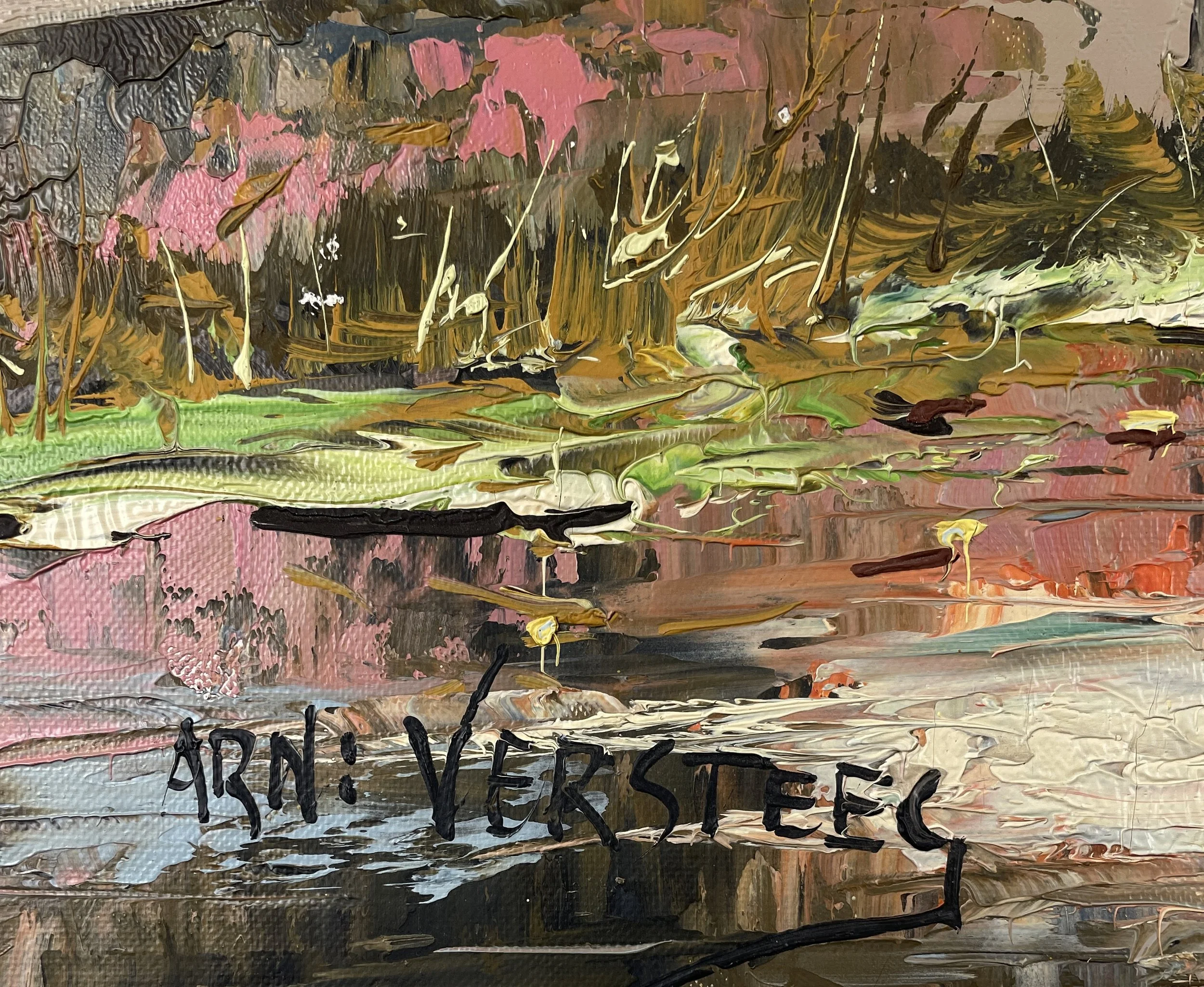 Image 2 of 4
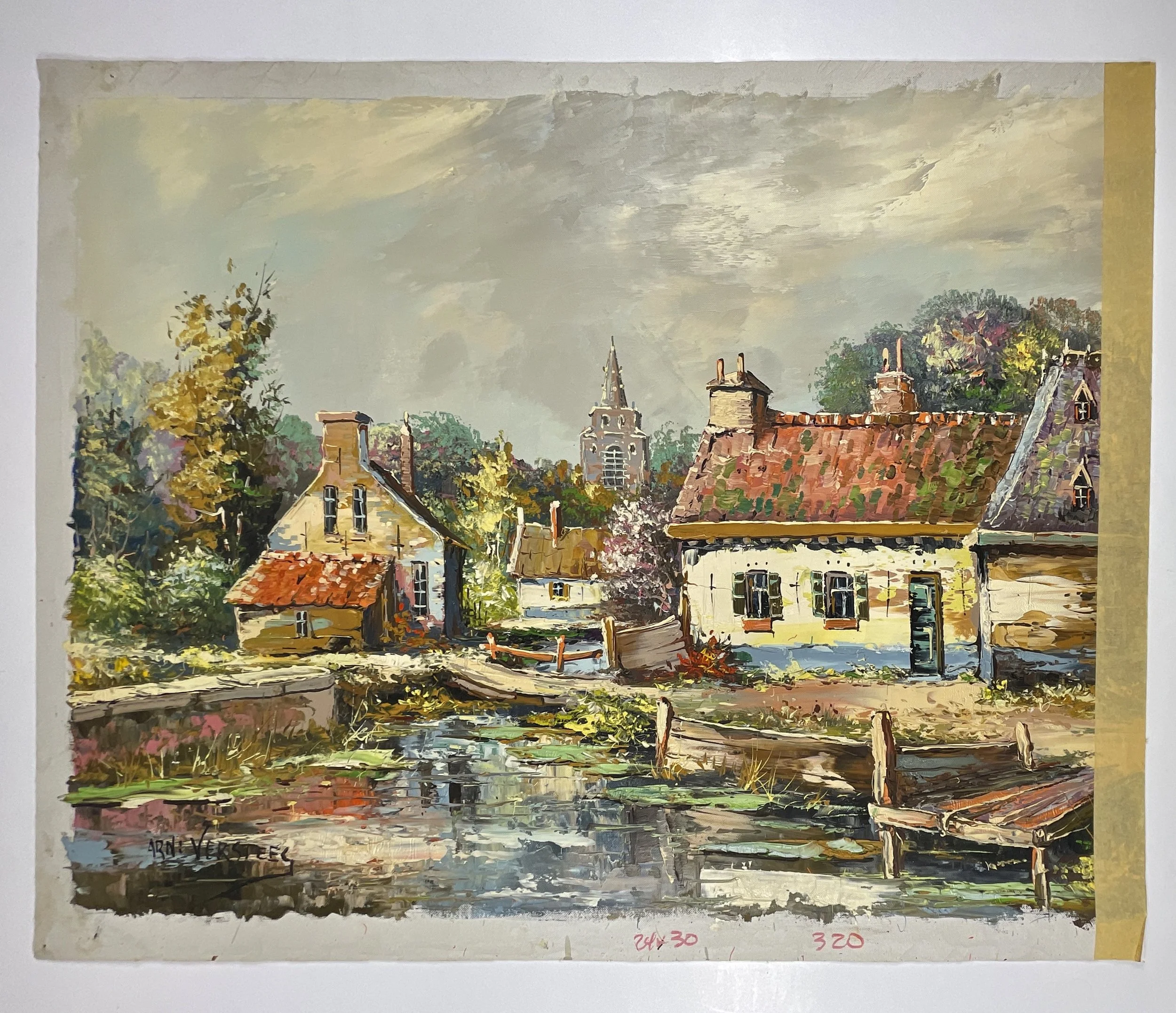 Image 3 of 4
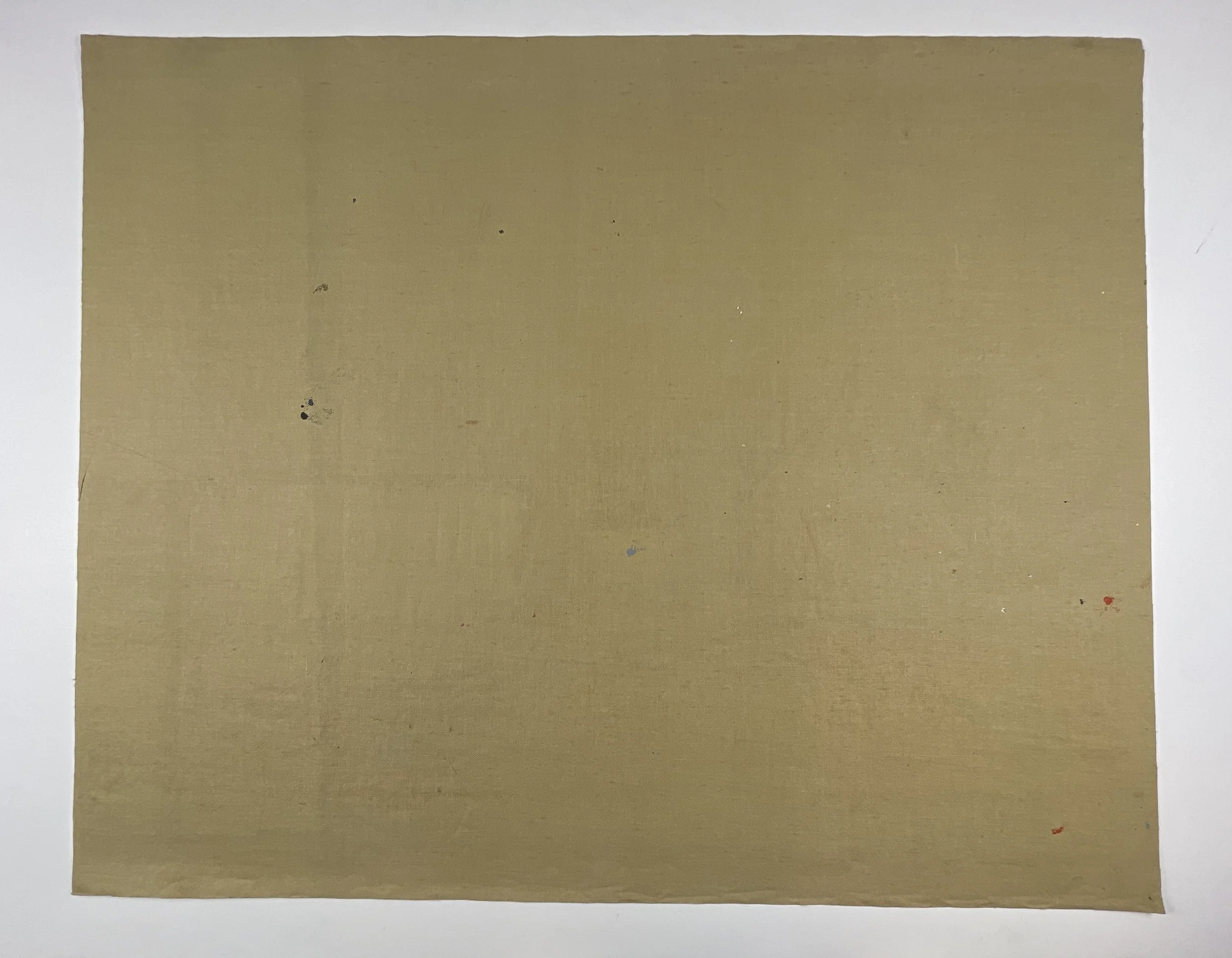 Image 4 of 4
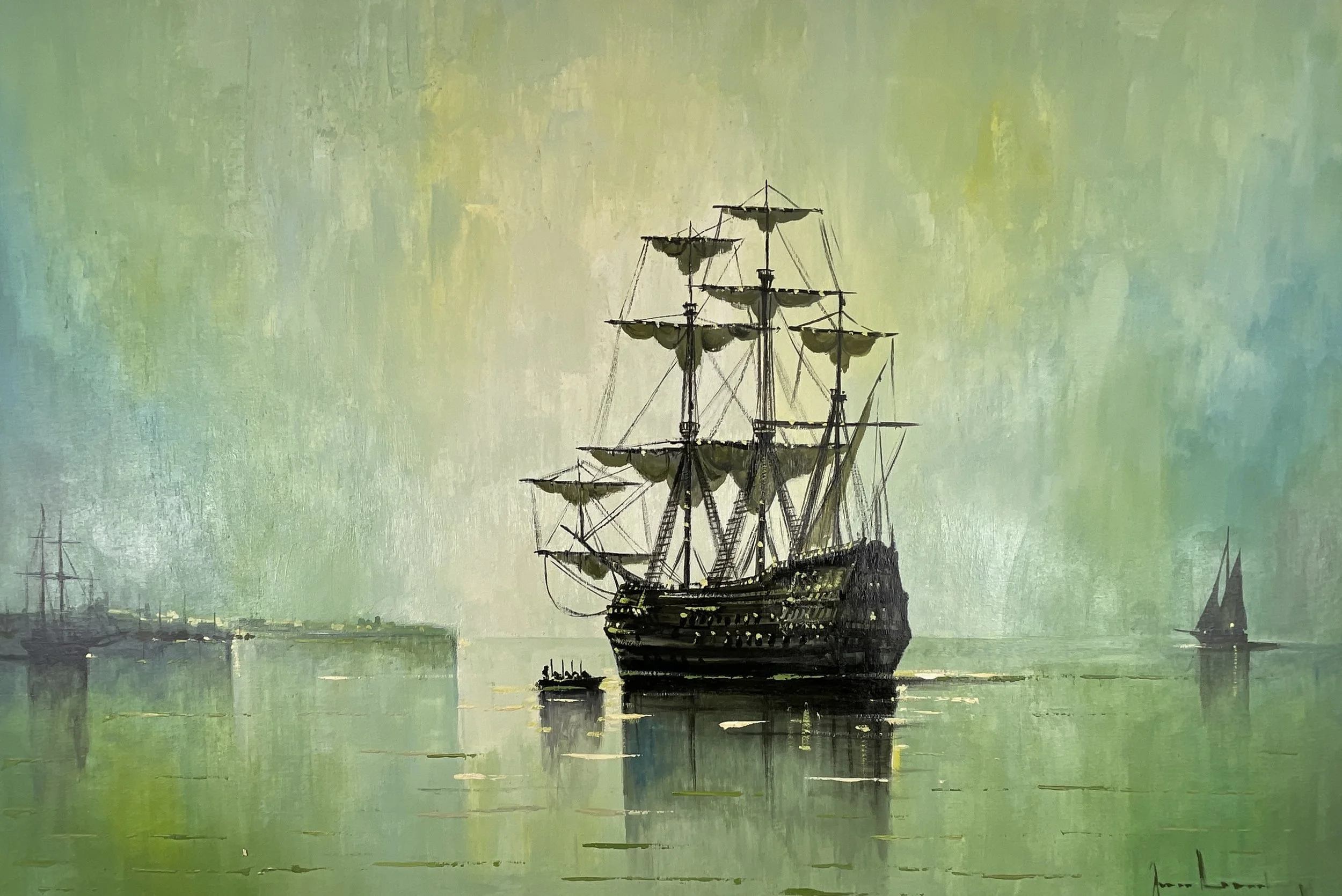
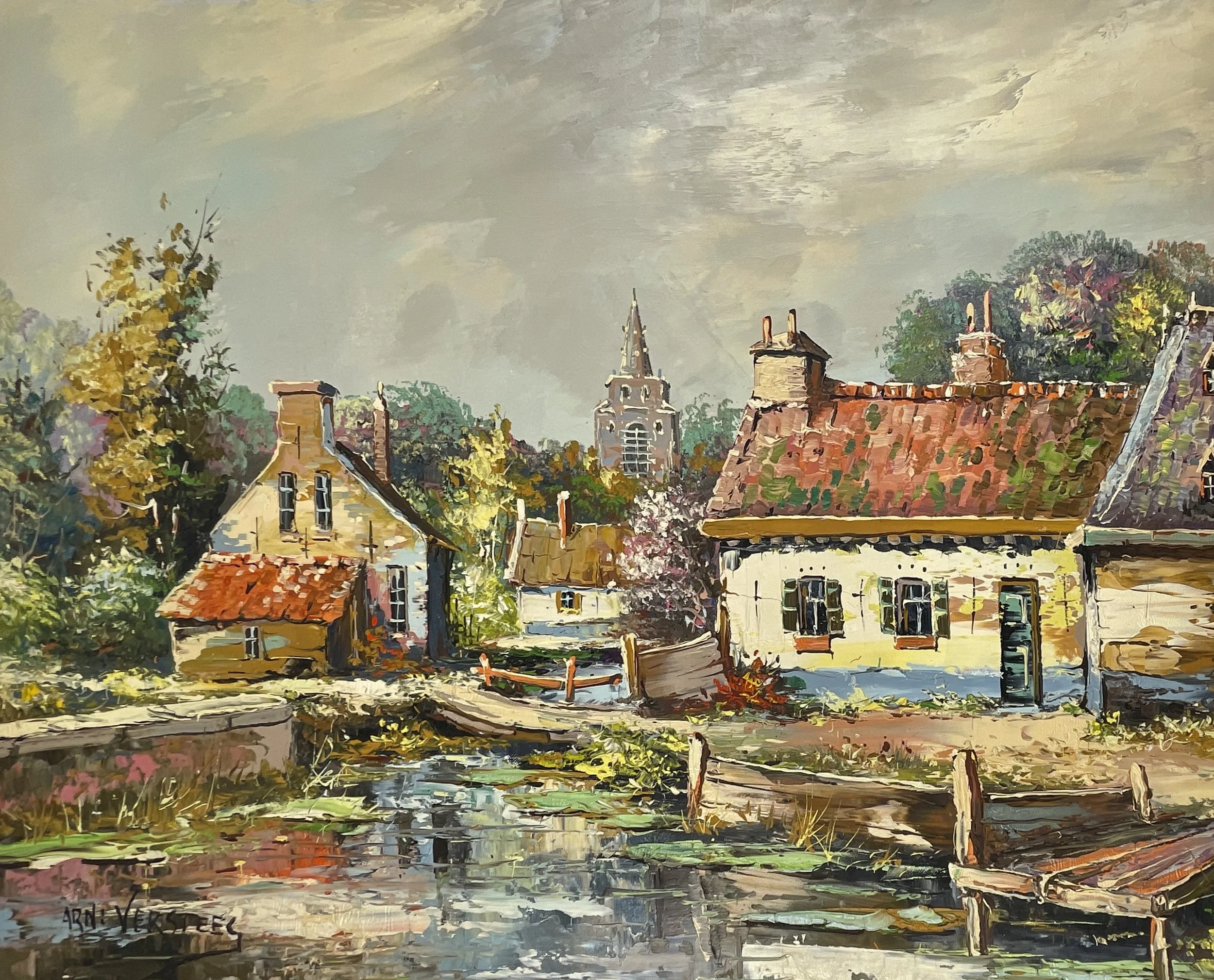
Village Canal with Church Spire (attributed), Arni Versteel (20th century), c.1965–1975, heavy impasto oil on canvas, 36 × 24 in., signed lower left.
Expressive European village landscape by Arni Versteel rendered in heavy impasto oil. The painting depicts a tranquil canal scene with cottages, tiled roofs, a small bridge, and a distant church spire. Rich palette knife textures and bold brushwork create a luminous countryside composition typical of mid-century decorative European landscape painting.
Artwork Description
This richly textured landscape painting attributed to Arni Versteel presents a picturesque European village arranged around a reflective canal and small wooden bridge. Executed in thick oil paint, the composition demonstrates the artist’s confident use of heavy impasto, with paint applied in raised layers that catch light across the surface.
In the foreground a calm canal reflects the surrounding buildings and vegetation, its surface broken by subtle ripples and floating patches of greenery. The reflection of rooftops and sky is rendered with broken strokes of blue, gray, and earthy tones, giving the water a natural sense of depth and movement.
The central portion of the painting is dominated by several rustic houses with sloping red tile roofs. Their walls are built up with textured strokes of warm creams, yellows, and ochres, suggesting the sunlit surfaces of old European masonry. The roofs themselves are constructed with thick palette knife applications of red, terracotta, and brown pigment, creating a tactile relief effect that is characteristic of impasto painting.
A small wooden bridge and low stone walls guide the viewer’s eye through the composition toward the center of the village. Beyond the houses, trees painted in lively greens and golds frame a tall church spire rising in the distance. This architectural element anchors the scene and introduces a sense of scale and depth.
The sky is painted with broad, atmospheric strokes of pale gray, cream, and muted blue. The soft tonal transitions suggest a calm afternoon light spreading across the village. This subtle sky contrasts with the dense textures of the buildings and foliage below.
Versteel’s approach emphasizes texture and movement rather than strict realism. The thick application of oil paint allows the artist to sculpt the landscape with the brush and palette knife. Light strikes the raised surfaces differently throughout the composition, creating a dynamic visual experience as the viewer moves around the painting.
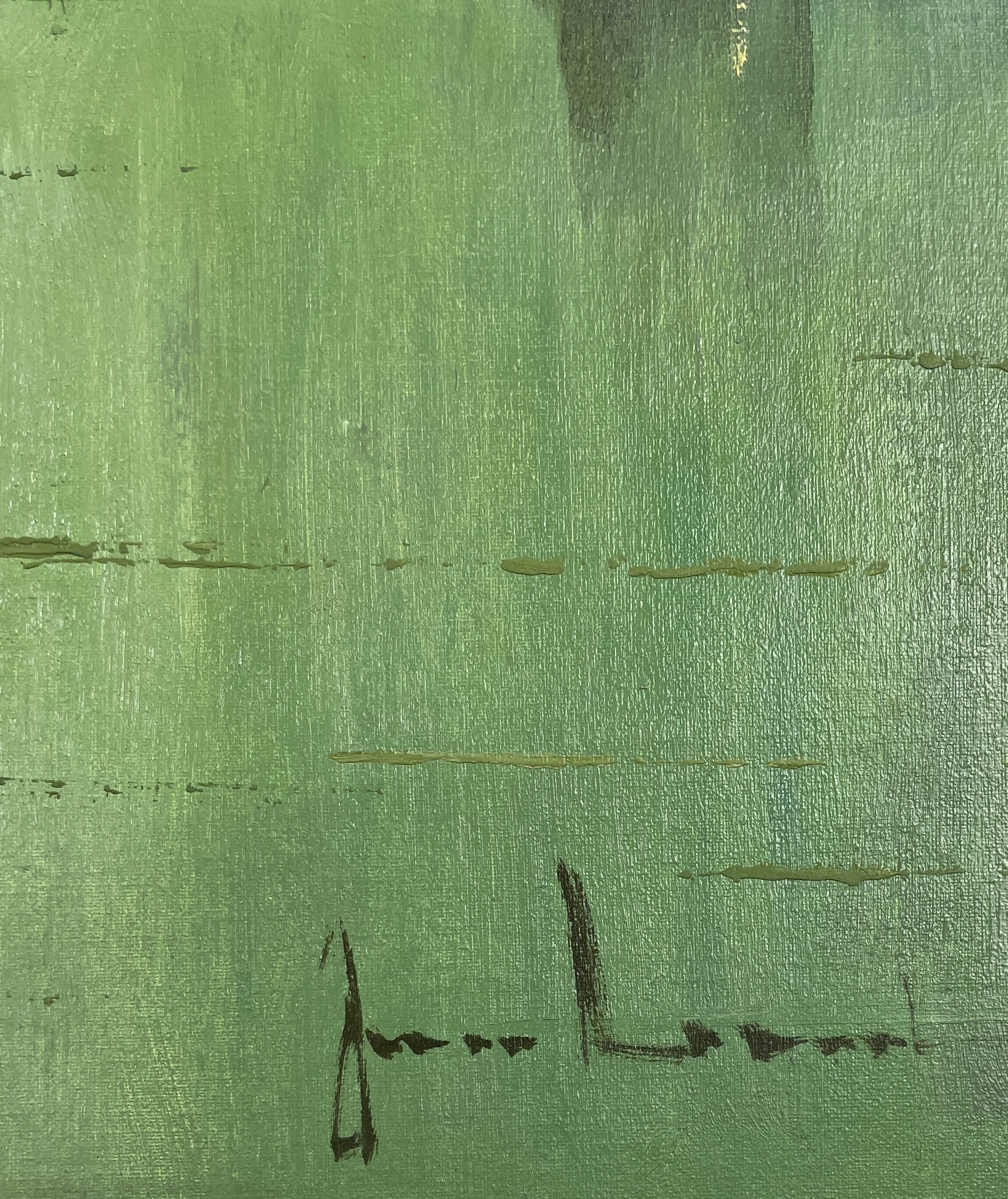
The work is signed “Arni Versteel” in the lower left corner and measures approximately 36 by 24 inches. The edges of the canvas show evidence of gallery handling and previous mounting, consistent with works distributed through gallery networks during the mid-to-late twentieth century.
Scenes like this were particularly popular among collectors during the 1960s and 1970s, when expressive European village landscapes with strong texture and color were widely exhibited in American galleries.
Artist Biography
Arni Versteel appears to have been active during the mid-to-late twentieth century as a painter of expressive European village landscapes and pastoral scenes. While detailed archival documentation about the artist remains limited, works bearing the Versteel signature demonstrate a painter working within the tradition of decorative European landscape painting that flourished in galleries during the post-war decades.
The artist’s paintings frequently depict small villages, canals, rustic houses, and church spires—subjects closely associated with rural scenes in the Netherlands, Belgium, northern France, and other parts of Western Europe. These settings provided rich visual material for artists who sought to capture the charm and architectural character of historic European towns.
Versteel’s work is particularly distinguished by the use of heavy impasto. In this technique, oil paint is applied thickly so that brushstrokes and palette knife marks remain visible on the canvas surface. The method was widely embraced by twentieth-century painters seeking to emphasize the physicality of paint and the expressive gesture of the artist’s hand.
This approach connects Versteel stylistically to a lineage of painters influenced by the post-Impressionist tradition. Artists such as Vincent van Gogh and later European expressionists demonstrated how thick paint could transform landscape painting into a more tactile and emotional experience. Versteel’s paintings reflect this influence through energetic strokes, vibrant color contrasts, and sculptural surfaces.
During the 1960s and 1970s, American collectors developed a strong appetite for romantic European village imagery. Galleries in New York and other cities introduced collectors to artists producing atmospheric landscapes that combined recognizable architecture with expressive painterly techniques.
Mitch Morse Gallery in New York, known for publishing original graphics and representing a wide range of international artists, was among the galleries that distributed paintings of this type. Through such networks, works by artists like Versteel entered private collections across the United States.
Although comprehensive biographical records remain scarce, the surviving paintings attributed to Arni Versteel reveal an artist skilled in combining architectural structure with painterly energy. The thick textures, warm color palette, and tranquil subject matter align the work with the decorative European landscape tradition that remained popular throughout the latter half of the twentieth century.
Today paintings attributed to Versteel are valued for their tactile surfaces, atmospheric village imagery, and their continuation of the long tradition of European pastoral landscape painting.
Arni Versteel European village landscape, heavy impasto oil on canvas, canal and cottages with church spire, signed, 36 × 24 in.
Certificate of Authentication
Artist: Arni Versteel
Title: Village Canal with Church Spire (attributed)
Medium: Oil on canvas, heavy impasto
Dimensions: 36 × 24 inches
Signature: Signed lower left
Date: circa 1965–1975
This artwork is an original oil painting attributed to Arni Versteel based on the visible signature and stylistic characteristics of mid-century impasto landscape painting.
Condition
Good vintage condition. Canvas structurally stable with evidence of previous gallery mounting along the edges. Paint surface intact with strong impasto texture. Minor handling marks consistent with age but no significant paint loss observed.
Provenance
Artist studio or early gallery distribution
Mitch Morse Gallery, New York — artist’s agent, publisher of original graphics, art dealer and distributor
Private collection acquired through Mitch Morse Gallery
Artfind Gallery, Washington DC (current owner)
All works acquired from Mitch Morse Gallery, which sourced artwork in New York, throughout the United States, and Europe.
Provenance Note: Mitch Morse Gallery Collection
This artwork originates from the inventory of Mitch Morse Gallery, a respected New York–based gallery and publisher active during the mid-to-late 20th century. Mitch Morse was an established figure in the American art market, serving as an artist’s agent, publisher of original graphics, art dealer, distributor, and fine art restorer. He was also a Design Affiliate of A.S.I.D., listed in Who’s Who in the East, and a guest lecturer in graphics at New York University, with appearances on radio and television discussing art and design.
Through his gallery and associated publishing operations, Morse acquired paintings, prints, and original works from artists and studios across New York, Europe, and international art markets, assembling a broad inventory representing a wide range of artistic traditions and mediums. Works from this collection circulated through galleries and collectors throughout the United States.
The present painting was acquired through this network and is now held in the collection of Artfind Gallery, Washington DC, continuing the documented chain of gallery provenance from Mitch Morse’s original acquisitions.
Village Canal with Church Spire (attributed), Arni Versteel (20th century), c.1965–1975, heavy impasto oil on canvas, 36 × 24 in., signed lower left.
Expressive European village landscape by Arni Versteel rendered in heavy impasto oil. The painting depicts a tranquil canal scene with cottages, tiled roofs, a small bridge, and a distant church spire. Rich palette knife textures and bold brushwork create a luminous countryside composition typical of mid-century decorative European landscape painting.
Artwork Description
This richly textured landscape painting attributed to Arni Versteel presents a picturesque European village arranged around a reflective canal and small wooden bridge. Executed in thick oil paint, the composition demonstrates the artist’s confident use of heavy impasto, with paint applied in raised layers that catch light across the surface.
In the foreground a calm canal reflects the surrounding buildings and vegetation, its surface broken by subtle ripples and floating patches of greenery. The reflection of rooftops and sky is rendered with broken strokes of blue, gray, and earthy tones, giving the water a natural sense of depth and movement.
The central portion of the painting is dominated by several rustic houses with sloping red tile roofs. Their walls are built up with textured strokes of warm creams, yellows, and ochres, suggesting the sunlit surfaces of old European masonry. The roofs themselves are constructed with thick palette knife applications of red, terracotta, and brown pigment, creating a tactile relief effect that is characteristic of impasto painting.
A small wooden bridge and low stone walls guide the viewer’s eye through the composition toward the center of the village. Beyond the houses, trees painted in lively greens and golds frame a tall church spire rising in the distance. This architectural element anchors the scene and introduces a sense of scale and depth.
The sky is painted with broad, atmospheric strokes of pale gray, cream, and muted blue. The soft tonal transitions suggest a calm afternoon light spreading across the village. This subtle sky contrasts with the dense textures of the buildings and foliage below.
Versteel’s approach emphasizes texture and movement rather than strict realism. The thick application of oil paint allows the artist to sculpt the landscape with the brush and palette knife. Light strikes the raised surfaces differently throughout the composition, creating a dynamic visual experience as the viewer moves around the painting.
The work is signed “Arni Versteel” in the lower left corner and measures approximately 36 by 24 inches. The edges of the canvas show evidence of gallery handling and previous mounting, consistent with works distributed through gallery networks during the mid-to-late twentieth century.
Scenes like this were particularly popular among collectors during the 1960s and 1970s, when expressive European village landscapes with strong texture and color were widely exhibited in American galleries.
Artist Biography
Arni Versteel appears to have been active during the mid-to-late twentieth century as a painter of expressive European village landscapes and pastoral scenes. While detailed archival documentation about the artist remains limited, works bearing the Versteel signature demonstrate a painter working within the tradition of decorative European landscape painting that flourished in galleries during the post-war decades.
The artist’s paintings frequently depict small villages, canals, rustic houses, and church spires—subjects closely associated with rural scenes in the Netherlands, Belgium, northern France, and other parts of Western Europe. These settings provided rich visual material for artists who sought to capture the charm and architectural character of historic European towns.
Versteel’s work is particularly distinguished by the use of heavy impasto. In this technique, oil paint is applied thickly so that brushstrokes and palette knife marks remain visible on the canvas surface. The method was widely embraced by twentieth-century painters seeking to emphasize the physicality of paint and the expressive gesture of the artist’s hand.
This approach connects Versteel stylistically to a lineage of painters influenced by the post-Impressionist tradition. Artists such as Vincent van Gogh and later European expressionists demonstrated how thick paint could transform landscape painting into a more tactile and emotional experience. Versteel’s paintings reflect this influence through energetic strokes, vibrant color contrasts, and sculptural surfaces.
During the 1960s and 1970s, American collectors developed a strong appetite for romantic European village imagery. Galleries in New York and other cities introduced collectors to artists producing atmospheric landscapes that combined recognizable architecture with expressive painterly techniques.
Mitch Morse Gallery in New York, known for publishing original graphics and representing a wide range of international artists, was among the galleries that distributed paintings of this type. Through such networks, works by artists like Versteel entered private collections across the United States.
Although comprehensive biographical records remain scarce, the surviving paintings attributed to Arni Versteel reveal an artist skilled in combining architectural structure with painterly energy. The thick textures, warm color palette, and tranquil subject matter align the work with the decorative European landscape tradition that remained popular throughout the latter half of the twentieth century.
Today paintings attributed to Versteel are valued for their tactile surfaces, atmospheric village imagery, and their continuation of the long tradition of European pastoral landscape painting.
Arni Versteel European village landscape, heavy impasto oil on canvas, canal and cottages with church spire, signed, 36 × 24 in.
Certificate of Authentication
Artist: Arni Versteel
Title: Village Canal with Church Spire (attributed)
Medium: Oil on canvas, heavy impasto
Dimensions: 36 × 24 inches
Signature: Signed lower left
Date: circa 1965–1975
This artwork is an original oil painting attributed to Arni Versteel based on the visible signature and stylistic characteristics of mid-century impasto landscape painting.
Condition
Good vintage condition. Canvas structurally stable with evidence of previous gallery mounting along the edges. Paint surface intact with strong impasto texture. Minor handling marks consistent with age but no significant paint loss observed.
Provenance
Artist studio or early gallery distribution
Mitch Morse Gallery, New York — artist’s agent, publisher of original graphics, art dealer and distributor
Private collection acquired through Mitch Morse Gallery
Artfind Gallery, Washington DC (current owner)
All works acquired from Mitch Morse Gallery, which sourced artwork in New York, throughout the United States, and Europe.
Provenance Note: Mitch Morse Gallery Collection
This artwork originates from the inventory of Mitch Morse Gallery, a respected New York–based gallery and publisher active during the mid-to-late 20th century. Mitch Morse was an established figure in the American art market, serving as an artist’s agent, publisher of original graphics, art dealer, distributor, and fine art restorer. He was also a Design Affiliate of A.S.I.D., listed in Who’s Who in the East, and a guest lecturer in graphics at New York University, with appearances on radio and television discussing art and design.
Through his gallery and associated publishing operations, Morse acquired paintings, prints, and original works from artists and studios across New York, Europe, and international art markets, assembling a broad inventory representing a wide range of artistic traditions and mediums. Works from this collection circulated through galleries and collectors throughout the United States.
The present painting was acquired through this network and is now held in the collection of Artfind Gallery, Washington DC, continuing the documented chain of gallery provenance from Mitch Morse’s original acquisitions.