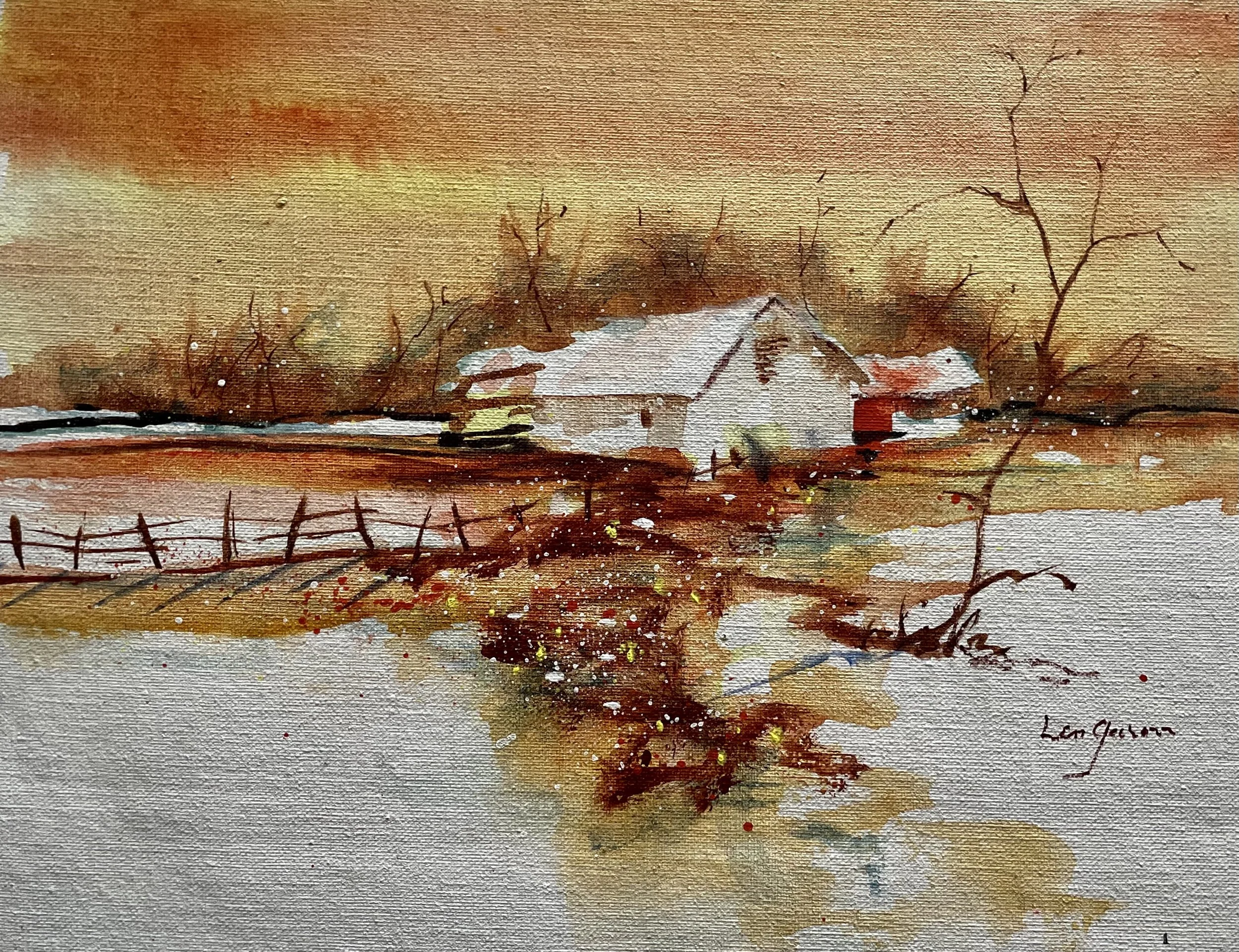
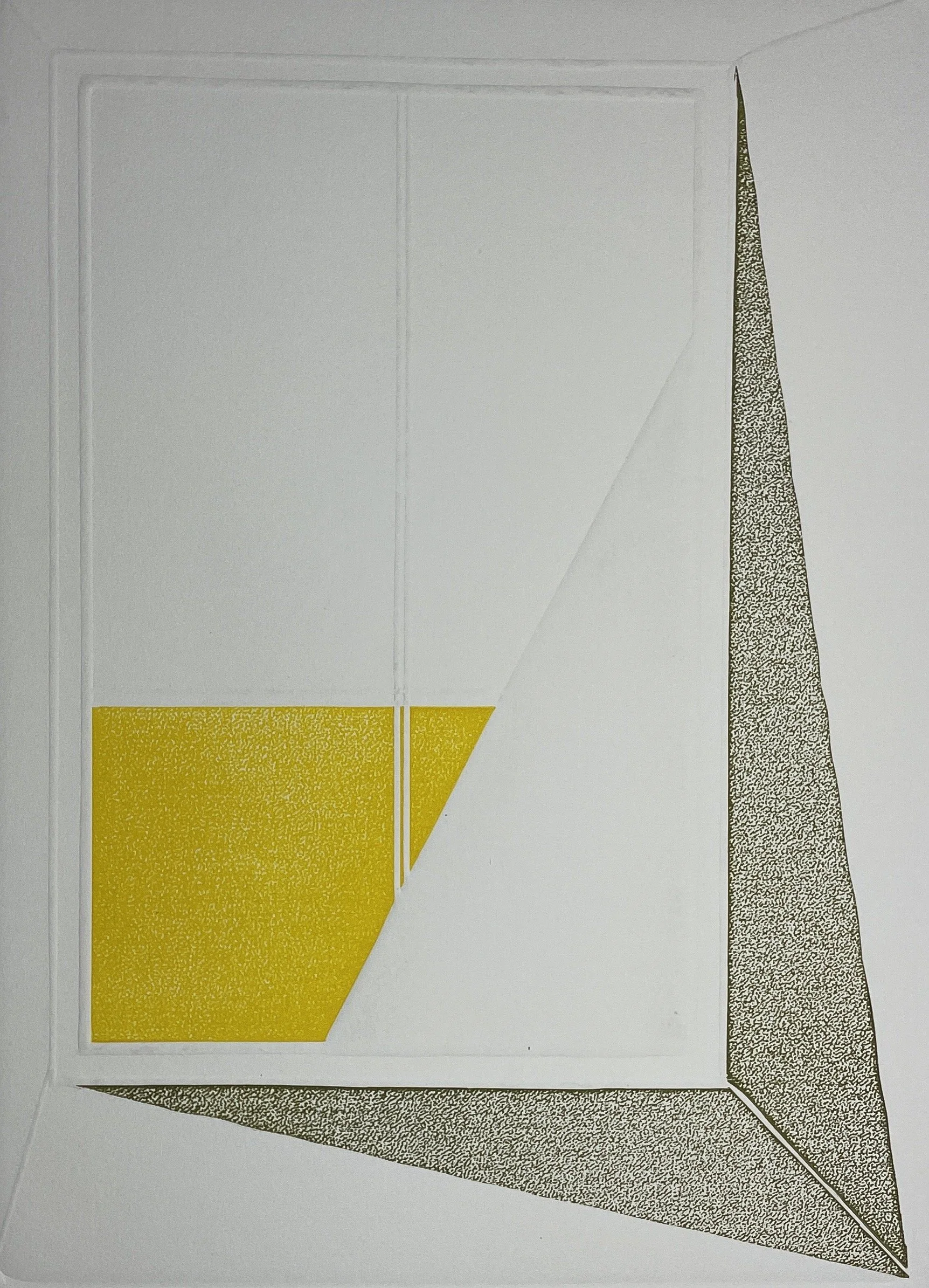
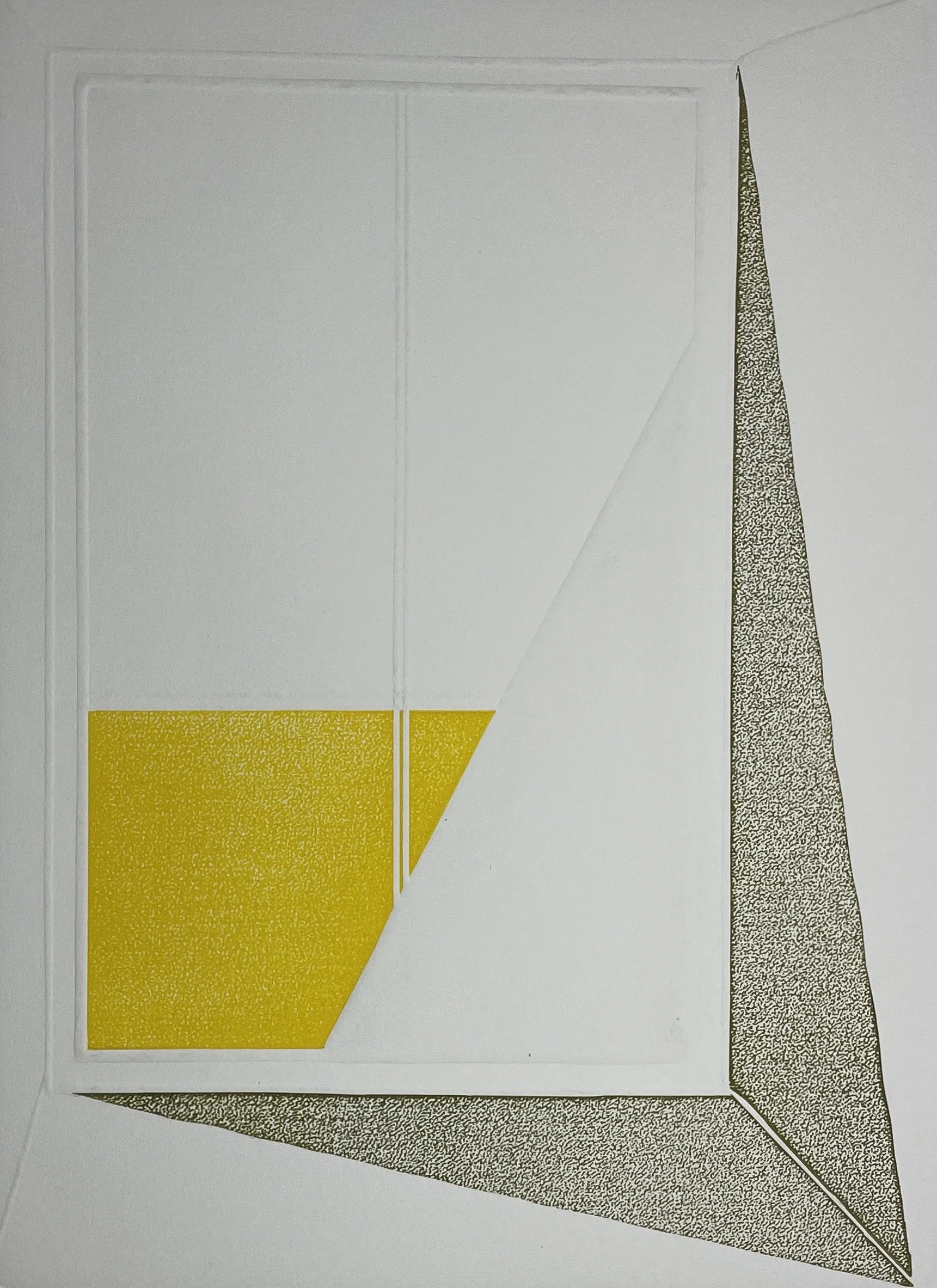
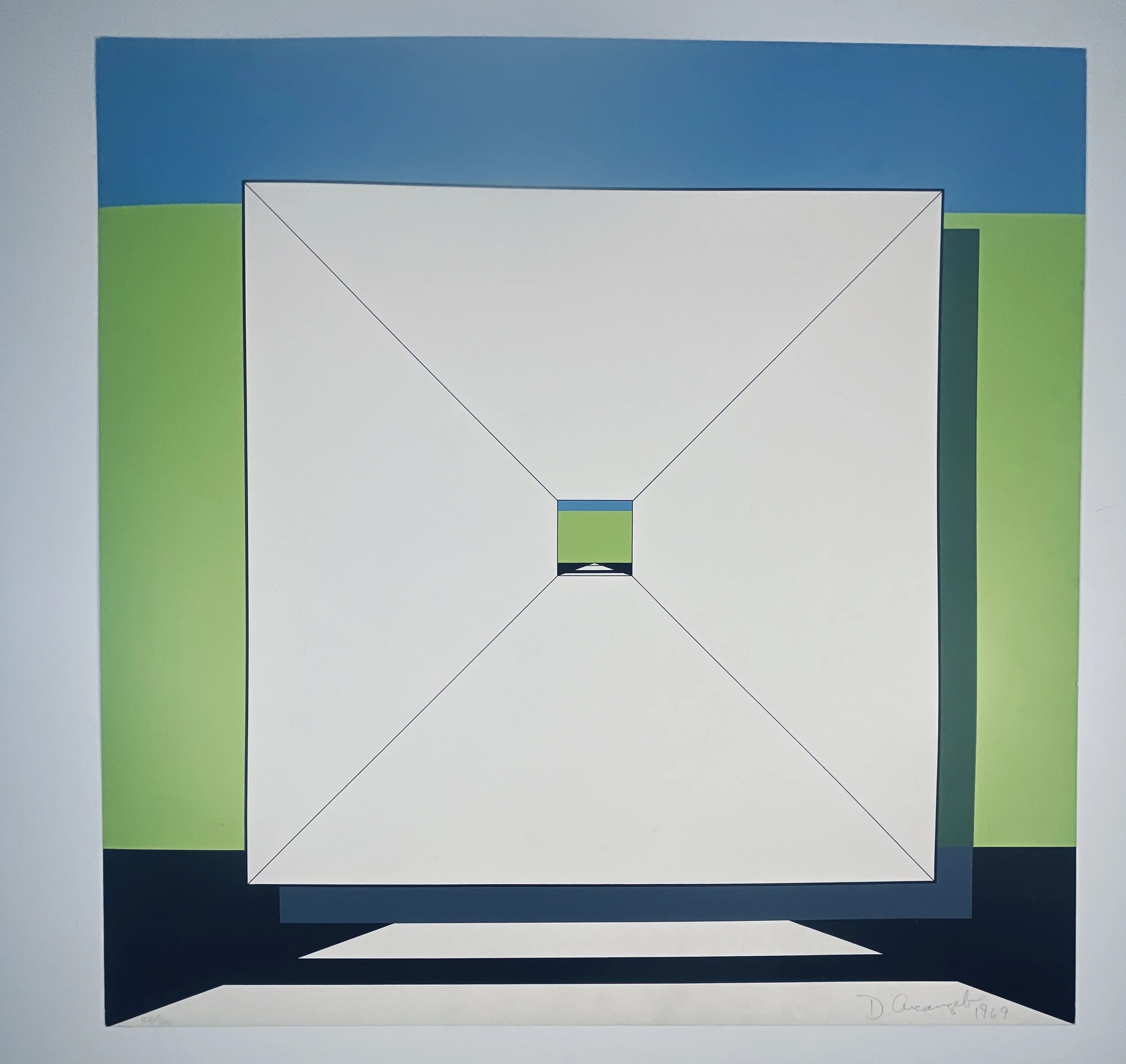
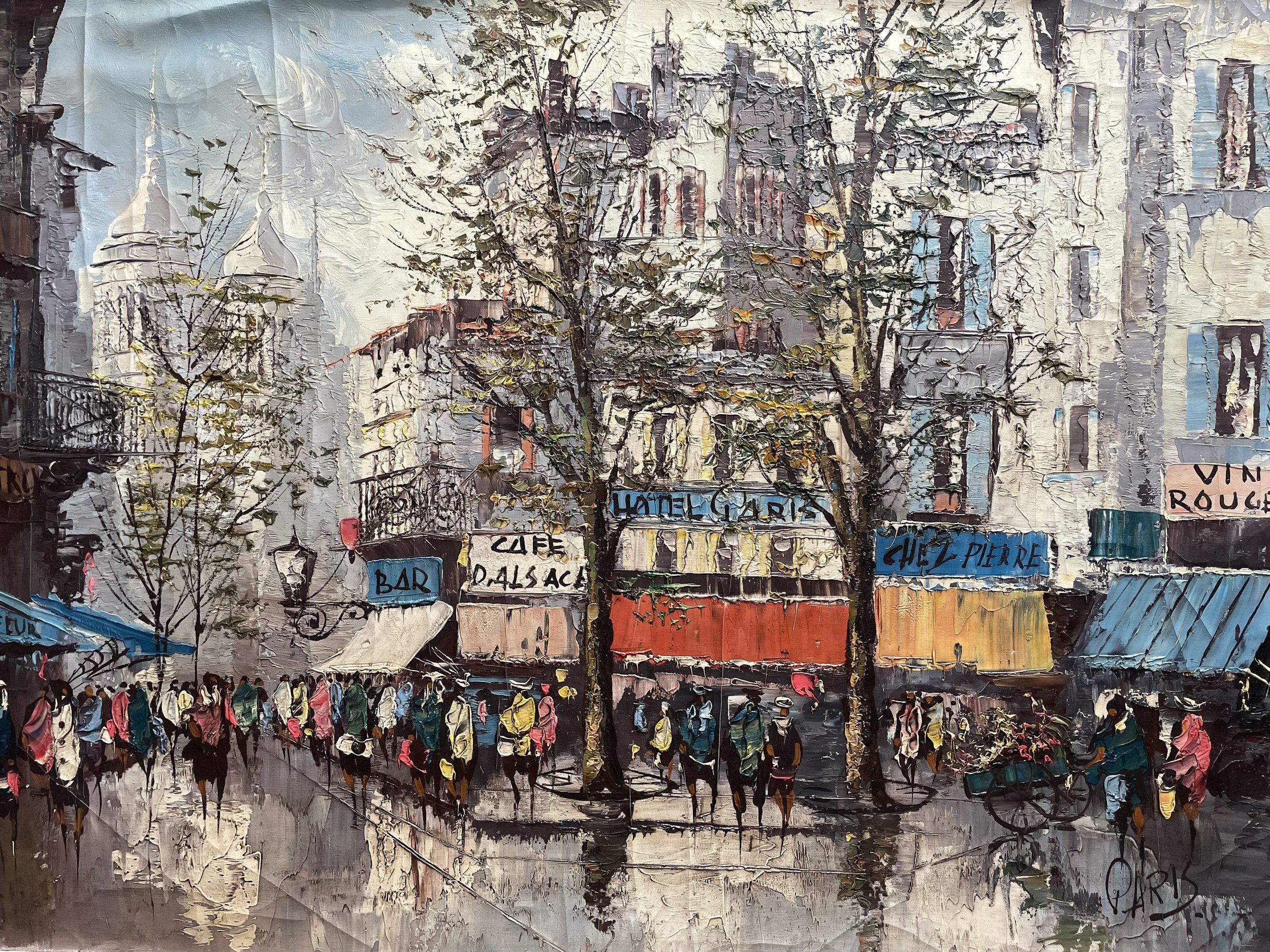
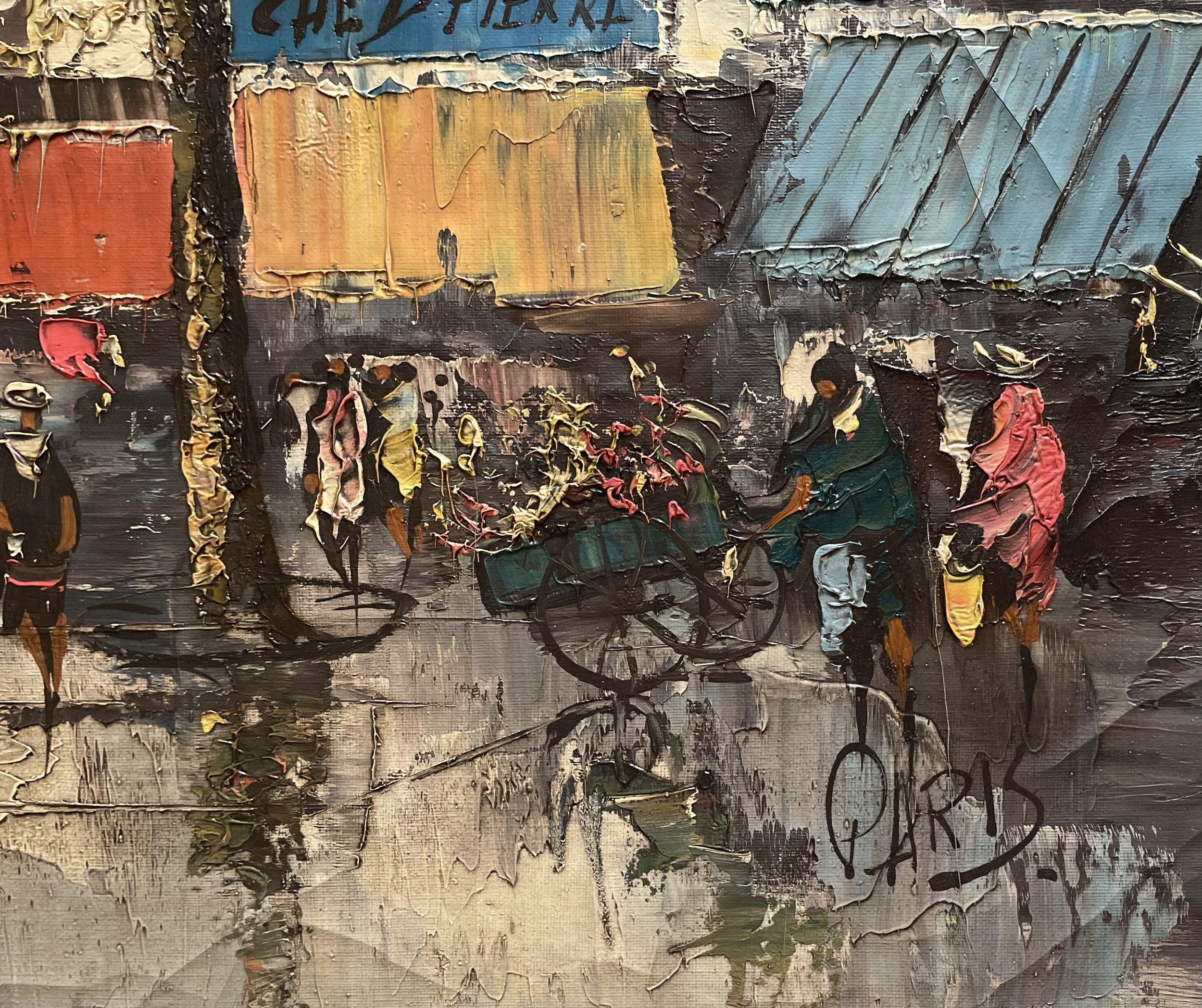
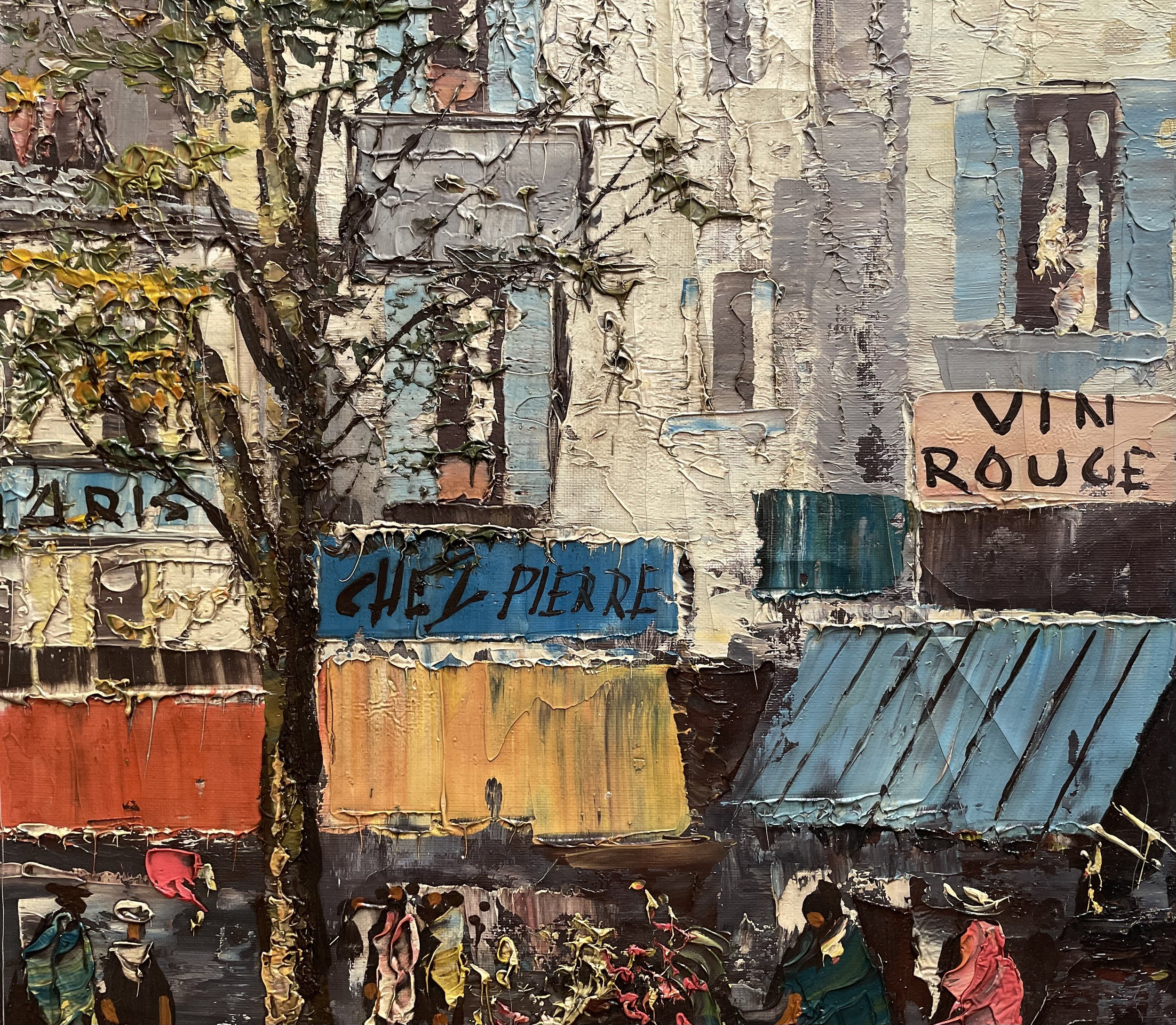
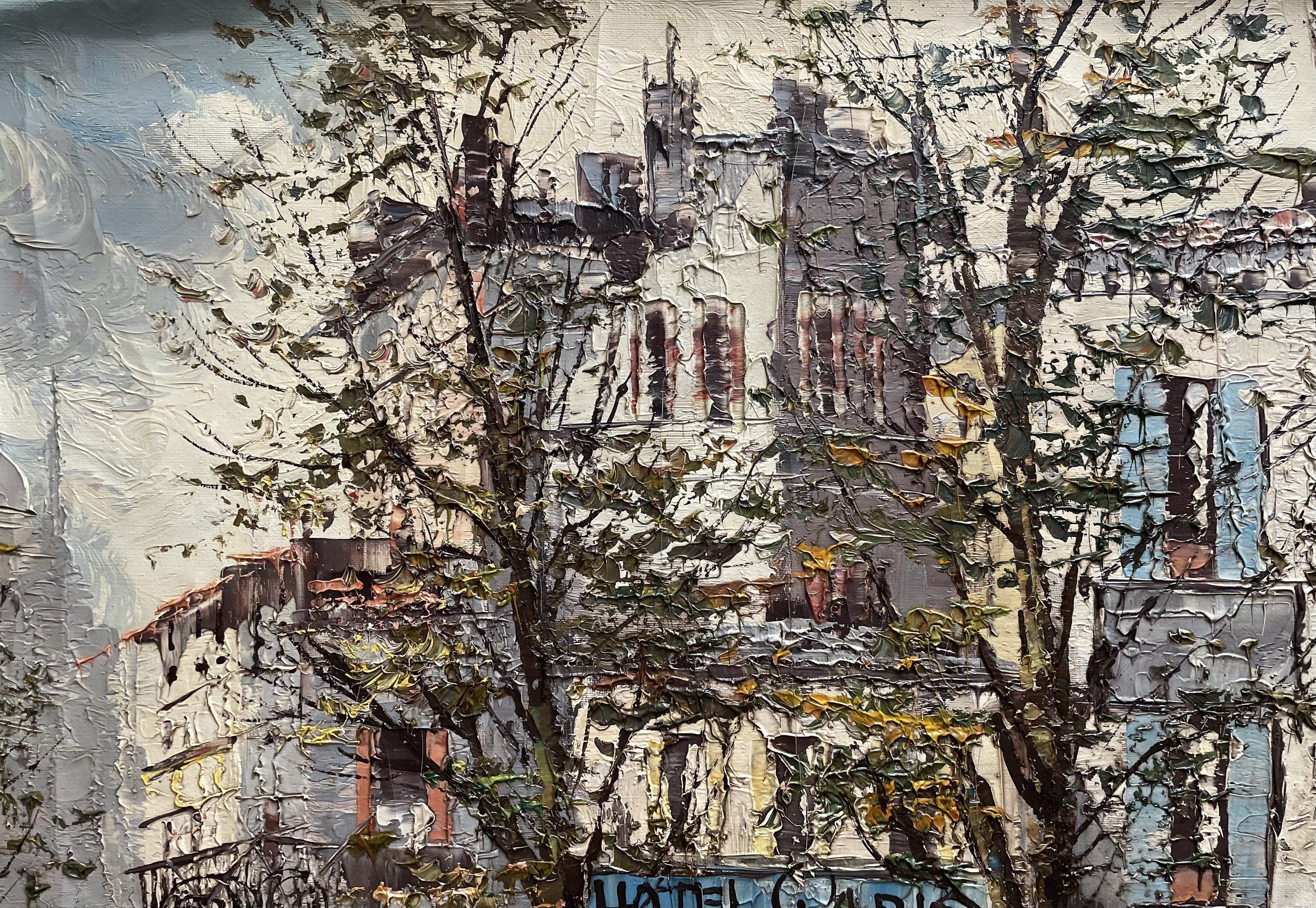
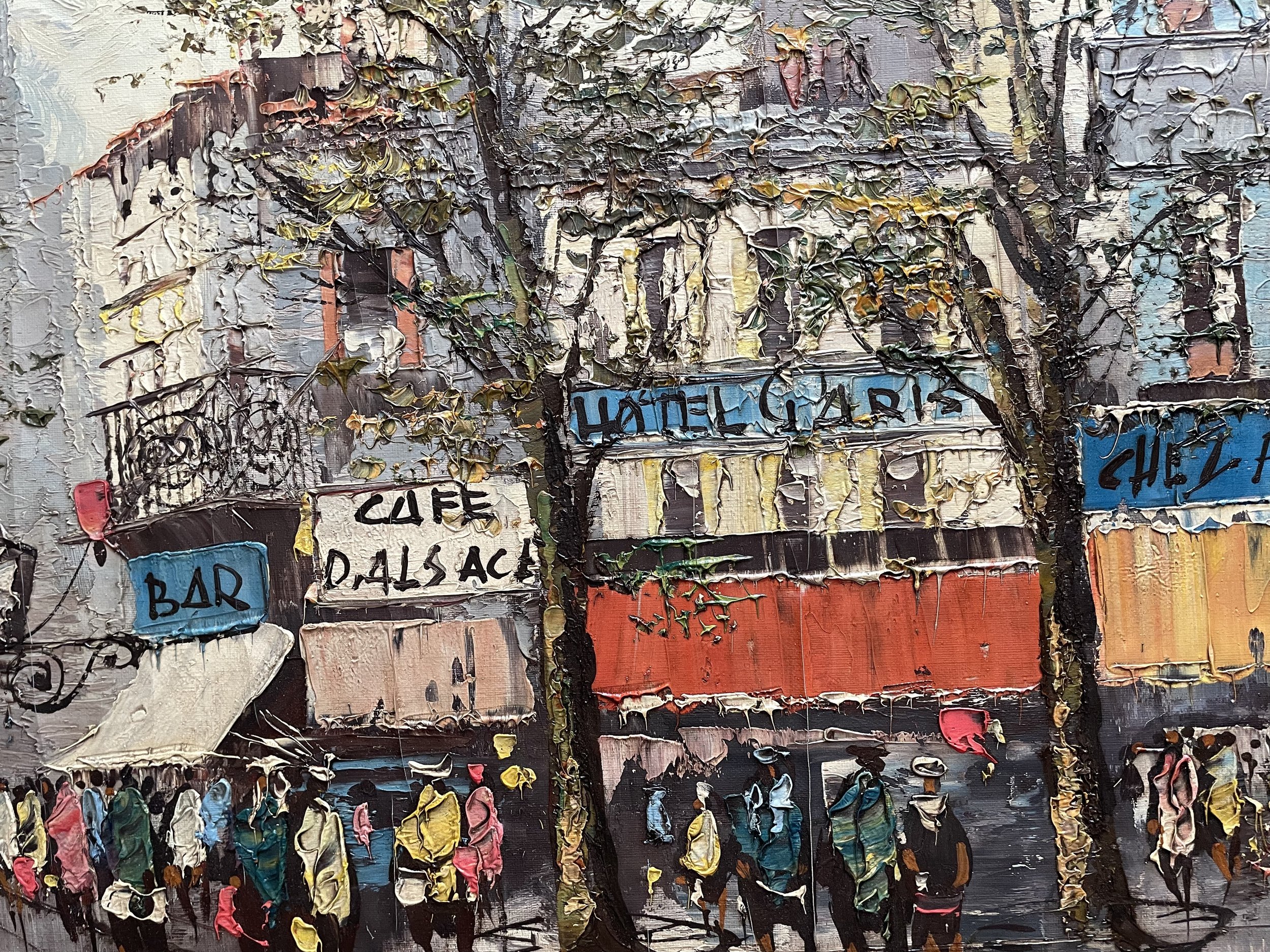
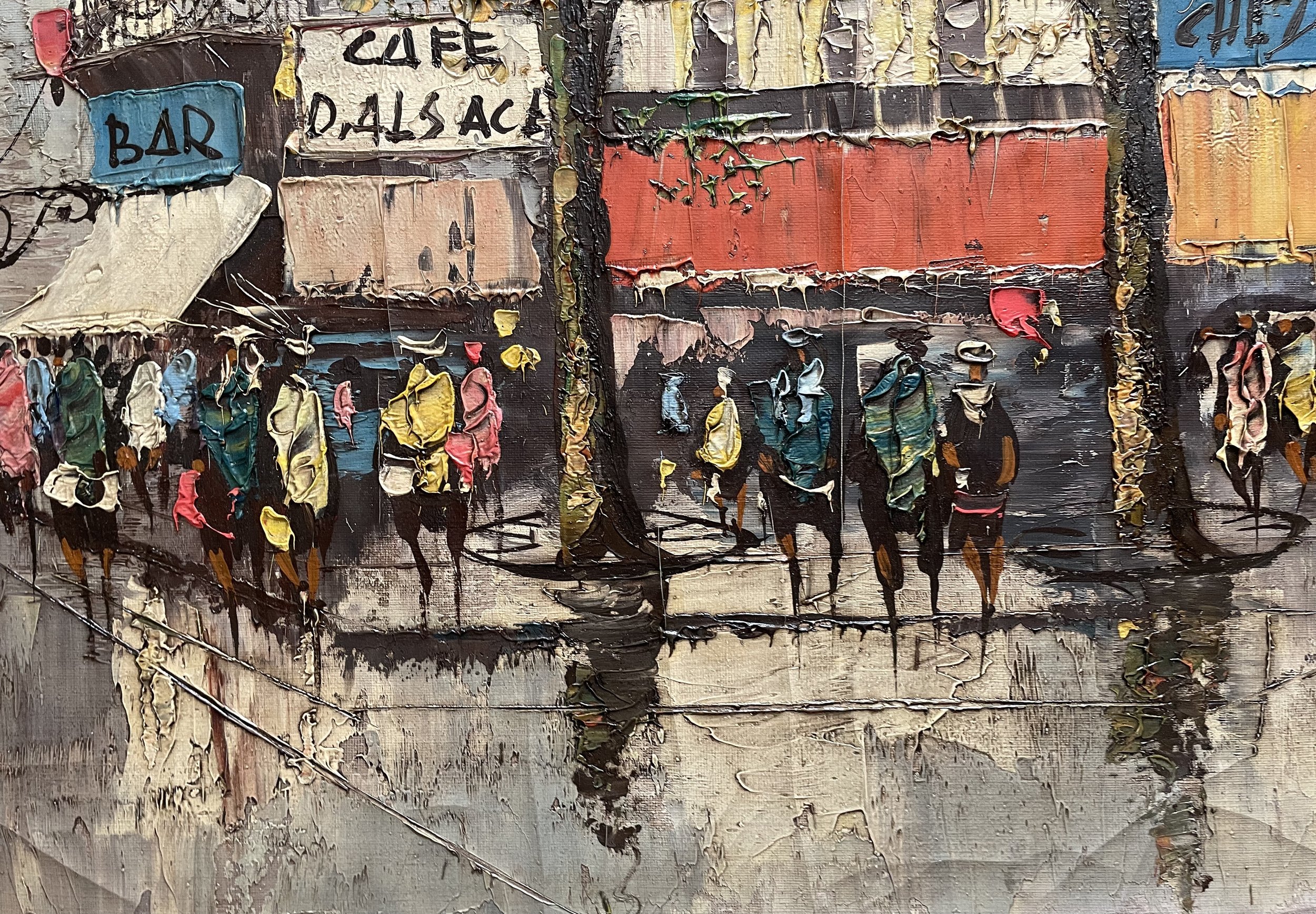
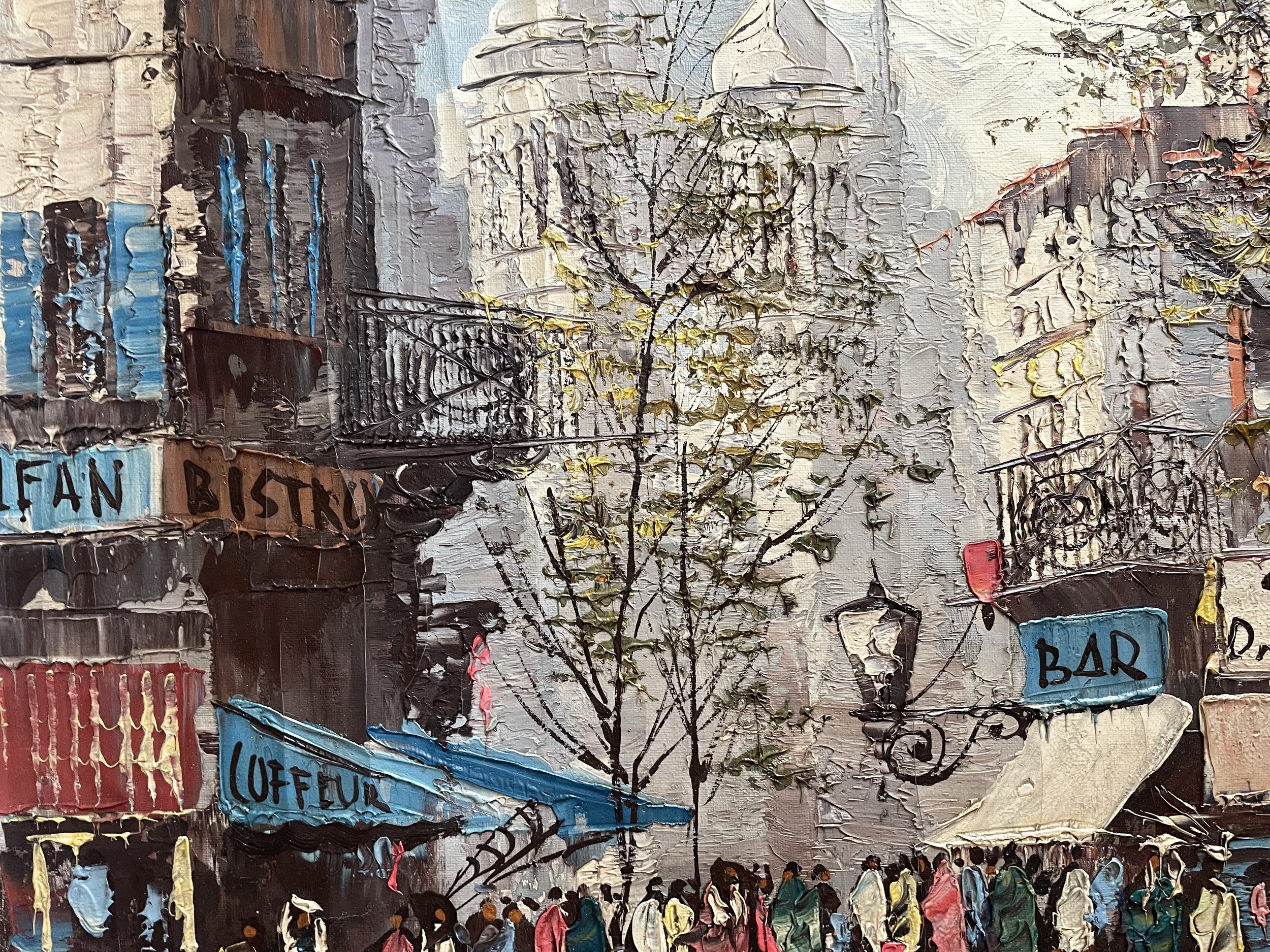
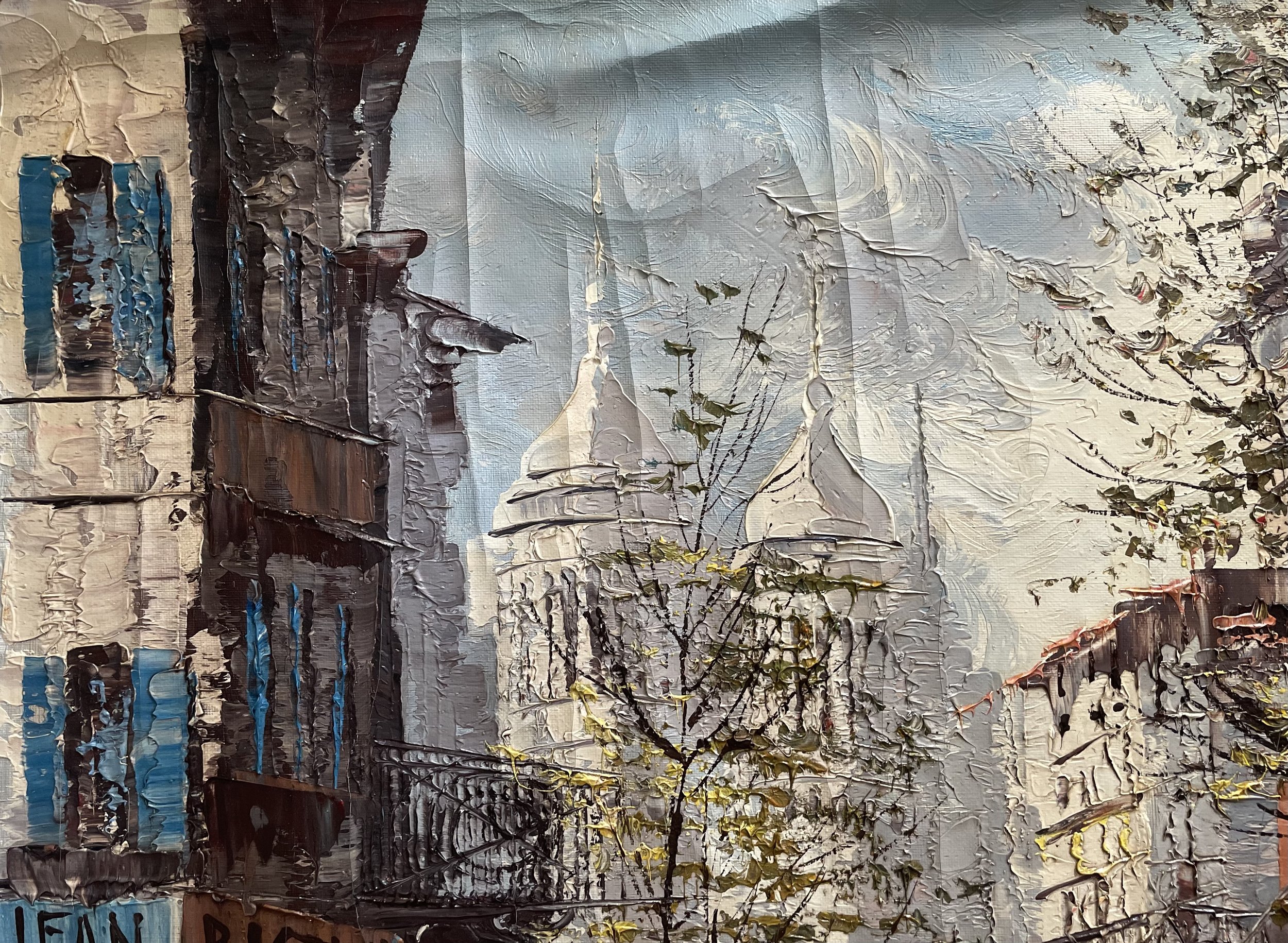
Virgin in Orange, Anique Taylor (American), c. 1970s–1980s, serigraph on paper, 22 × 30 in., titled "Virgin in Orange" lower center, numbered 161/325, pencil-signed lower right.
Artwork Description
A joyful, intricately patterned interior scene rendered in the vivid flat-color vocabulary of 1970s American decorative printmaking — a riot of pattern on pattern, surface on surface, color on color, that somehow achieves genuine visual harmony through the artist's masterful orchestration of a dense chromatic world.
The composition depicts a young woman — the "Virgin" of the title — reclining or sitting on an oversized orange sofa, her back to the viewer, dressed in white, absorbed in her own private world. She is surrounded by an interior of extraordinary decorative density: walls covered in bold vertical stripes of magenta-red and olive green at left, orange and yellow at center; a windowsill crowded with potted plants and houseplants rendered with botanical specificity — philodendrons, caladiums, ferns, and flowering plants in pots and trays; a view through the window to stylized garden trees in pale cream and green; a circular folk-art rug in greens, blues, and oranges on the floor; a floral-patterned cushion; a second chair at right with a floral seat. Two dark cats occupy the orange foreground — one stretched out luxuriously, one sitting upright watching — adding life and narrative to the scene.
The foreground border — a decorative band of stylized floral and leaf forms in greens, blues, and oranges on a striped ground — functions as a kind of visual frame within the frame, drawing the eye into the composition's depth while asserting the work's essentially decorative, pattern-based sensibility.
What is remarkable is how this overwhelming abundance of pattern and color coheres. Taylor controls the visual hierarchy through scale, value, and placement — the orange sofa and the woman in white anchor the composition's center of gravity, while the surrounding patterns recede into supporting roles despite their individual vibrancy. The woman's white dress reads as the one zone of stillness in an otherwise ceaseless visual activity — a quiet center in a singing world. The effect is warmly domestic, culturally rich, and deeply pleasurable — an interior understood not as architecture but as the accumulation of a life lived among beautiful things.
The serigraphic technique is complex — the number of color separations required to achieve this density of pattern is considerable, and the registration throughout is precise. The flat color areas characteristic of serigraph lend themselves perfectly to Taylor's pattern-based approach: each element reads as a distinct, cleanly edged color zone, the overall surface texture built entirely from the juxtaposition of flat shapes rather than painterly gradation.
Artist Biography
Anique Taylor creates works with urban, suburban and mythical subject matter. All of her paintings serve as a network of closely intertwined patterns and tones juxtaposed with people, plants, animals, houses and scenes from modern life and fantasy, in both realistic and surreal and dreamy circumstances. Qart
Taylor holds an MFA in Poetry from Drew University and an MFA in Drawing from Pratt Institute, as well as a Diplôme from Sorbonne University in Paris, France. Art in the Catskills She obtained her AFA, BFA, and MFA with Highest Honors from Pratt Institute and Silvermine College of Art. ART FIND
Taylor's work is held in notable collections including the estate of historian Barbara Tuchman and various prominent academic patrons. ART FIND Her exhibition history spans the New York metropolitan area and beyond, including the Bruce Museum, Noyes Museum, Avery Fisher Hall, the Schafler Gallery at Pratt Institute, and the Distinguished Artist Series in Montclair, New Jersey, where she received First Prize. ART FIND
Further exhibitions include the Hurlbutt Gallery Greenwich CT, the Stark Gallery Englewood NJ, the Mari Gallery of Westchester NY, Eleanor Jeck Gallery Tucson AZ, the Terrain Gallery New York, and the Cork Gallery at Avery Fisher Hall. RoGallery She has co-authored works for HBO, Scholastic, and Simon & Schuster, and her three-act play was performed by Playwrights Horizons and Williamstown Playhouse. Art in the Catskills
Taylor's interior scenes — of which Virgin in Orange is among the most accomplished — place her within a tradition of American women artists who explored the domestic interior as a space of visual abundance and psychological richness, from Miriam Schapiro's pattern-and-decoration movement of the 1970s through the broader feminist reclamation of craft and decorative art as serious artistic territory. Her work is notable for its genuine warmth and the specificity of its observation — these are real interiors, real plants, real cats, real lives, rendered with love and formal intelligence.
Virgin in Orange, Anique Taylor (American), c. 1970s–1980s, serigraph on paper, 22 × 30 in., titled "Virgin in Orange" lower center, numbered 161/325, pencil-signed lower right.
Artwork Description
A joyful, intricately patterned interior scene rendered in the vivid flat-color vocabulary of 1970s American decorative printmaking — a riot of pattern on pattern, surface on surface, color on color, that somehow achieves genuine visual harmony through the artist's masterful orchestration of a dense chromatic world.
The composition depicts a young woman — the "Virgin" of the title — reclining or sitting on an oversized orange sofa, her back to the viewer, dressed in white, absorbed in her own private world. She is surrounded by an interior of extraordinary decorative density: walls covered in bold vertical stripes of magenta-red and olive green at left, orange and yellow at center; a windowsill crowded with potted plants and houseplants rendered with botanical specificity — philodendrons, caladiums, ferns, and flowering plants in pots and trays; a view through the window to stylized garden trees in pale cream and green; a circular folk-art rug in greens, blues, and oranges on the floor; a floral-patterned cushion; a second chair at right with a floral seat. Two dark cats occupy the orange foreground — one stretched out luxuriously, one sitting upright watching — adding life and narrative to the scene.
The foreground border — a decorative band of stylized floral and leaf forms in greens, blues, and oranges on a striped ground — functions as a kind of visual frame within the frame, drawing the eye into the composition's depth while asserting the work's essentially decorative, pattern-based sensibility.
What is remarkable is how this overwhelming abundance of pattern and color coheres. Taylor controls the visual hierarchy through scale, value, and placement — the orange sofa and the woman in white anchor the composition's center of gravity, while the surrounding patterns recede into supporting roles despite their individual vibrancy. The woman's white dress reads as the one zone of stillness in an otherwise ceaseless visual activity — a quiet center in a singing world. The effect is warmly domestic, culturally rich, and deeply pleasurable — an interior understood not as architecture but as the accumulation of a life lived among beautiful things.
The serigraphic technique is complex — the number of color separations required to achieve this density of pattern is considerable, and the registration throughout is precise. The flat color areas characteristic of serigraph lend themselves perfectly to Taylor's pattern-based approach: each element reads as a distinct, cleanly edged color zone, the overall surface texture built entirely from the juxtaposition of flat shapes rather than painterly gradation.
Artist Biography
Anique Taylor creates works with urban, suburban and mythical subject matter. All of her paintings serve as a network of closely intertwined patterns and tones juxtaposed with people, plants, animals, houses and scenes from modern life and fantasy, in both realistic and surreal and dreamy circumstances. Qart
Taylor holds an MFA in Poetry from Drew University and an MFA in Drawing from Pratt Institute, as well as a Diplôme from Sorbonne University in Paris, France. Art in the Catskills She obtained her AFA, BFA, and MFA with Highest Honors from Pratt Institute and Silvermine College of Art. ART FIND
Taylor's work is held in notable collections including the estate of historian Barbara Tuchman and various prominent academic patrons. ART FIND Her exhibition history spans the New York metropolitan area and beyond, including the Bruce Museum, Noyes Museum, Avery Fisher Hall, the Schafler Gallery at Pratt Institute, and the Distinguished Artist Series in Montclair, New Jersey, where she received First Prize. ART FIND
Further exhibitions include the Hurlbutt Gallery Greenwich CT, the Stark Gallery Englewood NJ, the Mari Gallery of Westchester NY, Eleanor Jeck Gallery Tucson AZ, the Terrain Gallery New York, and the Cork Gallery at Avery Fisher Hall. RoGallery She has co-authored works for HBO, Scholastic, and Simon & Schuster, and her three-act play was performed by Playwrights Horizons and Williamstown Playhouse. Art in the Catskills
Taylor's interior scenes — of which Virgin in Orange is among the most accomplished — place her within a tradition of American women artists who explored the domestic interior as a space of visual abundance and psychological richness, from Miriam Schapiro's pattern-and-decoration movement of the 1970s through the broader feminist reclamation of craft and decorative art as serious artistic territory. Her work is notable for its genuine warmth and the specificity of its observation — these are real interiors, real plants, real cats, real lives, rendered with love and formal intelligence.
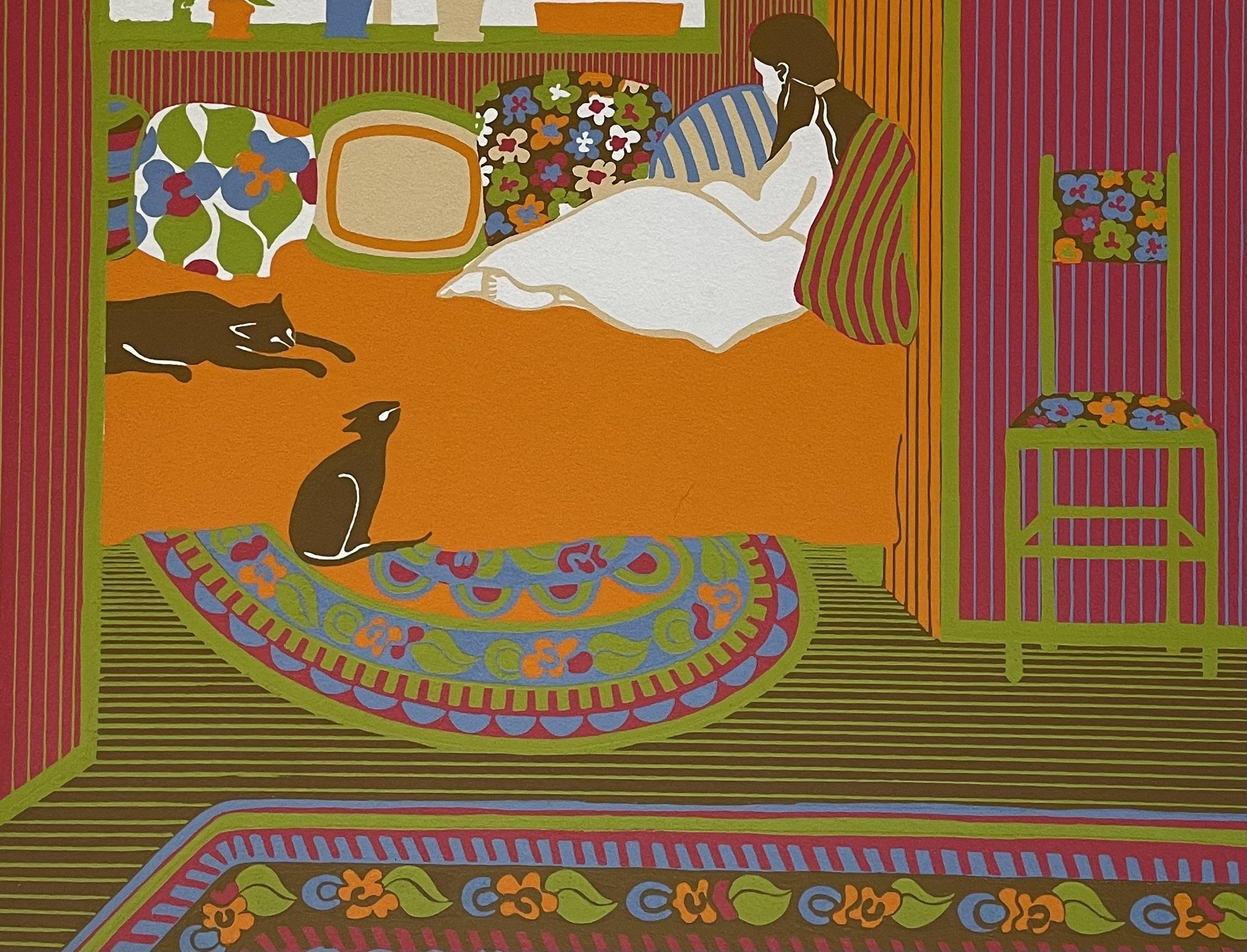 Image 1 of 10
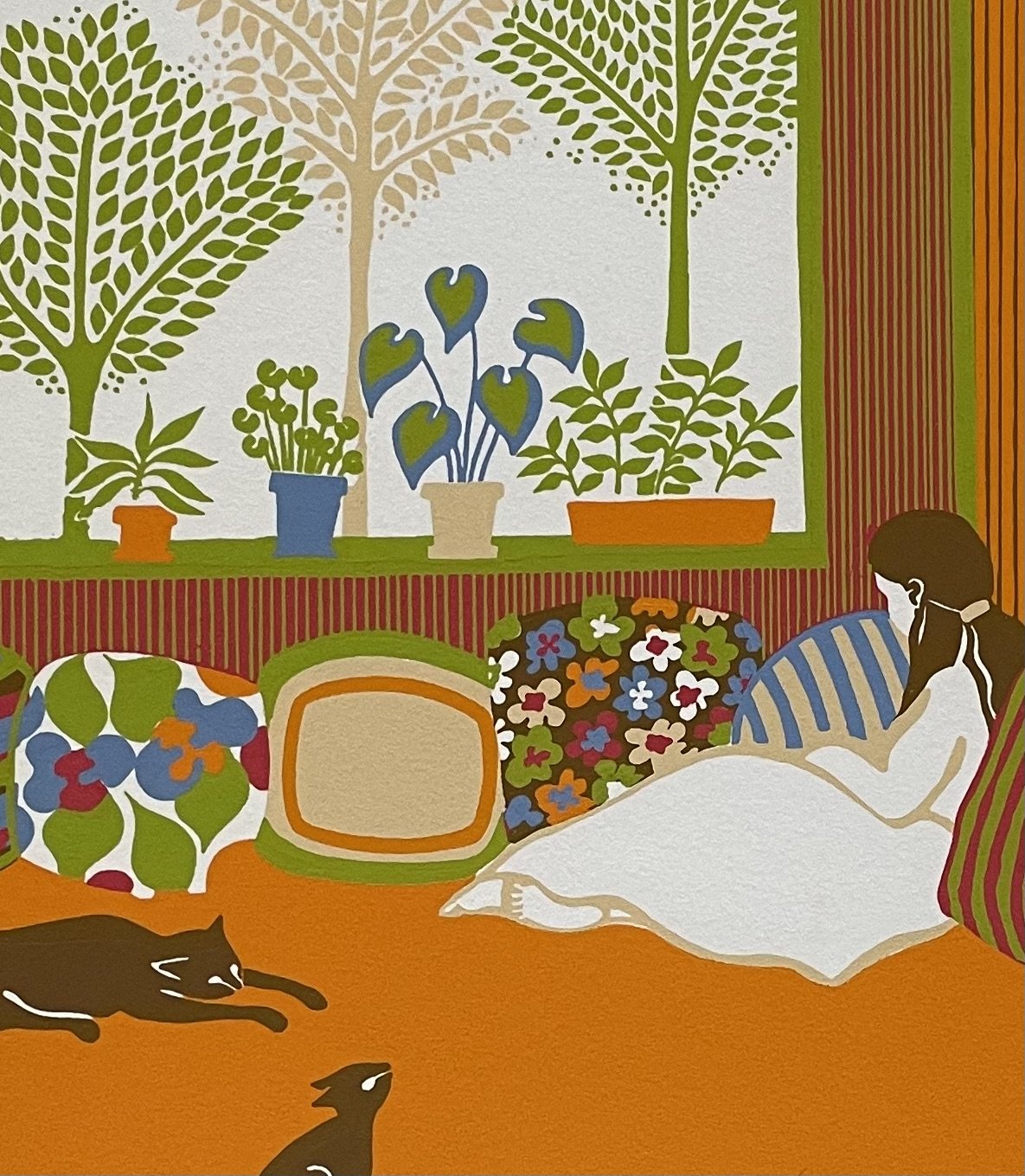 Image 2 of 10
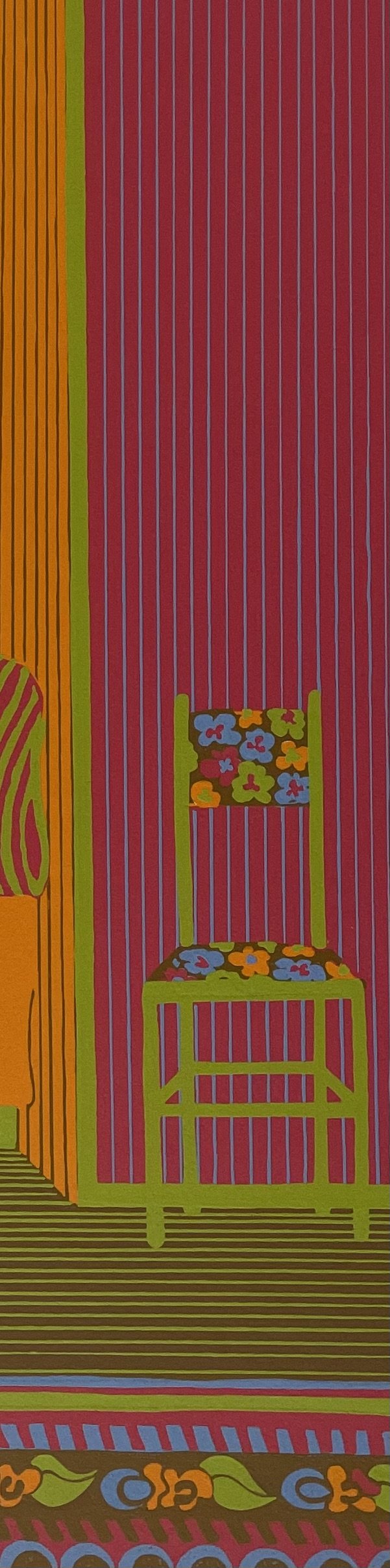 Image 3 of 10
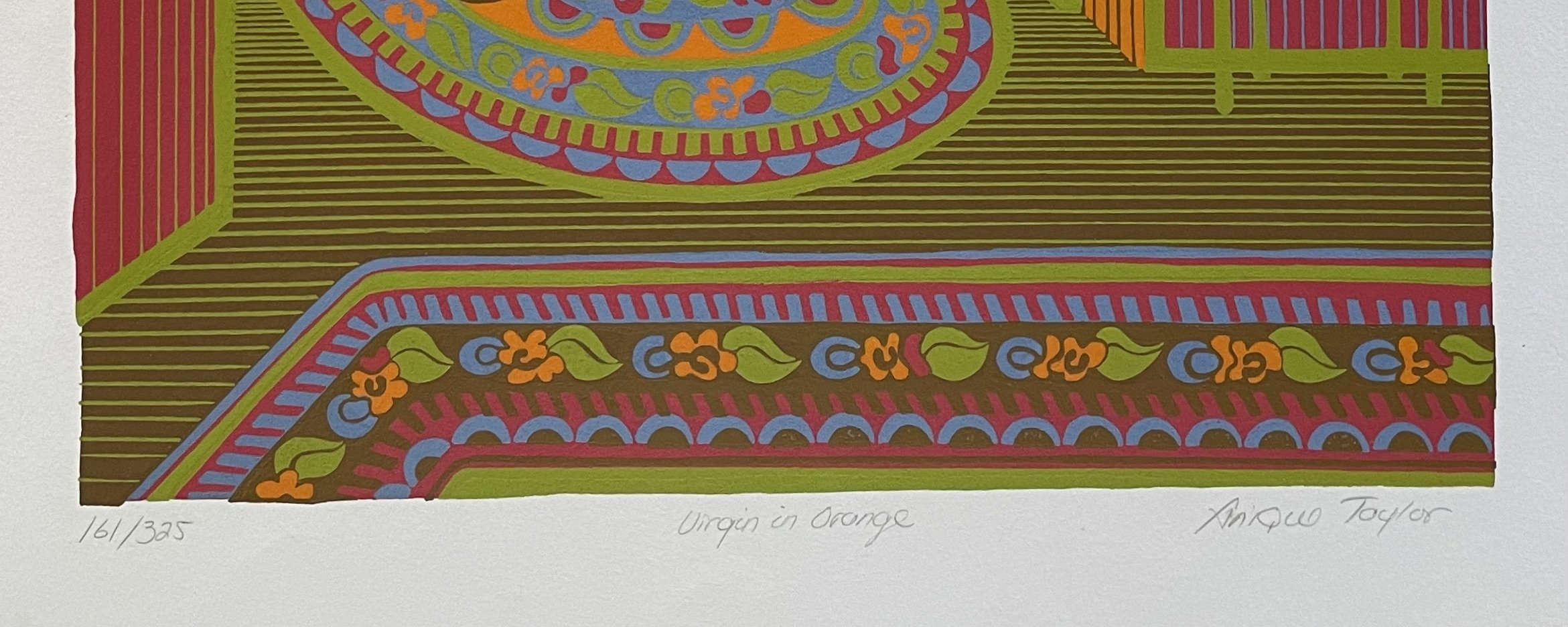 Image 4 of 10
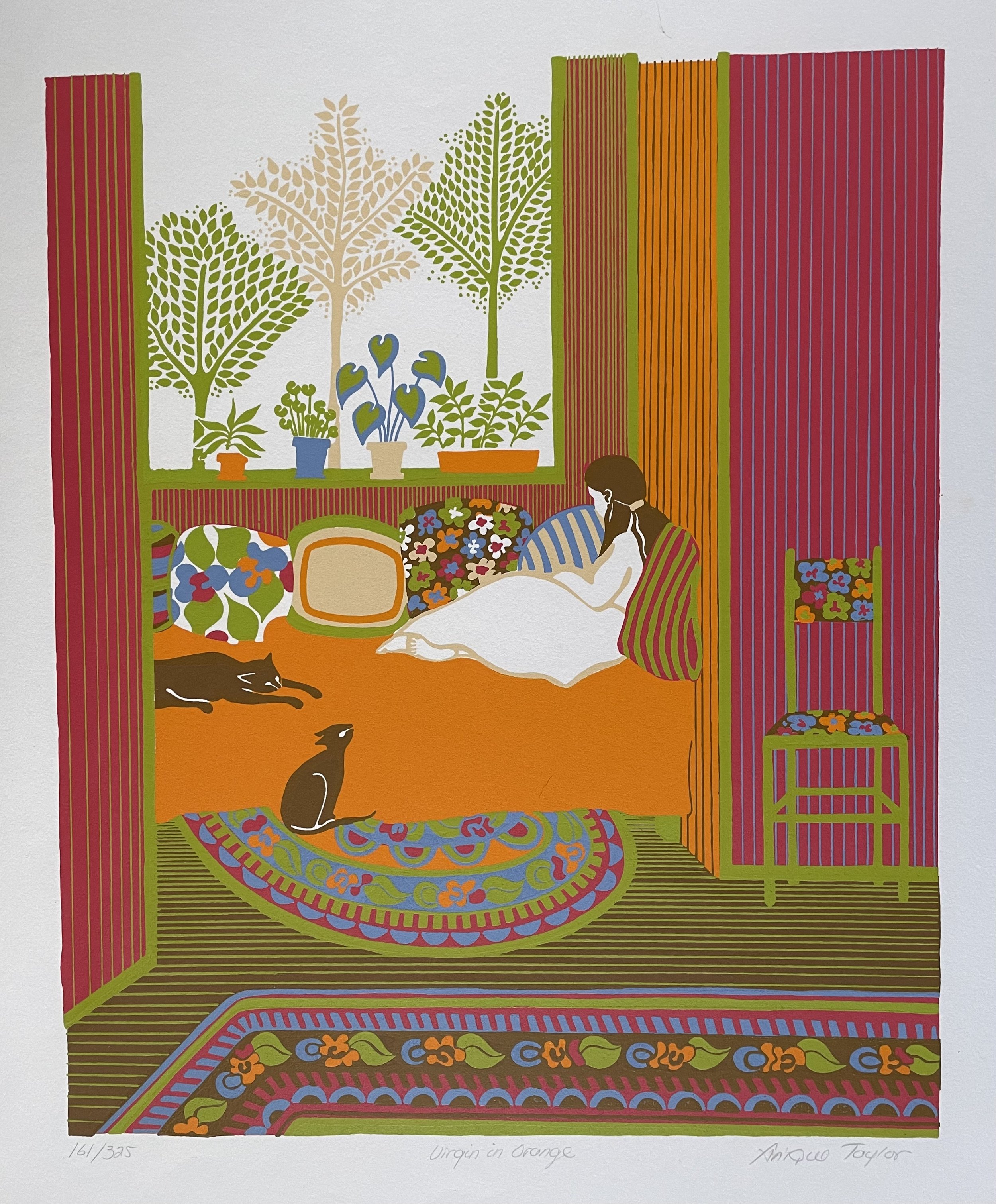 Image 5 of 10
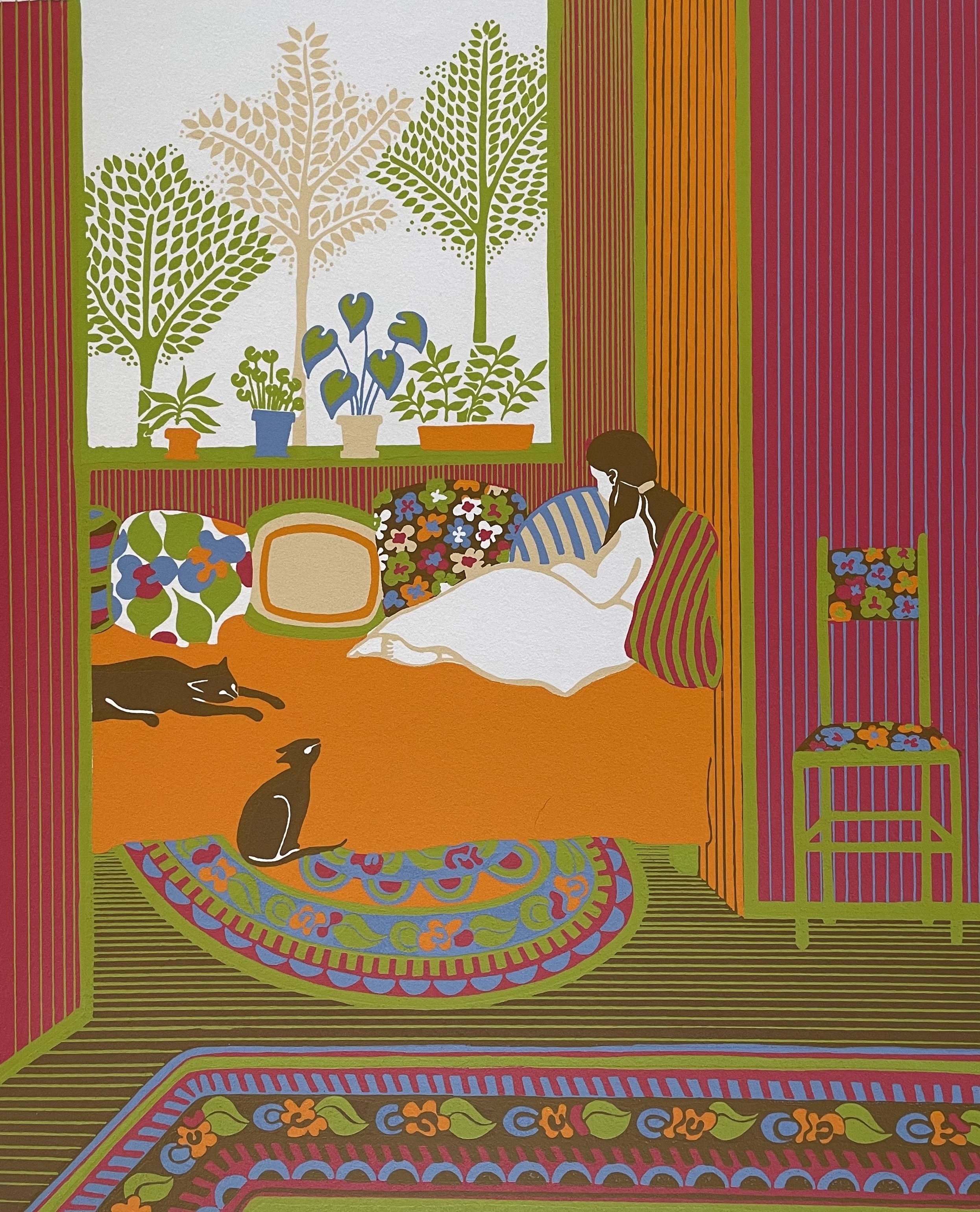 Image 6 of 10
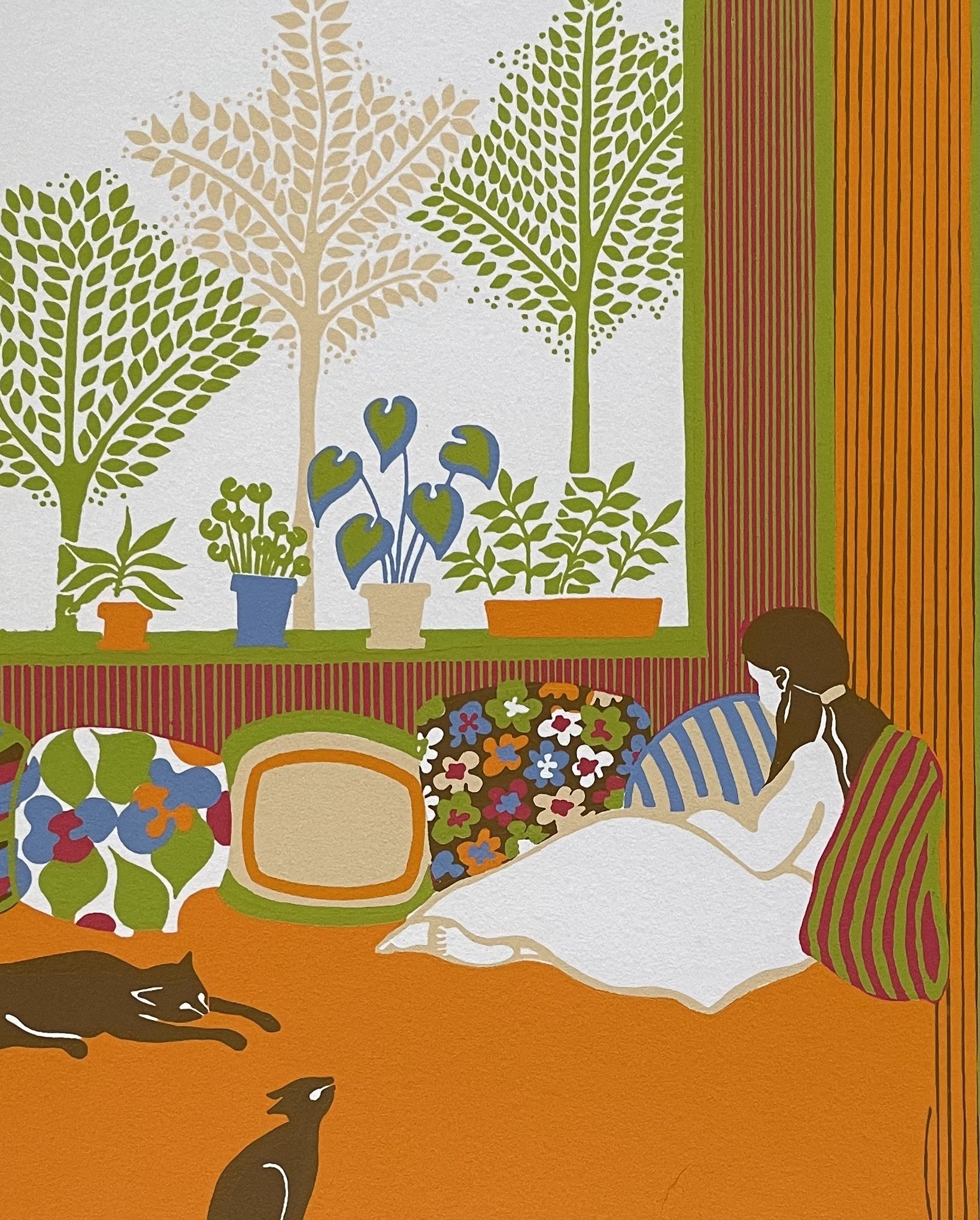 Image 7 of 10
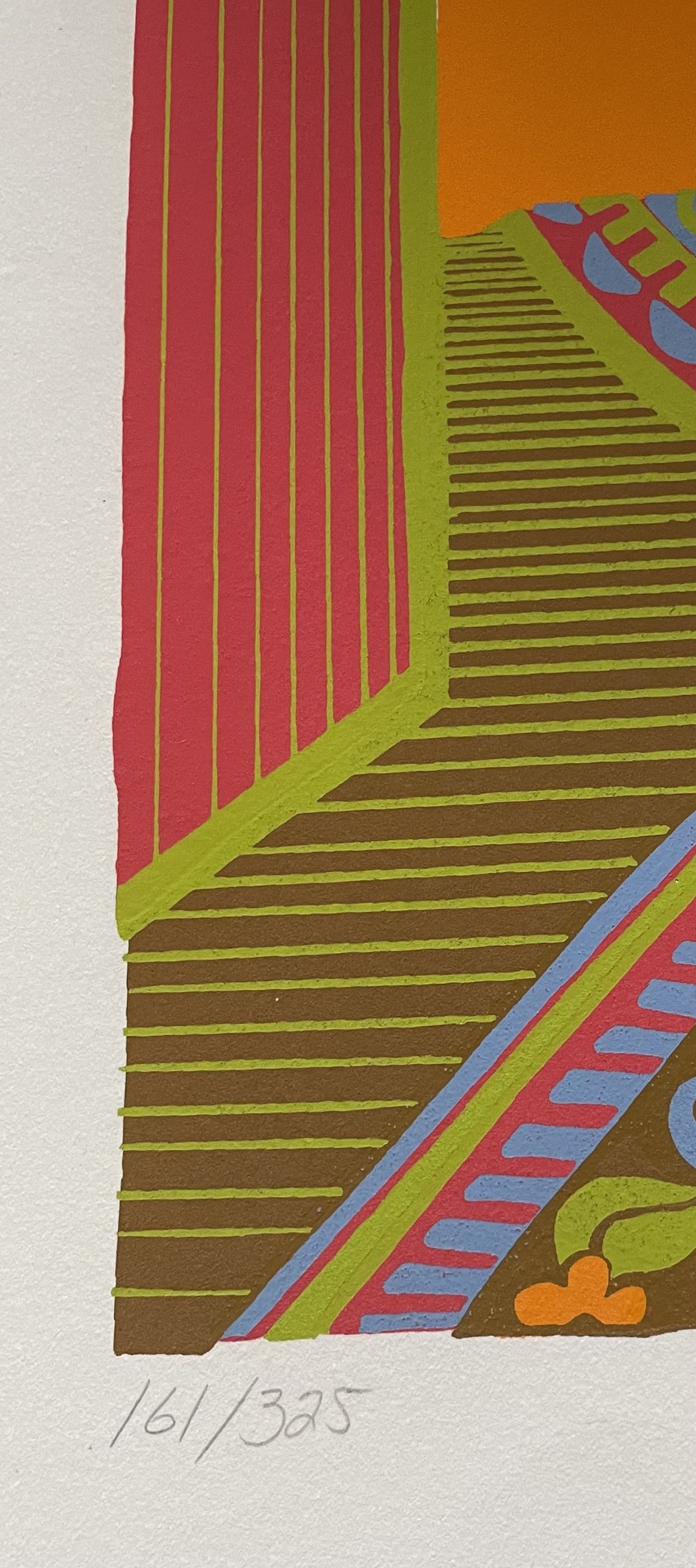 Image 8 of 10
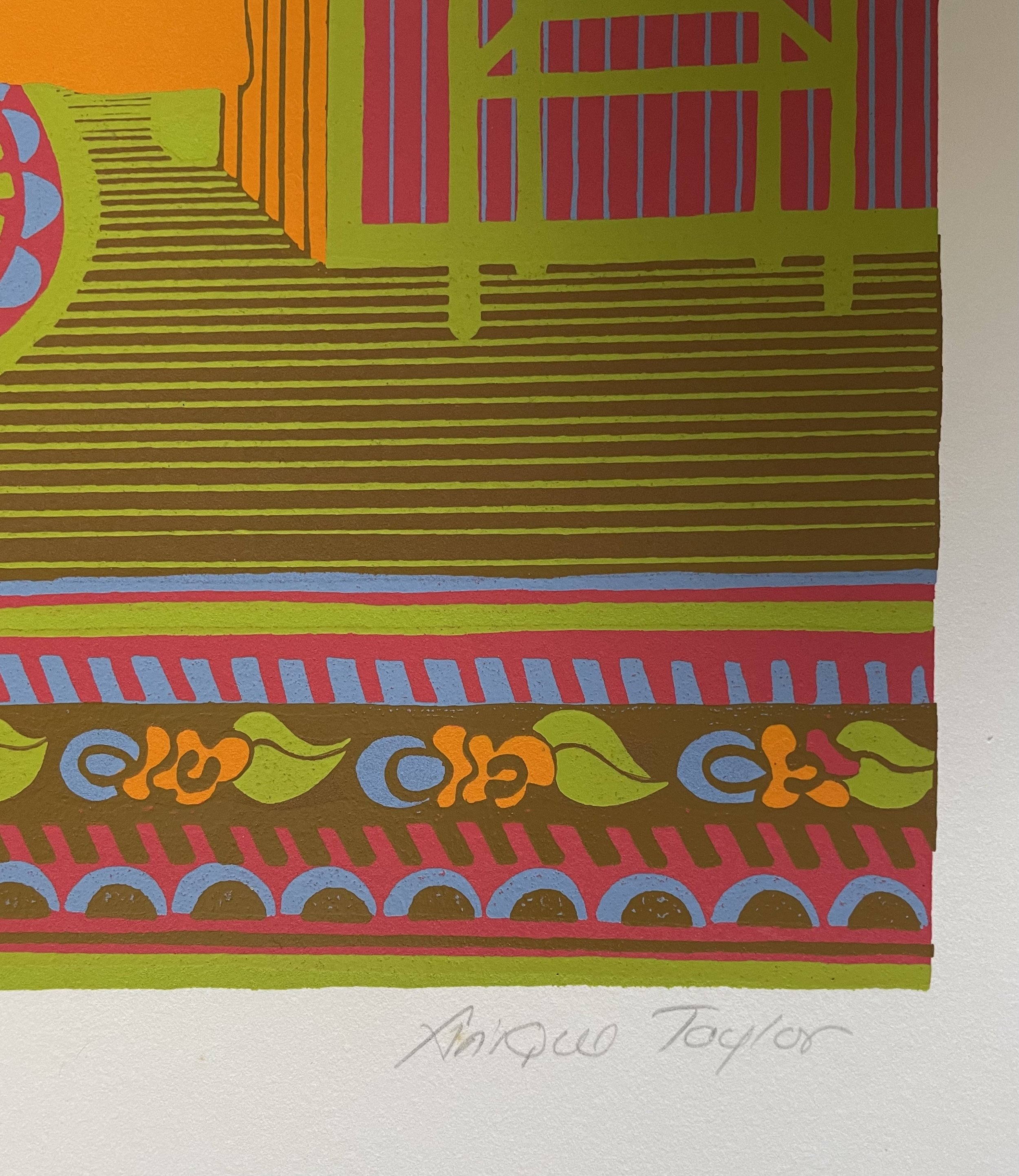 Image 9 of 10
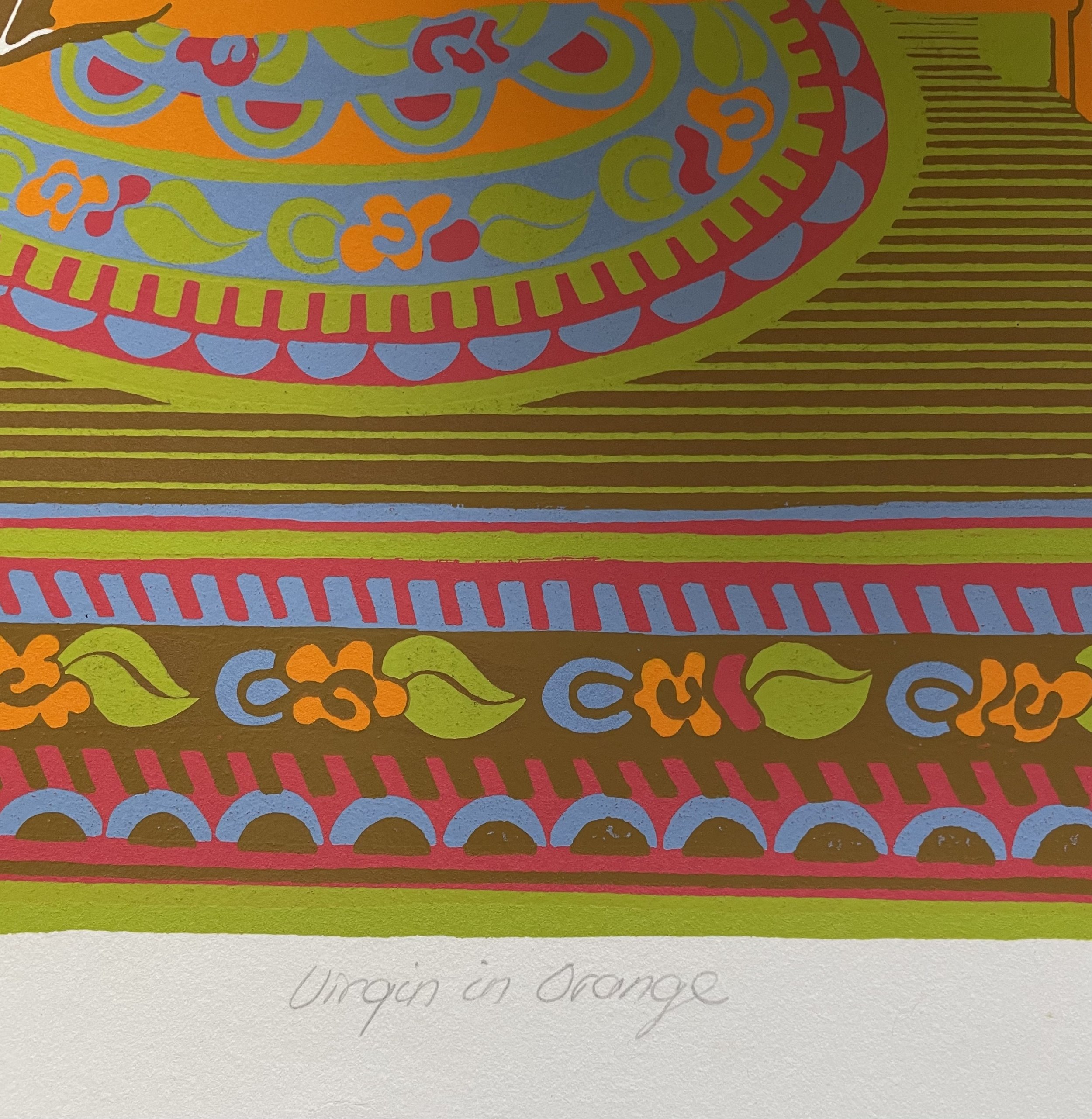 Image 10 of 10