 Image 1 of 4
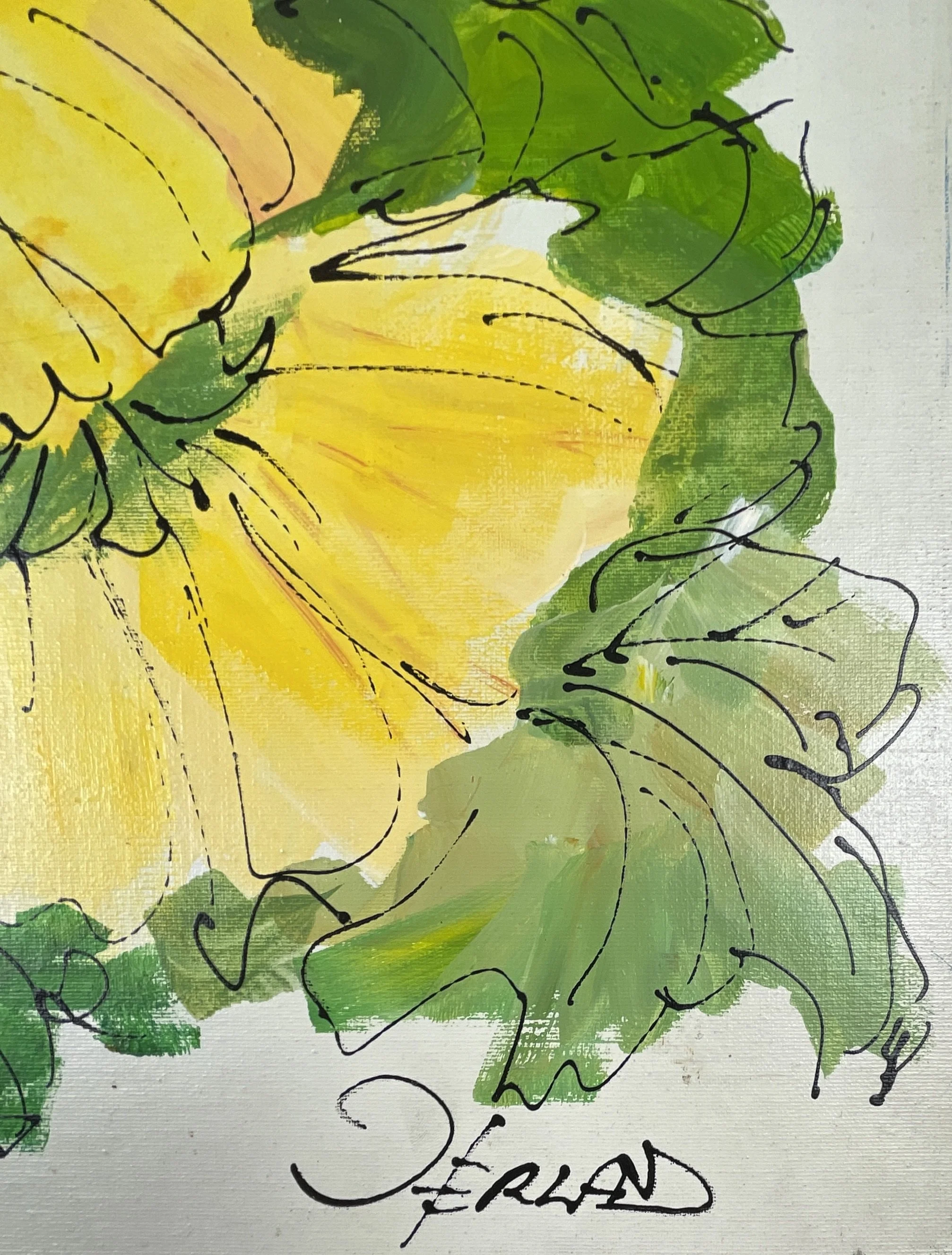 Image 2 of 4
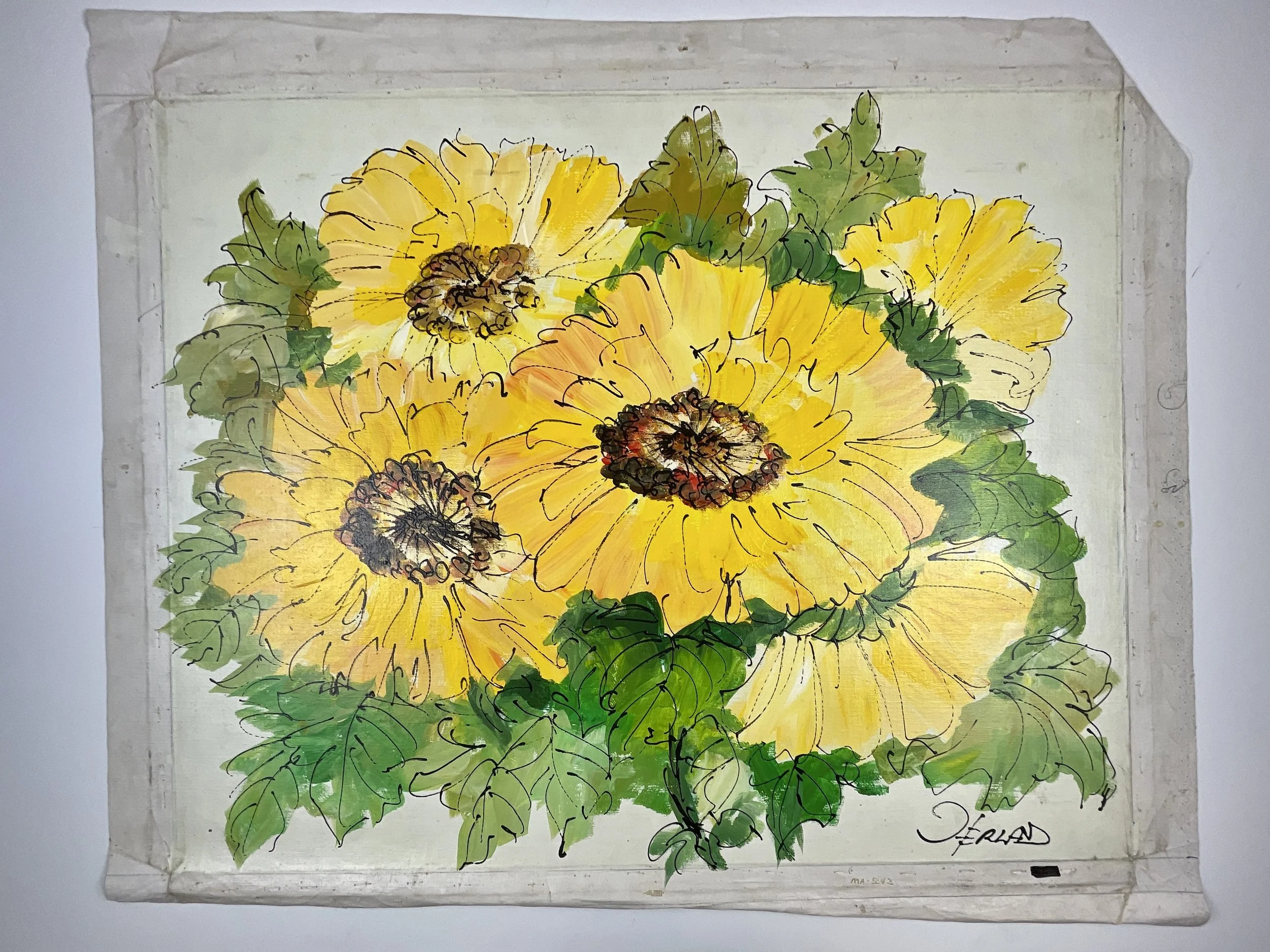 Image 3 of 4
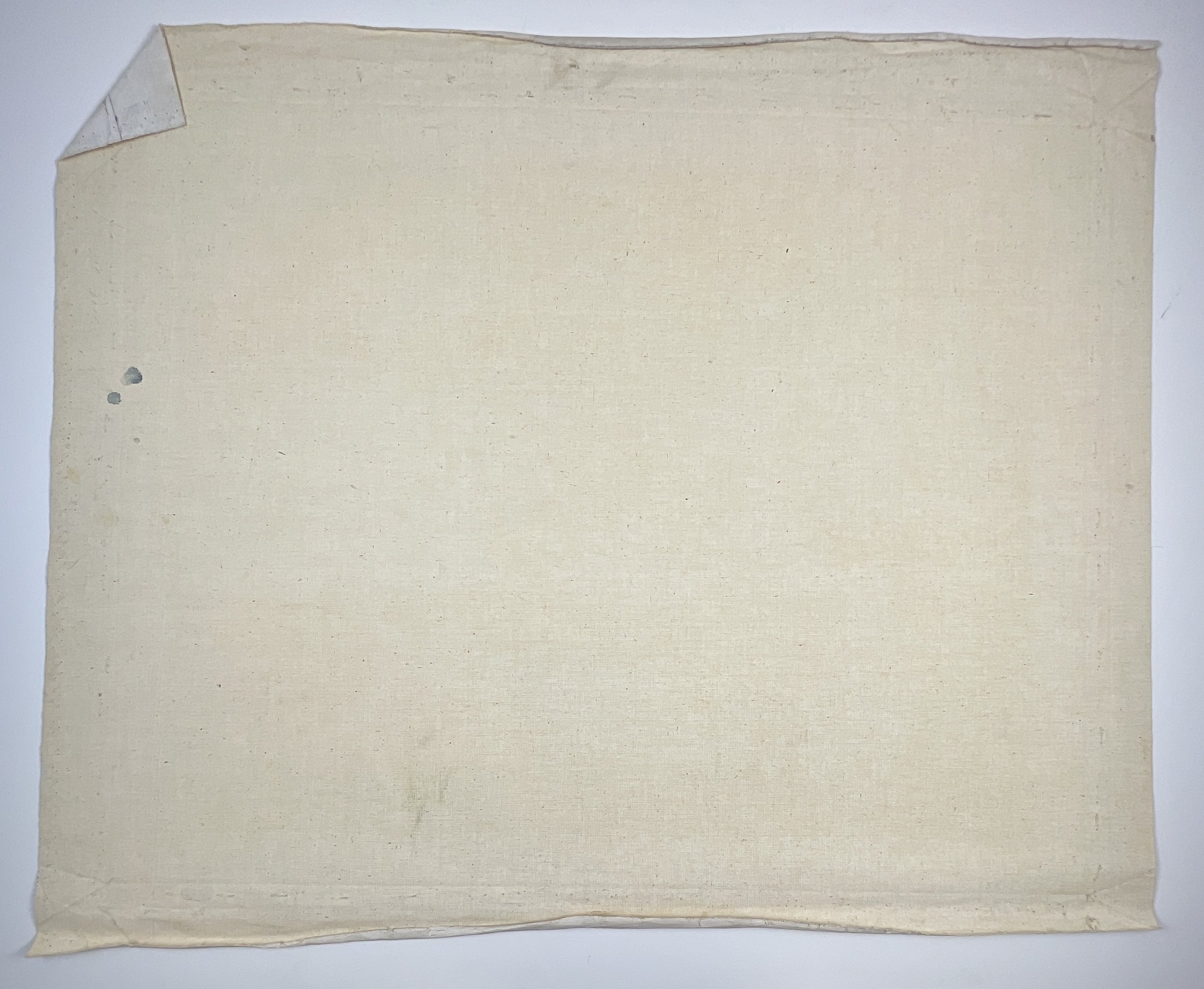 Image 4 of 4
Yellow Floral Still Life (attributed), Jack Herland (20th century), c.1960–1975, acrylic and ink on canvas, 30 × 24 in., signed lower right.
Expressive yellow floral still life by Jack Herland, executed in bold acrylic washes with gestural ink linework. Vibrant mid-century modern flower painting on canvas with lively graphic outlines and luminous color.
Artwork Description
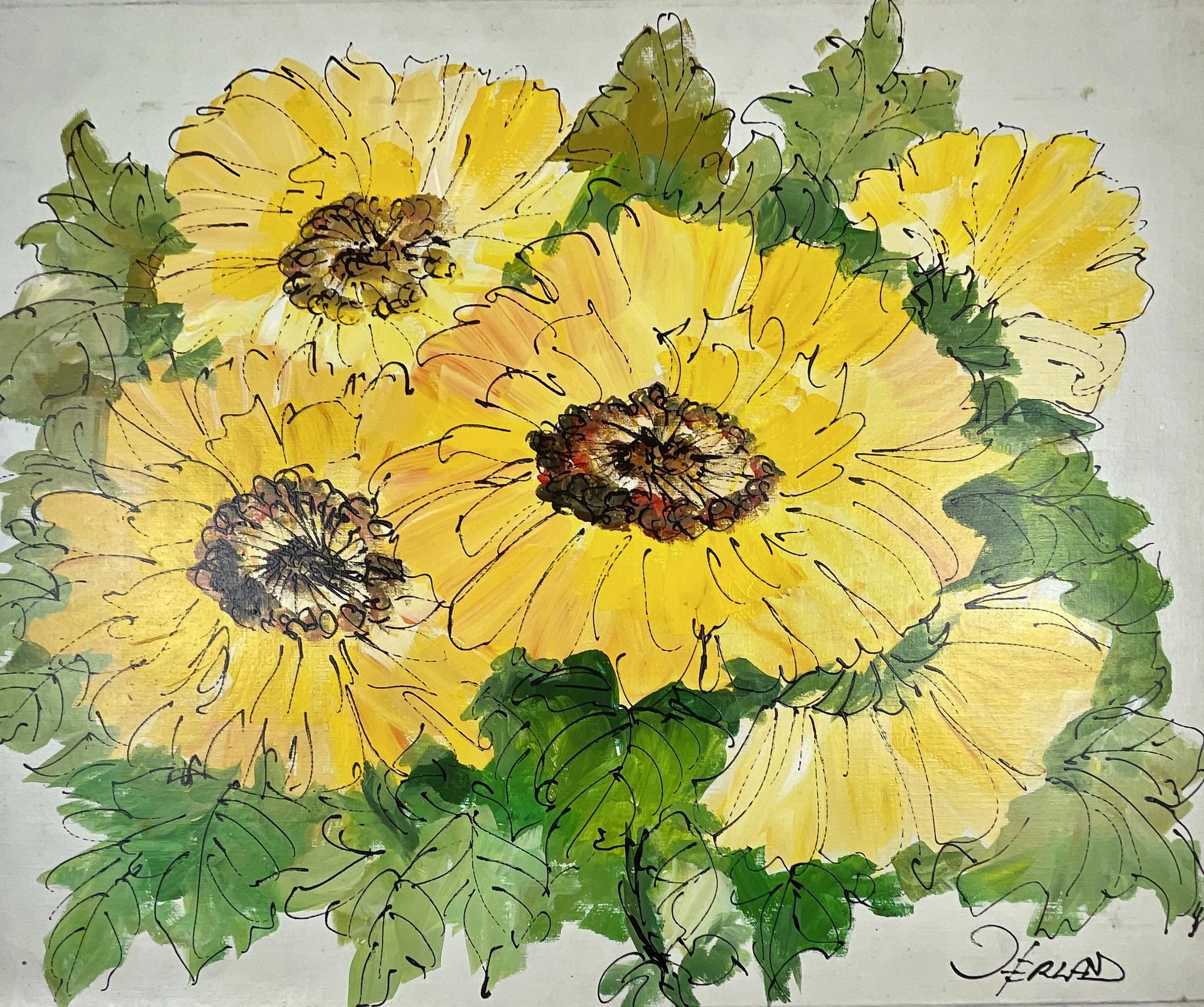
This lively floral still life by Jack Herland presents a bouquet of large yellow blossoms rendered with energetic brushwork and fluid black line drawing. The composition fills the canvas with oversized blooms, their layered petals radiating outward from textured centers of warm browns and umbers. Surrounding foliage in vibrant greens provides a rhythmic counterbalance to the luminous yellow petals.
Herland combines painterly washes with expressive contour lines, outlining petals and leaves in loose ink strokes that give the work a spontaneous, almost calligraphic character. The drawing lines sweep freely across the surface, emphasizing movement and gesture rather than strict botanical accuracy. This approach recalls the influence of Asian brush painting traditions, which Herland encountered through his studies with Professor Wang Chi Yuan.
The color handling suggests the use of acrylic paint rather than oil. The pigments appear flat and luminous with quick drying transitions between tones—characteristics typical of acrylic mediums that became increasingly popular among artists during the 1960s and 1970s. Over these washes the artist applied confident black ink or paint linework to define the forms.
The composition is intimate and decorative yet energetic. Rather than placing the flowers within a traditional vase arrangement, Herland allows the blossoms to dominate the field, creating a near-abstract arrangement of color, shape, and rhythm. The bold palette of sunflower yellows and verdant greens gives the painting a bright, optimistic character consistent with mid-century decorative modernism.
Signed “Herland” at the lower right, the work demonstrates the artist’s interest in combining traditional still-life subjects with modern gestural drawing and vibrant contemporary color.
Artist Biography
Jack Herland was a German-born American painter and decorative artist whose career developed within the vibrant mid-20th-century art scene of New York. Born in Germany, Herland immigrated to the United States at the age of sixteen, where he later pursued formal artistic training and built a multifaceted career as a painter, designer, and educator.
Herland studied under several respected artists and teachers, including John Groth and Stuart Davis, both influential figures in American modern art. Groth was known for his expressive illustration and wartime reportage, while Stuart Davis was a pioneering modernist whose bold colors and rhythmic compositions helped shape the development of American abstraction. These influences exposed Herland to a wide range of stylistic approaches—from gestural drawing to modernist color structures—that would inform his own work.
During World War II Herland served in the United States Army. After the war he became associated with a group of artists who produced hand-painted decorative objects, including glass and china gift items. This experience strengthened his sense of color harmony and decorative composition—qualities that remained central to his later painting.
Herland also studied with Professor Wang Chi Yuan, a Chinese painter and calligrapher known for bringing traditional Chinese brush techniques to Western audiences. This training introduced Herland to the expressive possibilities of ink line, brush rhythm, and the philosophical approach of East Asian painting traditions. The influence can be seen in his confident contour lines and fluid gestural strokes that often animate his floral compositions.
Throughout his career Herland exhibited at several respected cultural institutions and venues including the National Arts Club in New York, the China Institute, the Hudson Museum, and the Riverdale Neighborhood House. These exhibitions placed his work within a broader community of artists exploring both modernist and cross-cultural influences during the postwar decades.
In addition to painting, Herland was involved in consulting and design development for the lighting industry, applying his understanding of form, color, and decorative design to commercial products. He also taught painting in adult education programs, helping introduce new audiences to artistic practice.
Herland’s artistic output frequently focused on floral still lifes and decorative compositions. His paintings combine bright color, expressive outlines, and simplified forms, creating works that balance modernist energy with approachable subject matter. While less widely documented than some of his contemporaries, his work represents a fascinating intersection of American modernist influence, Asian brush traditions, and postwar decorative design aesthetics.
Today, paintings by Herland are appreciated for their vibrant color, gestural vitality, and connection to the lively artistic networks of mid-century New York.
Jack Herland yellow floral still life, acrylic and ink on canvas, signed, vibrant mid-century modern flower painting, 30 × 24 in.
Certificate of Authentication
Artist: Jack Herland
Title: Yellow Floral Still Life (attributed)
Medium: Acrylic and ink on canvas
Dimensions: 30 × 24 inches
Signature: Signed “Herland” lower right
Date: circa 1960–1975
This artwork is an original painting by Jack Herland based on the visible signature and stylistic characteristics consistent with the artist’s documented floral works.
Condition
Good vintage condition. Canvas shows age-appropriate wear with minor edge handling and slight surface discoloration visible on the reverse. Paint surface appears stable with no major losses observed.
Provenance
Artist studio / New York region
Mitch Morse Gallery, New York (art dealer and publisher of original graphics)
Private collection, acquired through Mitch Morse Gallery
Artfind Gallery, Washington DC (current owner)
All works acquired from Mitch Morse Gallery, which sourced artworks throughout New York, the United States, and Europe.
Provenance Note: Mitch Morse Gallery Collection
This artwork originates from the inventory of Mitch Morse Gallery, a respected New York–based gallery and publisher active during the mid-to-late 20th century. Mitch Morse was an established figure in the American art market, serving as an artist’s agent, publisher of original graphics, art dealer, distributor, and fine art restorer. He was also a Design Affiliate of A.S.I.D., listed in Who’s Who in the East, and a guest lecturer in graphics at New York University, with appearances on radio and television discussing art and design.
Through his gallery and associated publishing operations, Morse acquired paintings, prints, and original works from artists and studios across New York, Europe, and international art markets, assembling a broad inventory representing a wide range of artistic traditions and mediums. Works from this collection circulated through galleries and collectors throughout the United States.
The present painting was acquired through this network and is now held in the collection of Artfind Gallery, Washington DC, continuing the documented chain of gallery provenance from Mitch Morse’s original acquisitions.
Yellow Floral Still Life (attributed), Jack Herland (20th century), c.1960–1975, acrylic and ink on canvas, 30 × 24 in., signed lower right.
Expressive yellow floral still life by Jack Herland, executed in bold acrylic washes with gestural ink linework. Vibrant mid-century modern flower painting on canvas with lively graphic outlines and luminous color.
Artwork Description
This lively floral still life by Jack Herland presents a bouquet of large yellow blossoms rendered with energetic brushwork and fluid black line drawing. The composition fills the canvas with oversized blooms, their layered petals radiating outward from textured centers of warm browns and umbers. Surrounding foliage in vibrant greens provides a rhythmic counterbalance to the luminous yellow petals.
Herland combines painterly washes with expressive contour lines, outlining petals and leaves in loose ink strokes that give the work a spontaneous, almost calligraphic character. The drawing lines sweep freely across the surface, emphasizing movement and gesture rather than strict botanical accuracy. This approach recalls the influence of Asian brush painting traditions, which Herland encountered through his studies with Professor Wang Chi Yuan.
The color handling suggests the use of acrylic paint rather than oil. The pigments appear flat and luminous with quick drying transitions between tones—characteristics typical of acrylic mediums that became increasingly popular among artists during the 1960s and 1970s. Over these washes the artist applied confident black ink or paint linework to define the forms.
The composition is intimate and decorative yet energetic. Rather than placing the flowers within a traditional vase arrangement, Herland allows the blossoms to dominate the field, creating a near-abstract arrangement of color, shape, and rhythm. The bold palette of sunflower yellows and verdant greens gives the painting a bright, optimistic character consistent with mid-century decorative modernism.
Signed “Herland” at the lower right, the work demonstrates the artist’s interest in combining traditional still-life subjects with modern gestural drawing and vibrant contemporary color.
Artist Biography
Jack Herland was a German-born American painter and decorative artist whose career developed within the vibrant mid-20th-century art scene of New York. Born in Germany, Herland immigrated to the United States at the age of sixteen, where he later pursued formal artistic training and built a multifaceted career as a painter, designer, and educator.
Herland studied under several respected artists and teachers, including John Groth and Stuart Davis, both influential figures in American modern art. Groth was known for his expressive illustration and wartime reportage, while Stuart Davis was a pioneering modernist whose bold colors and rhythmic compositions helped shape the development of American abstraction. These influences exposed Herland to a wide range of stylistic approaches—from gestural drawing to modernist color structures—that would inform his own work.
During World War II Herland served in the United States Army. After the war he became associated with a group of artists who produced hand-painted decorative objects, including glass and china gift items. This experience strengthened his sense of color harmony and decorative composition—qualities that remained central to his later painting.
Herland also studied with Professor Wang Chi Yuan, a Chinese painter and calligrapher known for bringing traditional Chinese brush techniques to Western audiences. This training introduced Herland to the expressive possibilities of ink line, brush rhythm, and the philosophical approach of East Asian painting traditions. The influence can be seen in his confident contour lines and fluid gestural strokes that often animate his floral compositions.
Throughout his career Herland exhibited at several respected cultural institutions and venues including the National Arts Club in New York, the China Institute, the Hudson Museum, and the Riverdale Neighborhood House. These exhibitions placed his work within a broader community of artists exploring both modernist and cross-cultural influences during the postwar decades.
In addition to painting, Herland was involved in consulting and design development for the lighting industry, applying his understanding of form, color, and decorative design to commercial products. He also taught painting in adult education programs, helping introduce new audiences to artistic practice.
Herland’s artistic output frequently focused on floral still lifes and decorative compositions. His paintings combine bright color, expressive outlines, and simplified forms, creating works that balance modernist energy with approachable subject matter. While less widely documented than some of his contemporaries, his work represents a fascinating intersection of American modernist influence, Asian brush traditions, and postwar decorative design aesthetics.
Today, paintings by Herland are appreciated for their vibrant color, gestural vitality, and connection to the lively artistic networks of mid-century New York.
Jack Herland yellow floral still life, acrylic and ink on canvas, signed, vibrant mid-century modern flower painting, 30 × 24 in.
Certificate of Authentication
Artist: Jack Herland
Title: Yellow Floral Still Life (attributed)
Medium: Acrylic and ink on canvas
Dimensions: 30 × 24 inches
Signature: Signed “Herland” lower right
Date: circa 1960–1975
This artwork is an original painting by Jack Herland based on the visible signature and stylistic characteristics consistent with the artist’s documented floral works.
Condition
Good vintage condition. Canvas shows age-appropriate wear with minor edge handling and slight surface discoloration visible on the reverse. Paint surface appears stable with no major losses observed.
Provenance
Artist studio / New York region
Mitch Morse Gallery, New York (art dealer and publisher of original graphics)
Private collection, acquired through Mitch Morse Gallery
Artfind Gallery, Washington DC (current owner)
All works acquired from Mitch Morse Gallery, which sourced artworks throughout New York, the United States, and Europe.
Provenance Note: Mitch Morse Gallery Collection
This artwork originates from the inventory of Mitch Morse Gallery, a respected New York–based gallery and publisher active during the mid-to-late 20th century. Mitch Morse was an established figure in the American art market, serving as an artist’s agent, publisher of original graphics, art dealer, distributor, and fine art restorer. He was also a Design Affiliate of A.S.I.D., listed in Who’s Who in the East, and a guest lecturer in graphics at New York University, with appearances on radio and television discussing art and design.
Through his gallery and associated publishing operations, Morse acquired paintings, prints, and original works from artists and studios across New York, Europe, and international art markets, assembling a broad inventory representing a wide range of artistic traditions and mediums. Works from this collection circulated through galleries and collectors throughout the United States.
The present painting was acquired through this network and is now held in the collection of Artfind Gallery, Washington DC, continuing the documented chain of gallery provenance from Mitch Morse’s original acquisitions.